

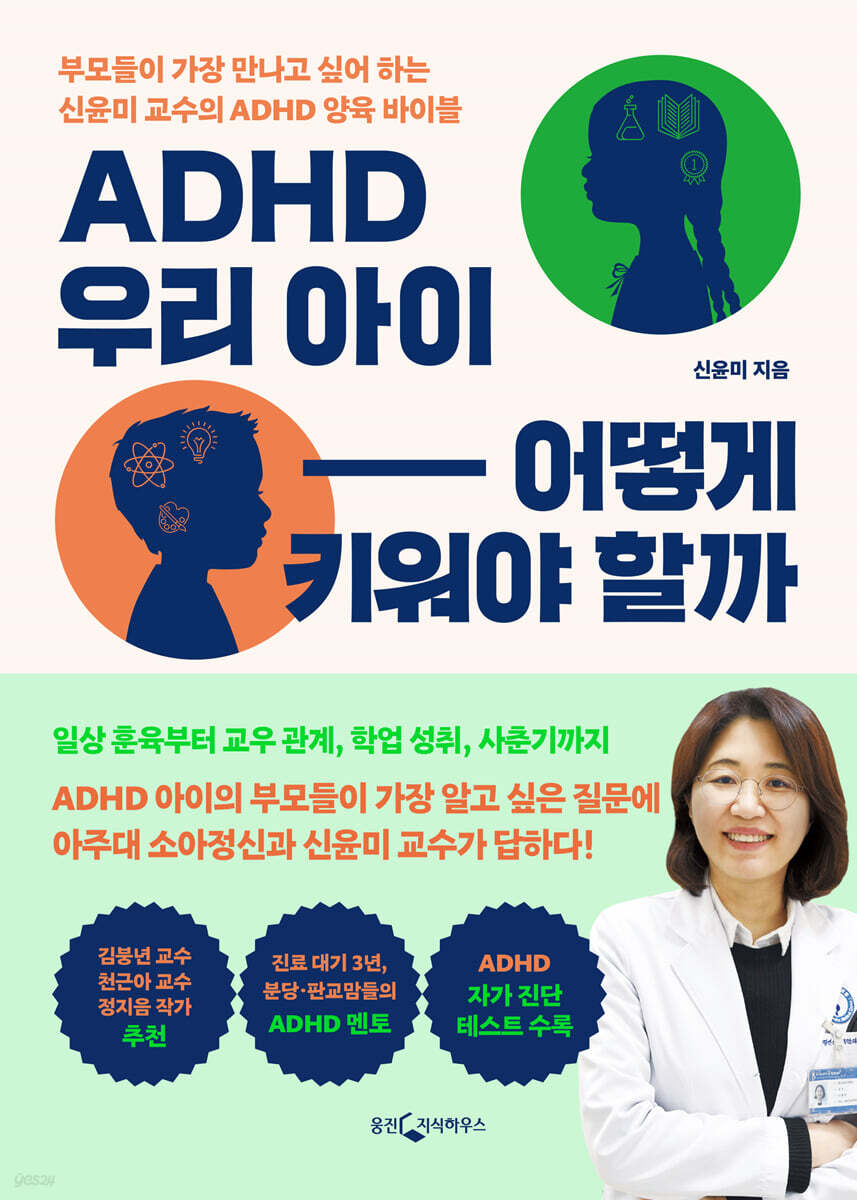
How should I raise my child with ADHD?
 |
Description
Book Introduction
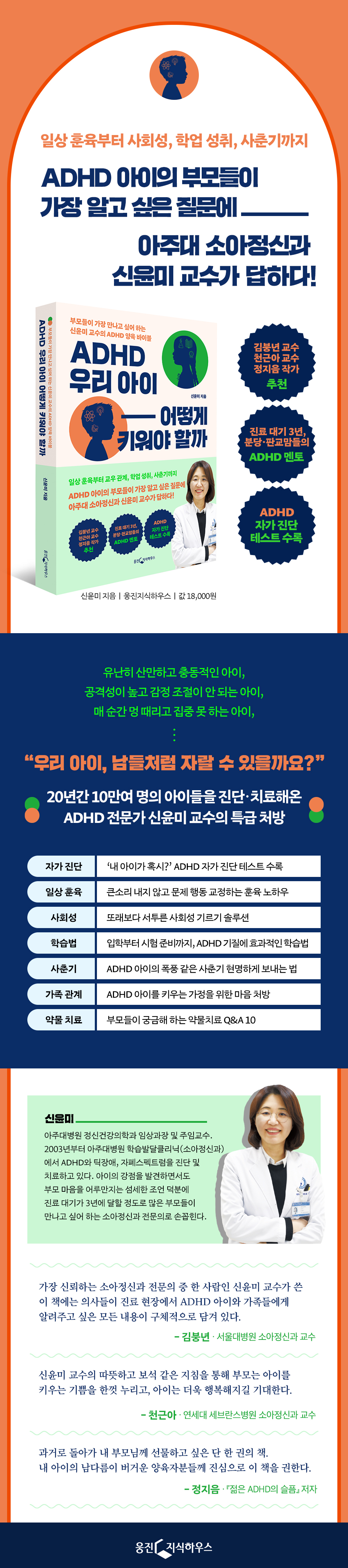
A child who is unusually distracted and impulsive, An aggressive and emotionally unstable child, A child who is absent-minded and unable to concentrate at all times, : “Will my child grow up like other children?” From everyday discipline to social skills, academic achievement, puberty, and drug treatment, Diagnosed and treated 100,000 children over 20 years A special prescription for ADHD from Professor Shin Yoon-mi of the Learning Development Clinic at Ajou University Hospital! Many parents are concerned about their children who appear to be different from their peers. There may be various reasons behind a child's unique behavior, but the main cause recently cited is Attention Deficit Hyperactivity Disorder, or 'ADHD'. ADHD, which occurs when the development of the prefrontal lobe of the brain is delayed and various problem behaviors that cannot be controlled by one's own will appear, has become a common childhood and adolescent disease that is diagnosed in at least one student in each class. In fact, mom cafes and online parenting communities are overflowing with complaints from parents who suspect their children have ADHD but are too afraid to go to the hospital, or who have been diagnosed with ADHD but don't know what to do for their children. “How to Raise a Child with ADHD” is a book that helps relieve the anxiety and worries of these parents. This is the first book by Professor Shin Yun-mi of the Learning and Development Clinic (Child Psychiatry) at Ajou University Hospital, who is considered the “ADHD specialist most wanted by parents” with a waiting list of up to three years for treatment. She generously shares her extensive clinical experience from meeting 100,000 children over the past 20 years. From self-diagnosis tests that can be used when you suspect your child has ADHD, to daily discipline, social skills, academic achievement, puberty, family relationships, and medication treatment, this book offers specific and effective parenting solutions by focusing on the topics that parents of children with ADHD most want to know about. In addition, it is packed with useful information, such as questions about ADHD treatment and testing conducted in pediatric psychiatry, a language development stage chart for infants and toddlers by age to assess a child's language ability, and a sleep guide for children with ADHD. This book, which contains detailed advice and prescriptions from Korea's top experts, will be a valuable guide for parents who are concerned that their children may have ADHD or who have felt lost while raising a child with ADHD. |
- You can preview some of the book's contents.
Preview
index
Special Tip_ ADHD Self-Diagnosis Chart for My Child
PART 1.
Counseling Room Story: One day, ADHD suddenly came to our house.
“My heart sinks every time the phone rings.”
“I’m suffering because my child only causes trouble at home.”
“How about taking that house’s daughter to the hospital?”
“We were born on the same day and at the same time, so how can we be so different?”
“I'm exhausted from struggling with a child who can't understand what I'm saying.”
“I never thought it would, but it looks like me when I was younger.”
Plus Tip_ I'm curious about the tests for ADHD diagnosis.
PART 2.
Family Relationships: Overcoming a Child's ADHD Takes the Whole Family
ADHD is a brain problem, not a parenting problem.
To parents who are depressed and hurt after their child's diagnosis
When parents are "one team," the prognosis is better.
How should I tell the child involved?
The more ADHD you have, the more you need time with your dad.
If you are raising a child with ADHD and a sibling without ADHD,
Plus Tip_ ADHD Hospital Treatment: What I'm Curious About
PART 3.
Everyday Discipline: Effectively Disciplining Your ADHD Child Who Never Gets Quiet
Three Essential Things to Remember in Verbal Discipline
The more ADHD your child is, the more you need to watch out for this.
The Key to "Holding Hands" with Your Child: Consistency
Reward Principles for Impatient ADHD Children
When parents are strict but children are impulsive
If a child knows how to make fun of adults, he would do this
Plus Tip_ Sleep Habits Essential for ADHD Children
PART 4.
Social Skills: Developing Social Skills in Children with ADHD
When it comes to social development, the key is a child's "disposition."
Understanding your child's friendships in detail
If you have a child with ADHD who is not very tactful and has difficulty forming relationships,
Building Language Confidence in ADHD Children Who Frequently Make Speech Errors
Mom's Training to Break the Habit of Speaking Incoherently
Just managing your emotions well will increase your social skills.
8:2 Language Use to Raise a Receptive Child
Plus Tip: Behind a child with good social skills are parents who coach their emotions.
PART 5.
Study Methods: Studying for ADHD Children May Need to Be a Little Different
If you are before entering elementary school, start with a clear ‘school routine’
Things you can do with help from your homeroom teacher
Four Activities to Build Learning Ability and Self-Esteem
Equipping yourself with the 'concept of time' essential for studying
Overcoming Attention Deficit, the Biggest Obstacle to Learning
Five Types of Learning Prescriptions That Parents Worry About
How to Teach Math to Children with ADHD Who Have Trouble Understanding Long Sentences
Three Memorization Techniques for ADHD Children Who Are Vulnerable to Memorization
"Activity Pruning" is Essential for ADHD in Upper Elementary School Students
Plus Tip_ Tics and ADHD: Prioritize
PART 6.
Puberty: How to Wisely Overcome the Stormy Adolescence of ADHD
What You Need to Know About Puberty in Your Child with ADHD
Children also have a 'privacy' that must be respected.
Please consider the growing need for recognition as we grow older.
Plus Tip: How to Communicate Properly with a Reticent Teenager
PART 7.
Medication: ADHD and Medication: What I Want to Know
Drug therapy is absolutely necessary in these cases - safety concerns
Drug therapy, in these cases, is good to use in conjunction with language problems.
10 Questions and Answers About ADHD Medication That Parents Are Most Curious About
Plus Tip_ Language Development Stages by Age in Infants and Toddlers
PART 1.
Counseling Room Story: One day, ADHD suddenly came to our house.
“My heart sinks every time the phone rings.”
“I’m suffering because my child only causes trouble at home.”
“How about taking that house’s daughter to the hospital?”
“We were born on the same day and at the same time, so how can we be so different?”
“I'm exhausted from struggling with a child who can't understand what I'm saying.”
“I never thought it would, but it looks like me when I was younger.”
Plus Tip_ I'm curious about the tests for ADHD diagnosis.
PART 2.
Family Relationships: Overcoming a Child's ADHD Takes the Whole Family
ADHD is a brain problem, not a parenting problem.
To parents who are depressed and hurt after their child's diagnosis
When parents are "one team," the prognosis is better.
How should I tell the child involved?
The more ADHD you have, the more you need time with your dad.
If you are raising a child with ADHD and a sibling without ADHD,
Plus Tip_ ADHD Hospital Treatment: What I'm Curious About
PART 3.
Everyday Discipline: Effectively Disciplining Your ADHD Child Who Never Gets Quiet
Three Essential Things to Remember in Verbal Discipline
The more ADHD your child is, the more you need to watch out for this.
The Key to "Holding Hands" with Your Child: Consistency
Reward Principles for Impatient ADHD Children
When parents are strict but children are impulsive
If a child knows how to make fun of adults, he would do this
Plus Tip_ Sleep Habits Essential for ADHD Children
PART 4.
Social Skills: Developing Social Skills in Children with ADHD
When it comes to social development, the key is a child's "disposition."
Understanding your child's friendships in detail
If you have a child with ADHD who is not very tactful and has difficulty forming relationships,
Building Language Confidence in ADHD Children Who Frequently Make Speech Errors
Mom's Training to Break the Habit of Speaking Incoherently
Just managing your emotions well will increase your social skills.
8:2 Language Use to Raise a Receptive Child
Plus Tip: Behind a child with good social skills are parents who coach their emotions.
PART 5.
Study Methods: Studying for ADHD Children May Need to Be a Little Different
If you are before entering elementary school, start with a clear ‘school routine’
Things you can do with help from your homeroom teacher
Four Activities to Build Learning Ability and Self-Esteem
Equipping yourself with the 'concept of time' essential for studying
Overcoming Attention Deficit, the Biggest Obstacle to Learning
Five Types of Learning Prescriptions That Parents Worry About
How to Teach Math to Children with ADHD Who Have Trouble Understanding Long Sentences
Three Memorization Techniques for ADHD Children Who Are Vulnerable to Memorization
"Activity Pruning" is Essential for ADHD in Upper Elementary School Students
Plus Tip_ Tics and ADHD: Prioritize
PART 6.
Puberty: How to Wisely Overcome the Stormy Adolescence of ADHD
What You Need to Know About Puberty in Your Child with ADHD
Children also have a 'privacy' that must be respected.
Please consider the growing need for recognition as we grow older.
Plus Tip: How to Communicate Properly with a Reticent Teenager
PART 7.
Medication: ADHD and Medication: What I Want to Know
Drug therapy is absolutely necessary in these cases - safety concerns
Drug therapy, in these cases, is good to use in conjunction with language problems.
10 Questions and Answers About ADHD Medication That Parents Are Most Curious About
Plus Tip_ Language Development Stages by Age in Infants and Toddlers
Detailed image
Into the book
Most hospitals become busy in March as the new school year begins.
Mothers who had been putting off treatment day after day while suspecting, 'Could my child have ADHD?' came to us holding their children's hands, feeling that they could no longer avoid it.
If a child wanders around during class or repeatedly engages in unwelcome behavior among their peers, they are labeled as a "noisy child," a "frequently reprimanded child," a "distracted and aggressive child," or a "child that no one wants to play with."
The problem is that once this image becomes fixed, whenever a similar situation arises, it is easy to be looked at with suspicion and criticism, asking, "Is that kid again?"
For this reason, if you suspect your child has ADHD, I urge you to get tested at a specialized institution before the child enters elementary school.
---From "I'm curious about the tests for diagnosing ADHD"
Whenever I hear that a father opposes his child's treatment or criticizes his mother, I always ask him to come to the hospital with him at least once.
Sometimes some mothers say, “My husband is really stubborn.
He was scared, saying, “I might fight with the teacher when I come here,” but I said, “It’s okay.
I tell him, “You still have to bring him.”
Because mom and dad must become 'one team' to overcome this difficult journey.
For this to happen, both parents need to have the same level of understanding of ADHD.
---From "When parents are 'one team', the prognosis is better"
Suwan's mother thought that her child was not able to listen to what she was saying because he had a poor concentration.
However, after talking to his mother and getting to know Suwan, I guessed that he had ADHD with a rather prominent language problem.
What does laundry have to do with language problems? There are three key aspects of language development that you should carefully consider when your child reaches 49 to 54 months of age.
First, the ability to remember what you've heard; second, the ability to understand complex sentences with double subjects and predicates; and finally, the ability to understand tense. Children with ADHD and language problems often have somewhat underdeveloped abilities in these three areas.
---From "I'm exhausted from wrestling with a child who doesn't understand what I'm saying"
Finally, parental nagging needs to be structured, if only to give what they say authority and meaning.
The ideal form is to end with 'Simple', 'Asking again', and 'Open ending'.
As I mentioned, children with ADHD have attention deficit problems, so it's better to keep it short and to the point.
When I give advice like this, people often say things like, “Stop playing games,” “Stay still,” or “Don’t interrupt.”
But in such commands, there is only the person giving the order and no one listening.
Nowhere in these words is there a child who is the listener.
---From “Three Essential Things to Have in Verbal Discipline”
Hyunyoung's mother said that her child was slow in everything except studying, but slow here does not mean that the speed itself is slow.
The child lacks an 'action calculator' that estimates the time required to complete a given task and then steps in to execute it.
You can tell just by looking at the process of Hyunyoung preparing to go to the academy.
By the time they reach second grade in elementary school, they have a concept of time, such as, "What day of the week is it, and what time do I go to the academy?"
But quiet ADHD kids like Hyunyoung don't have this standard.
So, the situation keeps repeating where I forget what day I go to school and what I need to bring, and my mom has to keep reminding me.
So, how should we teach children like Hyunyoung the concept of time?
---From "Equipping the 'Concept of Time' Essential for Studying"
When children are in the lower grades of elementary school, they come home and tell us in detail about what happened at school, but by the third grade, they start to stop talking.
Just by asking these two questions, you can get a good idea of your child's school life and friendships.
“Who do you eat lunch with?”
“When you go out to the playground during gym class, who do you sit with in the stands?”
From the third grade of elementary school, friends become extremely important.
Friends have a great influence on school life as well.
However, children diagnosed with quiet ADHD, especially girls, often experience unexpected difficulties in their friendships.
At this age, some girls have already reached puberty, so even if they are only in the third or fourth grade of elementary school, if they cannot read the unique, subtle and sensitive atmosphere, they are easily bullied.
Hyejeong, who is a quiet ADHD sufferer, was also slow to notice her attention deficit disorder, which was the starting point.
---From "If you have a child with ADHD who is oblivious and has difficulty forming relationships"
Let's start with the habit of speaking in a jumbled manner. These children have a habit of saying "1, 3, 5, 7, 9" instead of "1, 2, 3, 4, 5."
For example, it is difficult to say the subject, object, and predicate in order, as in the sentence, “I went for a walk with my dog at the park on the weekend.”
Because I can't organize my words, the flow of the content is not consistent and I speak sporadically.
You can also often see people who start a conversation with a puppy and then suddenly jump in a different direction that they think of.
If you ask, “What did you do this Chuseok?” you can answer, “I went to my grandmother’s house and flew a kite.”
That's right, where did that kite go?" is how it goes.
Mothers who had been putting off treatment day after day while suspecting, 'Could my child have ADHD?' came to us holding their children's hands, feeling that they could no longer avoid it.
If a child wanders around during class or repeatedly engages in unwelcome behavior among their peers, they are labeled as a "noisy child," a "frequently reprimanded child," a "distracted and aggressive child," or a "child that no one wants to play with."
The problem is that once this image becomes fixed, whenever a similar situation arises, it is easy to be looked at with suspicion and criticism, asking, "Is that kid again?"
For this reason, if you suspect your child has ADHD, I urge you to get tested at a specialized institution before the child enters elementary school.
---From "I'm curious about the tests for diagnosing ADHD"
Whenever I hear that a father opposes his child's treatment or criticizes his mother, I always ask him to come to the hospital with him at least once.
Sometimes some mothers say, “My husband is really stubborn.
He was scared, saying, “I might fight with the teacher when I come here,” but I said, “It’s okay.
I tell him, “You still have to bring him.”
Because mom and dad must become 'one team' to overcome this difficult journey.
For this to happen, both parents need to have the same level of understanding of ADHD.
---From "When parents are 'one team', the prognosis is better"
Suwan's mother thought that her child was not able to listen to what she was saying because he had a poor concentration.
However, after talking to his mother and getting to know Suwan, I guessed that he had ADHD with a rather prominent language problem.
What does laundry have to do with language problems? There are three key aspects of language development that you should carefully consider when your child reaches 49 to 54 months of age.
First, the ability to remember what you've heard; second, the ability to understand complex sentences with double subjects and predicates; and finally, the ability to understand tense. Children with ADHD and language problems often have somewhat underdeveloped abilities in these three areas.
---From "I'm exhausted from wrestling with a child who doesn't understand what I'm saying"
Finally, parental nagging needs to be structured, if only to give what they say authority and meaning.
The ideal form is to end with 'Simple', 'Asking again', and 'Open ending'.
As I mentioned, children with ADHD have attention deficit problems, so it's better to keep it short and to the point.
When I give advice like this, people often say things like, “Stop playing games,” “Stay still,” or “Don’t interrupt.”
But in such commands, there is only the person giving the order and no one listening.
Nowhere in these words is there a child who is the listener.
---From “Three Essential Things to Have in Verbal Discipline”
Hyunyoung's mother said that her child was slow in everything except studying, but slow here does not mean that the speed itself is slow.
The child lacks an 'action calculator' that estimates the time required to complete a given task and then steps in to execute it.
You can tell just by looking at the process of Hyunyoung preparing to go to the academy.
By the time they reach second grade in elementary school, they have a concept of time, such as, "What day of the week is it, and what time do I go to the academy?"
But quiet ADHD kids like Hyunyoung don't have this standard.
So, the situation keeps repeating where I forget what day I go to school and what I need to bring, and my mom has to keep reminding me.
So, how should we teach children like Hyunyoung the concept of time?
---From "Equipping the 'Concept of Time' Essential for Studying"
When children are in the lower grades of elementary school, they come home and tell us in detail about what happened at school, but by the third grade, they start to stop talking.
Just by asking these two questions, you can get a good idea of your child's school life and friendships.
“Who do you eat lunch with?”
“When you go out to the playground during gym class, who do you sit with in the stands?”
From the third grade of elementary school, friends become extremely important.
Friends have a great influence on school life as well.
However, children diagnosed with quiet ADHD, especially girls, often experience unexpected difficulties in their friendships.
At this age, some girls have already reached puberty, so even if they are only in the third or fourth grade of elementary school, if they cannot read the unique, subtle and sensitive atmosphere, they are easily bullied.
Hyejeong, who is a quiet ADHD sufferer, was also slow to notice her attention deficit disorder, which was the starting point.
---From "If you have a child with ADHD who is oblivious and has difficulty forming relationships"
Let's start with the habit of speaking in a jumbled manner. These children have a habit of saying "1, 3, 5, 7, 9" instead of "1, 2, 3, 4, 5."
For example, it is difficult to say the subject, object, and predicate in order, as in the sentence, “I went for a walk with my dog at the park on the weekend.”
Because I can't organize my words, the flow of the content is not consistent and I speak sporadically.
You can also often see people who start a conversation with a puppy and then suddenly jump in a different direction that they think of.
If you ask, “What did you do this Chuseok?” you can answer, “I went to my grandmother’s house and flew a kite.”
That's right, where did that kite go?" is how it goes.
---From "Mom's Training to Fix the Habit of Speaking Incoherently"
Publisher's Review
“There hasn't been a single easy day raising this child.”
If you are a parent who is worried about your child with ADHD,
The one and only must-read book!
3 years waiting for treatment,
The Specialist Parents Want to See Most
The ADHD Parenting Bible by Professor Shin Yun-mi of Ajou University Hospital
In recent years, the number of children diagnosed with ADHD has increased exponentially. ADHD is a condition characterized by delayed development of the prefrontal cortex, which impairs the proper functioning of various executive functions controlled by the brain, resulting in a variety of behavioral problems in daily life.
When people think of ADHD, they often picture the typical troublemaker, loud and distracted, or aggressive, as depicted on TV parenting shows. However, there's also a "silent ADHD" child who is inattentive and lacks focus, and the spectrum is quite diverse. This explains why experts call ADHD "the disease with a thousand faces."
In fact, if you go to a mom cafe or an online parenting community, you can easily find parents who are concerned that their children's various behaviors might be symptoms of ADHD.
However, many parents hesitate to seek treatment or counseling due to the fear of, "What if my child really has ADHD?" and the burden of taking their child to a pediatric psychiatrist.
The problem is that although the timing of diagnosis and treatment for children with ADHD is crucial to the prognosis, there are unfortunate cases where both children and parents suffer because they rely solely on inaccurate information floating around on the Internet or miss the timing of treatment.
『How should we raise our ADHD children?』 is a book written by Professor Shin Yun-mi of the Learning and Development Clinic at Ajou University Hospital, who is considered the "expert that parents most want to meet" after waiting three years for treatment, to provide practical help to parents.
In addition to vivid and rich case studies accumulated through meeting 100,000 children over 20 years, it also includes a self-diagnosis chart so that parents who suspect their child has ADHD can understand their child's condition from a more objective perspective.
In addition, we have gathered together the topics that parents of ADHD children are most curious about, such as daily discipline, social skills, learning methods, puberty, and medication treatment, and answered them from the perspective of a specialist.
“My child has ADHD. How on earth should I raise him?”
From everyday discipline to social skills, learning methods, puberty, family relationships, and drug treatment.
Better understand your ADHD child
33 parenting solutions applicable to different situations and ages
If your child has 'hyperactive ADHD', you will only exhaust your energy as a parent trying to control their excessive energy. If your child has 'quiet ADHD', you will often sigh at the sight of them being slow and absent-minded in everything.
Professor Shin Yun-mi advises, "These children have delayed brain development, so parents need to understand and approach them differently." She argues that simply understanding the temperament and mindset of a child with ADHD can make parenting much easier.
This book provides a specific parenting guide that utilizes the unique tendencies and temperaments of ADHD children.
It is packed with useful information, from disciplinary strategies to correct problem behavior without raising your voice, to various mother-style training methods to help children with ADHD develop their awkward social skills, to effective study prescriptions for children with a unique temperament that lacks time awareness and concentration.
Along with this, 33 solutions applicable to different situations and ages are presented with specific examples, such as know-how to wisely cope with the stormy adolescence that comes to children with ADHD, and how to raise children with ADHD who receive relatively more attention from parents together with other children.
Here, we also provide detailed plus tips from Korea's top pediatric psychiatrist, including a guide to treatment and examinations conducted in pediatric psychiatry, Q&A on medication prescriptions that parents are most curious about, essential sleeping habits for ADHD children who need a regular daily routine, principles for responding when ADHD and tic disorders coexist, and a language development stage chart for infants and toddlers by age to assess your child's language ability.
Children with ADHD can thrive.
With clinical experience gained from meeting 100,000 children over 20 years,
Warm comfort and encouragement for struggling parents
The shock to parents when their child is diagnosed with ADHD is significant.
It's hard enough to take your child to a psychiatrist, but accepting the diagnosis rationally is no easy task.
In this situation, many mothers blame themselves, wondering if their children ended up like this because they did not do well in prenatal education in the past or did not pay enough attention to their children because they both worked.
Moreover, if other family members deny the diagnosis and oppose treatment, saying, “That’s just how children grow up,” the primary caregiver’s depression is bound to increase.
Professor Shin Yun-mi, who has listened to the concerns and inner feelings of countless parents in her clinic for 20 years, offers warm comfort and empathy to mothers and fathers who have been hurt by their child's diagnosis.
The stories of 'ADHD students' who have grown up well and are doing their part in society, including the mindset that will help in the treatment process that takes place over a long period of time like a marathon, come as strong encouragement and support to parents who are worried about their children's future.
This book, which contains everything the nation's top specialists want to share with children with ADHD and their families in their daily clinical practice, is intended to help parents find greater peace of mind and children experience the joy of parenting that makes them happier.
If you are a parent who is worried about your child with ADHD,
The one and only must-read book!
3 years waiting for treatment,
The Specialist Parents Want to See Most
The ADHD Parenting Bible by Professor Shin Yun-mi of Ajou University Hospital
In recent years, the number of children diagnosed with ADHD has increased exponentially. ADHD is a condition characterized by delayed development of the prefrontal cortex, which impairs the proper functioning of various executive functions controlled by the brain, resulting in a variety of behavioral problems in daily life.
When people think of ADHD, they often picture the typical troublemaker, loud and distracted, or aggressive, as depicted on TV parenting shows. However, there's also a "silent ADHD" child who is inattentive and lacks focus, and the spectrum is quite diverse. This explains why experts call ADHD "the disease with a thousand faces."
In fact, if you go to a mom cafe or an online parenting community, you can easily find parents who are concerned that their children's various behaviors might be symptoms of ADHD.
However, many parents hesitate to seek treatment or counseling due to the fear of, "What if my child really has ADHD?" and the burden of taking their child to a pediatric psychiatrist.
The problem is that although the timing of diagnosis and treatment for children with ADHD is crucial to the prognosis, there are unfortunate cases where both children and parents suffer because they rely solely on inaccurate information floating around on the Internet or miss the timing of treatment.
『How should we raise our ADHD children?』 is a book written by Professor Shin Yun-mi of the Learning and Development Clinic at Ajou University Hospital, who is considered the "expert that parents most want to meet" after waiting three years for treatment, to provide practical help to parents.
In addition to vivid and rich case studies accumulated through meeting 100,000 children over 20 years, it also includes a self-diagnosis chart so that parents who suspect their child has ADHD can understand their child's condition from a more objective perspective.
In addition, we have gathered together the topics that parents of ADHD children are most curious about, such as daily discipline, social skills, learning methods, puberty, and medication treatment, and answered them from the perspective of a specialist.
“My child has ADHD. How on earth should I raise him?”
From everyday discipline to social skills, learning methods, puberty, family relationships, and drug treatment.
Better understand your ADHD child
33 parenting solutions applicable to different situations and ages
If your child has 'hyperactive ADHD', you will only exhaust your energy as a parent trying to control their excessive energy. If your child has 'quiet ADHD', you will often sigh at the sight of them being slow and absent-minded in everything.
Professor Shin Yun-mi advises, "These children have delayed brain development, so parents need to understand and approach them differently." She argues that simply understanding the temperament and mindset of a child with ADHD can make parenting much easier.
This book provides a specific parenting guide that utilizes the unique tendencies and temperaments of ADHD children.
It is packed with useful information, from disciplinary strategies to correct problem behavior without raising your voice, to various mother-style training methods to help children with ADHD develop their awkward social skills, to effective study prescriptions for children with a unique temperament that lacks time awareness and concentration.
Along with this, 33 solutions applicable to different situations and ages are presented with specific examples, such as know-how to wisely cope with the stormy adolescence that comes to children with ADHD, and how to raise children with ADHD who receive relatively more attention from parents together with other children.
Here, we also provide detailed plus tips from Korea's top pediatric psychiatrist, including a guide to treatment and examinations conducted in pediatric psychiatry, Q&A on medication prescriptions that parents are most curious about, essential sleeping habits for ADHD children who need a regular daily routine, principles for responding when ADHD and tic disorders coexist, and a language development stage chart for infants and toddlers by age to assess your child's language ability.
Children with ADHD can thrive.
With clinical experience gained from meeting 100,000 children over 20 years,
Warm comfort and encouragement for struggling parents
The shock to parents when their child is diagnosed with ADHD is significant.
It's hard enough to take your child to a psychiatrist, but accepting the diagnosis rationally is no easy task.
In this situation, many mothers blame themselves, wondering if their children ended up like this because they did not do well in prenatal education in the past or did not pay enough attention to their children because they both worked.
Moreover, if other family members deny the diagnosis and oppose treatment, saying, “That’s just how children grow up,” the primary caregiver’s depression is bound to increase.
Professor Shin Yun-mi, who has listened to the concerns and inner feelings of countless parents in her clinic for 20 years, offers warm comfort and empathy to mothers and fathers who have been hurt by their child's diagnosis.
The stories of 'ADHD students' who have grown up well and are doing their part in society, including the mindset that will help in the treatment process that takes place over a long period of time like a marathon, come as strong encouragement and support to parents who are worried about their children's future.
This book, which contains everything the nation's top specialists want to share with children with ADHD and their families in their daily clinical practice, is intended to help parents find greater peace of mind and children experience the joy of parenting that makes them happier.
GOODS SPECIFICS
- Publication date: October 5, 2022
- Page count, weight, size: 320 pages | 550g | 150*210*20mm
- ISBN13: 9788901264639
- ISBN10: 8901264633
You may also like
카테고리
korean


korean

![GQ KOREA Mark (Monthly): December [2025]](http://librairie.coreenne.fr/cdn/shop/files/8ef265dbbfbf186523ed75ba7319009d.jpg?v=1765340328&width=3840)


