

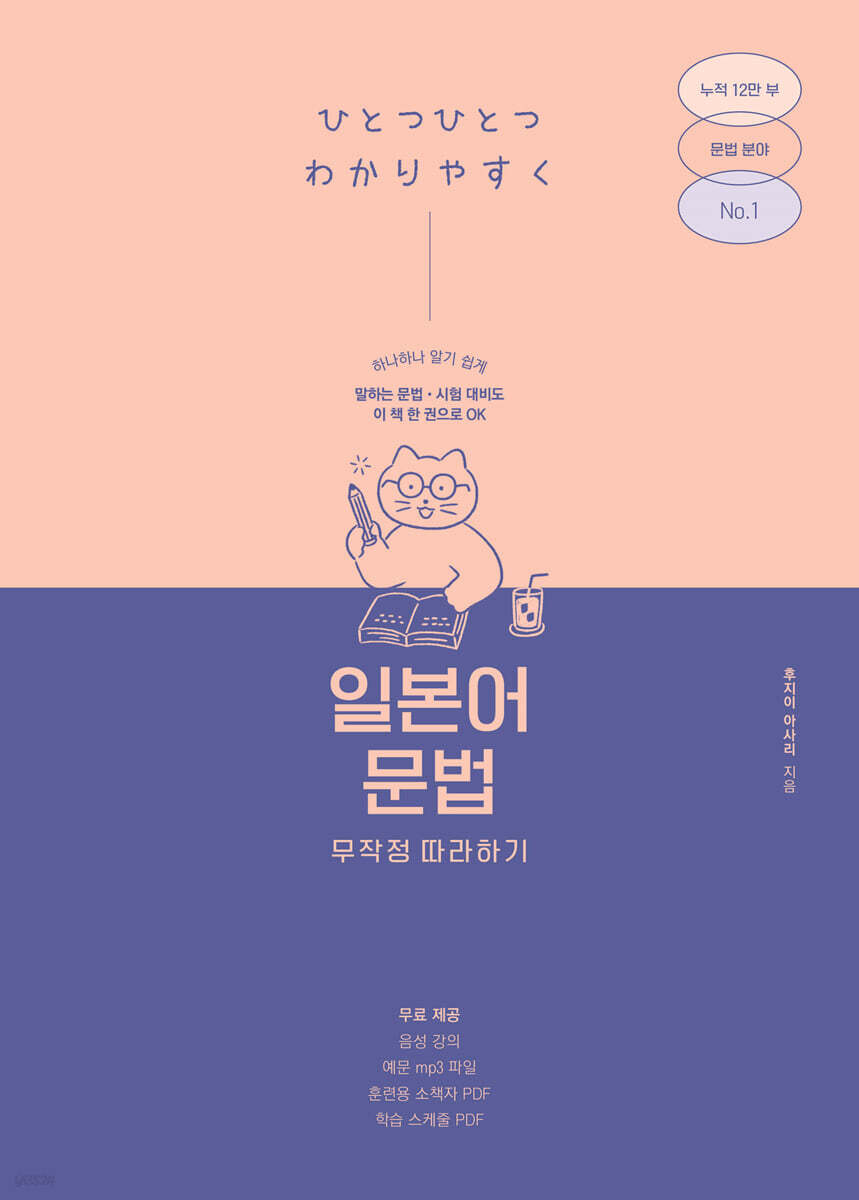
Just follow Japanese grammar
 |
Description
Book Introduction
By learning sound patterns
Build both listening and speaking skills at once.
The Bible of Japanese Grammar!
"Japanese Grammar: Just Follow It" has been a bestseller in the Japanese grammar category for 16 years, receiving the love of 120,000 readers.
For the first time in Korea, we applied the 'sound pattern learning method' to learn grammar by listening.
If you learn grammar by ear, you are guaranteed to improve your listening and speaking skills.
Additionally, it has the advantage of allowing beginners to naturally expand their vocabulary knowledge by creating example sentences using 2,000 essential words that they must learn.
To ensure that studying on your own is not difficult, we've added various corners and included a wealth of Mr. Fujii's signature friendly explanations.
If you're looking for a book that will help you master the fundamentals of grammar and a book you can refer to over and over again, this is a choice you won't regret.
Example mp3 files and key summary booklet pdf are provided free of charge on the website (www.gilbut.co.kr).
Build both listening and speaking skills at once.
The Bible of Japanese Grammar!
"Japanese Grammar: Just Follow It" has been a bestseller in the Japanese grammar category for 16 years, receiving the love of 120,000 readers.
For the first time in Korea, we applied the 'sound pattern learning method' to learn grammar by listening.
If you learn grammar by ear, you are guaranteed to improve your listening and speaking skills.
Additionally, it has the advantage of allowing beginners to naturally expand their vocabulary knowledge by creating example sentences using 2,000 essential words that they must learn.
To ensure that studying on your own is not difficult, we've added various corners and included a wealth of Mr. Fujii's signature friendly explanations.
If you're looking for a book that will help you master the fundamentals of grammar and a book you can refer to over and over again, this is a choice you won't regret.
Example mp3 files and key summary booklet pdf are provided free of charge on the website (www.gilbut.co.kr).
- You can preview some of the book's contents.
Preview
index
Preparation Yard - Japanese Characters
01 This is what Hiragana looks like!
02 This is what katakana looks like!
03 Japanese kanji are different like this!
Into the first yard, basic parts of speech
First Words: Learning Nouns
01 Common form of noun
02 Noun's polite form
Second Phrase: Learning Adjectives [na-adjectives·i-adjectives]
03 The regular form of the adjective
04 The polite form of the adjective
05 Difficult-to-use na-adjectives
06 The regular form of the i-adjective
07 The polite form of the i-adjective
Third Phrase: Mastering Verbs [First-Class Verbs, Second-Class Verbs, Third-Class Verbs]
08 The ordinary form of the first-class verb
09 The polite form of the first-class verb
10. Ordinary forms of second-class verbs
11. The polite form of the second-class verb
12 The ordinary form of third-class verbs
13 The polite form of the third-rate verb
Second yard: The ever-changing use of verbs
Fourth verse: Conjugation of first-class verbs that change to the あ conjugation
14 ない type
15. Ministry type
16 Passive
17 Passive ministry
Fifth verse: Conjugation of first-class verbs that change to the i-consonant
18 ますhyung
Sixth verse: Conjugation of first-class verbs that change to the う-dan
19 dictionary type
20 Prohibited
Seventh verse: Conjugation of first-class verbs that change to the え-dan
21 Imperative
22 Possible
23 ば-type
Eighth verse: Conjugation of first-class verbs that change to the o-dan
24 Will type
Ninth verse: Another conjugation of the verb, the te form
25 て type
A story about parts of speech that adds flavor to the third sentence
Tenth verse: Easy and difficult particles
26 Investigations You Must Know
27 Confusing Investigations
28 Particles used at the end of sentences
29 Other investigations
Eleventh verse: Useful interrogatives to know
30 interrogative pronouns
Twelfth verse: Adverbs that are easy to get wrong
31 Adverbs You Must Know
32 Adverbs with similar meaning and usage
Thirteenth verse: Tricky conjunctions
33 Conjunctions
Fourth Yard: A Special and In-Depth Grammar Story
Fourteenth verse: One step further into parts of speech
34 How to Modify Nouns
35 How to make the て form of nouns and adjectives
36 How to Make Adjectives into Adverbs
37 How to Make Adjectives into Verbs
38 How to make adjectives and verbs into nouns
39 Prefixes and Suffixes
Fifteenth verse: One step further into the verb
40 Expressions of Existence
41 'Give' and 'Receive'
42 Intransitive and transitive verbs
Fifth Yard: A Tasty and Colorful Expression Story
Sixteenth verse: Expressions related to nouns
43 Expressions that only connect nouns
44 Expressions that nounize sentences
Seventeenth Phrase: Expressions to Improve Your Japanese Skills
45 Expressions that connect to the nai form of verbs
46 Expressions that connect to the ます form of verbs
47 Expressions that connect to the dictionary form of verbs
48 Expressions linked to the volitional form of verbs
49 Expressions that connect to the te form of verbs
Expressions that connect to the た form of 50 verbs
51 Expressions that connect to the normal form of all parts of speech
Eighteenth verse: Expressions that are easy to understand when learned together
52 Expressions used when comparing
53 Expressions that pair positive and negative
54 Expressions used when making a request
Nineteenth verse: Expressions that form the final hurdle in grammar
55 Home expressions [~ば · ~と · ~たら · ~なら]
56 Honorific Expressions
Special Appendix
01 Sample Practice and Skill Building Answers
02 Sentence Pattern Search [Japanese/Korean]
01 This is what Hiragana looks like!
02 This is what katakana looks like!
03 Japanese kanji are different like this!
Into the first yard, basic parts of speech
First Words: Learning Nouns
01 Common form of noun
02 Noun's polite form
Second Phrase: Learning Adjectives [na-adjectives·i-adjectives]
03 The regular form of the adjective
04 The polite form of the adjective
05 Difficult-to-use na-adjectives
06 The regular form of the i-adjective
07 The polite form of the i-adjective
Third Phrase: Mastering Verbs [First-Class Verbs, Second-Class Verbs, Third-Class Verbs]
08 The ordinary form of the first-class verb
09 The polite form of the first-class verb
10. Ordinary forms of second-class verbs
11. The polite form of the second-class verb
12 The ordinary form of third-class verbs
13 The polite form of the third-rate verb
Second yard: The ever-changing use of verbs
Fourth verse: Conjugation of first-class verbs that change to the あ conjugation
14 ない type
15. Ministry type
16 Passive
17 Passive ministry
Fifth verse: Conjugation of first-class verbs that change to the i-consonant
18 ますhyung
Sixth verse: Conjugation of first-class verbs that change to the う-dan
19 dictionary type
20 Prohibited
Seventh verse: Conjugation of first-class verbs that change to the え-dan
21 Imperative
22 Possible
23 ば-type
Eighth verse: Conjugation of first-class verbs that change to the o-dan
24 Will type
Ninth verse: Another conjugation of the verb, the te form
25 て type
A story about parts of speech that adds flavor to the third sentence
Tenth verse: Easy and difficult particles
26 Investigations You Must Know
27 Confusing Investigations
28 Particles used at the end of sentences
29 Other investigations
Eleventh verse: Useful interrogatives to know
30 interrogative pronouns
Twelfth verse: Adverbs that are easy to get wrong
31 Adverbs You Must Know
32 Adverbs with similar meaning and usage
Thirteenth verse: Tricky conjunctions
33 Conjunctions
Fourth Yard: A Special and In-Depth Grammar Story
Fourteenth verse: One step further into parts of speech
34 How to Modify Nouns
35 How to make the て form of nouns and adjectives
36 How to Make Adjectives into Adverbs
37 How to Make Adjectives into Verbs
38 How to make adjectives and verbs into nouns
39 Prefixes and Suffixes
Fifteenth verse: One step further into the verb
40 Expressions of Existence
41 'Give' and 'Receive'
42 Intransitive and transitive verbs
Fifth Yard: A Tasty and Colorful Expression Story
Sixteenth verse: Expressions related to nouns
43 Expressions that only connect nouns
44 Expressions that nounize sentences
Seventeenth Phrase: Expressions to Improve Your Japanese Skills
45 Expressions that connect to the nai form of verbs
46 Expressions that connect to the ます form of verbs
47 Expressions that connect to the dictionary form of verbs
48 Expressions linked to the volitional form of verbs
49 Expressions that connect to the te form of verbs
Expressions that connect to the た form of 50 verbs
51 Expressions that connect to the normal form of all parts of speech
Eighteenth verse: Expressions that are easy to understand when learned together
52 Expressions used when comparing
53 Expressions that pair positive and negative
54 Expressions used when making a request
Nineteenth verse: Expressions that form the final hurdle in grammar
55 Home expressions [~ば · ~と · ~たら · ~なら]
56 Honorific Expressions
Special Appendix
01 Sample Practice and Skill Building Answers
02 Sentence Pattern Search [Japanese/Korean]
Detailed image
.jpg)
Publisher's Review
By learning sound patterns
Build both listening and speaking skills at once
The bible of Japanese grammar!
Grammar is also learned through sounds!
You think you can only read grammar books with your eyes?! Grammar is also something you can learn by listening to it and repeating it out loud, and it will be organized in your head naturally.
Plus, listening and conversation skills are guaranteed!
Learn grammar and vocabulary at the same time!
We created example sentences using 2,000 essential words that beginners must learn.
Expand your vocabulary knowledge naturally while studying grammar!
The best explanation without the need for private tutoring or academies!
We've generously included the know-how of Mr. Fujii, a Japanese language expert chosen by 250,000 readers.
We've compiled Japanese terms that Koreans find difficult, and will help self-study learners find them more satisfying!
※ This book is a revised edition of “Japanese Grammar: Just Follow” published in 2008.
We've updated the examples and practice problems to suit the times, and systematically reorganized the step-by-step structure to make learning easier.
Finish grammar easily with more substantial Mu-ttagi!
★ Features of this book
1.
Grammar is also learned through sound!
Most grammar books are learned by looking at them and writing them down with your hands.
Grammar memorized through sight alone has limitations in that it requires separate listening practice and cannot be applied directly to conversation.
What makes this book special is that it is a 'grammar book that you can speak right away.'
If you learn grammar using the 'sound pattern learning method', you can study grammar, listen, and speak all at once.
In addition to seeing grammar with your eyes (visual) and writing it with your hands (tactile), if you hear it with your ears (auditory) and read it out loud, you will use more senses to learn, which will greatly increase the learning effect!
2.
Learn grammar and vocabulary!
This book contains over 2,000 essential words that beginners must learn.
From the author's perspective, it would be easier and more convenient to write by using the same words over and over again.
However, I wanted to create a book that would allow students to learn vocabulary while learning grammar, so I created example sentences with a wealth of vocabulary.
Let's naturally improve our vocabulary while studying grammar! Download the free vocabulary index from the Gilbut website (www.gilbut.co.kr) and use it in a variety of ways during your studies.
3.
The power of natural repetition learning!
The step-by-step structure has been systematically reorganized to suit the level of self-study, so that even self-study can easily be done on one's own.
[Step 1) Mastering Core Grammar] Read the grammar explanations, look at examples and understand them, then solve sample practice problems to see if you have properly mastered the learned sentence structures.
Additionally, this course is structured so that you can thoroughly master what you learned in this course by organizing what you learned once again through the “Point Summary” corner and solving the [Step 2) Skill Building] problems.
Next, in the “Long-Text Challenge” section, you can read long texts to see how the grammar learned in each lesson is used in writing.
4.
No need for private tutoring or academies!
Professor Asari Fujii is a Japanese language expert who has taught Japanese at Seoul National University for over 10 years and has answered countless readers' questions. He has a clear understanding of what "Japanese language Koreans find difficult."
The book is filled with helpful explanations and tips for self-study learners.
There are various corners such as “Just a Moment” and “Get a Bonus”, which will satisfy your curiosity about Japanese and help you study Japanese more deeply.
Additionally, self-study becomes easier with the author's 7-hour and 40-minute audio lectures that are much more detailed and thorough than most video lectures!
★ A word from beta testers
An explanation that anyone can easily understand!
The grammar explanations are organized as they say, so it felt like I was listening to Professor Asari Fujii's voice while studying.
Thanks to this, I was able to concentrate more easily and study more enjoyably.
Personally, I liked the 'give' and 'receive' parts the most because they were so well organized.
I would say it was intuitively easy to understand.
Also, the causative, passive, and causative-passive parts were much easier to understand thanks to the teacher's explanation.
There were parts that I kept getting confused about while studying Japanese, but I finally understood them clearly this time.
I want to see it published soon so I can study while listening to Professor Fujii's lectures!
Kim Hyun-jung | 30s, Korean language instructor
If you follow the instructions, you will learn it naturally!
It seems to have twice the learning effect because it is structured so that you can read the grammar explanation, look at the examples to understand them, and then solve the problems through sample practice.
I also really liked the part where you could review what you learned through 'Point Summary' and solve problems to build your skills.
It seems like a system that can be used for repeated learning.
I stopped studying Japanese for a long time, but I started studying it again with this book. It's not difficult at all if you just follow the structure!
Hwang Ji-young | 40s, computer instructor
Corners that add depth to Japanese!
I liked that there were many corners where I could study Japanese more deeply, such as 'Just a moment' and 'Take this bonus.'
I was amazed by how these two sections addressed all the questions I had while studying, along with the truly insightful tips! Through the various sections and explanations, I was able to organize expressions I hadn't used before and even understand the nuances of each. The detailed explanations made it easy to understand.
This book lets you feel the heart of Mr. Fujii, who wants to teach you as much as possible.
Nam Yoon-ji | 20s, office worker
The grammar flow is natural!
After skimming through the table of contents and studying the book, I liked how the overall grammar study order seemed to flow naturally.
If you study from the first to the fifth yard, I think you will get the hang of Japanese grammar.
There are also review tools scattered throughout, so you can go over any confusing parts again! While this is a grammar book, it's also great that you can study by listening to example sentences and "Long Sentence Challenge" MP3 files.
I'm even more excited to hear that Professor Fujii's audio lectures will be added here.
Lee Bo-mi | 30s, office worker
★ Preview of the main text
[Step 1] Learning core grammar
The sentence structure was explained in detail and examples were provided.
Additionally, we have included a 'Preview Practice' corner for each sentence type so you can practice and check right away.
For each example, listen carefully to the audio and follow along.
Word organization
On the left side of each page, we've listed examples and vocabulary words that appear in the 'Preview Exercises'.
The number ① attached to the verb indicates a first-class verb (5-stage verb), ② indicates a second-class verb (1-stage verb), and ③ indicates a third-class verb (irregular verb).
Summary of points
I have briefly summarized what I learned in the course.
If there is anything you don't remember, go back to the text and check again.
[Step 2] Developing your skills
This is a corner to check whether you have properly learned the content learned in each subject.
You can refine your skills by reviewing what you have learned previously through problems.
The answer is in the 'Special Appendix'.
If there are any errors, be sure to go back to the main text and check them.
Take on the long challenge
This is a corner where you can listen to and read long Japanese texts.
The sentence patterns learned in the corresponding subject are sure to appear in the long text.
Check to see if you have learned it properly through the long text.
The words and their interpretations are listed below so you can study them easily.
Just a moment
We've compiled information that will help Koreans learn Japanese and understand Japanese culture.
Take a bonus
Although it is not essential grammar knowledge, I have included some additional information that is good to know.
You can learn the grammar you learned in each lesson in more depth.
Special Appendix: Booklet PDF
We have compiled a 'Point Summary' section that briefly summarizes what you learned in each subject.
You can download it from our website.
Build both listening and speaking skills at once
The bible of Japanese grammar!
Grammar is also learned through sounds!
You think you can only read grammar books with your eyes?! Grammar is also something you can learn by listening to it and repeating it out loud, and it will be organized in your head naturally.
Plus, listening and conversation skills are guaranteed!
Learn grammar and vocabulary at the same time!
We created example sentences using 2,000 essential words that beginners must learn.
Expand your vocabulary knowledge naturally while studying grammar!
The best explanation without the need for private tutoring or academies!
We've generously included the know-how of Mr. Fujii, a Japanese language expert chosen by 250,000 readers.
We've compiled Japanese terms that Koreans find difficult, and will help self-study learners find them more satisfying!
※ This book is a revised edition of “Japanese Grammar: Just Follow” published in 2008.
We've updated the examples and practice problems to suit the times, and systematically reorganized the step-by-step structure to make learning easier.
Finish grammar easily with more substantial Mu-ttagi!
★ Features of this book
1.
Grammar is also learned through sound!
Most grammar books are learned by looking at them and writing them down with your hands.
Grammar memorized through sight alone has limitations in that it requires separate listening practice and cannot be applied directly to conversation.
What makes this book special is that it is a 'grammar book that you can speak right away.'
If you learn grammar using the 'sound pattern learning method', you can study grammar, listen, and speak all at once.
In addition to seeing grammar with your eyes (visual) and writing it with your hands (tactile), if you hear it with your ears (auditory) and read it out loud, you will use more senses to learn, which will greatly increase the learning effect!
2.
Learn grammar and vocabulary!
This book contains over 2,000 essential words that beginners must learn.
From the author's perspective, it would be easier and more convenient to write by using the same words over and over again.
However, I wanted to create a book that would allow students to learn vocabulary while learning grammar, so I created example sentences with a wealth of vocabulary.
Let's naturally improve our vocabulary while studying grammar! Download the free vocabulary index from the Gilbut website (www.gilbut.co.kr) and use it in a variety of ways during your studies.
3.
The power of natural repetition learning!
The step-by-step structure has been systematically reorganized to suit the level of self-study, so that even self-study can easily be done on one's own.
[Step 1) Mastering Core Grammar] Read the grammar explanations, look at examples and understand them, then solve sample practice problems to see if you have properly mastered the learned sentence structures.
Additionally, this course is structured so that you can thoroughly master what you learned in this course by organizing what you learned once again through the “Point Summary” corner and solving the [Step 2) Skill Building] problems.
Next, in the “Long-Text Challenge” section, you can read long texts to see how the grammar learned in each lesson is used in writing.
4.
No need for private tutoring or academies!
Professor Asari Fujii is a Japanese language expert who has taught Japanese at Seoul National University for over 10 years and has answered countless readers' questions. He has a clear understanding of what "Japanese language Koreans find difficult."
The book is filled with helpful explanations and tips for self-study learners.
There are various corners such as “Just a Moment” and “Get a Bonus”, which will satisfy your curiosity about Japanese and help you study Japanese more deeply.
Additionally, self-study becomes easier with the author's 7-hour and 40-minute audio lectures that are much more detailed and thorough than most video lectures!
★ A word from beta testers
An explanation that anyone can easily understand!
The grammar explanations are organized as they say, so it felt like I was listening to Professor Asari Fujii's voice while studying.
Thanks to this, I was able to concentrate more easily and study more enjoyably.
Personally, I liked the 'give' and 'receive' parts the most because they were so well organized.
I would say it was intuitively easy to understand.
Also, the causative, passive, and causative-passive parts were much easier to understand thanks to the teacher's explanation.
There were parts that I kept getting confused about while studying Japanese, but I finally understood them clearly this time.
I want to see it published soon so I can study while listening to Professor Fujii's lectures!
Kim Hyun-jung | 30s, Korean language instructor
If you follow the instructions, you will learn it naturally!
It seems to have twice the learning effect because it is structured so that you can read the grammar explanation, look at the examples to understand them, and then solve the problems through sample practice.
I also really liked the part where you could review what you learned through 'Point Summary' and solve problems to build your skills.
It seems like a system that can be used for repeated learning.
I stopped studying Japanese for a long time, but I started studying it again with this book. It's not difficult at all if you just follow the structure!
Hwang Ji-young | 40s, computer instructor
Corners that add depth to Japanese!
I liked that there were many corners where I could study Japanese more deeply, such as 'Just a moment' and 'Take this bonus.'
I was amazed by how these two sections addressed all the questions I had while studying, along with the truly insightful tips! Through the various sections and explanations, I was able to organize expressions I hadn't used before and even understand the nuances of each. The detailed explanations made it easy to understand.
This book lets you feel the heart of Mr. Fujii, who wants to teach you as much as possible.
Nam Yoon-ji | 20s, office worker
The grammar flow is natural!
After skimming through the table of contents and studying the book, I liked how the overall grammar study order seemed to flow naturally.
If you study from the first to the fifth yard, I think you will get the hang of Japanese grammar.
There are also review tools scattered throughout, so you can go over any confusing parts again! While this is a grammar book, it's also great that you can study by listening to example sentences and "Long Sentence Challenge" MP3 files.
I'm even more excited to hear that Professor Fujii's audio lectures will be added here.
Lee Bo-mi | 30s, office worker
★ Preview of the main text
[Step 1] Learning core grammar
The sentence structure was explained in detail and examples were provided.
Additionally, we have included a 'Preview Practice' corner for each sentence type so you can practice and check right away.
For each example, listen carefully to the audio and follow along.
Word organization
On the left side of each page, we've listed examples and vocabulary words that appear in the 'Preview Exercises'.
The number ① attached to the verb indicates a first-class verb (5-stage verb), ② indicates a second-class verb (1-stage verb), and ③ indicates a third-class verb (irregular verb).
Summary of points
I have briefly summarized what I learned in the course.
If there is anything you don't remember, go back to the text and check again.
[Step 2] Developing your skills
This is a corner to check whether you have properly learned the content learned in each subject.
You can refine your skills by reviewing what you have learned previously through problems.
The answer is in the 'Special Appendix'.
If there are any errors, be sure to go back to the main text and check them.
Take on the long challenge
This is a corner where you can listen to and read long Japanese texts.
The sentence patterns learned in the corresponding subject are sure to appear in the long text.
Check to see if you have learned it properly through the long text.
The words and their interpretations are listed below so you can study them easily.
Just a moment
We've compiled information that will help Koreans learn Japanese and understand Japanese culture.
Take a bonus
Although it is not essential grammar knowledge, I have included some additional information that is good to know.
You can learn the grammar you learned in each lesson in more depth.
Special Appendix: Booklet PDF
We have compiled a 'Point Summary' section that briefly summarizes what you learned in each subject.
You can download it from our website.
GOODS SPECIFICS
- Date of issue: February 14, 2023
- Page count, weight, size: 668 pages | 1,180g | 174*243*35mm
- ISBN13: 9791140702978
You may also like
카테고리
korean


korean

![GQ KOREA Mark (Monthly): December [2025]](http://librairie.coreenne.fr/cdn/shop/files/8ef265dbbfbf186523ed75ba7319009d.jpg?v=1765340328&width=3840)


