

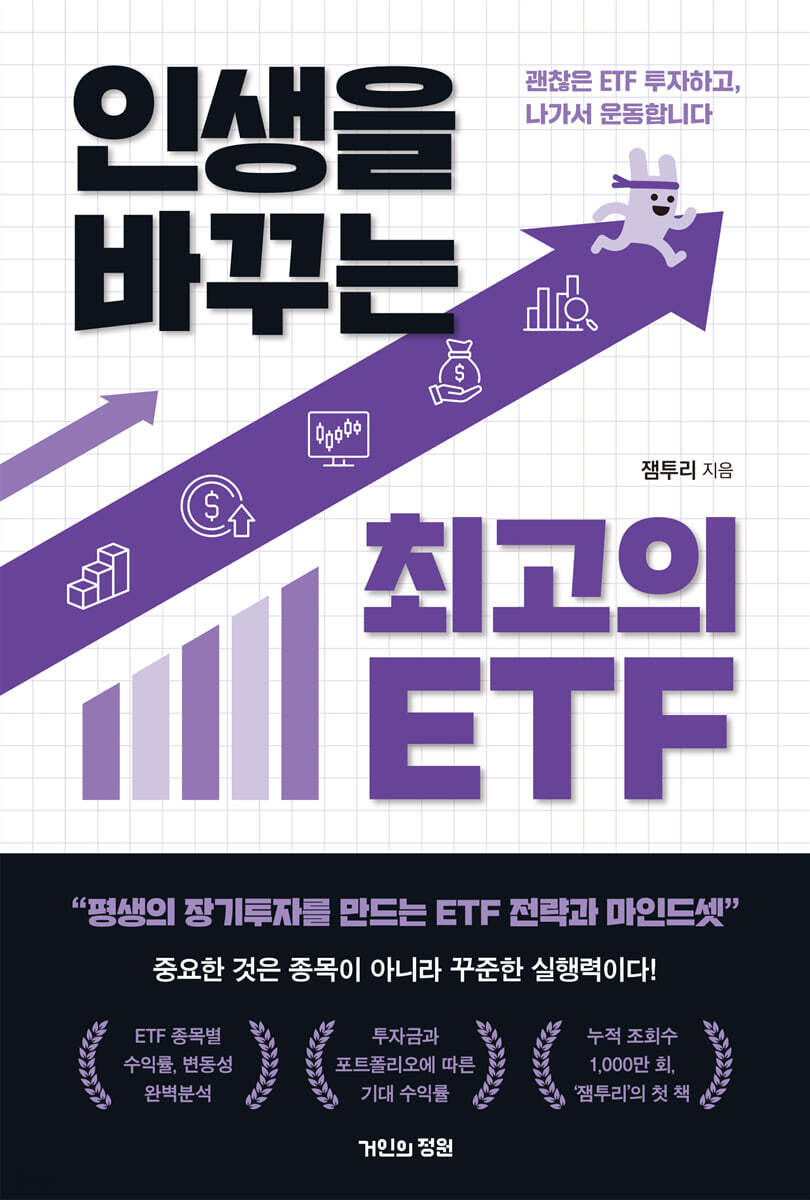
The Best ETFs to Change Your Life
 |
Description
Book Introduction
"Invest passively, live actively."
An ordinary office worker who became a FIRE tribe member tells us
Create a customized ETF strategy to accelerate your life's freedom.
☆ 10 million cumulative views, 'Jamturi's' first book ☆
☆ Complete analysis of returns and volatility by ETF stock ☆
The secret to success in stocks is simple.
It is about finding stocks suitable for long-term investment and investing steadily.
The problem is that it's difficult to determine which stocks are suitable for long-term investing and how much volatility I'm willing to tolerate and for how long.
The author, who went from being an ordinary office worker to becoming a FIRE investor, confidently says that the best investment is US stocks, and among them, 'ETFs'.
For ordinary people who commute to work every day, studying individual stocks and timing their purchases is a complex investment process that is difficult and carries a very low probability of success.
Therefore, investing in the overall growth of the U.S. stock market, which has been proven throughout history to be upward, is the most reliable investment.
The author provides a detailed analysis of the period-based returns and volatility of major ETFs, including market-tracking products like SPY, as well as smart beta, dividend growth, technology growth, covered call, and REITs.
Furthermore, to help readers develop their own "customized investment strategies," the report provides comparisons of volatility and returns when combining ETFs in various ratios, as well as comparisons with other asset classes such as the 60/40 portfolio, a traditional strategy that mixes stocks and bonds, Seoul apartments, and gold.
The reason we invest so hard is ultimately to live freely without being constrained by money.
The author emphasizes that a healthy and happy life is more important than investment strategy.
Rather than suffering through the pain of studying and buying and selling individual stocks, he says that true investment success is to build your own ETF portfolio based on data, invest 'passively', and live 'actively' by taking care of your health through exercise that does not cause loss of principal.
For those seeking to achieve the true purpose of investing—freedom—this book will be an invaluable guide.
An ordinary office worker who became a FIRE tribe member tells us
Create a customized ETF strategy to accelerate your life's freedom.
☆ 10 million cumulative views, 'Jamturi's' first book ☆
☆ Complete analysis of returns and volatility by ETF stock ☆
The secret to success in stocks is simple.
It is about finding stocks suitable for long-term investment and investing steadily.
The problem is that it's difficult to determine which stocks are suitable for long-term investing and how much volatility I'm willing to tolerate and for how long.
The author, who went from being an ordinary office worker to becoming a FIRE investor, confidently says that the best investment is US stocks, and among them, 'ETFs'.
For ordinary people who commute to work every day, studying individual stocks and timing their purchases is a complex investment process that is difficult and carries a very low probability of success.
Therefore, investing in the overall growth of the U.S. stock market, which has been proven throughout history to be upward, is the most reliable investment.
The author provides a detailed analysis of the period-based returns and volatility of major ETFs, including market-tracking products like SPY, as well as smart beta, dividend growth, technology growth, covered call, and REITs.
Furthermore, to help readers develop their own "customized investment strategies," the report provides comparisons of volatility and returns when combining ETFs in various ratios, as well as comparisons with other asset classes such as the 60/40 portfolio, a traditional strategy that mixes stocks and bonds, Seoul apartments, and gold.
The reason we invest so hard is ultimately to live freely without being constrained by money.
The author emphasizes that a healthy and happy life is more important than investment strategy.
Rather than suffering through the pain of studying and buying and selling individual stocks, he says that true investment success is to build your own ETF portfolio based on data, invest 'passively', and live 'actively' by taking care of your health through exercise that does not cause loss of principal.
For those seeking to achieve the true purpose of investing—freedom—this book will be an invaluable guide.
- You can preview some of the book's contents.
Preview
index
Part 1 Before You Start Investing
01 Stop thinking and just start.
02 Differences between poor and rich families
03 It is more dangerous not to invest
Why You Should Invest in Second-Party Stocks
01 Fighting Inflation
02 The only thing that beat inflation was stocks.
03 The only way to make money with money is through stocks.
Part 3: Why You Should Invest in US Stock ETFs
01 Why Stocks Continue to Rise
02 Reasons for not investing in Korean stocks
03 Reasons for not investing actively
04 Ultimately, there is nothing like US stock ETFs.
Part 4: The Best ETFs, The Best Investment Strategies
01 The simplest yet most powerful market ETF
02 Smart Beta ETFs that Fill Market Gaps
03 Dividend Growth ETFs that may not be flashy, but they quietly win.
04 Risky but Unavoidable Technology Growth ETFs
05 Hybrid ETF Strategy: Using Both Spears and Shields
06 Covered call ETFs that generate cash flow instead of price differences
07 Non-US ETFs excluding the US
08 Global ETFs that invest globally without hesitation
09 A strengthened ETF that focuses on investing in a small number of elite funds.
10 Bond ETFs and a 60/40 Portfolio Strategy
11 Gold and Commodities, Asset Allocation Portfolio Strategies
12 REIT ETFs that Invest in Real Estate
13 US Stock ETFs vs.
Seoul apartment
14. Bitcoin: An Essential Investment Asset
15 Best ETF Investment Strategies
Part 5: The Best ETFs: More Important Than the Best Investment Strategy
01 Why are the returns different for the same product?
02 Why the subject doesn't matter
03 It's not the stocks, it's the investors.
04 Don't package gambling addiction as stock investment.
05 Increase investment amount rather than rate of return
06 Minimum period for long-term investment success
Part 6: Overcoming Fear of Stock Investing
01 Aren't stocks too risky?
02 It seems like a high point, what should I do?
03 The exchange rate is high. What should I do?
04 What if the securities firm or asset management company goes bankrupt?
05 What if America fails?
06 Will it continue to rise by 10% per year?
Becoming a devotee of the final text
References and References
01 Stop thinking and just start.
02 Differences between poor and rich families
03 It is more dangerous not to invest
Why You Should Invest in Second-Party Stocks
01 Fighting Inflation
02 The only thing that beat inflation was stocks.
03 The only way to make money with money is through stocks.
Part 3: Why You Should Invest in US Stock ETFs
01 Why Stocks Continue to Rise
02 Reasons for not investing in Korean stocks
03 Reasons for not investing actively
04 Ultimately, there is nothing like US stock ETFs.
Part 4: The Best ETFs, The Best Investment Strategies
01 The simplest yet most powerful market ETF
02 Smart Beta ETFs that Fill Market Gaps
03 Dividend Growth ETFs that may not be flashy, but they quietly win.
04 Risky but Unavoidable Technology Growth ETFs
05 Hybrid ETF Strategy: Using Both Spears and Shields
06 Covered call ETFs that generate cash flow instead of price differences
07 Non-US ETFs excluding the US
08 Global ETFs that invest globally without hesitation
09 A strengthened ETF that focuses on investing in a small number of elite funds.
10 Bond ETFs and a 60/40 Portfolio Strategy
11 Gold and Commodities, Asset Allocation Portfolio Strategies
12 REIT ETFs that Invest in Real Estate
13 US Stock ETFs vs.
Seoul apartment
14. Bitcoin: An Essential Investment Asset
15 Best ETF Investment Strategies
Part 5: The Best ETFs: More Important Than the Best Investment Strategy
01 Why are the returns different for the same product?
02 Why the subject doesn't matter
03 It's not the stocks, it's the investors.
04 Don't package gambling addiction as stock investment.
05 Increase investment amount rather than rate of return
06 Minimum period for long-term investment success
Part 6: Overcoming Fear of Stock Investing
01 Aren't stocks too risky?
02 It seems like a high point, what should I do?
03 The exchange rate is high. What should I do?
04 What if the securities firm or asset management company goes bankrupt?
05 What if America fails?
06 Will it continue to rise by 10% per year?
Becoming a devotee of the final text
References and References
Detailed image

Into the book
So now the last remaining bastion is pension.
But this is more serious.
Our country's pension income replacement rate is 31.6%, the lowest among OECD countries.
The difference becomes even clearer when comparing the numbers directly with other countries.
Many OECD countries, including Spain (80.4%), Italy (76.1%), and the Netherlands (74.7%), have income replacement rates exceeding 70%, enabling pensions to provide a stable foundation for retirement.
For example, let's assume that the average lifetime income is the same at 4 million won.
In the Netherlands, you will receive 75% of the pension, or 3 million won per month.
On the other hand, in our country, 31.6%, or about 1.26 million won, will be received.
The low income replacement rate of Korea's pension system means that it is virtually impossible for us to rely on it for our retirement.
---From "It's more dangerous not to invest"
More importantly, stock replacement and weight adjustment (rebalancing) are automatic. ETFs track major indices like the S&P 500 or are comprised of stocks selected through specific strategies and logic.
And at set intervals, stocks are automatically replaced and weights are adjusted according to the logic.
This means that investors can automatically invest in the best-performing companies without having to conduct separate corporate analysis or portfolio management.
---From "In the end, there is nothing like US stock ETFs"
The dividend growth of dividend growth ETFs is 50-100% higher than that of general market ETFs.
In particular, among dividend growth ETFs, SCHD shows the highest dividend growth rate of over 11%.
This is why it has recently become so popular both domestically and internationally.
But the real reason to pay attention to dividend growth ETFs lies elsewhere, not in the dividends themselves.
By examining the long-term total return (TR) data for the index tracked by each ETF product, we can see that this seemingly boring strategy significantly outperforms the S&P 500.
---From "Dividend Growth ETFs That Silently Win, Though Not Flashy"
If you are far from retirement, you may want to consider a more aggressive 5:5 ratio.
Volatility is higher than 8:2, but the returns are also higher.
The appeal of this strategy is that despite including 50% of the volatile QQQ, the overall portfolio's volatility is lower than that of SPY.
This is because the two ETFs have a low correlation and move complementarily in different market conditions.
However, since technology stocks are highly volatile, it is advisable to gradually increase the proportion of dividend growth stocks such as SCHD as you approach retirement for stability.
---From "A Mixed ETF Strategy that Uses Both a Spear and a Shield"
The first thing to consider when creating an investment portfolio is to select assets that can yield a return of at least 7-8%.
Because prices continue to rise, nominal returns need to be at least 7-8% to beat inflation and achieve real asset growth.
Then, the real rate of return taking inflation into account will be around 5-6%.
But this is more serious.
Our country's pension income replacement rate is 31.6%, the lowest among OECD countries.
The difference becomes even clearer when comparing the numbers directly with other countries.
Many OECD countries, including Spain (80.4%), Italy (76.1%), and the Netherlands (74.7%), have income replacement rates exceeding 70%, enabling pensions to provide a stable foundation for retirement.
For example, let's assume that the average lifetime income is the same at 4 million won.
In the Netherlands, you will receive 75% of the pension, or 3 million won per month.
On the other hand, in our country, 31.6%, or about 1.26 million won, will be received.
The low income replacement rate of Korea's pension system means that it is virtually impossible for us to rely on it for our retirement.
---From "It's more dangerous not to invest"
More importantly, stock replacement and weight adjustment (rebalancing) are automatic. ETFs track major indices like the S&P 500 or are comprised of stocks selected through specific strategies and logic.
And at set intervals, stocks are automatically replaced and weights are adjusted according to the logic.
This means that investors can automatically invest in the best-performing companies without having to conduct separate corporate analysis or portfolio management.
---From "In the end, there is nothing like US stock ETFs"
The dividend growth of dividend growth ETFs is 50-100% higher than that of general market ETFs.
In particular, among dividend growth ETFs, SCHD shows the highest dividend growth rate of over 11%.
This is why it has recently become so popular both domestically and internationally.
But the real reason to pay attention to dividend growth ETFs lies elsewhere, not in the dividends themselves.
By examining the long-term total return (TR) data for the index tracked by each ETF product, we can see that this seemingly boring strategy significantly outperforms the S&P 500.
---From "Dividend Growth ETFs That Silently Win, Though Not Flashy"
If you are far from retirement, you may want to consider a more aggressive 5:5 ratio.
Volatility is higher than 8:2, but the returns are also higher.
The appeal of this strategy is that despite including 50% of the volatile QQQ, the overall portfolio's volatility is lower than that of SPY.
This is because the two ETFs have a low correlation and move complementarily in different market conditions.
However, since technology stocks are highly volatile, it is advisable to gradually increase the proportion of dividend growth stocks such as SCHD as you approach retirement for stability.
---From "A Mixed ETF Strategy that Uses Both a Spear and a Shield"
The first thing to consider when creating an investment portfolio is to select assets that can yield a return of at least 7-8%.
Because prices continue to rise, nominal returns need to be at least 7-8% to beat inflation and achieve real asset growth.
Then, the real rate of return taking inflation into account will be around 5-6%.
---From "A Comprehensive Guide to the Best ETF Investment Strategies"
Publisher's Review
Best Investors + Best Stocks = Successful Investment!
Worst Investors + Best Stocks = Complete Miscellaneous Stocks!
In the end, what matters is what suits me.
Portfolio and consistent execution!
★ Compare asset class returns, including stocks, bonds, gold, and apartments ★
★ Complete analysis of ETFs by stock and combination ★
★ The first book by 'Jamturi', an economic YouTuber who has become famous among experts through word of mouth ★
Many stock investors are looking for the best stocks that promise high returns.
But no matter how great a stock is, if it doesn't suit me, it's all for naught.
There are countless investors who get in late when stock prices are skyrocketing and then sell out of anxiety when the price drops even slightly, suffering losses.
Ultimately, the problem is that I don't know what stocks are suitable for my target return and planned investment period.
This book is for those people.
The author, who went from being an ordinary office worker to becoming a FIRE investor through stock investment alone, emphasizes that it is important to make the perfect investment for yourself, not the perfect investment for everyone else, and suggests US stock ETFs as the answer.
Rather than studying individual stocks and making uncertain investments by "going all over the place," the correct answer is to invest in ETFs, which have predictable volatility and returns based on backtesting and can achieve performance in line with the overall market growth.
History proves that US stocks are on the rise!
Among them, the most stable and reliable ETF!
There are many assets we can invest in, but over the past 200 years, stocks have been the only asset that has consistently grown while beating inflation.
The U.S. stock market, in particular, was at the center of it.
From the early 1900s to the 2020s, the real return of the S&P 500, adjusted for inflation, exceeds 440 times.
Even compared to the widely recognized Gangnam real estate market in Korea, it showed a significantly higher growth rate than the core apartment complexes in Apgujeong and Gangnam over the 20 years from 2004 to 2024. With its abundance of big tech companies leading the AI era, the United States is undoubtedly poised to lead the global economy going forward.
So, why are US stocks still considered "risky assets" despite their long history of stable growth? In a world where it's common for companies that were thriving just a few years ago to suddenly collapse, no one can guarantee the long-term growth potential of their investments.
The important thing is that history proves that even if the performance of individual companies is uncertain, the U.S. stock market as a whole tends to rise over the long term.
This is why you should invest in ETFs that are 'all market', i.e., buying all your eggs in one basket.
Complete analysis of returns and volatility by ETF stock and period!
Select the best stock based on your investment period and target amount!
So which ETFs should you invest in? The author advises first setting a goal: how much money you want to accumulate over a certain period of time.
It is about calculating the required rate of return based on each individual's goals and selecting the stock that is right for me by considering the volatility and rate of return from backtesting.
This book covers everything about ETFs, from the most basic yet powerful market ETFs to smart beta ETFs that select and invest in competitive companies, dividend growth ETFs that prioritize stability, covered call ETFs that prioritize cash flow, and ETFs that invest in various markets around the world.
Furthermore, we have enabled users to establish an optimal investment strategy by comparing the performance of major ETFs and other asset classes, including the 60/40 portfolio, a representative stock + bond strategy, as well as gold, raw materials, and apartments.
The optimal ETF combination and ratio to maximize returns!
Complete your own portfolio!
Hedging risk by simultaneously investing in stocks with low correlations is the most reliable strategy for increasing stability. This strategy is also applicable to ETF investments.
For example, one option is to simultaneously invest in SCHD, a dividend growth ETF, and QQQ, a growth ETF. SCHD, with its minimal exposure to technology stocks, is the perfect complement to mitigate the volatility of QQQ, a technology-focused fund that carries risks in exchange for high expected returns.
Conversely, QQQ offers an opportunity to make up for the disappointing returns from SCHD with explosive returns.
If you rebalance the two stocks periodically, you can achieve more stability and higher returns than SPY, which tracks the entire market.
The author analyzes the correlation coefficients between representative ETFs and proposes an optimal investment strategy that achieves both stability and return based on past returns and volatility when investing at specific ratios.
Throughout this book, the author emphasizes that a "happy life" is more important than the best investment strategy.
Ultimately, investing is about living freely without being swayed by money, but you shouldn't end up in a situation where you lose too much time to stocks and can't sleep because of worry, which is a situation where the roles are reversed.
He says that the 'real goal' we should pursue is to invest passively through ETFs and to live a healthy life by investing in exercise without losing principal.
I can confidently say that this book will be an excellent guide for those who pursue truly sound investing: investing in good ETFs and going out and exercising.
Worst Investors + Best Stocks = Complete Miscellaneous Stocks!
In the end, what matters is what suits me.
Portfolio and consistent execution!
★ Compare asset class returns, including stocks, bonds, gold, and apartments ★
★ Complete analysis of ETFs by stock and combination ★
★ The first book by 'Jamturi', an economic YouTuber who has become famous among experts through word of mouth ★
Many stock investors are looking for the best stocks that promise high returns.
But no matter how great a stock is, if it doesn't suit me, it's all for naught.
There are countless investors who get in late when stock prices are skyrocketing and then sell out of anxiety when the price drops even slightly, suffering losses.
Ultimately, the problem is that I don't know what stocks are suitable for my target return and planned investment period.
This book is for those people.
The author, who went from being an ordinary office worker to becoming a FIRE investor through stock investment alone, emphasizes that it is important to make the perfect investment for yourself, not the perfect investment for everyone else, and suggests US stock ETFs as the answer.
Rather than studying individual stocks and making uncertain investments by "going all over the place," the correct answer is to invest in ETFs, which have predictable volatility and returns based on backtesting and can achieve performance in line with the overall market growth.
History proves that US stocks are on the rise!
Among them, the most stable and reliable ETF!
There are many assets we can invest in, but over the past 200 years, stocks have been the only asset that has consistently grown while beating inflation.
The U.S. stock market, in particular, was at the center of it.
From the early 1900s to the 2020s, the real return of the S&P 500, adjusted for inflation, exceeds 440 times.
Even compared to the widely recognized Gangnam real estate market in Korea, it showed a significantly higher growth rate than the core apartment complexes in Apgujeong and Gangnam over the 20 years from 2004 to 2024. With its abundance of big tech companies leading the AI era, the United States is undoubtedly poised to lead the global economy going forward.
So, why are US stocks still considered "risky assets" despite their long history of stable growth? In a world where it's common for companies that were thriving just a few years ago to suddenly collapse, no one can guarantee the long-term growth potential of their investments.
The important thing is that history proves that even if the performance of individual companies is uncertain, the U.S. stock market as a whole tends to rise over the long term.
This is why you should invest in ETFs that are 'all market', i.e., buying all your eggs in one basket.
Complete analysis of returns and volatility by ETF stock and period!
Select the best stock based on your investment period and target amount!
So which ETFs should you invest in? The author advises first setting a goal: how much money you want to accumulate over a certain period of time.
It is about calculating the required rate of return based on each individual's goals and selecting the stock that is right for me by considering the volatility and rate of return from backtesting.
This book covers everything about ETFs, from the most basic yet powerful market ETFs to smart beta ETFs that select and invest in competitive companies, dividend growth ETFs that prioritize stability, covered call ETFs that prioritize cash flow, and ETFs that invest in various markets around the world.
Furthermore, we have enabled users to establish an optimal investment strategy by comparing the performance of major ETFs and other asset classes, including the 60/40 portfolio, a representative stock + bond strategy, as well as gold, raw materials, and apartments.
The optimal ETF combination and ratio to maximize returns!
Complete your own portfolio!
Hedging risk by simultaneously investing in stocks with low correlations is the most reliable strategy for increasing stability. This strategy is also applicable to ETF investments.
For example, one option is to simultaneously invest in SCHD, a dividend growth ETF, and QQQ, a growth ETF. SCHD, with its minimal exposure to technology stocks, is the perfect complement to mitigate the volatility of QQQ, a technology-focused fund that carries risks in exchange for high expected returns.
Conversely, QQQ offers an opportunity to make up for the disappointing returns from SCHD with explosive returns.
If you rebalance the two stocks periodically, you can achieve more stability and higher returns than SPY, which tracks the entire market.
The author analyzes the correlation coefficients between representative ETFs and proposes an optimal investment strategy that achieves both stability and return based on past returns and volatility when investing at specific ratios.
Throughout this book, the author emphasizes that a "happy life" is more important than the best investment strategy.
Ultimately, investing is about living freely without being swayed by money, but you shouldn't end up in a situation where you lose too much time to stocks and can't sleep because of worry, which is a situation where the roles are reversed.
He says that the 'real goal' we should pursue is to invest passively through ETFs and to live a healthy life by investing in exercise without losing principal.
I can confidently say that this book will be an excellent guide for those who pursue truly sound investing: investing in good ETFs and going out and exercising.
GOODS SPECIFICS
- Date of issue: June 27, 2025
- Page count, weight, size: 340 pages | 624g | 152*225*22mm
- ISBN13: 9791193869260
You may also like
카테고리
korean


korean

![ELLE 엘르 스페셜 에디션 A형 : 12월 [2025]](http://librairie.coreenne.fr/cdn/shop/files/b8e27a3de6c9538896439686c6b0e8fb.jpg?v=1766436872&width=3840)


