

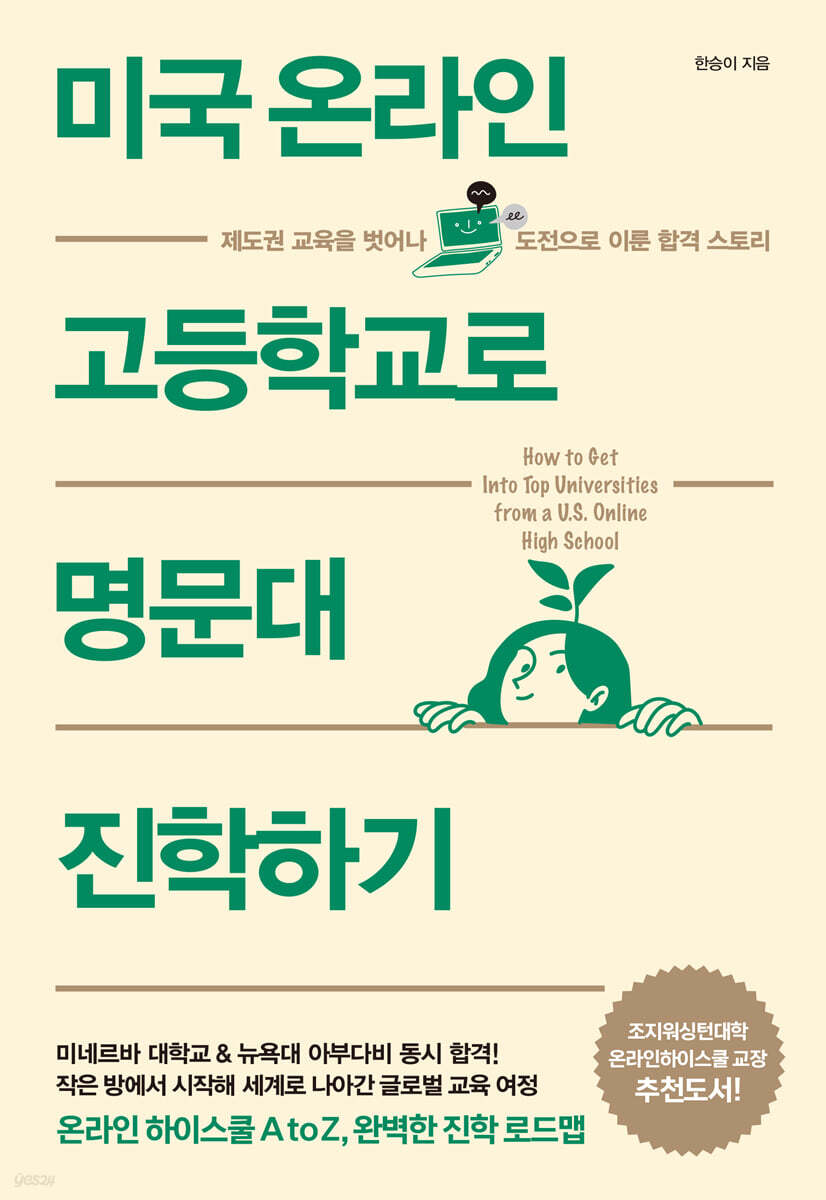
Admission to a prestigious university through an online high school in the US
 |
Description
Book Introduction
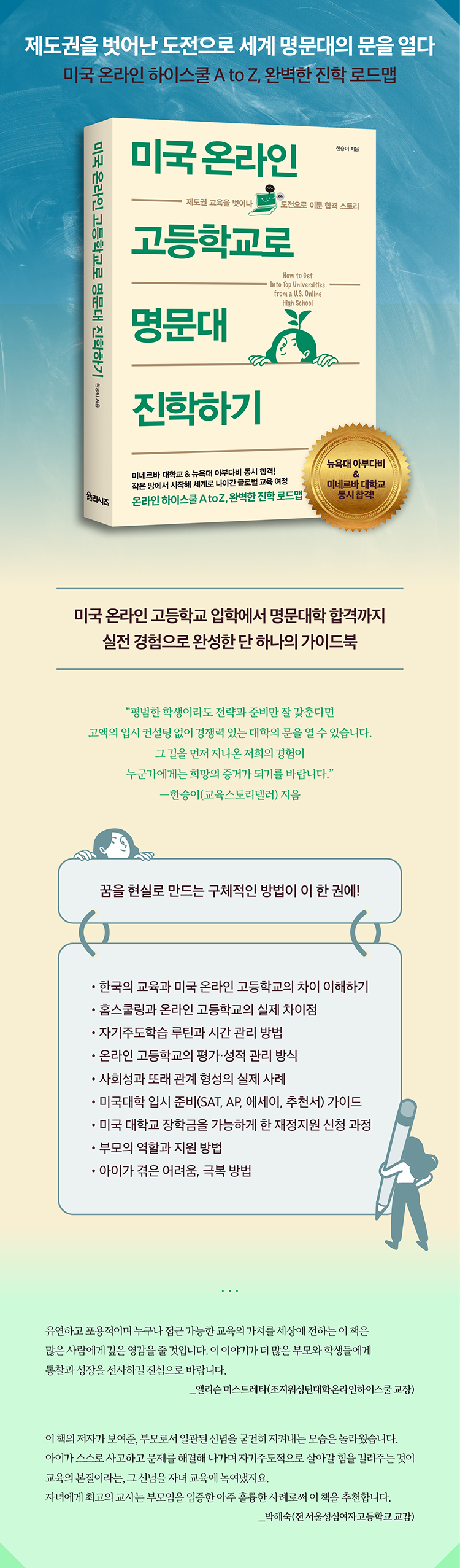
Opening the doors to a world-renowned university through a challenge beyond the established system
From online high school admission to acceptance, the only guidebook built on practical experience.
A book has been published that tells the story of a family's journey to successfully enter prestigious universities around the world through a new path: an American online high school, breaking away from the framework of Korean-style entrance exam education.
The author questioned the educational reality centered on academic competition and pondered an educational method that would foster children's initiative and autonomy. As a result, he made the unfamiliar choice of attending an online high school in the United States.
As a result, he achieved the remarkable feat of being accepted to both New York University Abu Dhabi and Minerva University at the same time.
This book meticulously unravels the reality of online high schools and the college entrance exam preparation process from a parent's perspective. It also includes specific know-how on curriculum, credit management, AP/SAT preparation, and portfolio strategies from major online schools in the United States.
In particular, by detailing the process of being accepted to a prestigious university through information search and self-directed learning without expensive admission consulting, it goes beyond the prejudice that "online education is an alternative" and proves that self-directed learning is a core competency for global university admissions.
This book questions the Korean education system, which is stuck in the "prestigious high school-prestigious university" formula, while also suggesting new advancement strategies and learning paradigms made possible in the digital age. It is a testament to the hope that "another path exists" for students and parents, and a practical guide useful for reading the changing times and preparing for future education.
From online high school admission to acceptance, the only guidebook built on practical experience.
A book has been published that tells the story of a family's journey to successfully enter prestigious universities around the world through a new path: an American online high school, breaking away from the framework of Korean-style entrance exam education.
The author questioned the educational reality centered on academic competition and pondered an educational method that would foster children's initiative and autonomy. As a result, he made the unfamiliar choice of attending an online high school in the United States.
As a result, he achieved the remarkable feat of being accepted to both New York University Abu Dhabi and Minerva University at the same time.
This book meticulously unravels the reality of online high schools and the college entrance exam preparation process from a parent's perspective. It also includes specific know-how on curriculum, credit management, AP/SAT preparation, and portfolio strategies from major online schools in the United States.
In particular, by detailing the process of being accepted to a prestigious university through information search and self-directed learning without expensive admission consulting, it goes beyond the prejudice that "online education is an alternative" and proves that self-directed learning is a core competency for global university admissions.
This book questions the Korean education system, which is stuck in the "prestigious high school-prestigious university" formula, while also suggesting new advancement strategies and learning paradigms made possible in the digital age. It is a testament to the hope that "another path exists" for students and parents, and a practical guide useful for reading the changing times and preparing for future education.
- You can preview some of the book's contents.
Preview
index
Recommendation
Education is not a matter of location, but of possibility. - Allison Mistretta, Principal, George Washington University Online High School
Ultimately, the best teachers are parents. _Park Hye-sook (former vice principal, Seoul Seongshim Girls' High School)
Prologue: The Courage to Face the Future, and Choices
Chapter 1.
There was not just one road
Farewell to familiarity, facing an unfamiliar reality
Asking for directions in confusion
Crumbling faith, blossoming questions
Learning resumed outside the system
Chapter 2.
Online High School in the US: A Strange Journey Begins
A morning walk changed my child.
Is it possible to have a social life in an online high school?
How are online high schools evaluated and graded?
K12: The Power to Make Online High Schools Real
Online High Schools: Which One is Best?
Chapter 3.
Study Methods & Portfolio Strategies
AP, an unfamiliar yet important first choice
How did you prepare for the AP and SAT exams?
Portfolio for Holistic Review
I liked that it was an online high school.
Chapter 4.
Let's go without admission consulting
In pursuit of broader possibilities
From the Common App to the essay
Developing a Support Strategy: What ED and EA Mean
New York University Abu Dhabi VS.
Minerva University
I came this far without any college admissions consulting.
Chapter 5.
Is it possible to attend American college without money?
US financial aid policies available to international students
A Practical Guide to Applying for Scholarships, CSS Profile
The world of scholarships open to international students
Children who received scholarships, touched by sincerity
Chapter 6.
The Parental Role: Between Involvement and Trust
Private education wisely
Don't let any excuse stop your child's dream.
Parents grow together too
Online High School: Nothing Special
Epilogue: The Road We've Walked Together, and a New Beginning
2025 GWUOHS Commencement Speech
[supplement]
1. 4 Steps to Studying for the AP Exam
2. Before going to an SAT academy, do this much.
3. Analysis of the Differences Between AP Calculus AB and BC
4.
Overseas University Admissions Schedule
5.
A collection of useful sites for preparing for US college admissions.
Education is not a matter of location, but of possibility. - Allison Mistretta, Principal, George Washington University Online High School
Ultimately, the best teachers are parents. _Park Hye-sook (former vice principal, Seoul Seongshim Girls' High School)
Prologue: The Courage to Face the Future, and Choices
Chapter 1.
There was not just one road
Farewell to familiarity, facing an unfamiliar reality
Asking for directions in confusion
Crumbling faith, blossoming questions
Learning resumed outside the system
Chapter 2.
Online High School in the US: A Strange Journey Begins
A morning walk changed my child.
Is it possible to have a social life in an online high school?
How are online high schools evaluated and graded?
K12: The Power to Make Online High Schools Real
Online High Schools: Which One is Best?
Chapter 3.
Study Methods & Portfolio Strategies
AP, an unfamiliar yet important first choice
How did you prepare for the AP and SAT exams?
Portfolio for Holistic Review
I liked that it was an online high school.
Chapter 4.
Let's go without admission consulting
In pursuit of broader possibilities
From the Common App to the essay
Developing a Support Strategy: What ED and EA Mean
New York University Abu Dhabi VS.
Minerva University
I came this far without any college admissions consulting.
Chapter 5.
Is it possible to attend American college without money?
US financial aid policies available to international students
A Practical Guide to Applying for Scholarships, CSS Profile
The world of scholarships open to international students
Children who received scholarships, touched by sincerity
Chapter 6.
The Parental Role: Between Involvement and Trust
Private education wisely
Don't let any excuse stop your child's dream.
Parents grow together too
Online High School: Nothing Special
Epilogue: The Road We've Walked Together, and a New Beginning
2025 GWUOHS Commencement Speech
[supplement]
1. 4 Steps to Studying for the AP Exam
2. Before going to an SAT academy, do this much.
3. Analysis of the Differences Between AP Calculus AB and BC
4.
Overseas University Admissions Schedule
5.
A collection of useful sites for preparing for US college admissions.
Detailed image
Into the book
This book is the story of an ordinary child, neither a genius nor a gifted child, who follows his own rhythm and develops his own potential.
As a mother, I have learned firsthand that education is more than just "how to study well"; it is also "the process of raising a person."
We decided to foster the 'power to prepare and choose for oneself' rather than the child's basic capabilities.
We walked together, cheering you on as you navigated the sea of information, re-planned when you made a mistake, and grew stronger through failure.
--- From the "Prologue"
It is not for those who are only aiming for expensive early study abroad, international schools, or Ivy League schools.
Rather, this book is for parents who want to research, think, and plan together to open up a 'realistic' future for their children.
I hope this book will be a small beacon of light for ordinary parents who are considering online high schools, dreaming of attending American universities, or worrying about their children's future and education.
--- From the "Prologue"
Although we made this decision together, I was the one who ultimately led him down this unfamiliar path, so it was my responsibility to fully embrace his complex emotions.
I wanted to hold her hand and comfort her, telling her it would be okay, that things would be okay, but deep down in my heart, I felt a regret that I couldn't express in words.
We were constantly worried that the child might be confused or hurt, and we left the school with a vague fear of what kind of mark this quiet separation would leave on the child's heart.
--- p.58
Walking has become a part of my daily routine.
At first, it was his mother's suggestion, but as time went by, the child began to prepare breakfast on his own, look forward to the walk, and take more initiative in carrying out subsequent tasks.
Starting my day with a walk naturally wakes up my brain and makes it easier to focus in class.
As I watched my child wake up and organize his daily routine, I felt that he was beginning to love life again.
--- p.72
The child's emotional isolation deepened.
When online classes started, it felt like I was dropped into the middle of an American city I'd never been to before.
It was a loneliness that I experienced not because I couldn't communicate verbally, but because I couldn't communicate emotionally.
In reality, the space without friends, the space where the daily communication through glances, smiles, and small gestures had disappeared, was much colder than I had imagined.
When my child first entered online high school, he was not prepared for this loneliness.
Actually, I was the same way.
--- p.76
Of course, there are concerns that the limitations of being online may lead to a lack of sociality.
However, in reality, it became the foundation for solving situations on my own without the help of others and planning my entrance exams independently and proactively.
To get something, you had to take initiative.
Even if it is said that it cannot be done, I am becoming a person who shows possibility and persuades others.
Furthermore, this proactive attitude played a significant role in conveying my earnestness and sincerity to college admissions officers.
--- p.87
Social life in online high schools is not something that is "nonexistent," but something that is "created by oneself."
And in it, the child realized the power of relationships and the value of his own existence, and expanded his friendships from his own room to the whole world.
Isn't this the true power of education we've been hoping for?
--- p.90
My child developed at his own pace, creating his own schedule and interacting with friends from all over the world.
Sometimes we get frustrated and make mistakes.
It may take a long time.
But all those experiences accumulated and raised my child to be a 'self-directed person'.
It's a power that can never be cultivated in a system that asks, "What time is it?" or "Why aren't you online?"
Education is ultimately not a matter of 'management' but of 'growth'.
--- p.127
The essence of choosing a school is not about reputation, but finding the 'structure that's right for us.'
The process can be taken care of calmly, and the costs can be managed according to the family's convenience.
And all that remains is the child's steps.
Now is the time for your child to learn at his own pace, even if it is slow at times.
As parents, all we could do was watch, believe, and wait.
--- p.129
Another great advantage of online classes is that you can learn at your own pace.
You can quickly progress through the parts you understand well, and you can sufficiently learn the difficult parts by watching them repeatedly.
By listening to the recorded lectures multiple times, reviewing them, and searching for necessary materials, the child experienced 'self-directed learning.'
--- p.166
American online high schools offer regular one-on-one weekly meetings with teachers, as well as various ways to ask questions and communicate via email, Skype chat, and video conferencing.
In particular, if there was a part of the class that was difficult to understand, I could ask questions through a real-time question session called the 'Help Desk' and receive immediate answers, and if I had any questions about assignments or exams, I received personalized feedback from the teacher.
--- p.169
In this way, I felt that online high schools had a more advanced structure in terms of depth of learning, freedom, choice, and self-direction.
At first it was strange and uneasy, but now I can say it with confidence.
“You made a really good choice.”
An environment where children can plan and learn on their own, and grow at their own pace and in their own way.
That was the greatest value that online high school gave me.
--- p.172
To start life on a solid foundation of 'sincerity' rather than 'help from entrance exam consulting'.
That may be the greatest gift we can give as parents.
Passing the exam through a child's story, not through consulting.
I sincerely hope that this will be a courageous beginning for someone reading this.
I sincerely hope that a true future will open up through conversations shared with children.
As a mother, I have learned firsthand that education is more than just "how to study well"; it is also "the process of raising a person."
We decided to foster the 'power to prepare and choose for oneself' rather than the child's basic capabilities.
We walked together, cheering you on as you navigated the sea of information, re-planned when you made a mistake, and grew stronger through failure.
--- From the "Prologue"
It is not for those who are only aiming for expensive early study abroad, international schools, or Ivy League schools.
Rather, this book is for parents who want to research, think, and plan together to open up a 'realistic' future for their children.
I hope this book will be a small beacon of light for ordinary parents who are considering online high schools, dreaming of attending American universities, or worrying about their children's future and education.
--- From the "Prologue"
Although we made this decision together, I was the one who ultimately led him down this unfamiliar path, so it was my responsibility to fully embrace his complex emotions.
I wanted to hold her hand and comfort her, telling her it would be okay, that things would be okay, but deep down in my heart, I felt a regret that I couldn't express in words.
We were constantly worried that the child might be confused or hurt, and we left the school with a vague fear of what kind of mark this quiet separation would leave on the child's heart.
--- p.58
Walking has become a part of my daily routine.
At first, it was his mother's suggestion, but as time went by, the child began to prepare breakfast on his own, look forward to the walk, and take more initiative in carrying out subsequent tasks.
Starting my day with a walk naturally wakes up my brain and makes it easier to focus in class.
As I watched my child wake up and organize his daily routine, I felt that he was beginning to love life again.
--- p.72
The child's emotional isolation deepened.
When online classes started, it felt like I was dropped into the middle of an American city I'd never been to before.
It was a loneliness that I experienced not because I couldn't communicate verbally, but because I couldn't communicate emotionally.
In reality, the space without friends, the space where the daily communication through glances, smiles, and small gestures had disappeared, was much colder than I had imagined.
When my child first entered online high school, he was not prepared for this loneliness.
Actually, I was the same way.
--- p.76
Of course, there are concerns that the limitations of being online may lead to a lack of sociality.
However, in reality, it became the foundation for solving situations on my own without the help of others and planning my entrance exams independently and proactively.
To get something, you had to take initiative.
Even if it is said that it cannot be done, I am becoming a person who shows possibility and persuades others.
Furthermore, this proactive attitude played a significant role in conveying my earnestness and sincerity to college admissions officers.
--- p.87
Social life in online high schools is not something that is "nonexistent," but something that is "created by oneself."
And in it, the child realized the power of relationships and the value of his own existence, and expanded his friendships from his own room to the whole world.
Isn't this the true power of education we've been hoping for?
--- p.90
My child developed at his own pace, creating his own schedule and interacting with friends from all over the world.
Sometimes we get frustrated and make mistakes.
It may take a long time.
But all those experiences accumulated and raised my child to be a 'self-directed person'.
It's a power that can never be cultivated in a system that asks, "What time is it?" or "Why aren't you online?"
Education is ultimately not a matter of 'management' but of 'growth'.
--- p.127
The essence of choosing a school is not about reputation, but finding the 'structure that's right for us.'
The process can be taken care of calmly, and the costs can be managed according to the family's convenience.
And all that remains is the child's steps.
Now is the time for your child to learn at his own pace, even if it is slow at times.
As parents, all we could do was watch, believe, and wait.
--- p.129
Another great advantage of online classes is that you can learn at your own pace.
You can quickly progress through the parts you understand well, and you can sufficiently learn the difficult parts by watching them repeatedly.
By listening to the recorded lectures multiple times, reviewing them, and searching for necessary materials, the child experienced 'self-directed learning.'
--- p.166
American online high schools offer regular one-on-one weekly meetings with teachers, as well as various ways to ask questions and communicate via email, Skype chat, and video conferencing.
In particular, if there was a part of the class that was difficult to understand, I could ask questions through a real-time question session called the 'Help Desk' and receive immediate answers, and if I had any questions about assignments or exams, I received personalized feedback from the teacher.
--- p.169
In this way, I felt that online high schools had a more advanced structure in terms of depth of learning, freedom, choice, and self-direction.
At first it was strange and uneasy, but now I can say it with confidence.
“You made a really good choice.”
An environment where children can plan and learn on their own, and grow at their own pace and in their own way.
That was the greatest value that online high school gave me.
--- p.172
To start life on a solid foundation of 'sincerity' rather than 'help from entrance exam consulting'.
That may be the greatest gift we can give as parents.
Passing the exam through a child's story, not through consulting.
I sincerely hope that this will be a courageous beginning for someone reading this.
I sincerely hope that a true future will open up through conversations shared with children.
--- p.220
Publisher's Review
Online High School: The Courage to Choose an Unfamiliar Path
A family that returned home after completing their overseas assignment in Singapore.
Although fortunate enough to be accepted into an international middle school, the parents' concerns deepened as they encountered the Korean education system, which differed from their expectations. The race to get into the top universities in Korea was fierce, students were evaluated solely on grades and school records, and the educational landscape was devoid of the fundamental question of "why study?"
As the author observes the child's curiosity and inquisitiveness gradually fading, he realizes that the true essence of learning lies in 'autonomy' and 'inquisitiveness.'
While exploring all possibilities for my child who dreams of attending the National University of Singapore, I discovered an alternative: an American online high school.
What I discovered after my investigation was surprising.
In the United States, online high schools have been established as a formal educational system since the mid-1990s, and numerous graduates have gone on to attend Ivy League schools and prestigious universities around the world.
This system has become more sophisticated since the pandemic, perfectly implementing the curriculum of prestigious offline high schools online.
The class was not just a simple remote lecture.
Students design their courses at their own pace, receive real-time feedback from teachers, and receive individual mentoring and career counseling.
It was a place where the philosophy that 'learning doesn't stop even after leaving school' was put into practice.
In a learning environment free from the constraints of time and space, students were developing their own initiative, experiencing exploration rather than competition, and growth rather than grades, realizing the true meaning of learning.
The book contains detailed, realistic accounts of the process of preparing for online high school.
From writing application documents to academic evaluations, interview preparation, tuition structure, time zone differences, and parental consent procedures, the author carefully unravels the unfamiliar process of "online study abroad," offering parents with similar concerns the advice and practical information they have gained from firsthand experience.
The Reality of Self-Directed Learning for Prestigious University Admission
The world's top universities no longer look at simple GPAs or SAT scores.
What they evaluate is 'what students learn on their own and how they connect with the world.'
From this perspective, online high schools have unique strengths.
Students in American online high schools are required to have significantly higher levels of self-management and time management skills than those in traditional schools.
All courses are taught online, but active student participation is essential, with real-time discussions, feedback, and team projects.
The autonomy, expressiveness, and critical thinking skills that are naturally developed during this process are directly linked to the core competencies preferred by universities.
This book details the practical admissions process, including strategies for selecting Advanced Placement (AP) courses, SAT preparation, essay writing tips, and portfolio building that combines volunteer work and internships.
In particular, the strategy for achieving 'acceptance of a scholarship to a prestigious university without admission consulting' is the key information that many parents are most curious about.
The author researched information and prepared the application on his own without expensive study abroad consulting.
The child created his own story through the Common App (the common application for American colleges) and revised his English essay several times to complete his own authentic narrative.
Through this process, it is proven that 'self-directed learning' is not just a slogan, but a practical ability that leads to acceptance into prestigious universities.
This is the point where we realize that the essence of education goes beyond entrance exams and lies in the ‘power to learn on one’s own.’
The self-directed learning skills developed in an online education environment are not only useful for college entrance exams.
The ability to find information on your own, manage your time, and set and achieve goals are core competencies required not only for college life but also for future society.
This book demonstrates, with concrete examples, how these abilities can be systematically cultivated in the unique environment of an online high school.
A realistic and practical roadmap for parents and students
This book provides a comprehensive guide for families considering online high school options.
From school selection criteria to scholarship application (CSS Profile) tips, college admissions schedule management, timetable design, and how to utilize the mentoring system, we provide detailed step-by-step guidance on the entire process from admission to graduation and university advancement.
Additionally, we objectively analyze the pros and cons of online classes and suggest customized strategies based on each student's personality.
For students with strong self-directed learning, we offer specific advice on how to expand project-based learning into global internships and research activities, while for students with weak self-motivation, we offer specific advice on how to leverage the school's mentoring system to establish a learning routine.
Above all, this book guides parents to view their children's education as a process of 'accompaniment' rather than 'control'.
The author, who confesses that he himself has grown through the admission and advancement process, defines the role of parents as a "balance between involvement and trust" after countless trials and errors.
The key is not unconditional intervention, but rather a facilitator role that helps the child make his or her own decisions.
This philosophy of 'not designing a child's life, but holding a light next to the child so that he or she can design it himself' runs through the entire book.
Through the author's intense four years of experience, you can indirectly learn how to maintain an appropriate distance from your adolescent child while still being a strong supporter when needed.
Meanwhile, the anxiety and worries of parents who have chosen an unfamiliar path are also evident.
The author candidly chronicles the real-world challenges and trials and errors that parents and children face, including moments of uncertainty while walking the uncertain path, the loneliness of online classes, jet lag, and the fear of taking a different path from their peers.
Therefore, this book is not just a simple success story, but also a growth record that vividly demonstrates the process of self-directed learning connecting with the world.
According to the author, online high school is not just an option for "special children," but a new educational paradigm that all families should seriously consider in this rapidly changing era.
The form of education has already changed significantly thanks to advances in digital technology and the pandemic experience.
Now is the time for learner-centered, personalized education, rather than physical school buildings.
Through the stories of families who have actually experienced such changes at the forefront, we can draw a concrete picture of the future of education.
Learning continues even after you leave school.
A family that returned home after completing their overseas assignment in Singapore.
Although fortunate enough to be accepted into an international middle school, the parents' concerns deepened as they encountered the Korean education system, which differed from their expectations. The race to get into the top universities in Korea was fierce, students were evaluated solely on grades and school records, and the educational landscape was devoid of the fundamental question of "why study?"
As the author observes the child's curiosity and inquisitiveness gradually fading, he realizes that the true essence of learning lies in 'autonomy' and 'inquisitiveness.'
While exploring all possibilities for my child who dreams of attending the National University of Singapore, I discovered an alternative: an American online high school.
What I discovered after my investigation was surprising.
In the United States, online high schools have been established as a formal educational system since the mid-1990s, and numerous graduates have gone on to attend Ivy League schools and prestigious universities around the world.
This system has become more sophisticated since the pandemic, perfectly implementing the curriculum of prestigious offline high schools online.
The class was not just a simple remote lecture.
Students design their courses at their own pace, receive real-time feedback from teachers, and receive individual mentoring and career counseling.
It was a place where the philosophy that 'learning doesn't stop even after leaving school' was put into practice.
In a learning environment free from the constraints of time and space, students were developing their own initiative, experiencing exploration rather than competition, and growth rather than grades, realizing the true meaning of learning.
The book contains detailed, realistic accounts of the process of preparing for online high school.
From writing application documents to academic evaluations, interview preparation, tuition structure, time zone differences, and parental consent procedures, the author carefully unravels the unfamiliar process of "online study abroad," offering parents with similar concerns the advice and practical information they have gained from firsthand experience.
The Reality of Self-Directed Learning for Prestigious University Admission
The world's top universities no longer look at simple GPAs or SAT scores.
What they evaluate is 'what students learn on their own and how they connect with the world.'
From this perspective, online high schools have unique strengths.
Students in American online high schools are required to have significantly higher levels of self-management and time management skills than those in traditional schools.
All courses are taught online, but active student participation is essential, with real-time discussions, feedback, and team projects.
The autonomy, expressiveness, and critical thinking skills that are naturally developed during this process are directly linked to the core competencies preferred by universities.
This book details the practical admissions process, including strategies for selecting Advanced Placement (AP) courses, SAT preparation, essay writing tips, and portfolio building that combines volunteer work and internships.
In particular, the strategy for achieving 'acceptance of a scholarship to a prestigious university without admission consulting' is the key information that many parents are most curious about.
The author researched information and prepared the application on his own without expensive study abroad consulting.
The child created his own story through the Common App (the common application for American colleges) and revised his English essay several times to complete his own authentic narrative.
Through this process, it is proven that 'self-directed learning' is not just a slogan, but a practical ability that leads to acceptance into prestigious universities.
This is the point where we realize that the essence of education goes beyond entrance exams and lies in the ‘power to learn on one’s own.’
The self-directed learning skills developed in an online education environment are not only useful for college entrance exams.
The ability to find information on your own, manage your time, and set and achieve goals are core competencies required not only for college life but also for future society.
This book demonstrates, with concrete examples, how these abilities can be systematically cultivated in the unique environment of an online high school.
A realistic and practical roadmap for parents and students
This book provides a comprehensive guide for families considering online high school options.
From school selection criteria to scholarship application (CSS Profile) tips, college admissions schedule management, timetable design, and how to utilize the mentoring system, we provide detailed step-by-step guidance on the entire process from admission to graduation and university advancement.
Additionally, we objectively analyze the pros and cons of online classes and suggest customized strategies based on each student's personality.
For students with strong self-directed learning, we offer specific advice on how to expand project-based learning into global internships and research activities, while for students with weak self-motivation, we offer specific advice on how to leverage the school's mentoring system to establish a learning routine.
Above all, this book guides parents to view their children's education as a process of 'accompaniment' rather than 'control'.
The author, who confesses that he himself has grown through the admission and advancement process, defines the role of parents as a "balance between involvement and trust" after countless trials and errors.
The key is not unconditional intervention, but rather a facilitator role that helps the child make his or her own decisions.
This philosophy of 'not designing a child's life, but holding a light next to the child so that he or she can design it himself' runs through the entire book.
Through the author's intense four years of experience, you can indirectly learn how to maintain an appropriate distance from your adolescent child while still being a strong supporter when needed.
Meanwhile, the anxiety and worries of parents who have chosen an unfamiliar path are also evident.
The author candidly chronicles the real-world challenges and trials and errors that parents and children face, including moments of uncertainty while walking the uncertain path, the loneliness of online classes, jet lag, and the fear of taking a different path from their peers.
Therefore, this book is not just a simple success story, but also a growth record that vividly demonstrates the process of self-directed learning connecting with the world.
According to the author, online high school is not just an option for "special children," but a new educational paradigm that all families should seriously consider in this rapidly changing era.
The form of education has already changed significantly thanks to advances in digital technology and the pandemic experience.
Now is the time for learner-centered, personalized education, rather than physical school buildings.
Through the stories of families who have actually experienced such changes at the forefront, we can draw a concrete picture of the future of education.
Learning continues even after you leave school.
GOODS SPECIFICS
- Date of issue: October 31, 2025
- Page count, weight, size: 288 pages | 396g | 146*212*17mm
- ISBN13: 9791199223943
- ISBN10: 1199223948
You may also like
카테고리
korean


korean

![GQ KOREA Mark (Monthly): December [2025]](http://librairie.coreenne.fr/cdn/shop/files/8ef265dbbfbf186523ed75ba7319009d.jpg?v=1765340328&width=3840)


