

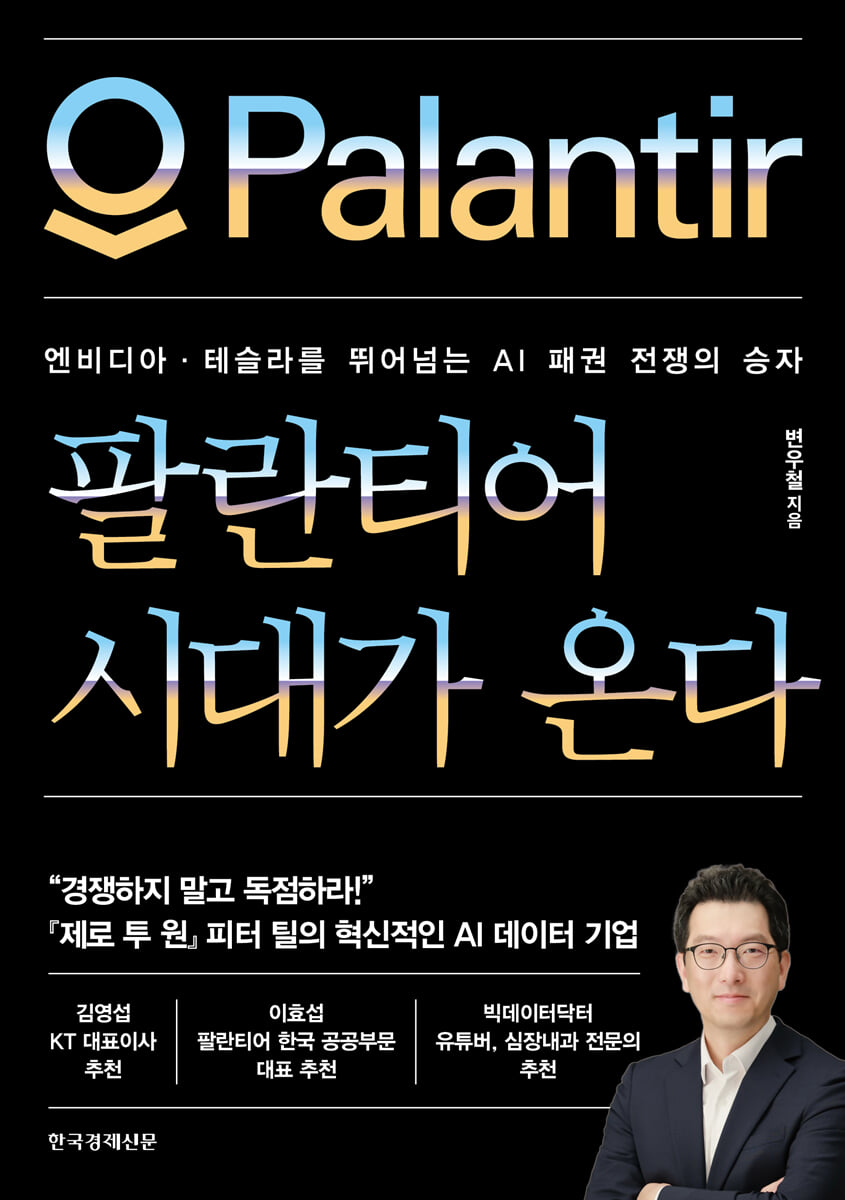
The Palantir Era is Coming
 |
Description
Book Introduction
Can Palantir monopolize the AI industry?
An insider's look at everything Palantir has to offer!
Praise and strong recommendation from top experts in various fields!
· Kim Young-seop, CEO of KT
Jincheol Park, the first CEO of Palantir Korea
· Hyo-Seop Lee, Head of Public Sector at Palantir Korea
Big Data Doctor, 110,000 YouTuber
The golden age of AI has arrived.
Big tech companies are competitively investing astronomical amounts of money in bulk purchases of GPUs and building data centers.
However, no company has yet emerged that is making money by utilizing AI technology.
That is, until Palantir came into the picture.
This book systematically explores the potential and technologies of Palantir, a company that exists in an era where data holds real power.
The author is Korea's leading Palantir expert, possessing both theoretical and practical experience, having implemented Palantir systems in large corporations three times.
It provides detailed and realistic information for general readers investing in Palantir and practitioners in the AI and data industries.
Readers will naturally gain an understanding of Palantir's technology, competitiveness, and unique data-utilization business.
Palantir isn't just a company with a skyrocketing stock price. It's a company that's building a massive data platform leveraging AI technology, and using it to fundamentally reshape every industry and organization on the planet.
It is also an innovative company that has achieved explosive growth without peer by building a clever business model.
Deeply understand Palantir's competitive edge
The only book that can predict the future of business
The author outlines Palantir's core technologies, including AIP, Ontology, Foundry, and Gotham, and discusses Palantir's present and future by deeply analyzing the cases of Korean companies that have adopted Palantir.
Additionally, we utilize the 'Deep Inside' special section to analyze Palantir's representative competitors, such as Databricks and Snowflake, and discuss what differentiates Palantir.
Palantir doesn't build Large Language Models (LLMs), doesn't develop AI technologies like deep learning, and doesn't build AI hardware using GPUs.
It simply uses AI technology to sort, select, and utilize data.
Palantir is not a company that unilaterally provides solutions.
We are a big data company that discovers essential problems in businesses and industries, extracts necessary data, and organizes it.
So how is Palantir responding to the AI revolution? If you're curious about Palantir's competitiveness, product line, customers, and business model—which extends beyond government and institutional sales to the private sector—you should read this book.
An insider's look at everything Palantir has to offer!
Praise and strong recommendation from top experts in various fields!
· Kim Young-seop, CEO of KT
Jincheol Park, the first CEO of Palantir Korea
· Hyo-Seop Lee, Head of Public Sector at Palantir Korea
Big Data Doctor, 110,000 YouTuber
The golden age of AI has arrived.
Big tech companies are competitively investing astronomical amounts of money in bulk purchases of GPUs and building data centers.
However, no company has yet emerged that is making money by utilizing AI technology.
That is, until Palantir came into the picture.
This book systematically explores the potential and technologies of Palantir, a company that exists in an era where data holds real power.
The author is Korea's leading Palantir expert, possessing both theoretical and practical experience, having implemented Palantir systems in large corporations three times.
It provides detailed and realistic information for general readers investing in Palantir and practitioners in the AI and data industries.
Readers will naturally gain an understanding of Palantir's technology, competitiveness, and unique data-utilization business.
Palantir isn't just a company with a skyrocketing stock price. It's a company that's building a massive data platform leveraging AI technology, and using it to fundamentally reshape every industry and organization on the planet.
It is also an innovative company that has achieved explosive growth without peer by building a clever business model.
Deeply understand Palantir's competitive edge
The only book that can predict the future of business
The author outlines Palantir's core technologies, including AIP, Ontology, Foundry, and Gotham, and discusses Palantir's present and future by deeply analyzing the cases of Korean companies that have adopted Palantir.
Additionally, we utilize the 'Deep Inside' special section to analyze Palantir's representative competitors, such as Databricks and Snowflake, and discuss what differentiates Palantir.
Palantir doesn't build Large Language Models (LLMs), doesn't develop AI technologies like deep learning, and doesn't build AI hardware using GPUs.
It simply uses AI technology to sort, select, and utilize data.
Palantir is not a company that unilaterally provides solutions.
We are a big data company that discovers essential problems in businesses and industries, extracts necessary data, and organizes it.
So how is Palantir responding to the AI revolution? If you're curious about Palantir's competitiveness, product line, customers, and business model—which extends beyond government and institutional sales to the private sector—you should read this book.
- You can preview some of the book's contents.
Preview
index
Prologue: A Journey to Discover the Essence of Palantir
This book's user manual
Glossary of Terms
Chapter 1: How Palantir Dominated the AI Ecosystem
01.
How Palantir Captivated Investors
02.
Peter Thiel Founds Palantir
03.
Dedicate yourself to solving your customers' problems
04.
The Secret of Explosive Stock Price Growth
05.
From Data to Agent: The Evolution of AIP
06.
Anduril and Palantir Redesign the Battleground
07.
Strategic Opportunities in the Trump 2.0 Era
· Deep Inside: Palantir's Competitors
Chapter 2: Palantir's Data Hegemony and Risk
01.
The expansion of the Palantir ecosystem depends on internalization.
02. KT Becomes a Partner with Technological Capabilities
03.
Open Platform, a Cradle of Engineer Training
04.
Balancing Security and Costs in Palantir Implementation
05.
Market Expansion Strategies Learned from Apple
· Deep Inside: Palantir-Based Work Order Innovation
Chapter 3: Special Mission: Introduce the Palantir System to Korea
01.
A series of countless rejections
02.
The Fellowship of the Ring departed for England
03.
Project Square
04.
The Role of a Palantir Dispatch Engineer
05.
Three questions to define the problem
06.
Frequent misunderstandings and the art of reconciliation
07.
A 70-Point MVP and Palantir-Style Agile
08.
DI360, born after much hardship
09.
A turning point for the expansion of Palantir's systems.
10.
Introducing a data agent system
11.
Overcome the Corona Pandemic
Deep Inside: The Evolution of Data Platforms
Chapter 4: Foundry: Changing the Paradigm of Digital Transformation
01.
Palantir Systems Infiltrates the Conservative Construction Industry
02.
Field-focused construction, embracing data
03.
ROI Structuring for This Contract
04.
Rediscovering Ontology-Based Operating Systems
05.
Turning the Absence of a Management System into an Opportunity
06.
The digital transformation revolution spreads to partners.
07.
The Dream of Digital Twins: The Shoulder Buddy M Project
08.
The secret to explosive user growth
09.
Why Palantir Signs Enterprise Contracts
10.
Digitalization of the Construction Industry Value Chain
· Deep Inside: How Palantir is Transforming Customer Engagement
Chapter 5: Designing the Future of AI with Ontology
01.
Foundry's four-tier architecture
02.
The three major functional elements that make up an ontology
03.
Ontology: Creating "1" Beyond Data Platforms
04.
Palantir vs. Point Solutions
05. The AI Revolution: Palantir's Response Strategy
06.
The Power to Break Through the Chasm: The Execution Power of AIP and Ontology
07.
From Analysis to Operations: The CCTV Safety Control Project
08.
Ontology-based 'On-site Home' project
· Deep Inside: A project to reduce on-site claim analysis time
Epilogue: The Challenge with Palantir Continues
Acknowledgements
Appendix: References
This book's user manual
Glossary of Terms
Chapter 1: How Palantir Dominated the AI Ecosystem
01.
How Palantir Captivated Investors
02.
Peter Thiel Founds Palantir
03.
Dedicate yourself to solving your customers' problems
04.
The Secret of Explosive Stock Price Growth
05.
From Data to Agent: The Evolution of AIP
06.
Anduril and Palantir Redesign the Battleground
07.
Strategic Opportunities in the Trump 2.0 Era
· Deep Inside: Palantir's Competitors
Chapter 2: Palantir's Data Hegemony and Risk
01.
The expansion of the Palantir ecosystem depends on internalization.
02. KT Becomes a Partner with Technological Capabilities
03.
Open Platform, a Cradle of Engineer Training
04.
Balancing Security and Costs in Palantir Implementation
05.
Market Expansion Strategies Learned from Apple
· Deep Inside: Palantir-Based Work Order Innovation
Chapter 3: Special Mission: Introduce the Palantir System to Korea
01.
A series of countless rejections
02.
The Fellowship of the Ring departed for England
03.
Project Square
04.
The Role of a Palantir Dispatch Engineer
05.
Three questions to define the problem
06.
Frequent misunderstandings and the art of reconciliation
07.
A 70-Point MVP and Palantir-Style Agile
08.
DI360, born after much hardship
09.
A turning point for the expansion of Palantir's systems.
10.
Introducing a data agent system
11.
Overcome the Corona Pandemic
Deep Inside: The Evolution of Data Platforms
Chapter 4: Foundry: Changing the Paradigm of Digital Transformation
01.
Palantir Systems Infiltrates the Conservative Construction Industry
02.
Field-focused construction, embracing data
03.
ROI Structuring for This Contract
04.
Rediscovering Ontology-Based Operating Systems
05.
Turning the Absence of a Management System into an Opportunity
06.
The digital transformation revolution spreads to partners.
07.
The Dream of Digital Twins: The Shoulder Buddy M Project
08.
The secret to explosive user growth
09.
Why Palantir Signs Enterprise Contracts
10.
Digitalization of the Construction Industry Value Chain
· Deep Inside: How Palantir is Transforming Customer Engagement
Chapter 5: Designing the Future of AI with Ontology
01.
Foundry's four-tier architecture
02.
The three major functional elements that make up an ontology
03.
Ontology: Creating "1" Beyond Data Platforms
04.
Palantir vs. Point Solutions
05. The AI Revolution: Palantir's Response Strategy
06.
The Power to Break Through the Chasm: The Execution Power of AIP and Ontology
07.
From Analysis to Operations: The CCTV Safety Control Project
08.
Ontology-based 'On-site Home' project
· Deep Inside: A project to reduce on-site claim analysis time
Epilogue: The Challenge with Palantir Continues
Acknowledgements
Appendix: References
Detailed image

Into the book
What has driven Palantir's rapid growth? It's not simply the technology behind building AI models; it's the experience of working with clients in the field to define problems, connect data, and design and operate ontologies that translate these insights into actionable plans. This is why investors value Palantir so highly.
Palantir continues to demonstrate that AI is not just about creating cool dashboards and chatbots; it's also about "executable AI," playing a key role in solving real-world challenges, increasing efficiency, and enhancing competitiveness for businesses and governments.
---From "The Secret to Palantir Captivating Investors"
At Palantir, our on-site engineers are our most important asset.
However, properly nurturing and growing them is by no means easy.
Previously, Palantir engineers had to personally handle updates and operations for complex solutions, leaving them with little time to engage deeply with customers and their issues in the field.
However, the situation changed with the emergence of the automation and distribution platform ‘Apollo’.
With solution deployment and updates automated, engineers can now spend more time focused on working alongside customers to solve problems and design workable solutions.
Thanks to this, Palantir was able to achieve faster and more powerful execution capabilities.
---From "Staking Our Lives on Solving Customer Problems"
Above all, the most urgent task is to establish a proven Palantir engineer training system, similar to SAP's certification system.
We need to systematize the certification process based on core competencies such as ontology design, action definition, and workshop-based MVP implementation, and establish a structure where personnel who complete this process are recognized as basic engineers in the market.
Furthermore, if this certification is directly linked to individual competency development and reflected in a tangible compensation system (e.g., salary, project unit price), the ecosystem will grow on its own without a separate expansion strategy.
Palantir has been leading the market through its technological prowess, security, and strategic closedness.
However, we must now gradually open up this closed ecosystem and expand the practical adoption base by activating the local engineering ecosystem.
We need to seriously consider whether this is the most realistic and sustainable path to driving Palantir's revenue growth beyond technology dissemination.
---From "Open Platform, a Cradle of Engineer Training"
Palantir's engineers define themselves as "problem definers" rather than "problem solvers."
It is a philosophical definition that transcends language differences and permeates the entire project.
They adhered to the principle that customers should define their own problems and that the definition process itself should be driven by data.
In fact, Palantir's platform, Foundry, was designed to enhance customers' decision-making capabilities.
By aggregating and visualizing diverse data through the platform, we were able to objectively examine whether what we previously perceived as a "problem" was actually a core issue, or whether the data revealed a more fundamental problem.
---From "The Role of Palantir Dispatched Engineers"
Previously, I had focused my use of Palantir Foundry primarily on data analytics, decision support, and the resulting business impact.
In other words, the foundry was perceived as an ‘analysis tool that proves management performance.’
However, we gradually began to focus on the possibility of expanding into an 'operating system' based on Palantir Ontology, which became an opportunity to shift the operational paradigm itself beyond the technical introduction.
In reality, I realized that the bigger obstacle was not the limitations of the foundry platform, but rather my own limitations in setting boundaries, thinking, "This is where the usability ends."
It was not the limitations of technology, but the limitations of thinking that were the real constraints.
---From "Rediscovery of Ontology-Based Operating Systems"
Palantir is not just a data platform with great features; it's a solution whose contract structure itself must be designed as part of a digital transformation strategy.
Approaching Palantir as a point solution for a specific purpose can result in a system that is very expensive and doesn't deliver ROI.
Maximizing value and ROI is achieved by maximizing the structure of the enterprise contract and using it without restrictions across all business areas, not just specific areas.
Company E combined this with its internal expansion strategy to transform the number of users from a "cost burden" to an "opportunity to maximize efficiency," thereby leveraging it as a challenge point to simultaneously achieve both speed and depth in digital transformation.
---From "Why Palantir Signs Enterprise Contracts"
Why do some AIs only write poetry, while others can make decisions that shut down factories? The answer to this question lies in Palantir's AI strategy.
The difference becomes clear when we examine why Palantir chose not to develop its own LLM and how it is transforming AI from a mere "advisor" to an "action agent" working alongside the company to solve problems at its core. This isn't a question of superior LMM performance, but rather a difference in the philosophy behind AI and the accumulated DNA of problem-solving practices.
---From "AI Revolution, Palantir's Response Strategy"
Just as multiple apps run on a single operating system, various processes exchange data with each other and begin to function as a true operating system that solves more complex and high-level problems.
In conclusion, our approach was not about introducing advanced technologies per se.
To solve the 'real-world problems' that companies face, we focused on the 'process' of problem-solving.
And by digitally capturing (encoding) the process, we transformed the data into a living asset for actual operations.
This is the essence of Palantir's solution: moving beyond analysis to operations, beyond reporting to action.
Palantir continues to demonstrate that AI is not just about creating cool dashboards and chatbots; it's also about "executable AI," playing a key role in solving real-world challenges, increasing efficiency, and enhancing competitiveness for businesses and governments.
---From "The Secret to Palantir Captivating Investors"
At Palantir, our on-site engineers are our most important asset.
However, properly nurturing and growing them is by no means easy.
Previously, Palantir engineers had to personally handle updates and operations for complex solutions, leaving them with little time to engage deeply with customers and their issues in the field.
However, the situation changed with the emergence of the automation and distribution platform ‘Apollo’.
With solution deployment and updates automated, engineers can now spend more time focused on working alongside customers to solve problems and design workable solutions.
Thanks to this, Palantir was able to achieve faster and more powerful execution capabilities.
---From "Staking Our Lives on Solving Customer Problems"
Above all, the most urgent task is to establish a proven Palantir engineer training system, similar to SAP's certification system.
We need to systematize the certification process based on core competencies such as ontology design, action definition, and workshop-based MVP implementation, and establish a structure where personnel who complete this process are recognized as basic engineers in the market.
Furthermore, if this certification is directly linked to individual competency development and reflected in a tangible compensation system (e.g., salary, project unit price), the ecosystem will grow on its own without a separate expansion strategy.
Palantir has been leading the market through its technological prowess, security, and strategic closedness.
However, we must now gradually open up this closed ecosystem and expand the practical adoption base by activating the local engineering ecosystem.
We need to seriously consider whether this is the most realistic and sustainable path to driving Palantir's revenue growth beyond technology dissemination.
---From "Open Platform, a Cradle of Engineer Training"
Palantir's engineers define themselves as "problem definers" rather than "problem solvers."
It is a philosophical definition that transcends language differences and permeates the entire project.
They adhered to the principle that customers should define their own problems and that the definition process itself should be driven by data.
In fact, Palantir's platform, Foundry, was designed to enhance customers' decision-making capabilities.
By aggregating and visualizing diverse data through the platform, we were able to objectively examine whether what we previously perceived as a "problem" was actually a core issue, or whether the data revealed a more fundamental problem.
---From "The Role of Palantir Dispatched Engineers"
Previously, I had focused my use of Palantir Foundry primarily on data analytics, decision support, and the resulting business impact.
In other words, the foundry was perceived as an ‘analysis tool that proves management performance.’
However, we gradually began to focus on the possibility of expanding into an 'operating system' based on Palantir Ontology, which became an opportunity to shift the operational paradigm itself beyond the technical introduction.
In reality, I realized that the bigger obstacle was not the limitations of the foundry platform, but rather my own limitations in setting boundaries, thinking, "This is where the usability ends."
It was not the limitations of technology, but the limitations of thinking that were the real constraints.
---From "Rediscovery of Ontology-Based Operating Systems"
Palantir is not just a data platform with great features; it's a solution whose contract structure itself must be designed as part of a digital transformation strategy.
Approaching Palantir as a point solution for a specific purpose can result in a system that is very expensive and doesn't deliver ROI.
Maximizing value and ROI is achieved by maximizing the structure of the enterprise contract and using it without restrictions across all business areas, not just specific areas.
Company E combined this with its internal expansion strategy to transform the number of users from a "cost burden" to an "opportunity to maximize efficiency," thereby leveraging it as a challenge point to simultaneously achieve both speed and depth in digital transformation.
---From "Why Palantir Signs Enterprise Contracts"
Why do some AIs only write poetry, while others can make decisions that shut down factories? The answer to this question lies in Palantir's AI strategy.
The difference becomes clear when we examine why Palantir chose not to develop its own LLM and how it is transforming AI from a mere "advisor" to an "action agent" working alongside the company to solve problems at its core. This isn't a question of superior LMM performance, but rather a difference in the philosophy behind AI and the accumulated DNA of problem-solving practices.
---From "AI Revolution, Palantir's Response Strategy"
Just as multiple apps run on a single operating system, various processes exchange data with each other and begin to function as a true operating system that solves more complex and high-level problems.
In conclusion, our approach was not about introducing advanced technologies per se.
To solve the 'real-world problems' that companies face, we focused on the 'process' of problem-solving.
And by digitally capturing (encoding) the process, we transformed the data into a living asset for actual operations.
This is the essence of Palantir's solution: moving beyond analysis to operations, beyond reporting to action.
---From the "Ontology-based 'Field Home' Project"
Publisher's Review
From the era of Elon Musk to the era of Peter Thiel!
Palantir's technology and future, leading the AI industry
This book isn't simply a company analysis or a technology explanation. It's the first record of a detailed, insider-driven dissection of Palantir, a company at the center of the AI hegemony war.
The author has worked with Palantir for seven years, introducing the Palantir system to major domestic companies three times.
He has achieved unprecedented records worldwide and has become Korea's leading Palantir expert, possessing both theoretical and practical experience.
Based on these experiences, Palantir shows how a company is revolutionizing the decision-making structure of a company.
We'll detail Palantir's core technologies that transform massive amounts of data into tools that can be used in real-world settings.
This practical book helps you understand Palantir's structural competitiveness, philosophy, and unique business model without being swayed by short-term stock price movements or fragmented valuations.
Palantir's secret weapon,
Unraveling ontology in the easiest and most systematic way
Ontology, an abstract term with philosophical roots, is an essential concept for understanding Palantir.
The author explains the ontology through real-world business cases.
Palantir's core technology is the mechanism that creates a "digital twin" of a company by tying together data, logic, and actions into a single organic structure.
Palantir demonstrates that data can be used as an operating system to structurally transform organizational decision-making.
By gaining a deep understanding of ontology, readers will gain a close understanding of how Palantir pushes the boundaries of AI technology to build "actionable AI."
Let's learn how data can be transformed into a strategic asset through real-world examples.
You will naturally come to vividly understand Palantir's technological prowess and competitiveness.
An essential guide for the era of AI and big data!
Investors should take a long-term view, and managers should develop a strategic roadmap.
Chapters 1 (How Palantir Dominated the AI Ecosystem) and 2 (Palantir's Data Hegemony and Risk) provide useful information for general investors.
We analyze why Palantir's stock price has soared and why its high valuation is justified.
Chapter 3 (Special Mission: Introducing Palantir Systems to Korea) and Chapter 4 (Foundry: Changing the Paradigm of Digital Transformation) tell the story of the author's introduction of Palantir in a storytelling format, and take a closer look at how Palantir works, the process of applying data technology to specific industries, and the ontology operating system.
Ontology is a structure that defines complex real-world business as objects and models the relationships between them to give meaning and function to data.
In other words, it is an essential concept for providing services that collect, process, and utilize necessary data (AI technology uses external data).
Hear the fascinating story of how data technology, centered around ontology, is applied in industrial settings and how Palantir collaborates with global companies to make money.
Chapter 5 (Designing the Future of AI with Ontology) analyzes whether Palantir can achieve "zero to one" in the industry and become a unique company based on ontology and foundry technologies.
This book is a must-read for anyone who is investing in Palantir but doesn't know exactly what kind of company it is, and it serves as a balanced guide for executives considering adopting Palantir.
Palantir's technology and future, leading the AI industry
This book isn't simply a company analysis or a technology explanation. It's the first record of a detailed, insider-driven dissection of Palantir, a company at the center of the AI hegemony war.
The author has worked with Palantir for seven years, introducing the Palantir system to major domestic companies three times.
He has achieved unprecedented records worldwide and has become Korea's leading Palantir expert, possessing both theoretical and practical experience.
Based on these experiences, Palantir shows how a company is revolutionizing the decision-making structure of a company.
We'll detail Palantir's core technologies that transform massive amounts of data into tools that can be used in real-world settings.
This practical book helps you understand Palantir's structural competitiveness, philosophy, and unique business model without being swayed by short-term stock price movements or fragmented valuations.
Palantir's secret weapon,
Unraveling ontology in the easiest and most systematic way
Ontology, an abstract term with philosophical roots, is an essential concept for understanding Palantir.
The author explains the ontology through real-world business cases.
Palantir's core technology is the mechanism that creates a "digital twin" of a company by tying together data, logic, and actions into a single organic structure.
Palantir demonstrates that data can be used as an operating system to structurally transform organizational decision-making.
By gaining a deep understanding of ontology, readers will gain a close understanding of how Palantir pushes the boundaries of AI technology to build "actionable AI."
Let's learn how data can be transformed into a strategic asset through real-world examples.
You will naturally come to vividly understand Palantir's technological prowess and competitiveness.
An essential guide for the era of AI and big data!
Investors should take a long-term view, and managers should develop a strategic roadmap.
Chapters 1 (How Palantir Dominated the AI Ecosystem) and 2 (Palantir's Data Hegemony and Risk) provide useful information for general investors.
We analyze why Palantir's stock price has soared and why its high valuation is justified.
Chapter 3 (Special Mission: Introducing Palantir Systems to Korea) and Chapter 4 (Foundry: Changing the Paradigm of Digital Transformation) tell the story of the author's introduction of Palantir in a storytelling format, and take a closer look at how Palantir works, the process of applying data technology to specific industries, and the ontology operating system.
Ontology is a structure that defines complex real-world business as objects and models the relationships between them to give meaning and function to data.
In other words, it is an essential concept for providing services that collect, process, and utilize necessary data (AI technology uses external data).
Hear the fascinating story of how data technology, centered around ontology, is applied in industrial settings and how Palantir collaborates with global companies to make money.
Chapter 5 (Designing the Future of AI with Ontology) analyzes whether Palantir can achieve "zero to one" in the industry and become a unique company based on ontology and foundry technologies.
This book is a must-read for anyone who is investing in Palantir but doesn't know exactly what kind of company it is, and it serves as a balanced guide for executives considering adopting Palantir.
GOODS SPECIFICS
- Date of issue: September 5, 2025
- Page count, weight, size: 308 pages | 506g | 148*210*18mm
- ISBN13: 9788947501873
- ISBN10: 8947501875
You may also like
카테고리
korean


korean

![ELLE 엘르 스페셜 에디션 A형 : 12월 [2025]](http://librairie.coreenne.fr/cdn/shop/files/b8e27a3de6c9538896439686c6b0e8fb.jpg?v=1766436872&width=3840)


