

Parents' speech becomes the child's emotions.
 |
Description
Book Introduction
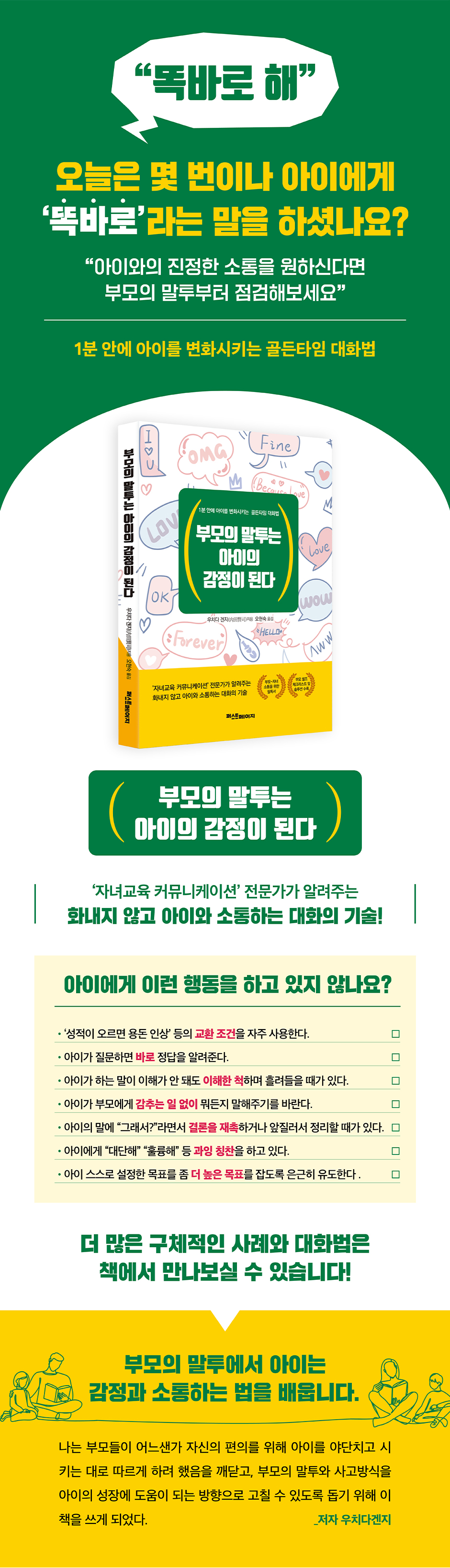
“Children learn to communicate their emotions through their parents’ speech.”
“If parents change their tone of speech, their child’s future will change!”
Warm words from parents that reflect their hearts enrich children's emotions, improve the relationship between parents and children, and ultimately make children listen to their parents.
When speech is repeated in life, it becomes a habit.
Also, the power to change a child without nagging or hurting their feelings lies in the way parents speak.
By communicating properly with your child, you can foster harmony in your family and foster the child's future growth.
Raising a child is not an easy task.
Any parent who has raised children will agree.
No parent wants to get angry, yell, or order around their beloved child.
However, the reality is that parents are too busy and their children act out of their own accord, unlike their parents' circumstances. When their children do not listen no matter how many times they are told to, the parents become impatient and end up scolding their children.
As a result, the relationship between parents and children often becomes more distant, and parents' worries grow.
I realized that parents have been scolding their children and trying to make them obey orders for their own convenience, so I wrote this book to help parents change their speech and thinking in a way that helps their children grow.
As you go through the process of improving, I hope you will reflect on your communication style and check whether the words you usually say to your child are either extremely short or, conversely, too long.
In such cases, the time that becomes a standard is ‘1 minute’.
One minute is an important golden time that busy parents can spare and that children can understand.
This book is filled with conversational tips that will help you convey your thoughts to your parents in less than a minute.
“If parents change their tone of speech, their child’s future will change!”
Warm words from parents that reflect their hearts enrich children's emotions, improve the relationship between parents and children, and ultimately make children listen to their parents.
When speech is repeated in life, it becomes a habit.
Also, the power to change a child without nagging or hurting their feelings lies in the way parents speak.
By communicating properly with your child, you can foster harmony in your family and foster the child's future growth.
Raising a child is not an easy task.
Any parent who has raised children will agree.
No parent wants to get angry, yell, or order around their beloved child.
However, the reality is that parents are too busy and their children act out of their own accord, unlike their parents' circumstances. When their children do not listen no matter how many times they are told to, the parents become impatient and end up scolding their children.
As a result, the relationship between parents and children often becomes more distant, and parents' worries grow.
I realized that parents have been scolding their children and trying to make them obey orders for their own convenience, so I wrote this book to help parents change their speech and thinking in a way that helps their children grow.
As you go through the process of improving, I hope you will reflect on your communication style and check whether the words you usually say to your child are either extremely short or, conversely, too long.
In such cases, the time that becomes a standard is ‘1 minute’.
One minute is an important golden time that busy parents can spare and that children can understand.
This book is filled with conversational tips that will help you convey your thoughts to your parents in less than a minute.
- You can preview some of the book's contents.
Preview
index
Chapter 1
The reason why it is not conveyed well to the child is because of incorrect expressions _16
4 Things You Shouldn't Say to Your Child
1.
Words that force parents' opinions _20
The imperative tone of “~hae”
2.
Words that diminish the value of praise _31
Excessive praise such as “great” or “excellent”
3.
Words that create false motivation _43
Presenting a condition: “If you do ~, I will do ~”
4.
Words that close a child's heart _48
A cut-off word that says, "That's enough"
Chapter 2
What I want to say in 1 minute! _59
3 Easy-to-Understand Communication Methods for Children
1.
Using 'Image' Appropriately _62
2.
When giving instructions, convey them clearly _77
3.
Step-by-step explanation using the 'step-by-step method' _83
Chapter 3
Parents' words that open a child's heart _90
The power to communicate comes from the power to listen.
1.
Become the best listener to your child _92
2.
Children form their values through their parents _98
3.
If not now, then later _103
4.
The Power of Listening: Bringing Out Your Child's Inner Feelings _110
Chapter 4
How to Talk to Your Child to Help Them Grow _119
When you teach correctly, your child grows!
1.
3 Steps to Encouragement to Boost Motivation _120
2.
Excessive encouragement can backfire _132
3.
Encouragement also requires preparation _137
4.
Mistakes and Failures Are Opportunities for Growth _142
5.
Talking to a child at eye level _149
6.
Always remember that the child is the main character of the conversation _155
7.
Give an answer that opens up possibilities _161
Chapter 5
Conversational Methods to Correct Your Child's Bad Habits _167
Parents' words that guide their children properly
1.
A kid who only plays games _168
2.
The Lying Child _174
3.
The Promise-Breaking Child _180
4.
Easily discouraged child _185
5.
A child who is violent towards his brother _189
6.
A child who makes excuses or blames others _194
7.
A child who speaks too little _200
In conclusion _206
The reason why it is not conveyed well to the child is because of incorrect expressions _16
4 Things You Shouldn't Say to Your Child
1.
Words that force parents' opinions _20
The imperative tone of “~hae”
2.
Words that diminish the value of praise _31
Excessive praise such as “great” or “excellent”
3.
Words that create false motivation _43
Presenting a condition: “If you do ~, I will do ~”
4.
Words that close a child's heart _48
A cut-off word that says, "That's enough"
Chapter 2
What I want to say in 1 minute! _59
3 Easy-to-Understand Communication Methods for Children
1.
Using 'Image' Appropriately _62
2.
When giving instructions, convey them clearly _77
3.
Step-by-step explanation using the 'step-by-step method' _83
Chapter 3
Parents' words that open a child's heart _90
The power to communicate comes from the power to listen.
1.
Become the best listener to your child _92
2.
Children form their values through their parents _98
3.
If not now, then later _103
4.
The Power of Listening: Bringing Out Your Child's Inner Feelings _110
Chapter 4
How to Talk to Your Child to Help Them Grow _119
When you teach correctly, your child grows!
1.
3 Steps to Encouragement to Boost Motivation _120
2.
Excessive encouragement can backfire _132
3.
Encouragement also requires preparation _137
4.
Mistakes and Failures Are Opportunities for Growth _142
5.
Talking to a child at eye level _149
6.
Always remember that the child is the main character of the conversation _155
7.
Give an answer that opens up possibilities _161
Chapter 5
Conversational Methods to Correct Your Child's Bad Habits _167
Parents' words that guide their children properly
1.
A kid who only plays games _168
2.
The Lying Child _174
3.
The Promise-Breaking Child _180
4.
Easily discouraged child _185
5.
A child who is violent towards his brother _189
6.
A child who makes excuses or blames others _194
7.
A child who speaks too little _200
In conclusion _206
Detailed image
Into the book
The suggestion type has the effect of leaving decision-making up to the child.
Children learn to think, judge, and make decisions for themselves.
If this becomes a habit, the child will act spontaneously without the parents having to say anything.
This is because this is also called ‘self-selection motivation’, and everyone, regardless of whether they are an adult or a child, has a tendency to stick to what they have decided for themselves.
--- p.27
'Praise' is not just a one-sided act of parents praising their children's growth, but rather a valuable method of communication that encourages and motivates children.
Therefore, let's think of 'when you fail to achieve something = when you are in the process of achieving something' and praise the process and effort not only when you succeed but also when you fail to achieve something.
--- p.35
I witnessed something similar a few days ago.
This happened in a local park that was bustling with children holding their parents' hands every weekend.
A father was diligently teaching soccer to a boy of about six years old.
The boy was not very good at kicking the ball, as he had only recently started playing soccer.
The father would come behind the child and teach him soccer diligently, telling him to move his feet like this and to watch the ball carefully before kicking it, but since skills cannot be improved in a short period of time, the ball would often roll in a completely different direction.
Still, the child would smile and kick the ball seriously as if he was having fun playing, and he would pick up the ball that went out of the way and throw it to his father with his hand.
But the father, perhaps angry that the child kept making mistakes, kicked the ball at the child and said in a slightly harsh tone, “You’re playing soccer right now.
“Don’t use your hands,” he instructed.
Then the child asked, “Why can’t you use your hands in soccer?”
At those words, Dad stopped saying, “Be quiet.
“Okay, do it quickly,” he blurted out.
--- p.50
It is said that even adults can only focus on listening to what someone else is saying for about 10 minutes, but children can focus for much shorter periods of time.
Children are a bundle of curiosity, and with objects of interest scattered everywhere, they have a hard time focusing on one thing.
Therefore, if you want to convey something clearly to your child, you must convey only the essence of what you want to say within a time frame in which the child can concentrate and listen.
The optimal time for a conversation with a child is one minute.
In terms of character count, it is around 350 characters.
Children learn to think, judge, and make decisions for themselves.
If this becomes a habit, the child will act spontaneously without the parents having to say anything.
This is because this is also called ‘self-selection motivation’, and everyone, regardless of whether they are an adult or a child, has a tendency to stick to what they have decided for themselves.
--- p.27
'Praise' is not just a one-sided act of parents praising their children's growth, but rather a valuable method of communication that encourages and motivates children.
Therefore, let's think of 'when you fail to achieve something = when you are in the process of achieving something' and praise the process and effort not only when you succeed but also when you fail to achieve something.
--- p.35
I witnessed something similar a few days ago.
This happened in a local park that was bustling with children holding their parents' hands every weekend.
A father was diligently teaching soccer to a boy of about six years old.
The boy was not very good at kicking the ball, as he had only recently started playing soccer.
The father would come behind the child and teach him soccer diligently, telling him to move his feet like this and to watch the ball carefully before kicking it, but since skills cannot be improved in a short period of time, the ball would often roll in a completely different direction.
Still, the child would smile and kick the ball seriously as if he was having fun playing, and he would pick up the ball that went out of the way and throw it to his father with his hand.
But the father, perhaps angry that the child kept making mistakes, kicked the ball at the child and said in a slightly harsh tone, “You’re playing soccer right now.
“Don’t use your hands,” he instructed.
Then the child asked, “Why can’t you use your hands in soccer?”
At those words, Dad stopped saying, “Be quiet.
“Okay, do it quickly,” he blurted out.
--- p.50
It is said that even adults can only focus on listening to what someone else is saying for about 10 minutes, but children can focus for much shorter periods of time.
Children are a bundle of curiosity, and with objects of interest scattered everywhere, they have a hard time focusing on one thing.
Therefore, if you want to convey something clearly to your child, you must convey only the essence of what you want to say within a time frame in which the child can concentrate and listen.
The optimal time for a conversation with a child is one minute.
In terms of character count, it is around 350 characters.
--- p.61
Publisher's Review
“If you want to have a real communication with your child,
“Check your parents’ tone of voice first.”
Kenji Uchida, who has been researching and lecturing on communication for a long time as the director of the Institute for Communication Studies, also experienced many trials and errors and times of reflection as a parent while raising two sons.
He experienced firsthand that the way adults talk is not suitable for children.
So, he studied the right way to communicate with children so that he could build a smooth relationship with them through smooth communication and further help the children grow.
With the help of parents around me and many others, I discovered methods of deep communication and have used them to resolve problems between parents and children who have visited the institute through dialogue.
And for all the parents who are struggling with their children's education today, all the secrets are included in this book.
The book uses examples from everyday life and ordinary households to vividly illustrate common verbal mistakes and incorrect speech patterns that parents often make when dealing with their children, making it easier to empathize.
It specifically explains what parts of a parent's speech are incorrect in everyday conversation, how a change in the parent's speech may affect the child's response, and how parents can help their child grow up healthy by using the right speech.
“Check your parents’ tone of voice first.”
Kenji Uchida, who has been researching and lecturing on communication for a long time as the director of the Institute for Communication Studies, also experienced many trials and errors and times of reflection as a parent while raising two sons.
He experienced firsthand that the way adults talk is not suitable for children.
So, he studied the right way to communicate with children so that he could build a smooth relationship with them through smooth communication and further help the children grow.
With the help of parents around me and many others, I discovered methods of deep communication and have used them to resolve problems between parents and children who have visited the institute through dialogue.
And for all the parents who are struggling with their children's education today, all the secrets are included in this book.
The book uses examples from everyday life and ordinary households to vividly illustrate common verbal mistakes and incorrect speech patterns that parents often make when dealing with their children, making it easier to empathize.
It specifically explains what parts of a parent's speech are incorrect in everyday conversation, how a change in the parent's speech may affect the child's response, and how parents can help their child grow up healthy by using the right speech.
GOODS SPECIFICS
- Date of issue: August 11, 2025
- Page count, weight, size: 210 pages | 270g | 135*200*14mm
- ISBN13: 9791199340008
- ISBN10: 1199340006
You may also like
카테고리
korean


korean

![ELLE 엘르 스페셜 에디션 A형 : 12월 [2025]](http://librairie.coreenne.fr/cdn/shop/files/b8e27a3de6c9538896439686c6b0e8fb.jpg?v=1766436872&width=3840)


