

War of the AI Titans
 |
Description
Book Introduction
★ Pulitzer Prize-winning Silicon Valley reporter for the New York Times
★ Meet tech giants and ask them, "How to become a winner in the AI market?"
★ Highly recommended by Song Gil-young (author of "Sidae Forecast"), Park Sang-gil (author of "Chat GPT Even Non-Majors Can Understand"), and the editor-in-chief of [Wired]!
★ It's like reading a thriller! A vivid strategic battle between tech companies as they steal, copy, and rip off each other!
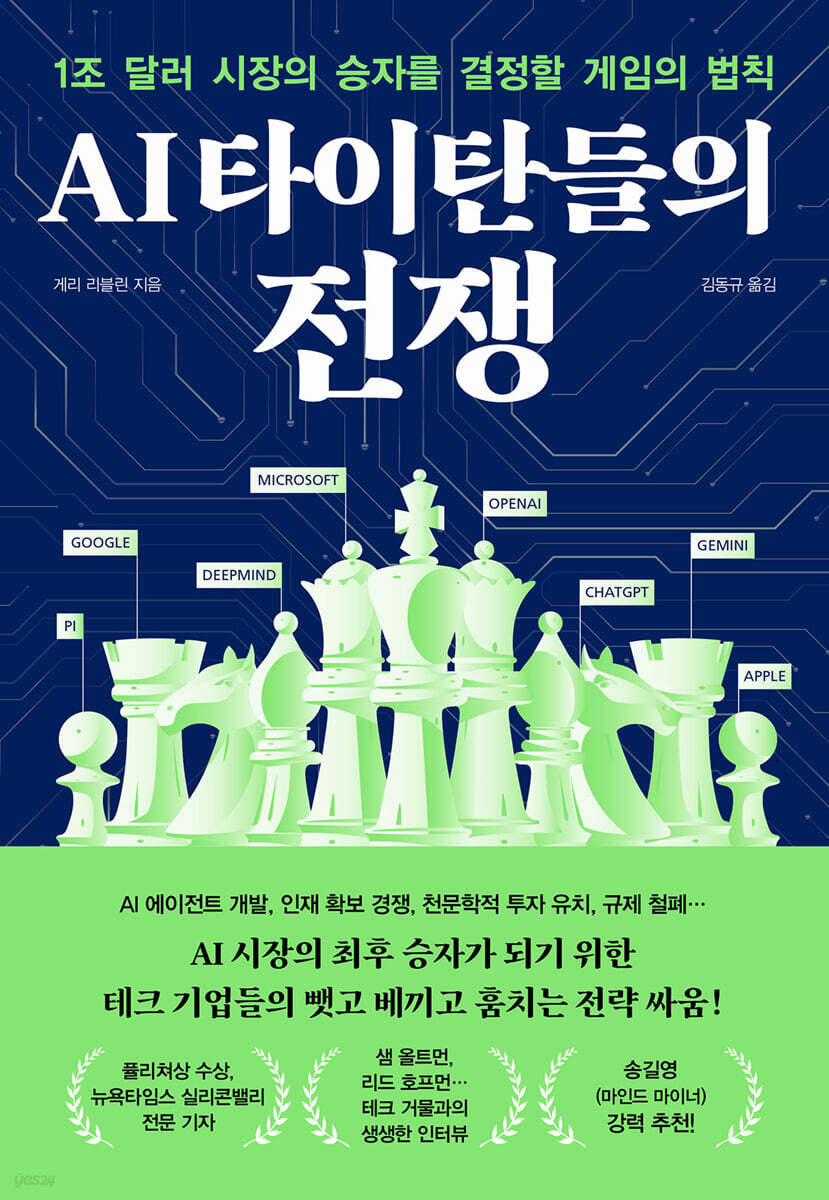
A thriller-like book, "Battle of the AI Titans," has been published, detailing the power struggles at the forefront of the AI industry.
Gary Rivlin, a Pulitzer Prize winner and renowned New York Times Silicon Valley correspondent, delves into the dynamics of the AI industry through dozens of in-depth interviews over two years with CEOs of OpenAI, Google, Microsoft, Meta, and other Silicon Valley heavyweights.
The book declares that the AI market is no longer an era of 'easy money' like it used to be.
As the computing capital required to develop large-scale models reaches astronomical levels, technological prowess is no longer absolute.
Among venture capitalists, the question is growing: “Can AI companies actually generate profits?”
OpenAI, the company behind ChatGPT, is estimated to have lost about $5 billion annually despite generating $3.7 billion in revenue by 2024.
The book vividly depicts the changing power landscape in Silicon Valley, from the firing of Sam Altman at OpenAI, Mustafa Suleiman's arrival at Microsoft, the counterattacks of Meta, Google, and Apple, and the bursting of the AI startup bubble, and predicts the future of large corporations and startups.
★ Meet tech giants and ask them, "How to become a winner in the AI market?"
★ Highly recommended by Song Gil-young (author of "Sidae Forecast"), Park Sang-gil (author of "Chat GPT Even Non-Majors Can Understand"), and the editor-in-chief of [Wired]!
★ It's like reading a thriller! A vivid strategic battle between tech companies as they steal, copy, and rip off each other!
A thriller-like book, "Battle of the AI Titans," has been published, detailing the power struggles at the forefront of the AI industry.
Gary Rivlin, a Pulitzer Prize winner and renowned New York Times Silicon Valley correspondent, delves into the dynamics of the AI industry through dozens of in-depth interviews over two years with CEOs of OpenAI, Google, Microsoft, Meta, and other Silicon Valley heavyweights.
The book declares that the AI market is no longer an era of 'easy money' like it used to be.
As the computing capital required to develop large-scale models reaches astronomical levels, technological prowess is no longer absolute.
Among venture capitalists, the question is growing: “Can AI companies actually generate profits?”
OpenAI, the company behind ChatGPT, is estimated to have lost about $5 billion annually despite generating $3.7 billion in revenue by 2024.
The book vividly depicts the changing power landscape in Silicon Valley, from the firing of Sam Altman at OpenAI, Mustafa Suleiman's arrival at Microsoft, the counterattacks of Meta, Google, and Apple, and the bursting of the AI startup bubble, and predicts the future of large corporations and startups.
- You can preview some of the book's contents.
Preview
index
Praise from those who read this book first
Introduction | Reid Hoffman and Elon Musk Open Their Eyes to AI
Introduction | AI is destroying Silicon Valley.
“In reality, the period during which you can make money is 18 months, at most 24 months.”
Chapter 1 | The First Battle That Will Determine AI's Fate
“Why would a smart young man like you waste his time on something like this?”
Chapter 2 | Reid Hoffman: Moving with Opportunity
“The era of easy money was coming to an end.”
Chapter 3 | Microsoft: A Tyrant Enters the Market
“What if Microsoft enters that market?”
Chapter 4 | DeepMind: The Never-ending Fundraising Battle
“To solve AI problems, we need to grow our company to the size of Google, but we don’t have time for that.”
Chapter 5 | OpenAI: A Gathering of Smart Talents
“Elon Musk is gone.
“I have cut off support.”
Chapter 6 | Satya Nadella Refreshes Microsoft
“Microsoft stock has started to rise for the first time since the spring of 2000.”
Chapter 7 | Google and DeepMind: Between Innovation and Reality
“Suddenly everything was put on hold.”
Chapter 8 | Reid Hoffman: With Great Power Comes Great Responsibility
“Starting a startup is like jumping off a cliff and having to build an airplane while you’re falling.”
Chapter 9 | Suleiman: The Era of AI and Humans Conversing Like Friends
“Within the next five years, this will go beyond the realm of possibility and become an inevitable reality.”
Chapter 10 | ChatGPT: The Beginning of AI Popularization
“If you’re not number one, no matter how much you talk about justice, it’s useless.”
Chapter 11 | The AI Meteor Falls on a Stagnant Silicon Valley
“There is no invincible company.
Any company can collapse in an instant.”
Chapter 12 | Microsoft vs. Google: Big Tech AI Battle
“The real competition has begun.”
Chapter 13 | The Rush of AI: On the Boundary Between Anticipation and Crisis
"The atmosphere is crazy right now. VCs are all rushing in."
Chapter 14 | AI Won't Replace Humans
“No matter how fierce the competition, we have the power to control the direction and speed of AI’s progress.”
Chapter 15 | Inflection AI: Creating Friendly AI
“Our goal is to enable users to interact with AI in a much more natural and comfortable way.”
Chapter 16 | When Will the Spring of the AI Industry End?
“Just look at these ridiculous companies getting so much investment.”
Chapter 17 | Countless Companies Dream of AI as Friends
“I thought it had to be clearly differentiated from other products.”
Chapter 18 | The Uncontrollable Future: Where Will AI Go?
“The more the government interferes in every little thing, the more the United States will fall behind in the global market.”
Chapter 19 | The End of Startups, Into the Embrace of Giants
“This is an unprecedented event in corporate history.”
The story continues | Microsoft, Google, Meta, Apple, OpenAI, and startups
Acknowledgements
Source of the article
Introduction | Reid Hoffman and Elon Musk Open Their Eyes to AI
Introduction | AI is destroying Silicon Valley.
“In reality, the period during which you can make money is 18 months, at most 24 months.”
Chapter 1 | The First Battle That Will Determine AI's Fate
“Why would a smart young man like you waste his time on something like this?”
Chapter 2 | Reid Hoffman: Moving with Opportunity
“The era of easy money was coming to an end.”
Chapter 3 | Microsoft: A Tyrant Enters the Market
“What if Microsoft enters that market?”
Chapter 4 | DeepMind: The Never-ending Fundraising Battle
“To solve AI problems, we need to grow our company to the size of Google, but we don’t have time for that.”
Chapter 5 | OpenAI: A Gathering of Smart Talents
“Elon Musk is gone.
“I have cut off support.”
Chapter 6 | Satya Nadella Refreshes Microsoft
“Microsoft stock has started to rise for the first time since the spring of 2000.”
Chapter 7 | Google and DeepMind: Between Innovation and Reality
“Suddenly everything was put on hold.”
Chapter 8 | Reid Hoffman: With Great Power Comes Great Responsibility
“Starting a startup is like jumping off a cliff and having to build an airplane while you’re falling.”
Chapter 9 | Suleiman: The Era of AI and Humans Conversing Like Friends
“Within the next five years, this will go beyond the realm of possibility and become an inevitable reality.”
Chapter 10 | ChatGPT: The Beginning of AI Popularization
“If you’re not number one, no matter how much you talk about justice, it’s useless.”
Chapter 11 | The AI Meteor Falls on a Stagnant Silicon Valley
“There is no invincible company.
Any company can collapse in an instant.”
Chapter 12 | Microsoft vs. Google: Big Tech AI Battle
“The real competition has begun.”
Chapter 13 | The Rush of AI: On the Boundary Between Anticipation and Crisis
"The atmosphere is crazy right now. VCs are all rushing in."
Chapter 14 | AI Won't Replace Humans
“No matter how fierce the competition, we have the power to control the direction and speed of AI’s progress.”
Chapter 15 | Inflection AI: Creating Friendly AI
“Our goal is to enable users to interact with AI in a much more natural and comfortable way.”
Chapter 16 | When Will the Spring of the AI Industry End?
“Just look at these ridiculous companies getting so much investment.”
Chapter 17 | Countless Companies Dream of AI as Friends
“I thought it had to be clearly differentiated from other products.”
Chapter 18 | The Uncontrollable Future: Where Will AI Go?
“The more the government interferes in every little thing, the more the United States will fall behind in the global market.”
Chapter 19 | The End of Startups, Into the Embrace of Giants
“This is an unprecedented event in corporate history.”
The story continues | Microsoft, Google, Meta, Apple, OpenAI, and startups
Acknowledgements
Source of the article
Detailed image

Into the book
Having written about the situation in and around Silicon Valley since the mid-1990s, I couldn't ignore another existential question: what does AI mean for Silicon Valley itself?
The essence of Silicon Valley has always been startups.
Google and Facebook started out in garages and friends' living rooms and grew into technology giants.
However, AI, especially generative AI, requires a lot of initial capital as the rewards for success are enormous.
This raises questions about whether startups can truly be competitive.
--- p.22
Hassabis, on the other hand, was exhausted.
By his calculations, he had spent only about 10 percent of his time on actual research over the past three years.
“We realized that if we really wanted to solve AI problems, we needed to grow the company to the size of Google, and we didn’t have time for that,” Hassabis said.
The three co-founders were also fed up with constantly losing talent to big, well-funded companies.
--- p.118
Of the conversations the two had during their first meeting, the one that stuck with Suleiman the most was the one about culture.
Hoffman argued that science fiction elements in books and films both shape and limit people's views of artificial intelligence.
Almost all science fiction books depict a dark and apocalyptic future, which instills fear in people.
--- p.131
Ballmer was so obsessed with expanding Windows' presence that he stifled innovation within the company.
I covered the story of longtime Microsoft employees who left the company after Ballmer's interference delayed or halted projects they had worked hard on.
One of them was a man who had been developing MP3 players since before the Apple iPod came along.
There was also someone who worked on the tablet development team before the iPad was released.
But that too was buried very slowly and painfully as Balmer clung to Windows.
--- p.152
There is a famous saying by Hoffman: “If a startup releases a product that its creators like, it has already missed its launch window.”
ChatGPT was a good example.
Altman tweeted a few months after ChatGPT launched:
“The reason I released it early, even though I knew it had some shortcomings, was because I thought it was important to input sufficient data and refine it through trial and error.”
--- p.255~256
Microsoft has sometimes acted like a giant afraid of its own shadow.
While the developers of InflectionAI believed that a "personal AI" needed a distinct personality, Microsoft's Copilot seemed to aim for the most bland personality possible.
--- p.368
Facebook was also an early adopter of AI, but took the wrong direction when Mark Zuckerberg pushed the metaverse.
He changed the company's name to 'Meta' in 2021 and invested billions of dollars in 3D virtual reality, putting his life on the line.
But by 2023, even Zuckerberg had a moment.
Meta didn't choose to be the fifth, tenth, or twentieth company to launch an LLM. Instead of operating LLM as a closed, proprietary structure like GPT--- p.4, Bard, Copilot, or Pi, it decided to open-source its large-scale language model, LLaMA.
The essence of Silicon Valley has always been startups.
Google and Facebook started out in garages and friends' living rooms and grew into technology giants.
However, AI, especially generative AI, requires a lot of initial capital as the rewards for success are enormous.
This raises questions about whether startups can truly be competitive.
--- p.22
Hassabis, on the other hand, was exhausted.
By his calculations, he had spent only about 10 percent of his time on actual research over the past three years.
“We realized that if we really wanted to solve AI problems, we needed to grow the company to the size of Google, and we didn’t have time for that,” Hassabis said.
The three co-founders were also fed up with constantly losing talent to big, well-funded companies.
--- p.118
Of the conversations the two had during their first meeting, the one that stuck with Suleiman the most was the one about culture.
Hoffman argued that science fiction elements in books and films both shape and limit people's views of artificial intelligence.
Almost all science fiction books depict a dark and apocalyptic future, which instills fear in people.
--- p.131
Ballmer was so obsessed with expanding Windows' presence that he stifled innovation within the company.
I covered the story of longtime Microsoft employees who left the company after Ballmer's interference delayed or halted projects they had worked hard on.
One of them was a man who had been developing MP3 players since before the Apple iPod came along.
There was also someone who worked on the tablet development team before the iPad was released.
But that too was buried very slowly and painfully as Balmer clung to Windows.
--- p.152
There is a famous saying by Hoffman: “If a startup releases a product that its creators like, it has already missed its launch window.”
ChatGPT was a good example.
Altman tweeted a few months after ChatGPT launched:
“The reason I released it early, even though I knew it had some shortcomings, was because I thought it was important to input sufficient data and refine it through trial and error.”
--- p.255~256
Microsoft has sometimes acted like a giant afraid of its own shadow.
While the developers of InflectionAI believed that a "personal AI" needed a distinct personality, Microsoft's Copilot seemed to aim for the most bland personality possible.
--- p.368
Facebook was also an early adopter of AI, but took the wrong direction when Mark Zuckerberg pushed the metaverse.
He changed the company's name to 'Meta' in 2021 and invested billions of dollars in 3D virtual reality, putting his life on the line.
But by 2023, even Zuckerberg had a moment.
Meta didn't choose to be the fifth, tenth, or twentieth company to launch an LLM. Instead of operating LLM as a closed, proprietary structure like GPT--- p.4, Bard, Copilot, or Pi, it decided to open-source its large-scale language model, LLaMA.
--- p.370
Publisher's Review
Deciding the winner of the $1 trillion market
What are the rules of the game?
《Battle of the AI Titans》 is packed with insights needed to understand today's AI landscape.
Why didn't Google and Microsoft, despite their technological prowess, launch products like ChatGPT first? The two tech giants, absolute leaders in search and cloud computing, possessed substantial technological capabilities, but they lagged behind OpenAI in launching AI services aimed at the general public.
The book finds the reason in organizational culture and fear of risk.
Why did Inflexion AI, founded by a star CEO, fail to overcome the barriers of reality? Inflexion AI, ambitiously founded by DeepMind co-founder Mustafa Suleiman, failed to secure market share amid fierce competition for speed and massive infrastructure costs.
In the end, it ended with the 'Ark Hire' method, where most of the founders and talent moved to Microsoft.
The book diagnoses that Silicon Valley's startup success formula no longer works through the case of Inflex AI.
What will the relationship between OpenAI and Microsoft look like going forward? What began as an initial strategic partnership has now evolved into a close capital and technology alliance.
However, differences in interests depending on the profit distribution structure, management rights issues, and the timing of the development of artificial general intelligence (AGI) may become variables in the future.
Author Gary Rivlin is a Pulitzer Prize-winning investigative journalist and Silicon Valley correspondent for The New York Times. He has spent two years covering Silicon Valley, closely following the people who are shaking up the AI industry.
We analyze this fast-paced industry from the perspectives of monetization vs. research focus, startup speed vs. corporate capital, and open source vs. closed.
It also reveals the true nature of Silicon Valley's key figures, if expressed frankly and openly.
Thanks to this, it can be read with excitement, as if it were a thriller.
Reid Hoffman, Sam Altman, Mustafa Suleiman…
Conversations with Key Figures in the AI Industry
What is the difference between those who survive and those who disappear?
In the ever-changing AI ecosystem, who will survive and emerge victorious?
This book features all the tech giants we know, including Elon Musk, Sam Altman, Satya Nadella, and Sundar Piazzi.
Among them, two people are particularly noteworthy.
Reid Hoffman, a legendary investor in Silicon Valley, and Mustafa Suleiman, founder of Inflexion AI.
Reid Hoffman is the investor Silicon Valley CEOs most want to meet.
As a co-founder of LinkedIn and PayPal and a founding member of Inflexion AI and OpenAI, he has a significant influence on the AI industry as a whole.
By following the rise and fall of the companies he invested in, we can see how the AI industry and the wheels of capital are intertwined.
Mustafa Suleiman is one of the most notable star CEOs in the AI industry.
As a co-founder of Google DeepMind, he led the artificial intelligence market.
In 2022, he gathered the best talents to form a dream team, attracted billions of won in investment, and founded Inflexion AI.
He introduced the chatbot 'Pi' with the goal of creating 'AI that converses like a human', but it failed to capture even 2% of the market share.
Eventually, in 2024, Suleiman left Inflexion AI and joined Microsoft.
Currently, Suleiman leads Microsoft's overall AI strategy, including Bing and Copilot.
His transformation from startup founder to big tech executive vividly illustrates the "wall of reality" AI startups face.
The book concludes with the sobering outlook that “most AI startups in Silicon Valley today are unlikely to survive and become wealthy.”
Amidst the clash between technology and capital, leadership and organization, dreams and reality, this book provides a firsthand account of the changes currently taking place in the AI industry.
Is AI a bubble or a transitional period?
The AI Industry from a "Capital War" Perspective
《Battle of the AI Titans》 directly compares the dot-com bubble era with today's AI industry.
Just as the internet boom of 1995 did, the emergence of ChatGPT in November 2022 shook Silicon Valley and the world. While optimism abounded that AI would fundamentally transform the world, the rush of investment without verifying profitability sparked a backlash, labeling it a "bubble."
Just as investors wagered millions of dollars during the dot-com bubble before even seeing a business plan, today's AI investment frenzy is unfolding at an extreme pace and scale.
The book illustrates these similarities, vividly capturing the common patterns of "innovation and speculation, expectation and anxiety" in two periods: the late 1990s and the early 2020s.
"Battle of the AI Titans" isn't simply a book documenting technological development. Through the vivid voices of key figures driving the AI industry, it reveals the shift from a technology-centric to a capital-centric world.
Ultimately, the diagnosis is that the winner will be determined by who has the capital and market dominance to endure to the end.
Through this book, readers will begin to clearly see the forces that will shape the present and future of the AI industry.
What are the rules of the game?
《Battle of the AI Titans》 is packed with insights needed to understand today's AI landscape.
Why didn't Google and Microsoft, despite their technological prowess, launch products like ChatGPT first? The two tech giants, absolute leaders in search and cloud computing, possessed substantial technological capabilities, but they lagged behind OpenAI in launching AI services aimed at the general public.
The book finds the reason in organizational culture and fear of risk.
Why did Inflexion AI, founded by a star CEO, fail to overcome the barriers of reality? Inflexion AI, ambitiously founded by DeepMind co-founder Mustafa Suleiman, failed to secure market share amid fierce competition for speed and massive infrastructure costs.
In the end, it ended with the 'Ark Hire' method, where most of the founders and talent moved to Microsoft.
The book diagnoses that Silicon Valley's startup success formula no longer works through the case of Inflex AI.
What will the relationship between OpenAI and Microsoft look like going forward? What began as an initial strategic partnership has now evolved into a close capital and technology alliance.
However, differences in interests depending on the profit distribution structure, management rights issues, and the timing of the development of artificial general intelligence (AGI) may become variables in the future.
Author Gary Rivlin is a Pulitzer Prize-winning investigative journalist and Silicon Valley correspondent for The New York Times. He has spent two years covering Silicon Valley, closely following the people who are shaking up the AI industry.
We analyze this fast-paced industry from the perspectives of monetization vs. research focus, startup speed vs. corporate capital, and open source vs. closed.
It also reveals the true nature of Silicon Valley's key figures, if expressed frankly and openly.
Thanks to this, it can be read with excitement, as if it were a thriller.
Reid Hoffman, Sam Altman, Mustafa Suleiman…
Conversations with Key Figures in the AI Industry
What is the difference between those who survive and those who disappear?
In the ever-changing AI ecosystem, who will survive and emerge victorious?
This book features all the tech giants we know, including Elon Musk, Sam Altman, Satya Nadella, and Sundar Piazzi.
Among them, two people are particularly noteworthy.
Reid Hoffman, a legendary investor in Silicon Valley, and Mustafa Suleiman, founder of Inflexion AI.
Reid Hoffman is the investor Silicon Valley CEOs most want to meet.
As a co-founder of LinkedIn and PayPal and a founding member of Inflexion AI and OpenAI, he has a significant influence on the AI industry as a whole.
By following the rise and fall of the companies he invested in, we can see how the AI industry and the wheels of capital are intertwined.
Mustafa Suleiman is one of the most notable star CEOs in the AI industry.
As a co-founder of Google DeepMind, he led the artificial intelligence market.
In 2022, he gathered the best talents to form a dream team, attracted billions of won in investment, and founded Inflexion AI.
He introduced the chatbot 'Pi' with the goal of creating 'AI that converses like a human', but it failed to capture even 2% of the market share.
Eventually, in 2024, Suleiman left Inflexion AI and joined Microsoft.
Currently, Suleiman leads Microsoft's overall AI strategy, including Bing and Copilot.
His transformation from startup founder to big tech executive vividly illustrates the "wall of reality" AI startups face.
The book concludes with the sobering outlook that “most AI startups in Silicon Valley today are unlikely to survive and become wealthy.”
Amidst the clash between technology and capital, leadership and organization, dreams and reality, this book provides a firsthand account of the changes currently taking place in the AI industry.
Is AI a bubble or a transitional period?
The AI Industry from a "Capital War" Perspective
《Battle of the AI Titans》 directly compares the dot-com bubble era with today's AI industry.
Just as the internet boom of 1995 did, the emergence of ChatGPT in November 2022 shook Silicon Valley and the world. While optimism abounded that AI would fundamentally transform the world, the rush of investment without verifying profitability sparked a backlash, labeling it a "bubble."
Just as investors wagered millions of dollars during the dot-com bubble before even seeing a business plan, today's AI investment frenzy is unfolding at an extreme pace and scale.
The book illustrates these similarities, vividly capturing the common patterns of "innovation and speculation, expectation and anxiety" in two periods: the late 1990s and the early 2020s.
"Battle of the AI Titans" isn't simply a book documenting technological development. Through the vivid voices of key figures driving the AI industry, it reveals the shift from a technology-centric to a capital-centric world.
Ultimately, the diagnosis is that the winner will be determined by who has the capital and market dominance to endure to the end.
Through this book, readers will begin to clearly see the forces that will shape the present and future of the AI industry.
GOODS SPECIFICS
- Date of issue: August 25, 2025
- Page count, weight, size: 492 pages | 720g | 152*220*31mm
- ISBN13: 9788925573304
- ISBN10: 892557330X
You may also like
카테고리
korean


korean

![GQ KOREA Mark (Monthly): December [2025]](http://librairie.coreenne.fr/cdn/shop/files/8ef265dbbfbf186523ed75ba7319009d.jpg?v=1765340328&width=3840)


