

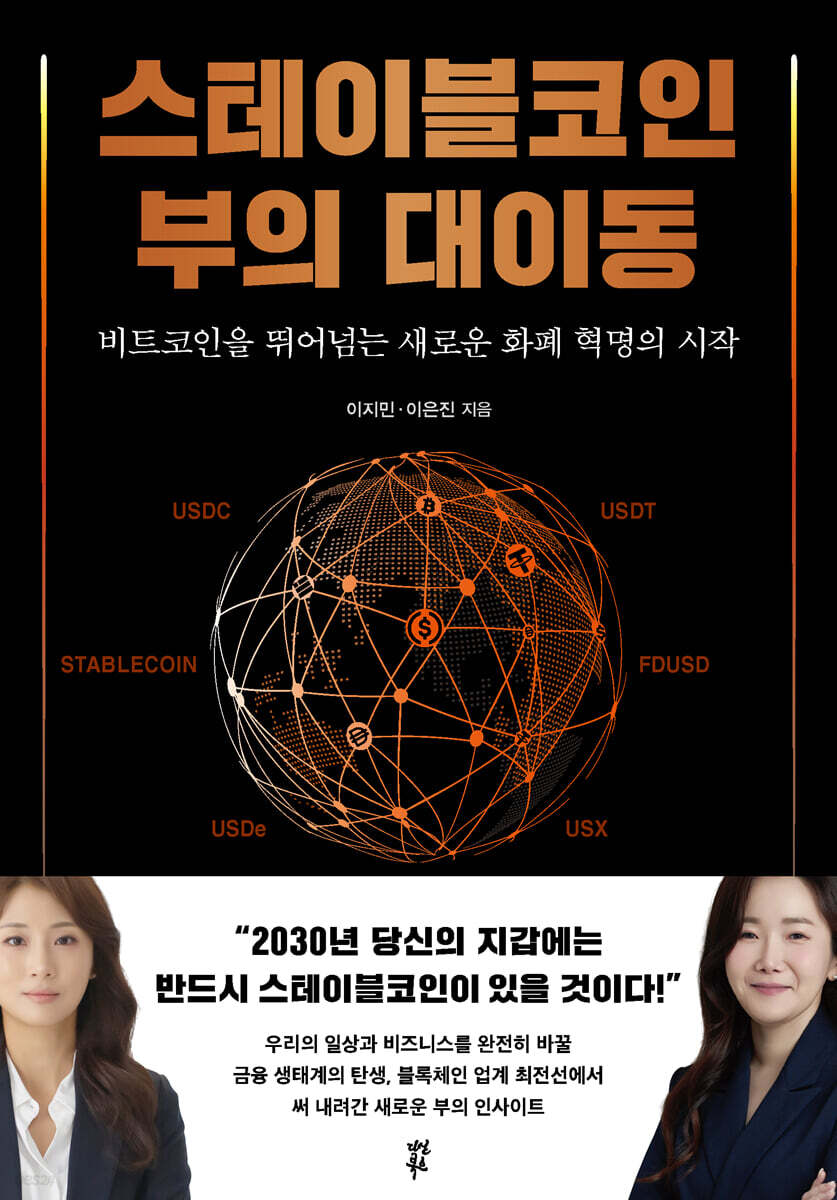
The Great Transfer of Stablecoin Wealth
 |
Description
Book Introduction
“In your wallet in 2030
“There will definitely be stablecoins!”
A single economic outlook that provides insight into the end of cash and the future of stablecoins.
“Stablecoins are a new frontier!”
- US President Donald Trump
“Stablecoins are ‘money.’
And ‘money’ creates opportunity.”
- Jerome Powell, Chairman of the U.S. Federal Reserve
“We need to build a stablecoin market based on the Korean Won.
“It can prevent the outflow of national wealth without alienation.”
- President Lee Jae-myung
As the debate surrounding stablecoins continues, they are emerging as more than just a technological advancement; they are also an innovation with significant implications for financial stability, monetary policy, and the international financial order.
The global stablecoin market is experiencing explosive growth, with ongoing experiments aimed at replacing existing financial systems.
The authors of this book are leading experts in stablecoins at the forefront of the blockchain industry, including the head of the Korean market for one of the world's top three cryptocurrency companies and the head of the Scroll Foundation's Korean branch, which is leading the popularization of stablecoins.
They highlight the limitations of traditional finance and vividly demonstrate the new economic order and business ecosystem created by stablecoins.
While many books on stablecoins have explored technical analysis and history from the perspectives of investors, journalists, and macroeconomic experts, none have captured the tectonic shifts in business within the stablecoin industry today, as well as the global capital flows and shifts, with such vivid realism.
This book clearly demonstrates the inevitable background for the emergence of stablecoins in the digital age and their future potential.
It also presents how individuals and businesses can seize opportunities for wealth amidst global trends, offering clear insights into stablecoins, an uncharted territory where innovation and risk coexist.
“There will definitely be stablecoins!”
A single economic outlook that provides insight into the end of cash and the future of stablecoins.
“Stablecoins are a new frontier!”
- US President Donald Trump
“Stablecoins are ‘money.’
And ‘money’ creates opportunity.”
- Jerome Powell, Chairman of the U.S. Federal Reserve
“We need to build a stablecoin market based on the Korean Won.
“It can prevent the outflow of national wealth without alienation.”
- President Lee Jae-myung
As the debate surrounding stablecoins continues, they are emerging as more than just a technological advancement; they are also an innovation with significant implications for financial stability, monetary policy, and the international financial order.
The global stablecoin market is experiencing explosive growth, with ongoing experiments aimed at replacing existing financial systems.
The authors of this book are leading experts in stablecoins at the forefront of the blockchain industry, including the head of the Korean market for one of the world's top three cryptocurrency companies and the head of the Scroll Foundation's Korean branch, which is leading the popularization of stablecoins.
They highlight the limitations of traditional finance and vividly demonstrate the new economic order and business ecosystem created by stablecoins.
While many books on stablecoins have explored technical analysis and history from the perspectives of investors, journalists, and macroeconomic experts, none have captured the tectonic shifts in business within the stablecoin industry today, as well as the global capital flows and shifts, with such vivid realism.
This book clearly demonstrates the inevitable background for the emergence of stablecoins in the digital age and their future potential.
It also presents how individuals and businesses can seize opportunities for wealth amidst global trends, offering clear insights into stablecoins, an uncharted territory where innovation and risk coexist.
- You can preview some of the book's contents.
Preview
index
Recommendation
prolog
Is the emergence of digital currency a coincidence or a necessity?
What is a trustworthy currency?
Part 1: The Birth and Evolution of Currency
Chapter 1: Money Built on Trust and Faith
From barley sacks to blockchain
Money is born from debt
The Collapse of the Dollar and America's Alternative
Part 2: The Era of Digital Currency Begins
Chapter 2: A New Solution for Finance: Stablecoins
The Birth of Stablecoins
A stablecoin that maintains the value of one dollar
Can Volatile Cryptocurrencies Be Used as Collateral?
Rather, it is a strategy that takes advantage of market volatility.
A new attempt at true decentralization
Increase safety and profitability by collateralizing real assets.
Chapter 3: The Technology That Powers Stablecoins
Why You Can Trust Stablecoins
A Bridge Between Stablecoins and Reality
How Stablecoins Cross-Chain
Part 3: Stablecoins: Restructuring Wealth
Chapter 4: The Birth of a New Financial Ecosystem
The era where money works for me
The Birth of DeFi: A Financial Revolution Without Intermediaries
Chapter 5: Generating Profits with Stablecoins
The easiest way to earn interest: staking
Earn deposit income with the lending protocol
Interest Cycle, Looping Strategy
The era of stablecoin interest payments
Can we avoid repeating the mistakes of the financial crisis?
Chapter 6: Pitfalls of Stablecoin Investment
If the stablecoin fails to maintain its value at $1,
There is no such thing as perfect code
Beware of regulatory traps
Check for 7 Investment Risk Signs
Part 4: How Stablecoins Have Transformed Daily Life and Business
Chapter 7: Financial Innovation Created by Stablecoins
Stablecoins are changing our daily lives.
Stablecoins are revolutionizing business-to-business transactions.
How to overcome the barriers of reality
Chapter 8: The Corporate Stablecoin War
Why Companies Are Jumping into Stablecoins
Korea's Stablecoin Battleground
Global Banks' Counterattack
PayPal, Apple, and Google are jumping in.
Part 5: The Global Challenge to Stablecoins
Chapter 9: Competition or Cooperation? CBDCs and Stablecoins
The emergence of central bank digital currencies
The Conflict Between Monetary Sovereignty and Privacy
Chapter 10: The Global Digital Currency Hegemony War
America's ambition to extend dollar hegemony
China's digital yuan aims to change the global financial order
The Future of Europe's Regulatory Priority
Conservative Japan's counter-strategy
Opportunities and Dilemmas of K-Stablecoins
Chapter 11: The World Is Already Moving
Inflation shields in Argentina and Brazil
Remittance Revolutions in the Philippines and Venezuela
Africa: A Testing Ground for Bankless Financial Innovation
Singapore and Hong Kong aim to become leading financial hubs
Part 6: The Future World Created by Stablecoins
Chapter 12: Tokenization Technology that Blurs Asset Boundaries
Real estate, stocks, bonds, and art become digital assets.
The Future of Digital Assets: Tokenization
Digital Asset Experiments Around the World
24-hour market
Chapter 13: Stablecoins, AI, and the Emergence of Human-Free Business
The dawn of an autonomous economy that operates without humans
The brain and body that power the autonomous economy
The Birth of a Borderless Digital Enterprise
What Should Humans Do in the AI Era?
Epilogue
How we make money in the digital society
Asking for trust again on the wave of change
main
prolog
Is the emergence of digital currency a coincidence or a necessity?
What is a trustworthy currency?
Part 1: The Birth and Evolution of Currency
Chapter 1: Money Built on Trust and Faith
From barley sacks to blockchain
Money is born from debt
The Collapse of the Dollar and America's Alternative
Part 2: The Era of Digital Currency Begins
Chapter 2: A New Solution for Finance: Stablecoins
The Birth of Stablecoins
A stablecoin that maintains the value of one dollar
Can Volatile Cryptocurrencies Be Used as Collateral?
Rather, it is a strategy that takes advantage of market volatility.
A new attempt at true decentralization
Increase safety and profitability by collateralizing real assets.
Chapter 3: The Technology That Powers Stablecoins
Why You Can Trust Stablecoins
A Bridge Between Stablecoins and Reality
How Stablecoins Cross-Chain
Part 3: Stablecoins: Restructuring Wealth
Chapter 4: The Birth of a New Financial Ecosystem
The era where money works for me
The Birth of DeFi: A Financial Revolution Without Intermediaries
Chapter 5: Generating Profits with Stablecoins
The easiest way to earn interest: staking
Earn deposit income with the lending protocol
Interest Cycle, Looping Strategy
The era of stablecoin interest payments
Can we avoid repeating the mistakes of the financial crisis?
Chapter 6: Pitfalls of Stablecoin Investment
If the stablecoin fails to maintain its value at $1,
There is no such thing as perfect code
Beware of regulatory traps
Check for 7 Investment Risk Signs
Part 4: How Stablecoins Have Transformed Daily Life and Business
Chapter 7: Financial Innovation Created by Stablecoins
Stablecoins are changing our daily lives.
Stablecoins are revolutionizing business-to-business transactions.
How to overcome the barriers of reality
Chapter 8: The Corporate Stablecoin War
Why Companies Are Jumping into Stablecoins
Korea's Stablecoin Battleground
Global Banks' Counterattack
PayPal, Apple, and Google are jumping in.
Part 5: The Global Challenge to Stablecoins
Chapter 9: Competition or Cooperation? CBDCs and Stablecoins
The emergence of central bank digital currencies
The Conflict Between Monetary Sovereignty and Privacy
Chapter 10: The Global Digital Currency Hegemony War
America's ambition to extend dollar hegemony
China's digital yuan aims to change the global financial order
The Future of Europe's Regulatory Priority
Conservative Japan's counter-strategy
Opportunities and Dilemmas of K-Stablecoins
Chapter 11: The World Is Already Moving
Inflation shields in Argentina and Brazil
Remittance Revolutions in the Philippines and Venezuela
Africa: A Testing Ground for Bankless Financial Innovation
Singapore and Hong Kong aim to become leading financial hubs
Part 6: The Future World Created by Stablecoins
Chapter 12: Tokenization Technology that Blurs Asset Boundaries
Real estate, stocks, bonds, and art become digital assets.
The Future of Digital Assets: Tokenization
Digital Asset Experiments Around the World
24-hour market
Chapter 13: Stablecoins, AI, and the Emergence of Human-Free Business
The dawn of an autonomous economy that operates without humans
The brain and body that power the autonomous economy
The Birth of a Borderless Digital Enterprise
What Should Humans Do in the AI Era?
Epilogue
How we make money in the digital society
Asking for trust again on the wave of change
main
Detailed image

Into the book
Finance is essentially a system that creates money through debt and operates on trust.
Banks create far more money in the form of loans than they deposit, and thanks to people's trust in the financial system, their accounts function like money.
Debt is the engine that creates assets, and trust is the fuel that drives that engine.
The problem, however, is that trust in the financial system can collapse more easily than expected.
The common thread in all crises, from the 1997 foreign exchange crisis to the 2008 Lehman Brothers bankruptcy and the 2023 Silicon Valley Bank run, is the collapse of trust.
So we are again faced with the question:
"Which is more trustworthy: the numbers recorded in a bank's database or the new fintech experiments running on a blockchain? The physical assets in a vault, the central bank's ledger, or the digital code?" This question isn't simply a matter of choosing a technology.
It is a fundamental choice about what we trust and what financial order we build on that trust.
And it is also the currency choice of the digital age that determines what kind of financial ecosystem we want to live in.
--- p.38, from “Chapter 1: Money Built on Trust and Faith”
In a market where prices fluctuate by tens of percent every day, not only investors but also entrepreneurs running cryptocurrency projects are in trouble.
It was not just that the value of an individual's assets was halved overnight; the business itself was facing an existential crisis.
A representative example is the ICO boom of 2017.
At the time, the main investment vehicle for ICOs was Ethereum.
Even if a project team receives millions of dollars in investment, the price of Ethereum plummets in just a few weeks or days, forcing them to lose half or even completely their operating funds.
Some projects had to lay off developers, scale back planned features, or in some cases, close down entirely.
As long as it was based on highly volatile assets, it could not guarantee investor protection or the stable continuation of the business.
Ultimately, the market came to one conclusion.
What is needed is a reliable, common medium of exchange whose price does not fluctuate.
this
Stablecoins emerged as a solution to this problem.
Simply put, it is a cryptocurrency that provides confidence that 1 coin can be used as if it were 1 dollar within the cryptocurrency ecosystem.
Stablecoins are coins that have value pegged to a national currency, such as the US dollar.
It has begun to establish itself as a usable currency within the cryptocurrency ecosystem.
--- p.53, from “Chapter 2: New Solutions for Finance, Stablecoins”
The profit structure that financial intermediaries have monopolized for the past several hundred years is now being dismantled.
Returning those profits directly to the capital providers—the liquidity providers—is not just a simple efficiency improvement; it is a revolution that rewrites the very mechanics of the capitalist financial system.
There is only one reason why all this is possible.
That is, it is programmable.
The new finance we are witnessing today is possible because the flow of profits, the method of distribution, and the structure of risk can all be defined through code.
Of course, there is still a long way to go.
There are many challenges to be addressed, including technical stability, regulatory clarity, and improving user experience.
But the direction has already been set.
Let's imagine 10 years from now.
Today's bank deposits may seem as outdated as public telephones.
And what will take its place will be a new financial system that runs on code, operates transparently, and returns most of its profits to users.
Will you ride the wave of change or will you remain content with the existing system?
The choice is yours, but the direction of change already seems clear.
--- p.154, from “Chapter 4: The Birth of a New Financial Ecosystem”
Stablecoin-based payment platforms go beyond simply reducing fees.
The new payment ecosystem also analyzes customers' payment data to provide useful insights to merchants.
For example, store owners can develop store management strategies based on information such as when sales are highest, which products sell most frequently, and which customer groups visit at which times.
Additionally, a structure can be created that generates additional revenue by identifying remaining balances (such as prepaid recharges or reward points) during the payment process.
In particular, the stablecoin-based payment ecosystem is one where QR payments are not yet widespread.
It is more effective in countries where the existing card network is poor.
In countries where existing payment infrastructure is not well-established, new technologies can be adopted relatively quickly.
No complicated terminals
Since payment, settlement, and information provision are all possible with just a smartphone, there is less burden on both customers and store owners.
Ultimately, the shift toward a stablecoin-based payment ecosystem isn't simply a technological shift; it's a payment innovation that directly transforms the lives of small business owners.
An era is dawning where small shops are freed from the massive card fee system and become the main payment processors through real-time settlement and data assetization.
--- From p.226-227, Chapter 7, “Financial Innovation Created by Stablecoins”
At one point, Korea's digital asset market experienced a harsh downturn, dubbed "Crypto Winter," in the wake of major international incidents such as the Terra Luna incident and the FTX bankruptcy.
Investors turned away from the cryptocurrency market due to distrust and volatility, and the overall industry sentiment soured.
But starting in June 2025, the atmosphere began to change.
A series of institutional catalysts have been announced that could mark a new turning point in the digital asset market.
A full-scale movement to develop the cryptocurrency industry at the policy and institutional level has begun.
Behind this lies President Lee Jae-myung's policy direction.
Throughout his campaign, the president consistently delivered positive messages about blockchain and digital assets, with the goal of transforming the country into a digital hub.
It received a lot of attention, especially from the younger generation and those working in the digital industry.
Immediately after his election, his promises began to translate into actual policies.
The biggest change is that legislation has been finalized to allow the issuance of stablecoins pegged to the Korean Won.
This means moving beyond simply allowing private companies to independently create and use digital won, and moving toward the government's institutional recognition and management of stablecoins, thereby securing Korea's digital financial sovereignty in the global financial market.
In the future, the won stablecoin is expected to be widely used in domestic payments, financial services, and international remittances.
Actual financial institutions and fintech companies are also preparing related projects.
Banks create far more money in the form of loans than they deposit, and thanks to people's trust in the financial system, their accounts function like money.
Debt is the engine that creates assets, and trust is the fuel that drives that engine.
The problem, however, is that trust in the financial system can collapse more easily than expected.
The common thread in all crises, from the 1997 foreign exchange crisis to the 2008 Lehman Brothers bankruptcy and the 2023 Silicon Valley Bank run, is the collapse of trust.
So we are again faced with the question:
"Which is more trustworthy: the numbers recorded in a bank's database or the new fintech experiments running on a blockchain? The physical assets in a vault, the central bank's ledger, or the digital code?" This question isn't simply a matter of choosing a technology.
It is a fundamental choice about what we trust and what financial order we build on that trust.
And it is also the currency choice of the digital age that determines what kind of financial ecosystem we want to live in.
--- p.38, from “Chapter 1: Money Built on Trust and Faith”
In a market where prices fluctuate by tens of percent every day, not only investors but also entrepreneurs running cryptocurrency projects are in trouble.
It was not just that the value of an individual's assets was halved overnight; the business itself was facing an existential crisis.
A representative example is the ICO boom of 2017.
At the time, the main investment vehicle for ICOs was Ethereum.
Even if a project team receives millions of dollars in investment, the price of Ethereum plummets in just a few weeks or days, forcing them to lose half or even completely their operating funds.
Some projects had to lay off developers, scale back planned features, or in some cases, close down entirely.
As long as it was based on highly volatile assets, it could not guarantee investor protection or the stable continuation of the business.
Ultimately, the market came to one conclusion.
What is needed is a reliable, common medium of exchange whose price does not fluctuate.
this
Stablecoins emerged as a solution to this problem.
Simply put, it is a cryptocurrency that provides confidence that 1 coin can be used as if it were 1 dollar within the cryptocurrency ecosystem.
Stablecoins are coins that have value pegged to a national currency, such as the US dollar.
It has begun to establish itself as a usable currency within the cryptocurrency ecosystem.
--- p.53, from “Chapter 2: New Solutions for Finance, Stablecoins”
The profit structure that financial intermediaries have monopolized for the past several hundred years is now being dismantled.
Returning those profits directly to the capital providers—the liquidity providers—is not just a simple efficiency improvement; it is a revolution that rewrites the very mechanics of the capitalist financial system.
There is only one reason why all this is possible.
That is, it is programmable.
The new finance we are witnessing today is possible because the flow of profits, the method of distribution, and the structure of risk can all be defined through code.
Of course, there is still a long way to go.
There are many challenges to be addressed, including technical stability, regulatory clarity, and improving user experience.
But the direction has already been set.
Let's imagine 10 years from now.
Today's bank deposits may seem as outdated as public telephones.
And what will take its place will be a new financial system that runs on code, operates transparently, and returns most of its profits to users.
Will you ride the wave of change or will you remain content with the existing system?
The choice is yours, but the direction of change already seems clear.
--- p.154, from “Chapter 4: The Birth of a New Financial Ecosystem”
Stablecoin-based payment platforms go beyond simply reducing fees.
The new payment ecosystem also analyzes customers' payment data to provide useful insights to merchants.
For example, store owners can develop store management strategies based on information such as when sales are highest, which products sell most frequently, and which customer groups visit at which times.
Additionally, a structure can be created that generates additional revenue by identifying remaining balances (such as prepaid recharges or reward points) during the payment process.
In particular, the stablecoin-based payment ecosystem is one where QR payments are not yet widespread.
It is more effective in countries where the existing card network is poor.
In countries where existing payment infrastructure is not well-established, new technologies can be adopted relatively quickly.
No complicated terminals
Since payment, settlement, and information provision are all possible with just a smartphone, there is less burden on both customers and store owners.
Ultimately, the shift toward a stablecoin-based payment ecosystem isn't simply a technological shift; it's a payment innovation that directly transforms the lives of small business owners.
An era is dawning where small shops are freed from the massive card fee system and become the main payment processors through real-time settlement and data assetization.
--- From p.226-227, Chapter 7, “Financial Innovation Created by Stablecoins”
At one point, Korea's digital asset market experienced a harsh downturn, dubbed "Crypto Winter," in the wake of major international incidents such as the Terra Luna incident and the FTX bankruptcy.
Investors turned away from the cryptocurrency market due to distrust and volatility, and the overall industry sentiment soured.
But starting in June 2025, the atmosphere began to change.
A series of institutional catalysts have been announced that could mark a new turning point in the digital asset market.
A full-scale movement to develop the cryptocurrency industry at the policy and institutional level has begun.
Behind this lies President Lee Jae-myung's policy direction.
Throughout his campaign, the president consistently delivered positive messages about blockchain and digital assets, with the goal of transforming the country into a digital hub.
It received a lot of attention, especially from the younger generation and those working in the digital industry.
Immediately after his election, his promises began to translate into actual policies.
The biggest change is that legislation has been finalized to allow the issuance of stablecoins pegged to the Korean Won.
This means moving beyond simply allowing private companies to independently create and use digital won, and moving toward the government's institutional recognition and management of stablecoins, thereby securing Korea's digital financial sovereignty in the global financial market.
In the future, the won stablecoin is expected to be widely used in domestic payments, financial services, and international remittances.
Actual financial institutions and fintech companies are also preparing related projects.
--- p.355~356, from “Chapter 10: The Global Digital Currency Hegemony War”
Publisher's Review
“Why is the world jumping into stablecoins now?”
Why You Should Know About Stablecoins Before Bitcoin!
Global big tech companies like Apple, Google, and PayPal, as well as leading Korean companies like Naver, Kakao, Toss, and Samsung Electronics, are rushing to enter the stablecoin market.
US President Trump signed the GENIUS Act, laying the institutional foundation for the full-scale use of stablecoins. The Lee Jae-myung administration is also actively pursuing the introduction of a won-denominated stablecoin, a pledge it has made.
Countries around the world, including the United States and South Korea, are fiercely competing to take the lead in stablecoins.
So why are corporations and countries around the world so actively jumping into the stablecoin market?
Beyond technological innovation, stablecoins represent a new opportunity to redesign the global financial ecosystem.
This book explores the opportunities and possibilities created by stablecoins through insights from two leaders at the forefront of the blockchain industry.
The important thing is that those opportunities and possibilities are no longer stories of the distant future.
Already, not only the United States, but also many countries around the world, including China, Europe, and Japan, are preparing to use stablecoins and accelerating the development of central bank digital currencies.
Furthermore, the stablecoin payment system, which enables real-time remittances and settlements 24/7 to anyone, anywhere, is breaking down financial barriers around the world and is already being actively used in Africa, Singapore, the Philippines, and other countries.
In contrast, while interest in virtual currencies is high in Korea, discussions on stablecoins have been particularly slow.
Public interest is growing as the Lee Jae-myung administration discusses related legislation to promote the introduction of stablecoins. However, negative perceptions that "digital assets are risky due to their high volatility" and realistic regulations still hinder the adoption.
There are still many hurdles to overcome before the introduction of a won stablecoin.
If things continue this way, there is a possibility that Korea will fall behind in the reorganization of the global financial order.
Therefore, now is the time to truly understand the potential of stablecoins and embrace their future as an immediate challenge.
Five years from now, your wallet will either contain money that has lost its value and is no longer usable, or a stablecoin that could reshape the global financial market. The choice you make now depends on your choices.
“A world where financial barriers are broken down and the world is connected,
“Will you seize the opportunity or just watch?”
New wealth insights from the forefront of the blockchain industry!
Stablecoins were born from long-standing questions: "What is the trust in money?" and "What system does money operate on?"
All of our actions, including entrusting money, making payments, and transacting, ultimately revolve around the trust we have in money.
However, people's trust was greatly shaken during the crises that followed, such as the 1997 foreign exchange crisis, the 2008 Lehman Brothers bankruptcy, and the 2023 Silicon Valley Bank run.
Stablecoins are what can fill this trust void.
Rather than relying on easily broken promises made by people, stablecoins, which operate on sophisticated blockchain technology, inevitably emerged as a new form of trust, a currency that can actually be used.
Since then, the stablecoin market has grown explosively.
Some stablecoin issuers have gained significant influence, holding more U.S. Treasury bonds than Saudi Arabia.
Even global big tech companies are rushing to dominate the stablecoin market.
In response, central banks around the world are also launching central bank digital currencies (CBDCs) to protect monetary sovereignty, and fintech companies are using speed and a spirit of experimentation to target niche markets that the existing financial system has failed to adequately cover.
If stablecoins begin to be used in earnest not only by large corporations with massive user bases and infrastructure, but also at the national level, our daily payment and financial environments will change more rapidly than we might expect.
Who will ultimately seize monetary sovereignty through stablecoins at the center of this massive transformation? And what strategies should we adopt to navigate the era of stablecoins? This book will help you turn the potential of stablecoins into conviction and discover the new financial landscape that future currencies will usher in.
Why You Should Know About Stablecoins Before Bitcoin!
Global big tech companies like Apple, Google, and PayPal, as well as leading Korean companies like Naver, Kakao, Toss, and Samsung Electronics, are rushing to enter the stablecoin market.
US President Trump signed the GENIUS Act, laying the institutional foundation for the full-scale use of stablecoins. The Lee Jae-myung administration is also actively pursuing the introduction of a won-denominated stablecoin, a pledge it has made.
Countries around the world, including the United States and South Korea, are fiercely competing to take the lead in stablecoins.
So why are corporations and countries around the world so actively jumping into the stablecoin market?
Beyond technological innovation, stablecoins represent a new opportunity to redesign the global financial ecosystem.
This book explores the opportunities and possibilities created by stablecoins through insights from two leaders at the forefront of the blockchain industry.
The important thing is that those opportunities and possibilities are no longer stories of the distant future.
Already, not only the United States, but also many countries around the world, including China, Europe, and Japan, are preparing to use stablecoins and accelerating the development of central bank digital currencies.
Furthermore, the stablecoin payment system, which enables real-time remittances and settlements 24/7 to anyone, anywhere, is breaking down financial barriers around the world and is already being actively used in Africa, Singapore, the Philippines, and other countries.
In contrast, while interest in virtual currencies is high in Korea, discussions on stablecoins have been particularly slow.
Public interest is growing as the Lee Jae-myung administration discusses related legislation to promote the introduction of stablecoins. However, negative perceptions that "digital assets are risky due to their high volatility" and realistic regulations still hinder the adoption.
There are still many hurdles to overcome before the introduction of a won stablecoin.
If things continue this way, there is a possibility that Korea will fall behind in the reorganization of the global financial order.
Therefore, now is the time to truly understand the potential of stablecoins and embrace their future as an immediate challenge.
Five years from now, your wallet will either contain money that has lost its value and is no longer usable, or a stablecoin that could reshape the global financial market. The choice you make now depends on your choices.
“A world where financial barriers are broken down and the world is connected,
“Will you seize the opportunity or just watch?”
New wealth insights from the forefront of the blockchain industry!
Stablecoins were born from long-standing questions: "What is the trust in money?" and "What system does money operate on?"
All of our actions, including entrusting money, making payments, and transacting, ultimately revolve around the trust we have in money.
However, people's trust was greatly shaken during the crises that followed, such as the 1997 foreign exchange crisis, the 2008 Lehman Brothers bankruptcy, and the 2023 Silicon Valley Bank run.
Stablecoins are what can fill this trust void.
Rather than relying on easily broken promises made by people, stablecoins, which operate on sophisticated blockchain technology, inevitably emerged as a new form of trust, a currency that can actually be used.
Since then, the stablecoin market has grown explosively.
Some stablecoin issuers have gained significant influence, holding more U.S. Treasury bonds than Saudi Arabia.
Even global big tech companies are rushing to dominate the stablecoin market.
In response, central banks around the world are also launching central bank digital currencies (CBDCs) to protect monetary sovereignty, and fintech companies are using speed and a spirit of experimentation to target niche markets that the existing financial system has failed to adequately cover.
If stablecoins begin to be used in earnest not only by large corporations with massive user bases and infrastructure, but also at the national level, our daily payment and financial environments will change more rapidly than we might expect.
Who will ultimately seize monetary sovereignty through stablecoins at the center of this massive transformation? And what strategies should we adopt to navigate the era of stablecoins? This book will help you turn the potential of stablecoins into conviction and discover the new financial landscape that future currencies will usher in.
GOODS SPECIFICS
- Date of issue: October 13, 2025
- Page count, weight, size: 468 pages | 768g | 150*215*30mm
- ISBN13: 9791130670522
- ISBN10: 113067052X
You may also like
카테고리
korean


korean

![ELLE 엘르 스페셜 에디션 A형 : 12월 [2025]](http://librairie.coreenne.fr/cdn/shop/files/b8e27a3de6c9538896439686c6b0e8fb.jpg?v=1766436872&width=3840)


