

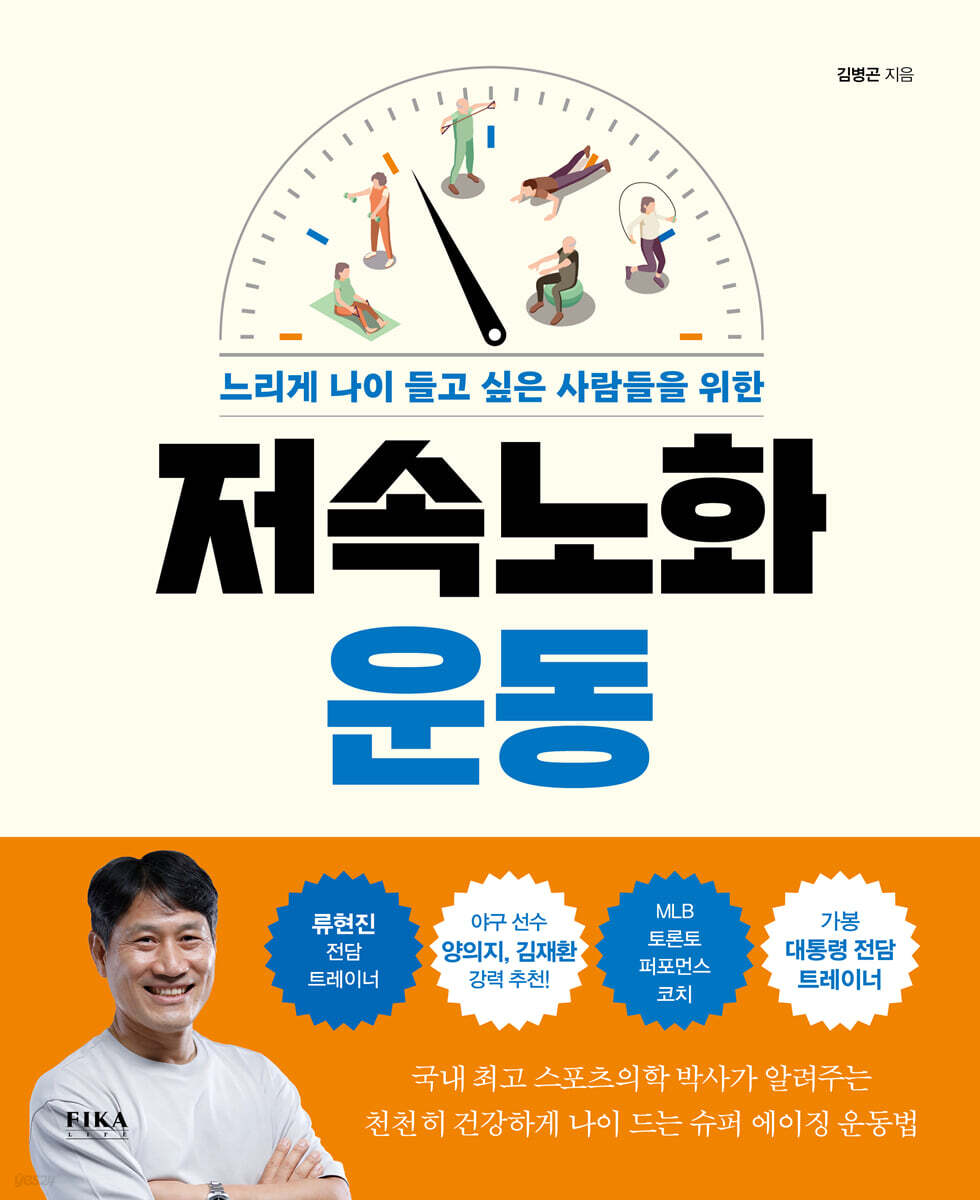
Slow-Aging Exercise
 |
Description
Book Introduction
★ Strongly recommended by baseball players Yang Eui-ji and Kim Jae-hwan! ★
★ Ryu Hyun-jin's dedicated trainer ★
★ Gabonese Presidential Trainer ★
The country's top sports medicine doctor tells you
Super-aging exercises to age slowly and healthily
Slow aging is not simply about living young, but about living healthily and well without disease.
To delay the inevitable decline in physical function and aging that comes with age and maintain a vibrant life, 'slow-aging exercise' is not an option but a necessity.
The author is a top sports medicine doctor in Korea and an expert who has managed the bodies of professional athletes such as Ryu Hyun-jin and Kim Byung-hyun. He has applied his accumulated know-how to the general public and published his first book, which compiles exercise methods that can be most effective for middle-aged and elderly people.
The author believes that “exercise is the most powerful tool for changing the quality of life as we age,” and emphasizes that in a super-aging society, there is no practice for slowing aging more necessary than exercise.
Exercise slows down the body's aging process.
So, it's good to do the essential exercises that you need to do as you get older.
《Slow Aging Exercise》 introduces the essential elements of slow aging: balance, flexibility, strength, cardiopulmonary endurance, and agility.
Additionally, we have created a customized exercise program so that you can check your physical age through a self-test and do exercises that are suitable for your body condition, from beginner to advanced.
Exercise is a crucial investment as we age, and it is the surest way to reap the rewards of youth and health.
If you want to extend your healthy lifespan, start slow-aging exercises right now with this book.
★ Ryu Hyun-jin's dedicated trainer ★
★ Gabonese Presidential Trainer ★
The country's top sports medicine doctor tells you
Super-aging exercises to age slowly and healthily
Slow aging is not simply about living young, but about living healthily and well without disease.
To delay the inevitable decline in physical function and aging that comes with age and maintain a vibrant life, 'slow-aging exercise' is not an option but a necessity.
The author is a top sports medicine doctor in Korea and an expert who has managed the bodies of professional athletes such as Ryu Hyun-jin and Kim Byung-hyun. He has applied his accumulated know-how to the general public and published his first book, which compiles exercise methods that can be most effective for middle-aged and elderly people.
The author believes that “exercise is the most powerful tool for changing the quality of life as we age,” and emphasizes that in a super-aging society, there is no practice for slowing aging more necessary than exercise.
Exercise slows down the body's aging process.
So, it's good to do the essential exercises that you need to do as you get older.
《Slow Aging Exercise》 introduces the essential elements of slow aging: balance, flexibility, strength, cardiopulmonary endurance, and agility.
Additionally, we have created a customized exercise program so that you can check your physical age through a self-test and do exercises that are suitable for your body condition, from beginner to advanced.
Exercise is a crucial investment as we age, and it is the surest way to reap the rewards of youth and health.
If you want to extend your healthy lifespan, start slow-aging exercises right now with this book.
index
Prologue _ From the Stadium to Everyday Life: The Path to Slow-Aging Exercise
Part 1.
There is a separate slow-aging exercise
Why You Need Slow-Aging Exercise
What is slow aging?
How to slow down aging?
The secret to being younger and healthier than your age
You can start in your 40s
Scientific evidence suggests that exercise slows aging.
Exercise Guide for Slow Aging
What kind of exercise should I do?
Exercise also has priorities
Balance: Finding the center of your body
Flexibility: Making joints smooth
Strength: Building a Foundation of Power
Cardiovascular Endurance: Building Stamina
Agility: Increase your body's reaction speed
Pre- and post-workout preparation and recovery
Part 2.
5 Essential Exercises for Slow Aging
Equilibrium
[Beginner] Balance with both feet parallel to each other
[Intermediate] Balancing on One Leg
[Advanced] Writing numbers while standing on one foot
pliability
Beginner Double-Handed Wall Push Stretch
[Intermediate] Lying down, full body stretch
[Advanced] Wall-holding rotational stretch
muscular strength
[Beginner + Upper Body] Lying on your stomach and lifting your knees
[Beginner + Lower Body] Bend your knees while holding a chair
[Beginner + Torso] Lying down and stretching arms and legs
[Intermediate + Upper Body] Knee Push-Ups
[Intermediate + Lower Body] Knee Bends in Place
[Intermediate + Torso] Lying down and moving your legs left and right
[Advanced + Upper Body] Table Push-ups
[Advanced + Lower Body] Rotate your torso while bending your knees
[Advanced + Torso] Lying upper and lower body lifts
Cardiopulmonary endurance
[Beginner] Walking in place
[Intermediate] Standing elbows and knees touching
[Advanced] Lie down and cheer
Agility
[Beginner] Jumping forward and backward
[Intermediate] Diagonal Jump
[Advanced] Jumping with both feet at the same time
[Beginner] _ 5 Essential Exercises for Slow Aging: A Week-Long Workout Program
[Intermediate] _ 5 Essential Exercises for Slow Aging: A Week-Long Workout Program
[Advanced] _ 5 Essential Exercises for Slow Aging: A Week-Long Workout Program
Part 3.
Simple exercises to reverse aging
Why Age-Specific Exercise Is Necessary
The 40s are the time when strength training is most necessary.
[40s] Pulling the band with both hands
[40s] Sit-up jump
[40s] Standing on one leg and bending over
When to Manage Cardiopulmonary Function in Your 50s
[50s] Lying face down and pulling your knees
[50s] Kick with your knees bent and your front foot
[50s] Running slowly
Your 60s are a time to increase flexibility.
[60s] Shoulder stretch while sitting on a chair
[60s] Leg Raise and Waist Bend Stretch
[60s] Wall-holding calf stretch
The 70s are a time to maintain a sense of balance.
[70s] Standing on tiptoes and heels
[70s] Walking sideways
[70s] Jumping in place with both feet
Part 4.
Stay healthy for life with slow-aging exercise
Sustainable Slow-Aging Exercise Practices
Find your own favorite exercise
Creating a daily exercise habit
Be flexible and not obsessive
Create a personalized workout planner
Changing Misconceptions About Exercise
Lifestyle habits with slow-aging exercise
Healthy life expectancy is important
Healthy and sufficient sleep is essential
A healthy weight prevents chronic diseases.
You can look 10 years younger just by avoiding stress.
Part 1.
There is a separate slow-aging exercise
Why You Need Slow-Aging Exercise
What is slow aging?
How to slow down aging?
The secret to being younger and healthier than your age
You can start in your 40s
Scientific evidence suggests that exercise slows aging.
Exercise Guide for Slow Aging
What kind of exercise should I do?
Exercise also has priorities
Balance: Finding the center of your body
Flexibility: Making joints smooth
Strength: Building a Foundation of Power
Cardiovascular Endurance: Building Stamina
Agility: Increase your body's reaction speed
Pre- and post-workout preparation and recovery
Part 2.
5 Essential Exercises for Slow Aging
Equilibrium
[Beginner] Balance with both feet parallel to each other
[Intermediate] Balancing on One Leg
[Advanced] Writing numbers while standing on one foot
pliability
Beginner Double-Handed Wall Push Stretch
[Intermediate] Lying down, full body stretch
[Advanced] Wall-holding rotational stretch
muscular strength
[Beginner + Upper Body] Lying on your stomach and lifting your knees
[Beginner + Lower Body] Bend your knees while holding a chair
[Beginner + Torso] Lying down and stretching arms and legs
[Intermediate + Upper Body] Knee Push-Ups
[Intermediate + Lower Body] Knee Bends in Place
[Intermediate + Torso] Lying down and moving your legs left and right
[Advanced + Upper Body] Table Push-ups
[Advanced + Lower Body] Rotate your torso while bending your knees
[Advanced + Torso] Lying upper and lower body lifts
Cardiopulmonary endurance
[Beginner] Walking in place
[Intermediate] Standing elbows and knees touching
[Advanced] Lie down and cheer
Agility
[Beginner] Jumping forward and backward
[Intermediate] Diagonal Jump
[Advanced] Jumping with both feet at the same time
[Beginner] _ 5 Essential Exercises for Slow Aging: A Week-Long Workout Program
[Intermediate] _ 5 Essential Exercises for Slow Aging: A Week-Long Workout Program
[Advanced] _ 5 Essential Exercises for Slow Aging: A Week-Long Workout Program
Part 3.
Simple exercises to reverse aging
Why Age-Specific Exercise Is Necessary
The 40s are the time when strength training is most necessary.
[40s] Pulling the band with both hands
[40s] Sit-up jump
[40s] Standing on one leg and bending over
When to Manage Cardiopulmonary Function in Your 50s
[50s] Lying face down and pulling your knees
[50s] Kick with your knees bent and your front foot
[50s] Running slowly
Your 60s are a time to increase flexibility.
[60s] Shoulder stretch while sitting on a chair
[60s] Leg Raise and Waist Bend Stretch
[60s] Wall-holding calf stretch
The 70s are a time to maintain a sense of balance.
[70s] Standing on tiptoes and heels
[70s] Walking sideways
[70s] Jumping in place with both feet
Part 4.
Stay healthy for life with slow-aging exercise
Sustainable Slow-Aging Exercise Practices
Find your own favorite exercise
Creating a daily exercise habit
Be flexible and not obsessive
Create a personalized workout planner
Changing Misconceptions About Exercise
Lifestyle habits with slow-aging exercise
Healthy life expectancy is important
Healthy and sufficient sleep is essential
A healthy weight prevents chronic diseases.
You can look 10 years younger just by avoiding stress.
Detailed image

Into the book
Healthy life expectancy, as defined by the World Health Organization (WHO), means “the number of years a person lives in good health without suffering from disease or injury.”
The ultimate goal of slow aging is to extend this healthy lifespan.
To achieve this, we must systematically manage factors that accelerate physical aging through medically proven methods.
--- p.13
Even starting in your 40s, you need to build muscle strength, maintain flexibility, and maintain overall physical and health health through exercise that's right for you to prevent accelerated aging, chronic pain, and the development of chronic diseases.
--- p.21
As we age, our physical functions decline, so rather than just exercising haphazardly, correct posture and a systematic program are more important than anything else.
Because incorrect movements can actually cause injuries and chronic pain.
As we age, the sensory functions of our joints, muscles, and nerves decline. If we repeat incorrect movements in this state, the brain may receive incorrect signals, which can lead to a breakdown in our body's balance and ability to control posture, which can cause pain in our back, knees, and shoulders.
--- p.26
Balance exercises are exercises that help maintain balance and stability, which may be weakened by aging, prevent falls, and improve body control.
As we age, our vision, vestibular system, muscles, and joints generally decline in function. Balance exercises strengthen these sensory functions, reducing body sway, maintaining a stable posture, and improving walking ability.
--- p.57
The body ages every day.
After age 30, people begin to gain weight and some of the cells in their muscles, liver, kidneys, and other organs begin to deteriorate.
The body loses water content and the bones lose some of their minerals, making them less dense.
Starting in your 40s, your overall bodily functions decline, and you begin to experience physical changes that you did not notice when you were younger, such as decreased muscle mass, decreased metabolism, weakened joints, and loss of balance.
This is why age-specific exercise is necessary.
--- p.118
To create long-lasting, sustainable exercise habits and truly achieve slow aging, you need to start gradually and find an exercise you enjoy.
Exercise is never a forced task.
Exercise that starts out forcefully will eventually tire you out and make it difficult to continue consistently.
If you choose an activity that you genuinely enjoy or that you find engaging and engaging, you'll be much more likely to find time to exercise, even in the midst of a busy schedule.
The ultimate goal of slow aging is to extend this healthy lifespan.
To achieve this, we must systematically manage factors that accelerate physical aging through medically proven methods.
--- p.13
Even starting in your 40s, you need to build muscle strength, maintain flexibility, and maintain overall physical and health health through exercise that's right for you to prevent accelerated aging, chronic pain, and the development of chronic diseases.
--- p.21
As we age, our physical functions decline, so rather than just exercising haphazardly, correct posture and a systematic program are more important than anything else.
Because incorrect movements can actually cause injuries and chronic pain.
As we age, the sensory functions of our joints, muscles, and nerves decline. If we repeat incorrect movements in this state, the brain may receive incorrect signals, which can lead to a breakdown in our body's balance and ability to control posture, which can cause pain in our back, knees, and shoulders.
--- p.26
Balance exercises are exercises that help maintain balance and stability, which may be weakened by aging, prevent falls, and improve body control.
As we age, our vision, vestibular system, muscles, and joints generally decline in function. Balance exercises strengthen these sensory functions, reducing body sway, maintaining a stable posture, and improving walking ability.
--- p.57
The body ages every day.
After age 30, people begin to gain weight and some of the cells in their muscles, liver, kidneys, and other organs begin to deteriorate.
The body loses water content and the bones lose some of their minerals, making them less dense.
Starting in your 40s, your overall bodily functions decline, and you begin to experience physical changes that you did not notice when you were younger, such as decreased muscle mass, decreased metabolism, weakened joints, and loss of balance.
This is why age-specific exercise is necessary.
--- p.118
To create long-lasting, sustainable exercise habits and truly achieve slow aging, you need to start gradually and find an exercise you enjoy.
Exercise is never a forced task.
Exercise that starts out forcefully will eventually tire you out and make it difficult to continue consistently.
If you choose an activity that you genuinely enjoy or that you find engaging and engaging, you'll be much more likely to find time to exercise, even in the midst of a busy schedule.
--- p.155
Publisher's Review
“Slow aging is all about ‘exercise’!”
Slow aging that is not too late, even starting in your 40s
The major trend across all generations in recent years is undoubtedly 'slow aging'.
It is receiving great attention from all generations, regardless of gender or age, as life expectancy is increasing while healthy life expectancy is decreasing.
Slow aging aims to extend healthy lifespan, which means living a long and healthy life without disease, rather than simply living longer.
The author, who is the country's top sports medicine doctor, says that exercise is the most fundamental and powerful tool to slow down the aging process.
He emphasizes that exercise is not a choice but a necessity, especially after the age of 40.
Our body's muscle mass peaks around the age of 25, gradually decreases from the age of 30, and decreases by 1% every year after reaching our 40s.
By the age of 80, muscle loss accelerates to the point where an average person loses 50% of their muscle mass. As muscle mass decreases, bones become weaker and the body becomes weaker overall, increasing the risk of falls and fractures, and can even lead to diabetes and dementia.
Exercise slows down the aging process.
Exercise can help extinguish chronic inflammation in the body and turn back the clock on aging.
It also has an anti-inflammatory effect in the body, preventing the accumulation of aged cells and reducing active oxygen.
In addition, it plays a crucial role in slowing down the body's aging process by restoring the function of damaged mitochondria and lowering stress hormone levels.
In this way, exercise is the most effective means of actively coping with complex physical changes.
“Exercise also has priorities!”
5 Essential Exercises for Smart, Slow-Aging
So, what kind of exercise should you do, and how should you do it? While the type of exercise you do is important, deciding which one to do first and which one to do last is also crucial.
Because the effect varies depending on the order of the exercises.
This book introduces exercise priorities centered on the five essential elements needed for slow aging.
The essential factors that determine health in middle age and old age are 'balance, flexibility, muscle strength, cardiopulmonary endurance, and agility', and it is most important to maintain a balance among these five factors.
If any of these are weakened, it can lead to a variety of problems, including decreased ability to perform daily activities and an increased risk of chronic diseases or falls.
The first step you need to do is balance exercises.
Equilibrium awakens the body's sense of balance and increases the stability of movement, which increases the effectiveness of the next step of exercise and reduces the risk of injury.
Step 2 is flexibility exercises, which increase the range of motion of your muscles and joints, making your body more flexible and reducing your risk of injury.
Once your body is somewhat prepared, it's time for step 3: strength training.
Since doing other exercises when you lack muscle strength increases the risk of injury, it is recommended to do strength training first to maximize the fat burning effect.
Step 4 is cardiopulmonary endurance exercise, which strengthens the heart and lungs, increases physical strength and vitality, and prevents cardiovascular diseases such as high blood pressure and arteriosclerosis.
Finally, level 5 agility exercises help you develop the ability to respond to falls in everyday life by increasing your nerve and muscle reaction speed.
By exercising in this order, you can reduce your risk of injury and maximize the benefits of your workout.
“The most powerful tool for changing the quality of life as we age is exercise.”
From Ryu Hyun-jin to the President, now a national health doctor
The author, a top sports medicine doctor in Korea who has coached professional Korean players such as Ryu Hyun-jin and Kim Byung-hyun, has been responsible for the bodies of professional baseball teams, national baseball teams, and professional golf tour players for the past 25 years.
In particular, he dedicated himself to the rehabilitation of players at LG Twins for 11 years, helping veterans such as Bong Jung-geun and Park Yong-taek recover from injuries, and also served as Ryu Hyun-jin's dedicated coach.
He also proved the excellence of K-healthcare overseas by working as a performance coach for the Toronto Blue Jays of the American Major League and as the healthcare director at the Gabon Presidential Palace in Africa.
Based on the principles and know-how gained from managing the bodies of elite athletes, the author has now set out to take care of the health of the nation.
With the belief that “exercise is the most powerful tool to change the quality of life as we age,” this book aims to convey to many people that exercise is not only about improving physical strength but is also the key to extending a healthy lifespan.
This book provides detailed, step-by-step exercise methods that anyone can follow.
Emphasizing the importance of customized exercise to supplement areas weakened by aging, the book includes a 'self-test' that allows you to check your physical age and, based on the results, implement a customized exercise program for beginner, intermediate, and advanced levels.
It also introduces areas that require more attention depending on age and includes additional exercise methods appropriate for each age group.
Slow aging ultimately means maintaining the ability to walk on two feet and move with two hands for a long time without relying on anything.
If you want to extend your healthy lifespan and regain your vitality, start the slow-aging movement right now with this book.
Slow aging that is not too late, even starting in your 40s
The major trend across all generations in recent years is undoubtedly 'slow aging'.
It is receiving great attention from all generations, regardless of gender or age, as life expectancy is increasing while healthy life expectancy is decreasing.
Slow aging aims to extend healthy lifespan, which means living a long and healthy life without disease, rather than simply living longer.
The author, who is the country's top sports medicine doctor, says that exercise is the most fundamental and powerful tool to slow down the aging process.
He emphasizes that exercise is not a choice but a necessity, especially after the age of 40.
Our body's muscle mass peaks around the age of 25, gradually decreases from the age of 30, and decreases by 1% every year after reaching our 40s.
By the age of 80, muscle loss accelerates to the point where an average person loses 50% of their muscle mass. As muscle mass decreases, bones become weaker and the body becomes weaker overall, increasing the risk of falls and fractures, and can even lead to diabetes and dementia.
Exercise slows down the aging process.
Exercise can help extinguish chronic inflammation in the body and turn back the clock on aging.
It also has an anti-inflammatory effect in the body, preventing the accumulation of aged cells and reducing active oxygen.
In addition, it plays a crucial role in slowing down the body's aging process by restoring the function of damaged mitochondria and lowering stress hormone levels.
In this way, exercise is the most effective means of actively coping with complex physical changes.
“Exercise also has priorities!”
5 Essential Exercises for Smart, Slow-Aging
So, what kind of exercise should you do, and how should you do it? While the type of exercise you do is important, deciding which one to do first and which one to do last is also crucial.
Because the effect varies depending on the order of the exercises.
This book introduces exercise priorities centered on the five essential elements needed for slow aging.
The essential factors that determine health in middle age and old age are 'balance, flexibility, muscle strength, cardiopulmonary endurance, and agility', and it is most important to maintain a balance among these five factors.
If any of these are weakened, it can lead to a variety of problems, including decreased ability to perform daily activities and an increased risk of chronic diseases or falls.
The first step you need to do is balance exercises.
Equilibrium awakens the body's sense of balance and increases the stability of movement, which increases the effectiveness of the next step of exercise and reduces the risk of injury.
Step 2 is flexibility exercises, which increase the range of motion of your muscles and joints, making your body more flexible and reducing your risk of injury.
Once your body is somewhat prepared, it's time for step 3: strength training.
Since doing other exercises when you lack muscle strength increases the risk of injury, it is recommended to do strength training first to maximize the fat burning effect.
Step 4 is cardiopulmonary endurance exercise, which strengthens the heart and lungs, increases physical strength and vitality, and prevents cardiovascular diseases such as high blood pressure and arteriosclerosis.
Finally, level 5 agility exercises help you develop the ability to respond to falls in everyday life by increasing your nerve and muscle reaction speed.
By exercising in this order, you can reduce your risk of injury and maximize the benefits of your workout.
“The most powerful tool for changing the quality of life as we age is exercise.”
From Ryu Hyun-jin to the President, now a national health doctor
The author, a top sports medicine doctor in Korea who has coached professional Korean players such as Ryu Hyun-jin and Kim Byung-hyun, has been responsible for the bodies of professional baseball teams, national baseball teams, and professional golf tour players for the past 25 years.
In particular, he dedicated himself to the rehabilitation of players at LG Twins for 11 years, helping veterans such as Bong Jung-geun and Park Yong-taek recover from injuries, and also served as Ryu Hyun-jin's dedicated coach.
He also proved the excellence of K-healthcare overseas by working as a performance coach for the Toronto Blue Jays of the American Major League and as the healthcare director at the Gabon Presidential Palace in Africa.
Based on the principles and know-how gained from managing the bodies of elite athletes, the author has now set out to take care of the health of the nation.
With the belief that “exercise is the most powerful tool to change the quality of life as we age,” this book aims to convey to many people that exercise is not only about improving physical strength but is also the key to extending a healthy lifespan.
This book provides detailed, step-by-step exercise methods that anyone can follow.
Emphasizing the importance of customized exercise to supplement areas weakened by aging, the book includes a 'self-test' that allows you to check your physical age and, based on the results, implement a customized exercise program for beginner, intermediate, and advanced levels.
It also introduces areas that require more attention depending on age and includes additional exercise methods appropriate for each age group.
Slow aging ultimately means maintaining the ability to walk on two feet and move with two hands for a long time without relying on anything.
If you want to extend your healthy lifespan and regain your vitality, start the slow-aging movement right now with this book.
GOODS SPECIFICS
- Date of issue: October 13, 2025
- Page count, weight, size: 176 pages | 528g | 188*230*12mm
- ISBN13: 9791193866399
- ISBN10: 1193866391
You may also like
카테고리
korean


korean

![GQ KOREA Mark (Monthly): December [2025]](http://librairie.coreenne.fr/cdn/shop/files/8ef265dbbfbf186523ed75ba7319009d.jpg?v=1765340328&width=3840)


