

Super-gap five-sensory literacy
 |
Description
Book Introduction
Studying emotions and studying head at the same time!
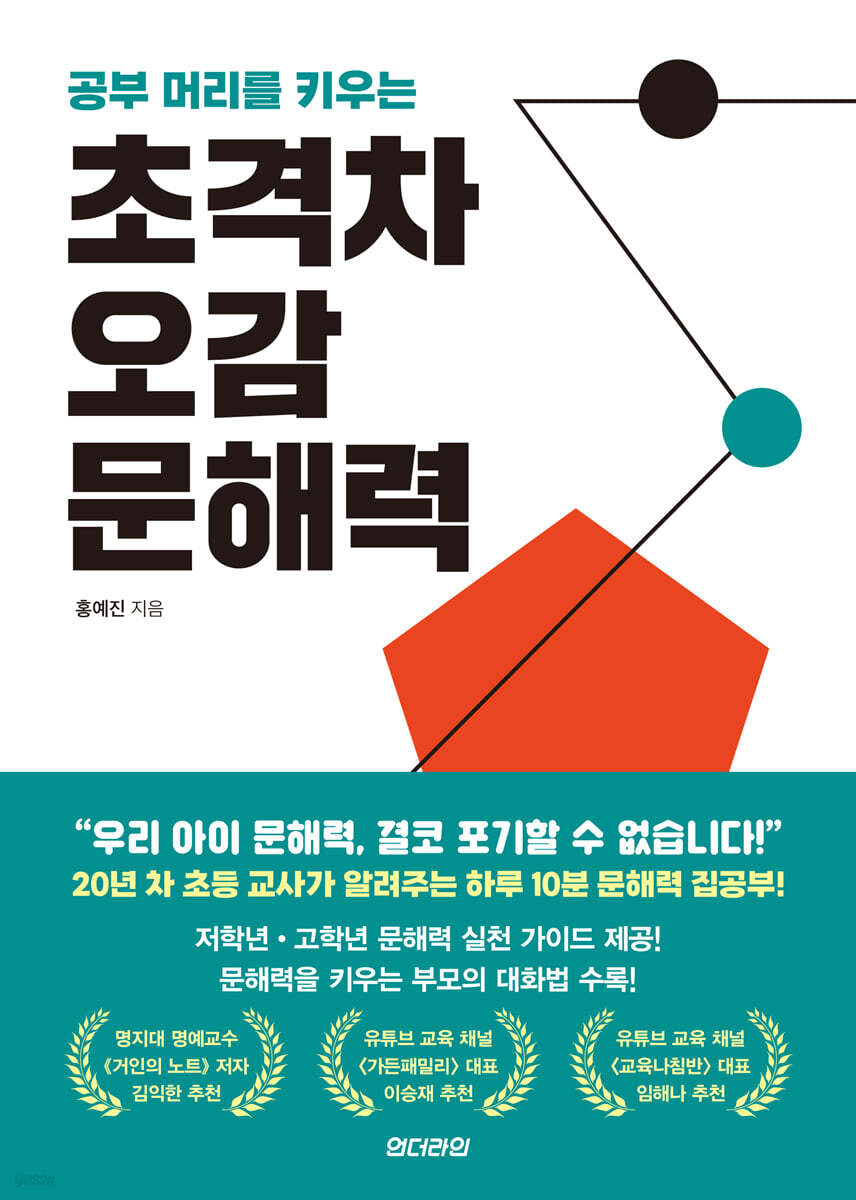
A 10-Minute Daily Five-Sensory Literacy Study at Home, Taught by an Elementary School Teacher with 20 Years of Experience
A veteran elementary school teacher with 20 years of experience has published "Super-Gap Five Senses Literacy," which contains literacy solutions that simultaneously cultivate both "study sensibility" and "study brain."
This book presents specific methods to explosively increase literacy skills by focusing on the five senses: listening (ears), speaking (mouth), reading (eyes), writing (hands), and feeling (heart).
Of these five senses, the ear (hearing) is the beginning of literacy and the root of understanding, and the mouth (speaking) is the power to logically expand thoughts.
The eyes (reading) teach reading strategies based on observation, and the hands (writing) are the process of concretizing and completing thoughts.
The final mind (emotion) can be said to be the ultimate root and completion of literacy.
This guide provides detailed instructions on how to develop abilities through the five senses.
It also helps children develop the ability to understand themselves, empathize with others, and view the world by explaining specific emotional expressions and communication methods with their parents.
These simple and easy-to-follow practices, proven effective by the author through his own experience in the classroom and at home, provide clear guidance to parents who are at a loss as to what to do.
"Super Gap Literacy" shows that literacy is not just a learning ability, but a core competency that fosters children's self-esteem, social skills, and life skills. It is a warm and practical guidebook for parents and children to grow together.
A 10-Minute Daily Five-Sensory Literacy Study at Home, Taught by an Elementary School Teacher with 20 Years of Experience
A veteran elementary school teacher with 20 years of experience has published "Super-Gap Five Senses Literacy," which contains literacy solutions that simultaneously cultivate both "study sensibility" and "study brain."
This book presents specific methods to explosively increase literacy skills by focusing on the five senses: listening (ears), speaking (mouth), reading (eyes), writing (hands), and feeling (heart).
Of these five senses, the ear (hearing) is the beginning of literacy and the root of understanding, and the mouth (speaking) is the power to logically expand thoughts.
The eyes (reading) teach reading strategies based on observation, and the hands (writing) are the process of concretizing and completing thoughts.
The final mind (emotion) can be said to be the ultimate root and completion of literacy.
This guide provides detailed instructions on how to develop abilities through the five senses.
It also helps children develop the ability to understand themselves, empathize with others, and view the world by explaining specific emotional expressions and communication methods with their parents.
These simple and easy-to-follow practices, proven effective by the author through his own experience in the classroom and at home, provide clear guidance to parents who are at a loss as to what to do.
"Super Gap Literacy" shows that literacy is not just a learning ability, but a core competency that fosters children's self-esteem, social skills, and life skills. It is a warm and practical guidebook for parents and children to grow together.
- You can preview some of the book's contents.
Preview
index
Opening remarks
Five-sense literacy that simultaneously develops both study sensibility and study brain
Chapter 0: Literacy Lessons Through the Five Senses: Ears, Mouth, Eyes, Hands, and Mind
Chapter 1: The Ears: Listening, the Beginning of Literacy
Children who first encounter the world through their ears
Children learn new expressions within the context of listening. Empathy grows as they understand the emotions and intentions contained in words. Causal reasoning skills, such as asking, "Why is that?", develop.
The power of repeated reading
Repeated reading to discover new meanings and vocabulary┃How to find flow and structure in a story┃Empathy to read others' minds┃Feel the rhythm and flow of sound with your body┃Parents' voices that give a sense of stability and the joy of communication
Stories heard orally remain in the memory for a long time.
Let the story permeate your whole body┃An infinite world unfolds in your mind┃Reading a story structure that is helpful in everyday life┃Experience your expressive power in a safe communication space┃Deeply lingering memories become the basis for new understanding
Imagination grows through listening
The moment when a parent's single word transforms into a vivid video scene┃Imagination grows by filling in the blank space on its own┃Flexible thinking grows the moment perspectives change┃Voice rhythm becomes a signal for scene change
Everyday sounds that open a child's mouth
Expand your vocabulary with new words from everyday life. Gaining knowledge through questions and conversations. Media literacy in everyday life: the foundation of critical thinking. How to improve real-life literacy.
I listened hard, so why can't I understand?
Why You Don't Understand the Content┃Five Strategies to Help You Understand the Content
Chapter 2: Speaking Expands a Child's Literacy
When your mind is at ease, words will follow naturally.
The absolute influence parents have on their children
Dinner Table Conversations: Awakening Children's Language
When recognized as a conversationalist, confidence grows┃When answering a child's questions seriously, curiosity awakens┃Vocabulary learned in everyday conversation┃Logical thinking skills deepen through conversation
The heart can only be known by expressing it in words.
Expressing emotions is an important foundation for literacy development. ┃A child's heart in silence. ┃How to open a child's mouth. ┃Children who express their feelings grow up with more confidence.
Words are a mirror reflecting the world a child sees.
A child's unique way of thinking contained in words┃You can also learn about a child's interests and tendencies┃Misconceptions are valuable data that shows a child's thought process┃How thoughts become words
How to get your child's thoughts out there
Observation first, questions later┃The density of focus is more important than the amount of time┃Capturing specific observation points┃Questions based on observation┃Observing the process of developing thoughts
Chapter 3: The Eye: Reading Begins with Observation
A child who sees the world well reads well.
Characteristics of Children with Good Observational Skills┃Why Should We Start by Developing Observational Skills?
The correlation between observation and comprehension skills
Seven Semantic Devices Your Child Should Pay Attention to
How to Double Your Observation Skills
Sentence Components Made Easy for Children┃Why Reading is Difficult┃Why Do We Need to Know Sentence Components?
We need an eye to see the bridge between sentences.
Connecting Words: Crucial Clues Hidden in Text | Types and Roles of Connecting Words | Easy and Simple Connecting Word Practice
Find the framework of the text
Writing is a living organism. How to understand the structure of writing. The ability to see the structure of writing does not develop overnight.
Chapter 4: Hands: A Child's Thoughts Come from His Fingertips
Writing that starts with one sentence
Let's start with something as simple as a horse┃The role of parents in helping children speak and write
Writing becomes easier when you have a framework to organize your thoughts.
Two effective thought-organizing frameworks
Writing requires knowing structure
A Natural Transition from Reading to Writing┃Four Methods of Structured Writing
Chapter 5: The Heart: Where the Powers of Listening, Speaking, Reading, and Writing Ultimately Connect
Parents' emotions are completely conveyed to their children
Emotional literacy begins with parents expressing their emotions. There is no right or wrong when it comes to emotions.
Practice facing and expressing emotions
Acknowledge your child's emotions as they are┃Find solutions together┃Practice expressing emotions in daily life┃Create a routine to write down emotions┃Treat all emotions with care
A single word can change a child's relationship.
What Happens When Emotional Literacy Is Lacked┃Home Conversations Become Your Child's Relationship Language┃Changing Language to Build Relationships
Appendix: Parents' Guide to Sense Literacy
How to Spark Literacy Curiosity in Early Elementary School Children
How to Make It for Upper Elementary School Children Who Can't Put It Off Any Longer
Conclusion
The power of words to understand our hearts and connect with others.
Five-sense literacy that simultaneously develops both study sensibility and study brain
Chapter 0: Literacy Lessons Through the Five Senses: Ears, Mouth, Eyes, Hands, and Mind
Chapter 1: The Ears: Listening, the Beginning of Literacy
Children who first encounter the world through their ears
Children learn new expressions within the context of listening. Empathy grows as they understand the emotions and intentions contained in words. Causal reasoning skills, such as asking, "Why is that?", develop.
The power of repeated reading
Repeated reading to discover new meanings and vocabulary┃How to find flow and structure in a story┃Empathy to read others' minds┃Feel the rhythm and flow of sound with your body┃Parents' voices that give a sense of stability and the joy of communication
Stories heard orally remain in the memory for a long time.
Let the story permeate your whole body┃An infinite world unfolds in your mind┃Reading a story structure that is helpful in everyday life┃Experience your expressive power in a safe communication space┃Deeply lingering memories become the basis for new understanding
Imagination grows through listening
The moment when a parent's single word transforms into a vivid video scene┃Imagination grows by filling in the blank space on its own┃Flexible thinking grows the moment perspectives change┃Voice rhythm becomes a signal for scene change
Everyday sounds that open a child's mouth
Expand your vocabulary with new words from everyday life. Gaining knowledge through questions and conversations. Media literacy in everyday life: the foundation of critical thinking. How to improve real-life literacy.
I listened hard, so why can't I understand?
Why You Don't Understand the Content┃Five Strategies to Help You Understand the Content
Chapter 2: Speaking Expands a Child's Literacy
When your mind is at ease, words will follow naturally.
The absolute influence parents have on their children
Dinner Table Conversations: Awakening Children's Language
When recognized as a conversationalist, confidence grows┃When answering a child's questions seriously, curiosity awakens┃Vocabulary learned in everyday conversation┃Logical thinking skills deepen through conversation
The heart can only be known by expressing it in words.
Expressing emotions is an important foundation for literacy development. ┃A child's heart in silence. ┃How to open a child's mouth. ┃Children who express their feelings grow up with more confidence.
Words are a mirror reflecting the world a child sees.
A child's unique way of thinking contained in words┃You can also learn about a child's interests and tendencies┃Misconceptions are valuable data that shows a child's thought process┃How thoughts become words
How to get your child's thoughts out there
Observation first, questions later┃The density of focus is more important than the amount of time┃Capturing specific observation points┃Questions based on observation┃Observing the process of developing thoughts
Chapter 3: The Eye: Reading Begins with Observation
A child who sees the world well reads well.
Characteristics of Children with Good Observational Skills┃Why Should We Start by Developing Observational Skills?
The correlation between observation and comprehension skills
Seven Semantic Devices Your Child Should Pay Attention to
How to Double Your Observation Skills
Sentence Components Made Easy for Children┃Why Reading is Difficult┃Why Do We Need to Know Sentence Components?
We need an eye to see the bridge between sentences.
Connecting Words: Crucial Clues Hidden in Text | Types and Roles of Connecting Words | Easy and Simple Connecting Word Practice
Find the framework of the text
Writing is a living organism. How to understand the structure of writing. The ability to see the structure of writing does not develop overnight.
Chapter 4: Hands: A Child's Thoughts Come from His Fingertips
Writing that starts with one sentence
Let's start with something as simple as a horse┃The role of parents in helping children speak and write
Writing becomes easier when you have a framework to organize your thoughts.
Two effective thought-organizing frameworks
Writing requires knowing structure
A Natural Transition from Reading to Writing┃Four Methods of Structured Writing
Chapter 5: The Heart: Where the Powers of Listening, Speaking, Reading, and Writing Ultimately Connect
Parents' emotions are completely conveyed to their children
Emotional literacy begins with parents expressing their emotions. There is no right or wrong when it comes to emotions.
Practice facing and expressing emotions
Acknowledge your child's emotions as they are┃Find solutions together┃Practice expressing emotions in daily life┃Create a routine to write down emotions┃Treat all emotions with care
A single word can change a child's relationship.
What Happens When Emotional Literacy Is Lacked┃Home Conversations Become Your Child's Relationship Language┃Changing Language to Build Relationships
Appendix: Parents' Guide to Sense Literacy
How to Spark Literacy Curiosity in Early Elementary School Children
How to Make It for Upper Elementary School Children Who Can't Put It Off Any Longer
Conclusion
The power of words to understand our hearts and connect with others.
Detailed image

Into the book
Listening is the easiest way for children to naturally acquire vocabulary, rhythm, and metaphors.
What enriches children's expressive powers are not the words rigidly written in workbooks, but the expressions that live, breathe, and move in everyday conversation.
Listening experience is the first step in developing a child's literacy.
A parent's affectionate voice quietly settles on a child's heart, nurturing the seeds of language, thought, and empathy.
Take a step closer to your child and tell them about the day's scenery in rich language.
--- p.31
Auditory cues are an important component of literacy.
The rhythm and stress patterns of sentences you learn from listening will help you understand sentence structure when you read later.
In particular, listening, unlike reading, has the characteristic of being irreversible.
When you read, you can go back and read it again if you need to, but when you listen to a story, you can't go back and catch up on what you missed.
These characteristics naturally make children more focused, develop the ability to listen carefully, and select important information.
--- p.55
Language is the process of structuring thoughts.
The moment the scattered thoughts in our heads make sense, they take on order and logic and create meaning.
As children gain experience expressing themselves verbally, they will become better at understanding the structure and logic of text when reading.
--- p.73
Misconceptions are the result of a child's active efforts to construct meaning.
It is often not completely wrong, but rather a partial understanding, or the result of logical inference based on one's existing knowledge and a hypothesis.
When discovering these misconceptions, parents should listen to their children sincerely without judging them.
By continuing the conversation with open-ended questions, children can develop their own thoughts and gain deeper understanding.
--- p.111
Reading is essentially the ability to see the invisible.
It is the act of drawing in one's mind the thoughts, feelings, situations and scenes of the writer expressed through symbols called letters.
This very ability is closely related to the ability to observe.
The ability to observe the world closely, notice changes, and discover hidden meanings is the foundation of reading ability.
Reading skills developed on a solid foundation of observation are much more solid and lasting.
This is because it allows you to go beyond simply deciphering the letters and understand the deeper meaning contained within the text.
If you want your child to be a good reader, first make him or her an observant child.
--- pp.141~142
Observant children don't just look at words; they capture the flow of meaning between sentences.
'But'
When the word 'so' appears, we notice that the content of the preceding and following sentences is opposite, and when the word 'so' appears, we notice that there is a cause and effect relationship.
When you can grasp these crucial clues that allow you to interpret the relationships between sentences, you can better understand the meaning of the text.
--- p.162
Writing is a process of calmly looking into your own mind and thoughts, and expressing them one step deeper than words.
As children write, they organize memories, capture emotions, structure thoughts, and refine language in their own unique way.
And gradually, you will learn how to convey your feelings while thinking about the reader and how to communicate deeply with others.
Writing is not simply a record; it is a process of organizing your thoughts, organizing them into words, and building a solid literacy that connects you to the world.
--- p.183
Literacy is not just the skill of reading and writing.
Literacy is the power that allows a child to accept the world, understand their emotions, express them, and connect with others and the world.
It is not the skill of language, but the power of emotions that connects the child's self with the world.
When children can read the emotions, context, and even the flow of relationships contained in words and writing, they can connect more warmly with the world and understand themselves more firmly.
Emotional literacy is the power to connect the power of listening, speaking, reading, and writing to the 'heart'.
What enriches children's expressive powers are not the words rigidly written in workbooks, but the expressions that live, breathe, and move in everyday conversation.
Listening experience is the first step in developing a child's literacy.
A parent's affectionate voice quietly settles on a child's heart, nurturing the seeds of language, thought, and empathy.
Take a step closer to your child and tell them about the day's scenery in rich language.
--- p.31
Auditory cues are an important component of literacy.
The rhythm and stress patterns of sentences you learn from listening will help you understand sentence structure when you read later.
In particular, listening, unlike reading, has the characteristic of being irreversible.
When you read, you can go back and read it again if you need to, but when you listen to a story, you can't go back and catch up on what you missed.
These characteristics naturally make children more focused, develop the ability to listen carefully, and select important information.
--- p.55
Language is the process of structuring thoughts.
The moment the scattered thoughts in our heads make sense, they take on order and logic and create meaning.
As children gain experience expressing themselves verbally, they will become better at understanding the structure and logic of text when reading.
--- p.73
Misconceptions are the result of a child's active efforts to construct meaning.
It is often not completely wrong, but rather a partial understanding, or the result of logical inference based on one's existing knowledge and a hypothesis.
When discovering these misconceptions, parents should listen to their children sincerely without judging them.
By continuing the conversation with open-ended questions, children can develop their own thoughts and gain deeper understanding.
--- p.111
Reading is essentially the ability to see the invisible.
It is the act of drawing in one's mind the thoughts, feelings, situations and scenes of the writer expressed through symbols called letters.
This very ability is closely related to the ability to observe.
The ability to observe the world closely, notice changes, and discover hidden meanings is the foundation of reading ability.
Reading skills developed on a solid foundation of observation are much more solid and lasting.
This is because it allows you to go beyond simply deciphering the letters and understand the deeper meaning contained within the text.
If you want your child to be a good reader, first make him or her an observant child.
--- pp.141~142
Observant children don't just look at words; they capture the flow of meaning between sentences.
'But'
When the word 'so' appears, we notice that the content of the preceding and following sentences is opposite, and when the word 'so' appears, we notice that there is a cause and effect relationship.
When you can grasp these crucial clues that allow you to interpret the relationships between sentences, you can better understand the meaning of the text.
--- p.162
Writing is a process of calmly looking into your own mind and thoughts, and expressing them one step deeper than words.
As children write, they organize memories, capture emotions, structure thoughts, and refine language in their own unique way.
And gradually, you will learn how to convey your feelings while thinking about the reader and how to communicate deeply with others.
Writing is not simply a record; it is a process of organizing your thoughts, organizing them into words, and building a solid literacy that connects you to the world.
--- p.183
Literacy is not just the skill of reading and writing.
Literacy is the power that allows a child to accept the world, understand their emotions, express them, and connect with others and the world.
It is not the skill of language, but the power of emotions that connects the child's self with the world.
When children can read the emotions, context, and even the flow of relationships contained in words and writing, they can connect more warmly with the world and understand themselves more firmly.
Emotional literacy is the power to connect the power of listening, speaking, reading, and writing to the 'heart'.
--- p.234
Publisher's Review
Literacy, the foundation of all learning and the power of life
Children of the digital generation, accustomed to video content and short texts, have great difficulty reading long texts, understanding the context, or expressing their thoughts logically.
This decline in literacy is not simply a problem limited to the Korean language subject, but rather undermines the foundation of all academic learning, acting as a major factor in widening the gap in overall learning, ultimately leading to a decline in academic persistence.
Furthermore, this leads to a vicious cycle that has a negative impact on the child's self-confidence and emotional development.
The author, an elementary school teacher with 20 years of experience, has personally experienced these problems in the educational field.
To help children who are discouraged by their lack of understanding reconnect with their studies, friends, and the world, we researched easy, fun, and effective literacy teaching methods.
After experimenting with various methods to improve literacy skills in the classroom and at home, the author has compiled into one book a literacy study method that anyone can follow at home and is proven to be effective.
Developing your study skills through 10 minutes a day, using all five senses
This book presents a method to improve literacy skills at home by investing just 10 minutes a day, according to the child's developmental stage, from lower elementary school to upper elementary school.
The core solution proposed by the author, an elementary school teacher with 20 years of experience, is five-sense literacy.
Sensory literacy is the ability to hear with your ears, speak with your mouth, read with your eyes, write with your hands, and feel and connect with your heart.
By utilizing all five senses equally, language comprehension, thinking skills, and emotional stability are developed evenly.
Children naturally expand their causal thinking and logical expression skills through their ears and mouths in everyday conversations with their parents.
Also, based on observation, it develops the ability of the eyes (reading) and hands (writing) and forms the habit of reading properly and expressing accurately.
The heart is a key element in developing empathy, the ability to express emotions in words and understand oneself and others.
When children can express their feelings verbally, they develop the ability to empathize with others.
This soon expands to literacy, which allows one to grasp the deep meaning (context) hidden in text, helping to naturally connect the world and language.
1.
Ear (listening): The beginning of literacy and the root of understanding.
Through a warm word from a parent or repeated reading, a child learns the emotions and intentions contained in words.
Additionally, listening to stories can help you develop the ability to create an infinite world of imagination in your head.
2.
Mouth (speaking): The power to logically expand thoughts.
Through everyday communication, such as conversations around the dinner table, children practice expressing their thoughts and feelings in words.
When your mind is at ease, words follow naturally, which in turn leads to the ability to organize complex thoughts.
3.
Eye (Reading): A reading strategy based on observation.
A child who sees the world well is also good at reading.
This is a strategy to increase learning efficiency by developing a 'reading mind' that goes beyond simply reading letters and understands the hidden links (connecting words) between sentences and the skeleton (structure) of the text.
4.
Hand (writing): The process of concretizing and completing thoughts.
Writing is the process of bringing complex thoughts from your head to your fingertips, concretizing them, and organizing them.
You can develop the habit of starting with one sentence and vividly expressing what you observed.
5.
Mind (Emotion): The ultimate root and completion of literacy.
‘Emotional literacy’ is the final link between all the skills of listening, speaking, reading, and writing.
When you can healthily recognize and express your own emotions, you can accurately understand the emotions of others and the emotional context of texts.
This will help the child develop a strong emotional foundation for a happy life.
This book explains various literacy study methods tailored to the developmental stages of lower and upper elementary school students.
For lower elementary school students (grades 1-3), we focus on listening (ears) and speaking (mouth) to help expand language skills.
Increase vocabulary and listening comprehension of written structures through everyday sounds and parental conversations, and improve thinking and expressive skills through dinner table conversations.
The key is to strengthen listening and speaking skills through play-based activities so that younger children can develop literacy skills in a fun way.
Upper elementary school students (grades 4-6) can improve their reading (eye) and writing (hand) skills by learning to identify sentence elements, understand the structure of text, summarize key points, and practice writing.
The core philosophy of this book is that warm, emotional communication with parents is the foundation of language development.
For parents who don't know how to lead a conversation with their children, we provide specific conversation examples.
Warm conversations with parents play an important role in helping children kill two birds with one stone: emotional stability and improved literacy.
This book is a friendly guide that helps you develop a true study mind based on healthy emotions.
Children of the digital generation, accustomed to video content and short texts, have great difficulty reading long texts, understanding the context, or expressing their thoughts logically.
This decline in literacy is not simply a problem limited to the Korean language subject, but rather undermines the foundation of all academic learning, acting as a major factor in widening the gap in overall learning, ultimately leading to a decline in academic persistence.
Furthermore, this leads to a vicious cycle that has a negative impact on the child's self-confidence and emotional development.
The author, an elementary school teacher with 20 years of experience, has personally experienced these problems in the educational field.
To help children who are discouraged by their lack of understanding reconnect with their studies, friends, and the world, we researched easy, fun, and effective literacy teaching methods.
After experimenting with various methods to improve literacy skills in the classroom and at home, the author has compiled into one book a literacy study method that anyone can follow at home and is proven to be effective.
Developing your study skills through 10 minutes a day, using all five senses
This book presents a method to improve literacy skills at home by investing just 10 minutes a day, according to the child's developmental stage, from lower elementary school to upper elementary school.
The core solution proposed by the author, an elementary school teacher with 20 years of experience, is five-sense literacy.
Sensory literacy is the ability to hear with your ears, speak with your mouth, read with your eyes, write with your hands, and feel and connect with your heart.
By utilizing all five senses equally, language comprehension, thinking skills, and emotional stability are developed evenly.
Children naturally expand their causal thinking and logical expression skills through their ears and mouths in everyday conversations with their parents.
Also, based on observation, it develops the ability of the eyes (reading) and hands (writing) and forms the habit of reading properly and expressing accurately.
The heart is a key element in developing empathy, the ability to express emotions in words and understand oneself and others.
When children can express their feelings verbally, they develop the ability to empathize with others.
This soon expands to literacy, which allows one to grasp the deep meaning (context) hidden in text, helping to naturally connect the world and language.
1.
Ear (listening): The beginning of literacy and the root of understanding.
Through a warm word from a parent or repeated reading, a child learns the emotions and intentions contained in words.
Additionally, listening to stories can help you develop the ability to create an infinite world of imagination in your head.
2.
Mouth (speaking): The power to logically expand thoughts.
Through everyday communication, such as conversations around the dinner table, children practice expressing their thoughts and feelings in words.
When your mind is at ease, words follow naturally, which in turn leads to the ability to organize complex thoughts.
3.
Eye (Reading): A reading strategy based on observation.
A child who sees the world well is also good at reading.
This is a strategy to increase learning efficiency by developing a 'reading mind' that goes beyond simply reading letters and understands the hidden links (connecting words) between sentences and the skeleton (structure) of the text.
4.
Hand (writing): The process of concretizing and completing thoughts.
Writing is the process of bringing complex thoughts from your head to your fingertips, concretizing them, and organizing them.
You can develop the habit of starting with one sentence and vividly expressing what you observed.
5.
Mind (Emotion): The ultimate root and completion of literacy.
‘Emotional literacy’ is the final link between all the skills of listening, speaking, reading, and writing.
When you can healthily recognize and express your own emotions, you can accurately understand the emotions of others and the emotional context of texts.
This will help the child develop a strong emotional foundation for a happy life.
This book explains various literacy study methods tailored to the developmental stages of lower and upper elementary school students.
For lower elementary school students (grades 1-3), we focus on listening (ears) and speaking (mouth) to help expand language skills.
Increase vocabulary and listening comprehension of written structures through everyday sounds and parental conversations, and improve thinking and expressive skills through dinner table conversations.
The key is to strengthen listening and speaking skills through play-based activities so that younger children can develop literacy skills in a fun way.
Upper elementary school students (grades 4-6) can improve their reading (eye) and writing (hand) skills by learning to identify sentence elements, understand the structure of text, summarize key points, and practice writing.
The core philosophy of this book is that warm, emotional communication with parents is the foundation of language development.
For parents who don't know how to lead a conversation with their children, we provide specific conversation examples.
Warm conversations with parents play an important role in helping children kill two birds with one stone: emotional stability and improved literacy.
This book is a friendly guide that helps you develop a true study mind based on healthy emotions.
GOODS SPECIFICS
- Date of issue: November 7, 2025
- Page count, weight, size: 304 pages | 434g | 150*210*17mm
- ISBN13: 9791198743077
- ISBN10: 1198743077
You may also like
카테고리
korean


korean

![GQ KOREA Mark (Monthly): December [2025]](http://librairie.coreenne.fr/cdn/shop/files/8ef265dbbfbf186523ed75ba7319009d.jpg?v=1765340328&width=3840)


