

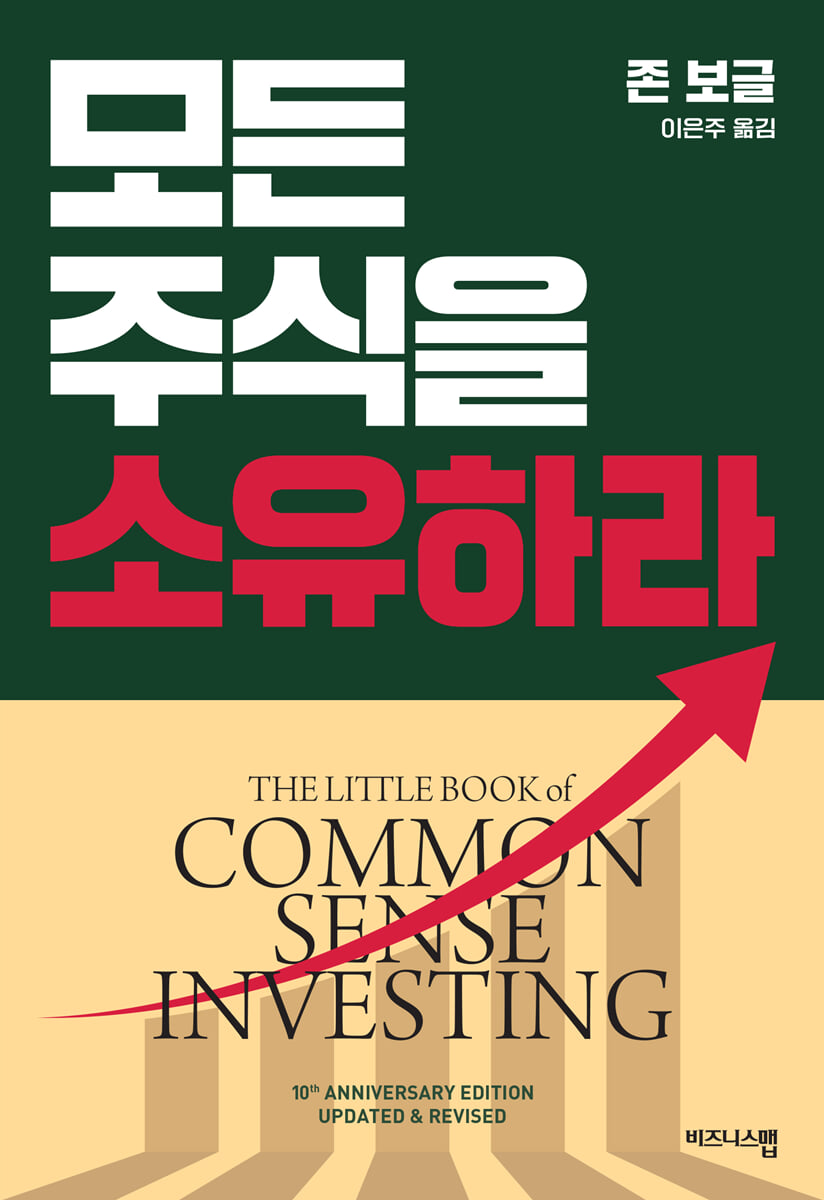
Own All the Stocks (Recovered Edition)
 |
Description
Book Introduction
Investment guru, legend of the fund industry
John Bogle's Rules for Successful Investing
Simplicity is often underestimated, but it is precisely this simplicity, 'common sense', that John Bogle championed throughout his life.
He says.
“Don’t try to beat the market, try to own the whole market.” Invisible costs like commissions, transaction fees, and taxes eat away at compound interest.
Conversely, if you hold a low-cost index for a long time, the "average investor" will outperform many active strategies over the long term.
This book demonstrates this with data and arguments, and advises us to focus on variables we can control rather than making flashy predictions.
In today's market, this message is even clearer.
The key is wide, cheap, and long.
When choosing a product, first check the total compensation (commission) and, if necessary, look into the tracking error and the range of the underlying index.
Above all, you should be wary of frequent trading (especially short-term trading of ETFs) that prioritizes transactional nature.
Bogle was innovation itself.
Through Vanguard, he raised the principles of low cost, long-term, and diversified investment strategies to the standard of the investment industry.
This book doesn't promise any specific stock or 'one size fits all'.
Instead, it presents a standard for investment life that anyone can practice.
“Don’t choose, own.
“Don’t be shaken, keep going.” As the noise of the market grows louder, what shines is not complex technology, but sustainable habits.
For today's Korean investors, this book will serve as the most concise and powerful compass.
John Bogle's Rules for Successful Investing
Simplicity is often underestimated, but it is precisely this simplicity, 'common sense', that John Bogle championed throughout his life.
He says.
“Don’t try to beat the market, try to own the whole market.” Invisible costs like commissions, transaction fees, and taxes eat away at compound interest.
Conversely, if you hold a low-cost index for a long time, the "average investor" will outperform many active strategies over the long term.
This book demonstrates this with data and arguments, and advises us to focus on variables we can control rather than making flashy predictions.
In today's market, this message is even clearer.
The key is wide, cheap, and long.
When choosing a product, first check the total compensation (commission) and, if necessary, look into the tracking error and the range of the underlying index.
Above all, you should be wary of frequent trading (especially short-term trading of ETFs) that prioritizes transactional nature.
Bogle was innovation itself.
Through Vanguard, he raised the principles of low cost, long-term, and diversified investment strategies to the standard of the investment industry.
This book doesn't promise any specific stock or 'one size fits all'.
Instead, it presents a standard for investment life that anyone can practice.
“Don’t choose, own.
“Don’t be shaken, keep going.” As the noise of the market grows louder, what shines is not complex technology, but sustainable habits.
For today's Korean investors, this book will serve as the most concise and powerful compass.
- You can preview some of the book's contents.
Preview
index
Dedicated to the 10th Anniversary Revised and Expanded Edition | Don't Turn a Winning Game into a Losing Game
Chapter 1: Fable: The House of Gotlax
Chapter 2: Rational Exuberance: Shareholder Returns Must Align with Corporate Profits
Chapter 3: Investors and Companies Share a Common Destiny: Occam's Razor
Chapter 4: How Winning Games Become Losing Games: The Cruel Laws of Simple Arithmetic
Chapter 5: The Power of Invisible Costs: As Fund Managers' Shares Grow, Investors' Shares Decrease
Chapter 6: Who Got All the Dividends?: Mutual Funds Eating Dividends
Chapter 7: Beware of the "Three in the Morning, Four in the Evening": Not all announced fund returns go to investors.
Chapter 8: Taxes Are Costs, Too: Investing Needs Tax Tech, Too
Chapter 9: When the Good Times Are Gone: Profitability is a Living, Moving Thing
Chapter 10: Fund Selection Criteria: It's easier to buy the whole haystack than to find a needle in a haystack.
Chapter 11: Regression to the Mean: Yesterday's Winners May Be Tomorrow's Losers
Chapter 12: Need Advice on Fund Selection?: The Light and Dark Side of Investment Advice
Chapter 13: Simple is Best: Investing in Index Funds That Hold All Stocks
Chapter 14: Bond Funds: Another Area Where the Laws of Brutal Arithmetic Apply More Strongly
Chapter 15: Exchange Traded Funds (ETFs): For Day Traders
Chapter 16: Index Funds That Can't Beat the Market: The Emergence of a New Paradigm?
Chapter 17: Benjamin Graham and Index Investing Strategy: A Story Told by Warren Buffett
Chapter 18: Asset Allocation I: When to Start Investing, When Your Assets Are Growing, and When to Retire
Chapter 19: Asset Allocation II: Retirement Investment and Financial Planning
Chapter 20: The Golden Rules of Investing: Market-Tested and Time-Tested Investment Principles
Appendix Review: What Should I Do Now?
Acknowledgements
Chapter 1: Fable: The House of Gotlax
Chapter 2: Rational Exuberance: Shareholder Returns Must Align with Corporate Profits
Chapter 3: Investors and Companies Share a Common Destiny: Occam's Razor
Chapter 4: How Winning Games Become Losing Games: The Cruel Laws of Simple Arithmetic
Chapter 5: The Power of Invisible Costs: As Fund Managers' Shares Grow, Investors' Shares Decrease
Chapter 6: Who Got All the Dividends?: Mutual Funds Eating Dividends
Chapter 7: Beware of the "Three in the Morning, Four in the Evening": Not all announced fund returns go to investors.
Chapter 8: Taxes Are Costs, Too: Investing Needs Tax Tech, Too
Chapter 9: When the Good Times Are Gone: Profitability is a Living, Moving Thing
Chapter 10: Fund Selection Criteria: It's easier to buy the whole haystack than to find a needle in a haystack.
Chapter 11: Regression to the Mean: Yesterday's Winners May Be Tomorrow's Losers
Chapter 12: Need Advice on Fund Selection?: The Light and Dark Side of Investment Advice
Chapter 13: Simple is Best: Investing in Index Funds That Hold All Stocks
Chapter 14: Bond Funds: Another Area Where the Laws of Brutal Arithmetic Apply More Strongly
Chapter 15: Exchange Traded Funds (ETFs): For Day Traders
Chapter 16: Index Funds That Can't Beat the Market: The Emergence of a New Paradigm?
Chapter 17: Benjamin Graham and Index Investing Strategy: A Story Told by Warren Buffett
Chapter 18: Asset Allocation I: When to Start Investing, When Your Assets Are Growing, and When to Retire
Chapter 19: Asset Allocation II: Retirement Investment and Financial Planning
Chapter 20: The Golden Rules of Investing: Market-Tested and Time-Tested Investment Principles
Appendix Review: What Should I Do Now?
Acknowledgements
Into the book
The key to successful investment lies in none other than ‘common sense.’
As Warren Buffett, revered as the "Oracle of Omaha," has said, the best way to invest is to "invest based on common sense."
It may seem simple when you think about it, but it is not as easy as it sounds.
There is a very certain successful investment strategy that can be verified with simple calculations and has been verified with past data.
It is to own all the stocks of domestic listed companies at a low cost.
This way, investors can take almost all of the profits these companies generate in the form of dividends and increased corporate performance.
The best way to implement this strategy is surprisingly simple.
It involves purchasing a fund comprised of a market portfolio (a portfolio that combines all securities traded on the market in proportion to their respective market capitalizations) and then holding it for as long as possible.
--- p.11-12
Although there are times when the stock price does not match the actual corporate value, in the long run, we can see that the stock price eventually moves in the direction of the corporate value.
Therefore, although most investors almost intuitively accept that the past is a prelude to the future, past stock market returns contain speculative elements, making them unsuitable as a guide for predicting the future.
Just listen to the words of the great British economist John Maynard Keynes and you will quickly understand that past earnings cannot predict future earnings.
--- p.49
It's hard to expect the fund industry to abandon its quest for new funds or excessive promotional campaigns any time soon.
Therefore, it will take time and direct experience for investors who have been taking counterproductive actions from a short-term perspective to recognize reality.
However, a wise investor should heed the advice outlined in Chapter 4 not only to minimize costs but also to eliminate emotional factors from investment decisions and actions.
In other words, investors need to improve their short-term behavior that reacts immediately to market fluctuations.
The advantage of index funds, in addition to their low expenses, is that they reduce the risk of being lured by hype and choosing a "slim" fund.
From a long-term perspective, index funds, which aim to avoid the short-term "noise" of the stock market and avoid the popular funds of the day, are the only hope for long-term returns for investors.
There is no room for emotions in index investing.
The formula for successful investing is to own the entire stock market through index funds and then do nothing.
You just have to maintain that state.
--- p.125-126
When trying to implement a lifelong investment strategy, you have two options.
The first is the classic approach: pick three or four active funds and hope they perform well.
However, the fund manager in charge is unlikely to remain with the fund for more than nine years at most, and the fund itself is unlikely to last more than ten years.
As a result, you end up holding 30 to 40 active funds throughout your life, which incurs huge fees and turnover costs.
A second option is to choose a market portfolio fund that pays no fees and has virtually no trading costs.
This index fund simply tracks the market index for the rest of its life without a separate fund manager.
But no matter how much I think about it, there doesn't seem to be a way for active funds to be managed more efficiently or to generate more consistent returns than index funds.
Simplicity, cost-effectiveness, and long-term holding are key elements of investment success.
--- p.174
Graham's invaluable legacy to us is his unwavering commitment to long-term investment principles, coupled with common sense, intelligence, clarity of thought, simplicity, and an appreciation for financial history.
Graham summarizes his advice:
“It might be comforting to hear this from ordinary investors, but for most investors, success doesn’t necessarily require tremendous courage, knowledge, judgment, or experience.
If you don't over-extend yourself and act safely with a defensive investment method that doesn't deviate from your standards, you can definitely succeed in investing.
Achieving satisfactory results is not as difficult as people think.
On the other hand, achieving outstanding results is not as easy as you might think.”
As Warren Buffett, revered as the "Oracle of Omaha," has said, the best way to invest is to "invest based on common sense."
It may seem simple when you think about it, but it is not as easy as it sounds.
There is a very certain successful investment strategy that can be verified with simple calculations and has been verified with past data.
It is to own all the stocks of domestic listed companies at a low cost.
This way, investors can take almost all of the profits these companies generate in the form of dividends and increased corporate performance.
The best way to implement this strategy is surprisingly simple.
It involves purchasing a fund comprised of a market portfolio (a portfolio that combines all securities traded on the market in proportion to their respective market capitalizations) and then holding it for as long as possible.
--- p.11-12
Although there are times when the stock price does not match the actual corporate value, in the long run, we can see that the stock price eventually moves in the direction of the corporate value.
Therefore, although most investors almost intuitively accept that the past is a prelude to the future, past stock market returns contain speculative elements, making them unsuitable as a guide for predicting the future.
Just listen to the words of the great British economist John Maynard Keynes and you will quickly understand that past earnings cannot predict future earnings.
--- p.49
It's hard to expect the fund industry to abandon its quest for new funds or excessive promotional campaigns any time soon.
Therefore, it will take time and direct experience for investors who have been taking counterproductive actions from a short-term perspective to recognize reality.
However, a wise investor should heed the advice outlined in Chapter 4 not only to minimize costs but also to eliminate emotional factors from investment decisions and actions.
In other words, investors need to improve their short-term behavior that reacts immediately to market fluctuations.
The advantage of index funds, in addition to their low expenses, is that they reduce the risk of being lured by hype and choosing a "slim" fund.
From a long-term perspective, index funds, which aim to avoid the short-term "noise" of the stock market and avoid the popular funds of the day, are the only hope for long-term returns for investors.
There is no room for emotions in index investing.
The formula for successful investing is to own the entire stock market through index funds and then do nothing.
You just have to maintain that state.
--- p.125-126
When trying to implement a lifelong investment strategy, you have two options.
The first is the classic approach: pick three or four active funds and hope they perform well.
However, the fund manager in charge is unlikely to remain with the fund for more than nine years at most, and the fund itself is unlikely to last more than ten years.
As a result, you end up holding 30 to 40 active funds throughout your life, which incurs huge fees and turnover costs.
A second option is to choose a market portfolio fund that pays no fees and has virtually no trading costs.
This index fund simply tracks the market index for the rest of its life without a separate fund manager.
But no matter how much I think about it, there doesn't seem to be a way for active funds to be managed more efficiently or to generate more consistent returns than index funds.
Simplicity, cost-effectiveness, and long-term holding are key elements of investment success.
--- p.174
Graham's invaluable legacy to us is his unwavering commitment to long-term investment principles, coupled with common sense, intelligence, clarity of thought, simplicity, and an appreciation for financial history.
Graham summarizes his advice:
“It might be comforting to hear this from ordinary investors, but for most investors, success doesn’t necessarily require tremendous courage, knowledge, judgment, or experience.
If you don't over-extend yourself and act safely with a defensive investment method that doesn't deviate from your standards, you can definitely succeed in investing.
Achieving satisfactory results is not as difficult as people think.
On the other hand, achieving outstanding results is not as easy as you might think.”
--- p.285-286
Publisher's Review
The most important thing is not to lose the 'basics'
Here, we have an investment guru who amassed enormous wealth using only the 'basics' and 'common sense' of investing.
He achieved enormous profits and provided great help to investors who were suffering and frustrated with his investment strategy, which was so simple and common sense that everyone ignored it.
Through his investment philosophy and rules, you will be able to find the answer to what true successful investing is today.
A person who took a path that no one else took because it was so obvious
John Bogle, founder of the global asset management company Vanguard Group and famous for developing the first index fund.
He is a legend in the investment industry, especially in the fund industry.
In the American stock market, where numerous active funds were rampant, he developed a sensible and rational index fund, bringing them all to their knees.
When the world's first index fund was developed in 1975, the fund raised only $16 million, but it recorded annual returns of over 30%, providing enormous profits to Vanguard investors and contributing significantly to the growth of their assets.
Although he was initially treated as a "heretic" for challenging industry practices, he is now revered as a "saint of Wall Street" for his extraordinary returns and his philosophy of putting investors' interests first.
Today, Vanguard Group has grown based on Bogle's investment philosophy and has established itself as a global asset management company, managing approximately 450 funds worldwide and approximately $10-11 trillion in assets.
The Investment Laws of John Bogle, the Saint of Wall Street
John Bogle uses his investment principles, which have made countless Vanguard clients wealthy, to help readers of this book do the same.
When he developed the index fund, the U.S. stock market was booming.
Stock indices were rising, and it was the so-called 'golden age of funds', with numerous funds emerging.
However, most funds failed to even keep up with market returns, and investors failed to benefit from rising stock prices.
Bogle says the most effective investment strategy is to own all publicly traded stocks while minimizing expenses, including commissions.
He adds that index funds, which are portfolios of these listed stocks, are the only strategy that guarantees investors returns.
Filled with deep insights and practical advice, this book demonstrates why this proven investment strategy is bound to succeed and how it can be applied to any investor's portfolio.
Readers will be able to glimpse the insights of a master beyond conventional investment knowledge, thereby establishing sound investment values.
Above all, you will learn how to make your investments a 'winner's game'.
Here, we have an investment guru who amassed enormous wealth using only the 'basics' and 'common sense' of investing.
He achieved enormous profits and provided great help to investors who were suffering and frustrated with his investment strategy, which was so simple and common sense that everyone ignored it.
Through his investment philosophy and rules, you will be able to find the answer to what true successful investing is today.
A person who took a path that no one else took because it was so obvious
John Bogle, founder of the global asset management company Vanguard Group and famous for developing the first index fund.
He is a legend in the investment industry, especially in the fund industry.
In the American stock market, where numerous active funds were rampant, he developed a sensible and rational index fund, bringing them all to their knees.
When the world's first index fund was developed in 1975, the fund raised only $16 million, but it recorded annual returns of over 30%, providing enormous profits to Vanguard investors and contributing significantly to the growth of their assets.
Although he was initially treated as a "heretic" for challenging industry practices, he is now revered as a "saint of Wall Street" for his extraordinary returns and his philosophy of putting investors' interests first.
Today, Vanguard Group has grown based on Bogle's investment philosophy and has established itself as a global asset management company, managing approximately 450 funds worldwide and approximately $10-11 trillion in assets.
The Investment Laws of John Bogle, the Saint of Wall Street
John Bogle uses his investment principles, which have made countless Vanguard clients wealthy, to help readers of this book do the same.
When he developed the index fund, the U.S. stock market was booming.
Stock indices were rising, and it was the so-called 'golden age of funds', with numerous funds emerging.
However, most funds failed to even keep up with market returns, and investors failed to benefit from rising stock prices.
Bogle says the most effective investment strategy is to own all publicly traded stocks while minimizing expenses, including commissions.
He adds that index funds, which are portfolios of these listed stocks, are the only strategy that guarantees investors returns.
Filled with deep insights and practical advice, this book demonstrates why this proven investment strategy is bound to succeed and how it can be applied to any investor's portfolio.
Readers will be able to glimpse the insights of a master beyond conventional investment knowledge, thereby establishing sound investment values.
Above all, you will learn how to make your investments a 'winner's game'.
GOODS SPECIFICS
- Date of issue: September 30, 2025
- Format: Hardcover book binding method guide
- Page count, weight, size: 364 pages | 128*188*30mm
- ISBN13: 9788986022995
- ISBN10: 8986022990
You may also like
카테고리
korean


korean

![GQ KOREA Mark (Monthly): December [2025]](http://librairie.coreenne.fr/cdn/shop/files/8ef265dbbfbf186523ed75ba7319009d.jpg?v=1765340328&width=3840)


