

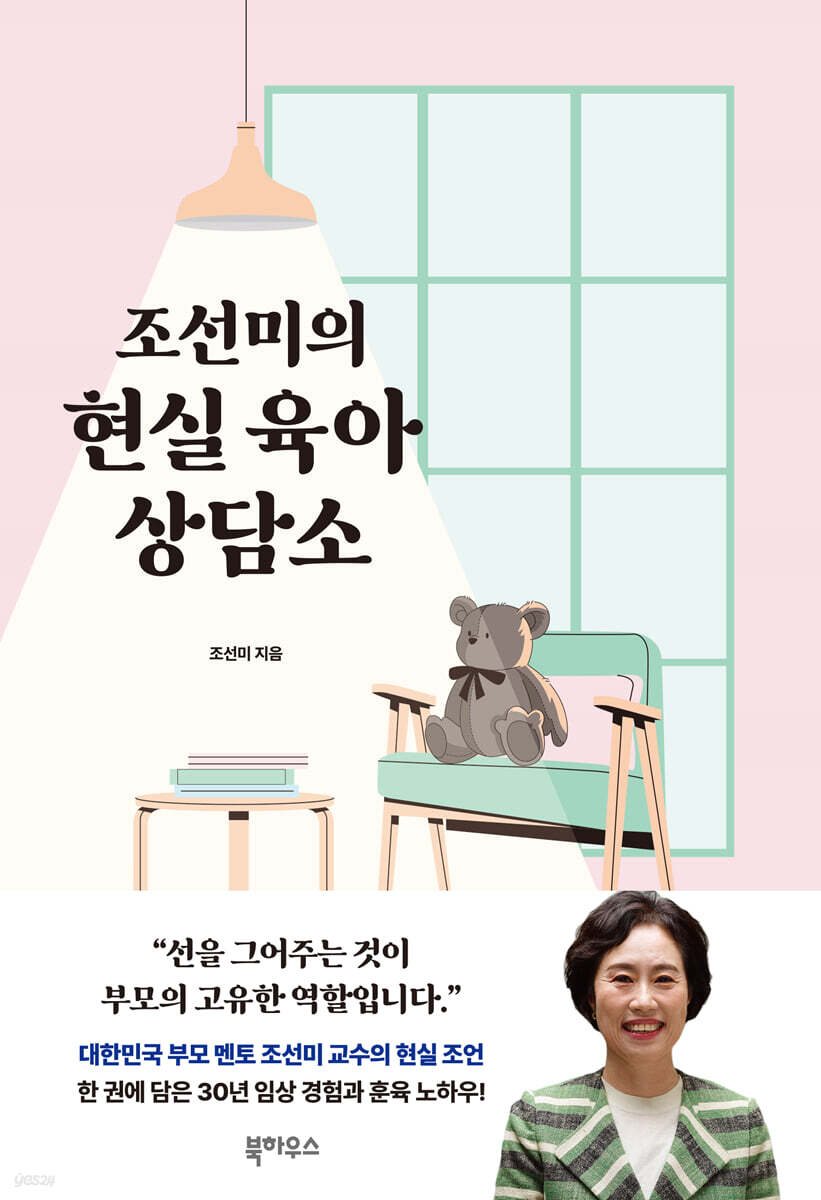
Joseonmi's Reality Parenting Counseling Center
 |
Description
Book Introduction
“It is the parent’s unique role to draw the line.”
Practical Advice from Professor Cho Seon-mi, a Parents' Mentor in South Korea
30 years of clinical experience and training know-how in one book!
“Read their minds, but always discipline them.” A very practical parenting guide for parents, delivered with honest and straightforward language by Professor Cho Sun-mi of Ajou University.
I want to be a good parent, but in reality, parents are always fighting, arguing, getting angry, and regretting things with their children.
Is my child just different? Am I a bad mother? I feel like I'm not living up to the ideal discipline I see in the media and books, and my self-destructiveness only grows.
This book is a parenting guide written by Professor Cho Sun-mi, based on her professional insight, experience, and knowledge, for parents who are concerned about how to effectively discipline their children and change their behavior.
He speaks openly about the need for 'appropriate discipline' to parents who struggle to correct their children's behavior because they are overly focused on 'mind reading'.
If you become an 'authoritative' parent who is not swayed by your children, your children will grow up emotionally comfortable.
It provides clear and refreshing advice on how to effectively teach children what to do and what not to do.
It explains why discipline is difficult, the nature of discipline, what words to avoid when disciplining, how to correct problem behavior, and how to give effective instructions, while kindly explaining how to discipline children in each case by getting to the core.
In particular, it examines the causes of problem behaviors such as tantrums, whining, violent behavior, stubbornness, and sulking, suggests disciplinary principles and methods for each situation, and provides detailed guidance on how to pass on good habits to children.
Practical Advice from Professor Cho Seon-mi, a Parents' Mentor in South Korea
30 years of clinical experience and training know-how in one book!
“Read their minds, but always discipline them.” A very practical parenting guide for parents, delivered with honest and straightforward language by Professor Cho Sun-mi of Ajou University.
I want to be a good parent, but in reality, parents are always fighting, arguing, getting angry, and regretting things with their children.
Is my child just different? Am I a bad mother? I feel like I'm not living up to the ideal discipline I see in the media and books, and my self-destructiveness only grows.
This book is a parenting guide written by Professor Cho Sun-mi, based on her professional insight, experience, and knowledge, for parents who are concerned about how to effectively discipline their children and change their behavior.
He speaks openly about the need for 'appropriate discipline' to parents who struggle to correct their children's behavior because they are overly focused on 'mind reading'.
If you become an 'authoritative' parent who is not swayed by your children, your children will grow up emotionally comfortable.
It provides clear and refreshing advice on how to effectively teach children what to do and what not to do.
It explains why discipline is difficult, the nature of discipline, what words to avoid when disciplining, how to correct problem behavior, and how to give effective instructions, while kindly explaining how to discipline children in each case by getting to the core.
In particular, it examines the causes of problem behaviors such as tantrums, whining, violent behavior, stubbornness, and sulking, suggests disciplinary principles and methods for each situation, and provides detailed guidance on how to pass on good habits to children.
- You can preview some of the book's contents.
Preview
index
To parents who are tired of fighting with their children every day |
Part 1: If you know this, you'll be half as angry.
Why Discipline is Hard
Don't persuade, direct.
How to give effective instructions
The essence of discipline is developing frustration tolerance.
The goal of discipline is to develop good habits.
Nonverbal messages are also important
Consistency is important, but don't be obsessed.
Things to avoid when disciplining
'Time Out' to Correct Problem Behavior Without Getting Angry
Sticker system that reinforces behavior with rewards
Three things you should never do
Corporal punishment is not discipline.
Part 2: You need to set boundaries for your child's behavior to help them grow well.
Every time I give instructions, he says no
If things don't go their way, they throw a tantrum.
Magic Spell "I want this"
Why is my child the only one who whines like this?
The child is acting violently.
My child's speech is becoming increasingly rough.
The child is obsessed with his mother.
My child is very opinionated.
A nagging mother, a talking back child
I'm sensitive to everything and get upset easily.
My child's tail is too long
Is my child impatient? Could it be ADHD?
Part 3: Good Habits Become Weapons for Life
I suffer every day because my child hates brushing his teeth.
My child sucks his thumb. Can I leave him alone?
How long should mom and dad let the baby sleep?
I've been afraid to eat since food got stuck in my throat.
I don't want to go to daycare
This morning feels like war, can't we get some relief?
My child has no concept of time.
What should I do about my child who only looks at his smartphone?
I wish I hadn't played the game
Part 4: Reality: Mothers Need Patience More Than Love
Read your child's mind and judge his or her claims.
Empathy and comfort twice a day is enough.
Excessive praise is poisonous.
Three Misconceptions Parents Have About Self-Esteem
Excessive interaction harms concentration.
Don't expect your child to understand your heart.
Things I only realized after becoming a mother
Am I a good mother?
In conclusion | You are a good enough parent
Part 1: If you know this, you'll be half as angry.
Why Discipline is Hard
Don't persuade, direct.
How to give effective instructions
The essence of discipline is developing frustration tolerance.
The goal of discipline is to develop good habits.
Nonverbal messages are also important
Consistency is important, but don't be obsessed.
Things to avoid when disciplining
'Time Out' to Correct Problem Behavior Without Getting Angry
Sticker system that reinforces behavior with rewards
Three things you should never do
Corporal punishment is not discipline.
Part 2: You need to set boundaries for your child's behavior to help them grow well.
Every time I give instructions, he says no
If things don't go their way, they throw a tantrum.
Magic Spell "I want this"
Why is my child the only one who whines like this?
The child is acting violently.
My child's speech is becoming increasingly rough.
The child is obsessed with his mother.
My child is very opinionated.
A nagging mother, a talking back child
I'm sensitive to everything and get upset easily.
My child's tail is too long
Is my child impatient? Could it be ADHD?
Part 3: Good Habits Become Weapons for Life
I suffer every day because my child hates brushing his teeth.
My child sucks his thumb. Can I leave him alone?
How long should mom and dad let the baby sleep?
I've been afraid to eat since food got stuck in my throat.
I don't want to go to daycare
This morning feels like war, can't we get some relief?
My child has no concept of time.
What should I do about my child who only looks at his smartphone?
I wish I hadn't played the game
Part 4: Reality: Mothers Need Patience More Than Love
Read your child's mind and judge his or her claims.
Empathy and comfort twice a day is enough.
Excessive praise is poisonous.
Three Misconceptions Parents Have About Self-Esteem
Excessive interaction harms concentration.
Don't expect your child to understand your heart.
Things I only realized after becoming a mother
Am I a good mother?
In conclusion | You are a good enough parent
Detailed image

Into the book
“Discipline isn’t just about telling people what not to do and teaching them to wait.
If you thought that was all there was to it, then you don't know how to discipline properly.
“The hidden aspect of discipline that many parents overlook is consistency.”
---p.19
“I think habits are the essence of a person.
What a person looks like, how tall they are, what they think, these are all characteristics of a person, but aren't the most essential parts of a person's life their repeated actions?
This repeated behavior is a habit.”
---p.46
“The key to time-out is not to impose anxiety or fear on the child, but to temporarily stop an activity the child enjoys.
“The younger the child, the more they need to move constantly, and if they are not allowed to move, they get bored and have a hard time.”
---p.70
“The reasons children throw tantrums are similar regardless of age.
“Because they cannot control their emotions or actions and cannot distinguish between what they should and should not do.”
---p.107
“So why do kids whine so much? It’s simple.
Whining is a child's way of asking for something to be done quickly.
“It’s a way of attracting attention, especially when my mom is distracted and not paying attention to me.”
---p.121
“While expressing your emotions honestly is necessary in some situations, there are limitations to how you can express them.
In these situations, many parents feel confused about how much they should allow and where they should start controlling.
Let me give you a simple guideline.
Just think, ‘Would it be okay to do this outside right now?’”
---pp.134~135
“But here is where parents make a big mistake.
When you tell them to read their mind, there are cases where they go beyond reading their child's emotions and let the child do as he or she pleases.
However, there are times when a child's claim can be accepted and times when it cannot.
Therefore, parents should read the child's feelings, but decide whether to accept the child's claim or not."
---p.223
“In short, be generous with praise when you try something new or make a positive attempt.
Even if you don't do it, praise yourself for even thinking about doing it, saying, "You've thought about doing it." ---p.239
“We regret not because we did not love, but because we did not endure.
“If you want to scream right now, but can take a deep breath and speak softly, that in itself is already an enormous amount of love.”
If you thought that was all there was to it, then you don't know how to discipline properly.
“The hidden aspect of discipline that many parents overlook is consistency.”
---p.19
“I think habits are the essence of a person.
What a person looks like, how tall they are, what they think, these are all characteristics of a person, but aren't the most essential parts of a person's life their repeated actions?
This repeated behavior is a habit.”
---p.46
“The key to time-out is not to impose anxiety or fear on the child, but to temporarily stop an activity the child enjoys.
“The younger the child, the more they need to move constantly, and if they are not allowed to move, they get bored and have a hard time.”
---p.70
“The reasons children throw tantrums are similar regardless of age.
“Because they cannot control their emotions or actions and cannot distinguish between what they should and should not do.”
---p.107
“So why do kids whine so much? It’s simple.
Whining is a child's way of asking for something to be done quickly.
“It’s a way of attracting attention, especially when my mom is distracted and not paying attention to me.”
---p.121
“While expressing your emotions honestly is necessary in some situations, there are limitations to how you can express them.
In these situations, many parents feel confused about how much they should allow and where they should start controlling.
Let me give you a simple guideline.
Just think, ‘Would it be okay to do this outside right now?’”
---pp.134~135
“But here is where parents make a big mistake.
When you tell them to read their mind, there are cases where they go beyond reading their child's emotions and let the child do as he or she pleases.
However, there are times when a child's claim can be accepted and times when it cannot.
Therefore, parents should read the child's feelings, but decide whether to accept the child's claim or not."
---p.223
“In short, be generous with praise when you try something new or make a positive attempt.
Even if you don't do it, praise yourself for even thinking about doing it, saying, "You've thought about doing it." ---p.239
“We regret not because we did not love, but because we did not endure.
“If you want to scream right now, but can take a deep breath and speak softly, that in itself is already an enormous amount of love.”
---p.262
Publisher's Review
From ‘Excessive Mind Reading’ to ‘Balanced Parenting’
Professor Cho Sun-mi's Guide to Childcare: Changing the Parenting Paradigm
30 years of clinical experience and training know-how in one book!
'Why is my child like this?' Many parents fight a daily parenting war because their child whines, throws tantrums, and refuses to listen.
Even though parents diligently seek out various parenting knowledge and information, parenting is still a difficult and challenging task.
I want to be the 'ideal' parent who can read my child's mind well, but I always end up getting angry, yelling, and then turning around and regretting it.
Where on earth did it all go wrong?
Professor Cho Sun-mi of Ajou University, a mentor for parents in Korea, has written a book titled "Cho Sun-mi's Reality Parenting Counseling Center." This book clearly and bluntly explains the principles and methods of discipline that are essential for parents who are wondering, "Am I the only bad mother?" or "Is my parenting style the problem?"
This is a concise and clear parenting guide that distills 30 years of clinical experience and know-how, focusing only on the essential points.
Don't beat around the bush.
It is characterized by giving realistic advice using direct language that busy and tired parents can quickly understand, such as “Please, try to read minds a little”, “The essence of discipline is frustration”, and “Understand the mind, but frustration is also necessary”.
It might give you a flash of insight.
In these days when the prevailing parenting method is to accept and listen to a child's feelings affectionately as much as possible, this book speaks candidly about the need for 'appropriate discipline' to parents struggling with the difficulties of parenting.
Especially in these times when “mind-reading” books that respect children’s emotions are so popular, this book, which advises that “there is no need to read minds when disciplining” as if it desperately needs to find a balance, may be quite unconventional for parents.
“You need to set boundaries for your children to thrive.”
One of the unique roles of parents is to 'draw the line'.
The most realistic, concrete, and essential core advice
A child should receive unconditional love from his parents.
This is also a basic premise in this book.
No matter what anyone says, the more a child feels that he or she is loved, the healthier he or she will grow up to be.
But love alone isn't the answer to everything when it comes to parenting.
This book emphasizes that “discipline is the foundation of skills that children will need to survive in society throughout their lives,” and that we should not neglect discipline, which is essential, under the pretext of wanting to be “friend-like parents” or “democratic parents” due to an aversion to discipline itself.
In order for children to grow up to be strong individuals without fear of failure, parents must give them the opportunity to regulate their emotions on their own.
It is also emphasized again that greater love is what fosters in children the resilience to endure hardships, as well as the autonomy and independence to enable them to endure difficult and challenging situations.
Will reading a child's mind solve everything? What if they do things they shouldn't and repeat misbehavior? These days, there are more and more cases of "excessive mind reading" resulting in problems like children who can't regulate their emotions, becoming dependent, or becoming self-centered.
If we accept and allow everything, and then when it is time to discipline, proper discipline is not provided, not only the parents but also the child suffers.
In this book, the author, based on his clear insight as a psychologist and clinical expert, provides specific guidance on when to 'discipline', how to do it, and what to keep in mind.
It details how to discipline calmly and consistently.
Discipline is one of the important roles that parents must play, teaching what can be done and what cannot be done, and teaching patience.
If you explain things one by one and try to read their minds, they will get frustrated and end up yelling and getting angry. However, if you take the initiative and give clear instructions, the anger will decrease and the children will not feel that their parents are suddenly getting angry.
Children also learn to give up quickly, thinking, "This is useless," and become emotionally comfortable.
If you try to explain and persuade your child one by one, the discipline will often be ineffective and your authority as a parent will be weakened.
If the condition is severe, both the parent and the child will fall into a pit of suffering, as the child will become stubborn and ignore the parent.
According to Professor Cho Sun-mi, “the essence of discipline is to frustrate the child.”
If a child is prevented from doing what he wants to do (a wrong behavior), he will experience 'frustration', and by enduring this frustration, he will develop self-reliance.
Parents should believe that their children are learning tools that they can use to navigate the world, and if they are determined to correct their behavior, they should be patient and correct them until their children follow suit.
For example, if a child does not stop misbehaving, such as hitting someone or throwing something, even after being told to do so several times, you should try to temporarily stop the behavior and restrain the activity through a 'time-out'.
While it is important to correct bad behavior, it is also very important to form good habits.
Developing good habits is like giving children the skills they need to thrive.
The most powerful way to form a habit is through repetition, so you need to start with something simple and make rules that you follow consistently.
One of the methods suggested in this book is the 'sticker system', which is not something very grandiose and can be easily tried by anyone.
Using praise stickers as a reward until the taught behavior becomes a habit is extremely effective.
If you apply the sticker system appropriately, you may find that children demonstrate much greater self-control than you might think.
Discipline methods that instill confidence in parents
"Moderately Indifferent Parenting" Instead of Overprotection and Excessive Interference
This book emphasizes the importance of setting boundaries and developing good habits, exploring parenting challenges through concrete examples and offering simple, clear solutions that can be implemented immediately.
From behavioral problems like throwing tantrums, whining, ignoring rules, acting out violently, and being clingy to their mother, to a variety of habitual issues like brushing teeth, sleeping, going to kindergarten, and playing games.
It goes through the most difficult and curious issues for parents one by one, and clearly provides the principles and know-how for successful discipline.
When a child is upset because they can't get what they want, should parents always try to make them feel better? Giving in to their child's every wish just because they're upset is a surefire way to ruin them.
The child demands more and more and becomes much more upset when something is not done.
Then what should we do?
Here are some things to remember:
Children develop mental strength by enduring things that don't go their way.
Excessive mind reading can make a child think that only his or her own feelings are important.
Professor Cho Sun-mi advises, “When emotions explode, give the child time until he or she can control his or her emotions on his or her own.”
He added, “Children of moderately indifferent parents tend to tolerate failure more indifferently.”
Readers who have read a lot of parenting books will understand this right away.
This book is designed to give parents confidence in parenting.
It provides a firm balance, reminding children that if they stick to the basics of “accept their feelings, but correct their behavior,” their children will grow up well without any problems.
Instead of making you think, 'Oh my, how can I do all this?', this is a book that makes you think, 'I can do this too.'
Although written in easy-to-understand, everyday language, the deeper context is based on scientific evidence. If you carefully consider each topic and apply it to your own real-world situation, it will serve as a valuable guide when you feel lost and confused.
Professor Cho Sun-mi's Guide to Childcare: Changing the Parenting Paradigm
30 years of clinical experience and training know-how in one book!
'Why is my child like this?' Many parents fight a daily parenting war because their child whines, throws tantrums, and refuses to listen.
Even though parents diligently seek out various parenting knowledge and information, parenting is still a difficult and challenging task.
I want to be the 'ideal' parent who can read my child's mind well, but I always end up getting angry, yelling, and then turning around and regretting it.
Where on earth did it all go wrong?
Professor Cho Sun-mi of Ajou University, a mentor for parents in Korea, has written a book titled "Cho Sun-mi's Reality Parenting Counseling Center." This book clearly and bluntly explains the principles and methods of discipline that are essential for parents who are wondering, "Am I the only bad mother?" or "Is my parenting style the problem?"
This is a concise and clear parenting guide that distills 30 years of clinical experience and know-how, focusing only on the essential points.
Don't beat around the bush.
It is characterized by giving realistic advice using direct language that busy and tired parents can quickly understand, such as “Please, try to read minds a little”, “The essence of discipline is frustration”, and “Understand the mind, but frustration is also necessary”.
It might give you a flash of insight.
In these days when the prevailing parenting method is to accept and listen to a child's feelings affectionately as much as possible, this book speaks candidly about the need for 'appropriate discipline' to parents struggling with the difficulties of parenting.
Especially in these times when “mind-reading” books that respect children’s emotions are so popular, this book, which advises that “there is no need to read minds when disciplining” as if it desperately needs to find a balance, may be quite unconventional for parents.
“You need to set boundaries for your children to thrive.”
One of the unique roles of parents is to 'draw the line'.
The most realistic, concrete, and essential core advice
A child should receive unconditional love from his parents.
This is also a basic premise in this book.
No matter what anyone says, the more a child feels that he or she is loved, the healthier he or she will grow up to be.
But love alone isn't the answer to everything when it comes to parenting.
This book emphasizes that “discipline is the foundation of skills that children will need to survive in society throughout their lives,” and that we should not neglect discipline, which is essential, under the pretext of wanting to be “friend-like parents” or “democratic parents” due to an aversion to discipline itself.
In order for children to grow up to be strong individuals without fear of failure, parents must give them the opportunity to regulate their emotions on their own.
It is also emphasized again that greater love is what fosters in children the resilience to endure hardships, as well as the autonomy and independence to enable them to endure difficult and challenging situations.
Will reading a child's mind solve everything? What if they do things they shouldn't and repeat misbehavior? These days, there are more and more cases of "excessive mind reading" resulting in problems like children who can't regulate their emotions, becoming dependent, or becoming self-centered.
If we accept and allow everything, and then when it is time to discipline, proper discipline is not provided, not only the parents but also the child suffers.
In this book, the author, based on his clear insight as a psychologist and clinical expert, provides specific guidance on when to 'discipline', how to do it, and what to keep in mind.
It details how to discipline calmly and consistently.
Discipline is one of the important roles that parents must play, teaching what can be done and what cannot be done, and teaching patience.
If you explain things one by one and try to read their minds, they will get frustrated and end up yelling and getting angry. However, if you take the initiative and give clear instructions, the anger will decrease and the children will not feel that their parents are suddenly getting angry.
Children also learn to give up quickly, thinking, "This is useless," and become emotionally comfortable.
If you try to explain and persuade your child one by one, the discipline will often be ineffective and your authority as a parent will be weakened.
If the condition is severe, both the parent and the child will fall into a pit of suffering, as the child will become stubborn and ignore the parent.
According to Professor Cho Sun-mi, “the essence of discipline is to frustrate the child.”
If a child is prevented from doing what he wants to do (a wrong behavior), he will experience 'frustration', and by enduring this frustration, he will develop self-reliance.
Parents should believe that their children are learning tools that they can use to navigate the world, and if they are determined to correct their behavior, they should be patient and correct them until their children follow suit.
For example, if a child does not stop misbehaving, such as hitting someone or throwing something, even after being told to do so several times, you should try to temporarily stop the behavior and restrain the activity through a 'time-out'.
While it is important to correct bad behavior, it is also very important to form good habits.
Developing good habits is like giving children the skills they need to thrive.
The most powerful way to form a habit is through repetition, so you need to start with something simple and make rules that you follow consistently.
One of the methods suggested in this book is the 'sticker system', which is not something very grandiose and can be easily tried by anyone.
Using praise stickers as a reward until the taught behavior becomes a habit is extremely effective.
If you apply the sticker system appropriately, you may find that children demonstrate much greater self-control than you might think.
Discipline methods that instill confidence in parents
"Moderately Indifferent Parenting" Instead of Overprotection and Excessive Interference
This book emphasizes the importance of setting boundaries and developing good habits, exploring parenting challenges through concrete examples and offering simple, clear solutions that can be implemented immediately.
From behavioral problems like throwing tantrums, whining, ignoring rules, acting out violently, and being clingy to their mother, to a variety of habitual issues like brushing teeth, sleeping, going to kindergarten, and playing games.
It goes through the most difficult and curious issues for parents one by one, and clearly provides the principles and know-how for successful discipline.
When a child is upset because they can't get what they want, should parents always try to make them feel better? Giving in to their child's every wish just because they're upset is a surefire way to ruin them.
The child demands more and more and becomes much more upset when something is not done.
Then what should we do?
Here are some things to remember:
Children develop mental strength by enduring things that don't go their way.
Excessive mind reading can make a child think that only his or her own feelings are important.
Professor Cho Sun-mi advises, “When emotions explode, give the child time until he or she can control his or her emotions on his or her own.”
He added, “Children of moderately indifferent parents tend to tolerate failure more indifferently.”
Readers who have read a lot of parenting books will understand this right away.
This book is designed to give parents confidence in parenting.
It provides a firm balance, reminding children that if they stick to the basics of “accept their feelings, but correct their behavior,” their children will grow up well without any problems.
Instead of making you think, 'Oh my, how can I do all this?', this is a book that makes you think, 'I can do this too.'
Although written in easy-to-understand, everyday language, the deeper context is based on scientific evidence. If you carefully consider each topic and apply it to your own real-world situation, it will serve as a valuable guide when you feel lost and confused.
GOODS SPECIFICS
- Date of issue: April 20, 2023
- Page count, weight, size: 272 pages | 350g | 140*205*17mm
- ISBN13: 9791164052035
- ISBN10: 1164052039
You may also like
카테고리
korean


korean

![GQ KOREA Mark (Monthly): December [2025]](http://librairie.coreenne.fr/cdn/shop/files/8ef265dbbfbf186523ed75ba7319009d.jpg?v=1765340328&width=3840)


