

The Art of War: All the Strategies and Tactics of the World
 |
Description
Book Introduction
Since its appearance in the 6th century BC, The Art of War has been a timeless bestseller, with thousands of commentaries written about it.
Every year at the beginning of the year, leaders from all walks of life, as well as many people seeking answers to life's problems, turn to The Art of War.
In times of peace, The Art of War continues to be loved as a management book and a book on how to live in the world.
However, it is true that there is a bit of a disconnect in the way that The Art of War, which was originally a military book, is packaged as a lesson for leadership or self-development.
So, an expert well-versed in military history presented a commentary on Sun Tzu's The Art of War, using wars and battles that left their mark on history.
Historian Yonghan Lim, who established himself as an expert in the field of military history with his talk show "War History Talk" reaching 80 million views, has published a commentary that interprets the Art of War as a history of wars across the East and the West, past and present.
Every year at the beginning of the year, leaders from all walks of life, as well as many people seeking answers to life's problems, turn to The Art of War.
In times of peace, The Art of War continues to be loved as a management book and a book on how to live in the world.
However, it is true that there is a bit of a disconnect in the way that The Art of War, which was originally a military book, is packaged as a lesson for leadership or self-development.
So, an expert well-versed in military history presented a commentary on Sun Tzu's The Art of War, using wars and battles that left their mark on history.
Historian Yonghan Lim, who established himself as an expert in the field of military history with his talk show "War History Talk" reaching 80 million views, has published a commentary that interprets the Art of War as a history of wars across the East and the West, past and present.
- You can preview some of the book's contents.
Preview
index
Introduction
Part 1 Accounting
Part 2 Operation
Part 3: The Pore's Scheme
Part 4: Form
Part 5: Three Forces
Part 6: Falsehood and Reality
Part 7: Military Conflict
Part 8: Nine Changes
Part 9: Marching
Part 10: Topography
Part 11: Nine Earths
Part 12: Fire Attack
Chapter 13: Use of Time
Part 1 Accounting
Part 2 Operation
Part 3: The Pore's Scheme
Part 4: Form
Part 5: Three Forces
Part 6: Falsehood and Reality
Part 7: Military Conflict
Part 8: Nine Changes
Part 9: Marching
Part 10: Topography
Part 11: Nine Earths
Part 12: Fire Attack
Chapter 13: Use of Time
Detailed image
Into the book
Since the ability to uncover the truth determines the outcome of a war, efforts to cultivate that ability are also very important. Let me give you an example of a genius.
There is a theory that Karl Mack, the Austrian commander who faced Napoleon at the Battle of Ulm in 1805, became mentally unstable and died while struggling with the mystery of Napoleon.
The mystery of Napoleon was the uncanny ability of his army to move.
No, the expression 'appearance' would be more correct.
Until then, the standard way to wage war was to gather troops in advance to be deployed to the battle zone.
Due to uncertain maps, narrow roads, poor logistics, and infantry-centered armies, commanders of the time began battles by massing their troops in the expected battle area.
Even if there was an army hidden behind them, they couldn't be pushed far away.
To detect such obvious tricks, both sides mobilized cavalry to reconnoiter the daily movement range of their infantry.
If there were no enemies inside, it meant that the troops on this battlefield were all there were.
But Napoleon went beyond this and moved his corps, sometimes hundreds of kilometers away, along different routes to ensure they arrived at the battlefield at a set time.
Those who entered the battle only after seeing the size of Napoleon's army in front of them were often terrified by the French army that suddenly appeared in the middle of the battle and were defeated.
The Battle of Austerlitz took place in what is now the Czech Republic, and Marshal Davout arrived at the battlefield after a forced march of 110 kilometers in two days.
--- p.23~24
The most dangerous logic in war is unfounded optimism, and the most dangerous person is the unprepared hardliner.
In war, hardliners prevail.
If even a small victory had been achieved just before that, the cautious person would likely be labeled a coward.
True courage comes from fear.
A man who does not know fear cannot be a true warrior.
A leader must be able to distinguish between those who appear brave because they are frivolous and those who are true fighters, between those who are cautious because they are timid and those who are cautious because they have a broad perspective.
Only then can you heed the advice of these advisors and know when to fight and when not to fight.
When we think of the Mongol army, we tend to think of battle-hardened and wild warriors.
In fact, before Genghis Khan, such people were treated as warriors, but Genghis Khan changed the standard of warriors.
The leader that Genghis Khan most disliked was a brave and reckless warrior without a plan.
Genghis Khan would isolate such people from the battlefield and send them to a horse feeding place.
For Genghis Khan, a good officer was someone who knew when to fight and when not to fight, and who knew how to wait patiently until the optimal moment to launch an attack.
Genghis Khan adhered to two standards that might seem incongruous with the image of a savage warrior of the steppes: wisdom and perseverance, and his army became the most powerful in the world.
--- p.148
Sun Tzu's problem is how to deal with the 'unfortunate situations' that inevitably arise on the battlefield, that is, the unpredictable and ever-changing situations that arise during the battle between friendly and enemy forces using all their wits.
It is also an unavoidable situation in long-distance expeditions and wars of conquest.
This is a situation that no amount of training or countless battles in the home country can prepare you for.
If you prepare enough data every time you encounter Shincheonji and try to jump in, you will never achieve unification of the world even if it takes 100 years.
The meaning of these words from Sun Tzu may be better understood by us living in modern times.
In today's world, where new technologies change the world overnight, it is impossible to fully prepare for tomorrow's changes.
The only way is to develop coping skills, not pre-learning.
Here we can see the most crucial part of the advice given by the grandson.
It is the ability and reaction to respond in unknown situations.
--- p.154~155
Sun Tzu said that one should not attack an enemy attempting to cross the river while he is underwater, but rather attack after he has crossed halfway.
When attacking them, it is advised not to fight by sticking to the water's edge, but to use the surrounding high ground.
Some commanders may object to this statement.
The success or failure of a river crossing operation or landing operation depends on securing a beachhead.
To prevent enemy follow-up units from continuing to cross without allowing a bridgehead, it would be effective to keep friendly forces on the water's edge and fundamentally block any opportunity to establish a bridgehead.
But if you fight by sticking to the water's edge, the battle will eventually become a fight between the front line of your forces and the front line of the enemy forces.
In short, Sun Tzu advises us to use the terrain more effectively.
There are usually slopes or highlands around the water.
The grandson tells him to take advantage of the terrain.
This is not to say that you should give up on securing a bridgehead, but rather that you should not limit your tactics by focusing solely on the bridgehead.
When devising strategies and tactics, we often get caught up in formalities like 'bridgeheads' and fail to see the big picture.
--- p.335
This insight that the essence of a mercenary is speed breathed eternal life into The Art of War.
Even in the West, before the Napoleonic era, The Art of War was translated and became a bestseller, and even today, it remains a must-read for generals in both the East and the West.
The decisive factor in why it is still respected in modern warfare despite being an ancient military book is that Sun Tzu spread the tactical principles of utilizing speed throughout the book.
The era in which the grandson lived was one of rife division and discord.
A country's army was a confederation of warring factions and meddlesome aristocrats.
Having lived in such a time, Sun Tzu would have noticed the power of division early on and applied it to his tactics.
But it is a remarkable insight to suggest speed and maneuverability as a means of division.
At that time, cavalry had not yet appeared in the Central Plains, and the use of chariots was very limited.
Cavalry was the exclusive domain of nomads.
Yet, Sun Tzu developed the theory of tactics based on speed, a concept that could only be imagined when cavalry warfare was possible.
This insight is the true life force of The Art of War.
There is a theory that Karl Mack, the Austrian commander who faced Napoleon at the Battle of Ulm in 1805, became mentally unstable and died while struggling with the mystery of Napoleon.
The mystery of Napoleon was the uncanny ability of his army to move.
No, the expression 'appearance' would be more correct.
Until then, the standard way to wage war was to gather troops in advance to be deployed to the battle zone.
Due to uncertain maps, narrow roads, poor logistics, and infantry-centered armies, commanders of the time began battles by massing their troops in the expected battle area.
Even if there was an army hidden behind them, they couldn't be pushed far away.
To detect such obvious tricks, both sides mobilized cavalry to reconnoiter the daily movement range of their infantry.
If there were no enemies inside, it meant that the troops on this battlefield were all there were.
But Napoleon went beyond this and moved his corps, sometimes hundreds of kilometers away, along different routes to ensure they arrived at the battlefield at a set time.
Those who entered the battle only after seeing the size of Napoleon's army in front of them were often terrified by the French army that suddenly appeared in the middle of the battle and were defeated.
The Battle of Austerlitz took place in what is now the Czech Republic, and Marshal Davout arrived at the battlefield after a forced march of 110 kilometers in two days.
--- p.23~24
The most dangerous logic in war is unfounded optimism, and the most dangerous person is the unprepared hardliner.
In war, hardliners prevail.
If even a small victory had been achieved just before that, the cautious person would likely be labeled a coward.
True courage comes from fear.
A man who does not know fear cannot be a true warrior.
A leader must be able to distinguish between those who appear brave because they are frivolous and those who are true fighters, between those who are cautious because they are timid and those who are cautious because they have a broad perspective.
Only then can you heed the advice of these advisors and know when to fight and when not to fight.
When we think of the Mongol army, we tend to think of battle-hardened and wild warriors.
In fact, before Genghis Khan, such people were treated as warriors, but Genghis Khan changed the standard of warriors.
The leader that Genghis Khan most disliked was a brave and reckless warrior without a plan.
Genghis Khan would isolate such people from the battlefield and send them to a horse feeding place.
For Genghis Khan, a good officer was someone who knew when to fight and when not to fight, and who knew how to wait patiently until the optimal moment to launch an attack.
Genghis Khan adhered to two standards that might seem incongruous with the image of a savage warrior of the steppes: wisdom and perseverance, and his army became the most powerful in the world.
--- p.148
Sun Tzu's problem is how to deal with the 'unfortunate situations' that inevitably arise on the battlefield, that is, the unpredictable and ever-changing situations that arise during the battle between friendly and enemy forces using all their wits.
It is also an unavoidable situation in long-distance expeditions and wars of conquest.
This is a situation that no amount of training or countless battles in the home country can prepare you for.
If you prepare enough data every time you encounter Shincheonji and try to jump in, you will never achieve unification of the world even if it takes 100 years.
The meaning of these words from Sun Tzu may be better understood by us living in modern times.
In today's world, where new technologies change the world overnight, it is impossible to fully prepare for tomorrow's changes.
The only way is to develop coping skills, not pre-learning.
Here we can see the most crucial part of the advice given by the grandson.
It is the ability and reaction to respond in unknown situations.
--- p.154~155
Sun Tzu said that one should not attack an enemy attempting to cross the river while he is underwater, but rather attack after he has crossed halfway.
When attacking them, it is advised not to fight by sticking to the water's edge, but to use the surrounding high ground.
Some commanders may object to this statement.
The success or failure of a river crossing operation or landing operation depends on securing a beachhead.
To prevent enemy follow-up units from continuing to cross without allowing a bridgehead, it would be effective to keep friendly forces on the water's edge and fundamentally block any opportunity to establish a bridgehead.
But if you fight by sticking to the water's edge, the battle will eventually become a fight between the front line of your forces and the front line of the enemy forces.
In short, Sun Tzu advises us to use the terrain more effectively.
There are usually slopes or highlands around the water.
The grandson tells him to take advantage of the terrain.
This is not to say that you should give up on securing a bridgehead, but rather that you should not limit your tactics by focusing solely on the bridgehead.
When devising strategies and tactics, we often get caught up in formalities like 'bridgeheads' and fail to see the big picture.
--- p.335
This insight that the essence of a mercenary is speed breathed eternal life into The Art of War.
Even in the West, before the Napoleonic era, The Art of War was translated and became a bestseller, and even today, it remains a must-read for generals in both the East and the West.
The decisive factor in why it is still respected in modern warfare despite being an ancient military book is that Sun Tzu spread the tactical principles of utilizing speed throughout the book.
The era in which the grandson lived was one of rife division and discord.
A country's army was a confederation of warring factions and meddlesome aristocrats.
Having lived in such a time, Sun Tzu would have noticed the power of division early on and applied it to his tactics.
But it is a remarkable insight to suggest speed and maneuverability as a means of division.
At that time, cavalry had not yet appeared in the Central Plains, and the use of chariots was very limited.
Cavalry was the exclusive domain of nomads.
Yet, Sun Tzu developed the theory of tactics based on speed, a concept that could only be imagined when cavalry warfare was possible.
This insight is the true life force of The Art of War.
--- p.397~398
Publisher's Review
The Art of War was used as a surefire strategy in the 6th century BC, when China was divided into dozens of countries and war and intrigue were rampant.
About 800 years later, in the 2nd century, Cao Cao, who founded the Wei Dynasty, was an avid reader of The Art of War and published the most widely read commentary on it today.
And then, 1200 years later, Grand Prince Suyang published the "Mugyeong Chilseo Juhae" (Notes on the Art of War), which was annotated on the Art of War by Sun Tzu, and 100 years later, Yi Sun-sin protected our seas from Japanese pirates using the strategies and tactics developed from the Art of War.
And then, 400 years later, during the two world wars, Germany's Rommel, the United States' Patton, and even Douglas MacArthur during the Korean War all used The Art of War as a textbook.
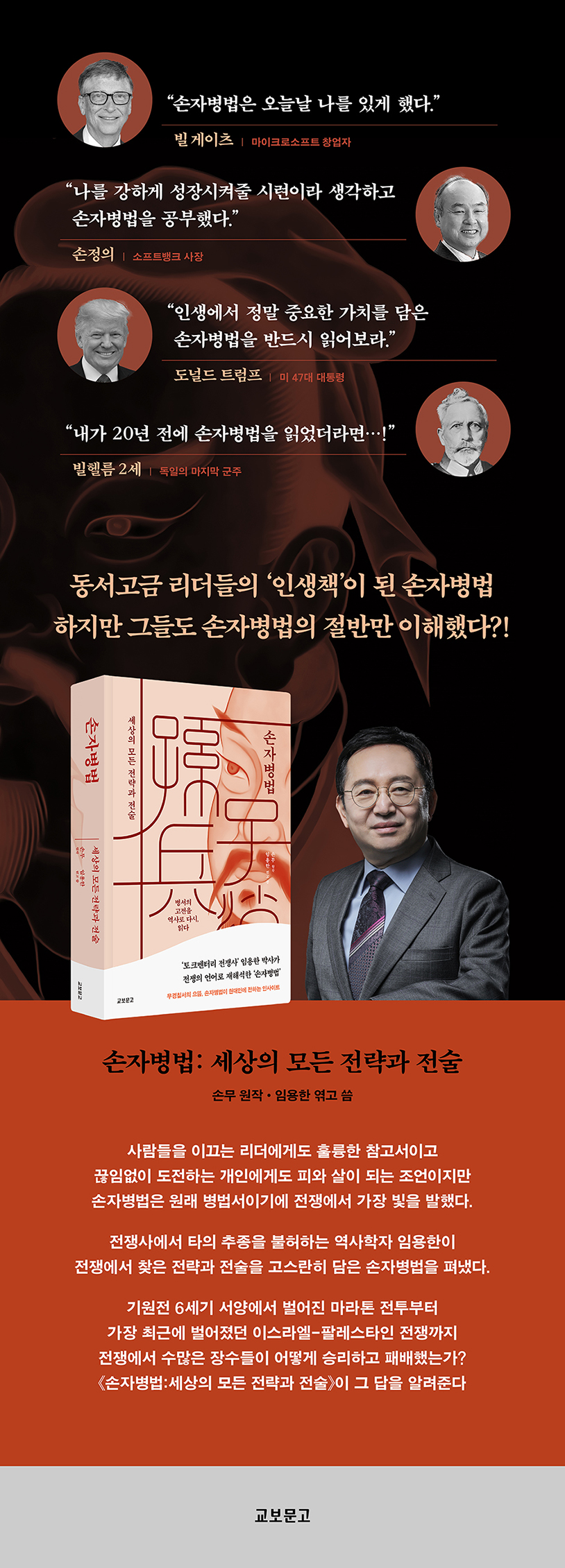
Even in this age of peace, businessmen like Bill Gates and Masayoshi Son, who have conquered the world, say they found answers in The Art of War, and Donald Trump, who overcame defeat to be re-elected as the 47th President of the United States, also chose The Art of War as the book of his life.
What is the secret behind the Bronze Age military strategy book that has served as a guide for leaders of all ages, East and West, in times of war and peace, for over 2,500 years?
A best-selling book that has created a passionate readership for 2,500 years.
The new book, "The Art of War: All the Strategies and Tactics of the World," stands out among the numerous commentaries published in the world for its interpretation of the Art of War through war.
The author of this book, Yonghan Lim, has established himself as a unique storyteller of war history by presenting interesting accounts of wars across the East and the West through the Defense TV talk documentary War History.
In particular, it received a lot of attention for presenting a new perspective by closely analyzing the history of the war-torn era and adding a realistic interpretation.
The author felt disappointed to see instances where The Art of War, which is arguably the reference for all strategies and tactics in the world, was interpreted out of touch with the realities of war.
This continued to grow as the talk documentary War History progressed, and eventually led to the writing of a commentary on the Art of War, which highlighted the history of war.
A new The Art of War, written by an author well-versed in military history, and presented through war.
What differentiates "The Art of War: All the Strategies and Tactics of the World" from other books on the art of war is that it contains a wealth of actual war cases to preserve the characteristics of a military strategy book.
The author divides the Art of War into three stages.
First, this book attempts to find the meaning of Sun Tzu's words in the context of Sun Tzu's time.
The 6th century BC, the period of transition from the Bronze Age to the Iron Age, also saw different methods of warfare.
By analyzing the political situation of the time and the war that took place within it, I tried to most accurately understand Sun Tzu's intentions.
Next, we will recall wars and battles from the East and the West, past and present, from the Battle of Marathon in the 6th century BC to the most recent war, which is still ongoing in Israel and Palestine, and explain how the famous sayings of The Art of War lead to victory or failure in war.
From famous generals such as Alexander the Great of the Hellenistic Empire that united the East and the West, Hannibal of Carthage, Yi Sun-sin of Joseon, and Napoleon of France, to examples of failed generals such as Moltke of the Schlieffen Plan, George Moore of the Vietnam War, and Cornwallis of the Revolutionary War, we examine them within the framework of The Art of War.
This proves why the Art of War has maintained its vitality to the present day.
Finally, it extends to all leaders who are fighting the silent war of modern times.
Only when we look at the book of military strategy through the magnifying glass of 'war' can we see the truth.
Therefore, this book is expected to provide a new perspective and enjoyment not only to those who are reading The Art of War for the first time, but also to readers who have already read The Art of War.
About 800 years later, in the 2nd century, Cao Cao, who founded the Wei Dynasty, was an avid reader of The Art of War and published the most widely read commentary on it today.
And then, 1200 years later, Grand Prince Suyang published the "Mugyeong Chilseo Juhae" (Notes on the Art of War), which was annotated on the Art of War by Sun Tzu, and 100 years later, Yi Sun-sin protected our seas from Japanese pirates using the strategies and tactics developed from the Art of War.
And then, 400 years later, during the two world wars, Germany's Rommel, the United States' Patton, and even Douglas MacArthur during the Korean War all used The Art of War as a textbook.
Even in this age of peace, businessmen like Bill Gates and Masayoshi Son, who have conquered the world, say they found answers in The Art of War, and Donald Trump, who overcame defeat to be re-elected as the 47th President of the United States, also chose The Art of War as the book of his life.
What is the secret behind the Bronze Age military strategy book that has served as a guide for leaders of all ages, East and West, in times of war and peace, for over 2,500 years?
A best-selling book that has created a passionate readership for 2,500 years.
The new book, "The Art of War: All the Strategies and Tactics of the World," stands out among the numerous commentaries published in the world for its interpretation of the Art of War through war.
The author of this book, Yonghan Lim, has established himself as a unique storyteller of war history by presenting interesting accounts of wars across the East and the West through the Defense TV talk documentary War History.
In particular, it received a lot of attention for presenting a new perspective by closely analyzing the history of the war-torn era and adding a realistic interpretation.
The author felt disappointed to see instances where The Art of War, which is arguably the reference for all strategies and tactics in the world, was interpreted out of touch with the realities of war.
This continued to grow as the talk documentary War History progressed, and eventually led to the writing of a commentary on the Art of War, which highlighted the history of war.
A new The Art of War, written by an author well-versed in military history, and presented through war.
What differentiates "The Art of War: All the Strategies and Tactics of the World" from other books on the art of war is that it contains a wealth of actual war cases to preserve the characteristics of a military strategy book.
The author divides the Art of War into three stages.
First, this book attempts to find the meaning of Sun Tzu's words in the context of Sun Tzu's time.
The 6th century BC, the period of transition from the Bronze Age to the Iron Age, also saw different methods of warfare.
By analyzing the political situation of the time and the war that took place within it, I tried to most accurately understand Sun Tzu's intentions.
Next, we will recall wars and battles from the East and the West, past and present, from the Battle of Marathon in the 6th century BC to the most recent war, which is still ongoing in Israel and Palestine, and explain how the famous sayings of The Art of War lead to victory or failure in war.
From famous generals such as Alexander the Great of the Hellenistic Empire that united the East and the West, Hannibal of Carthage, Yi Sun-sin of Joseon, and Napoleon of France, to examples of failed generals such as Moltke of the Schlieffen Plan, George Moore of the Vietnam War, and Cornwallis of the Revolutionary War, we examine them within the framework of The Art of War.
This proves why the Art of War has maintained its vitality to the present day.
Finally, it extends to all leaders who are fighting the silent war of modern times.
Only when we look at the book of military strategy through the magnifying glass of 'war' can we see the truth.
Therefore, this book is expected to provide a new perspective and enjoyment not only to those who are reading The Art of War for the first time, but also to readers who have already read The Art of War.
GOODS SPECIFICS
- Date of issue: January 28, 2025
- Format: Hardcover book binding method guide
- Page count, weight, size: 464 pages | 898g | 160*232*32mm
- ISBN13: 9791170612162
- ISBN10: 1170612164
You may also like
카테고리
korean


korean

![ELLE 엘르 스페셜 에디션 A형 : 12월 [2025]](http://librairie.coreenne.fr/cdn/shop/files/b8e27a3de6c9538896439686c6b0e8fb.jpg?v=1766436872&width=3840)


