

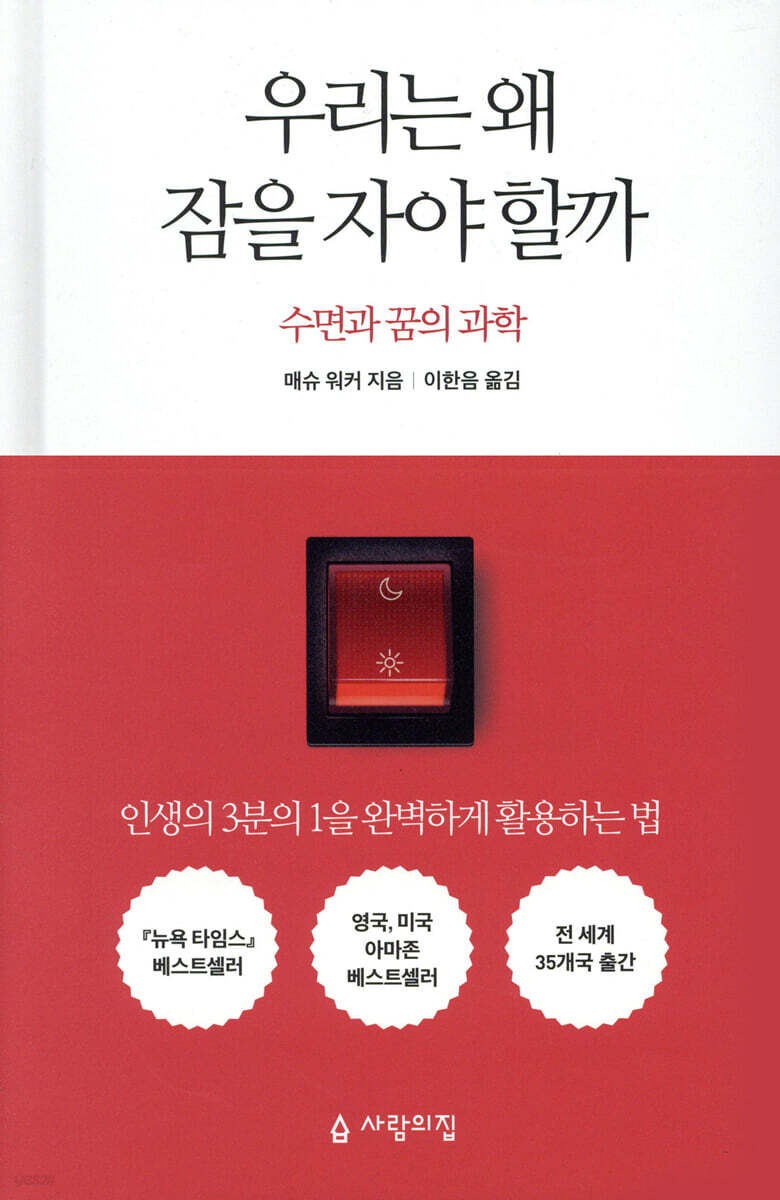
Why do we need to sleep?
 |
Description
Book Introduction
Matthew Walker, a world-renowned neuroscientist and sleep expert, has published his book, Why We Sleep, in translation by Open Books. Walker is a recognized sleep medicine expert with over 100 scientific papers published and a prolific researcher. He is also a self-proclaimed "sleep diplomat" who actively engages with the public through television and radio. In this book, the author, from the forefront of sleep medicine, explains the various aspects of sleep that we were previously unaware of, in an easy-to-understand manner, backed by scientific evidence. He also offers brilliant insights into how sleep's amazing power can lead our lives in a better direction. With the explosion of scientific discovery over the past two decades, the topic of sleep has begun to be reexamined. What do we gain from sleep? The benefits of sleep, as outlined by the author in this book, are truly astonishing. By getting enough sleep, we can achieve enhanced memory and higher creativity. People who get enough sleep are seen as more attractive than those who don't. It helps you maintain a slimmer body and reduces your appetite. It prevents cancer and dementia, and also prevents colds and flu. Reduces the risk of heart attack, stroke, and diabetes. Feelings of happiness are heightened and feelings of depression and anxiety disappear. Dreams that accompany sleep help alleviate painful memories from when we are awake. The brain can also create virtual realities that allow creativity to blossom by fusing past and present knowledge. Sleep and dreams also perform numerous other tasks in our bodies and minds. We have to sleep. Almost every question about sleep that the author raises in this book perfectly explains why we need to sleep. How do caffeine and alcohol affect sleep? What actually happens during REM sleep? Why do our sleep patterns change as we age? How do common sleeping pills work, and what long-term harm can they cause? How do dreams enhance learning, mood, and energy, and regulate hormones? How are sleep related to children's development, and to productivity, achievement, and performance in the workplace? This book, written clearly, engagingly, and accessible, will completely transform your understanding and perception of sleep and its impact on you. Let's make the most of one third of our day. Because that is the most efficient and perfect way to utilize the remaining two-thirds of your life. |
- You can preview some of the book's contents.
Preview
index
Part 1: What is sleep?
Chapter 1: Falling asleep
Chapter 2: Caffeine, Jet Lag, and Melatonin
Chapter 3: Defining and Requesting Sleep
Chapter 4: Apes, Dinosaurs, and Half-Brain Sleep
Chapter 5: Changes in Sleep Throughout Life
Part 2: Why Do We Sleep?
Chapter 6: Mother and Shakespeare Knew
Chapter 7: Too Extreme to Be Included in the Guinness Book of World Records
Chapter 8: Cancer, Heart Attacks, and Shortened Lifespan
Part 3: How and Why Do We Dream?
Chapter 9: Frequently Occurring Psychotic Symptoms
Chapter 10: Dreams as Night Therapy
Chapter 11: Dream Creativity and Dream Control
Part 4: From Sleeping Pills to a Transformed Society
Chapter 12 Things That Happen at Night
Chapter 13: iPad, Factory Siren, and Night Drinking
Chapter 14: Ways to Help or Hinder Sleep
Chapter 15: Sleep and Society
Chapter 16: A New Outlook for Sleep in the 21st Century
Conclusion: To sleep or not to sleep, that is the question.
Appendix: Twelve Secrets to Healthy Sleep
Acknowledgements
Search
Translator's Note
Chapter 1: Falling asleep
Chapter 2: Caffeine, Jet Lag, and Melatonin
Chapter 3: Defining and Requesting Sleep
Chapter 4: Apes, Dinosaurs, and Half-Brain Sleep
Chapter 5: Changes in Sleep Throughout Life
Part 2: Why Do We Sleep?
Chapter 6: Mother and Shakespeare Knew
Chapter 7: Too Extreme to Be Included in the Guinness Book of World Records
Chapter 8: Cancer, Heart Attacks, and Shortened Lifespan
Part 3: How and Why Do We Dream?
Chapter 9: Frequently Occurring Psychotic Symptoms
Chapter 10: Dreams as Night Therapy
Chapter 11: Dream Creativity and Dream Control
Part 4: From Sleeping Pills to a Transformed Society
Chapter 12 Things That Happen at Night
Chapter 13: iPad, Factory Siren, and Night Drinking
Chapter 14: Ways to Help or Hinder Sleep
Chapter 15: Sleep and Society
Chapter 16: A New Outlook for Sleep in the 21st Century
Conclusion: To sleep or not to sleep, that is the question.
Appendix: Twelve Secrets to Healthy Sleep
Acknowledgements
Search
Translator's Note
Detailed image

Into the book
Unlike most other authors, I won't be disappointed if the reader falls asleep while reading this book.
In fact, given the subject matter and content of this book, I actively encourage readers to do just that.
Based on what I know about the relationship between sleep and memory, I think it's the highest compliment I can give a reader if they fall asleep, because it means they can't resist the urge to integrate and remember what I'm saying.
So, while reading this book, feel free to move in and out of your consciousness, following the flow of your consciousness.
I wouldn't be offended at all.
On the contrary, you will be happy.
--- p.24
Have you ever stayed up all night working? That is, stayed up all night without any sleep and then the next day? If you've done so and can remember a lot about what it was like, you've likely experienced periods of extreme sleepiness and discomfort, followed by periods where, paradoxically, you felt more alert, even though you stayed up longer.
Why is that? --- p.54
Imagine a situation where the reader comes into the living room late one night while chatting with a friend.
But my younger sister (let's call her Jessica) is lying on the sofa, not moving.
Without even opening his eyes, he just hunched over and tilted his head to one side.
You immediately turn to your friend and say.
"Quiet, Jessica is sleeping." But how did you know? In less than a second, you judged Jessica's condition without a second's hesitation.
Why don't we assume Jessica is in a coma, or worse, dead? --- p.61
[Why do most 16-year-olds drive as if they have a missing part of their brain? They do.] Deep sleep and developmental time are needed for the neural maturation that fills in this [gap] in the frontal lobe.
When your children finally reach their mid-20s and their insurance premiums start to decrease, be thankful for sleep.
Because sleep is what saves you money.
--- pp.136~137
Usain Bolt, the 100-meter dash superstar, often naps a few hours before a race before setting world records or winning gold medals in the Olympic final.
Our research also supports his wisdom.
Taking a nap that allows enough sleep spindles to occur not only significantly improves motor skill memory, but also reduces muscle fatigue and revitalizes your energy levels.
--- p.188
As a result, 1.2 million traffic accidents occur in the United States each year due to drowsiness.
In other words, it is like this.
Every 30 seconds you're reading this book, a drowsy car accident occurs somewhere in America.
As you read this chapter, someone has probably lost their life in a fatigue-related car accident.
--- p.205
Lack of sleep not only causes your heart to beat faster and your blood pressure to rise, but it also damages the tissues of your blood vessels, which are already stressed.
This is especially true of the coronary arteries, the arteries that supply blood to the heart itself.
This vital passage must be clean and wide open to continuously supply blood to the heart.
If this passage narrows or becomes blocked, the heart can suffer a comprehensive and sometimes fatal blow from lack of oxygen.
This is commonly called [myocardial infarction].
--- p.242
In fact, writing down your waking thoughts, feelings, and worries has been proven to be beneficial for your mental health, and this seems to apply to dreams as well.
As Socrates often declared, a psychologically healthy and meaningful life is a savored life.
However, psychoanalysis based on Freud's theories is unscientific and has no ability to decipher dreams in a reproducible, reliable, and systematic way.
This fact must be made known to everyone.
--- p.291
Now consider occupations that require sleep deprivation, such as police officers, soldiers, doctors, nurses, and paramedics.
Not to mention those who perform the ultimate form of caregiving: parents of newborns.
These are roles that require accurate reading of other people's emotions to make important, even life-threatening, decisions.
You need to assess the emotional distress or pain level to determine whether the person is truly in danger enough to warrant using a weapon, whether you need to change the dosage of your pain medication, or whether you need to comfort or firmly admonish.
--- p.310
The concept of lucid dreaming was once dismissed as nonsense.
Scientists have debated whether such dreams exist.
It is understandable that there was so much skepticism.
First, the claim that we can consciously control a process that usually occurs independently of our will only makes the already absurd experience of dreaming even more absurd.
Second, how can such a subjective claim be objectively proven? Especially when one is asleep while dreaming? --- p.332
Michael Koch became a man who couldn't sleep.
And in return, he lost his life.
Before he developed insomnia, Coke was a very energetic and talented person.
He was a devoted husband and a high school music teacher in New Lexington, just south of Chicago.
But when I turned 40, I started having trouble sleeping.
At first I thought it might be my wife's snoring.
After hearing that, his wife, Penny Coke, slept alone on the sofa for ten days.
But instead of getting better, Coke's insomnia only got worse.
After months of not being able to sleep, he realized there was something else going on and decided to seek medical help.
However, none of the doctors who first examined Coke could figure out the cause of his insomnia.
Some doctors have even diagnosed sleep-related disorders, such as multiple sclerosis.
--- pp.361~362
Many people live in a state of extreme fatigue.
Why is this so? What exactly is it about modernity that so disrupts our instinctive sleep patterns, robs us of our freedom to sleep, and robs us of the ability to get a good night's sleep? For those who don't have sleep disorders, the underlying causes of this sleep deprivation may seem difficult to pinpoint.
No, if it seems obvious, it's wrong.
--- p.377
More generally, I feel that society itself needs to break down its negative and counterintuitive attitudes toward sleep.
That attitude is summed up perfectly in the words of a U.S. senator:
“I always feel disgusted when I think about needing sleep.
“Like death, sleep can make even the strongest of men lie down.” This attitude perfectly summarizes many modern views on sleep.
It makes you feel disgusting, annoying, and weak.
Even though the senator is actually Frank Underwood from the American TV show "House of Cards," I believe the writers of the show have hit on the heart of the sleep deprivation issue—which seems to me to be their story.
In fact, given the subject matter and content of this book, I actively encourage readers to do just that.
Based on what I know about the relationship between sleep and memory, I think it's the highest compliment I can give a reader if they fall asleep, because it means they can't resist the urge to integrate and remember what I'm saying.
So, while reading this book, feel free to move in and out of your consciousness, following the flow of your consciousness.
I wouldn't be offended at all.
On the contrary, you will be happy.
--- p.24
Have you ever stayed up all night working? That is, stayed up all night without any sleep and then the next day? If you've done so and can remember a lot about what it was like, you've likely experienced periods of extreme sleepiness and discomfort, followed by periods where, paradoxically, you felt more alert, even though you stayed up longer.
Why is that? --- p.54
Imagine a situation where the reader comes into the living room late one night while chatting with a friend.
But my younger sister (let's call her Jessica) is lying on the sofa, not moving.
Without even opening his eyes, he just hunched over and tilted his head to one side.
You immediately turn to your friend and say.
"Quiet, Jessica is sleeping." But how did you know? In less than a second, you judged Jessica's condition without a second's hesitation.
Why don't we assume Jessica is in a coma, or worse, dead? --- p.61
[Why do most 16-year-olds drive as if they have a missing part of their brain? They do.] Deep sleep and developmental time are needed for the neural maturation that fills in this [gap] in the frontal lobe.
When your children finally reach their mid-20s and their insurance premiums start to decrease, be thankful for sleep.
Because sleep is what saves you money.
--- pp.136~137
Usain Bolt, the 100-meter dash superstar, often naps a few hours before a race before setting world records or winning gold medals in the Olympic final.
Our research also supports his wisdom.
Taking a nap that allows enough sleep spindles to occur not only significantly improves motor skill memory, but also reduces muscle fatigue and revitalizes your energy levels.
--- p.188
As a result, 1.2 million traffic accidents occur in the United States each year due to drowsiness.
In other words, it is like this.
Every 30 seconds you're reading this book, a drowsy car accident occurs somewhere in America.
As you read this chapter, someone has probably lost their life in a fatigue-related car accident.
--- p.205
Lack of sleep not only causes your heart to beat faster and your blood pressure to rise, but it also damages the tissues of your blood vessels, which are already stressed.
This is especially true of the coronary arteries, the arteries that supply blood to the heart itself.
This vital passage must be clean and wide open to continuously supply blood to the heart.
If this passage narrows or becomes blocked, the heart can suffer a comprehensive and sometimes fatal blow from lack of oxygen.
This is commonly called [myocardial infarction].
--- p.242
In fact, writing down your waking thoughts, feelings, and worries has been proven to be beneficial for your mental health, and this seems to apply to dreams as well.
As Socrates often declared, a psychologically healthy and meaningful life is a savored life.
However, psychoanalysis based on Freud's theories is unscientific and has no ability to decipher dreams in a reproducible, reliable, and systematic way.
This fact must be made known to everyone.
--- p.291
Now consider occupations that require sleep deprivation, such as police officers, soldiers, doctors, nurses, and paramedics.
Not to mention those who perform the ultimate form of caregiving: parents of newborns.
These are roles that require accurate reading of other people's emotions to make important, even life-threatening, decisions.
You need to assess the emotional distress or pain level to determine whether the person is truly in danger enough to warrant using a weapon, whether you need to change the dosage of your pain medication, or whether you need to comfort or firmly admonish.
--- p.310
The concept of lucid dreaming was once dismissed as nonsense.
Scientists have debated whether such dreams exist.
It is understandable that there was so much skepticism.
First, the claim that we can consciously control a process that usually occurs independently of our will only makes the already absurd experience of dreaming even more absurd.
Second, how can such a subjective claim be objectively proven? Especially when one is asleep while dreaming? --- p.332
Michael Koch became a man who couldn't sleep.
And in return, he lost his life.
Before he developed insomnia, Coke was a very energetic and talented person.
He was a devoted husband and a high school music teacher in New Lexington, just south of Chicago.
But when I turned 40, I started having trouble sleeping.
At first I thought it might be my wife's snoring.
After hearing that, his wife, Penny Coke, slept alone on the sofa for ten days.
But instead of getting better, Coke's insomnia only got worse.
After months of not being able to sleep, he realized there was something else going on and decided to seek medical help.
However, none of the doctors who first examined Coke could figure out the cause of his insomnia.
Some doctors have even diagnosed sleep-related disorders, such as multiple sclerosis.
--- pp.361~362
Many people live in a state of extreme fatigue.
Why is this so? What exactly is it about modernity that so disrupts our instinctive sleep patterns, robs us of our freedom to sleep, and robs us of the ability to get a good night's sleep? For those who don't have sleep disorders, the underlying causes of this sleep deprivation may seem difficult to pinpoint.
No, if it seems obvious, it's wrong.
--- p.377
More generally, I feel that society itself needs to break down its negative and counterintuitive attitudes toward sleep.
That attitude is summed up perfectly in the words of a U.S. senator:
“I always feel disgusted when I think about needing sleep.
“Like death, sleep can make even the strongest of men lie down.” This attitude perfectly summarizes many modern views on sleep.
It makes you feel disgusting, annoying, and weak.
Even though the senator is actually Frank Underwood from the American TV show "House of Cards," I believe the writers of the show have hit on the heart of the sleep deprivation issue—which seems to me to be their story.
--- p.459
Publisher's Review
The Science of Sleep and Dreams
Humans spend two-thirds of their lives awake.
We move around consciously and spend what we call productive time.
They engage in social activities, protect themselves from threats to their survival, obtain food, and reproduce.
On the other hand, the rest of the time when we cannot perform these activities, namely while we sleep, seems evolutionarily very unproductive.
Still, we sleep.
Despite the obvious dangers, the fact that all living things still sleep clearly means that the benefits are so great that they more than compensate for the harm.
At least numerous studies consistently show that getting enough sleep doesn't deprive us of any biological benefits.
Rather, there is no reason why we should not sleep.
The sad thing is that humans are the only species that deliberately reduces their sleep time.
The author's argument is clear.
We should focus on making the most of the first third of our lives.
Sleep is one of the most important yet least understood activities related to our lives, health, and longevity.
Until very recently, science had no answers to questions like why we sleep, how sleep benefits our bodies and brains, and why sleep deprivation causes serious health problems.
Compared to other basic needs such as appetite, thirst, and sexual desire, sleep has been a subject with significantly less understanding than its quantitative and qualitative importance in human life.
With the explosion of scientific discovery over the past two decades, the topic of sleep has begun to be reexamined.
What do we gain from sleep? The benefits of sleep, as outlined by the author in this book, are truly astonishing.
By getting enough sleep, we can achieve enhanced memory and higher creativity.
People who get enough sleep are seen as more attractive than those who don't.
It helps you maintain a slimmer body and reduces your appetite.
It prevents cancer and dementia, and also prevents colds and flu.
Reduces the risk of heart attack, stroke, and diabetes.
Feelings of happiness are heightened and feelings of depression and anxiety disappear.
Dreams that accompany sleep help alleviate painful memories from when we are awake.
The brain can also create virtual realities that allow creativity to blossom by fusing past and present knowledge.
Sleep and dreams also perform numerous other tasks in our bodies and minds.
To you who forgot the night
How many hours of sleep is appropriate for a person? Five? Six? Seven? Let's imagine the morning routine of modern people.
I wake up every morning with the help of an alarm clock and consume caffeine to keep my mind clear.
These seemingly commonplace examples are actually a clear example of the sleep deprivation phenomenon that is seen all over the world, and the World Health Organization has already declared sleep deprivation an epidemic across developed countries.
The United States, the United Kingdom, South Korea, and Japan are the countries that have seen the greatest decreases in sleep time over the past century, and the countries that have seen the greatest increases in the number of patients suffering from physical and mental illnesses caused by sleep deprivation.
We somehow wake up and start the day.
But it's hard to shake off the feeling of being sleep-deprived all day long.
If you're wondering if it's necessary to call sleep deprivation an epidemic, let's take a look at the following symptoms that occur in our bodies when we're sleep deprived.
When we don't get enough sleep, our body's immune system is damaged first.
Your risk of developing cancer doubles, and changes in your body that could be precursors to Alzheimer's disease and diabetes occur.
Cardiovascular disease, stroke, and congestive heart failure occur.
Sleep deprivation can worsen symptoms of major mental illnesses, including depression, anxiety, and suicide.
And as sleep time shortens, lifespan also shortens.
This is why the author describes sleep deprivation as a "slow form of self-euthanasia."
Fortunately, the numerous scientific data and analyses in this book prescribe a remedy that will solve all of these problems once and for all.
A natural remedy that costs absolutely nothing is a good eight hours of sleep.
For those of you struggling with sleepiness
Despite the obvious benefits of sleep, we try desperately to reduce it.
Our self-rationalizations to reduce sleep are endless: to escape the stigma of being a morning person, being lazy and weak-willed, and to become a basic quality of modern life.
Of course, there are people who are born with trouble sleeping.
They wake up on their own without the help of an alarm clock even after only six hours of sleep.
And you don't have to sleep again until the day is over.
Due to the influence of certain genes, these people can sleep less than others without any problems.
People would probably like to believe that they are exactly this type of person.
It may be because his daily routine is actually one of sleeping little and staying awake for a long time, but in reality, it is extremely unlikely that he is of that type.
The author explains why by quoting his colleague.
[If you were to express the number of people who can survive without any problems on less than five hours of sleep as a percentage of the population, it would still be zero even if you round up.] Can we really think that we, who make up less than 1 percent of the population, have a lower chance of being struck by lightning in our lifetime?
Sleep is the most effective and unique means by which we can renew the health of our brain and body every day.
Yet, individuals and society today rarely mention the word sleep when discussing health.
Managers and employees who arrive at work at dawn and work late into the night not only fail to contribute to the company, but also cause great losses by making poor decisions due to lack of sleep.
Trainees who work 30-hour days make mistakes like making incorrect diagnoses and inserting surgical instruments into the abdomen and stitching it up.
Drowsy driving causes more accidents than drunk driving, but less than 2 percent of the effort is put into preventing it.
We have to sleep.
Almost every question about sleep that the author raises in this book perfectly explains why we need to sleep.
How do caffeine and alcohol affect sleep? What actually happens during REM sleep? Why do our sleep patterns change as we age? How do common sleeping pills work, and what long-term harm can they cause? How do dreams enhance learning, mood, and energy, and regulate hormones? How are sleep related to children's development, and to productivity, achievement, and performance in the workplace? This book, written clearly, engagingly, and accessible, will completely transform your understanding and perception of sleep and its impact on you.
Let's make the most of one third of our day.
Because that is the most efficient and perfect way to utilize the remaining two-thirds of your life.
Humans spend two-thirds of their lives awake.
We move around consciously and spend what we call productive time.
They engage in social activities, protect themselves from threats to their survival, obtain food, and reproduce.
On the other hand, the rest of the time when we cannot perform these activities, namely while we sleep, seems evolutionarily very unproductive.
Still, we sleep.
Despite the obvious dangers, the fact that all living things still sleep clearly means that the benefits are so great that they more than compensate for the harm.
At least numerous studies consistently show that getting enough sleep doesn't deprive us of any biological benefits.
Rather, there is no reason why we should not sleep.
The sad thing is that humans are the only species that deliberately reduces their sleep time.
The author's argument is clear.
We should focus on making the most of the first third of our lives.
Sleep is one of the most important yet least understood activities related to our lives, health, and longevity.
Until very recently, science had no answers to questions like why we sleep, how sleep benefits our bodies and brains, and why sleep deprivation causes serious health problems.
Compared to other basic needs such as appetite, thirst, and sexual desire, sleep has been a subject with significantly less understanding than its quantitative and qualitative importance in human life.
With the explosion of scientific discovery over the past two decades, the topic of sleep has begun to be reexamined.
What do we gain from sleep? The benefits of sleep, as outlined by the author in this book, are truly astonishing.
By getting enough sleep, we can achieve enhanced memory and higher creativity.
People who get enough sleep are seen as more attractive than those who don't.
It helps you maintain a slimmer body and reduces your appetite.
It prevents cancer and dementia, and also prevents colds and flu.
Reduces the risk of heart attack, stroke, and diabetes.
Feelings of happiness are heightened and feelings of depression and anxiety disappear.
Dreams that accompany sleep help alleviate painful memories from when we are awake.
The brain can also create virtual realities that allow creativity to blossom by fusing past and present knowledge.
Sleep and dreams also perform numerous other tasks in our bodies and minds.
To you who forgot the night
How many hours of sleep is appropriate for a person? Five? Six? Seven? Let's imagine the morning routine of modern people.
I wake up every morning with the help of an alarm clock and consume caffeine to keep my mind clear.
These seemingly commonplace examples are actually a clear example of the sleep deprivation phenomenon that is seen all over the world, and the World Health Organization has already declared sleep deprivation an epidemic across developed countries.
The United States, the United Kingdom, South Korea, and Japan are the countries that have seen the greatest decreases in sleep time over the past century, and the countries that have seen the greatest increases in the number of patients suffering from physical and mental illnesses caused by sleep deprivation.
We somehow wake up and start the day.
But it's hard to shake off the feeling of being sleep-deprived all day long.
If you're wondering if it's necessary to call sleep deprivation an epidemic, let's take a look at the following symptoms that occur in our bodies when we're sleep deprived.
When we don't get enough sleep, our body's immune system is damaged first.
Your risk of developing cancer doubles, and changes in your body that could be precursors to Alzheimer's disease and diabetes occur.
Cardiovascular disease, stroke, and congestive heart failure occur.
Sleep deprivation can worsen symptoms of major mental illnesses, including depression, anxiety, and suicide.
And as sleep time shortens, lifespan also shortens.
This is why the author describes sleep deprivation as a "slow form of self-euthanasia."
Fortunately, the numerous scientific data and analyses in this book prescribe a remedy that will solve all of these problems once and for all.
A natural remedy that costs absolutely nothing is a good eight hours of sleep.
For those of you struggling with sleepiness
Despite the obvious benefits of sleep, we try desperately to reduce it.
Our self-rationalizations to reduce sleep are endless: to escape the stigma of being a morning person, being lazy and weak-willed, and to become a basic quality of modern life.
Of course, there are people who are born with trouble sleeping.
They wake up on their own without the help of an alarm clock even after only six hours of sleep.
And you don't have to sleep again until the day is over.
Due to the influence of certain genes, these people can sleep less than others without any problems.
People would probably like to believe that they are exactly this type of person.
It may be because his daily routine is actually one of sleeping little and staying awake for a long time, but in reality, it is extremely unlikely that he is of that type.
The author explains why by quoting his colleague.
[If you were to express the number of people who can survive without any problems on less than five hours of sleep as a percentage of the population, it would still be zero even if you round up.] Can we really think that we, who make up less than 1 percent of the population, have a lower chance of being struck by lightning in our lifetime?
Sleep is the most effective and unique means by which we can renew the health of our brain and body every day.
Yet, individuals and society today rarely mention the word sleep when discussing health.
Managers and employees who arrive at work at dawn and work late into the night not only fail to contribute to the company, but also cause great losses by making poor decisions due to lack of sleep.
Trainees who work 30-hour days make mistakes like making incorrect diagnoses and inserting surgical instruments into the abdomen and stitching it up.
Drowsy driving causes more accidents than drunk driving, but less than 2 percent of the effort is put into preventing it.
We have to sleep.
Almost every question about sleep that the author raises in this book perfectly explains why we need to sleep.
How do caffeine and alcohol affect sleep? What actually happens during REM sleep? Why do our sleep patterns change as we age? How do common sleeping pills work, and what long-term harm can they cause? How do dreams enhance learning, mood, and energy, and regulate hormones? How are sleep related to children's development, and to productivity, achievement, and performance in the workplace? This book, written clearly, engagingly, and accessible, will completely transform your understanding and perception of sleep and its impact on you.
Let's make the most of one third of our day.
Because that is the most efficient and perfect way to utilize the remaining two-thirds of your life.
GOODS SPECIFICS
- Date of issue: February 25, 2019
- Format: Hardcover book binding method guide
- Page count, weight, size: 512 pages | 775g | 148*223*34mm
- ISBN13: 9788932919584
- ISBN10: 8932919585
You may also like
카테고리
korean


korean

![ELLE 엘르 스페셜 에디션 A형 : 12월 [2025]](http://librairie.coreenne.fr/cdn/shop/files/b8e27a3de6c9538896439686c6b0e8fb.jpg?v=1766436872&width=3840)


