

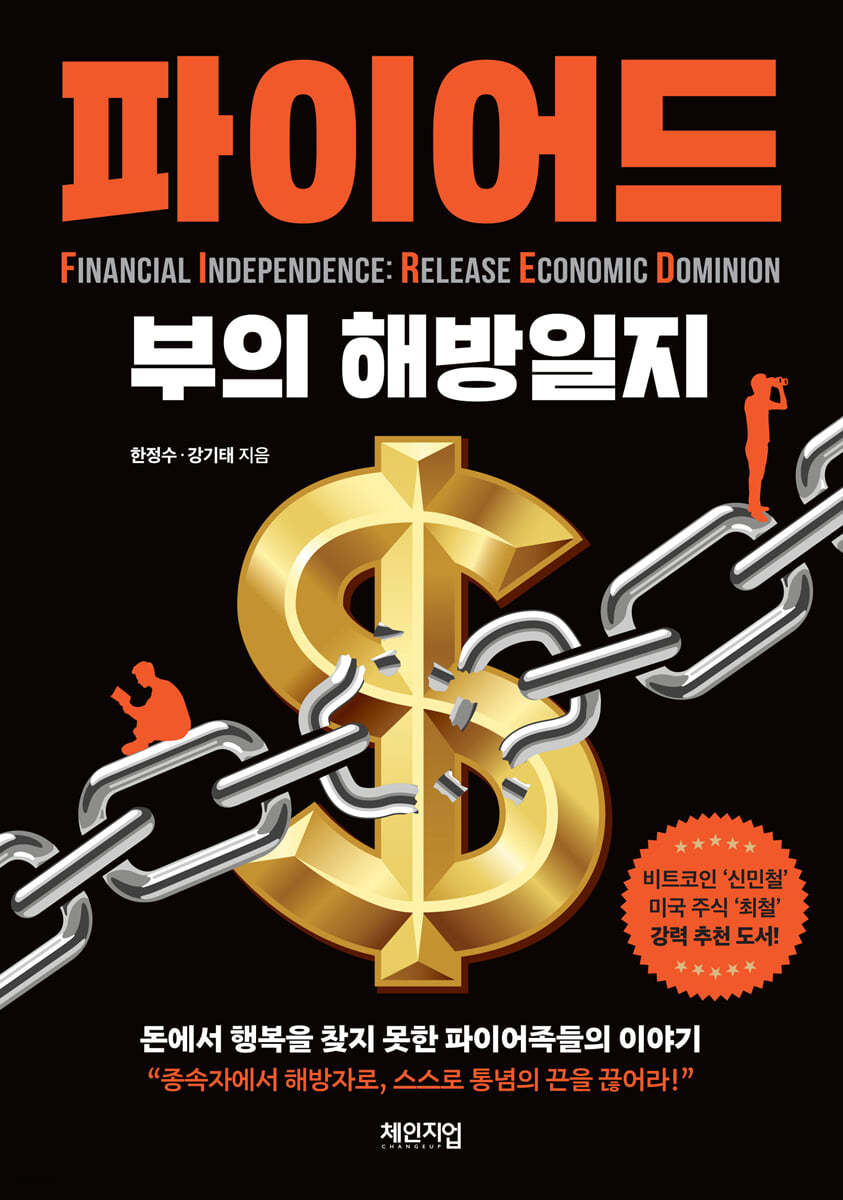
Fired: The Liberation of Wealth
 |
Description
Book Introduction
“Can you build wealth in a short period of time?”
“What is the life like for those who are free from money?”
“Do rich people really do nothing?”
Never dream of becoming a FIRE tribe member before reading this book!
The life formula of two young people who achieved financial freedom with billions of dollars in assets.
Fire tribe, a name both close and distant that was popular for a time.
Everyone has probably imagined themselves making a lot of money and retiring at an early age at least once.
But few people know exactly how they made their money, how they spent it, and what their plans are for the future.
The answer is simple.
'Because I've never experienced that kind of life.'
It's easy to think that having a lot of money will unconditionally make you happy, but in reality, that's often not the case.
The world is overflowing with things that are more precious and valuable than money, and there are many cases where people who 'just have a lot of money' end up missing out on various elements of happiness.
The two authors, who are active both online and offline, have been working individually and together to steadily expand their economic conditions and environment.
And now, through this book, I am trying to redefine a new 'concept' and 'standard' of wealth.
A must-read for those who are swayed by money!
If you look closely at life, there are very few things that are not connected to money.
In other words, everything is about 'money'.
Everyone lives with some degree of financial deficiency, but if the quality of life depends on the degree of financial deficiency, then we should no longer live with this deficiency.
The two authors emphasize that 'money allows everything, but at the same time does not allow everything.'
The 'GOAL' of a life dominated by money and a life not dominated by money are fundamentally different, and this provides an opportunity to seek a change in values.
People who are unhappy because they have no money, people who are happy but have no money, people who have a lot of money but are unhappy, and people who have a lot of money and are even happy.
What kind of life are you living right now?
“What is the life like for those who are free from money?”
“Do rich people really do nothing?”
Never dream of becoming a FIRE tribe member before reading this book!
The life formula of two young people who achieved financial freedom with billions of dollars in assets.
Fire tribe, a name both close and distant that was popular for a time.
Everyone has probably imagined themselves making a lot of money and retiring at an early age at least once.
But few people know exactly how they made their money, how they spent it, and what their plans are for the future.
The answer is simple.
'Because I've never experienced that kind of life.'
It's easy to think that having a lot of money will unconditionally make you happy, but in reality, that's often not the case.
The world is overflowing with things that are more precious and valuable than money, and there are many cases where people who 'just have a lot of money' end up missing out on various elements of happiness.
The two authors, who are active both online and offline, have been working individually and together to steadily expand their economic conditions and environment.
And now, through this book, I am trying to redefine a new 'concept' and 'standard' of wealth.
A must-read for those who are swayed by money!
If you look closely at life, there are very few things that are not connected to money.
In other words, everything is about 'money'.
Everyone lives with some degree of financial deficiency, but if the quality of life depends on the degree of financial deficiency, then we should no longer live with this deficiency.
The two authors emphasize that 'money allows everything, but at the same time does not allow everything.'
The 'GOAL' of a life dominated by money and a life not dominated by money are fundamentally different, and this provides an opportunity to seek a change in values.
People who are unhappy because they have no money, people who are happy but have no money, people who have a lot of money but are unhappy, and people who have a lot of money and are even happy.
What kind of life are you living right now?
- You can preview some of the book's contents.
Preview
index
Prologue_ Like André Kostolany
Chapter 1.
Fire Tribe, 4 years later
1-1 Two different, same dream
1-2 The life of an office worker who feels a lack of money
1-3 The process by which the meaning of 'day' changes
1-4 The Rich People We Met
1-5 Running Mate with Further Growth
Chapter 2.
Wealth gives you everything
2-1 The illusion that money is not important
2-2 Money, to rule or to be ruled
2-3 Money allows freedom of time
2-4 Money allows freedom of thought
2-5 Money expands the learning experience
Chapter 3.
Wealth doesn't give you everything.
3-1 The illusion that money is everything
3-2 There is no price tag for human relationships.
3-3 The price of happiness is constantly rising.
3-4 'Money' cannot replace 'work'
3-5 The Trap of 'Lack of Money'
Chapter 4.
Conditions and characteristics of the liberator
4-1 The Two Axes of Money and Happiness
4-2 Diversify your self-esteem portfolio
4-3 Free yourself from the path set by society.
4-4 Avoid comparing yourself to others.
4-5 The life of an investor similar to a liberator
Chapter 5.
A Guide to Living as a Rich Liberator
5-1 The Price of Not Executing: "The Life I Wanted to Live"
5-2 Venture Investment in Life Direction and Time
5-3 People who have changed their environment can change it.
5-4 Mind Setting of the Abundant Liberator
5-5 Life Strategy Book: Love Books
Appendix_ Thoughts on Investment
Epilogue_ From now on, it's not 'us' story, it's 'you' story.
Chapter 1.
Fire Tribe, 4 years later
1-1 Two different, same dream
1-2 The life of an office worker who feels a lack of money
1-3 The process by which the meaning of 'day' changes
1-4 The Rich People We Met
1-5 Running Mate with Further Growth
Chapter 2.
Wealth gives you everything
2-1 The illusion that money is not important
2-2 Money, to rule or to be ruled
2-3 Money allows freedom of time
2-4 Money allows freedom of thought
2-5 Money expands the learning experience
Chapter 3.
Wealth doesn't give you everything.
3-1 The illusion that money is everything
3-2 There is no price tag for human relationships.
3-3 The price of happiness is constantly rising.
3-4 'Money' cannot replace 'work'
3-5 The Trap of 'Lack of Money'
Chapter 4.
Conditions and characteristics of the liberator
4-1 The Two Axes of Money and Happiness
4-2 Diversify your self-esteem portfolio
4-3 Free yourself from the path set by society.
4-4 Avoid comparing yourself to others.
4-5 The life of an investor similar to a liberator
Chapter 5.
A Guide to Living as a Rich Liberator
5-1 The Price of Not Executing: "The Life I Wanted to Live"
5-2 Venture Investment in Life Direction and Time
5-3 People who have changed their environment can change it.
5-4 Mind Setting of the Abundant Liberator
5-5 Life Strategy Book: Love Books
Appendix_ Thoughts on Investment
Epilogue_ From now on, it's not 'us' story, it's 'you' story.
Detailed image

Into the book
But we quickly became accustomed to the 'freedom' that money brought.
And soon, a feeling of 'emptiness' came from deep within my heart.
"I thought money only brought happiness, but why do I feel loneliness and emptiness at the same time? Is it because the hunger to earn money has disappeared?" I was confused, unable to figure out why.
We started gathering people who were struggling with similar issues and in similar situations to find answers.
And we opened a space for people like that to gather and talk about their concerns and future.
In the process, I met over 100 young wealthy people and heard about their various success stories, philosophies on money and happiness, and the direction they pursue in life.
--- p.9
At first, I didn't even think about doing anything new.
I thought that in order to achieve something additional while working at a company, I should at least not harm my coworkers.
Even if I didn't do it very well, I tried to do at least one person's share.
After spending six months like that in a hectic manner, I started to gradually adjust to work life.
Around September or October, I started to have more free time, and soon my body started to feel achy.
During that time, we met each other and decided to take on the 'challenge of the future' together.
That's how our change began.
--- p.26
The first step to liberation from money is not to 'ignore and reject' money, but rather to recognize and acknowledge its importance.
Also, recognizing the importance of money doesn't necessarily mean saving and accumulating money.
It requires understanding the properties of money and at least a minimal understanding of the system by which money is created.
People who have dedicated their lives to money and made a lot of money through investments or business are more likely to be calm and detached in the face of money than those who have tried hard to ignore it.
The reason we do business and invest is not simply to make money.
It is to live a life free from money, without being trapped by it.
--- p.74
This figure was derived under the assumption that the salary received was just spent without being used for anything.
It is very difficult for an average office worker to save 2 million won every month.
Even if you save up, it takes almost 4 years to save 100 million, and 40 years to save 1 billion.
After calculating this, I felt like I didn't need to go to work anymore.
This is because, thanks to the liquidity boom, assets have reached an amount that cannot be earned in a lifetime of working, let alone 15 years.
Even if I received my salary, it had almost no effect on my assets.
Suddenly, I felt like I had 'the time I should have spent at work for the next 30 years'.
The money I earned felt like just numbers, so it didn't really hit me, but only then did I feel the weight of the money.
In the past, 10 million won was just 10 million won, but this amount of money was not just money, but also like 30 years of time.
We felt like we had made 30 years of money from our investments.
--- p.86
Happiness does not reside in things, people, or positions themselves, but arises from the experiences that accompany them.
The happiness that comes from continuing to own something is not greater than the happiness that came from first holding it in your hands.
That is, if everything in this world were to become yours in an instant, you would feel an indescribable sense of happiness, but once you get used to that state, you will never feel that initial happiness again.
Because of these human characteristics, happiness or unhappiness is not necessarily proportional to physical conditions or environmental factors.
Modern people live lives that are qualitatively much better than those of the kings who lived during the Joseon Dynasty.
In every aspect, including the food we eat, our favorite foods, our hobbies, travel, healthcare, safety, culture, and content, our lives are ahead of those of the Joseon Dynasty.
However, we cannot conclude that we are all happier than the people who lived during the Joseon Dynasty.
--- p.124
As time passes and the door to upward mobility becomes narrower, some younger generations begin to realize that their current class might become the class of their descendants.
So, before the hierarchy becomes entrenched, we put in more effort and sacrifice more to catch the 'last train' of social mobility.
It is a struggle to move upstream even if it means giving up one's own happiness.
Some have given up on any hope of upward mobility and have become NEETs, meaning “young people who do not work and are not receiving education or training.”
In the first half of 2024, Statistics Korea classified 182,000 men in their 30s as "just resting."
This figure is over 5% of the male population in their 30s.
This is the highest number since related statistics began being compiled in 2014, and is higher than the number in the first half of 2021 (164,000 people), when the COVID-19 pandemic was at its peak.
It seems like we are following the Japanese path of 'gap inheritance'.
--- p.178
The most important purpose of setting goals is 'the changes achieved in the process of achieving those goals.'
Because growth occurs in the process of pursuing and achieving goals.
If your goal is to become a millionaire, the fact that you will achieve that goal and become someone who can make millions of dollars is more valuable than the million dollars itself.
A million dollars can be lost in an instant, but the ability to make a million dollars can bring in another million dollars.
This can also be a 'stepping stone' to the ability to earn ten million dollars.
If we were asked to choose between the ability to make a million dollars and a million dollars, we would choose the ability to make a million dollars without hesitation.
It's like struggling between 'fish' and 'the ability to catch fish'.
And soon, a feeling of 'emptiness' came from deep within my heart.
"I thought money only brought happiness, but why do I feel loneliness and emptiness at the same time? Is it because the hunger to earn money has disappeared?" I was confused, unable to figure out why.
We started gathering people who were struggling with similar issues and in similar situations to find answers.
And we opened a space for people like that to gather and talk about their concerns and future.
In the process, I met over 100 young wealthy people and heard about their various success stories, philosophies on money and happiness, and the direction they pursue in life.
--- p.9
At first, I didn't even think about doing anything new.
I thought that in order to achieve something additional while working at a company, I should at least not harm my coworkers.
Even if I didn't do it very well, I tried to do at least one person's share.
After spending six months like that in a hectic manner, I started to gradually adjust to work life.
Around September or October, I started to have more free time, and soon my body started to feel achy.
During that time, we met each other and decided to take on the 'challenge of the future' together.
That's how our change began.
--- p.26
The first step to liberation from money is not to 'ignore and reject' money, but rather to recognize and acknowledge its importance.
Also, recognizing the importance of money doesn't necessarily mean saving and accumulating money.
It requires understanding the properties of money and at least a minimal understanding of the system by which money is created.
People who have dedicated their lives to money and made a lot of money through investments or business are more likely to be calm and detached in the face of money than those who have tried hard to ignore it.
The reason we do business and invest is not simply to make money.
It is to live a life free from money, without being trapped by it.
--- p.74
This figure was derived under the assumption that the salary received was just spent without being used for anything.
It is very difficult for an average office worker to save 2 million won every month.
Even if you save up, it takes almost 4 years to save 100 million, and 40 years to save 1 billion.
After calculating this, I felt like I didn't need to go to work anymore.
This is because, thanks to the liquidity boom, assets have reached an amount that cannot be earned in a lifetime of working, let alone 15 years.
Even if I received my salary, it had almost no effect on my assets.
Suddenly, I felt like I had 'the time I should have spent at work for the next 30 years'.
The money I earned felt like just numbers, so it didn't really hit me, but only then did I feel the weight of the money.
In the past, 10 million won was just 10 million won, but this amount of money was not just money, but also like 30 years of time.
We felt like we had made 30 years of money from our investments.
--- p.86
Happiness does not reside in things, people, or positions themselves, but arises from the experiences that accompany them.
The happiness that comes from continuing to own something is not greater than the happiness that came from first holding it in your hands.
That is, if everything in this world were to become yours in an instant, you would feel an indescribable sense of happiness, but once you get used to that state, you will never feel that initial happiness again.
Because of these human characteristics, happiness or unhappiness is not necessarily proportional to physical conditions or environmental factors.
Modern people live lives that are qualitatively much better than those of the kings who lived during the Joseon Dynasty.
In every aspect, including the food we eat, our favorite foods, our hobbies, travel, healthcare, safety, culture, and content, our lives are ahead of those of the Joseon Dynasty.
However, we cannot conclude that we are all happier than the people who lived during the Joseon Dynasty.
--- p.124
As time passes and the door to upward mobility becomes narrower, some younger generations begin to realize that their current class might become the class of their descendants.
So, before the hierarchy becomes entrenched, we put in more effort and sacrifice more to catch the 'last train' of social mobility.
It is a struggle to move upstream even if it means giving up one's own happiness.
Some have given up on any hope of upward mobility and have become NEETs, meaning “young people who do not work and are not receiving education or training.”
In the first half of 2024, Statistics Korea classified 182,000 men in their 30s as "just resting."
This figure is over 5% of the male population in their 30s.
This is the highest number since related statistics began being compiled in 2014, and is higher than the number in the first half of 2021 (164,000 people), when the COVID-19 pandemic was at its peak.
It seems like we are following the Japanese path of 'gap inheritance'.
--- p.178
The most important purpose of setting goals is 'the changes achieved in the process of achieving those goals.'
Because growth occurs in the process of pursuing and achieving goals.
If your goal is to become a millionaire, the fact that you will achieve that goal and become someone who can make millions of dollars is more valuable than the million dollars itself.
A million dollars can be lost in an instant, but the ability to make a million dollars can bring in another million dollars.
This can also be a 'stepping stone' to the ability to earn ten million dollars.
If we were asked to choose between the ability to make a million dollars and a million dollars, we would choose the ability to make a million dollars without hesitation.
It's like struggling between 'fish' and 'the ability to catch fish'.
--- p.216
Publisher's Review
Subordinate or Liberator, which side are you on?
Reset the 'concept of wealth' you knew!
We think that if we just have money, everything will be fine and we can do anything, but the real lives of the rich are a little different from what we think.
While there are certainly many things that money can solve, what's even more obvious is that there are still many things that money can't solve.
"Do the rich live without worry?" "Do the rich live happily, doing whatever they want?" "Is the next step for the rich simply maintaining their wealth?" The authors offer answers to all these questions based on their own experiences.
Through this opportunity, you will be able to experience the lives of the wealthy and the various aspects of life after retirement that seemed so distant.
'Handling Type' Shin Min-cheol strongly recommends 'Mi-ju Eun' Choi Cheol!
The Story of Economic Freedom That No One Tells You
These days, interest in ‘money’ and ‘wealth’ is higher than ever.
In the 'smart society' at the center of the 4th industrial revolution, only smart people make money.
In the midst of the unwavering investment fervor surrounding Bitcoin, altcoins, real estate, gold, the dollar, and stocks, the spectacle of winners and losers is now a familiar one.
It is now commonplace for people who are agitated here to feel somehow distant from happiness.
Here are two young people offering a new vision of 'life after death.'
I hope you can experience a life beyond economic freedom and a world beyond material possessions through this book.
This will be a precious gift to readers, providing them with both a new reading experience and a direction for their lives.
Reset the 'concept of wealth' you knew!
We think that if we just have money, everything will be fine and we can do anything, but the real lives of the rich are a little different from what we think.
While there are certainly many things that money can solve, what's even more obvious is that there are still many things that money can't solve.
"Do the rich live without worry?" "Do the rich live happily, doing whatever they want?" "Is the next step for the rich simply maintaining their wealth?" The authors offer answers to all these questions based on their own experiences.
Through this opportunity, you will be able to experience the lives of the wealthy and the various aspects of life after retirement that seemed so distant.
'Handling Type' Shin Min-cheol strongly recommends 'Mi-ju Eun' Choi Cheol!
The Story of Economic Freedom That No One Tells You
These days, interest in ‘money’ and ‘wealth’ is higher than ever.
In the 'smart society' at the center of the 4th industrial revolution, only smart people make money.
In the midst of the unwavering investment fervor surrounding Bitcoin, altcoins, real estate, gold, the dollar, and stocks, the spectacle of winners and losers is now a familiar one.
It is now commonplace for people who are agitated here to feel somehow distant from happiness.
Here are two young people offering a new vision of 'life after death.'
I hope you can experience a life beyond economic freedom and a world beyond material possessions through this book.
This will be a precious gift to readers, providing them with both a new reading experience and a direction for their lives.
GOODS SPECIFICS
- Date of issue: February 12, 2025
- Page count, weight, size: 268 pages | 430g | 148*210*17mm
- ISBN13: 9791191378672
- ISBN10: 1191378675
You may also like
카테고리
korean


korean

![ELLE 엘르 스페셜 에디션 A형 : 12월 [2025]](http://librairie.coreenne.fr/cdn/shop/files/b8e27a3de6c9538896439686c6b0e8fb.jpg?v=1766436872&width=3840)


