

Daniels' Running Formula
 |
Description
Book Introduction
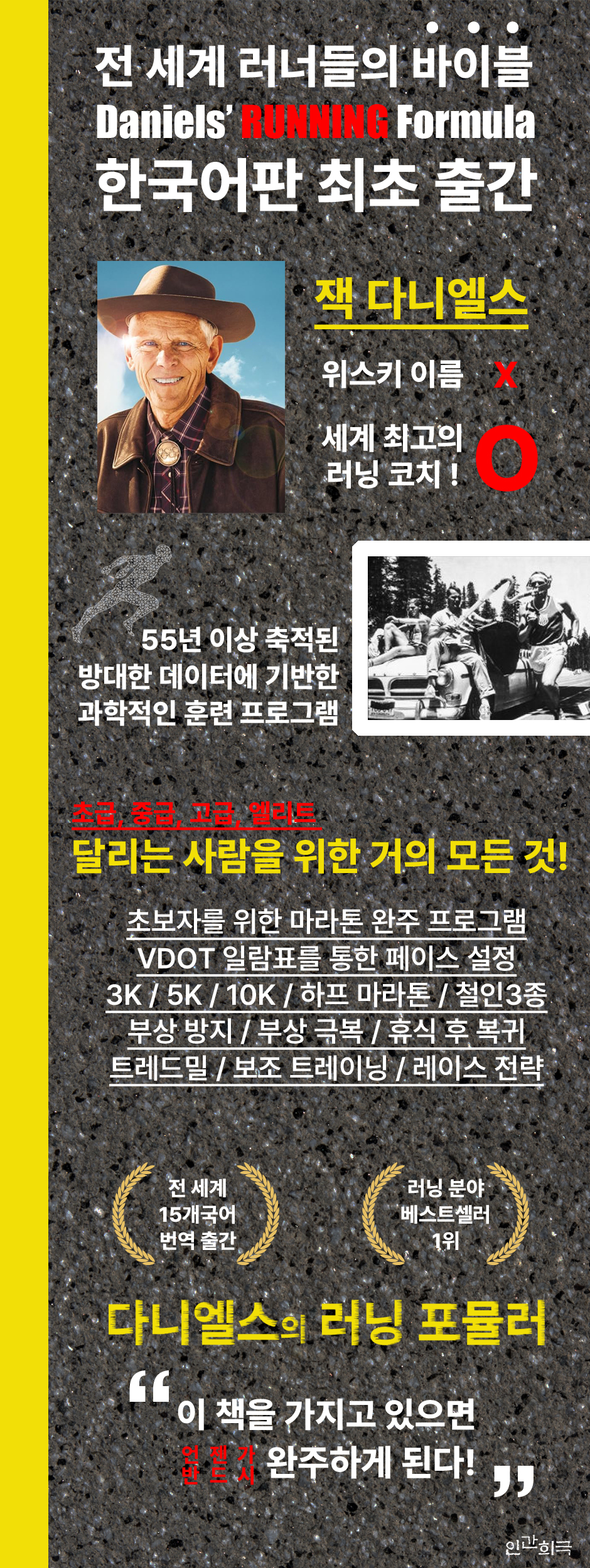
The masterpiece of the world's best running coach, Jack Daniels, is finally available in Korean!
Korean marathon record holder Lee Bong-ju and Masters champion Robert Hudson strongly recommend!
We provide scientific training programs for everyone from beginners to elites!
Whether you want to start running to lose weight, want to complete a marathon at least once, want to run faster but don't know how, or want to become a world-class athlete, no matter where you are as a runner, you no longer need to search for a good method.
This is because the Korean edition of 『Daniels' Running Formula』, which has been translated into 15 languages and is widely loved as the bible of runners around the world, has finally been published.
With over 55 years of experience in running training, Dr. Jack Daniels offers intuitive training programs you can use right now to help you achieve your goals, no matter what they may be.
Check out the latest training information, including a beginner marathon completion program, pace setting using VDOT schedules, and treadmill training methods!
Korean marathon record holder Lee Bong-ju and Masters champion Robert Hudson strongly recommend!
We provide scientific training programs for everyone from beginners to elites!
Whether you want to start running to lose weight, want to complete a marathon at least once, want to run faster but don't know how, or want to become a world-class athlete, no matter where you are as a runner, you no longer need to search for a good method.
This is because the Korean edition of 『Daniels' Running Formula』, which has been translated into 15 languages and is widely loved as the bible of runners around the world, has finally been published.
With over 55 years of experience in running training, Dr. Jack Daniels offers intuitive training programs you can use right now to help you achieve your goals, no matter what they may be.
Check out the latest training information, including a beginner marathon completion program, pace setting using VDOT schedules, and treadmill training methods!
- You can preview some of the book's contents.
Preview
index
Recommendation_Bongju Lee & Robert Hudson
preface
Part I: Understanding the Training Formula
Chapter 1: The Key to Successful Running
Chapter 2 Training Principles and Tips
Chapter 3: Profiles of Physiological Capacity and Profiles of Individual Training
Chapter 4 Training Types and Intensity
Chapter 5 VDOT Training System
Chapter 6: Training Specific to the Environment and High Altitudes
Chapter 7 Treadmill Training
Chapter 8: Strength Training
Chapter 9 Rest and Assistive Training
Part II Applying the Running Formula
Chapter 10 Season-Specific Training
Chapter 11 800m Training
Chapter 12 1.5K~3.2K Training
Chapter 13: 5K and 10K Training
Chapter 14 Cross-Country Training
Chapter 15: 15K, Half Marathon, 30K Training
Chapter 16 Marathon Training
Chapter 17: Ultramarathon Training
Chapter 18 Triathlon Training
supplement
Glossary of terms
Acknowledgements
About the Author / About the Translator
preface
Part I: Understanding the Training Formula
Chapter 1: The Key to Successful Running
Chapter 2 Training Principles and Tips
Chapter 3: Profiles of Physiological Capacity and Profiles of Individual Training
Chapter 4 Training Types and Intensity
Chapter 5 VDOT Training System
Chapter 6: Training Specific to the Environment and High Altitudes
Chapter 7 Treadmill Training
Chapter 8: Strength Training
Chapter 9 Rest and Assistive Training
Part II Applying the Running Formula
Chapter 10 Season-Specific Training
Chapter 11 800m Training
Chapter 12 1.5K~3.2K Training
Chapter 13: 5K and 10K Training
Chapter 14 Cross-Country Training
Chapter 15: 15K, Half Marathon, 30K Training
Chapter 16 Marathon Training
Chapter 17: Ultramarathon Training
Chapter 18 Triathlon Training
supplement
Glossary of terms
Acknowledgements
About the Author / About the Translator
Detailed image
Into the book
A coach must understand which group his players fall into and treat them as individuals with different strengths and weaknesses.
The goal should be to teach each runner to be an optimist who internalizes the good and externalizes the bad.
--- p.33
This is especially evident in younger runners' races.
Even the best runners with fast times will eventually slow down considerably if they start too fast.
This is a common pattern.
However, in these races, other runners in the same group tend to follow the leader who is overpacing.
This pace is much harder for them than for the lead runner, so they all end up spreading out before the lead runner.
The winning runner may think this was a race-winning strategy, but if the third or fourth runner that day ran at a more consistent pace, even the fastest runner would suffer a bitter defeat.
--- p.41
CO2 is constantly transported to the lungs through the blood from the tissues of the body that are active.
Therefore, the CO2 content in the lungs becomes much higher than in the inhaled air.
In fact, at any time (even at rest), the percentage of CO2 in the air in your lungs is 4.0% or 5.0%.
This ratio is very comfortable, but once you start training, the amount of CO2 produced by the working muscles gradually increases compared to when at rest.
Therefore, the proportion of CO2, a waste product, increases during exercise. When the CO2 proportion exceeds the normal range (4--- p.5%), the body detects this and breathes heavily to remove the excess CO2.
It is not the decrease in O2 but the increase in CO2 that triggers heavy breathing.
In fact, if you breathe normal air, the amount of O2 is sufficient.
--- p.68
In this book, each type of training is represented by a letter such as E, M, T, I, R, etc.
Each letter is an acronym for a word that represents the intensity of the training and also the type (see Figure 4.1).
Most training programs consist of several types of training.
E(Easy) stands for easy running, M(Marathon) for marathon pace running, T(Threshold) for threshold running, I(Interval) for interval training, and R(Repetition) for repetition training.
Figure 4.1 shows the time in minutes for continuous running training and repeated training (W/R).
In addition, it shows the purpose and effect of each training session, the ratio of training volume to weekly mileage, the ratio of VO2max associated with each training session, and the ratio of training to rest (for intermittent running).
--- p.93
Table 5.6 shows VDOT (and 1,600m race times) by performance level from ages 18 to 80.
Runners aged 18 to 38 were grouped into one age group, but those aged 39 and older were divided into age groups and adjusted accordingly.
Roughly speaking, a VDOT 3.5 is equivalent to just lying down, and a VDOT 10 is equivalent to a comfortable walk.
According to Table 5.6, a 58-year-old woman who runs 1,600 m in 7 minutes is at the same level as a younger woman (18-38 years old) who runs the same distance in 5 minutes and 4 seconds.
I myself am currently a level 7, and I was exactly the same level 7 15 years ago or 40 years ago.
It seems like it won't reach level 8.
--- p.142
It's important to remember that even when training with the same program, responses to it vary slightly from runner to runner, and there's no one-size-fits-all program that works best for everyone.
Still, everyone needs something.
It's about eating right, getting enough water, getting enough rest, and trusting your training.
You must believe that if you continue with the training you are doing now, not only will your running performance improve, but your health will also improve.
Running is a great way to enrich your day, even if you just enjoy it.
I like supporting runners.
I hope that people who run enjoy running.
The goal should be to teach each runner to be an optimist who internalizes the good and externalizes the bad.
--- p.33
This is especially evident in younger runners' races.
Even the best runners with fast times will eventually slow down considerably if they start too fast.
This is a common pattern.
However, in these races, other runners in the same group tend to follow the leader who is overpacing.
This pace is much harder for them than for the lead runner, so they all end up spreading out before the lead runner.
The winning runner may think this was a race-winning strategy, but if the third or fourth runner that day ran at a more consistent pace, even the fastest runner would suffer a bitter defeat.
--- p.41
CO2 is constantly transported to the lungs through the blood from the tissues of the body that are active.
Therefore, the CO2 content in the lungs becomes much higher than in the inhaled air.
In fact, at any time (even at rest), the percentage of CO2 in the air in your lungs is 4.0% or 5.0%.
This ratio is very comfortable, but once you start training, the amount of CO2 produced by the working muscles gradually increases compared to when at rest.
Therefore, the proportion of CO2, a waste product, increases during exercise. When the CO2 proportion exceeds the normal range (4--- p.5%), the body detects this and breathes heavily to remove the excess CO2.
It is not the decrease in O2 but the increase in CO2 that triggers heavy breathing.
In fact, if you breathe normal air, the amount of O2 is sufficient.
--- p.68
In this book, each type of training is represented by a letter such as E, M, T, I, R, etc.
Each letter is an acronym for a word that represents the intensity of the training and also the type (see Figure 4.1).
Most training programs consist of several types of training.
E(Easy) stands for easy running, M(Marathon) for marathon pace running, T(Threshold) for threshold running, I(Interval) for interval training, and R(Repetition) for repetition training.
Figure 4.1 shows the time in minutes for continuous running training and repeated training (W/R).
In addition, it shows the purpose and effect of each training session, the ratio of training volume to weekly mileage, the ratio of VO2max associated with each training session, and the ratio of training to rest (for intermittent running).
--- p.93
Table 5.6 shows VDOT (and 1,600m race times) by performance level from ages 18 to 80.
Runners aged 18 to 38 were grouped into one age group, but those aged 39 and older were divided into age groups and adjusted accordingly.
Roughly speaking, a VDOT 3.5 is equivalent to just lying down, and a VDOT 10 is equivalent to a comfortable walk.
According to Table 5.6, a 58-year-old woman who runs 1,600 m in 7 minutes is at the same level as a younger woman (18-38 years old) who runs the same distance in 5 minutes and 4 seconds.
I myself am currently a level 7, and I was exactly the same level 7 15 years ago or 40 years ago.
It seems like it won't reach level 8.
--- p.142
It's important to remember that even when training with the same program, responses to it vary slightly from runner to runner, and there's no one-size-fits-all program that works best for everyone.
Still, everyone needs something.
It's about eating right, getting enough water, getting enough rest, and trusting your training.
You must believe that if you continue with the training you are doing now, not only will your running performance improve, but your health will also improve.
Running is a great way to enrich your day, even if you just enjoy it.
I like supporting runners.
I hope that people who run enjoy running.
--- p.336
Publisher's Review
The best choice for runners!
When most people hear the name Jack Daniels, they probably think of a bottle of whiskey.
But if you're a runner, you'll immediately think of Jack Daniels, the world-renowned running coach and sports physiologist.
Dr. Jack Daniels is often called the Albert Einstein of the sports world, having laid the scientific foundation for nearly all running training programs in use today.
Daniels' Running Formula, which is the culmination of over 55 years of research, has captivated runners around the world by providing a clear "formula" for runners of any level to find the right pace for their ability. This latest edition, published for the first time in Korean, contains the most up-to-date training information, including an enhanced marathon completion program for beginners, pace setting using VDOT tables, and treadmill training methods.
Dr. Jack Daniels' running philosophy is simple.
Maximize results with minimal training! Readers of "Daniels' Running Formula" will be able to immediately improve their running abilities with clear instructions, as if they were mathematical formulas, just as the title suggests.
From e-learning to VDOT, the bible covers all the basics of running!
If you've ever been confused by the seemingly cryptic words like "E-learning," "M pace," "lactic acid threshold," and "VDOT" all you see when you search for related videos with the simple intention of starting running to control your weight, I recommend you start with "Daniels' Running Formula."
If anyone is explaining how to train for running, it's likely to be rooted in some form in the research and philosophy of Dr. Jack Daniels or to have drawn on some of the training programs included in his magnum opus, The Daniels' Running Formula.
This book is the most clear way to learn the basic concepts, as the developer himself explains why running is divided into letters such as E, M, T, I, and R, and how the term VDOT came about.
Plus, with detailed training programs that can be customized to your individual needs, from 800m to marathon, including race goals, fitness status, recovery from rest or injury, training at low and high altitudes, seasonal settings, and in-depth information on treadmill training, we'll provide you with the ideal, actionable manual for any level of runner.
The answer to why life is most often compared to a marathon!
As you read "Daniels' Running Formula," you'll find yourself amazed by the insight that's reminiscent of a self-help book.
The advice of someone who has literally “run for a long time” without losing passion in one field for over 55 years is deeply meaningful in every word.
For example, the author of this book lists the basic principles of running and says this:
“Runners need to learn to focus on what they are doing now.
You shouldn't waste too much time worrying about other things.
If you've done everything you can to execute your plan and then lose to someone, just accept that the other person was better that day.
What you need to do now is reflect on the race and think carefully about what you would change if you could run the same race again.
“There are often as many opportunities to learn from defeat as there are from victory (or more so).” He also expresses in a runner-like way how to accept oneself.
“According to Table 5.6, a 58-year-old woman who runs 1,600 m in 7 minutes is at the same level as a younger woman (18-38 years old) who runs the same distance in 5 minutes and 4 seconds.
I myself am currently a level 7, and I was exactly the same level 7 15 years ago or 40 years ago.
“It seems like it won’t reach level 8.”
Reading "Daniel's Running Formula" feels like taking a sports science class, but at some point it feels like a book of math formulas, and at other times it feels like a full-fledged training guide that makes you want to run right now.
But the most important thing is to enjoy running.
The author says this:
“Still, everyone has something they need.
It's about eating right, getting enough water, getting enough rest, and trusting your training.
You must believe that if you continue with the training you are doing now, not only will your running performance improve, but your health will also improve.
Running is a great way to enrich your day, even if you just enjoy it.
I like supporting runners.
“I hope that people who run enjoy running.”
If you're a serious runner and you follow any training principles, chances are they're either rooted in the research and philosophy of Dr. Jack Daniels or are derived from portions of his popular book, "The Daniels' Running Formula."
- [Running Times]
When most people hear the name Jack Daniels, they probably think of a bottle of whiskey.
But if you're a runner, you'll immediately think of Jack Daniels, the world-renowned running coach and sports physiologist.
Dr. Jack Daniels is often called the Albert Einstein of the sports world, having laid the scientific foundation for nearly all running training programs in use today.
Daniels' Running Formula, which is the culmination of over 55 years of research, has captivated runners around the world by providing a clear "formula" for runners of any level to find the right pace for their ability. This latest edition, published for the first time in Korean, contains the most up-to-date training information, including an enhanced marathon completion program for beginners, pace setting using VDOT tables, and treadmill training methods.
Dr. Jack Daniels' running philosophy is simple.
Maximize results with minimal training! Readers of "Daniels' Running Formula" will be able to immediately improve their running abilities with clear instructions, as if they were mathematical formulas, just as the title suggests.
From e-learning to VDOT, the bible covers all the basics of running!
If you've ever been confused by the seemingly cryptic words like "E-learning," "M pace," "lactic acid threshold," and "VDOT" all you see when you search for related videos with the simple intention of starting running to control your weight, I recommend you start with "Daniels' Running Formula."
If anyone is explaining how to train for running, it's likely to be rooted in some form in the research and philosophy of Dr. Jack Daniels or to have drawn on some of the training programs included in his magnum opus, The Daniels' Running Formula.
This book is the most clear way to learn the basic concepts, as the developer himself explains why running is divided into letters such as E, M, T, I, and R, and how the term VDOT came about.
Plus, with detailed training programs that can be customized to your individual needs, from 800m to marathon, including race goals, fitness status, recovery from rest or injury, training at low and high altitudes, seasonal settings, and in-depth information on treadmill training, we'll provide you with the ideal, actionable manual for any level of runner.
The answer to why life is most often compared to a marathon!
As you read "Daniels' Running Formula," you'll find yourself amazed by the insight that's reminiscent of a self-help book.
The advice of someone who has literally “run for a long time” without losing passion in one field for over 55 years is deeply meaningful in every word.
For example, the author of this book lists the basic principles of running and says this:
“Runners need to learn to focus on what they are doing now.
You shouldn't waste too much time worrying about other things.
If you've done everything you can to execute your plan and then lose to someone, just accept that the other person was better that day.
What you need to do now is reflect on the race and think carefully about what you would change if you could run the same race again.
“There are often as many opportunities to learn from defeat as there are from victory (or more so).” He also expresses in a runner-like way how to accept oneself.
“According to Table 5.6, a 58-year-old woman who runs 1,600 m in 7 minutes is at the same level as a younger woman (18-38 years old) who runs the same distance in 5 minutes and 4 seconds.
I myself am currently a level 7, and I was exactly the same level 7 15 years ago or 40 years ago.
“It seems like it won’t reach level 8.”
Reading "Daniel's Running Formula" feels like taking a sports science class, but at some point it feels like a book of math formulas, and at other times it feels like a full-fledged training guide that makes you want to run right now.
But the most important thing is to enjoy running.
The author says this:
“Still, everyone has something they need.
It's about eating right, getting enough water, getting enough rest, and trusting your training.
You must believe that if you continue with the training you are doing now, not only will your running performance improve, but your health will also improve.
Running is a great way to enrich your day, even if you just enjoy it.
I like supporting runners.
“I hope that people who run enjoy running.”
If you're a serious runner and you follow any training principles, chances are they're either rooted in the research and philosophy of Dr. Jack Daniels or are derived from portions of his popular book, "The Daniels' Running Formula."
- [Running Times]
GOODS SPECIFICS
- Date of issue: April 10, 2024
- Page count, weight, size: 424 pages | 658g | 152*225*27mm
- ISBN13: 9788993784817
- ISBN10: 8993784817
You may also like
카테고리
korean


korean

![GQ KOREA Mark (Monthly): December [2025]](http://librairie.coreenne.fr/cdn/shop/files/8ef265dbbfbf186523ed75ba7319009d.jpg?v=1765340328&width=3840)


