

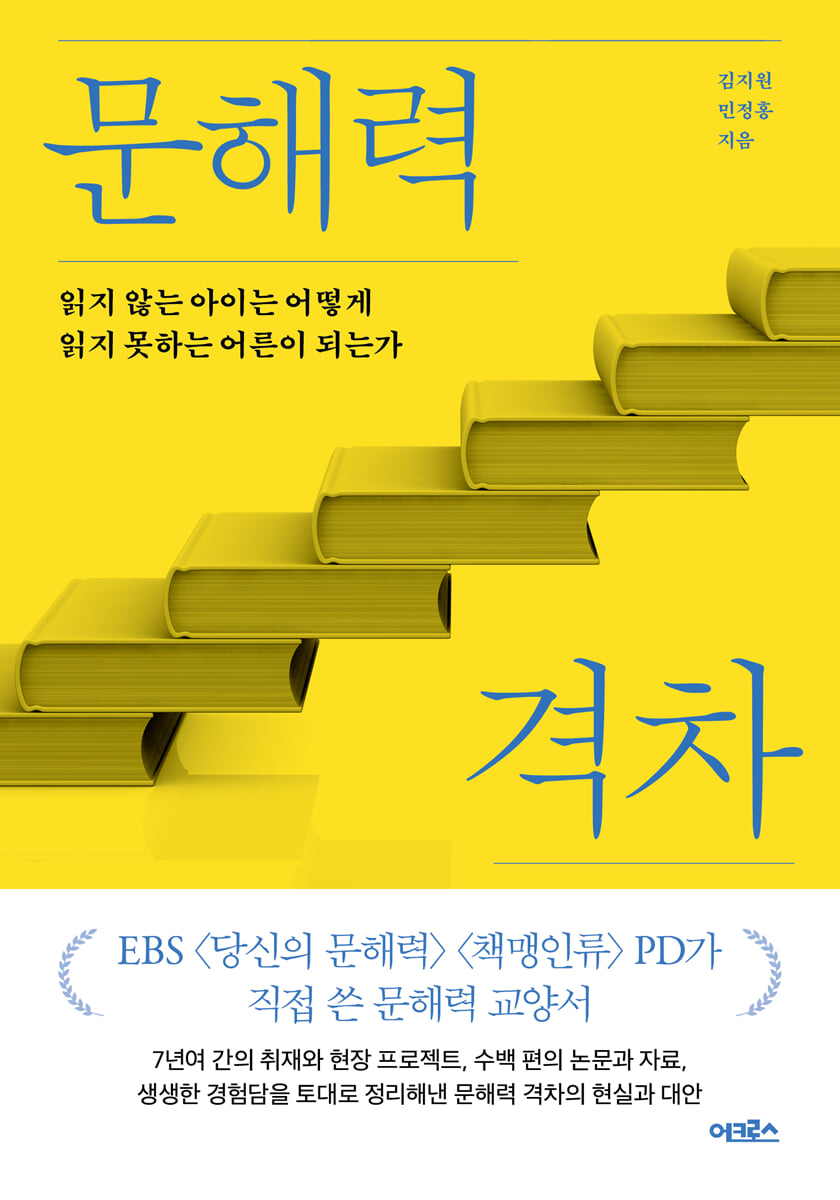
literacy gap
 |
Description
Book Introduction
The two producers who directed EBS's 'Literacy Series', which brought about a literacy craze in Korea, such as 'Your Literacy' and 'Book Blind Humanity', talk about the literacy gap in our society.
Drawing on seven years of reporting, major domestic and international research and experiments, and educational policies, this book explains how the literacy gap is created and deepens, and presents new stories that will challenge our common understanding of literacy.
As literacy is emphasized, literacy academies and textbooks are overflowing, but the number of children who have difficulty reading and writing is actually increasing.
In first grade classrooms, there are children with the literacy level of a three-year-old and children with the literacy level of an eight-year-old, and this gap is widening.
Why do some people read well and others don't? Misconceptions about literacy and social factors that hinder reading exacerbate the literacy gap.
Children who have difficulty reading will gradually stop reading and eventually grow up to be adults who cannot read.
Can the literacy gap truly be overcome through individual willpower alone? Could misinformation and preconceptions be further distancing us from reading? Furthermore, is our society neglecting the literacy gap? This book is a reliable guide that will help us understand the essence of literacy, something we've been missing, and free us from the anxieties and concerns surrounding it.
Drawing on seven years of reporting, major domestic and international research and experiments, and educational policies, this book explains how the literacy gap is created and deepens, and presents new stories that will challenge our common understanding of literacy.
As literacy is emphasized, literacy academies and textbooks are overflowing, but the number of children who have difficulty reading and writing is actually increasing.
In first grade classrooms, there are children with the literacy level of a three-year-old and children with the literacy level of an eight-year-old, and this gap is widening.
Why do some people read well and others don't? Misconceptions about literacy and social factors that hinder reading exacerbate the literacy gap.
Children who have difficulty reading will gradually stop reading and eventually grow up to be adults who cannot read.
Can the literacy gap truly be overcome through individual willpower alone? Could misinformation and preconceptions be further distancing us from reading? Furthermore, is our society neglecting the literacy gap? This book is a reliable guide that will help us understand the essence of literacy, something we've been missing, and free us from the anxieties and concerns surrounding it.
- You can preview some of the book's contents.
Preview
index
Author's Note
Prologue: The Age of Reading Disappearance
Part 1: How the Literacy Gap Is Created
1.
The illusion that anyone can read
How do you read this? / People who can't read / Reading is essential for survival / Shocking facts revealed by the VWFA experiment / A brain that doesn't collaborate can't read / Difficulty reading means survival is threatened
2.
A society that urges us to read quickly and extensively
Learning speed reading with Magic Eye / How speed reading became an object of envy / The desire to read quickly and a lot / The secret of super speed readers who read 10,000 words per minute / Eye leap, the key to fast reading / How effective is fast reading? / What we miss while shouting about speed reading.
3.
The easily overlooked essence of literacy: the rich get richer and the poor get poorer.
Where do you go for literacy? / Individual differences ignored in the race for speed / The 'rich get richer, poor get poorer' phenomenon occurring even in literacy / Office workers reading elementary school textbooks / Why do we ignore the gap / Until below-average children recover their literacy skills
4.
The truth behind the saying, "Reading is no fun."
How many words did you read today? / The reversal of children who read diligently digitally / The war of concentration / The Ivy League student who never finished a book / How to make reading more fun than using a smartphone
5.
The price of ignoring reading aloud
Am I dyslexic? / Children who can't tell the difference between 'ㅏ' and 'ㅓ' / Phonological awareness determines dyslexia / Sound value, the starting point and core of reading / The relationship between sound value and reading automation revealed through brain experiments / The secret behind 'reviews only Koreans can read' / The 'reading war' over sound value / How to improve reading fluency
6.
The brain knows the difference between what you learn from YouTube.
A book read in 10 minutes / Why audio and video are easier to understand / What the illustrations in "The Man Who Planted Trees" tell us / "Desirable difficulties" essential for learning / How to prevent "digital amnesia"
7.
The illusion that questions are more important than background knowledge
The Age of Omnipotent Questions / What Activity-Based Classes Have Missed / The Illusion That Questions Are More Important Than Background Knowledge / Why Can't I Read Even When I Have High Reading Ability? / An Experiment Reading Untitled Articles / A Showdown with Lying AI
8.
The serious reality brought about by the vocabulary gap
We offer our 'deepest apologies' for your 'profound dissatisfaction' / Vocabulary: A Weapon for Understanding the World / The Scary Reality of the 'Vocabulary Gap' / Nine Out of Ten Middle School Students Lack Vocabulary / A Tool for Empathy and Communication
Part 2: 6 Keys to Overcoming the Literacy Gap
9.
Motivation: The moment when "I have to read" turns into "I want to read"
"You have to read a lot to get into Seoul National University." / An obsession with useful reading / The British reading strategy that made reading "cool" / Reading methods that improve literacy
10.
Rewards: What's Most Effective?
Searching for a "Reading Star" / The Results of Rewards and Competition / A Special Reward System at a Prestigious Reading School / A Word That Helped Me Endure Boring Reading / The Birth of a True Reading Star
11.
Level: Raise your self-esteem, not your difficulty.
Wounded pride leads to reading failure / Betrayal of recommended books / How to find the right book for me
12.
Interaction: Literacy is not built in isolation.
A 22-month-old who only says "Dad" / The secret to developing early childhood literacy / The key to literacy development
13.
Digital Literacy: A Powerful Weapon in an Age of Information Overload
The Reading Area Where Koreans Are Most Vulnerable / A Checklist for Developing Critical Literacy
14.
Social Reading: The Power of Reading Together
Middle school students addicted to games are on a reading mission / Social reading has become a global trend / The effectiveness of reading together is proven through experiments / If you want to improve comprehension, read collaboratively / We are connected.
Epilogue: For a world where everyone can read, understand, and communicate
main
Prologue: The Age of Reading Disappearance
Part 1: How the Literacy Gap Is Created
1.
The illusion that anyone can read
How do you read this? / People who can't read / Reading is essential for survival / Shocking facts revealed by the VWFA experiment / A brain that doesn't collaborate can't read / Difficulty reading means survival is threatened
2.
A society that urges us to read quickly and extensively
Learning speed reading with Magic Eye / How speed reading became an object of envy / The desire to read quickly and a lot / The secret of super speed readers who read 10,000 words per minute / Eye leap, the key to fast reading / How effective is fast reading? / What we miss while shouting about speed reading.
3.
The easily overlooked essence of literacy: the rich get richer and the poor get poorer.
Where do you go for literacy? / Individual differences ignored in the race for speed / The 'rich get richer, poor get poorer' phenomenon occurring even in literacy / Office workers reading elementary school textbooks / Why do we ignore the gap / Until below-average children recover their literacy skills
4.
The truth behind the saying, "Reading is no fun."
How many words did you read today? / The reversal of children who read diligently digitally / The war of concentration / The Ivy League student who never finished a book / How to make reading more fun than using a smartphone
5.
The price of ignoring reading aloud
Am I dyslexic? / Children who can't tell the difference between 'ㅏ' and 'ㅓ' / Phonological awareness determines dyslexia / Sound value, the starting point and core of reading / The relationship between sound value and reading automation revealed through brain experiments / The secret behind 'reviews only Koreans can read' / The 'reading war' over sound value / How to improve reading fluency
6.
The brain knows the difference between what you learn from YouTube.
A book read in 10 minutes / Why audio and video are easier to understand / What the illustrations in "The Man Who Planted Trees" tell us / "Desirable difficulties" essential for learning / How to prevent "digital amnesia"
7.
The illusion that questions are more important than background knowledge
The Age of Omnipotent Questions / What Activity-Based Classes Have Missed / The Illusion That Questions Are More Important Than Background Knowledge / Why Can't I Read Even When I Have High Reading Ability? / An Experiment Reading Untitled Articles / A Showdown with Lying AI
8.
The serious reality brought about by the vocabulary gap
We offer our 'deepest apologies' for your 'profound dissatisfaction' / Vocabulary: A Weapon for Understanding the World / The Scary Reality of the 'Vocabulary Gap' / Nine Out of Ten Middle School Students Lack Vocabulary / A Tool for Empathy and Communication
Part 2: 6 Keys to Overcoming the Literacy Gap
9.
Motivation: The moment when "I have to read" turns into "I want to read"
"You have to read a lot to get into Seoul National University." / An obsession with useful reading / The British reading strategy that made reading "cool" / Reading methods that improve literacy
10.
Rewards: What's Most Effective?
Searching for a "Reading Star" / The Results of Rewards and Competition / A Special Reward System at a Prestigious Reading School / A Word That Helped Me Endure Boring Reading / The Birth of a True Reading Star
11.
Level: Raise your self-esteem, not your difficulty.
Wounded pride leads to reading failure / Betrayal of recommended books / How to find the right book for me
12.
Interaction: Literacy is not built in isolation.
A 22-month-old who only says "Dad" / The secret to developing early childhood literacy / The key to literacy development
13.
Digital Literacy: A Powerful Weapon in an Age of Information Overload
The Reading Area Where Koreans Are Most Vulnerable / A Checklist for Developing Critical Literacy
14.
Social Reading: The Power of Reading Together
Middle school students addicted to games are on a reading mission / Social reading has become a global trend / The effectiveness of reading together is proven through experiments / If you want to improve comprehension, read collaboratively / We are connected.
Epilogue: For a world where everyone can read, understand, and communicate
main
Detailed image

Into the book
The problem is that there is a growing number of children who have trouble reading and writing even after learning Korean.
There may be regional differences, but according to elementary school teachers, while in the past there were about 2-3 children in a class who could not read or write, now there are about 5-6.
Additionally, there is a growing trend of children who can read letters but do not know the sound values of consonants and vowels.
In the Korean curriculum, the division of subjects becomes clearer and the number of words in textbooks increases when students reach the third grade of elementary school.
People naturally assume that children of this age will be able to read and understand textbooks on their own after learning to read.
Fortunately, many children can read, but the problem is that some children, even though they appear to have mastered the letters, do not read accurately or fluently, or do not understand what they read.
There is a clear difference between being able to read and write (illiteracy) and being able to read and understand text (literacy).
For children who are not illiterate but lack literacy skills, textbooks are like huge, thick wads of blank paper.
--- From "The Age of Reading Disappearance"
We're obsessed with speed and volume, watching videos at double speed, reading and scrolling on our smartphones while eating, walking, or even riding our bikes.
The amount of information available to us has increased exponentially, as research has shown that the total amount of information a person encounters in a day is approximately 34GB.
The world around us has completely changed.
The sheer volume of data produced and consumed through various media, including smartphones, TV, and printed materials, continues to grow, and with more information available, it's only natural to want to access it more quickly.
If the problem isn't me, but the society I belong to has changed, wouldn't it be reasonable to read more, faster, to adapt? But there's one problem.
The question is whether the reading mechanism is suitable for reading quickly.
--- From "A Society That Urges Us to Read Fast and A Lot"
Jeni Riley, who has long studied early literacy at University College London, asked five-year-olds just starting primary school this question:
'How much difference does the literacy ability of children just entering elementary school differ?' The results were shocking.
Riley's research found that there was a developmental gap of about five years between children of the same age in the same class.
That is, among students who have just entered first grade, there are some who have the reading ability of a three-year-old, while there are also some who have the reading ability of an eight-year-old.
--- From "The Easily Overlooked Essence of Literacy: The Rich Get Richer and the Poor Get Poorer"
In “Your Literacy,” a vocabulary test was conducted on 2,405 third-year middle school students.
It was to check the vocabulary level of middle school students.
The survey results showed that only 9% of the participating students scored 88 points or higher, which is considered to be a level where they have the vocabulary to understand the textbook on their own.
The remaining 91% of students were at a level where they could not read, understand, and study textbooks on their own.
In particular, 11% of students scored below 43 points, making it difficult to understand the content.
Even if you try to study independently, it is virtually impossible to read and understand the textbook content on your own, so studying alone is difficult.
In order to understand the current curriculum, Korean vocabulary education is necessary, but while studying English vocabulary and taking vocabulary tests is very familiar, studying Korean vocabulary feels very unfamiliar.
There may be regional differences, but according to elementary school teachers, while in the past there were about 2-3 children in a class who could not read or write, now there are about 5-6.
Additionally, there is a growing trend of children who can read letters but do not know the sound values of consonants and vowels.
In the Korean curriculum, the division of subjects becomes clearer and the number of words in textbooks increases when students reach the third grade of elementary school.
People naturally assume that children of this age will be able to read and understand textbooks on their own after learning to read.
Fortunately, many children can read, but the problem is that some children, even though they appear to have mastered the letters, do not read accurately or fluently, or do not understand what they read.
There is a clear difference between being able to read and write (illiteracy) and being able to read and understand text (literacy).
For children who are not illiterate but lack literacy skills, textbooks are like huge, thick wads of blank paper.
--- From "The Age of Reading Disappearance"
We're obsessed with speed and volume, watching videos at double speed, reading and scrolling on our smartphones while eating, walking, or even riding our bikes.
The amount of information available to us has increased exponentially, as research has shown that the total amount of information a person encounters in a day is approximately 34GB.
The world around us has completely changed.
The sheer volume of data produced and consumed through various media, including smartphones, TV, and printed materials, continues to grow, and with more information available, it's only natural to want to access it more quickly.
If the problem isn't me, but the society I belong to has changed, wouldn't it be reasonable to read more, faster, to adapt? But there's one problem.
The question is whether the reading mechanism is suitable for reading quickly.
--- From "A Society That Urges Us to Read Fast and A Lot"
Jeni Riley, who has long studied early literacy at University College London, asked five-year-olds just starting primary school this question:
'How much difference does the literacy ability of children just entering elementary school differ?' The results were shocking.
Riley's research found that there was a developmental gap of about five years between children of the same age in the same class.
That is, among students who have just entered first grade, there are some who have the reading ability of a three-year-old, while there are also some who have the reading ability of an eight-year-old.
--- From "The Easily Overlooked Essence of Literacy: The Rich Get Richer and the Poor Get Poorer"
In “Your Literacy,” a vocabulary test was conducted on 2,405 third-year middle school students.
It was to check the vocabulary level of middle school students.
The survey results showed that only 9% of the participating students scored 88 points or higher, which is considered to be a level where they have the vocabulary to understand the textbook on their own.
The remaining 91% of students were at a level where they could not read, understand, and study textbooks on their own.
In particular, 11% of students scored below 43 points, making it difficult to understand the content.
Even if you try to study independently, it is virtually impossible to read and understand the textbook content on your own, so studying alone is difficult.
In order to understand the current curriculum, Korean vocabulary education is necessary, but while studying English vocabulary and taking vocabulary tests is very familiar, studying Korean vocabulary feels very unfamiliar.
--- From "The Serious Reality Brought About by the Vocabulary Gap"
GOODS SPECIFICS
- Date of issue: May 30, 2025
- Page count, weight, size: 296 pages | 432g | 140*200*20mm
- ISBN13: 9791167742094
- ISBN10: 1167742095
You may also like
카테고리
korean


korean

![GQ KOREA Mark (Monthly): December [2025]](http://librairie.coreenne.fr/cdn/shop/files/8ef265dbbfbf186523ed75ba7319009d.jpg?v=1765340328&width=3840)


