

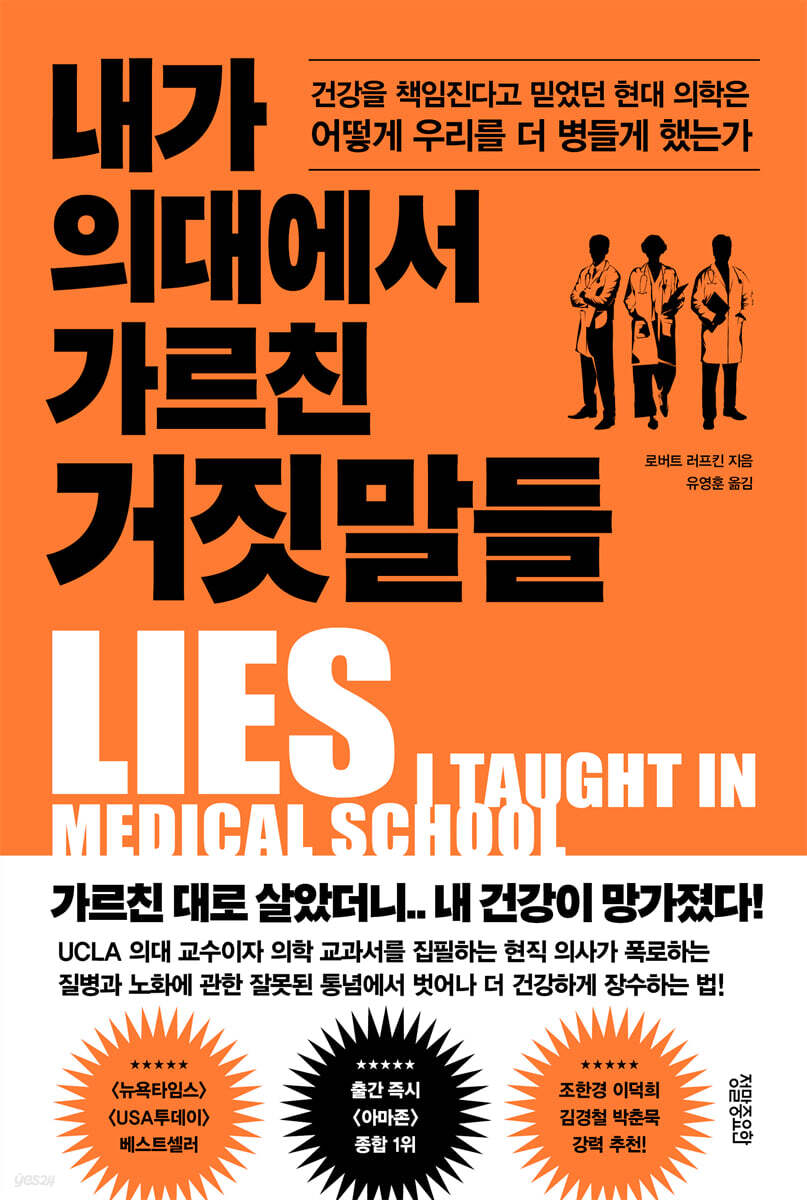
The Lies I Was Taught in Medical School
 |
Description
Book Introduction
Amazon, New York Times, and USA Today bestseller
A current doctor who is a professor at a prestigious American medical school and author of a medical textbook reveals
How to live longer and healthier by breaking free from common myths about disease and aging!
“I lived as I was taught, but my health was ruined!”
The author of this book, Dr. Rifkin, grew up eating a low-fat, high-carbohydrate diet thanks to his mother, who was a professional medical nutritionist. He used seed oils like canola oil instead of saturated fat and ate white omelets with the yolks, which are high in cholesterol, removed.
After becoming a medical school professor, he taught the same knowledge he had learned in medical school as his mother had taught him, and he achieved a position widely recognized in the medical community, receiving millions of dollars in research grants and research support from pharmaceutical companies.
However, the author experienced death at a young age due to diabetes, high blood pressure, dyslipidemia, and arthritis.
How did this illness develop in a person who had been eating a diet prepared by a licensed nutritionist all his life, following the recommendations of health authorities and the Food Pyramid?
What if what we've long believed to be common health advice turns out to be false? What if the various dietary and medication advice doctors give their patients lacks scientific basis? Dr. Rifkin confesses the failures of modern medicine, stating that what we were taught in medical school was like navigating a maze with a faulty map. Without understanding the true causes of chronic diseases like obesity, diabetes, high blood pressure, and heart disease, we've been hurtling down the wrong path, putting us in serious health jeopardy today.
As science advances day by day and new research results continue to emerge, overturning what we took for granted, doctors who fail to keep up with the latest medical updates are still spreading false medical knowledge that has been proven to be false.
The author is concerned about the current reality where unproven lies are accepted as established "facts," and advises on the latest medical "facts" that have been accurately verified based on numerous research papers and statistical data.
Scientific data demonstrates that obesity, diabetes, cancer, and heart disease all stem from metabolic imbalances, offering innovative yet practical solutions to overcome chronic diseases.
A current doctor who is a professor at a prestigious American medical school and author of a medical textbook reveals
How to live longer and healthier by breaking free from common myths about disease and aging!
“I lived as I was taught, but my health was ruined!”
The author of this book, Dr. Rifkin, grew up eating a low-fat, high-carbohydrate diet thanks to his mother, who was a professional medical nutritionist. He used seed oils like canola oil instead of saturated fat and ate white omelets with the yolks, which are high in cholesterol, removed.
After becoming a medical school professor, he taught the same knowledge he had learned in medical school as his mother had taught him, and he achieved a position widely recognized in the medical community, receiving millions of dollars in research grants and research support from pharmaceutical companies.
However, the author experienced death at a young age due to diabetes, high blood pressure, dyslipidemia, and arthritis.
How did this illness develop in a person who had been eating a diet prepared by a licensed nutritionist all his life, following the recommendations of health authorities and the Food Pyramid?
What if what we've long believed to be common health advice turns out to be false? What if the various dietary and medication advice doctors give their patients lacks scientific basis? Dr. Rifkin confesses the failures of modern medicine, stating that what we were taught in medical school was like navigating a maze with a faulty map. Without understanding the true causes of chronic diseases like obesity, diabetes, high blood pressure, and heart disease, we've been hurtling down the wrong path, putting us in serious health jeopardy today.
As science advances day by day and new research results continue to emerge, overturning what we took for granted, doctors who fail to keep up with the latest medical updates are still spreading false medical knowledge that has been proven to be false.
The author is concerned about the current reality where unproven lies are accepted as established "facts," and advises on the latest medical "facts" that have been accurately verified based on numerous research papers and statistical data.
Scientific data demonstrates that obesity, diabetes, cancer, and heart disease all stem from metabolic imbalances, offering innovative yet practical solutions to overcome chronic diseases.
- You can preview some of the book's contents.
Preview
index
A Testimonial from Dr. Jason Fung
Preface to the Korean edition
introduction
Chapter 1: The Story of How I Went to the Gates of the Underworld Despite Doing What I Learned (in Medical School)
Chapter 2 Metabolism Lie “Metabolism is simply the process by which our bodies digest food.”
Chapter 3: The Obesity Lie: “Just exercise more and eat less and you’ll lose weight.”
Chapter 4: The Diabetes Lie “Sugar is not harmful unless it causes weight gain and cavities.”
Chapter 5: The Fatty Liver Lie: “There is no cure for nonalcoholic fatty liver disease.”
Chapter 6: Hypertension Lies “The best treatment for hypertension is medication.”
Chapter 7: Cardiovascular Disease Lies “Statins are a good choice for preventing heart disease.”
Chapter 8: Cancer Lies “Cancer is usually caused by accumulated DNA damage.”
Chapter 9: The Alzheimer's Disease Lie “Alzheimer's disease is a progressive disease caused by the accumulation of amyloid beta and is incurable.”
Chapter 10 Mental Health Lies “Metabolism has no significant effect on mental health.”
Chapter 11: The Life Lie “Aging is an inevitable result of accumulated wear and tear.”
Chapter 12: Health Design “Simply changing your lifestyle habits can prevent and improve diseases that you get from hospitals.”
The truth will set you free and you will live your best life.
Additional Program Information
Recommended books
References
Preface to the Korean edition
introduction
Chapter 1: The Story of How I Went to the Gates of the Underworld Despite Doing What I Learned (in Medical School)
Chapter 2 Metabolism Lie “Metabolism is simply the process by which our bodies digest food.”
Chapter 3: The Obesity Lie: “Just exercise more and eat less and you’ll lose weight.”
Chapter 4: The Diabetes Lie “Sugar is not harmful unless it causes weight gain and cavities.”
Chapter 5: The Fatty Liver Lie: “There is no cure for nonalcoholic fatty liver disease.”
Chapter 6: Hypertension Lies “The best treatment for hypertension is medication.”
Chapter 7: Cardiovascular Disease Lies “Statins are a good choice for preventing heart disease.”
Chapter 8: Cancer Lies “Cancer is usually caused by accumulated DNA damage.”
Chapter 9: The Alzheimer's Disease Lie “Alzheimer's disease is a progressive disease caused by the accumulation of amyloid beta and is incurable.”
Chapter 10 Mental Health Lies “Metabolism has no significant effect on mental health.”
Chapter 11: The Life Lie “Aging is an inevitable result of accumulated wear and tear.”
Chapter 12: Health Design “Simply changing your lifestyle habits can prevent and improve diseases that you get from hospitals.”
The truth will set you free and you will live your best life.
Additional Program Information
Recommended books
References
Detailed image

Into the book
It would be a lie to say I had no worries.
Besides, it was confusing.
How could this happen? According to established scientific theory, this should be impossible.
My mother, who raised me, was a nutritionist and a licensed nutritionist.
The diet was followed exactly as recommended by health authorities and as instructed in the food pyramid.
I grew up like this, but I shouldn't be like this at this age.
I, who had been a good model student, was heading towards the gates of the afterlife.
Alarm bells rang in my shocked head.
Something is seriously wrong in the medical community.
I've been hearing nothing but lies all this time, so I was curious about the truth.
--- From "The story of how I went to the gates of the afterlife even though I did what I learned (in medical school)"
Whether in classroom instruction or at academic conferences with other medical professionals, the issue of metabolism was rarely discussed.
Even if rarely mentioned, the ambassador was a simple but important issue, but not as crucial as the treatment of the disease.
It would be nice to take the time to study nutrition, but I figured that wouldn't happen unless a malnourished patient knocked on my door.
Even when I was suffering from high blood pressure and diabetes, I looked at the ambassadors that way, just like everyone around me.
Metabolism is the way your body digests and uses food, and that's it.
In Chapter 1, we mentioned Alzheimer's disease, heart disease, and diabetes, all of which are metabolic diseases.
I had symptoms of two of those diseases, but I never thought about it.
No, the ambassador was the nutritionist's concern.
As 'real medical professionals', we have focused more on treating heart disease when it occurs than on preventing it.
Let alone the idea of treating heart disease 20 years before it occurs.
--- From "Metabolism Lies"
Hill calculated that if Americans could influence their energy balance by just 100 calories a day, “we would prevent weight gain for the majority of the population.”
The solution he recommended to achieve this goal was “the habit of reducing energy intake and increasing physical activity.”
Soon, the advice was to eat less and exercise more.
Hill has actually been a longtime advocate for the value of carbohydrates, especially sugars.
It was said to be a tool for losing weight.
Taubes accused him in his book:
“I even received money from the Sugar Association to write an article arguing that sugar is necessary even in diet plans.
It was hypothesized that a high-carbohydrate, especially sugar-laden, diet would 'in fact reduce the likelihood of overeating, rather than increase it, as some popular diet theories claim.'
Here's what Hill wrote:
“The theory that sugar intake immediately increases insulin levels, which then leads to excess fat storage, is unproven and biologically implausible.” To fully understand the context of Hill’s views, it’s worth considering where his funding came from.
Hill admitted to receiving consulting fees from Coca-Cola, Kraft, and Mars (maker of Snickers, M&Ms, and Mars chocolate bars).
These are companies that make and sell processed foods that are loaded with sugar and carbohydrates.
--- From "Obesity Lies"
So, what is the optimal blood glucose level? We've already introduced the diagnostic values for diabetes suggested by the American Diabetes Association.
But we didn't talk about the numbers that should be considered normal.
That's a pretty low number.
Let's find out your ideal blood sugar level.
A normal human blood sugar level is about 90 mg/dL.
This figure is equal to 5 mM (millimoles per liter, mmol/L).
Since the molecular weight of the glucose molecule C6H12O6 is approximately 180 g/mol, the total amount of glucose normally carried in the blood and circulating in the body is approximately 4 g (assuming the blood volume of an average adult is 5 liters).
Just one teaspoon.
Beyond this point, no matter how much, your body will work tirelessly to get rid of the excess.
Because sugar dissolves directly into the bloodstream, when we consume more than this small amount of sugar or refined carbohydrates, our body sounds an alarm and activates the insulin system to protect us from high blood sugar levels.
So, to avoid triggering an insulin reaction, you should consume less than a teaspoon of sugar.
How much would that be in food terms? Just one slice of bread contains about five teaspoons.
While one teaspoon satisfies the body's needs, the remaining four teaspoons trigger an insulin response.
--- From "Diabetes Lies"
A figure in the mural is force-feeding food to a goose.
This would be the first record in history of fatty liver disease.
To make foie gras, you must first feed the ducks or geese something they don't normally eat.
Even that should be eaten in larger quantities than usual.
What on earth are they forcing me to eat? First of all, it's not alcohol.
In theory, 'drunken foie gras' is possible.
This is a scene where one of the macronutrients is force-fed.
Since it is a macronutrient, it would be one of fat, protein, or carbohydrates.
At first glance, it's easy to assume that the Romans or Egyptians were trying to create fatty liver geese, so they fed them fat.
But recent research suggests that eating cholesterol and saturated fat doesn't necessarily cause atherosclerosis, the buildup of fatty plaque in the blood vessels that can lead to heart attacks.
Pliny gives the answer.
Instead of the French word foie gras, he called it iecur ficatum in Latin.
'Iekur' means liver, and 'picatum' comes from the word ficus, which refers to figs.
Ultimately, the key ingredient that made the liver oily was not fat or even protein, but figs, or more precisely, the sugar contained in figs.
So the culprit is carbohydrates.
--- From "Fatty Liver Lies"
Is that really true? Does high LDL make you more prone to heart attack?
The question turned out to be wrong.
LDL alone is not a good predictor of heart attack risk.
Rather, it is better to observe the actual blood vessels and see if there is any damage.
Fortunately, you don't have to cut into your skin to see your veins.
You can do a computed tomography scan of your heart.
Simply put, it is taking a CT scan.
Instead of guessing from numbers, a CT scan can be used to observe atheromatous plaques forming in blood vessels through X-ray images.
So we can more accurately assess the risk of heart attack.
A study of 23,143 patients with varying LDL levels found no correlation between LDL and the risk of atherosclerosis.
Instead, calcified atheromatous plaques in the arteries were the major risk factor.
The less plaque there was, the lower the risk.
And the more plaque there was, the greater the risk. LDL levels and plaque levels did not correlate.
A 2009 study published in the American Heart Journal reported that three-quarters of 136,905 patients hospitalized for heart disease had normal LDL levels.
Bottom line is, LDL isn't as important as people claim it is.
--- From "Cardiovascular Disease Lies"
The year was 1901.
The Germans needed a better lubricant for their U-boat submarines.
German scientists have figured out how to create a partially solidified fat by adding hydrogen to liquid vegetable oil.
The recipe was later sold to Procter & Gamble, and the American company decided to market the oil as a cooking oil for baking and frying.
It is a shortening product called Crisco.
It's just a shame that trans fats have emerged and heart disease has skyrocketed.
Crisco later changed its recipe slightly, reducing trans fat to less than 0.5 grams per serving.
It was a trick that allowed the trans fat content to be listed as 0g on the product's nutritional information label.
Procter & Gamble then paid the American Heart Association $1.7 million to promote its new Crisco oil, spreading the lie that cooking with it was healthier than using animal fats.
I try to avoid eating seed oils and vegetable oils as much as possible.
They are loaded with omega-6 fatty acids (linoleic acid), which cause inflammation.
These eight oils are often promoted as “healthy vegetable” oils.
That's not true.
Butter, beef tallow, and ghee, an Indian type of ghee.
Healthy oils include coconut oil, palm oil, olive oil, and avocado oil.
Besides, it was confusing.
How could this happen? According to established scientific theory, this should be impossible.
My mother, who raised me, was a nutritionist and a licensed nutritionist.
The diet was followed exactly as recommended by health authorities and as instructed in the food pyramid.
I grew up like this, but I shouldn't be like this at this age.
I, who had been a good model student, was heading towards the gates of the afterlife.
Alarm bells rang in my shocked head.
Something is seriously wrong in the medical community.
I've been hearing nothing but lies all this time, so I was curious about the truth.
--- From "The story of how I went to the gates of the afterlife even though I did what I learned (in medical school)"
Whether in classroom instruction or at academic conferences with other medical professionals, the issue of metabolism was rarely discussed.
Even if rarely mentioned, the ambassador was a simple but important issue, but not as crucial as the treatment of the disease.
It would be nice to take the time to study nutrition, but I figured that wouldn't happen unless a malnourished patient knocked on my door.
Even when I was suffering from high blood pressure and diabetes, I looked at the ambassadors that way, just like everyone around me.
Metabolism is the way your body digests and uses food, and that's it.
In Chapter 1, we mentioned Alzheimer's disease, heart disease, and diabetes, all of which are metabolic diseases.
I had symptoms of two of those diseases, but I never thought about it.
No, the ambassador was the nutritionist's concern.
As 'real medical professionals', we have focused more on treating heart disease when it occurs than on preventing it.
Let alone the idea of treating heart disease 20 years before it occurs.
--- From "Metabolism Lies"
Hill calculated that if Americans could influence their energy balance by just 100 calories a day, “we would prevent weight gain for the majority of the population.”
The solution he recommended to achieve this goal was “the habit of reducing energy intake and increasing physical activity.”
Soon, the advice was to eat less and exercise more.
Hill has actually been a longtime advocate for the value of carbohydrates, especially sugars.
It was said to be a tool for losing weight.
Taubes accused him in his book:
“I even received money from the Sugar Association to write an article arguing that sugar is necessary even in diet plans.
It was hypothesized that a high-carbohydrate, especially sugar-laden, diet would 'in fact reduce the likelihood of overeating, rather than increase it, as some popular diet theories claim.'
Here's what Hill wrote:
“The theory that sugar intake immediately increases insulin levels, which then leads to excess fat storage, is unproven and biologically implausible.” To fully understand the context of Hill’s views, it’s worth considering where his funding came from.
Hill admitted to receiving consulting fees from Coca-Cola, Kraft, and Mars (maker of Snickers, M&Ms, and Mars chocolate bars).
These are companies that make and sell processed foods that are loaded with sugar and carbohydrates.
--- From "Obesity Lies"
So, what is the optimal blood glucose level? We've already introduced the diagnostic values for diabetes suggested by the American Diabetes Association.
But we didn't talk about the numbers that should be considered normal.
That's a pretty low number.
Let's find out your ideal blood sugar level.
A normal human blood sugar level is about 90 mg/dL.
This figure is equal to 5 mM (millimoles per liter, mmol/L).
Since the molecular weight of the glucose molecule C6H12O6 is approximately 180 g/mol, the total amount of glucose normally carried in the blood and circulating in the body is approximately 4 g (assuming the blood volume of an average adult is 5 liters).
Just one teaspoon.
Beyond this point, no matter how much, your body will work tirelessly to get rid of the excess.
Because sugar dissolves directly into the bloodstream, when we consume more than this small amount of sugar or refined carbohydrates, our body sounds an alarm and activates the insulin system to protect us from high blood sugar levels.
So, to avoid triggering an insulin reaction, you should consume less than a teaspoon of sugar.
How much would that be in food terms? Just one slice of bread contains about five teaspoons.
While one teaspoon satisfies the body's needs, the remaining four teaspoons trigger an insulin response.
--- From "Diabetes Lies"
A figure in the mural is force-feeding food to a goose.
This would be the first record in history of fatty liver disease.
To make foie gras, you must first feed the ducks or geese something they don't normally eat.
Even that should be eaten in larger quantities than usual.
What on earth are they forcing me to eat? First of all, it's not alcohol.
In theory, 'drunken foie gras' is possible.
This is a scene where one of the macronutrients is force-fed.
Since it is a macronutrient, it would be one of fat, protein, or carbohydrates.
At first glance, it's easy to assume that the Romans or Egyptians were trying to create fatty liver geese, so they fed them fat.
But recent research suggests that eating cholesterol and saturated fat doesn't necessarily cause atherosclerosis, the buildup of fatty plaque in the blood vessels that can lead to heart attacks.
Pliny gives the answer.
Instead of the French word foie gras, he called it iecur ficatum in Latin.
'Iekur' means liver, and 'picatum' comes from the word ficus, which refers to figs.
Ultimately, the key ingredient that made the liver oily was not fat or even protein, but figs, or more precisely, the sugar contained in figs.
So the culprit is carbohydrates.
--- From "Fatty Liver Lies"
Is that really true? Does high LDL make you more prone to heart attack?
The question turned out to be wrong.
LDL alone is not a good predictor of heart attack risk.
Rather, it is better to observe the actual blood vessels and see if there is any damage.
Fortunately, you don't have to cut into your skin to see your veins.
You can do a computed tomography scan of your heart.
Simply put, it is taking a CT scan.
Instead of guessing from numbers, a CT scan can be used to observe atheromatous plaques forming in blood vessels through X-ray images.
So we can more accurately assess the risk of heart attack.
A study of 23,143 patients with varying LDL levels found no correlation between LDL and the risk of atherosclerosis.
Instead, calcified atheromatous plaques in the arteries were the major risk factor.
The less plaque there was, the lower the risk.
And the more plaque there was, the greater the risk. LDL levels and plaque levels did not correlate.
A 2009 study published in the American Heart Journal reported that three-quarters of 136,905 patients hospitalized for heart disease had normal LDL levels.
Bottom line is, LDL isn't as important as people claim it is.
--- From "Cardiovascular Disease Lies"
The year was 1901.
The Germans needed a better lubricant for their U-boat submarines.
German scientists have figured out how to create a partially solidified fat by adding hydrogen to liquid vegetable oil.
The recipe was later sold to Procter & Gamble, and the American company decided to market the oil as a cooking oil for baking and frying.
It is a shortening product called Crisco.
It's just a shame that trans fats have emerged and heart disease has skyrocketed.
Crisco later changed its recipe slightly, reducing trans fat to less than 0.5 grams per serving.
It was a trick that allowed the trans fat content to be listed as 0g on the product's nutritional information label.
Procter & Gamble then paid the American Heart Association $1.7 million to promote its new Crisco oil, spreading the lie that cooking with it was healthier than using animal fats.
I try to avoid eating seed oils and vegetable oils as much as possible.
They are loaded with omega-6 fatty acids (linoleic acid), which cause inflammation.
These eight oils are often promoted as “healthy vegetable” oils.
That's not true.
Butter, beef tallow, and ghee, an Indian type of ghee.
Healthy oils include coconut oil, palm oil, olive oil, and avocado oil.
--- From "Health Design"
Publisher's Review
Do you believe that modern medicine is a science that cannot and will not be wrong?
If so, you will be spending a lot of your life eating and sleeping in hospitals.
Most people mistakenly believe that natural science is objective, accurate, and that once established, theories are eternal, but this is not true.
When errors are discovered in a theory that dominated an era, it is mercilessly discarded and a new theory takes its place.
As with all academic fields, medicine is constantly evolving and changing.
"The Lies I Taught in Medical School" emphasizes that doctors must also change accordingly.
When you go to the hospital because you are sick, doctors ask about your symptoms and prescribe medicine.
However, most of the medications prescribed by doctors only relieve symptoms.
Although you may feel better temporarily, you will end up going to the hospital again with the same symptoms.
Because the root cause has not been resolved.
All diseases, including diabetes, high blood pressure, heart disease, cancer, and Alzheimer's, are ultimately related to metabolism, so we must start by looking at metabolism.
The author explains the principles of metabolism step by step to support his argument.
Three Terrible Lies of Modern Medicine
Modern medicine is lying to you.
There are many more lies in the book, but let's look at just three representative, terrible lies.
1.
A calorie is just a calorie.
This is a typical lie about obesity.
Obesity is a more serious condition than being overweight due to excessive body fat, and currently, about half of Americans are obese.
Obesity is not only unhealthy, but is also a risk factor for most chronic diseases.
The saying "a calorie is a calorie" is false for two reasons.
One is that calories alone are unlikely to cause obesity, and the other is that calories have different effects on controlling obesity depending on their type.
The key to controlling weight gain is figuring out how many calories you burn and how many you store.
The key to solving the problem lies not in the total number of calories, but in the biochemical signals of our body, and the culprit is insulin.
Therefore, if insulin is not activated, no matter how much you eat, the calories will not be stored as fat and you will not gain weight.
However, the government-recommended 'food pyramid' is filled with foods that strongly stimulate insulin secretion (requiring large amounts of consumption) at the bottom, which causes fat to accumulate in our bodies.
At the very moment when we banished fat from our diets and welcomed carbohydrates, obesity rates soared and haven't come down since.
2.
Type 2 diabetes is best treated with insulin.
Type 2 diabetes occurs when carbohydrates consumed through food stimulate insulin.
When insulin levels are chronically high, our bodies become insulin resistant, and our cells become increasingly indifferent to insulin.
This is how it enters a vicious cycle.
Ultimately, this vicious cycle has left 38% of American adults pre-diabetic.
Modern medicine is more focused on managing diabetes than on improving its symptoms, so it's better at prescribing insulin or medication than providing guidance on nutritional changes that can help address the underlying cause.
By simply changing your lifestyle habits, you can not only achieve powerful and effective changes, but you can also prevent complications from drug use.
According to pharmaceutical research firms, sales of insulin and diabetes drugs reached $23 billion in 2013, and the American Diabetes Association received more than $5 million in funding from pharmaceutical companies in 2022 alone.
3.
Dietary saturated fat and cholesterol cause heart disease.
The number one cause of death in Americans is heart disease.
These results are the product of Ansel Keys's falsified diet-heart hypothesis, which states that "dietary fat increases blood cholesterol, which in turn increases cholesterol levels and causes heart disease."
For these and other reasons, people around the world have rapidly switched to a low-fat, high-carbohydrate diet to prevent heart disease.
Saturated fats have been replaced by trans fats, vegetable oils, starches, and grains.
During this period, the most profitable drug, statins, emerged.
Despite the massive onslaught of statins, one in three Americans still has prediabetes, and 80% of people with diabetes die from heart disease.
Despite this, the U.S. Centers for Disease Control and Prevention is still treating only the symptoms rather than the cause.
Following the food pyramid and common sense about health ruined my body.
An Unbiased Health Essential for Everyone
This book signals a paradigm shift, explaining the causes of chronic disease in an accessible way and debunking misconceptions in modern medicine.
It reveals that metabolic disorders are the root cause of most chronic diseases and introduces ways to bring about positive changes in health by preventing chronic diseases.
So what does "proper eating habits" for metabolism mean? There are countless books on diet and nutrition.
The contents are also slightly different.
Moreover, nutrition alone is not the only answer to addressing risk factors, including environmental and genetic factors.
Even people who "eat right" may still be at risk of dying early in their 40s and 50s, and they likely don't even know it.
Dr. Ruffkin confesses that he did just that.
He said he was a person who did everything right.
Yet, he developed a life-threatening chronic illness that could have killed him.
This book takes a broader perspective on food intake.
It tells you what happens to food when it enters your body and why.
This part is given more attention than in previous books.
We also look into topics not covered in bestselling diet and critically acclaimed books on nutrition.
At the end of this book, we learn about aging and longevity.
When it comes to longevity, there are breakthroughs related to aging, particularly metabolic function.
It also contains information on how to enjoy the benefits and live a longer and healthier life.
In particular, it is said that as time passes and the body wears out, one becomes old, but this is a lie.
Now I know this isn't true.
Aging is a program.
Some animals are more strongly programmed to age than others.
For example, Pacific salmon spawn and die immediately.
On the other hand, there are animals that practically do not age.
Aging has long been thought to be the single biggest risk factor for all chronic diseases, but this isn't necessarily the case.
But if we get off track at this point, then a lot more about aging becomes wrong.
If you knew the truth, you might want to scream.
The author is tearing apart the lies in medical textbooks that he believed in and taught, but which ultimately made him sick and ultimately made him question his beliefs.
Believing that the truth that saved his life can save yours too.
Now, let's go and get our health back.
Discover the real science behind chronic disease and put your plan to restore your health and live a long life.
If so, you will be spending a lot of your life eating and sleeping in hospitals.
Most people mistakenly believe that natural science is objective, accurate, and that once established, theories are eternal, but this is not true.
When errors are discovered in a theory that dominated an era, it is mercilessly discarded and a new theory takes its place.
As with all academic fields, medicine is constantly evolving and changing.
"The Lies I Taught in Medical School" emphasizes that doctors must also change accordingly.
When you go to the hospital because you are sick, doctors ask about your symptoms and prescribe medicine.
However, most of the medications prescribed by doctors only relieve symptoms.
Although you may feel better temporarily, you will end up going to the hospital again with the same symptoms.
Because the root cause has not been resolved.
All diseases, including diabetes, high blood pressure, heart disease, cancer, and Alzheimer's, are ultimately related to metabolism, so we must start by looking at metabolism.
The author explains the principles of metabolism step by step to support his argument.
Three Terrible Lies of Modern Medicine
Modern medicine is lying to you.
There are many more lies in the book, but let's look at just three representative, terrible lies.
1.
A calorie is just a calorie.
This is a typical lie about obesity.
Obesity is a more serious condition than being overweight due to excessive body fat, and currently, about half of Americans are obese.
Obesity is not only unhealthy, but is also a risk factor for most chronic diseases.
The saying "a calorie is a calorie" is false for two reasons.
One is that calories alone are unlikely to cause obesity, and the other is that calories have different effects on controlling obesity depending on their type.
The key to controlling weight gain is figuring out how many calories you burn and how many you store.
The key to solving the problem lies not in the total number of calories, but in the biochemical signals of our body, and the culprit is insulin.
Therefore, if insulin is not activated, no matter how much you eat, the calories will not be stored as fat and you will not gain weight.
However, the government-recommended 'food pyramid' is filled with foods that strongly stimulate insulin secretion (requiring large amounts of consumption) at the bottom, which causes fat to accumulate in our bodies.
At the very moment when we banished fat from our diets and welcomed carbohydrates, obesity rates soared and haven't come down since.
2.
Type 2 diabetes is best treated with insulin.
Type 2 diabetes occurs when carbohydrates consumed through food stimulate insulin.
When insulin levels are chronically high, our bodies become insulin resistant, and our cells become increasingly indifferent to insulin.
This is how it enters a vicious cycle.
Ultimately, this vicious cycle has left 38% of American adults pre-diabetic.
Modern medicine is more focused on managing diabetes than on improving its symptoms, so it's better at prescribing insulin or medication than providing guidance on nutritional changes that can help address the underlying cause.
By simply changing your lifestyle habits, you can not only achieve powerful and effective changes, but you can also prevent complications from drug use.
According to pharmaceutical research firms, sales of insulin and diabetes drugs reached $23 billion in 2013, and the American Diabetes Association received more than $5 million in funding from pharmaceutical companies in 2022 alone.
3.
Dietary saturated fat and cholesterol cause heart disease.
The number one cause of death in Americans is heart disease.
These results are the product of Ansel Keys's falsified diet-heart hypothesis, which states that "dietary fat increases blood cholesterol, which in turn increases cholesterol levels and causes heart disease."
For these and other reasons, people around the world have rapidly switched to a low-fat, high-carbohydrate diet to prevent heart disease.
Saturated fats have been replaced by trans fats, vegetable oils, starches, and grains.
During this period, the most profitable drug, statins, emerged.
Despite the massive onslaught of statins, one in three Americans still has prediabetes, and 80% of people with diabetes die from heart disease.
Despite this, the U.S. Centers for Disease Control and Prevention is still treating only the symptoms rather than the cause.
Following the food pyramid and common sense about health ruined my body.
An Unbiased Health Essential for Everyone
This book signals a paradigm shift, explaining the causes of chronic disease in an accessible way and debunking misconceptions in modern medicine.
It reveals that metabolic disorders are the root cause of most chronic diseases and introduces ways to bring about positive changes in health by preventing chronic diseases.
So what does "proper eating habits" for metabolism mean? There are countless books on diet and nutrition.
The contents are also slightly different.
Moreover, nutrition alone is not the only answer to addressing risk factors, including environmental and genetic factors.
Even people who "eat right" may still be at risk of dying early in their 40s and 50s, and they likely don't even know it.
Dr. Ruffkin confesses that he did just that.
He said he was a person who did everything right.
Yet, he developed a life-threatening chronic illness that could have killed him.
This book takes a broader perspective on food intake.
It tells you what happens to food when it enters your body and why.
This part is given more attention than in previous books.
We also look into topics not covered in bestselling diet and critically acclaimed books on nutrition.
At the end of this book, we learn about aging and longevity.
When it comes to longevity, there are breakthroughs related to aging, particularly metabolic function.
It also contains information on how to enjoy the benefits and live a longer and healthier life.
In particular, it is said that as time passes and the body wears out, one becomes old, but this is a lie.
Now I know this isn't true.
Aging is a program.
Some animals are more strongly programmed to age than others.
For example, Pacific salmon spawn and die immediately.
On the other hand, there are animals that practically do not age.
Aging has long been thought to be the single biggest risk factor for all chronic diseases, but this isn't necessarily the case.
But if we get off track at this point, then a lot more about aging becomes wrong.
If you knew the truth, you might want to scream.
The author is tearing apart the lies in medical textbooks that he believed in and taught, but which ultimately made him sick and ultimately made him question his beliefs.
Believing that the truth that saved his life can save yours too.
Now, let's go and get our health back.
Discover the real science behind chronic disease and put your plan to restore your health and live a long life.
GOODS SPECIFICS
- Date of issue: December 31, 2024
- Page count, weight, size: 412 pages | 610g | 152*225*25mm
- ISBN13: 9791186745786
You may also like
카테고리
korean


korean

![ELLE 엘르 스페셜 에디션 A형 : 12월 [2025]](http://librairie.coreenne.fr/cdn/shop/files/b8e27a3de6c9538896439686c6b0e8fb.jpg?v=1766436872&width=3840)


