

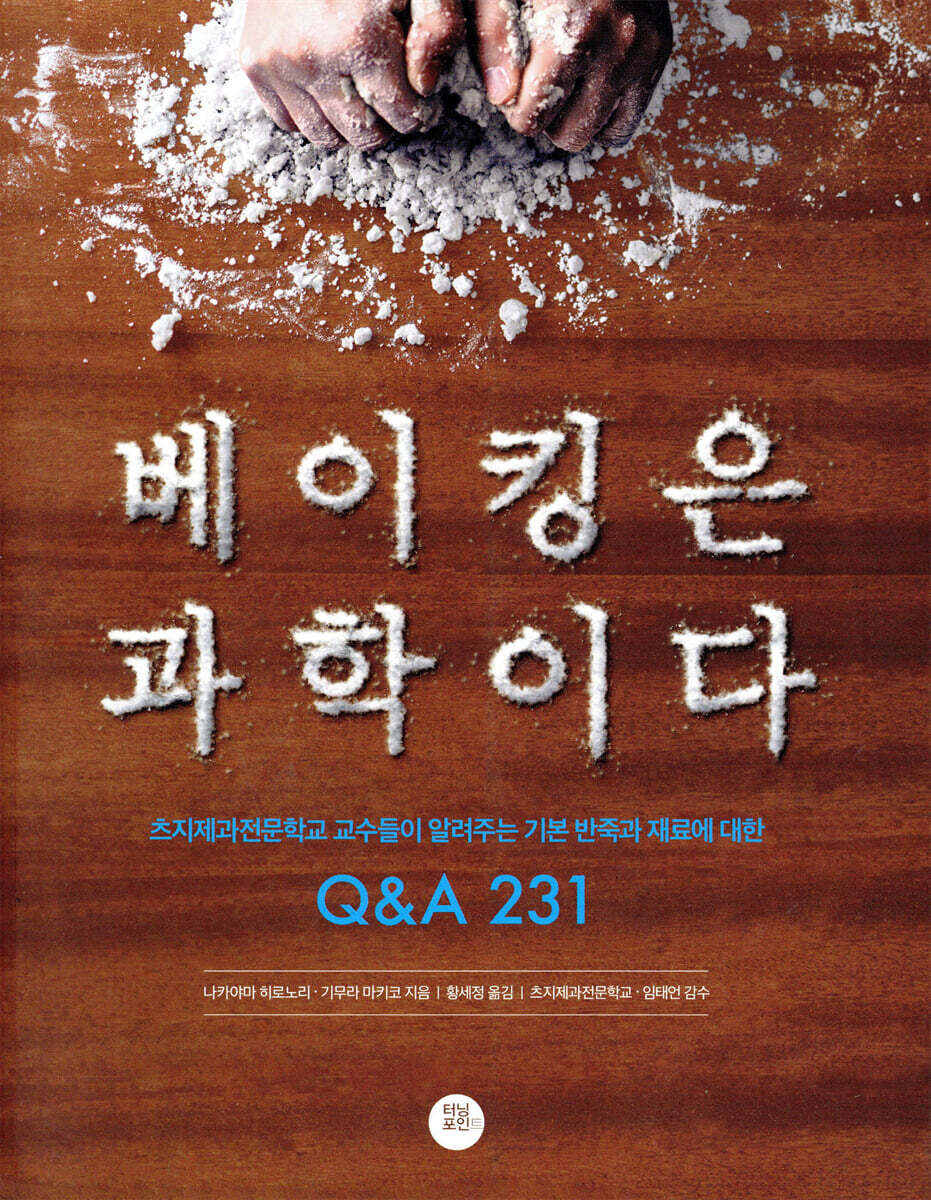
Baking is a science
 |
Description
Book Introduction
A baking textbook that solves the problem of "I made it just as the book instructed, but why doesn't it work?"
Even if you make it according to the order in the book, the state of the dough that appears each time you go through the process of making bubbles or mixing ingredients is obviously different for each person.
The important thing in baking is to always 'observe' the changes in the dough, whether it's the moment you mix the ingredients to make the dough or while you're baking it in the oven.
And you always have to ask yourself, "Why are we doing this?", such as why are we mixing the ingredients in this order, or why is the dough warm at this particular time?
Furthermore, the biggest secret to mastering baking is to always ask yourself, "Why does it turn out like that?" and find and understand the answer.
"Baking is a Science" scientifically explains such questions in a Q&A format, allowing you to understand the reasons for failure.
This book will help you avoid repeating the same mistakes because it will help you understand the exact reasons for your failures.
Even if you make it according to the order in the book, the state of the dough that appears each time you go through the process of making bubbles or mixing ingredients is obviously different for each person.
The important thing in baking is to always 'observe' the changes in the dough, whether it's the moment you mix the ingredients to make the dough or while you're baking it in the oven.
And you always have to ask yourself, "Why are we doing this?", such as why are we mixing the ingredients in this order, or why is the dough warm at this particular time?
Furthermore, the biggest secret to mastering baking is to always ask yourself, "Why does it turn out like that?" and find and understand the answer.
"Baking is a Science" scientifically explains such questions in a Q&A format, allowing you to understand the reasons for failure.
This book will help you avoid repeating the same mistakes because it will help you understand the exact reasons for your failures.
- You can preview some of the book's contents.
Preview
index
Before you start baking
[Q&A on Baking Stories You Never Knew]
- When and where did the custom of eating birthday cake originate?
- When did people start eating Christmas cake in Japan?
- The size of the round cake is indicated in 'ho(?)'. What size does the 'ho' unit refer to?
- When I make a roll cake, the sponge cake keeps splitting and not drying properly. Why is that?
- How can I make decorative fruit look fresh?
- What should I do if I can't find the heavy cream of the consistency called for in the recipe?
- Why is it okay for chiffon cake batter to stick to the pan?
- Why does the middle part of the madeleine bulge out and crack?
- When I bake a tart with candied fruit, some of the dough gets soggy or burns and sticks to the pan. Why does this happen?
- Why are the surfaces of macarons smooth and have blemishes?
- When I look at recipes for French bread, I sometimes see Type 45 flour listed. What does this mean?
- What is the cassonade often used in crème brûlée?
- What is the difference between yellow and brown Mont Blanc?
- Have salty snacks been around since ancient times?
- What is the difference between confiture and jule?
- Are kimbob and marshmallow the same thing?
[Baking Tools Q&A]
- What basic tools do I need to start baking at home?
- How do I calculate the amount when the size of the cake pan I have is different from the size of the pan in the recipe?
- What material should I choose for the frame?
Why do I preheat the oven? And what is the appropriate preheat temperature?
- I've heard that it's not a good idea to put the dough in right after the oven reaches preheat temperature. Why is that?
- Why doesn't the dough placed side by side on the same plate bake evenly to a consistent color?
- What is a convection oven?
- When baking sponge cake batter in an oven pan, how do I prevent it from sticking to the bottom?
- Which cake knife should I choose?
- Is there a special trick to slicing sponge cake into even thicknesses?
- How can I cut a cake decorated with cream neatly?
Q&A on the baking process
Cookie Encyclopedia
Cream Encyclopedia
CHAPTER 1 Sponge Cake Batter Made with Public Law
- Basic method of making sponge cake using public method
- Which material does what?
- Structural changes observed during the cooking process
- Imagine the dough cooking process
- Difference between public law and separate law
[Q&A on Sponge Cake Batter Made with Public Law]
- Is there an easier way to make the war bubble?
- Why do you stir with a whisk when adding sugar to the egg and then double boiling it?
- After adding sugar to the egg, how high should I heat it in a double boiler?
- The temperature that heats up the war
- What speed should I use to beat eggs with a hand mixer until they are well-blended?
- The egg foam is even and fine.
- Before adding the flour, how long should I beat the eggs until they are foamy?
- A simple way to check if the foam is adequate
- Why do you touch the bottom of the bowl after you've whipped the foam?
- Things to consider when making foam with a hand mixer
- Every time I make a bubble, the bubble's state changes. If there's a way to fix this, please let me know.
- I often hear people say to 'mix the dough as if cutting it,' but it doesn't mix well.
How should I mix it?
- Texture characteristics resulting from differences in mixing methods
- How much flour should I mix after pouring it into the foamy egg?
Sponge Cake and Gluten I/The Harmful Effects of Excessive Gluten
- Please tell me the criteria for judging whether or not the flour has been properly mixed into the foamy egg.
- At what temperature should the melted butter that I add to the dough last be heated?
- When adding melted butter to the batter, why do you pour it in with a spatula?
- After adding melted butter to the dough, how much should I mix? Please give me a guideline.
- What is the final specific gravity of the dough?
- Number of mixing times and specific gravity of dough
- When the sponge cake is baked, the mold falls onto the work surface. Why is that?
- The reason why the dough sinks in
- Why are there wrinkles on the surface of a baked sponge cake?
- Why do you turn the sponge cake upside down after baking it to cool it?
- Why do you use cake flour in sponge cake batter?
- I want to make a sponge cake with a softer and lighter texture. How should I do it?
- Sponge cake and gluten II/firm and soft elasticity
- How do I make a moist sponge cake?
- Dough and starch/starch gelatinization
- Can I use liquid fat like salad oil instead of melted butter?
- I want to reduce the sweetness when making a sponge cake. Is it okay to reduce the amount of sugar?
- What happens if I increase the amount of sugar in my sponge cake batter?
- Can I make a sponge cake using white sugar instead of granulated sugar?
- Why isn't my cocoa-flavored sponge cake batter rising properly?
- If I change the sponge cake batter ratio, what rules should I follow to adjust it?
CHAPTER 2 Sponge cake batter made using the separate method
- Basic method for making sponge cake using the separate method
- Which material does what?
- Structural changes observed during the cooking process
- Imagine the dough cooking process
[Q&A on Sponge Cake Made with a Separate Method]
- When whipping egg whites, is it better to use eggs straight from the refrigerator or eggs that have been brought out to room temperature?
- Why do you beat the egg whites well before whipping them?
- Please teach me the correct way to whip egg whites.
- Why do I add sugar in three steps when whipping egg whites?
- When do you add sugar to egg whites to make foam?
- The difference in timing of adding sugar when mixing by hand and using a mixer
- If there is a set standard for how much the meringue should be whipped, please let me know.
- I whipped the egg whites until they became foamy.
Can I use it like this?
- After adding sugar to the egg yolks, what is the best way to beat them until they become foamy?
- Please teach me how to mix whipped egg yolks or flour into meringue.
- Which is easier to mix: mixing egg yolks into meringue or mixing meringue into egg yolks?
- The egg yolks aren't mixing well into the meringue. Why is that?
- What is the best state for the dough to be in after mixing the flour?
- Why do you sprinkle powdered sugar on the biscuit before baking it?
- Please teach me how to apply the sponge cake batter made with the separate method.
CHAPTER 3 Butter Dough
- Basic method of making butter dough
- Which material does what?
- Structural changes observed during the cooking process
- Imagine the dough cooking process
- Another method (flower batter method)
[Butter Dough Q&A]
- How much butter and sugar should I mix?
- No matter how much I mix sugar into butter, it doesn't turn white. Why is that?
- Please teach me how to mix eggs well into butter.
- I put an egg in the butter and it quickly became fluffy.
What is the reason?
- The relationship between the temperature of butter and eggs
- When I added the eggs to the butter, separation started to occur.
Is there any way to recover the dough so that I can continue using it?
- After adding flour, what is the recommended mixing time?
- How can I make the butter dough rise more?
- Points for making butter dough well using the separate method
- How can I make butter dough crack nicely when baked?
- Why gaps appear
- I would like to apply the reference mixing ratio for butter dough in more diverse ways. What should I keep in mind when changing the mixing ratio?
CHAPTER 4 Tart Dough
- Basic method of making tart dough
- Which material does what?
- Imagine the dough cooking process
- Another way to make tart dough (sablaju method)
[Tart Dough Q&A]
- How hard should the butter be?
- Why do you add eggs little by little to the creamed butter?
- Please tell me what the dough will look like once the eggs are completely mixed into the butter.
- When adding flour to tart dough, please teach me how to mix it well.
- When I bake a tart dough that has been heated to a high temperature, it becomes hard. Why is that?
- I baked the tart dough, but the bottom came up.
Please teach me how to stop this.
- When baking with a pressing stone, when is it best to remove the pressing stone?
- Shirayaki and Karayaki
- I made the tart dough correctly, but it shrunk when I baked it.
What is the reason?
- Why do you use flour in tart dough?
- What should I be careful of when changing the tart dough mixture?
CHAPTER 5 Pie Dough
- Basic method of making pie dough
- Which material does what?
- Structural changes observed during the cooking process
- Imagine the dough cooking process
- Other ways to make pie dough (feuille en versé, feuille rapide)
[Pie Dough Q&A]
- How many layers will the foldable pie dough have when baked?
- When making detrang, how much dough should I knead?
- How to absorb water evenly
- How much rest is good for Detrang?
- Reset the gluten network structure
- Why do you mix strong flour and cake flour when making Detrangp?
- The effect of salt on gluten
- How do I thinly spread a lump of butter?
- How hard should the butter be?
- I rolled out the dough with the butter completely covered, and the butter cracked.
What is the reason?
- I stretched the foldable pie dough and it ended up being too soft.
What should I do?
- The surface of the foldable pie dough is blotched with white and yellow.
What is the reason?
- Why do you fold the dough twice and then put it in the refrigerator to rest?
- Why do you rotate the dough 90 degrees every time you fold it into three sections?
- Why do you put pique in pie dough?
- How to use a pique roller
- Please tell me what butter does in Detrampe.
- Why does adding vinegar to Detrampe's recipe help the pie layers rise better?
- Does the more layers of foldable pie dough you add, the more it will rise?
CHAPTER 6 Choux Dough
- Basic method of making choux pastry
- Which material does what?
- Structural changes observed during the cooking process
- Imagine the dough cooking process
[Choux Dough Q&A]
- Why do you mix flour into boiling water?
- Why do you boil butter in hot water?
- The role of butter in preventing clumping
- Why do you put wheat flour in hot water and then put it back on the fire to fry it?
- Please tell me the standard for how much deseche is appropriate.
- Why do you mix whole eggs into the choux pastry that has been made into a luxurious dessert?
- Does the amount of eggs determine the texture of the dough?
- Please teach me a good way to mix whole eggs into the choux pastry dough.
- Please teach me the criteria for determining whether the choux pastry is properly done.
- Why doesn't the texture of the choux pastry turn out the way it should after adding the eggs?
- Why do you spray water on the choux pastry made with a piping bag?
- Why does the puffed sugar sink the moment I take it out of the oven?
- How do I control the temperature to bake the choux well?
- Adjust the oven when baking the choux.
- How does changing the type of flour affect the baking of choux?
- What happens when you change the amount of eggs in the dough when you bake it?
- How can I improve the flavor of the choux pastry?
- How should I adjust the mixture if I want to change the texture of the choux pastry?
CHAPTER 7 Chocolate
- Basic method of making chocolate bonbons with ganache
- The structure of chocolate
- The need for tempering
- Structural changes observed through the tempering process
- Other tempering methods (marble method, inoculation method)
- Inoculation method using solid chocolate
[Chocolate Q&A]
- What is the difference between dark chocolate, milk chocolate, and white chocolate?
- What kind of chocolate is couverture chocolate?
- When melting chocolate, can't you put it in a pot and heat it over direct heat?
- I melted the chocolate in a double boiler, but it separated and hardened.
What is the reason?
- Why do milk chocolate and white chocolate have a lower melting temperature than dark chocolate?
- Please explain the theory of tempering.
1
- There are white patterns on the surface of the hardened chocolate. What are these?
- Please teach me how to check if tempering is done properly.
- Why won't the chocolate come out of the mold?
- Why doesn't Part A Glace need tempering?
- When making ganache, why does the water in the whipped cream mix instead of separating?
- Why do you use low-fat cream close to 35% when making ganache?
- Why is the chocolate coated so thickly in the ganache?
- Please tell me about the right environment for making and storing chocolate.
CHAPTER 8 Cream
Chantilly cream
- Basic method of making Chantilly cream
- Types of sugar and timing of addition
[Chantilly Cream Q&A]
- Please teach me how to make whipped cream foam more easily.
- Why does it get flaky before it foams properly?
- How do you determine the right amount of whipping cream?
- How much whipped cream should I whip when decorating a sponge cake?
- Why doesn't the cream become rich when I whip a large amount of whipping cream at once with a mixer?
- Why does the speed at which foam is formed differ depending on the fat content of the whipping cream?
- The fat content of whipping cream varies greatly, from 35% to 50%. How do I differentiate between the two?
- If I increase the amount of sugar I add to the whipped cream, will the whipped cream lose its strength?
custard cream
- Basic method of making custard cream
Custard Cream Q&A
- What exactly does it mean to heat 'until it becomes thin again'?
- Basic method of making Italian meringue
- [Italian Meringue Q&A]
- Why do you put sugar in syrup form?
- Can't all the sugar be put into syrup?
- Is there a way to know when the syrup has reached 118-120℃ without measuring it with a thermometer?
- Even though I made it according to the recipe, why is the meringue not firm and not shiny?
- When making Italian meringue - the level of foam in the egg whites
- After pouring hot syrup, why does it continue to foam while it cools down?
- Please teach me how to decorate a cake using Italian meringue.
buttercream
- Basic method of making buttercream
- Part a Bombran?
[Buttercream Q&A]
- When making buttercream, what consistency of butter should I use?
- How should I mix it after adding the Italian meringue?
Anglaise sauce
- Basic method of making anglaise sauce
[Anglaise Sauce Q&A]
- Why is the Anglaise sauce not heated above 80-85℃?
almond cream
- Basic method of making almond cream
Almond Cream Q&A
- I made it according to the recipe, but the cream is too runny.
What is the reason?
Q&A on Baking Ingredients
CHAPTER 1 Eggs
[Egg Selection Q&A]
- What size eggs should I use?
- Liquid egg
- Are there any differences in the ingredients between white and brown eggs?
- Please teach me how to tell the freshness of eggs.
- Why are egg whites thick and elastic when fresh, but become runny like water when they get cold?
- Egg freshness and carbon dioxide gas
[Egg Foaming (Egg Foaming, Protein Denaturation) Q&A]
- Why do bubbles form when I beat an egg?
- Surface tension
- Why does egg white foam well, but egg yolk doesn't?
- Please tell me the criteria for selecting a tool to beat eggs.
- Why do you always add sugar when whisking eggs?
- When whisking eggs, does varying the amount of sugar make a difference in the texture of the foam?
- When whipping egg whites, how does the freshness of the eggs affect the foam?
- When I beat the egg whites, water seeped out.
What is the reason?
- Why doesn't foam form when I pause for a moment while stirring and then stir again?
[Heat-Coagulating Eggs (Thermocoagulability of Eggs, Thermal Denaturation of Proteins) Q&A]
- Why do you steam and harden pudding?
- Why does increasing the amount of sugar in a pudding make it softer?
- Coagulation of eggs with milk
- Why are there 'holes' in the pudding?
[Q&A on Mixing Oil and Water Using the Emulsifying Power of Eggs (Egg Yolk Emulsifying Power)]
- Why doesn't the moist egg separate when mixed with butter?
CHAPTER 2 Flour
[Flour Types Q&A]
- Why do you use a sieve to sift the flour?
- What is the difference between strong flour and strong wheat flour?
- Why do you use strong flour in the powder?
Protein and Gluten Q&A
- What is gluten?
- Why do we use cake flour for sponge cakes and strong flour for bread or fermented pastries?
- The relationship between the amount of gluten and water
- Please tell me about ingredients that strengthen or weaken gluten.
[Starch Luxury Q&A]
- I baked a sponge cake, but why did it become hard after a few days?
- Difference in viscosity depending on moisture content
- If I add a lot of sugar to the sponge cake batter, why does it still remain soft after a few days?
- How does the viscosity of the starch in flour change during the gelatinization process?
- Gelatinization temperature and viscosity of various starches
CHAPTER 3 Sugar
[Types of Sugar Q&A]
- Please tell me what type of sugar is suitable for making confectionery.
- What is the difference between granulated sugar and white sugar when baking?
- Among the processed granulated sugars, which one is most commonly used in baking?
- The main role of sugar in influencing baking
[Sugar Hydrophilicity Q&A]
- When I reduced the amount of sugar in my sponge cake batter, why did it lose its moist texture?
- Why does water seep out of jelly with reduced sugar content over time?
- Why doesn't jam spoil?
- How to make strawberry jam
- The water-retaining properties of sugar that help pectin gel.
- How high should the sugar content of jam be to keep it from spoiling and for a long time?
- How do you make candied fruit called confit?
[Sugar Recrystallization Q&A]
- Why does syrup that has melted and become transparent solidify again?
- How do you make the fondant for eclairs?
- How to make fondant
- How to use fondant
- How do whiskey bonbons manage to keep whiskey syrup inside those thin candies?
- How to make whiskey bonbons
[Sugar Coloring Q&A]
- Why does increasing the amount of sugar in the dough lead to better color when baked?
- What is reducing sugar?
- When I increase the amount of granulated sugar when baking cookies, why does it turn a golden brown color?
- What's the secret to making good caramel for pudding?
- How to make caramel
CHAPTER 4 Milk and Cream
[Q&A on Milk Types]
- They say freshly squeezed milk tastes richer. Why is that?
- Why do different milks have different flavors even though they have the same fat content?
- What is the difference between Jersey milk and regular milk?
[Q&A on Types of Whipped Cream]
- What is the difference between milk and cream?
- In whipping cream, there is butterfat and vegetable fat. What is the difference?
- When I whip vegetable cream, it doesn't separate as easily as fat cream. Why is that?
- Why do some whipped creams made with butterfat have a short shelf life and others have a long shelf life?
- Why does the color of whipped cream vary depending on the product?
[Q&A on whipping cream (foaming)]
-Why does whipped cream foam up?
- Why does whipping cream turn yellow when whipped?
[Other Q&A]
- When I mix sour fruit puree with whipped cream, it separates. Why is that?
- How do you make milk foam for cappuccino?
CHAPTER 5 Butter
[Types of Butter Q&A]
- Which is better for baking, salted butter or unsalted butter?
- Why does making baked goods with cultured butter improve the flavor?
- They say you can make butter with whipping cream. Is that true?
- Does butter contain water as well as fat?
- What is low-moisture butter?
[Butter Heating Q&A]
Why do you use burnt butter when making financiers? And how do you burn it?
- In what cases is it best to use refined butter?
- If I put melted butter in the refrigerator to harden it again, it loses its original smoothness. Why is that?
[Butter Creaming Q&A]
- When making butter dough, why do you mix sugar into the butter evenly?
[Q&A on Butter's Shortening Properties]
- When making tart dough or cookies, why shouldn't the dough become soft while working?
[Butter Plasticity Q&A]
- When I roll out butter for a folding pie crust, why does it stretch like clay?
CHAPTER 6 Bulking Agents, Coagulants, Flavoring Agents, and Coloring Agents
[Bolstering Agent Q&A]
- What is the difference between baking soda and baking powder?
- If I use baking powder specifically for baked goods, will the baked goods really rise well?
- Why do bubbles appear on the surface of dough that has baking powder added when left out for a while?
- Even though I added baking powder, the dough doesn't rise well.
Why is that?
[Coagulant Q&A]
- Why do you use gelatin to firm up mousse and bavarois?
- Which is easier to use, sheet gelatin or powdered gelatin?
- Why is it necessary to use cold water when soaking sheet gelatin?
- I added the specified amount of gelatin according to the recipe, but why isn't the jelly hardening?
- If I reduce the amount of sugar in the jelly, does the curdling phenomenon occur or the coagulation power weaken? Why is this?
- How much gelatin do I need to make jelly?
- What is the jelly strength?
- Why doesn't kiwi jelly harden?
- What is Karajinan?
- The degree of hardening of carrageenan varies depending on the product. Why is that?
- What is pectin added when making jam?
[Fragrance Q&A]
- There are Bourbon vanilla beans and Tahitian vanilla beans. What is the difference?
- How should I differentiate between vanilla essence and vanilla oil?
- How do you use vanilla beans?
[Coloring Q&A]
- They say there are natural and synthetic coloring agents. Can you tell me what the difference is?
- Can powdered pigments be colored by directly spraying them on?
- How do I color white chocolate?
[Q&A on Baking Stories You Never Knew]
- When and where did the custom of eating birthday cake originate?
- When did people start eating Christmas cake in Japan?
- The size of the round cake is indicated in 'ho(?)'. What size does the 'ho' unit refer to?
- When I make a roll cake, the sponge cake keeps splitting and not drying properly. Why is that?
- How can I make decorative fruit look fresh?
- What should I do if I can't find the heavy cream of the consistency called for in the recipe?
- Why is it okay for chiffon cake batter to stick to the pan?
- Why does the middle part of the madeleine bulge out and crack?
- When I bake a tart with candied fruit, some of the dough gets soggy or burns and sticks to the pan. Why does this happen?
- Why are the surfaces of macarons smooth and have blemishes?
- When I look at recipes for French bread, I sometimes see Type 45 flour listed. What does this mean?
- What is the cassonade often used in crème brûlée?
- What is the difference between yellow and brown Mont Blanc?
- Have salty snacks been around since ancient times?
- What is the difference between confiture and jule?
- Are kimbob and marshmallow the same thing?
[Baking Tools Q&A]
- What basic tools do I need to start baking at home?
- How do I calculate the amount when the size of the cake pan I have is different from the size of the pan in the recipe?
- What material should I choose for the frame?
Why do I preheat the oven? And what is the appropriate preheat temperature?
- I've heard that it's not a good idea to put the dough in right after the oven reaches preheat temperature. Why is that?
- Why doesn't the dough placed side by side on the same plate bake evenly to a consistent color?
- What is a convection oven?
- When baking sponge cake batter in an oven pan, how do I prevent it from sticking to the bottom?
- Which cake knife should I choose?
- Is there a special trick to slicing sponge cake into even thicknesses?
- How can I cut a cake decorated with cream neatly?
Q&A on the baking process
Cookie Encyclopedia
Cream Encyclopedia
CHAPTER 1 Sponge Cake Batter Made with Public Law
- Basic method of making sponge cake using public method
- Which material does what?
- Structural changes observed during the cooking process
- Imagine the dough cooking process
- Difference between public law and separate law
[Q&A on Sponge Cake Batter Made with Public Law]
- Is there an easier way to make the war bubble?
- Why do you stir with a whisk when adding sugar to the egg and then double boiling it?
- After adding sugar to the egg, how high should I heat it in a double boiler?
- The temperature that heats up the war
- What speed should I use to beat eggs with a hand mixer until they are well-blended?
- The egg foam is even and fine.
- Before adding the flour, how long should I beat the eggs until they are foamy?
- A simple way to check if the foam is adequate
- Why do you touch the bottom of the bowl after you've whipped the foam?
- Things to consider when making foam with a hand mixer
- Every time I make a bubble, the bubble's state changes. If there's a way to fix this, please let me know.
- I often hear people say to 'mix the dough as if cutting it,' but it doesn't mix well.
How should I mix it?
- Texture characteristics resulting from differences in mixing methods
- How much flour should I mix after pouring it into the foamy egg?
Sponge Cake and Gluten I/The Harmful Effects of Excessive Gluten
- Please tell me the criteria for judging whether or not the flour has been properly mixed into the foamy egg.
- At what temperature should the melted butter that I add to the dough last be heated?
- When adding melted butter to the batter, why do you pour it in with a spatula?
- After adding melted butter to the dough, how much should I mix? Please give me a guideline.
- What is the final specific gravity of the dough?
- Number of mixing times and specific gravity of dough
- When the sponge cake is baked, the mold falls onto the work surface. Why is that?
- The reason why the dough sinks in
- Why are there wrinkles on the surface of a baked sponge cake?
- Why do you turn the sponge cake upside down after baking it to cool it?
- Why do you use cake flour in sponge cake batter?
- I want to make a sponge cake with a softer and lighter texture. How should I do it?
- Sponge cake and gluten II/firm and soft elasticity
- How do I make a moist sponge cake?
- Dough and starch/starch gelatinization
- Can I use liquid fat like salad oil instead of melted butter?
- I want to reduce the sweetness when making a sponge cake. Is it okay to reduce the amount of sugar?
- What happens if I increase the amount of sugar in my sponge cake batter?
- Can I make a sponge cake using white sugar instead of granulated sugar?
- Why isn't my cocoa-flavored sponge cake batter rising properly?
- If I change the sponge cake batter ratio, what rules should I follow to adjust it?
CHAPTER 2 Sponge cake batter made using the separate method
- Basic method for making sponge cake using the separate method
- Which material does what?
- Structural changes observed during the cooking process
- Imagine the dough cooking process
[Q&A on Sponge Cake Made with a Separate Method]
- When whipping egg whites, is it better to use eggs straight from the refrigerator or eggs that have been brought out to room temperature?
- Why do you beat the egg whites well before whipping them?
- Please teach me the correct way to whip egg whites.
- Why do I add sugar in three steps when whipping egg whites?
- When do you add sugar to egg whites to make foam?
- The difference in timing of adding sugar when mixing by hand and using a mixer
- If there is a set standard for how much the meringue should be whipped, please let me know.
- I whipped the egg whites until they became foamy.
Can I use it like this?
- After adding sugar to the egg yolks, what is the best way to beat them until they become foamy?
- Please teach me how to mix whipped egg yolks or flour into meringue.
- Which is easier to mix: mixing egg yolks into meringue or mixing meringue into egg yolks?
- The egg yolks aren't mixing well into the meringue. Why is that?
- What is the best state for the dough to be in after mixing the flour?
- Why do you sprinkle powdered sugar on the biscuit before baking it?
- Please teach me how to apply the sponge cake batter made with the separate method.
CHAPTER 3 Butter Dough
- Basic method of making butter dough
- Which material does what?
- Structural changes observed during the cooking process
- Imagine the dough cooking process
- Another method (flower batter method)
[Butter Dough Q&A]
- How much butter and sugar should I mix?
- No matter how much I mix sugar into butter, it doesn't turn white. Why is that?
- Please teach me how to mix eggs well into butter.
- I put an egg in the butter and it quickly became fluffy.
What is the reason?
- The relationship between the temperature of butter and eggs
- When I added the eggs to the butter, separation started to occur.
Is there any way to recover the dough so that I can continue using it?
- After adding flour, what is the recommended mixing time?
- How can I make the butter dough rise more?
- Points for making butter dough well using the separate method
- How can I make butter dough crack nicely when baked?
- Why gaps appear
- I would like to apply the reference mixing ratio for butter dough in more diverse ways. What should I keep in mind when changing the mixing ratio?
CHAPTER 4 Tart Dough
- Basic method of making tart dough
- Which material does what?
- Imagine the dough cooking process
- Another way to make tart dough (sablaju method)
[Tart Dough Q&A]
- How hard should the butter be?
- Why do you add eggs little by little to the creamed butter?
- Please tell me what the dough will look like once the eggs are completely mixed into the butter.
- When adding flour to tart dough, please teach me how to mix it well.
- When I bake a tart dough that has been heated to a high temperature, it becomes hard. Why is that?
- I baked the tart dough, but the bottom came up.
Please teach me how to stop this.
- When baking with a pressing stone, when is it best to remove the pressing stone?
- Shirayaki and Karayaki
- I made the tart dough correctly, but it shrunk when I baked it.
What is the reason?
- Why do you use flour in tart dough?
- What should I be careful of when changing the tart dough mixture?
CHAPTER 5 Pie Dough
- Basic method of making pie dough
- Which material does what?
- Structural changes observed during the cooking process
- Imagine the dough cooking process
- Other ways to make pie dough (feuille en versé, feuille rapide)
[Pie Dough Q&A]
- How many layers will the foldable pie dough have when baked?
- When making detrang, how much dough should I knead?
- How to absorb water evenly
- How much rest is good for Detrang?
- Reset the gluten network structure
- Why do you mix strong flour and cake flour when making Detrangp?
- The effect of salt on gluten
- How do I thinly spread a lump of butter?
- How hard should the butter be?
- I rolled out the dough with the butter completely covered, and the butter cracked.
What is the reason?
- I stretched the foldable pie dough and it ended up being too soft.
What should I do?
- The surface of the foldable pie dough is blotched with white and yellow.
What is the reason?
- Why do you fold the dough twice and then put it in the refrigerator to rest?
- Why do you rotate the dough 90 degrees every time you fold it into three sections?
- Why do you put pique in pie dough?
- How to use a pique roller
- Please tell me what butter does in Detrampe.
- Why does adding vinegar to Detrampe's recipe help the pie layers rise better?
- Does the more layers of foldable pie dough you add, the more it will rise?
CHAPTER 6 Choux Dough
- Basic method of making choux pastry
- Which material does what?
- Structural changes observed during the cooking process
- Imagine the dough cooking process
[Choux Dough Q&A]
- Why do you mix flour into boiling water?
- Why do you boil butter in hot water?
- The role of butter in preventing clumping
- Why do you put wheat flour in hot water and then put it back on the fire to fry it?
- Please tell me the standard for how much deseche is appropriate.
- Why do you mix whole eggs into the choux pastry that has been made into a luxurious dessert?
- Does the amount of eggs determine the texture of the dough?
- Please teach me a good way to mix whole eggs into the choux pastry dough.
- Please teach me the criteria for determining whether the choux pastry is properly done.
- Why doesn't the texture of the choux pastry turn out the way it should after adding the eggs?
- Why do you spray water on the choux pastry made with a piping bag?
- Why does the puffed sugar sink the moment I take it out of the oven?
- How do I control the temperature to bake the choux well?
- Adjust the oven when baking the choux.
- How does changing the type of flour affect the baking of choux?
- What happens when you change the amount of eggs in the dough when you bake it?
- How can I improve the flavor of the choux pastry?
- How should I adjust the mixture if I want to change the texture of the choux pastry?
CHAPTER 7 Chocolate
- Basic method of making chocolate bonbons with ganache
- The structure of chocolate
- The need for tempering
- Structural changes observed through the tempering process
- Other tempering methods (marble method, inoculation method)
- Inoculation method using solid chocolate
[Chocolate Q&A]
- What is the difference between dark chocolate, milk chocolate, and white chocolate?
- What kind of chocolate is couverture chocolate?
- When melting chocolate, can't you put it in a pot and heat it over direct heat?
- I melted the chocolate in a double boiler, but it separated and hardened.
What is the reason?
- Why do milk chocolate and white chocolate have a lower melting temperature than dark chocolate?
- Please explain the theory of tempering.
1
- There are white patterns on the surface of the hardened chocolate. What are these?
- Please teach me how to check if tempering is done properly.
- Why won't the chocolate come out of the mold?
- Why doesn't Part A Glace need tempering?
- When making ganache, why does the water in the whipped cream mix instead of separating?
- Why do you use low-fat cream close to 35% when making ganache?
- Why is the chocolate coated so thickly in the ganache?
- Please tell me about the right environment for making and storing chocolate.
CHAPTER 8 Cream
Chantilly cream
- Basic method of making Chantilly cream
- Types of sugar and timing of addition
[Chantilly Cream Q&A]
- Please teach me how to make whipped cream foam more easily.
- Why does it get flaky before it foams properly?
- How do you determine the right amount of whipping cream?
- How much whipped cream should I whip when decorating a sponge cake?
- Why doesn't the cream become rich when I whip a large amount of whipping cream at once with a mixer?
- Why does the speed at which foam is formed differ depending on the fat content of the whipping cream?
- The fat content of whipping cream varies greatly, from 35% to 50%. How do I differentiate between the two?
- If I increase the amount of sugar I add to the whipped cream, will the whipped cream lose its strength?
custard cream
- Basic method of making custard cream
Custard Cream Q&A
- What exactly does it mean to heat 'until it becomes thin again'?
- Basic method of making Italian meringue
- [Italian Meringue Q&A]
- Why do you put sugar in syrup form?
- Can't all the sugar be put into syrup?
- Is there a way to know when the syrup has reached 118-120℃ without measuring it with a thermometer?
- Even though I made it according to the recipe, why is the meringue not firm and not shiny?
- When making Italian meringue - the level of foam in the egg whites
- After pouring hot syrup, why does it continue to foam while it cools down?
- Please teach me how to decorate a cake using Italian meringue.
buttercream
- Basic method of making buttercream
- Part a Bombran?
[Buttercream Q&A]
- When making buttercream, what consistency of butter should I use?
- How should I mix it after adding the Italian meringue?
Anglaise sauce
- Basic method of making anglaise sauce
[Anglaise Sauce Q&A]
- Why is the Anglaise sauce not heated above 80-85℃?
almond cream
- Basic method of making almond cream
Almond Cream Q&A
- I made it according to the recipe, but the cream is too runny.
What is the reason?
Q&A on Baking Ingredients
CHAPTER 1 Eggs
[Egg Selection Q&A]
- What size eggs should I use?
- Liquid egg
- Are there any differences in the ingredients between white and brown eggs?
- Please teach me how to tell the freshness of eggs.
- Why are egg whites thick and elastic when fresh, but become runny like water when they get cold?
- Egg freshness and carbon dioxide gas
[Egg Foaming (Egg Foaming, Protein Denaturation) Q&A]
- Why do bubbles form when I beat an egg?
- Surface tension
- Why does egg white foam well, but egg yolk doesn't?
- Please tell me the criteria for selecting a tool to beat eggs.
- Why do you always add sugar when whisking eggs?
- When whisking eggs, does varying the amount of sugar make a difference in the texture of the foam?
- When whipping egg whites, how does the freshness of the eggs affect the foam?
- When I beat the egg whites, water seeped out.
What is the reason?
- Why doesn't foam form when I pause for a moment while stirring and then stir again?
[Heat-Coagulating Eggs (Thermocoagulability of Eggs, Thermal Denaturation of Proteins) Q&A]
- Why do you steam and harden pudding?
- Why does increasing the amount of sugar in a pudding make it softer?
- Coagulation of eggs with milk
- Why are there 'holes' in the pudding?
[Q&A on Mixing Oil and Water Using the Emulsifying Power of Eggs (Egg Yolk Emulsifying Power)]
- Why doesn't the moist egg separate when mixed with butter?
CHAPTER 2 Flour
[Flour Types Q&A]
- Why do you use a sieve to sift the flour?
- What is the difference between strong flour and strong wheat flour?
- Why do you use strong flour in the powder?
Protein and Gluten Q&A
- What is gluten?
- Why do we use cake flour for sponge cakes and strong flour for bread or fermented pastries?
- The relationship between the amount of gluten and water
- Please tell me about ingredients that strengthen or weaken gluten.
[Starch Luxury Q&A]
- I baked a sponge cake, but why did it become hard after a few days?
- Difference in viscosity depending on moisture content
- If I add a lot of sugar to the sponge cake batter, why does it still remain soft after a few days?
- How does the viscosity of the starch in flour change during the gelatinization process?
- Gelatinization temperature and viscosity of various starches
CHAPTER 3 Sugar
[Types of Sugar Q&A]
- Please tell me what type of sugar is suitable for making confectionery.
- What is the difference between granulated sugar and white sugar when baking?
- Among the processed granulated sugars, which one is most commonly used in baking?
- The main role of sugar in influencing baking
[Sugar Hydrophilicity Q&A]
- When I reduced the amount of sugar in my sponge cake batter, why did it lose its moist texture?
- Why does water seep out of jelly with reduced sugar content over time?
- Why doesn't jam spoil?
- How to make strawberry jam
- The water-retaining properties of sugar that help pectin gel.
- How high should the sugar content of jam be to keep it from spoiling and for a long time?
- How do you make candied fruit called confit?
[Sugar Recrystallization Q&A]
- Why does syrup that has melted and become transparent solidify again?
- How do you make the fondant for eclairs?
- How to make fondant
- How to use fondant
- How do whiskey bonbons manage to keep whiskey syrup inside those thin candies?
- How to make whiskey bonbons
[Sugar Coloring Q&A]
- Why does increasing the amount of sugar in the dough lead to better color when baked?
- What is reducing sugar?
- When I increase the amount of granulated sugar when baking cookies, why does it turn a golden brown color?
- What's the secret to making good caramel for pudding?
- How to make caramel
CHAPTER 4 Milk and Cream
[Q&A on Milk Types]
- They say freshly squeezed milk tastes richer. Why is that?
- Why do different milks have different flavors even though they have the same fat content?
- What is the difference between Jersey milk and regular milk?
[Q&A on Types of Whipped Cream]
- What is the difference between milk and cream?
- In whipping cream, there is butterfat and vegetable fat. What is the difference?
- When I whip vegetable cream, it doesn't separate as easily as fat cream. Why is that?
- Why do some whipped creams made with butterfat have a short shelf life and others have a long shelf life?
- Why does the color of whipped cream vary depending on the product?
[Q&A on whipping cream (foaming)]
-Why does whipped cream foam up?
- Why does whipping cream turn yellow when whipped?
[Other Q&A]
- When I mix sour fruit puree with whipped cream, it separates. Why is that?
- How do you make milk foam for cappuccino?
CHAPTER 5 Butter
[Types of Butter Q&A]
- Which is better for baking, salted butter or unsalted butter?
- Why does making baked goods with cultured butter improve the flavor?
- They say you can make butter with whipping cream. Is that true?
- Does butter contain water as well as fat?
- What is low-moisture butter?
[Butter Heating Q&A]
Why do you use burnt butter when making financiers? And how do you burn it?
- In what cases is it best to use refined butter?
- If I put melted butter in the refrigerator to harden it again, it loses its original smoothness. Why is that?
[Butter Creaming Q&A]
- When making butter dough, why do you mix sugar into the butter evenly?
[Q&A on Butter's Shortening Properties]
- When making tart dough or cookies, why shouldn't the dough become soft while working?
[Butter Plasticity Q&A]
- When I roll out butter for a folding pie crust, why does it stretch like clay?
CHAPTER 6 Bulking Agents, Coagulants, Flavoring Agents, and Coloring Agents
[Bolstering Agent Q&A]
- What is the difference between baking soda and baking powder?
- If I use baking powder specifically for baked goods, will the baked goods really rise well?
- Why do bubbles appear on the surface of dough that has baking powder added when left out for a while?
- Even though I added baking powder, the dough doesn't rise well.
Why is that?
[Coagulant Q&A]
- Why do you use gelatin to firm up mousse and bavarois?
- Which is easier to use, sheet gelatin or powdered gelatin?
- Why is it necessary to use cold water when soaking sheet gelatin?
- I added the specified amount of gelatin according to the recipe, but why isn't the jelly hardening?
- If I reduce the amount of sugar in the jelly, does the curdling phenomenon occur or the coagulation power weaken? Why is this?
- How much gelatin do I need to make jelly?
- What is the jelly strength?
- Why doesn't kiwi jelly harden?
- What is Karajinan?
- The degree of hardening of carrageenan varies depending on the product. Why is that?
- What is pectin added when making jam?
[Fragrance Q&A]
- There are Bourbon vanilla beans and Tahitian vanilla beans. What is the difference?
- How should I differentiate between vanilla essence and vanilla oil?
- How do you use vanilla beans?
[Coloring Q&A]
- They say there are natural and synthetic coloring agents. Can you tell me what the difference is?
- Can powdered pigments be colored by directly spraying them on?
- How do I color white chocolate?
Detailed image

Publisher's Review
“You can’t master baking without knowing why you failed.”
The secret to mastering baking is observing, feeling, being curious, and then approaching that curiosity scientifically.
Eggs, sugar, flour, butter.
With just these four ingredients, you can make delicious cookies and bread.
The greatest joy of baking is using these ingredients to create new flavors and shapes that are completely different from their original form.
If you put choux pastry or sponge cake batter in the oven and watch it closely, it will gradually begin to rise.
Anyone who sees that sight will feel their heart pounding with anticipation.
But sometimes, for reasons unknown, these expectations can suddenly turn into nightmares.
Sometimes people say, “My sponge cake doesn’t rise properly and becomes hard.”
When asked what process they went through to make a cake, they usually answer, “I just made it just like it was written in the book...”
However, even if you make it according to the order in the book, the state of the dough that appears each time you go through the process of making bubbles or mixing ingredients is obviously different for each person.
Most of the reasons for mistakes are things like whisking the eggs incorrectly, mixing the ingredients for too long, or baking in the oven for too long.
Explains the secrets to making the best dough and various methods.
"Baking is a Science" focuses on the crucial points for optimal dough preparation and various methods for achieving them, based on case studies, to help each person achieve the baking they desire.
An important thing in baking is to always observe the changes in the dough, whether it is the moment you mix the ingredients to make the dough or the moment you put the dough in the oven and bake it.
And it explains all the phenomena, such as why the ingredients are mixed in this order, why the dough is warmed at this particular time, etc., so that you can think about 'Why does it happen like that?' and find the answer and understand it.
It answers all your questions in a Q&A format and helps you create your own unique recipes.
"Baking is a Science" addresses questions that arise during the baking process in a Q&A format and has been scientifically verified.
Baking techniques passed down through generations were naturally established through countless trials and successes. However, now we can scientifically prove the reasons why they were done that way, and the results are explained in detail so that readers can easily understand them.
This book also introduces examples of dough mixing, explaining in detail the rules by which these dough mixings are determined, and the differences in the results when different types of flour or sugar are used, so it will be helpful when creating your own unique recipes.
The secret to mastering baking is observing, feeling, being curious, and then approaching that curiosity scientifically.
Eggs, sugar, flour, butter.
With just these four ingredients, you can make delicious cookies and bread.
The greatest joy of baking is using these ingredients to create new flavors and shapes that are completely different from their original form.
If you put choux pastry or sponge cake batter in the oven and watch it closely, it will gradually begin to rise.
Anyone who sees that sight will feel their heart pounding with anticipation.
But sometimes, for reasons unknown, these expectations can suddenly turn into nightmares.
Sometimes people say, “My sponge cake doesn’t rise properly and becomes hard.”
When asked what process they went through to make a cake, they usually answer, “I just made it just like it was written in the book...”
However, even if you make it according to the order in the book, the state of the dough that appears each time you go through the process of making bubbles or mixing ingredients is obviously different for each person.
Most of the reasons for mistakes are things like whisking the eggs incorrectly, mixing the ingredients for too long, or baking in the oven for too long.
Explains the secrets to making the best dough and various methods.
"Baking is a Science" focuses on the crucial points for optimal dough preparation and various methods for achieving them, based on case studies, to help each person achieve the baking they desire.
An important thing in baking is to always observe the changes in the dough, whether it is the moment you mix the ingredients to make the dough or the moment you put the dough in the oven and bake it.
And it explains all the phenomena, such as why the ingredients are mixed in this order, why the dough is warmed at this particular time, etc., so that you can think about 'Why does it happen like that?' and find the answer and understand it.
It answers all your questions in a Q&A format and helps you create your own unique recipes.
"Baking is a Science" addresses questions that arise during the baking process in a Q&A format and has been scientifically verified.
Baking techniques passed down through generations were naturally established through countless trials and successes. However, now we can scientifically prove the reasons why they were done that way, and the results are explained in detail so that readers can easily understand them.
This book also introduces examples of dough mixing, explaining in detail the rules by which these dough mixings are determined, and the differences in the results when different types of flour or sugar are used, so it will be helpful when creating your own unique recipes.
GOODS SPECIFICS
- Publication date: November 10, 2017
- Page count, weight, size: 328 pages | 930g | 188*240*23mm
- ISBN13: 9791161340098
- ISBN10: 1161340092
You may also like
카테고리
korean


korean

![ELLE 엘르 스페셜 에디션 A형 : 12월 [2025]](http://librairie.coreenne.fr/cdn/shop/files/b8e27a3de6c9538896439686c6b0e8fb.jpg?v=1766436872&width=3840)


