

C Language for Beginners
 |
Description
Book Introduction
A friendly guide for readers new to C programming.
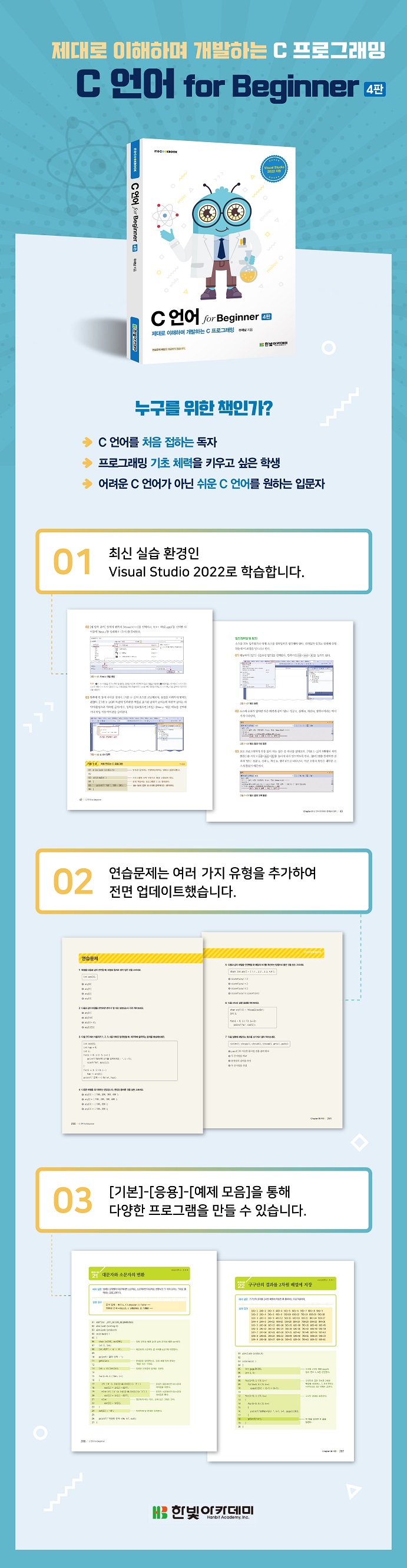
『C Language for Beginners』 has been revised into its 4th edition.
We have implemented Visual Studio 2022 as a new practice environment, and have also completely revamped the practice problems.
This book helps you understand the basic concepts of programming through easy explanations and provides hands-on coding practice with over 190 examples.
Furthermore, you can fully understand C programming by solving various practice problems.
If you want easy and fun C programming rather than difficult C programming, start with 『C Language for Beginners, 4th Edition』!
※ This book was developed as a textbook for university lectures, so it does not provide answers to practice problems.
※ Naver Cafe: https://cafe.naver.com/itcookbook
『C Language for Beginners』 has been revised into its 4th edition.
We have implemented Visual Studio 2022 as a new practice environment, and have also completely revamped the practice problems.
This book helps you understand the basic concepts of programming through easy explanations and provides hands-on coding practice with over 190 examples.
Furthermore, you can fully understand C programming by solving various practice problems.
If you want easy and fun C programming rather than difficult C programming, start with 『C Language for Beginners, 4th Edition』!
※ This book was developed as a textbook for university lectures, so it does not provide answers to practice problems.
※ Naver Cafe: https://cafe.naver.com/itcookbook
- You can preview some of the book's contents.
Preview
index
CHAPTER 01 Understanding the C Language and Compiler Installation
SECTION 01 Understanding the C Language
1. Overview of Programming
Features of 2C
3 Types of C Compilers
SECTION 02 C program writing sequence
1 Program Coding
[Basic 1-1] A Taste of C Programming
2 Compile and link
3 Run the program
SECTION 03 C Compiler Installation and Simple Practice
1. Versions of Visual Studio available for practice
2 Install Visual Studio Community
3 A simple program to write for the first time
[Basic 1-2] Creating Your First C Program
[Basic 1-3] Modifying the source (modifying the calculated value)
[Basic 1-4] Editing the source (a single line spacing)
summation
Practice problems
CHAPTER 02 A Practical C Program to Try Out
SECTION 01 Review of the program writing process
1 Create a second project
2 Program Coding
[Basic 2-1] Creating the second C program
3 Build (Compile/Link)
4 Run
SECTION 02 Preview of the scanf( ) function
1 scanf( ) function that receives a value
[Application 2-2] Modifying the source (entering values via the keyboard)
[Application 2-3] Modifying the source (help output)
Example Collection 01 Program to add four numbers
Example Collection 02 Calculator using if statement
Example Collection 03 Error-Free Calculator
summation
Practice problems
CHAPTER 03 printf( ) function and data format
SECTION 01 Basic form of the printf( ) function
1 Basic usage of the printf( ) function (integer)
[Basic 3-1] Example 1 of using the printf( ) function
[Basic 3-2] Example 2 of using the printf( ) function
2 Frequently used formats other than integers
[Basic 3-3] Output Example 1 Using Format
[Application 3-4] Example 2 of Output Using Format
SECTION 02 Formatting the printf( ) function
Output with 1 digit
[Basic 3-5] Example 1 of Using Various Formats
2 Format characters with various functions
[Application 3-6] Example 2 of Using Various Formats
SECTION 03 Understanding Variables
1 Variable declaration
2. How to store values in variables
[Basic 3-7] Example of assigning a value to a variable
[Application 3-8] Example 1 of Assigning Variables to Variables
[Application 3-9] Example 2: Assigning Variables to Variables
SECTION 04 Data Types and Arrays
1 bit, byte, hexadecimal
Binary conversion practice
3 Numeric data types
[Basic 3-10] Example of using integers without decimal points
[Basic 3-11] Example of using real numbers with decimal points
4 character data types
[Basic 3-12] Example 1 of Using Character Variables
[Application 3-13] Example 2 of Using Character Variables
5 Strings and arrays of multiple characters
[Basic 3-14] Example 1 of using string format
[Application 3-15] Example 2 of Using String Format
Example Collection 04 Program to print integers
Example Collection 05 Determining the base of the input integer
Example Collection 06 Checking the size of a data type
Example Collection 07 Outputting the input string in reverse order
summation
Practice problems
CHAPTER 04 Understanding C Operators
SECTION 01 Arithmetic Operators
1 Basic arithmetic operators
[Basic 4-1] Examples of using arithmetic operators
2 Operator Precedence and Coercion
[Application 4-2] Operator Precedence and Forced Type Conversion Example
3 Assignment operators and increment and decrement operators
[Basic 4-3] Examples of using assignment and increment/decrement operators
[Application 4-4] Example of using increment/decrement operators
SECTION 02 Relational Operators
[Basic 4-5] Examples of using relational operators
SECTION 03 Logical Operators
[Basic 4-6] Example 1 of Using Logical Operators
[Application 4-7] Example 2 of Using Logical Operators
SECTION 04 Bitwise Operators
SECTION 05 Operator Precedence
[Basic 4-8] Example of using bitwise AND operator
[Basic 4-9] Example of using bitwise OR operator
[Basic 4-10] Example of using the bitwise exclusive OR operator
[Application 4-11] Example of using masks in bit operations
[Basic 4-12] Example of using bitwise negation operator
[Basic 4-13] Example of using the bitwise left shift operator
[Basic 4-14] Example of using the bitwise right shift operator
[Application 4-15] Examples of using bitwise left shift and bitwise right shift operators
Example Collection 08 Arithmetic Operations on Two Input Real Numbers
Example Collection 09 Coin Exchange Program
Example Collection 10 Leap Year Calculation Program
summation
Practice problems
CHAPTER 05 Conditional Statements
SECTION 01 if statement
1 Basic if statement
[Basic 5-1] Basic if statement usage example 1
[Basic 5-2] Basic if statement usage example 2
[Basic 5-3] Basic if statement usage example 3
2 if~else statements
[Basic 5-4] Example of using if~else statement
[Basic 5-5] Example 1 of using if~else statements using blocks
[Application 5-6] Example 2 of using if~else statements using blocks
SECTION 02 Nested if statements
[Basic 5-7] Example 1 of using nested if statements
[Application 5-8] Example 2 of using nested if statements
SECTION 03 switch~case statement
[Basic 5-9] Example 1 of using the switch~case statement
[Application 5-10] Example 2 of using the switch~case statement
Example Collection 11: A Simple Calculator Using a Simple If Statement
Example Collection 12: Simple Calculator Using Duplicate If Statements
Example Collection 13: A Simple Calculator Using the Switch-Case Statement
summation
Practice problems
CHAPTER 06 Basics of Loops, for Loops
SECTION 01 Simple for loop
1 Understanding the for statement
[Basic 6-1] Example of repeatedly printing the same sentence
[Basic 6-2] Basic for loop usage example
2. Concept and Use of the For Loop
[Basic 6-3] Examples of using for loops and blocks
[Basic 6-4] Example 1 of using the for loop
[Basic 6-5] Example 2 of using the for loop
[Basic 6-6] Calculating the sum without using a for loop
[Basic 6-7] Calculating the sum using the for loop 1
[Basic 6-8] Calculating the sum using the for loop 2
[Application 6-9] Calculating the sum using the for loop 3
[Basic 6-10] Calculating the sum using the for loop 4
[Application 6-11] Calculating the sum using the for loop 5
[Basic 6-12] Multiplication table program using for loop
SECTION 02 Nested for loops
1. Concept of nested for loops
[Basic 6-13] Example 1 of using nested for loops
2. Utilizing nested for loops
[Application 6-14] Example 2 of Using Nested For Loops
[Application 6-15] Example 3 of Using Nested For Loops
SECTION 03 Various types of for loops
1. For loop using multiple initial values and increment/decrement expressions
[Basic 6-16] Various Uses of the For Loop 1
2 For loop without initial value or increment/decrement expression
[Basic 6-17] Various Uses of the For Loop 2
[Application 6-18] Various Examples of Using the For Loop 3
Example Collection 14 Multiplication Table Output Program
Example Collection 15 ASCII Code Table Output Program
Example 16: Outputting the input characters in reverse order
summation
Practice problems
CHAPTER 07 While Loops and Flow Control
SECTION 01 while loop
1 Comparison of for and while loops
[Basic 7-1] Example 1: Changing a for loop to a while loop
[Application 7-2] Example 2: Changing a for loop to a while loop
2 while loop for infinite loop
[Basic 7-3] Creating an infinite loop using the while loop
[Application 7-4] Calculator using infinite loop
SECTION 02 do~while statement
1 Difference between do-while and while loops
[Basic 7-5] Example 1 of using the do-while loop
[Application 7-6] Example 2 of using the do-while loop
SECTION 03 Other Control Statements
1 Break statement to escape a loop
[Basic 7-7] Example 1 of using the break statement
[Basic 7-8] Example 2 of using the break statement
[Application 7-9] Example 3 of Using the Break Statement
2 Continue statement that returns to the loop
[Basic 7-10] Example of using the continue statement
3 Goto statement to move to a specified location
[Basic 7-11] Example of using goto statement
4. Return statement that returns to where the current function was called
[Basic 7-12] Example of using the return statement
Example Collection 17 Calculator to find the sum of multiples
Example Collection 18 Distinguishing the Type of Input String
Example Collection 19: Print as many asterisks as the number entered
summation
Practice problems
CHAPTER 08 Array
SECTION 01 Understanding Arrays
1 Why use arrays?
[Basic 8-1] Example of declaring and printing multiple variable values
[Basic 8-2] Example of declaring and printing values in an array
2. Scope of application of arrays
[Application 8-3] Example of using array indexes with a for loop
[Basic 8-4] Array Initialization Example 1
[Application 8-5] Array Initialization Example 2
[Basic 8-6] Example of calculating the size of an array
SECTION 02 Arrays and Strings
1 Integer array and character array
[Basic 8-7] Example of declaring and printing a string
[Application 8-8] Example of printing strings in reverse order
2 Handling strings with string functions
[Basic 8-9] Example of using the string processing function strlen( )
[Basic 8-10] Example of using the string processing function strcpy( )
[Basic 8-11] Example of using the string processing function strcat( )
[Basic 8-12] Example of using the string processing function strcmp( )
[Application 8-13] Example of using string input/output functions gets( ) and puts( )
SECTION 03 Two-dimensional array
1 Basic concepts of two-dimensional arrays
[Basic 8-14] Example 1 of Using a Two-Dimensional Array
[Application 8-15] Example 2 of Using a Two-Dimensional Array
2 Initializing a two-dimensional array
[Basic 8-16] Example of initializing a two-dimensional array
3 Arrays of 3 or more dimensions
Example Collection 20: Output the input string in reverse order
Example Collection 21: Converting Uppercase and Lowercase Letters
Example 22: Saving the results of the multiplication table in a two-dimensional array
Example Collection 23: Converting specific characters in a string
summation
Practice problems
CHAPTER 09 Arrays and Pointers
SECTION 01 Stack
1 Understanding Stacks
2 Creating a stack with an array
[Basic 9-1] Stack Implementation Example 1
[Application 9-2] Stack Implementation Example 2
SECTION 02 Memory and Addresses
1 Memory allocation for integer variables
[Basic 9-3] Finding the address of a variable
2 Memory allocation for integer array
[Basic 9-4] Memory Allocation for Integer Arrays 1
[Application 9-5] Memory Allocation for Integer Arrays 2
SECTION 03 POINTER
[Basic 9-6] Relationship between general variables and pointer variables
[Application 9-7] Understanding Pointer Relationships
SECTION 04 Relationship between arrays and pointers
1 Character array and pointer
[Basic 9-8] Relationship between character arrays and pointers 1
2 Applications of character arrays and pointers
[Application 9-9] Relationship between character arrays and pointers 2
3 Pointer Learning Know-How
Example 24: Using pointers to print strings in reverse order
Example 25: Swapping two values using pointers
Example 26 Sorting an array using pointers
summation
Practice problems
CHAPTER 10 FUNCTIONS
SECTION 01 Understanding Functions
1. Concept of function
[Basic 10-1] Example of a program for serving coffee directly
[Basic 10-1] changed using the [Basic 10-2] function
[Basic 10-3] Changed to accept orders from multiple people [Basic 10-2]
2. Shape and use of functions
[Basic 10-4] Example 1 of Using Functions
[Application 10-5] Example 2 of Using Functions
SECTION 02 Local and Global Variables
[Basic 10-6] Distinction between local and global variables
SECTION 03 Function return values and parameters
1. Classification of functions based on whether or not they return a value
[Basic 10-7] Comparing functions based on whether they return a value or not
2. How to pass parameters
[Basic 10-8] Parameter Passing Method: Passing by Value
[Basic 10-9] Parameter Passing Method: Passing by Address
[Application 10-10] Comparison of Parameter Passing Methods
Example Collection 27 Multiplication Table Program Using Functions
Example Collection 28: Case Conversion Program Using Functions
Example Collection 29 Number Automatic Lottery Program
summation
Practice problems
CHAPTER 11 Standard Input/Output and File Input/Output
SECTION 01 Standard Input/Output Functions
1 Formatted input/output functions
[Basic 11-1] Example of using formatted input/output functions
2 String input/output functions
[Basic 11-2] Example of using string input/output functions
3-character input/output functions
[Basic 11-3] Example 1 of Using Character Input/Output Functions
[Application 11-4] Example 2 of Using Character Input/Output Functions
[Basic 11-5] Example 3 of Using Character Input/Output Functions
[Basic 11-6] Example 4 of Using Character Input/Output Functions
SECTION 02 File Input/Output Functions
1 Basic process of file input/output
Input using 2 files
[Basic 11-7] Input Example 1 Using a File
[Application 11-8] Input Example 2 Using a File
[Basic 11-9] Example 3 of Input Using a File
Output using 3 files
[Basic 11-10] Output Example 1 Using a File
[Application 11-11] Output Example 2 Using a File
[Basic 11-12] Example 3 of Output Using a File
Example Collection 30 Outputting the multiplication table to a file
Example Collection 31: Read strings from a file and output them to the file in reverse order.
summation
Practice problems
CHAPTER 12 ADVANCED POINTERS
SECTION 01 Memory Allocation Functions
1 Key Pointers to Remember
[Basic 12-1] Example of calculating the sum of integers using pointers
2. Dynamic memory allocation: malloc( ) function
[Basic 12-2] Example of memory waste due to fixed-size arrays
[Application 12-3] Example of using the malloc( ) function
[Basic 12-4] Comparison of malloc( ) and calloc( ) functions
[Application 12-5] Example of using the realloc( ) function
SECTION 02 Pointer Array
1. Handling multiple lines of strings: two-dimensional arrays
[Basic 12-6] Example of using a two-dimensional array
2. Utilizing pointer arrays
[Application 12-7] Example of using pointer arrays
Example 32: Adding only even numbers
Example Collection 33: Outputting the input string in reverse order
summation
Practice problems
CHAPTER 13 Structures, Unions, and Enumerations
SECTION 01 Structure
1. Concept of structure
2. Grammar of structures
[Basic 13-1] Structure Usage Example
3 Utilization of structures
[Basic 13-2] Example without using structure
[Basic 13-3] Modified using structure [Basic 13-2]
[Basic 13-4] Example without using a structure array
[Application 13-5] Modified using a structure array [Basic 13-4]
[Basic 13-6] Example of using structure pointers
SECTION 02 Union
1. The concept of a common body
2 Grammar of unions
[Basic 13-7] Example of using unions
SECTION 03 Enumeration
[Basic 13-8] Enumeration Usage Example
Example Collection 34: Student Management Using Structure Pointers
Example Collection 35 Mixing Structures and Unions
Example Collection 36: Outputting Month Names Using Enumerations
summation
Practice problems
CHAPTER 14 C for Creating Advanced Programs
SECTION 01 main( ) function
1 Parameters of the main( ) function
[Basic 14-1] Example 1 of using parameters in the main( ) function
[Application 14-2] Example 2 of using parameters in the main( ) function
SECTION 02 Header File
1 Understanding header files
2 User-created header files
[Basic 14-3] Example of using a custom header file
3 Splitting a file into multiple parts
[Basic 14-4] Example of separating files by function
SECTION 03 Preprocessing Statements and Reserved Words
1 Preprocessing statement
[Basic 14-5] Example of using the #define statement
2 reserved words
[Basic 14-6] Example of using static reserved words
[Basic 14-7] Example 1 of using the extern reserved word
[Application 14-8] Example 2 of using the extern reserved word
Example Collection 37 Copying Text Files
Example 38: Outputting the multiplication table using static reserved words
summation
Practice problems
CHAPTER 15 Practical Projects
SECTION 01 Contact Management Tool Ver 1.0
1 Program Overview
2 Program Implementation
3 Full source
SECTION 02 Photo Editing Tool Ver 1.0
1 Program Overview
2 Program Implementation
3 Full source
Appendix Dev-C++ and Debugging
SECTION 01 Installing and Using Dev-C++
1 Installing Dev-C++
2 A simple program written in Dev-C++
3 Open an existing project
SECTION 02 Debugging with the Compiler
1 Debugging in Visual Studio
2 Debugging in Dev-C++
Search
SECTION 01 Understanding the C Language
1. Overview of Programming
Features of 2C
3 Types of C Compilers
SECTION 02 C program writing sequence
1 Program Coding
[Basic 1-1] A Taste of C Programming
2 Compile and link
3 Run the program
SECTION 03 C Compiler Installation and Simple Practice
1. Versions of Visual Studio available for practice
2 Install Visual Studio Community
3 A simple program to write for the first time
[Basic 1-2] Creating Your First C Program
[Basic 1-3] Modifying the source (modifying the calculated value)
[Basic 1-4] Editing the source (a single line spacing)
summation
Practice problems
CHAPTER 02 A Practical C Program to Try Out
SECTION 01 Review of the program writing process
1 Create a second project
2 Program Coding
[Basic 2-1] Creating the second C program
3 Build (Compile/Link)
4 Run
SECTION 02 Preview of the scanf( ) function
1 scanf( ) function that receives a value
[Application 2-2] Modifying the source (entering values via the keyboard)
[Application 2-3] Modifying the source (help output)
Example Collection 01 Program to add four numbers
Example Collection 02 Calculator using if statement
Example Collection 03 Error-Free Calculator
summation
Practice problems
CHAPTER 03 printf( ) function and data format
SECTION 01 Basic form of the printf( ) function
1 Basic usage of the printf( ) function (integer)
[Basic 3-1] Example 1 of using the printf( ) function
[Basic 3-2] Example 2 of using the printf( ) function
2 Frequently used formats other than integers
[Basic 3-3] Output Example 1 Using Format
[Application 3-4] Example 2 of Output Using Format
SECTION 02 Formatting the printf( ) function
Output with 1 digit
[Basic 3-5] Example 1 of Using Various Formats
2 Format characters with various functions
[Application 3-6] Example 2 of Using Various Formats
SECTION 03 Understanding Variables
1 Variable declaration
2. How to store values in variables
[Basic 3-7] Example of assigning a value to a variable
[Application 3-8] Example 1 of Assigning Variables to Variables
[Application 3-9] Example 2: Assigning Variables to Variables
SECTION 04 Data Types and Arrays
1 bit, byte, hexadecimal
Binary conversion practice
3 Numeric data types
[Basic 3-10] Example of using integers without decimal points
[Basic 3-11] Example of using real numbers with decimal points
4 character data types
[Basic 3-12] Example 1 of Using Character Variables
[Application 3-13] Example 2 of Using Character Variables
5 Strings and arrays of multiple characters
[Basic 3-14] Example 1 of using string format
[Application 3-15] Example 2 of Using String Format
Example Collection 04 Program to print integers
Example Collection 05 Determining the base of the input integer
Example Collection 06 Checking the size of a data type
Example Collection 07 Outputting the input string in reverse order
summation
Practice problems
CHAPTER 04 Understanding C Operators
SECTION 01 Arithmetic Operators
1 Basic arithmetic operators
[Basic 4-1] Examples of using arithmetic operators
2 Operator Precedence and Coercion
[Application 4-2] Operator Precedence and Forced Type Conversion Example
3 Assignment operators and increment and decrement operators
[Basic 4-3] Examples of using assignment and increment/decrement operators
[Application 4-4] Example of using increment/decrement operators
SECTION 02 Relational Operators
[Basic 4-5] Examples of using relational operators
SECTION 03 Logical Operators
[Basic 4-6] Example 1 of Using Logical Operators
[Application 4-7] Example 2 of Using Logical Operators
SECTION 04 Bitwise Operators
SECTION 05 Operator Precedence
[Basic 4-8] Example of using bitwise AND operator
[Basic 4-9] Example of using bitwise OR operator
[Basic 4-10] Example of using the bitwise exclusive OR operator
[Application 4-11] Example of using masks in bit operations
[Basic 4-12] Example of using bitwise negation operator
[Basic 4-13] Example of using the bitwise left shift operator
[Basic 4-14] Example of using the bitwise right shift operator
[Application 4-15] Examples of using bitwise left shift and bitwise right shift operators
Example Collection 08 Arithmetic Operations on Two Input Real Numbers
Example Collection 09 Coin Exchange Program
Example Collection 10 Leap Year Calculation Program
summation
Practice problems
CHAPTER 05 Conditional Statements
SECTION 01 if statement
1 Basic if statement
[Basic 5-1] Basic if statement usage example 1
[Basic 5-2] Basic if statement usage example 2
[Basic 5-3] Basic if statement usage example 3
2 if~else statements
[Basic 5-4] Example of using if~else statement
[Basic 5-5] Example 1 of using if~else statements using blocks
[Application 5-6] Example 2 of using if~else statements using blocks
SECTION 02 Nested if statements
[Basic 5-7] Example 1 of using nested if statements
[Application 5-8] Example 2 of using nested if statements
SECTION 03 switch~case statement
[Basic 5-9] Example 1 of using the switch~case statement
[Application 5-10] Example 2 of using the switch~case statement
Example Collection 11: A Simple Calculator Using a Simple If Statement
Example Collection 12: Simple Calculator Using Duplicate If Statements
Example Collection 13: A Simple Calculator Using the Switch-Case Statement
summation
Practice problems
CHAPTER 06 Basics of Loops, for Loops
SECTION 01 Simple for loop
1 Understanding the for statement
[Basic 6-1] Example of repeatedly printing the same sentence
[Basic 6-2] Basic for loop usage example
2. Concept and Use of the For Loop
[Basic 6-3] Examples of using for loops and blocks
[Basic 6-4] Example 1 of using the for loop
[Basic 6-5] Example 2 of using the for loop
[Basic 6-6] Calculating the sum without using a for loop
[Basic 6-7] Calculating the sum using the for loop 1
[Basic 6-8] Calculating the sum using the for loop 2
[Application 6-9] Calculating the sum using the for loop 3
[Basic 6-10] Calculating the sum using the for loop 4
[Application 6-11] Calculating the sum using the for loop 5
[Basic 6-12] Multiplication table program using for loop
SECTION 02 Nested for loops
1. Concept of nested for loops
[Basic 6-13] Example 1 of using nested for loops
2. Utilizing nested for loops
[Application 6-14] Example 2 of Using Nested For Loops
[Application 6-15] Example 3 of Using Nested For Loops
SECTION 03 Various types of for loops
1. For loop using multiple initial values and increment/decrement expressions
[Basic 6-16] Various Uses of the For Loop 1
2 For loop without initial value or increment/decrement expression
[Basic 6-17] Various Uses of the For Loop 2
[Application 6-18] Various Examples of Using the For Loop 3
Example Collection 14 Multiplication Table Output Program
Example Collection 15 ASCII Code Table Output Program
Example 16: Outputting the input characters in reverse order
summation
Practice problems
CHAPTER 07 While Loops and Flow Control
SECTION 01 while loop
1 Comparison of for and while loops
[Basic 7-1] Example 1: Changing a for loop to a while loop
[Application 7-2] Example 2: Changing a for loop to a while loop
2 while loop for infinite loop
[Basic 7-3] Creating an infinite loop using the while loop
[Application 7-4] Calculator using infinite loop
SECTION 02 do~while statement
1 Difference between do-while and while loops
[Basic 7-5] Example 1 of using the do-while loop
[Application 7-6] Example 2 of using the do-while loop
SECTION 03 Other Control Statements
1 Break statement to escape a loop
[Basic 7-7] Example 1 of using the break statement
[Basic 7-8] Example 2 of using the break statement
[Application 7-9] Example 3 of Using the Break Statement
2 Continue statement that returns to the loop
[Basic 7-10] Example of using the continue statement
3 Goto statement to move to a specified location
[Basic 7-11] Example of using goto statement
4. Return statement that returns to where the current function was called
[Basic 7-12] Example of using the return statement
Example Collection 17 Calculator to find the sum of multiples
Example Collection 18 Distinguishing the Type of Input String
Example Collection 19: Print as many asterisks as the number entered
summation
Practice problems
CHAPTER 08 Array
SECTION 01 Understanding Arrays
1 Why use arrays?
[Basic 8-1] Example of declaring and printing multiple variable values
[Basic 8-2] Example of declaring and printing values in an array
2. Scope of application of arrays
[Application 8-3] Example of using array indexes with a for loop
[Basic 8-4] Array Initialization Example 1
[Application 8-5] Array Initialization Example 2
[Basic 8-6] Example of calculating the size of an array
SECTION 02 Arrays and Strings
1 Integer array and character array
[Basic 8-7] Example of declaring and printing a string
[Application 8-8] Example of printing strings in reverse order
2 Handling strings with string functions
[Basic 8-9] Example of using the string processing function strlen( )
[Basic 8-10] Example of using the string processing function strcpy( )
[Basic 8-11] Example of using the string processing function strcat( )
[Basic 8-12] Example of using the string processing function strcmp( )
[Application 8-13] Example of using string input/output functions gets( ) and puts( )
SECTION 03 Two-dimensional array
1 Basic concepts of two-dimensional arrays
[Basic 8-14] Example 1 of Using a Two-Dimensional Array
[Application 8-15] Example 2 of Using a Two-Dimensional Array
2 Initializing a two-dimensional array
[Basic 8-16] Example of initializing a two-dimensional array
3 Arrays of 3 or more dimensions
Example Collection 20: Output the input string in reverse order
Example Collection 21: Converting Uppercase and Lowercase Letters
Example 22: Saving the results of the multiplication table in a two-dimensional array
Example Collection 23: Converting specific characters in a string
summation
Practice problems
CHAPTER 09 Arrays and Pointers
SECTION 01 Stack
1 Understanding Stacks
2 Creating a stack with an array
[Basic 9-1] Stack Implementation Example 1
[Application 9-2] Stack Implementation Example 2
SECTION 02 Memory and Addresses
1 Memory allocation for integer variables
[Basic 9-3] Finding the address of a variable
2 Memory allocation for integer array
[Basic 9-4] Memory Allocation for Integer Arrays 1
[Application 9-5] Memory Allocation for Integer Arrays 2
SECTION 03 POINTER
[Basic 9-6] Relationship between general variables and pointer variables
[Application 9-7] Understanding Pointer Relationships
SECTION 04 Relationship between arrays and pointers
1 Character array and pointer
[Basic 9-8] Relationship between character arrays and pointers 1
2 Applications of character arrays and pointers
[Application 9-9] Relationship between character arrays and pointers 2
3 Pointer Learning Know-How
Example 24: Using pointers to print strings in reverse order
Example 25: Swapping two values using pointers
Example 26 Sorting an array using pointers
summation
Practice problems
CHAPTER 10 FUNCTIONS
SECTION 01 Understanding Functions
1. Concept of function
[Basic 10-1] Example of a program for serving coffee directly
[Basic 10-1] changed using the [Basic 10-2] function
[Basic 10-3] Changed to accept orders from multiple people [Basic 10-2]
2. Shape and use of functions
[Basic 10-4] Example 1 of Using Functions
[Application 10-5] Example 2 of Using Functions
SECTION 02 Local and Global Variables
[Basic 10-6] Distinction between local and global variables
SECTION 03 Function return values and parameters
1. Classification of functions based on whether or not they return a value
[Basic 10-7] Comparing functions based on whether they return a value or not
2. How to pass parameters
[Basic 10-8] Parameter Passing Method: Passing by Value
[Basic 10-9] Parameter Passing Method: Passing by Address
[Application 10-10] Comparison of Parameter Passing Methods
Example Collection 27 Multiplication Table Program Using Functions
Example Collection 28: Case Conversion Program Using Functions
Example Collection 29 Number Automatic Lottery Program
summation
Practice problems
CHAPTER 11 Standard Input/Output and File Input/Output
SECTION 01 Standard Input/Output Functions
1 Formatted input/output functions
[Basic 11-1] Example of using formatted input/output functions
2 String input/output functions
[Basic 11-2] Example of using string input/output functions
3-character input/output functions
[Basic 11-3] Example 1 of Using Character Input/Output Functions
[Application 11-4] Example 2 of Using Character Input/Output Functions
[Basic 11-5] Example 3 of Using Character Input/Output Functions
[Basic 11-6] Example 4 of Using Character Input/Output Functions
SECTION 02 File Input/Output Functions
1 Basic process of file input/output
Input using 2 files
[Basic 11-7] Input Example 1 Using a File
[Application 11-8] Input Example 2 Using a File
[Basic 11-9] Example 3 of Input Using a File
Output using 3 files
[Basic 11-10] Output Example 1 Using a File
[Application 11-11] Output Example 2 Using a File
[Basic 11-12] Example 3 of Output Using a File
Example Collection 30 Outputting the multiplication table to a file
Example Collection 31: Read strings from a file and output them to the file in reverse order.
summation
Practice problems
CHAPTER 12 ADVANCED POINTERS
SECTION 01 Memory Allocation Functions
1 Key Pointers to Remember
[Basic 12-1] Example of calculating the sum of integers using pointers
2. Dynamic memory allocation: malloc( ) function
[Basic 12-2] Example of memory waste due to fixed-size arrays
[Application 12-3] Example of using the malloc( ) function
[Basic 12-4] Comparison of malloc( ) and calloc( ) functions
[Application 12-5] Example of using the realloc( ) function
SECTION 02 Pointer Array
1. Handling multiple lines of strings: two-dimensional arrays
[Basic 12-6] Example of using a two-dimensional array
2. Utilizing pointer arrays
[Application 12-7] Example of using pointer arrays
Example 32: Adding only even numbers
Example Collection 33: Outputting the input string in reverse order
summation
Practice problems
CHAPTER 13 Structures, Unions, and Enumerations
SECTION 01 Structure
1. Concept of structure
2. Grammar of structures
[Basic 13-1] Structure Usage Example
3 Utilization of structures
[Basic 13-2] Example without using structure
[Basic 13-3] Modified using structure [Basic 13-2]
[Basic 13-4] Example without using a structure array
[Application 13-5] Modified using a structure array [Basic 13-4]
[Basic 13-6] Example of using structure pointers
SECTION 02 Union
1. The concept of a common body
2 Grammar of unions
[Basic 13-7] Example of using unions
SECTION 03 Enumeration
[Basic 13-8] Enumeration Usage Example
Example Collection 34: Student Management Using Structure Pointers
Example Collection 35 Mixing Structures and Unions
Example Collection 36: Outputting Month Names Using Enumerations
summation
Practice problems
CHAPTER 14 C for Creating Advanced Programs
SECTION 01 main( ) function
1 Parameters of the main( ) function
[Basic 14-1] Example 1 of using parameters in the main( ) function
[Application 14-2] Example 2 of using parameters in the main( ) function
SECTION 02 Header File
1 Understanding header files
2 User-created header files
[Basic 14-3] Example of using a custom header file
3 Splitting a file into multiple parts
[Basic 14-4] Example of separating files by function
SECTION 03 Preprocessing Statements and Reserved Words
1 Preprocessing statement
[Basic 14-5] Example of using the #define statement
2 reserved words
[Basic 14-6] Example of using static reserved words
[Basic 14-7] Example 1 of using the extern reserved word
[Application 14-8] Example 2 of using the extern reserved word
Example Collection 37 Copying Text Files
Example 38: Outputting the multiplication table using static reserved words
summation
Practice problems
CHAPTER 15 Practical Projects
SECTION 01 Contact Management Tool Ver 1.0
1 Program Overview
2 Program Implementation
3 Full source
SECTION 02 Photo Editing Tool Ver 1.0
1 Program Overview
2 Program Implementation
3 Full source
Appendix Dev-C++ and Debugging
SECTION 01 Installing and Using Dev-C++
1 Installing Dev-C++
2 A simple program written in Dev-C++
3 Open an existing project
SECTION 02 Debugging with the Compiler
1 Debugging in Visual Studio
2 Debugging in Dev-C++
Search
Detailed image
GOODS SPECIFICS
- Date of issue: January 3, 2022
- Page count, weight, size: 536 pages | 188*257*35mm
- ISBN13: 9791156645702
- ISBN10: 1156645700
You may also like
카테고리
korean


korean

![GQ KOREA Mark (Monthly): December [2025]](http://librairie.coreenne.fr/cdn/shop/files/8ef265dbbfbf186523ed75ba7319009d.jpg?v=1765340328&width=3840)


