

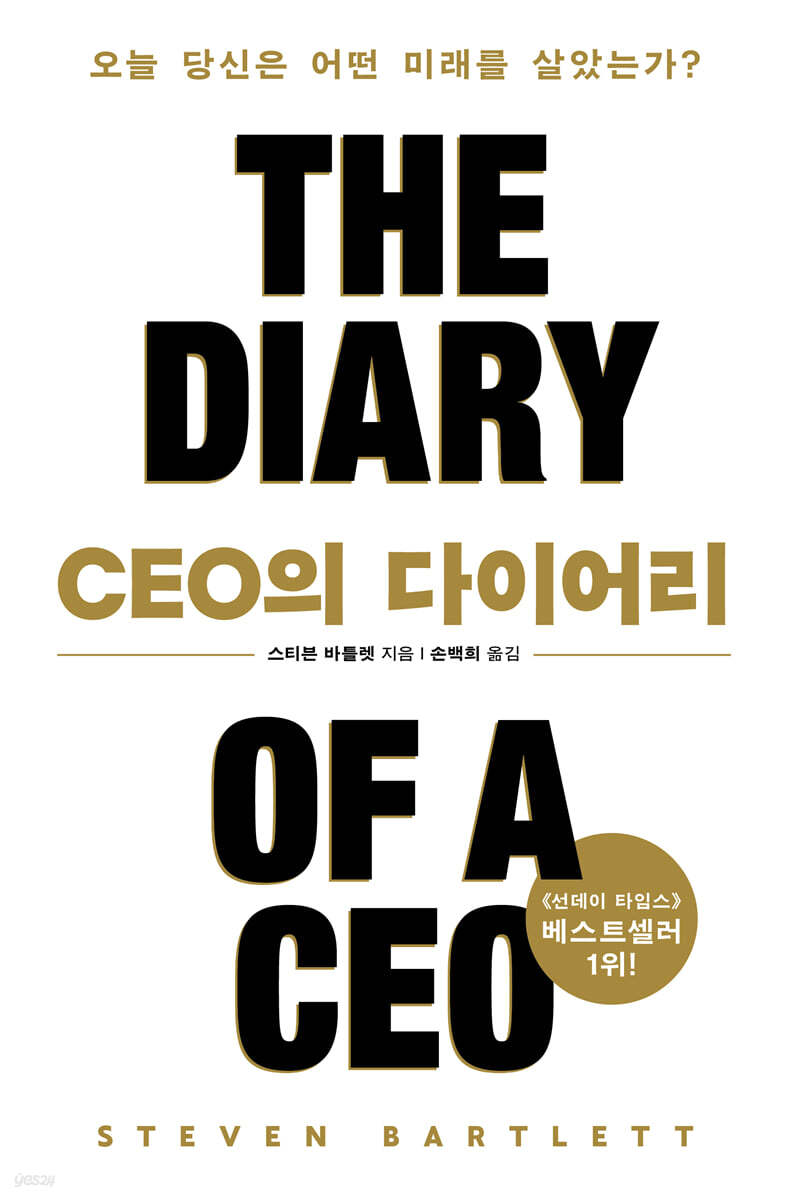
CEO's Diary
 |
Description
Book Introduction
“Everyone buys books, but few read them.
“What kind of person are you?”
A megahit from a channel with 10.5 million subscribers, published in 35 countries and reaching millions of readers, and becoming a bestseller.
The 33 Success Formulas of Today's Top Mentors, Directly Meet by Agile Young Entrepreneur Stephen Bartlett
Shin Soo-jung, Simon Sinek, Robert Greene, and Gary Vaynerchuk are highly recommended.
The Korean edition of "The CEO's Diary," which immediately became a Sunday Times bestseller and inspired countless readers in 35 countries, is finally out! Stephen Bartlett, a successful serial entrepreneur and renowned mentor to 10.5 million readers worldwide, has uncovered the common "formula for success" from the experiences of over 250 of the world's leading figures, including Yuval Harari, Robert Green, Simon Sinek, and Boris Johnson, and summarized them in his signature, refreshing prose.
This explosive self-help book provides the principles and actionable skills to make success and growth truly your own.
As CEO Shin Su-jeong, who wrote the recommendation, put it, “It’s concise, direct, entertaining, and very readable, yet packed with scientific evidence and ‘Aha!’ insights for every topic.”
Author Steve Bartlett, who started with no capital, no connections, and no education and built a multi-billion dollar company by the age of 26, earned the title of the enviable perfect life, but he willingly set out to find answers to unanswered questions and was transformed through conversations with great people.
I discovered the secret to bold momentum at an event with Barack Obama, and I learned how to maximize my strengths during an interview with Jimmy Carr.
I realized that even globally recognized figures like this one are not perfect in every way.
It's the same for everyone.
If you're not satisfied with today, read Stephen Bartlett's Law, which will change your future, no matter what your circumstances.
It's time to finally awaken the potential that has been floating around in your head.
“What kind of person are you?”
A megahit from a channel with 10.5 million subscribers, published in 35 countries and reaching millions of readers, and becoming a bestseller.
The 33 Success Formulas of Today's Top Mentors, Directly Meet by Agile Young Entrepreneur Stephen Bartlett
Shin Soo-jung, Simon Sinek, Robert Greene, and Gary Vaynerchuk are highly recommended.
The Korean edition of "The CEO's Diary," which immediately became a Sunday Times bestseller and inspired countless readers in 35 countries, is finally out! Stephen Bartlett, a successful serial entrepreneur and renowned mentor to 10.5 million readers worldwide, has uncovered the common "formula for success" from the experiences of over 250 of the world's leading figures, including Yuval Harari, Robert Green, Simon Sinek, and Boris Johnson, and summarized them in his signature, refreshing prose.
This explosive self-help book provides the principles and actionable skills to make success and growth truly your own.
As CEO Shin Su-jeong, who wrote the recommendation, put it, “It’s concise, direct, entertaining, and very readable, yet packed with scientific evidence and ‘Aha!’ insights for every topic.”
Author Steve Bartlett, who started with no capital, no connections, and no education and built a multi-billion dollar company by the age of 26, earned the title of the enviable perfect life, but he willingly set out to find answers to unanswered questions and was transformed through conversations with great people.
I discovered the secret to bold momentum at an event with Barack Obama, and I learned how to maximize my strengths during an interview with Jimmy Carr.
I realized that even globally recognized figures like this one are not perfect in every way.
It's the same for everyone.
If you're not satisfied with today, read Stephen Bartlett's Law, which will change your future, no matter what your circumstances.
It's time to finally awaken the potential that has been floating around in your head.
- You can preview some of the book's contents.
Preview
index
Introduction Who am I and what book is this?
Part 1: Yourself
Rule 1: Fill the five buckets in order.
Rule 2: To be a master, you must be able to teach.
Rule 3: Don't just "oppose" things.
Rule 4: Let go of your old beliefs.
Rule 5: Be open to things you don't like.
Rule 6: Don't just tell, ask.
Rule 7: Don't Compromise Your Self-Narrative
Rule 8: Never Fight Bad Habits
Rule 9: Always Put Your Health First
Part 2: Self-narrative
Rule 10: Uselessness Defines Usefulness
Rule 11: Don't Become a Background for Something
Rule 12: Sway People's Emotions
Rule 13: Implement innovative thinking first.
Rule 14: Value is Born from Friction
Rule 15: Frames are more important than content.
Rule 16: Remember the Goldilocks Effect
Rule 17: Lead with an Experience and Drive to a Purchase
Rule 18: Decide the outcome within 5 seconds.
Part 3: Philosophy of Life
Rule 19: Pay Attention to Every Little Thing
Rule 20: If you want to survive, you must change.
Rule 21: Fail More Than Your Competitors
Rule 22: Stick to Plan A as much as possible.
Rule 23: Don't be an ostrich.
Rule 24: Turn Pressure into a Special Opportunity
Rule 25: Imagine failure as often as possible.
Rule 26: Where is more important than what?
Rule 27: Strong will comes from death, time, and the pulpit.
Part 4: Life in an Organization
Rule 28: Don't look for a method, look for a person.
Rule 29: Design a Strong Belief and Culture
Rule 30: Three Criteria for Building a Great Team
Rule 31: Create a sense of progress.
Rule 32: Don't treat everyone the same way.
Rule 33: There is no end to learning.
References
Part 1: Yourself
Rule 1: Fill the five buckets in order.
Rule 2: To be a master, you must be able to teach.
Rule 3: Don't just "oppose" things.
Rule 4: Let go of your old beliefs.
Rule 5: Be open to things you don't like.
Rule 6: Don't just tell, ask.
Rule 7: Don't Compromise Your Self-Narrative
Rule 8: Never Fight Bad Habits
Rule 9: Always Put Your Health First
Part 2: Self-narrative
Rule 10: Uselessness Defines Usefulness
Rule 11: Don't Become a Background for Something
Rule 12: Sway People's Emotions
Rule 13: Implement innovative thinking first.
Rule 14: Value is Born from Friction
Rule 15: Frames are more important than content.
Rule 16: Remember the Goldilocks Effect
Rule 17: Lead with an Experience and Drive to a Purchase
Rule 18: Decide the outcome within 5 seconds.
Part 3: Philosophy of Life
Rule 19: Pay Attention to Every Little Thing
Rule 20: If you want to survive, you must change.
Rule 21: Fail More Than Your Competitors
Rule 22: Stick to Plan A as much as possible.
Rule 23: Don't be an ostrich.
Rule 24: Turn Pressure into a Special Opportunity
Rule 25: Imagine failure as often as possible.
Rule 26: Where is more important than what?
Rule 27: Strong will comes from death, time, and the pulpit.
Part 4: Life in an Organization
Rule 28: Don't look for a method, look for a person.
Rule 29: Design a Strong Belief and Culture
Rule 30: Three Criteria for Building a Great Team
Rule 31: Create a sense of progress.
Rule 32: Don't treat everyone the same way.
Rule 33: There is no end to learning.
References
Detailed image

Into the book
It doesn't matter where you are or what you do.
This law is true now, and it will be true in 100 years.
This law is based on psychology, science, and centuries of research.
We validated its validity by surveying tens of thousands of people across various age groups and occupations around the world.
When I conceived this book, I assumed five core beliefs.
1.
Most books are unnecessarily long.
2.
Most of them are overly complicated.
3.
A picture is worth a thousand words.
4.
The power of story is stronger than the power of statistics.
But both are important.
5.
I believe in the value of nuance, and often the truth lies somewhere in the middle.
--- p.10 From the “Introductory Note”
Even if you don't agree with the other person's opinion, avoid the emotional temptation to start the conversation with statements like, "I disagree" or "You're wrong."
Instead, even when refuting, you should start by talking about commonalities, points of agreement, and parts of the other person's argument that you understand.
No matter how rational and logical an argument is, if it is countered, it loses its persuasiveness.
Even if there is a lot of evidence and objective validity, it is useless.
--- p.35 From 「Rule 3 | Don't just 'oppose' it」
In terms of inducing action, it is much more effective to ask questions like “Can you do it?” that ask about ability rather than whether to act, or “If you ~, would you ~?” that ask about overall possibility rather than conditional probability, to ask “Would you ~?” that asks about responsibility and whether to act.
--- p.67 From "Rule 6 | Don't just talk, ask"
In 1995, a fellow journalist and I started a project to track the frequency of the word "revolution/revolutionary" in media advertising.
By scanning various editions of one newspaper from 1950 to 1995, we discovered that the word "revolution" was used sparingly, primarily in a political context, until the late 1960s.
But by the late 1960s, the word was being used frequently by mainstream political parties on both the left and the right, and even by youth groups.
Then, in the mid-1970s, I came across an advertisement in a newspaper for a furniture brand that claimed to have produced office chairs using “revolutionary Swedish technology.”
Advertisements that came out after that included everything from electronics to medicines, chocolate, milk, cooking oil, and even detergents, all using the word “revolutionary.”
After about 20 years, the word "revolution" had become so overused that its meaning had faded, both politically and from a marketing perspective.
The effect of this word had virtually disappeared.
--- p.122 From "Rule 11 | Don't Become a Background for Something"
As the sharp-eyed among you may know, that's precisely why I've included a short, five-second blurb at the beginning of every rule in this book to make it clear why you should know that rule.
Even if readers don't read every rule, I figured that by grabbing their attention and making a commitment like that, they would be at least 25 percent more likely to read that rule.
In a business that generates compound interest, 25 percent is a number that can completely change the landscape of the business.
--- p.178 From "Rule 18 | Decide the Match in 5 Seconds"
In his 2015 shareholder letter, Jeff Bezos explained how he decides which experiments to pursue and which not:
Some decisions are like one-way doors, with consequences that are almost or completely irreversible.
So, we need to make decisions carefully and thoughtfully, taking our time and after sufficient deliberation and discussion.
If you open that door and go out, you won't be able to come back in even if you see something you don't like.
--- p.214 From "Rule 21 | Fail More Than Your Competitors"
We think better, make better decisions, and achieve better results when we are closest to reality.
The examples of Kodak, Nokia, Blockbuster, Yahoo, BlackBerry, and MySpace clearly show that the more we perceive reality as unclear, the more likely we are to act like ostriches in the face of innovation, change, and inconvenient truths.
This law is true now, and it will be true in 100 years.
This law is based on psychology, science, and centuries of research.
We validated its validity by surveying tens of thousands of people across various age groups and occupations around the world.
When I conceived this book, I assumed five core beliefs.
1.
Most books are unnecessarily long.
2.
Most of them are overly complicated.
3.
A picture is worth a thousand words.
4.
The power of story is stronger than the power of statistics.
But both are important.
5.
I believe in the value of nuance, and often the truth lies somewhere in the middle.
--- p.10 From the “Introductory Note”
Even if you don't agree with the other person's opinion, avoid the emotional temptation to start the conversation with statements like, "I disagree" or "You're wrong."
Instead, even when refuting, you should start by talking about commonalities, points of agreement, and parts of the other person's argument that you understand.
No matter how rational and logical an argument is, if it is countered, it loses its persuasiveness.
Even if there is a lot of evidence and objective validity, it is useless.
--- p.35 From 「Rule 3 | Don't just 'oppose' it」
In terms of inducing action, it is much more effective to ask questions like “Can you do it?” that ask about ability rather than whether to act, or “If you ~, would you ~?” that ask about overall possibility rather than conditional probability, to ask “Would you ~?” that asks about responsibility and whether to act.
--- p.67 From "Rule 6 | Don't just talk, ask"
In 1995, a fellow journalist and I started a project to track the frequency of the word "revolution/revolutionary" in media advertising.
By scanning various editions of one newspaper from 1950 to 1995, we discovered that the word "revolution" was used sparingly, primarily in a political context, until the late 1960s.
But by the late 1960s, the word was being used frequently by mainstream political parties on both the left and the right, and even by youth groups.
Then, in the mid-1970s, I came across an advertisement in a newspaper for a furniture brand that claimed to have produced office chairs using “revolutionary Swedish technology.”
Advertisements that came out after that included everything from electronics to medicines, chocolate, milk, cooking oil, and even detergents, all using the word “revolutionary.”
After about 20 years, the word "revolution" had become so overused that its meaning had faded, both politically and from a marketing perspective.
The effect of this word had virtually disappeared.
--- p.122 From "Rule 11 | Don't Become a Background for Something"
As the sharp-eyed among you may know, that's precisely why I've included a short, five-second blurb at the beginning of every rule in this book to make it clear why you should know that rule.
Even if readers don't read every rule, I figured that by grabbing their attention and making a commitment like that, they would be at least 25 percent more likely to read that rule.
In a business that generates compound interest, 25 percent is a number that can completely change the landscape of the business.
--- p.178 From "Rule 18 | Decide the Match in 5 Seconds"
In his 2015 shareholder letter, Jeff Bezos explained how he decides which experiments to pursue and which not:
Some decisions are like one-way doors, with consequences that are almost or completely irreversible.
So, we need to make decisions carefully and thoughtfully, taking our time and after sufficient deliberation and discussion.
If you open that door and go out, you won't be able to come back in even if you see something you don't like.
--- p.214 From "Rule 21 | Fail More Than Your Competitors"
We think better, make better decisions, and achieve better results when we are closest to reality.
The examples of Kodak, Nokia, Blockbuster, Yahoo, BlackBerry, and MySpace clearly show that the more we perceive reality as unclear, the more likely we are to act like ostriches in the face of innovation, change, and inconvenient truths.
--- p.241 From "Rule 23 | Don't Act Like an Ostrich"
Publisher's Review
“Everyone buys books, but few read them.
Everyone wants to grow, but few embrace it.
Everyone wants to be happy, but few are willing to change.
“What kind of person are you?”
★ Starting a business from scratch at 20 → Growing to a market cap of approximately 300 billion won by 26 → 10.5 million YouTube subscribers by 30! A successful mentor shares his "real weapon" for life and business.
★ A book that has received praise from domestic and international self-development mentors, including Jay Sethi, Mo Ga-dat, and Shin Su-jeong.
What do historian Yuval Harari, author Robert Greene, and YouTuber Mr. Beast have in common?
The scientific pattern of success revealed through direct conversations with global leaders!
"Is there a formula for success?" Stephen Bartlett, who started his first business at age 20 and had nearly $100 million in assets by 26, wanted to know.
How are other people in the world navigating similar situations as you, and how can your experiences also help the world?
So, through his podcast, Bartlett spoke directly with over 250 world leaders and celebrities (from all walks of life and from all walks of life, including Robert Green, Yuval Harari, Boris Johnson, and Mr. Beast) to delve into the common principles of success.
As a self-made entrepreneur, I have shared the wisdom I have acquired on my own and the patterns of success I have discovered through cross-examination through friendly conversations with global leaders on my podcast and YouTube channel, 'Diary of a CEO.'
His channel, which he built up step by step, recorded 50 million monthly listeners and over 1 billion cumulative views, and was ranked #1 in the 'Most Listened to Podcast' on Spotify Europe as of 2024. As of 2025, he is inspiring over 10.5 million subscribers on YouTube.
Among the vast contents, the essence that Bartlett organized to share with people is 『CEO's Diary』.
This book, which immediately reached number one on the Sunday Times bestseller list and sold over a million copies, is neither a simple collection of success stories nor a business strategy book that follows trends.
This book summarizes the science of success, which is practical and can be implemented by anyone, through a large amount of data.
“This book is not about business strategy.
Strategies change like the seasons.
This book is about something much more permanent.”
The difference between those who say "I can do it" and those who "just do it"
Simple, concrete steps to change your life right now!
The 33 laws of success contained in "CEO's Diary" are scientific, yet not at all complicated.
It is not a tactic only for high-ranking officials or the elite.
This is because it is based on the latest research in psychology, behavioral economics, and neuroscience, and has been refined into a practical way that anyone can apply it to their daily lives.
It covers all aspects of modern life, from how to improve work efficiency at all levels, from employees to leaders, how to design interpersonal relationships, and even goal setting and health management.
This book is a realistic blueprint for success for all of us living in this era.
'So what should we do?' The focus of this book is 'practice.'
The author believed that small, concrete actions, rather than grand theories, create change.
At the end of each chapter, there are aphorisms to help readers organize their complex thoughts, such as, “Don’t struggle to change reality, invest in creating perception.”
This book covers everything from trivial human relationships to weighty decisions that determine the success or failure of a business, something that everyone living in modern society has experienced and pondered at least once.
This book, which has already been published in 35 countries and has become a bestseller, has changed the course of countless readers' lives.
The moment you open this book, your life will move from vague aspirations to concrete action.
The change has already begun.
“I bought three copies of this book.
One for me, one for my daughter,
“The last one is to give as a gift to someone who doesn’t know this book yet.”
―Amazon Reader Reviews
Everyone wants to grow, but few embrace it.
Everyone wants to be happy, but few are willing to change.
“What kind of person are you?”
★ Starting a business from scratch at 20 → Growing to a market cap of approximately 300 billion won by 26 → 10.5 million YouTube subscribers by 30! A successful mentor shares his "real weapon" for life and business.
★ A book that has received praise from domestic and international self-development mentors, including Jay Sethi, Mo Ga-dat, and Shin Su-jeong.
What do historian Yuval Harari, author Robert Greene, and YouTuber Mr. Beast have in common?
The scientific pattern of success revealed through direct conversations with global leaders!
"Is there a formula for success?" Stephen Bartlett, who started his first business at age 20 and had nearly $100 million in assets by 26, wanted to know.
How are other people in the world navigating similar situations as you, and how can your experiences also help the world?
So, through his podcast, Bartlett spoke directly with over 250 world leaders and celebrities (from all walks of life and from all walks of life, including Robert Green, Yuval Harari, Boris Johnson, and Mr. Beast) to delve into the common principles of success.
As a self-made entrepreneur, I have shared the wisdom I have acquired on my own and the patterns of success I have discovered through cross-examination through friendly conversations with global leaders on my podcast and YouTube channel, 'Diary of a CEO.'
His channel, which he built up step by step, recorded 50 million monthly listeners and over 1 billion cumulative views, and was ranked #1 in the 'Most Listened to Podcast' on Spotify Europe as of 2024. As of 2025, he is inspiring over 10.5 million subscribers on YouTube.
Among the vast contents, the essence that Bartlett organized to share with people is 『CEO's Diary』.
This book, which immediately reached number one on the Sunday Times bestseller list and sold over a million copies, is neither a simple collection of success stories nor a business strategy book that follows trends.
This book summarizes the science of success, which is practical and can be implemented by anyone, through a large amount of data.
“This book is not about business strategy.
Strategies change like the seasons.
This book is about something much more permanent.”
The difference between those who say "I can do it" and those who "just do it"
Simple, concrete steps to change your life right now!
The 33 laws of success contained in "CEO's Diary" are scientific, yet not at all complicated.
It is not a tactic only for high-ranking officials or the elite.
This is because it is based on the latest research in psychology, behavioral economics, and neuroscience, and has been refined into a practical way that anyone can apply it to their daily lives.
It covers all aspects of modern life, from how to improve work efficiency at all levels, from employees to leaders, how to design interpersonal relationships, and even goal setting and health management.
This book is a realistic blueprint for success for all of us living in this era.
'So what should we do?' The focus of this book is 'practice.'
The author believed that small, concrete actions, rather than grand theories, create change.
At the end of each chapter, there are aphorisms to help readers organize their complex thoughts, such as, “Don’t struggle to change reality, invest in creating perception.”
This book covers everything from trivial human relationships to weighty decisions that determine the success or failure of a business, something that everyone living in modern society has experienced and pondered at least once.
This book, which has already been published in 35 countries and has become a bestseller, has changed the course of countless readers' lives.
The moment you open this book, your life will move from vague aspirations to concrete action.
The change has already begun.
“I bought three copies of this book.
One for me, one for my daughter,
“The last one is to give as a gift to someone who doesn’t know this book yet.”
―Amazon Reader Reviews
GOODS SPECIFICS
- Date of issue: July 1, 2025
- Page count, weight, size: 368 pages | 526g | 145*220*24mm
- ISBN13: 9791155818275
- ISBN10: 115581827X
You may also like
카테고리
korean


korean

![ELLE 엘르 스페셜 에디션 A형 : 12월 [2025]](http://librairie.coreenne.fr/cdn/shop/files/b8e27a3de6c9538896439686c6b0e8fb.jpg?v=1766436872&width=3840)


