

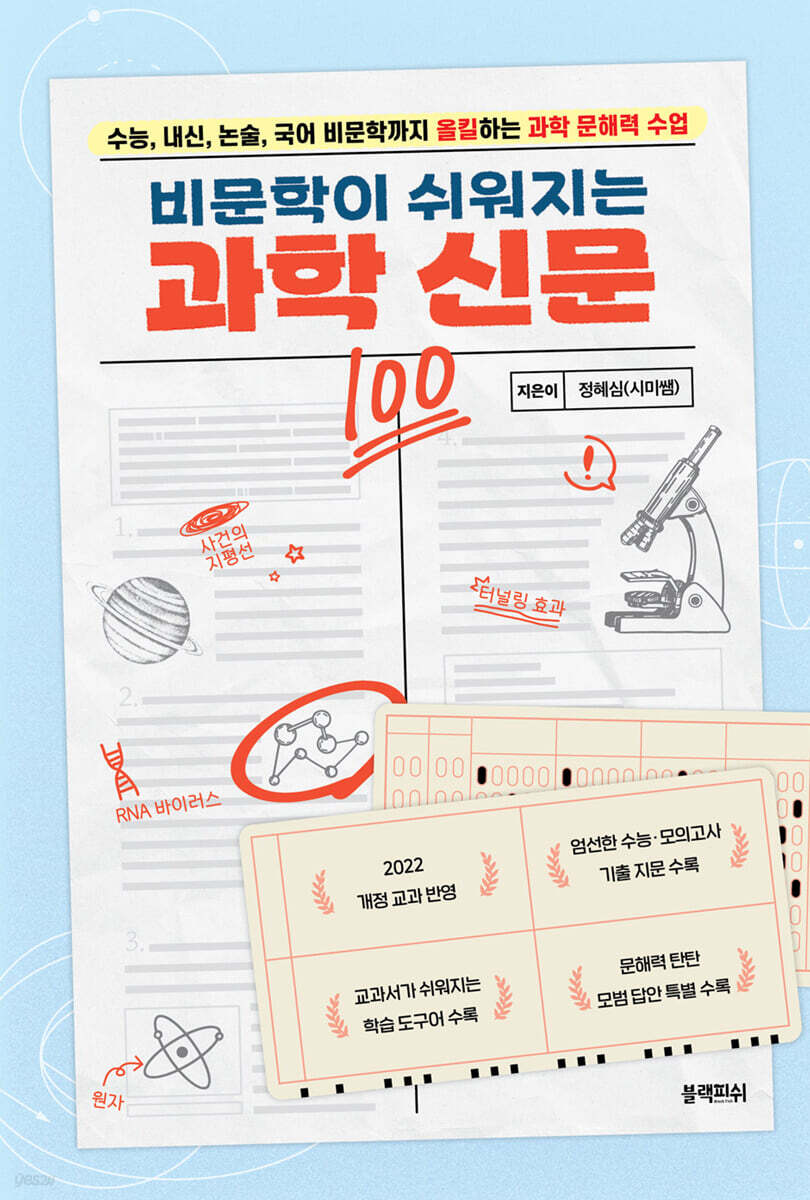
A science newspaper that makes non-fiction easy
 |
Description
Book Introduction
Top-notch scientific literacy essential for the AI era!
Teacher Simi, a science × Korean language fusion class expert and current educational researcher
A solidly designed special lecture on science reading and writing
* Linked to the 2022 revised curriculum, carefully selected concepts from previous CSAT and mock exams included *
“I don’t know where to start when it comes to preparing for integrated science.”
“Since science is difficult, even non-literature texts in Korean have become difficult!”
“Am I the only one who doesn’t have enough time to solve science problems?”
Science is the subject that teenagers find most difficult.
However, science is a major subject that has emerged as a key point for the 2028 College Scholastic Ability Test (CSAT), and if you give up on it because it is difficult, it can affect not only your school grades but also your CSAT, essay, and even your Korean language and non-literature grades, so it is a subject that requires constant, focused study.
The author, Simi, who is currently an educational researcher at the Gyeonggi Provincial Office of Education's Future Science Education Institute, published a new concept science x Korean language fusion liberal arts book, "Science Newspaper that Makes Non-Fiction Easy," to help teenagers who have difficulty studying science.
With this book, which simultaneously develops both science and engineering knowledge and literacy based on a systematic learning design, you will be able to read both new and complex scientific theories and lengthy scientific texts with ease and familiarity.
The book contains scientific concepts that have appeared in actual college entrance exams and mock exams, organized by level of difficulty.
It covers physics, chemistry, life science, and earth science, so you can prepare for 'integrated science' without worrying about anything, and it also helps expand scientific thinking skills through hands-on scientific writing.
From middle school students preparing for the college entrance exam to high school students preparing for the college entrance exam, if you are a student who needs "science literacy," open this book right now.
In the age of artificial intelligence, this book is filled with special thinking training that can be used beyond school and throughout one's life.
Teacher Simi, a science × Korean language fusion class expert and current educational researcher
A solidly designed special lecture on science reading and writing
* Linked to the 2022 revised curriculum, carefully selected concepts from previous CSAT and mock exams included *
“I don’t know where to start when it comes to preparing for integrated science.”
“Since science is difficult, even non-literature texts in Korean have become difficult!”
“Am I the only one who doesn’t have enough time to solve science problems?”
Science is the subject that teenagers find most difficult.
However, science is a major subject that has emerged as a key point for the 2028 College Scholastic Ability Test (CSAT), and if you give up on it because it is difficult, it can affect not only your school grades but also your CSAT, essay, and even your Korean language and non-literature grades, so it is a subject that requires constant, focused study.
The author, Simi, who is currently an educational researcher at the Gyeonggi Provincial Office of Education's Future Science Education Institute, published a new concept science x Korean language fusion liberal arts book, "Science Newspaper that Makes Non-Fiction Easy," to help teenagers who have difficulty studying science.
With this book, which simultaneously develops both science and engineering knowledge and literacy based on a systematic learning design, you will be able to read both new and complex scientific theories and lengthy scientific texts with ease and familiarity.
The book contains scientific concepts that have appeared in actual college entrance exams and mock exams, organized by level of difficulty.
It covers physics, chemistry, life science, and earth science, so you can prepare for 'integrated science' without worrying about anything, and it also helps expand scientific thinking skills through hands-on scientific writing.
From middle school students preparing for the college entrance exam to high school students preparing for the college entrance exam, if you are a student who needs "science literacy," open this book right now.
In the age of artificial intelligence, this book is filled with special thinking training that can be used beyond school and throughout one's life.
- You can preview some of the book's contents.
Preview
index
To begin with
Chapter 1.
Physics - The Secret of the Force That Moves the World?
One Light Step - How does a 300,000-ton giant offshore oil platform stand on the sea?
One Light Step - How does an archer hit 10 points with his arrow?
Slowly, two feet _ Why do cars deliberately crash into walls?
Finally, three wheels: Are electric vehicles truly safe? The secrets hidden inside their batteries.
Finally, four legs - Time can stop? It's possible in a black hole!
Jumping to the College Scholastic Ability Test - What's the secret to drones staying in the sky?
Jumping to the College Scholastic Ability Test - How can we observe a world smaller than our fingertips?
Chapter 2.
Chemistry - Let's open the invisible world!
One Light Step - What would happen if you lit a candle inside a spaceship?
One Light Step _ How do small, hard kernels of corn become cloud-like popcorn?
Slowly, two feet _ Why does my head hurt when I go to a high mountain?
Finally, three steps - Where does the oxygen we breathe come from?
Finally, four legs _ Was the periodic table perfect from the beginning?
Jumping to the College Scholastic Ability Test - Are atoms really indivisible?
Jumping to the College Scholastic Ability Test - Can gases be explained with mathematics?
Chapter 3.
Life Sciences - The Reason We Live
One light step - creating a heart from cells? How is that possible?
One light step _ Why do I yawn without realizing it, and why do I follow suit when my friend does it?
Slowly, two feet _ What's different about people who can drink milk?
Finally, three shots - Why does the flu vaccine change every year?
Finally Four Feet _ Why do newborn babies not get sick easily?
Jumping to the CSAT - How do self-diagnosis kits detect viruses?
Jumping to the College Scholastic Ability Test - Will viruses be transmitted when undergoing organ transplants?
Chapter 4.
Earth Science - Earth's View of the Universe
One Light Step _ I traveled from Seoul to New York, but why did time go backwards?
One light step _ Green curtains fluttering in the night sky?
Slowly, two feet _ What if you could travel through space at the speed of light?
Finally, three steps _ Is there a map of the universe that we know?
Finally, how were the four-legged moons of Saturn discovered?
Jumping to the College Scholastic Ability Test - How can we predict wind direction from weather forecasts?
Jumping to the CSAT - Is the brightest star in the night sky really the brightest?
Model Answer: Building Literacy Through Writing
References
Chapter 1.
Physics - The Secret of the Force That Moves the World?
One Light Step - How does a 300,000-ton giant offshore oil platform stand on the sea?
One Light Step - How does an archer hit 10 points with his arrow?
Slowly, two feet _ Why do cars deliberately crash into walls?
Finally, three wheels: Are electric vehicles truly safe? The secrets hidden inside their batteries.
Finally, four legs - Time can stop? It's possible in a black hole!
Jumping to the College Scholastic Ability Test - What's the secret to drones staying in the sky?
Jumping to the College Scholastic Ability Test - How can we observe a world smaller than our fingertips?
Chapter 2.
Chemistry - Let's open the invisible world!
One Light Step - What would happen if you lit a candle inside a spaceship?
One Light Step _ How do small, hard kernels of corn become cloud-like popcorn?
Slowly, two feet _ Why does my head hurt when I go to a high mountain?
Finally, three steps - Where does the oxygen we breathe come from?
Finally, four legs _ Was the periodic table perfect from the beginning?
Jumping to the College Scholastic Ability Test - Are atoms really indivisible?
Jumping to the College Scholastic Ability Test - Can gases be explained with mathematics?
Chapter 3.
Life Sciences - The Reason We Live
One light step - creating a heart from cells? How is that possible?
One light step _ Why do I yawn without realizing it, and why do I follow suit when my friend does it?
Slowly, two feet _ What's different about people who can drink milk?
Finally, three shots - Why does the flu vaccine change every year?
Finally Four Feet _ Why do newborn babies not get sick easily?
Jumping to the CSAT - How do self-diagnosis kits detect viruses?
Jumping to the College Scholastic Ability Test - Will viruses be transmitted when undergoing organ transplants?
Chapter 4.
Earth Science - Earth's View of the Universe
One Light Step _ I traveled from Seoul to New York, but why did time go backwards?
One light step _ Green curtains fluttering in the night sky?
Slowly, two feet _ What if you could travel through space at the speed of light?
Finally, three steps _ Is there a map of the universe that we know?
Finally, how were the four-legged moons of Saturn discovered?
Jumping to the College Scholastic Ability Test - How can we predict wind direction from weather forecasts?
Jumping to the CSAT - Is the brightest star in the night sky really the brightest?
Model Answer: Building Literacy Through Writing
References
Detailed image

Into the book
This book was created to help you develop the ability to read scientific texts easily, understand them accurately, and explain them in your own words.
Why is this activity necessary? Because if you develop the habit of digesting scientific concepts in your own language, you'll be able to quickly and accurately grasp the meaning of even difficult and complex new theories.
--- From the text “Starting”
Have you ever felt like the days passed too quickly? Or perhaps time seemed to pass too slowly, as if it had stopped? In fact, it's natural for time to feel different depending on our mood or circumstances.
It is a given that people living in Seoul and New York spend the same 24 hours a day.
But did you know that if you're near a black hole, time can actually flow differently? The closer you get to a black hole, the slower time passes.
What is the reason?
The concept of time we normally know is based on classical physics.
According to classical physics, time flows equally for everyone.
But according to Einstein's general theory of relativity, time can flow differently depending on gravity.
Time slows down in places where gravity is strong, and a black hole is a prime example.
The phenomenon of time slowing down, or time dilation, is not something we commonly experience in our daily lives.
However, this phenomenon occurs in objects moving at speeds close to the speed of light or in places where gravity is very strong.
For example, imagine an astronaut traveling in a spaceship at nearly the speed of light. While a year on Earth might seem like only a few months, the astronaut might feel like it's been a year.
--- Main Text "Time can stop? It's possible in a black hole! (Chapter 1.
Among the "physics"
In fact, there is very little water in a kernel of corn.
They say it's usually around 13-15%.
It may look dry on the outside, but there are water droplets hidden inside, and that is where everything begins.
When heat is applied, the water inside the corn kernels changes into water vapor, or gas.
The problem is, the husks of corn for popcorn are incredibly hard.
The water vapor is trapped inside and cannot escape.
As the gas increases, the pressure also increases.
Then, at the moment when the shell says, “I can’t take it anymore!”, it bursts with a “bang!”
Is this the end? Not at all.
When the corn husk bursts, the starch inside comes out all at once along with the steam.
How fast is that, in that short moment, the molecular structure inside changes.
The starch molecules, which were originally tightly packed together, become loose and fluffy when exposed to heat and pressure.
And the most surprising thing is the change in volume.
Initially, the size of a corn kernel is only about 5mm, but after it bursts, it grows to about 2-3cm in diameter.
The volume increases by about 40 to 50 times.
--- Main Text "How do small, hard corn kernels become cloud-like popcorn?" (Chapter 2.
Among the "Chemistry"
Have you ever seen a heart transplant scene on a TV show? It's touching to see someone miraculously revived with a new organ in a critical situation, but in reality, organ transplants aren't that simple.
Even when a transplant is needed, there are reasons why not just any organ can be used right away.
When a foreign substance enters our body, it produces a strong immune response to protect itself.
This reaction occurs not only to bacteria and viruses, but also to other human organs.
A protein called MHC (major histocompatibility complex) plays a crucial role here. MHC acts like an identification card attached to the cell surface, saying, "This is my body."
However, if the MHC of the transplanted organ is different from ours, immune cells view it as an invader with a fake ID and attack it fiercely.
The further apart we are genetically, the greater the difference in MHC, and the more severe the rejection reaction.
Why is this activity necessary? Because if you develop the habit of digesting scientific concepts in your own language, you'll be able to quickly and accurately grasp the meaning of even difficult and complex new theories.
--- From the text “Starting”
Have you ever felt like the days passed too quickly? Or perhaps time seemed to pass too slowly, as if it had stopped? In fact, it's natural for time to feel different depending on our mood or circumstances.
It is a given that people living in Seoul and New York spend the same 24 hours a day.
But did you know that if you're near a black hole, time can actually flow differently? The closer you get to a black hole, the slower time passes.
What is the reason?
The concept of time we normally know is based on classical physics.
According to classical physics, time flows equally for everyone.
But according to Einstein's general theory of relativity, time can flow differently depending on gravity.
Time slows down in places where gravity is strong, and a black hole is a prime example.
The phenomenon of time slowing down, or time dilation, is not something we commonly experience in our daily lives.
However, this phenomenon occurs in objects moving at speeds close to the speed of light or in places where gravity is very strong.
For example, imagine an astronaut traveling in a spaceship at nearly the speed of light. While a year on Earth might seem like only a few months, the astronaut might feel like it's been a year.
--- Main Text "Time can stop? It's possible in a black hole! (Chapter 1.
Among the "physics"
In fact, there is very little water in a kernel of corn.
They say it's usually around 13-15%.
It may look dry on the outside, but there are water droplets hidden inside, and that is where everything begins.
When heat is applied, the water inside the corn kernels changes into water vapor, or gas.
The problem is, the husks of corn for popcorn are incredibly hard.
The water vapor is trapped inside and cannot escape.
As the gas increases, the pressure also increases.
Then, at the moment when the shell says, “I can’t take it anymore!”, it bursts with a “bang!”
Is this the end? Not at all.
When the corn husk bursts, the starch inside comes out all at once along with the steam.
How fast is that, in that short moment, the molecular structure inside changes.
The starch molecules, which were originally tightly packed together, become loose and fluffy when exposed to heat and pressure.
And the most surprising thing is the change in volume.
Initially, the size of a corn kernel is only about 5mm, but after it bursts, it grows to about 2-3cm in diameter.
The volume increases by about 40 to 50 times.
--- Main Text "How do small, hard corn kernels become cloud-like popcorn?" (Chapter 2.
Among the "Chemistry"
Have you ever seen a heart transplant scene on a TV show? It's touching to see someone miraculously revived with a new organ in a critical situation, but in reality, organ transplants aren't that simple.
Even when a transplant is needed, there are reasons why not just any organ can be used right away.
When a foreign substance enters our body, it produces a strong immune response to protect itself.
This reaction occurs not only to bacteria and viruses, but also to other human organs.
A protein called MHC (major histocompatibility complex) plays a crucial role here. MHC acts like an identification card attached to the cell surface, saying, "This is my body."
However, if the MHC of the transplanted organ is different from ours, immune cells view it as an invader with a fake ID and attack it fiercely.
The further apart we are genetically, the greater the difference in MHC, and the more severe the rejection reaction.
--- Main text “Will viruses be transmitted during organ transplant?” (Chapter 3.
From "Life Science"
From "Life Science"
Publisher's Review
"Prepare for the integrated science and non-literature sections of the CSAT with this one book!"
Develop vocabulary, reading comprehension, and literacy skills
Teacher Simi's Science Writing Class
Science is the subject that teenagers find most difficult.
Because of the complex concepts and unfamiliar terms, there are countless cases where people worry that they can't understand no matter how much they study, and they get stuck even just reading before solving the problems.
Moreover, this problem does not end with simply declining science grades.
As science texts appear without fail in the non-literature section of the Korean language section of the College Scholastic Ability Test, low understanding of science also affects the decline in Korean language scores.
How can we overcome the simultaneous learning difficulties in science and Korean?
《Science Newspaper that Makes Non-Fiction Easy》 is a science x Korean fusion writing book that simultaneously improves science and engineering knowledge and literacy. The author (Teacher Simi), a current educational researcher, helps young people to build their own writing structure and move on to 'understanding-explanation-application' even when faced with long scientific texts based on a systematic learning design that goes from 'opening thoughts with stories → firmly grasping concepts → building a foundation step by step (building vocabulary) → building literacy through writing.'
By following the author and practicing explaining the core of scientific theories in your own words (writing), you will be able to quickly and accurately grasp the meaning of difficult and complex theories you encounter.
The essentials of physics, chemistry, life science, and earth science!
From basic middle school concepts to advanced concepts for the CSAT,
Develop science and engineering literacy with step-by-step learning design!
This book introduces core scientific theories in physics, chemistry, life science, and earth science, which were frequently tested on the college entrance exam and mock exams, step by step, from concepts to vocabulary and reading comprehension.
Not only has it increased its connection to internal grades in line with the revised 2022 curriculum, but it also has an in-depth structure that gradually increases in difficulty from middle school basic concepts (a light step) to concepts that actually appear on the CSAT (jumping to the CSAT), so even teenagers who lack basic knowledge can start without burden.
For example, 〈Chapter 1.
The development of “Physics” is as follows.
* Light Step: How Does a 300,000-Ton Giant Offshore Oil Platform Stand on the Sea? - Buoyancy and Center of Gravity (Middle School 1st Grade Science)
* Slowly, with both feet: Why do cars deliberately crash into walls? - Collisions, Inertia (Middle School 1st grade science, Advanced Integrated Science)
* Finally, Three Steps: Are Electric Vehicles Really Safe? The Hidden Secrets of Batteries - Batteries, Thermal Runaway, and the Anode and Cathode (Middle School Science, Advanced Integrated Science)
* Finally, Four Legs: Time Can Stop? It's Possible in a Black Hole! - General Relativity, Black Holes (Advanced Physics Elective)
* Jumping to the CSAT: How can we observe a world smaller than our fingertips? - Quantum mechanics, tunneling effects, nanomaterials (Mock exam questions)
The author, who realized while teaching children directly at school that "science must be easy and fun for literacy to follow," first developed a learning method that increases "interest" in studying and then adds "fun" to it, and included it in this book.
The author's key secret to developing "top-level scientific literacy" is to naturally increase "confidence" through the process of gradually building new knowledge based on what you already know.
“What’s important is the ability to organize your thoughts by following the sentences!”
The Secret to Writing Skills Essential for the AI Era
In the age of AI, the power to ask questions and structure writing has become more important, even if it means finding clear answers.
This is why the ‘vocabulary, reading comprehension, and literacy’ of young people must be emphasized.
The author has placed devices to strengthen sentence structure throughout the book.
In [Building a Solid Concept], we will go over the learning tools that make textbooks easier in a concise and clear manner once again, and in [Building a Solid Foundation Step by Step], we will practice accurately understanding the meaning of key sentences through O/X quizzes and vocabulary building.
And in the final stage, [Building Literacy through Writing], students will train themselves to internalize scientific concepts through a variety of engaging writing activities, including conducting virtual interviews, writing newspaper articles, and writing advertising copy.
Are you unsure where to start preparing for Integrated Science? Are you finding science so difficult that even non-fiction texts in Korean are a struggle? Are you constantly running out of time to solve science problems? This book is the place to start by developing your ability to read scientific texts! By starting with reading texts and developing the habit of reorganizing scientific concepts into your own sentences, you'll no longer be afraid of unfamiliar scientific theories.
This is the moment when a shortcut to the top 1% in science opens.
Develop vocabulary, reading comprehension, and literacy skills
Teacher Simi's Science Writing Class
Science is the subject that teenagers find most difficult.
Because of the complex concepts and unfamiliar terms, there are countless cases where people worry that they can't understand no matter how much they study, and they get stuck even just reading before solving the problems.
Moreover, this problem does not end with simply declining science grades.
As science texts appear without fail in the non-literature section of the Korean language section of the College Scholastic Ability Test, low understanding of science also affects the decline in Korean language scores.
How can we overcome the simultaneous learning difficulties in science and Korean?
《Science Newspaper that Makes Non-Fiction Easy》 is a science x Korean fusion writing book that simultaneously improves science and engineering knowledge and literacy. The author (Teacher Simi), a current educational researcher, helps young people to build their own writing structure and move on to 'understanding-explanation-application' even when faced with long scientific texts based on a systematic learning design that goes from 'opening thoughts with stories → firmly grasping concepts → building a foundation step by step (building vocabulary) → building literacy through writing.'
By following the author and practicing explaining the core of scientific theories in your own words (writing), you will be able to quickly and accurately grasp the meaning of difficult and complex theories you encounter.
The essentials of physics, chemistry, life science, and earth science!
From basic middle school concepts to advanced concepts for the CSAT,
Develop science and engineering literacy with step-by-step learning design!
This book introduces core scientific theories in physics, chemistry, life science, and earth science, which were frequently tested on the college entrance exam and mock exams, step by step, from concepts to vocabulary and reading comprehension.
Not only has it increased its connection to internal grades in line with the revised 2022 curriculum, but it also has an in-depth structure that gradually increases in difficulty from middle school basic concepts (a light step) to concepts that actually appear on the CSAT (jumping to the CSAT), so even teenagers who lack basic knowledge can start without burden.
For example, 〈Chapter 1.
The development of “Physics” is as follows.
* Light Step: How Does a 300,000-Ton Giant Offshore Oil Platform Stand on the Sea? - Buoyancy and Center of Gravity (Middle School 1st Grade Science)
* Slowly, with both feet: Why do cars deliberately crash into walls? - Collisions, Inertia (Middle School 1st grade science, Advanced Integrated Science)
* Finally, Three Steps: Are Electric Vehicles Really Safe? The Hidden Secrets of Batteries - Batteries, Thermal Runaway, and the Anode and Cathode (Middle School Science, Advanced Integrated Science)
* Finally, Four Legs: Time Can Stop? It's Possible in a Black Hole! - General Relativity, Black Holes (Advanced Physics Elective)
* Jumping to the CSAT: How can we observe a world smaller than our fingertips? - Quantum mechanics, tunneling effects, nanomaterials (Mock exam questions)
The author, who realized while teaching children directly at school that "science must be easy and fun for literacy to follow," first developed a learning method that increases "interest" in studying and then adds "fun" to it, and included it in this book.
The author's key secret to developing "top-level scientific literacy" is to naturally increase "confidence" through the process of gradually building new knowledge based on what you already know.
“What’s important is the ability to organize your thoughts by following the sentences!”
The Secret to Writing Skills Essential for the AI Era
In the age of AI, the power to ask questions and structure writing has become more important, even if it means finding clear answers.
This is why the ‘vocabulary, reading comprehension, and literacy’ of young people must be emphasized.
The author has placed devices to strengthen sentence structure throughout the book.
In [Building a Solid Concept], we will go over the learning tools that make textbooks easier in a concise and clear manner once again, and in [Building a Solid Foundation Step by Step], we will practice accurately understanding the meaning of key sentences through O/X quizzes and vocabulary building.
And in the final stage, [Building Literacy through Writing], students will train themselves to internalize scientific concepts through a variety of engaging writing activities, including conducting virtual interviews, writing newspaper articles, and writing advertising copy.
Are you unsure where to start preparing for Integrated Science? Are you finding science so difficult that even non-fiction texts in Korean are a struggle? Are you constantly running out of time to solve science problems? This book is the place to start by developing your ability to read scientific texts! By starting with reading texts and developing the habit of reorganizing scientific concepts into your own sentences, you'll no longer be afraid of unfamiliar scientific theories.
This is the moment when a shortcut to the top 1% in science opens.
GOODS SPECIFICS
- Date of issue: September 16, 2025
- Page count, weight, size: 256 pages | 452g | 152*225*15mm
- ISBN13: 9788968335167
- ISBN10: 8968335168
You may also like
카테고리
korean


korean

![GQ KOREA Mark (Monthly): December [2025]](http://librairie.coreenne.fr/cdn/shop/files/8ef265dbbfbf186523ed75ba7319009d.jpg?v=1765340328&width=3840)


