

Dictionary of Literacy Education Terms
 |
Description
Book Introduction
This is a specialized dictionary of educational terms that organizes frequently confused and misused concepts in domestic literacy discourse into a single system, helping researchers and classrooms communicate using the same language.
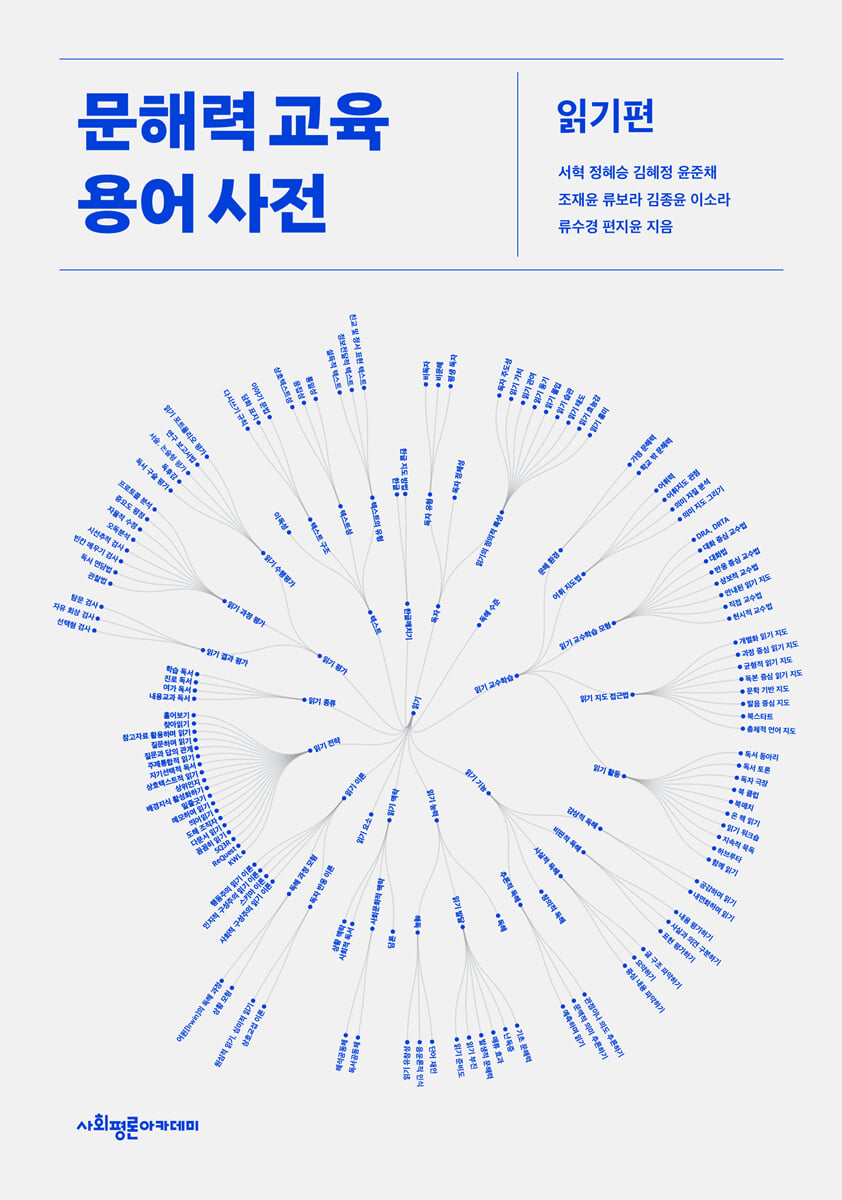
『Reading』 begins with a general introduction to ‘literacy, text, discourse, and context’ and then combines ‘reading ability, reading theory, reading elements, reading comprehension level, reading function, reading strategy, types of reading, reading teaching and learning, Hangul mastery, and reading assessment’ into one flow, presenting not only definitions of terms but also educational applications and limitations, as well as related concepts.
Rather than following the general dictionary index order, the entries are arranged based on the organic connection of concepts and the direction from theory to practice.
『Reading』 begins with a general introduction to ‘literacy, text, discourse, and context’ and then combines ‘reading ability, reading theory, reading elements, reading comprehension level, reading function, reading strategy, types of reading, reading teaching and learning, Hangul mastery, and reading assessment’ into one flow, presenting not only definitions of terms but also educational applications and limitations, as well as related concepts.
Rather than following the general dictionary index order, the entries are arranged based on the organic connection of concepts and the direction from theory to practice.
- You can preview some of the book's contents.
Preview
Into the book
As literacy education expands and deepens across multiple layers, the same terms are increasingly used interchangeably in different contexts, creating conceptual confusion. This book was published to establish the meaning of literacy education terminology, enhance clarity in interdisciplinary communication, and improve consistency between theory and practice.
The purpose of this book is to systematically organize and define key concepts actually used in literacy education, and in particular, to reflect recent educational changes such as media literacy and reading in digital environments, we aimed to include a wide range of concepts, including existing concepts as well as newly emerging terms.
To this end, this dictionary was completed through the direct participation of literacy education researchers and field experts, and through numerous rounds of writing, revision, discussion, and proofreading.
The terms to be included in the dictionary were selected through consultation between experts in each sub-field, focusing on the reading area.
We hope that this dictionary will serve as a useful guide not only for researchers and educators in the fields of literacy education, Korean language education, and language education, but also for students preparing for teacher certification exams, undergraduate students majoring in related fields, and even general readers interested in literacy.
We also hope that it will serve as a foundation for various educational and research activities, including curriculum revision, textbook development, and teaching and learning material design.
The purpose of this book is to systematically organize and define key concepts actually used in literacy education, and in particular, to reflect recent educational changes such as media literacy and reading in digital environments, we aimed to include a wide range of concepts, including existing concepts as well as newly emerging terms.
To this end, this dictionary was completed through the direct participation of literacy education researchers and field experts, and through numerous rounds of writing, revision, discussion, and proofreading.
The terms to be included in the dictionary were selected through consultation between experts in each sub-field, focusing on the reading area.
We hope that this dictionary will serve as a useful guide not only for researchers and educators in the fields of literacy education, Korean language education, and language education, but also for students preparing for teacher certification exams, undergraduate students majoring in related fields, and even general readers interested in literacy.
We also hope that it will serve as a foundation for various educational and research activities, including curriculum revision, textbook development, and teaching and learning material design.
---From the "Preface"
Publisher's Review
Standardizing the Language of Literacy Research and Education: Proposing a Common Reference Language for Reading Education
As literacy education rapidly expands, to minimize confusion where the same words are used with different meanings in different contexts, experts from each field gathered to discuss and review key terms from academia and schools, and unified the descriptive principles.
For each term, we aim to provide a basic framework of definitions, conceptual history and perspectives, educational significance, related terms, and references, making it a "highly useful dictionary" that can be immediately referenced in research design and teaching materials production.
Readers can consistently check how the same terminology is interpreted and applied across subjects, media, and learning stages.
The Flow of 'Reading Education' in Literacy Education: Linking Concepts, Theory, Practice, and Evaluation
The structure begins with a general introduction (literacy, text, discourse, context), then organizes major perspectives such as reading theories such as behaviorism and cognitive/social constructivism, as well as schema and reader response theory, and then deals with core concepts such as textuality, cohesion, unity, and intertextuality.
And it has a linked structure of 'concept → lesson → evaluation' that leads to the reader's defining characteristics (motivation, interest, efficacy, immersion, etc.), reading level and function (fact, inference, criticism, appreciation, creativity), strategy (KWL, SQ3R, underlining, diagram organizer, etc.), teaching and learning (direct teaching method, present teaching method, complementary teaching method, response/dialogue-centered teaching method, reading workshop, book club, reading discussion, etc.), and lastly, evaluation (outcome, process, performance evaluation, misreading analysis, eye tracking, protocol analysis, reading portfolio, etc.).
Even within a single item, cross-references between upper and lower concepts and adjacent terms help with contextual understanding.
Added convenience: page navigation and indexing of titles
The page navigation and indexing functions within the text allow you to quickly find only the items you need, and the hierarchy of the current heading is visualized at the bottom of the text, making it easier to navigate to the desired information and understand the context when writing actual class or research documents.
By presenting the background and research history of each heading, as well as a guide to related terms, it is easy to expand the discussion by considering the various categories of use of a single term.
The index function displays topics, concepts, etc. in a different order than the order of the headings, so you can review the headings in the 'dictionary index order' that is familiar from using existing academic books.
This structure has the advantage of grouping together contextual usage examples of the same term, thereby improving the accuracy of teaching materials and research citations.
The "Literacy Education Terminology: Reading Edition" provides researchers with a baseline for defining concepts and prior discussion, teachers with a common language for lesson design and assessment, and prospective teachers and learners with a map connecting reading theory, strategies, and practice.
Reflecting the post-digital data environment, this book aims to provide a "standard for literacy education terminology" that allows for consistent instructional design and achievement monitoring both inside and outside of school.
As literacy education rapidly expands, to minimize confusion where the same words are used with different meanings in different contexts, experts from each field gathered to discuss and review key terms from academia and schools, and unified the descriptive principles.
For each term, we aim to provide a basic framework of definitions, conceptual history and perspectives, educational significance, related terms, and references, making it a "highly useful dictionary" that can be immediately referenced in research design and teaching materials production.
Readers can consistently check how the same terminology is interpreted and applied across subjects, media, and learning stages.
The Flow of 'Reading Education' in Literacy Education: Linking Concepts, Theory, Practice, and Evaluation
The structure begins with a general introduction (literacy, text, discourse, context), then organizes major perspectives such as reading theories such as behaviorism and cognitive/social constructivism, as well as schema and reader response theory, and then deals with core concepts such as textuality, cohesion, unity, and intertextuality.
And it has a linked structure of 'concept → lesson → evaluation' that leads to the reader's defining characteristics (motivation, interest, efficacy, immersion, etc.), reading level and function (fact, inference, criticism, appreciation, creativity), strategy (KWL, SQ3R, underlining, diagram organizer, etc.), teaching and learning (direct teaching method, present teaching method, complementary teaching method, response/dialogue-centered teaching method, reading workshop, book club, reading discussion, etc.), and lastly, evaluation (outcome, process, performance evaluation, misreading analysis, eye tracking, protocol analysis, reading portfolio, etc.).
Even within a single item, cross-references between upper and lower concepts and adjacent terms help with contextual understanding.
Added convenience: page navigation and indexing of titles
The page navigation and indexing functions within the text allow you to quickly find only the items you need, and the hierarchy of the current heading is visualized at the bottom of the text, making it easier to navigate to the desired information and understand the context when writing actual class or research documents.
By presenting the background and research history of each heading, as well as a guide to related terms, it is easy to expand the discussion by considering the various categories of use of a single term.
The index function displays topics, concepts, etc. in a different order than the order of the headings, so you can review the headings in the 'dictionary index order' that is familiar from using existing academic books.
This structure has the advantage of grouping together contextual usage examples of the same term, thereby improving the accuracy of teaching materials and research citations.
The "Literacy Education Terminology: Reading Edition" provides researchers with a baseline for defining concepts and prior discussion, teachers with a common language for lesson design and assessment, and prospective teachers and learners with a map connecting reading theory, strategies, and practice.
Reflecting the post-digital data environment, this book aims to provide a "standard for literacy education terminology" that allows for consistent instructional design and achievement monitoring both inside and outside of school.
GOODS SPECIFICS
- Date of issue: September 5, 2025
- Page count, weight, size: 332 pages | 165*235*30mm
- ISBN13: 9791167071934
- ISBN10: 116707193X
You may also like
카테고리
korean


korean

![GQ KOREA Mark (Monthly): December [2025]](http://librairie.coreenne.fr/cdn/shop/files/8ef265dbbfbf186523ed75ba7319009d.jpg?v=1765340328&width=3840)


