

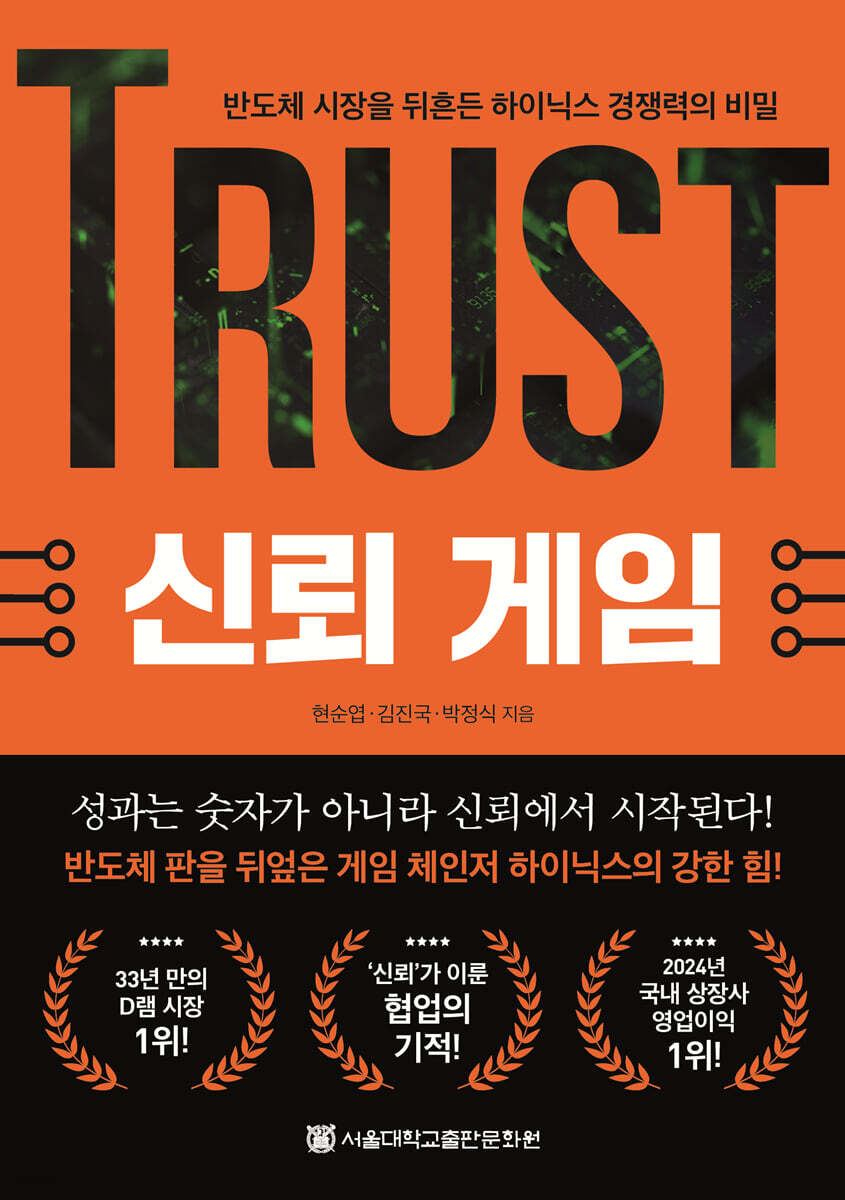
Trust Game
 |
Description
Book Introduction
It's not about who you work with, it's about how you work together!
All About the "Trust Game" That Led Hynix to First Place
What is the secret to SK Hynix's competitive edge, which will shake up the semiconductor market in 2025? It wasn't technology or capital, but trust. This trust, built around the CEO and a top team of leaders, spread throughout the company, fostering collaboration, spontaneous innovation, and engagement among engineers.
This is in line with the conditions for high-performance teams revealed by Google's 'Project Aristotle', namely psychological safety.
Trust is a competitive advantage that is difficult to imitate, the source of Hynix's deep change, and a key driving force in today's semiconductor industry.
This book contains everything about Hynix's deep change, which involved abandoning familiarity and choosing an uncomfortable path out of desperation for "fundamental competitiveness."
All About the "Trust Game" That Led Hynix to First Place
What is the secret to SK Hynix's competitive edge, which will shake up the semiconductor market in 2025? It wasn't technology or capital, but trust. This trust, built around the CEO and a top team of leaders, spread throughout the company, fostering collaboration, spontaneous innovation, and engagement among engineers.
This is in line with the conditions for high-performance teams revealed by Google's 'Project Aristotle', namely psychological safety.
Trust is a competitive advantage that is difficult to imitate, the source of Hynix's deep change, and a key driving force in today's semiconductor industry.
This book contains everything about Hynix's deep change, which involved abandoning familiarity and choosing an uncomfortable path out of desperation for "fundamental competitiveness."
- You can preview some of the book's contents.
Preview
index
How can a second-rate company become a first-rate company?
Preface: The Secret to Hynix's Competitiveness: A Game of Trust
Chapter 1: Changes in the competitive landscape of memory semiconductors
Unexpected tectonic shifts in memory semiconductors
What's been going on at Hynix?
David and Goliath fight
The Red Queen Effect: If you're not more competitive than your competitors, you're doomed.
The Edge of a Cliff, 10 Years Under Creditors, and the SK Acquisition
Chapter 2: The Trust Game
Corporate management is a game of trust.
Is your company a trust game or a political game?
Corporate Competitiveness and Trust Game
A prerequisite for strengthening competitiveness: Efforts to strengthen capabilities.
The long-standing rule of the semiconductor game: fierce competition.
The fierce competition for the 52-hour workweek
The intensity of the VUCA era is immersion
Changing the Rules of the Semiconductor Game: Collaboration
Put your heart and soul into collaboration
Chapter 3: The Cultural Trust Game
The Starting Point of the Trust Game: Trust with Major Shareholders
Cultural fusion between SK and Hynix
SKMS Permeates Hynix Culture
Speak up loudly
Introduction and spread of Wononwon
Learn and learn again
Chapter 4: The Strategic Trust Game
Shift Left Strategy
Innovative advancements in technology transfer standards
From relay baton touch to completion
Facilitating groundbreaking inter-sectoral talent mobility
Transformation from a manufacturing-focused company to a technology-focused company
Changes in the trust game brought about by DT
Chapter 5: The Trust Game in Human Resources and Organizations
Hynix Trust Game's Top Team
Appointment of a Technology CEO
Sufficient tenure and long-term succession preparation
Hynix's Symbolic Leadership: Humble Leadership
Decentralization and autonomy of HR
Distance from the principle of punishment for new appearances, which is a rule of the exhibition system
Chapter 6: The Fruit of Hynix's Trust Game: HBM
Developing the world's first HBM
Let's find variables that can shake up the existing market structure.
Success Follows Trials: Falling Behind in HBM2 Development
Overcoming Failure to Develop HBM2E
Hynix's one-team culture
Developing MR-MUF Technology, the Key to HBM's Success
HBM's business continues to face challenges
Decision-making driven by the power of communication
Chapter 7 Finite and Infinite Games
Simon Sinek's Game Theory: Two Views of Business
Companies Falling into the Trap of Finite Games
The memory semiconductor industry is transforming into an endless game mode.
Hynix's transformation into an infinite gaming system
Conclusion: Letting go of familiarity and moving towards discomfort
Preface: The Secret to Hynix's Competitiveness: A Game of Trust
Chapter 1: Changes in the competitive landscape of memory semiconductors
Unexpected tectonic shifts in memory semiconductors
What's been going on at Hynix?
David and Goliath fight
The Red Queen Effect: If you're not more competitive than your competitors, you're doomed.
The Edge of a Cliff, 10 Years Under Creditors, and the SK Acquisition
Chapter 2: The Trust Game
Corporate management is a game of trust.
Is your company a trust game or a political game?
Corporate Competitiveness and Trust Game
A prerequisite for strengthening competitiveness: Efforts to strengthen capabilities.
The long-standing rule of the semiconductor game: fierce competition.
The fierce competition for the 52-hour workweek
The intensity of the VUCA era is immersion
Changing the Rules of the Semiconductor Game: Collaboration
Put your heart and soul into collaboration
Chapter 3: The Cultural Trust Game
The Starting Point of the Trust Game: Trust with Major Shareholders
Cultural fusion between SK and Hynix
SKMS Permeates Hynix Culture
Speak up loudly
Introduction and spread of Wononwon
Learn and learn again
Chapter 4: The Strategic Trust Game
Shift Left Strategy
Innovative advancements in technology transfer standards
From relay baton touch to completion
Facilitating groundbreaking inter-sectoral talent mobility
Transformation from a manufacturing-focused company to a technology-focused company
Changes in the trust game brought about by DT
Chapter 5: The Trust Game in Human Resources and Organizations
Hynix Trust Game's Top Team
Appointment of a Technology CEO
Sufficient tenure and long-term succession preparation
Hynix's Symbolic Leadership: Humble Leadership
Decentralization and autonomy of HR
Distance from the principle of punishment for new appearances, which is a rule of the exhibition system
Chapter 6: The Fruit of Hynix's Trust Game: HBM
Developing the world's first HBM
Let's find variables that can shake up the existing market structure.
Success Follows Trials: Falling Behind in HBM2 Development
Overcoming Failure to Develop HBM2E
Hynix's one-team culture
Developing MR-MUF Technology, the Key to HBM's Success
HBM's business continues to face challenges
Decision-making driven by the power of communication
Chapter 7 Finite and Infinite Games
Simon Sinek's Game Theory: Two Views of Business
Companies Falling into the Trap of Finite Games
The memory semiconductor industry is transforming into an endless game mode.
Hynix's transformation into an infinite gaming system
Conclusion: Letting go of familiarity and moving towards discomfort
Into the book
At Hynix, the foundation of innovation is often described as "engineer's touch," a term that describes engineers' independent thinking and the practice of coming up with new ideas and implementing them.
The results achieved through the hands of these engineers can be called adaptive results.
What creates this achievement is not the pressure of long working hours, but the engineers' dedication.
--- p.68
What is absolutely necessary for a collaborative system to function more perfectly is a collaborative culture (mindset), also known as one-team spirit.
A collaborative culture is essentially about trusting each other.
The belief that short-term self-sacrifice will result in greater benefits rather than losses, and the desire for collaborative organizations to prioritize common goals.
Without a culture of mutual trust, collaborative systems can easily become "responsibility-shy" systems driven by minimal collaborative effort, simply adhering to R&R regulations, rather than maximizing collaborative effort.
--- p.76~77
Ultimately, the essence of corporate management is a game of trust.
Trust is the fundamental driving force behind organizational innovation, collaboration, and engagement.
In a culture where members trust one another, crises become opportunities, and limitations become challenges.
For a company to achieve sustainable growth, it must put more effort into fostering a fertile foundation for a culture of trust than in developing a cool cultural code.
Only then does culture become a powerful weapon that supports strategy execution.
--- p.86
If I had to pick one keyword that is most emphasized in SKMS's management philosophy, it would be 'voluntary and motivated brain use.'
The English abbreviation VWBE (Voluntary/Willing Brain Engagement) is mainly used.
The words 'voluntary and motivated' are frequently used in SK's daily life, and they embody the philosophy that people maximize their brain power when they are spontaneous and motivated, and this maximizes their happiness and performance.
--- p.95
SKHU has a whopping 7,000 in-house instructors.
These are individuals who have passed the instructor evaluation and are voluntarily carrying out both on-the-job and teaching activities.
This is the best indicator of Hynix's active learning culture.
In-house instructors say they learn more effectively by "learning by teaching," as they prepare to share their knowledge and experience with others, sharpening their understanding of theory and practice. SKHU College graduates receive in-house instructor certification, teach juniors, and further develop into professional instructors, contributing to Hynix's technological competitiveness.
In this way, SKHU is a place for building trust between seniors and juniors (between instructors and professors and students) through the curriculum, and an effective learning environment where students experience consideration and respect for one another.
--- p.121
Hynix's shift left strategy was not simply a process improvement, but a "deep change" that reconstructed the company's fundamental collaborative DNA.
Through changes in technology transfer criteria across divisions, a shift in technology development methods, and groundbreaking personnel movements, Hynix successfully transformed itself from a manufacturing-centric company to a technology-centric one.
The most important thing in this process was ‘trust.’
Breaking down barriers between departments, understanding each other, and working together toward a common goal—trust-based collaboration—was a key element of Hynix's success.
The shift left strategy served as a catalyst to systematically build and strengthen this trust.
The results achieved through the hands of these engineers can be called adaptive results.
What creates this achievement is not the pressure of long working hours, but the engineers' dedication.
--- p.68
What is absolutely necessary for a collaborative system to function more perfectly is a collaborative culture (mindset), also known as one-team spirit.
A collaborative culture is essentially about trusting each other.
The belief that short-term self-sacrifice will result in greater benefits rather than losses, and the desire for collaborative organizations to prioritize common goals.
Without a culture of mutual trust, collaborative systems can easily become "responsibility-shy" systems driven by minimal collaborative effort, simply adhering to R&R regulations, rather than maximizing collaborative effort.
--- p.76~77
Ultimately, the essence of corporate management is a game of trust.
Trust is the fundamental driving force behind organizational innovation, collaboration, and engagement.
In a culture where members trust one another, crises become opportunities, and limitations become challenges.
For a company to achieve sustainable growth, it must put more effort into fostering a fertile foundation for a culture of trust than in developing a cool cultural code.
Only then does culture become a powerful weapon that supports strategy execution.
--- p.86
If I had to pick one keyword that is most emphasized in SKMS's management philosophy, it would be 'voluntary and motivated brain use.'
The English abbreviation VWBE (Voluntary/Willing Brain Engagement) is mainly used.
The words 'voluntary and motivated' are frequently used in SK's daily life, and they embody the philosophy that people maximize their brain power when they are spontaneous and motivated, and this maximizes their happiness and performance.
--- p.95
SKHU has a whopping 7,000 in-house instructors.
These are individuals who have passed the instructor evaluation and are voluntarily carrying out both on-the-job and teaching activities.
This is the best indicator of Hynix's active learning culture.
In-house instructors say they learn more effectively by "learning by teaching," as they prepare to share their knowledge and experience with others, sharpening their understanding of theory and practice. SKHU College graduates receive in-house instructor certification, teach juniors, and further develop into professional instructors, contributing to Hynix's technological competitiveness.
In this way, SKHU is a place for building trust between seniors and juniors (between instructors and professors and students) through the curriculum, and an effective learning environment where students experience consideration and respect for one another.
--- p.121
Hynix's shift left strategy was not simply a process improvement, but a "deep change" that reconstructed the company's fundamental collaborative DNA.
Through changes in technology transfer criteria across divisions, a shift in technology development methods, and groundbreaking personnel movements, Hynix successfully transformed itself from a manufacturing-centric company to a technology-centric one.
The most important thing in this process was ‘trust.’
Breaking down barriers between departments, understanding each other, and working together toward a common goal—trust-based collaboration—was a key element of Hynix's success.
The shift left strategy served as a catalyst to systematically build and strengthen this trust.
--- p.164
Publisher's Review
“Success starts with trust, not numbers!”
The powerful force of Hynix, the game changer that turned the semiconductor industry upside down!
★★★ No. 1 in the DRAM market after 33 years
★★★ Ranked #1 in Operating Profit among Domestic Listed Companies in 2024
★★★ The Miracle of Collaboration Created by 'Trust'
This book contains real-life examples from approximately 10 years after Hynix was acquired by the SK Group, when the company began to seriously strengthen its competitiveness.
This is a record of the process organized and interpreted by former executives who served as members of Hynix's Top Team leadership team during this period.
In the past, Hynix was nothing more than a weak, second-tier company that lagged significantly behind the leading company, Samsung, in all aspects of competitiveness.
What is the secret behind Hynix's remarkable market turnaround, despite its disadvantages often likened to a David-versus-Goliath battle? The authors find the answer in the concept of the "trust game."
The trust game is a concept developed in behavioral economics to experimentally measure trust, cooperation, and reciprocity between humans.
The core of this game is that when participants pursue common interests based on mutual trust and cooperation, the overall benefit is maximized.
When this principle was applied to Hynix's corporate management, it became a key driving force for strengthening competitiveness.
The keys to success in today's semiconductor industry are collaboration and innovation.
And both of these are activated based on trust.
Because Hynix was able to play the "trust game" better than its competitors, it also outperformed them in collaboration and innovation, increasing its chances of market success.
Based on these findings, this book introduces how Hynix's trust game worked, with specific examples from various perspectives, including corporate culture, strategy, personnel, and organization.
In particular, these cases vividly demonstrate Hynix's unique efforts and execution capabilities, which are rarely seen in general companies.
A game of trust at the corporate culture level
Several unique practices demonstrated by SK during the integration process following SK's acquisition of Hynix led to Hynix's trust in its major shareholder, which became the starting point of Hynix's trust game.
In addition, SK's corporate culture, based on 'trust in people', represented by SKMS, clearly demonstrates that it has evolved into Hynix's culture of trust by fusing with Hynix's existing 'fierceness'-centered culture.
A symbolic example of this culture of trust is 'Speak Up'.
Speak Up is a unique culture at Hynix that encourages the free expression of one's thoughts and ideas, and it is a culture that is difficult to create without trust.
One-on-one communication, which further activated this speak-up culture, is almost the only case among large domestic companies where it has been established company-wide, and is considered a representative example that clearly shows Hynix's culture of trust and communication between superiors and subordinates.
Hynix's unique learning culture is also evident in its insight-enhancing programs for senior executives, including 'SK Hynix University,' 'CREATE,' and the 'Hynix-Stanford Insight Program.'
In this way, Hynix's voluntary learning enthusiasm and vibrant learning culture further solidified the foundation of a trusting culture and served as a key input element in Hynix's trust game.
A strategic trust game
The strategy that further strengthened trust between Hynix's organizations was 'Shift Left.'
Semiconductor technology development typically proceeds in the order of 'research lab → development → manufacturing,' and collaboration at each stage is key to technological perfection and success.
Hynix changed this step-by-step collaboration structure during its technology development process.
This is called "shifting left", where an organization in the technology development stage "advances" the goals of the subsequent manufacturing organization toward its own goals.
This strategy, named after the meaning of "moving left," was an attempt by each organization to advance its technological maturity more quickly by preemptively adopting the goals of other organizations.
This strategy allowed Hynix to raise trust among its technology development organizations to a new level and also resolved the "yield N curve," a long-standing problem for Hynix.
The shift left strategy not only strengthened trust between organizations, but also contributed to enhancing strategy execution capabilities by reflecting organizational shifts among executives.
Moreover, the strategic shift from a manufacturing-centric to a technology-centric company was truly a 'deep change' for Hynix.
Hynix had to transform itself from a manufacturing company that prioritized efficiency and productivity to a technology innovation company.
To achieve this, we prioritized innovation and learning over corporate operations, and promoted a horizontal, autonomous culture, fostering excellent engineers, collaboration, a speak-up culture, learning through failure, and digital transformation (DT) innovation.
This change was a complete departure from Hynix's existing culture and required a true "deep change."
However, Hynix has successfully overcome the challenges faced by other companies by overcoming these difficult organizational changes step by step through a game of trust.
Trust Game at the Human Resources and Organizational Levels
At the heart of Hynix's trust game was a leadership team known as the "Top Team." Centered around the CEO and comprised of division heads and headquarters managers, this Top Team, built on strong mutual trust, fostered a culture of trust throughout the organization and played a key role in establishing Hynix's unique collaborative culture.
In particular, the high level of trust among the top team is deeply related to the emergence of a technology CEO.
In a corporate environment prone to political entanglements, Hynix established a technology-centric, rational decision-making structure through a trust game, supported by the long tenure and expertise of its technology CEO.
Furthermore, the hallmark of Hynix's leadership is "humble leadership." The humble leadership demonstrated by many executives, including the CEO, differentiates the company from the prevailing top-down leadership style in Korea, and has significantly contributed to strengthening a culture of trust.
In addition, Hynix boldly delegated HR authority to each division head, allowing each organization to make its own personnel decisions.
This decentralization of HR has empowered leaders in each organization to take responsibility for talent development and motivation, naturally leading to increased trust and autonomy within the organization. This reflects the philosophy that HR is no longer the sole responsibility of the human resources department, but rather the actual driving force behind competitiveness: field leaders.
This is a good example of another evolution in Hynix's trust game.
Meanwhile, Hynix chose to maintain a certain distance from the 'reward-reward-reward' principle, which is generally emphasized in the semiconductor industry where discipline and control are highly valued.
Believing that challenges and bold attempts without fear of failure are the driving force behind innovation, Hynix has focused more on innovation and collaboration than on excessively strict discipline.
This approach was essential for maintaining a culture of trust, and indeed, Hynix developed its competitiveness through an organizational culture based on trust rather than a system of meritocracy.
The powerful force of Hynix, the game changer that turned the semiconductor industry upside down!
★★★ No. 1 in the DRAM market after 33 years
★★★ Ranked #1 in Operating Profit among Domestic Listed Companies in 2024
★★★ The Miracle of Collaboration Created by 'Trust'
This book contains real-life examples from approximately 10 years after Hynix was acquired by the SK Group, when the company began to seriously strengthen its competitiveness.
This is a record of the process organized and interpreted by former executives who served as members of Hynix's Top Team leadership team during this period.
In the past, Hynix was nothing more than a weak, second-tier company that lagged significantly behind the leading company, Samsung, in all aspects of competitiveness.
What is the secret behind Hynix's remarkable market turnaround, despite its disadvantages often likened to a David-versus-Goliath battle? The authors find the answer in the concept of the "trust game."
The trust game is a concept developed in behavioral economics to experimentally measure trust, cooperation, and reciprocity between humans.
The core of this game is that when participants pursue common interests based on mutual trust and cooperation, the overall benefit is maximized.
When this principle was applied to Hynix's corporate management, it became a key driving force for strengthening competitiveness.
The keys to success in today's semiconductor industry are collaboration and innovation.
And both of these are activated based on trust.
Because Hynix was able to play the "trust game" better than its competitors, it also outperformed them in collaboration and innovation, increasing its chances of market success.
Based on these findings, this book introduces how Hynix's trust game worked, with specific examples from various perspectives, including corporate culture, strategy, personnel, and organization.
In particular, these cases vividly demonstrate Hynix's unique efforts and execution capabilities, which are rarely seen in general companies.
A game of trust at the corporate culture level
Several unique practices demonstrated by SK during the integration process following SK's acquisition of Hynix led to Hynix's trust in its major shareholder, which became the starting point of Hynix's trust game.
In addition, SK's corporate culture, based on 'trust in people', represented by SKMS, clearly demonstrates that it has evolved into Hynix's culture of trust by fusing with Hynix's existing 'fierceness'-centered culture.
A symbolic example of this culture of trust is 'Speak Up'.
Speak Up is a unique culture at Hynix that encourages the free expression of one's thoughts and ideas, and it is a culture that is difficult to create without trust.
One-on-one communication, which further activated this speak-up culture, is almost the only case among large domestic companies where it has been established company-wide, and is considered a representative example that clearly shows Hynix's culture of trust and communication between superiors and subordinates.
Hynix's unique learning culture is also evident in its insight-enhancing programs for senior executives, including 'SK Hynix University,' 'CREATE,' and the 'Hynix-Stanford Insight Program.'
In this way, Hynix's voluntary learning enthusiasm and vibrant learning culture further solidified the foundation of a trusting culture and served as a key input element in Hynix's trust game.
A strategic trust game
The strategy that further strengthened trust between Hynix's organizations was 'Shift Left.'
Semiconductor technology development typically proceeds in the order of 'research lab → development → manufacturing,' and collaboration at each stage is key to technological perfection and success.
Hynix changed this step-by-step collaboration structure during its technology development process.
This is called "shifting left", where an organization in the technology development stage "advances" the goals of the subsequent manufacturing organization toward its own goals.
This strategy, named after the meaning of "moving left," was an attempt by each organization to advance its technological maturity more quickly by preemptively adopting the goals of other organizations.
This strategy allowed Hynix to raise trust among its technology development organizations to a new level and also resolved the "yield N curve," a long-standing problem for Hynix.
The shift left strategy not only strengthened trust between organizations, but also contributed to enhancing strategy execution capabilities by reflecting organizational shifts among executives.
Moreover, the strategic shift from a manufacturing-centric to a technology-centric company was truly a 'deep change' for Hynix.
Hynix had to transform itself from a manufacturing company that prioritized efficiency and productivity to a technology innovation company.
To achieve this, we prioritized innovation and learning over corporate operations, and promoted a horizontal, autonomous culture, fostering excellent engineers, collaboration, a speak-up culture, learning through failure, and digital transformation (DT) innovation.
This change was a complete departure from Hynix's existing culture and required a true "deep change."
However, Hynix has successfully overcome the challenges faced by other companies by overcoming these difficult organizational changes step by step through a game of trust.
Trust Game at the Human Resources and Organizational Levels
At the heart of Hynix's trust game was a leadership team known as the "Top Team." Centered around the CEO and comprised of division heads and headquarters managers, this Top Team, built on strong mutual trust, fostered a culture of trust throughout the organization and played a key role in establishing Hynix's unique collaborative culture.
In particular, the high level of trust among the top team is deeply related to the emergence of a technology CEO.
In a corporate environment prone to political entanglements, Hynix established a technology-centric, rational decision-making structure through a trust game, supported by the long tenure and expertise of its technology CEO.
Furthermore, the hallmark of Hynix's leadership is "humble leadership." The humble leadership demonstrated by many executives, including the CEO, differentiates the company from the prevailing top-down leadership style in Korea, and has significantly contributed to strengthening a culture of trust.
In addition, Hynix boldly delegated HR authority to each division head, allowing each organization to make its own personnel decisions.
This decentralization of HR has empowered leaders in each organization to take responsibility for talent development and motivation, naturally leading to increased trust and autonomy within the organization. This reflects the philosophy that HR is no longer the sole responsibility of the human resources department, but rather the actual driving force behind competitiveness: field leaders.
This is a good example of another evolution in Hynix's trust game.
Meanwhile, Hynix chose to maintain a certain distance from the 'reward-reward-reward' principle, which is generally emphasized in the semiconductor industry where discipline and control are highly valued.
Believing that challenges and bold attempts without fear of failure are the driving force behind innovation, Hynix has focused more on innovation and collaboration than on excessively strict discipline.
This approach was essential for maintaining a culture of trust, and indeed, Hynix developed its competitiveness through an organizational culture based on trust rather than a system of meritocracy.
GOODS SPECIFICS
- Date of issue: July 20, 2025
- Page count, weight, size: 228 pages | 148*210*20mm
- ISBN13: 9788952139627
- ISBN10: 8952139623
You may also like
카테고리
korean


korean

![GQ KOREA Mark (Monthly): December [2025]](http://librairie.coreenne.fr/cdn/shop/files/8ef265dbbfbf186523ed75ba7319009d.jpg?v=1765340328&width=3840)


