

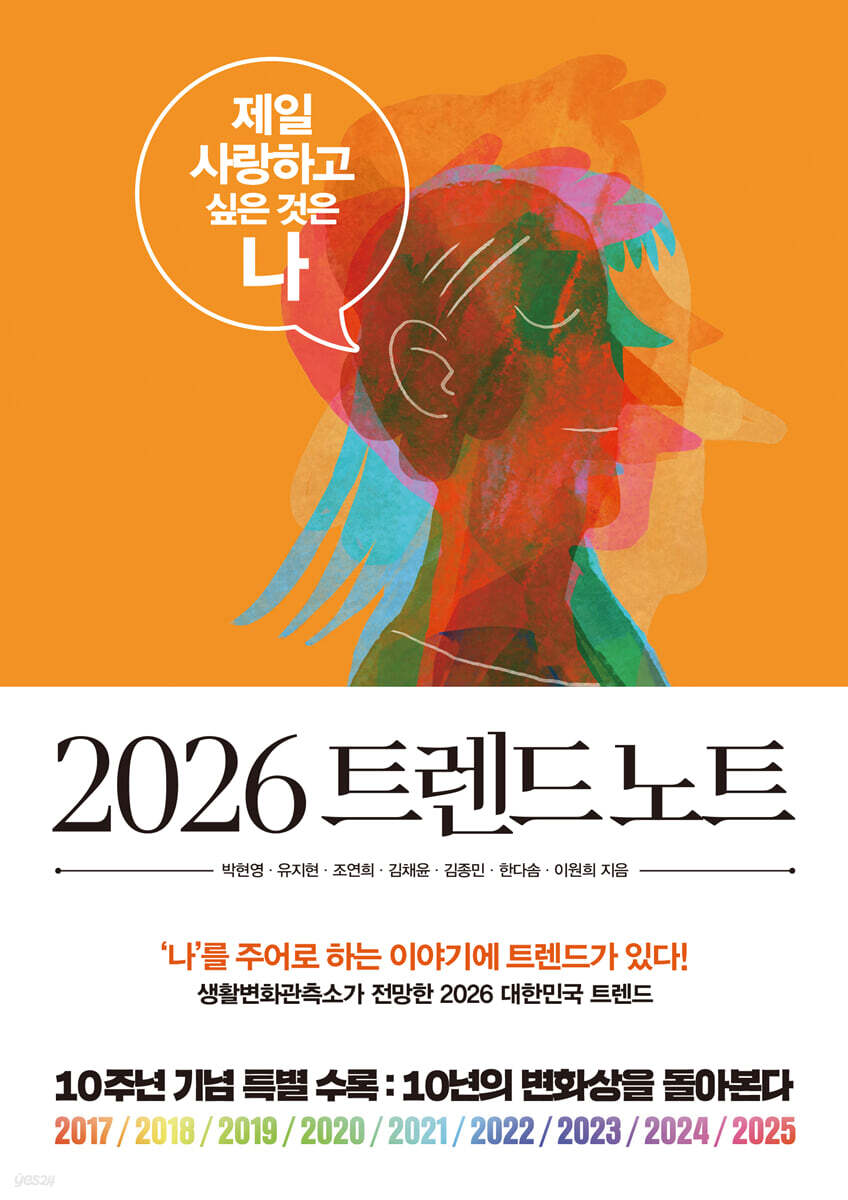
2026 Trend Notes
 |
Description
Book Introduction
10 years of change from 'we' to 'me'
From the age of survival to the age of identity, and then to the age of authenticity.
The tenth book in the Trend Note series, which observes changes in the lives of Koreans, is published.
The past decade has been a time of transition from 'we' to 'me', a time of moving from the 'age of survival' to the 'age of identity'.
It was a time when the value of 'I am important' was highlighted, but more precisely, it was a time for me to get to know myself.
Now is the time to focus on the new me I have discovered.
The 'era of real' is now dawning.
The common thread that runs through the era of survival, the era of identity, and the era of authenticity is ‘working hard.’
In the age of survival, we live 'hard' for our families and our country; in the age of identity, we live 'hard' to keep up with the new lifestyle; and in the age of authenticity, we live 'hard' to become an expert in the field we have chosen.
《2026 Trend Note》 explores what Korean society is passionate about and why.
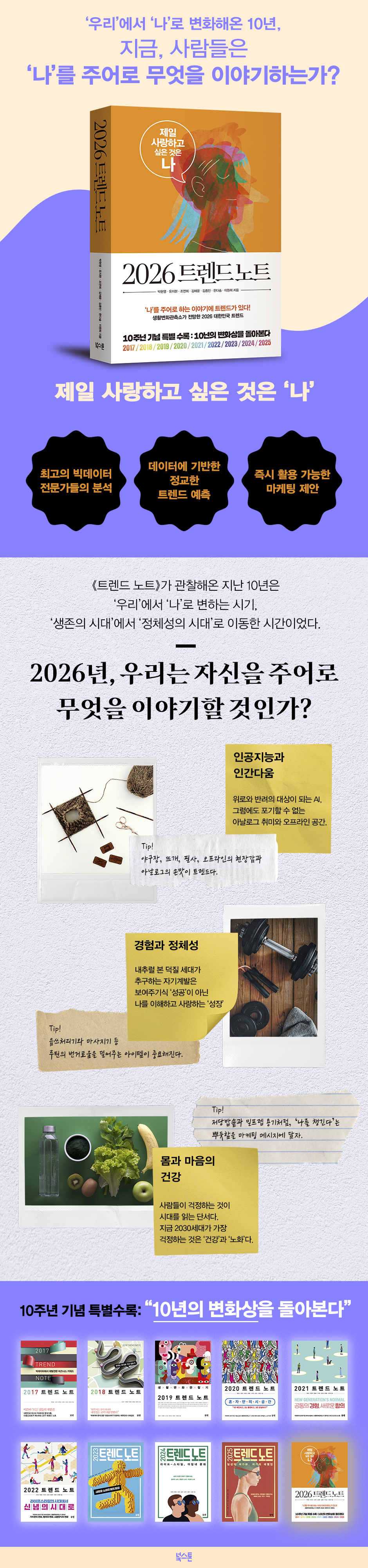
Based on data accumulated by the Lifestyle Change Observatory, we analyze the daily lives and consumption of Koreans in a three-dimensional manner along four axes: technology, experience, identity, and health.
From the age of survival to the age of identity, and then to the age of authenticity.
The tenth book in the Trend Note series, which observes changes in the lives of Koreans, is published.
The past decade has been a time of transition from 'we' to 'me', a time of moving from the 'age of survival' to the 'age of identity'.
It was a time when the value of 'I am important' was highlighted, but more precisely, it was a time for me to get to know myself.
Now is the time to focus on the new me I have discovered.
The 'era of real' is now dawning.
The common thread that runs through the era of survival, the era of identity, and the era of authenticity is ‘working hard.’
In the age of survival, we live 'hard' for our families and our country; in the age of identity, we live 'hard' to keep up with the new lifestyle; and in the age of authenticity, we live 'hard' to become an expert in the field we have chosen.
《2026 Trend Note》 explores what Korean society is passionate about and why.
Based on data accumulated by the Lifestyle Change Observatory, we analyze the daily lives and consumption of Koreans in a three-dimensional manner along four axes: technology, experience, identity, and health.
- You can preview some of the book's contents.
Preview
index
Foreword | Why Read Trend Books in the AI Era?
Prologue | Deep Dive Beyond the Bubbles
Addendum to "2025 Trend Notes"
Part 1: Artificial Intelligence and Humanity
Chapter 1: The New Value of Offline Spaces in the AI Era
A Decade of AI: A Trend Only Comes When "I" Become the Subject
The Future of AI: Companions
The Reality of "I" in the AI Era: The Meaning of Offline Space
What AI Can't Do: Still, I Want to Grow as a Human
Implications for Marketers
Chapter 2: Why Non-Digital Hobbies Are Getting Attention
Why analog?
The New Value of Analog Hobbies: "Together"
Clues to reading new trends
Implications for Marketers
Part 2: Experience and Identity
Chapter 3: 10 Years of Self-Development: Changing the Way I Grow
Tangible "growth" instead of grandiose "success."
The only thing I can control is my body
The New Self-Improvement Formula: Small, Repeated Things
If you really love me
Implications for Marketers
Chapter 4: Being a fan means living your life the most authentically.
Fandom drives the market
Teenagers discovering themselves through fandom, and those in their 20s and 30s comforting themselves.
Why Baseball and Band Fandoms Are So Popular: A Sense of Growth, Immersion, and Relief
From over-immersion and ignorance to cost-effectiveness and health
The ultimate destination of fandom is ultimately 'me'
Implications for Marketers
Chapter 5: "Dance Kids" Become Members of Society
When content becomes identity
The identity of "MuDo Kids" leads to certification.
The collective identity of 'MuDo Kids'
Identity passed down from 'Mudo Kids' to 'Mudo Grandsons'
The cultural DNA that 'MuDo Kids' will spread
Implications for Marketers
Part 3: Health of Body and Mind
Chapter 6: In an Age of Anxiety, Consuming Recovery and Comfort
Anxiety, an emotion we have to live with
Things that fill your recovery time
Comfort found in the gaps of everyday life
Self-understanding makes me stronger.
Implications for Marketers
Chapter 7: The Meaning of 'Home Cooking' in This Era
The healthiest 61-year-old, the unhealthiest 32-year-old
Slow aging, for those of you who will live alone for a long time
The first generation to cook for me
Still, we eat dessert
Implications for Marketers
Epilogue | On Money, Family, and Aging
Appendix | Trend Note: A Prologue to the Past Decade of Change
Prologue | Deep Dive Beyond the Bubbles
Addendum to "2025 Trend Notes"
Part 1: Artificial Intelligence and Humanity
Chapter 1: The New Value of Offline Spaces in the AI Era
A Decade of AI: A Trend Only Comes When "I" Become the Subject
The Future of AI: Companions
The Reality of "I" in the AI Era: The Meaning of Offline Space
What AI Can't Do: Still, I Want to Grow as a Human
Implications for Marketers
Chapter 2: Why Non-Digital Hobbies Are Getting Attention
Why analog?
The New Value of Analog Hobbies: "Together"
Clues to reading new trends
Implications for Marketers
Part 2: Experience and Identity
Chapter 3: 10 Years of Self-Development: Changing the Way I Grow
Tangible "growth" instead of grandiose "success."
The only thing I can control is my body
The New Self-Improvement Formula: Small, Repeated Things
If you really love me
Implications for Marketers
Chapter 4: Being a fan means living your life the most authentically.
Fandom drives the market
Teenagers discovering themselves through fandom, and those in their 20s and 30s comforting themselves.
Why Baseball and Band Fandoms Are So Popular: A Sense of Growth, Immersion, and Relief
From over-immersion and ignorance to cost-effectiveness and health
The ultimate destination of fandom is ultimately 'me'
Implications for Marketers
Chapter 5: "Dance Kids" Become Members of Society
When content becomes identity
The identity of "MuDo Kids" leads to certification.
The collective identity of 'MuDo Kids'
Identity passed down from 'Mudo Kids' to 'Mudo Grandsons'
The cultural DNA that 'MuDo Kids' will spread
Implications for Marketers
Part 3: Health of Body and Mind
Chapter 6: In an Age of Anxiety, Consuming Recovery and Comfort
Anxiety, an emotion we have to live with
Things that fill your recovery time
Comfort found in the gaps of everyday life
Self-understanding makes me stronger.
Implications for Marketers
Chapter 7: The Meaning of 'Home Cooking' in This Era
The healthiest 61-year-old, the unhealthiest 32-year-old
Slow aging, for those of you who will live alone for a long time
The first generation to cook for me
Still, we eat dessert
Implications for Marketers
Epilogue | On Money, Family, and Aging
Appendix | Trend Note: A Prologue to the Past Decade of Change
Detailed image
Into the book
The process by which humans adopt new technologies follows a certain flow.
Step 1 is useful.
'This technique is useful.' Step 2 is play.
Have you tried this? I've tried it too.
Isn't it funny? Isn't it fun?' It's about playing with other people with or through this technique.
Step 3 is emotional exchange.
Nowadays, ‘empathy’ and ‘comfort’ are especially important.
New technologies only take their place in our daily lives when we feel like they understand us and listen to our stories.
ChatGPT, which started out as a simple work tool, is now evolving into a hobby friend with whom I can share my photo album and a companion AI that shares my worries.
--- From Chapter 1, "The New Value of Offline Space in the AI Era"
Humans are beings who want to move their feet and go somewhere.
The AI era has us rethinking the fundamental human need for mobility. In this age of AI, sports that challenge human limits through physical movement are gaining traction.
Running is a representative example.
Before COVID-19, running had the keyword 'crew.'
A representative brand is Nike.
The running crew organized by Nike was the hippest and hottest.
In the wake of COVID-19, running has gained the keyword "training."
People overcame their limits through training, trained like athletes, and shortened their records.
A representative brand is Salomon.
A 12-week trail running training course planned by Salomon has been in the spotlight.
As we move into 2025, the keywords added to running are ‘long-distance running’ and ‘slow running.’
"Let's gather," "Let's train," and then what? "Let's not overdo it."
Long-distance running and slow running are meant to be ways to continue at your own pace without overdoing it.
--- From Chapter 1, "The New Value of Offline Space in the AI Era"
For example, the expression 'pursio' is often used among people who enjoy knitting as a hobby.
Pursio is the process of 'unraveling' the yarn again to repair a mistake made while knitting.
It must have been a painful process, as all the hard work up to now has gone to waste.
But people say that even that pain is part of the knitting process and is meaningful.
For beginners, 'Pursio' is like an unavoidable fate for leveling up, and how boldly they decide to do it and execute it becomes a measure of their growth.
When people say they 'value the process,' it broadly implies a variety of meanings, such as effort, challenge, failure, and going back.
In analog hobbies, people find fulfillment not in the end result, but in discovering the 'me who endured the process'.
In other words, the result of knitting is not only the work itself, but also the growth of myself through enduring the process of creating that work.
--- From Chapter 2, “Why Non-Digital Hobbies Are Getting Attention”
The five ‘○○ feelings’ that have increased every year for the past three years are ‘stability’, ‘sense of accomplishment’, ‘sense of fatigue’, ‘sense of connectedness’, and ‘sense of immersion’.
These are also words that appeared earlier when explaining the value of analog hobbies.
Fatigue and stability move as an antagonistic pair.
Earlier, I said that people are feeling tired of the unpredictable society that is changing rapidly, led by technological innovation, and the flood of highly stimulating content.
The pressure of not being able to keep up with the pace of change and falling behind only adds to the fatigue.
People, exhausted by this high level of uncertainty and overstimulation, want a moderate sense of stability in return, and as a result, stability is increasingly mentioned as the most important value pursued in this era.
--- From Chapter 2, “Why Non-Digital Hobbies Are Getting Attention”
Where do people find self-fulfillment these days? Let's look again at the chart of keywords related to "self-development."
Keywords that have risen over the past 10 years are 'growth', 'day', 'change', 'exercise', and 'challenge'.
These five things give us a clear hint as to where self-development is headed today.
‘Growth’ has become more important than ‘success’, and the stability that comes from consistently training yourself every day and repeating small actions has become more important.
In particular, the change in the number of mentions of ‘growth’ and ‘success’ clearly illustrates this transition.
In the first quarter of 2024, 'growth' surpassed 'success' for the first time, with 'growth' increasing by about 2.8 times and 'success' increasing by 2 times compared to 2021.
Both keywords are seeing increasing mentions, but the upward trend for 'growth' is steeper.
Now, the value of ‘growth’ has become more important to people living in Korean society.
--- From Chapter 3, “10 Years of Self-Development: Changes in the Way I Grow”
Ultimately, fandom starts with feelings toward the object of one's affection, but its ultimate destination is the accumulation of positive self-love that leads to self-efficacy, self-esteem, and a sense of belonging.
So, when you become a fan, you start to think things like, 'I realized that I am this kind of person', 'I like the fact that I like ○○'.
In this era, virtue goes beyond mere consumption; it is a journey to create a 'self' with healthy self-love.
--- From Chapter 4, "Being a fan means living the most true to yourself"
Long-running content serves as a meaningful generational divide.
Running Man, which has been on the air for a longer period than Infinite Challenge, also expresses its identity with the keyword ‘Running Man Kids.’
(...) That cultural code manifests itself in consumption and influence.
When the movie "Slam Dunk" was released, people rushed to the theater to watch it N times, spammed a post about a beer brand called "Kyunghwasuwol" with "Bleach" memes and left thousands of comments in a single day, and waited in line at the Hongdae Animate "Jujutsu Kaisen" collaboration cafe from 6 a.m. for the opening run.
The implications of this phenomenon are clear.
In the past, identity was determined by external factors such as age, place of birth, and school, but now the content that one voluntarily chooses and consumes is becoming the core of identity.
Whether they are 'Infinite Challenge Kids' or 'Running Man Kids', they are all defining themselves based on the cultural experiences they have chosen for themselves.
--- From Chapter 5, “Dance Kids” Becoming Members of Society
Even though it is a mass-produced product stamped identically from a factory and can be purchased anywhere in the country, the fact that I have chosen it and it becomes 'mine,' that it will always be with me, and that I can attach meaning to it by containing my wishes, is a powerful message of comfort to us living in these uncertain times.
Great features or outstanding utility are not what consumers respond to.
Even if it is rough and has some flaws, if you can infuse your own meaning or symbolism into the product, it becomes enough reason for consumers to become attached to it.
I am happy to meet the four-leaf clover man, and it is the same to cherish the warding cod and the moon jar in my space.
--- From Chapter 6, “The Age of Anxiety: Consuming Recovery and Comfort”
Let's examine why the keyword "slow aging" has captured our hearts, especially the hearts of the younger generation.
We will all live longer than any previous generation, so the challenge is aging healthily.
Let's think about this by connecting it to the values widely shared in our society.
The first is the Korean cultural code of 'longing for beauty', the second is the historical background in which living alone has become the norm, and the third is the longing for achievement.
Step 1 is useful.
'This technique is useful.' Step 2 is play.
Have you tried this? I've tried it too.
Isn't it funny? Isn't it fun?' It's about playing with other people with or through this technique.
Step 3 is emotional exchange.
Nowadays, ‘empathy’ and ‘comfort’ are especially important.
New technologies only take their place in our daily lives when we feel like they understand us and listen to our stories.
ChatGPT, which started out as a simple work tool, is now evolving into a hobby friend with whom I can share my photo album and a companion AI that shares my worries.
--- From Chapter 1, "The New Value of Offline Space in the AI Era"
Humans are beings who want to move their feet and go somewhere.
The AI era has us rethinking the fundamental human need for mobility. In this age of AI, sports that challenge human limits through physical movement are gaining traction.
Running is a representative example.
Before COVID-19, running had the keyword 'crew.'
A representative brand is Nike.
The running crew organized by Nike was the hippest and hottest.
In the wake of COVID-19, running has gained the keyword "training."
People overcame their limits through training, trained like athletes, and shortened their records.
A representative brand is Salomon.
A 12-week trail running training course planned by Salomon has been in the spotlight.
As we move into 2025, the keywords added to running are ‘long-distance running’ and ‘slow running.’
"Let's gather," "Let's train," and then what? "Let's not overdo it."
Long-distance running and slow running are meant to be ways to continue at your own pace without overdoing it.
--- From Chapter 1, "The New Value of Offline Space in the AI Era"
For example, the expression 'pursio' is often used among people who enjoy knitting as a hobby.
Pursio is the process of 'unraveling' the yarn again to repair a mistake made while knitting.
It must have been a painful process, as all the hard work up to now has gone to waste.
But people say that even that pain is part of the knitting process and is meaningful.
For beginners, 'Pursio' is like an unavoidable fate for leveling up, and how boldly they decide to do it and execute it becomes a measure of their growth.
When people say they 'value the process,' it broadly implies a variety of meanings, such as effort, challenge, failure, and going back.
In analog hobbies, people find fulfillment not in the end result, but in discovering the 'me who endured the process'.
In other words, the result of knitting is not only the work itself, but also the growth of myself through enduring the process of creating that work.
--- From Chapter 2, “Why Non-Digital Hobbies Are Getting Attention”
The five ‘○○ feelings’ that have increased every year for the past three years are ‘stability’, ‘sense of accomplishment’, ‘sense of fatigue’, ‘sense of connectedness’, and ‘sense of immersion’.
These are also words that appeared earlier when explaining the value of analog hobbies.
Fatigue and stability move as an antagonistic pair.
Earlier, I said that people are feeling tired of the unpredictable society that is changing rapidly, led by technological innovation, and the flood of highly stimulating content.
The pressure of not being able to keep up with the pace of change and falling behind only adds to the fatigue.
People, exhausted by this high level of uncertainty and overstimulation, want a moderate sense of stability in return, and as a result, stability is increasingly mentioned as the most important value pursued in this era.
--- From Chapter 2, “Why Non-Digital Hobbies Are Getting Attention”
Where do people find self-fulfillment these days? Let's look again at the chart of keywords related to "self-development."
Keywords that have risen over the past 10 years are 'growth', 'day', 'change', 'exercise', and 'challenge'.
These five things give us a clear hint as to where self-development is headed today.
‘Growth’ has become more important than ‘success’, and the stability that comes from consistently training yourself every day and repeating small actions has become more important.
In particular, the change in the number of mentions of ‘growth’ and ‘success’ clearly illustrates this transition.
In the first quarter of 2024, 'growth' surpassed 'success' for the first time, with 'growth' increasing by about 2.8 times and 'success' increasing by 2 times compared to 2021.
Both keywords are seeing increasing mentions, but the upward trend for 'growth' is steeper.
Now, the value of ‘growth’ has become more important to people living in Korean society.
--- From Chapter 3, “10 Years of Self-Development: Changes in the Way I Grow”
Ultimately, fandom starts with feelings toward the object of one's affection, but its ultimate destination is the accumulation of positive self-love that leads to self-efficacy, self-esteem, and a sense of belonging.
So, when you become a fan, you start to think things like, 'I realized that I am this kind of person', 'I like the fact that I like ○○'.
In this era, virtue goes beyond mere consumption; it is a journey to create a 'self' with healthy self-love.
--- From Chapter 4, "Being a fan means living the most true to yourself"
Long-running content serves as a meaningful generational divide.
Running Man, which has been on the air for a longer period than Infinite Challenge, also expresses its identity with the keyword ‘Running Man Kids.’
(...) That cultural code manifests itself in consumption and influence.
When the movie "Slam Dunk" was released, people rushed to the theater to watch it N times, spammed a post about a beer brand called "Kyunghwasuwol" with "Bleach" memes and left thousands of comments in a single day, and waited in line at the Hongdae Animate "Jujutsu Kaisen" collaboration cafe from 6 a.m. for the opening run.
The implications of this phenomenon are clear.
In the past, identity was determined by external factors such as age, place of birth, and school, but now the content that one voluntarily chooses and consumes is becoming the core of identity.
Whether they are 'Infinite Challenge Kids' or 'Running Man Kids', they are all defining themselves based on the cultural experiences they have chosen for themselves.
--- From Chapter 5, “Dance Kids” Becoming Members of Society
Even though it is a mass-produced product stamped identically from a factory and can be purchased anywhere in the country, the fact that I have chosen it and it becomes 'mine,' that it will always be with me, and that I can attach meaning to it by containing my wishes, is a powerful message of comfort to us living in these uncertain times.
Great features or outstanding utility are not what consumers respond to.
Even if it is rough and has some flaws, if you can infuse your own meaning or symbolism into the product, it becomes enough reason for consumers to become attached to it.
I am happy to meet the four-leaf clover man, and it is the same to cherish the warding cod and the moon jar in my space.
--- From Chapter 6, “The Age of Anxiety: Consuming Recovery and Comfort”
Let's examine why the keyword "slow aging" has captured our hearts, especially the hearts of the younger generation.
We will all live longer than any previous generation, so the challenge is aging healthily.
Let's think about this by connecting it to the values widely shared in our society.
The first is the Korean cultural code of 'longing for beauty', the second is the historical background in which living alone has become the norm, and the third is the longing for achievement.
--- From Chapter 7, “The Meaning of ‘Home Cooking’ in This Era”
Publisher's Review
There is a trend in stories that use 'I' as the subject!
Now, what do people talk about when they use 'I' as the subject?
This is the AI era.
If you ask why TrendSeo is talking about the AI era now when AlphaGo beat Lee Sedol 9-dan in 2016, there are two reasons.
First, while before, it was mainly about impressions and observations like, 'This is what AI is like,' now people say, 'I experienced AI myself.'
The subject changed from 'AI' to 'I'.
A trend is only complete when the subject becomes 'me'.
Bagels will become a trend when more and more people say, "I tried a bagel myself," rather than "I heard the bagel was delicious."
That's why Trend Note reads trends from people's social media feeds, not newspapers.
From the "Snow" photo app in 2023 to the "Ghibli-style profile" craze of ChatGPT in 2025, AI has gone from being a leader in future industries to being an everyday friend who entertains me, listens to my worries, and comforts me.
Second, another trend is emerging in the wake of AI.
To be precise, an opposing trend is emerging that is antagonistic to AI.
The value of old analogues, which are the antithesis of digital and artificial intelligence, such as seasons and weather, hobbies that utilize hands and feet, and tastes and spatial sensations felt through the senses, is being shed new light.
Above all, the desire for ‘growth’ is burning.
Even if we are inferior to machines, humans are beings who desire to change for the better.
However, the way of growth is changing.
Routine-type growth that allows you to feel a little better than yesterday without exhausting yourself is gaining popularity.
There is also a clear tendency to want safe achievements that are 'without failure'.
Because the days we have to live are too long to burn them out like the Miracle Morning.
In an age where AI is more productive than humans, the challenge for us who will live long lives is: "How can we protect ourselves and live sustainably?"
"2026 Trend Notes" shows the behavior of those who answer this question and suggests what opportunities can be seized within it.
The Human Challenge in the AI Era: "How Can I Protect Myself and Live Steadily?"
Part 1 deals not with AI as a technology, but with AI as the general public perceives it, as a "companion" that we ask questions about, have fun with, and sometimes find solace in sharing our darkest emotions with.
At the same time, we also examine how the pursuit of human uniqueness and stability, which becomes more evident in the AI era, is leading to analog hobbies.
In this age of technology, let us pay attention to the values of the 'body' and 'field' that technology cannot change.
Part 2 examines the characteristics of the 1030 generation and the values they have spread throughout society.
The lenses through which this can be confirmed are ‘self-development’ and ‘fanaticism.’
Self-improvement and virtue have a common value in that they are ways of loving myself.
By understanding the self-development trend that pursues growth over success, the natural-born fan generation that grew up with idols, and the identity of the so-called "Infinite Challenge Kids," we can understand the values of the 1030 generation and the consumption trends they lead.
Part 3 deals with the health of body and mind.
What people fear and what they worry about provides clues to the times.
At the center of our age's worries and fears are 'health' and 'aging'.
The desire to cherish and care for oneself in order to live a long life is creating a huge trend that is enough to treat health as a part of one's life.
Let's pay particular attention to the fact that this trend is being led by the 2030 generation.
Additionally, to commemorate the 10th anniversary of its publication, the prologue of the previous issue of Trend Notes has been included as an appendix.
By examining the trends that have emerged each year, we will be able to gain a broader understanding of how Korean society's values and lifestyles have changed.
If I were to summarize that change in one sentence, I would say it was '10 years of change from 'us' to 'me'.
For the older generation, who have lived their lives prioritizing the group over the individual, the declaration that they will cherish and care for themselves the most may seem unfamiliar.
You might get angry and say, "This is selfishness that only cares about itself."
However, as the subtitle of this book, “The One I Want to Love Most is Me,” suggests, the self-love that the current generation emphasizes is not simple selfishness, but a survival strategy and a way of growth to survive in this era where we will live a long time.
The core of the new trend is the recognition that relationships and society can only continue if we protect and care for ourselves.
Trends are ultimately antagonistic.
When one side overflows, the opposite side rises to maintain balance.
Therefore, those who read trends must look not only at what is currently 'hot' but also at what is on the other side of it.
Examples include the rise of 'romance' in the age of 'efficiency', the rise of analog hobbies in the AI era, dopamine detox due to dopamine overload, and the success of offline events such as Buddhist expos and international book fairs born from the age of solitude.
《2026 Trend Note》 provides insights for interpreting today and preparing for tomorrow through the principle of this antagonism.
Understanding current trends and simultaneously preparing counter-strategies—that's the sensibility we all need in these uncertain times, and that's the message this book delivers.
Now, what do people talk about when they use 'I' as the subject?
This is the AI era.
If you ask why TrendSeo is talking about the AI era now when AlphaGo beat Lee Sedol 9-dan in 2016, there are two reasons.
First, while before, it was mainly about impressions and observations like, 'This is what AI is like,' now people say, 'I experienced AI myself.'
The subject changed from 'AI' to 'I'.
A trend is only complete when the subject becomes 'me'.
Bagels will become a trend when more and more people say, "I tried a bagel myself," rather than "I heard the bagel was delicious."
That's why Trend Note reads trends from people's social media feeds, not newspapers.
From the "Snow" photo app in 2023 to the "Ghibli-style profile" craze of ChatGPT in 2025, AI has gone from being a leader in future industries to being an everyday friend who entertains me, listens to my worries, and comforts me.
Second, another trend is emerging in the wake of AI.
To be precise, an opposing trend is emerging that is antagonistic to AI.
The value of old analogues, which are the antithesis of digital and artificial intelligence, such as seasons and weather, hobbies that utilize hands and feet, and tastes and spatial sensations felt through the senses, is being shed new light.
Above all, the desire for ‘growth’ is burning.
Even if we are inferior to machines, humans are beings who desire to change for the better.
However, the way of growth is changing.
Routine-type growth that allows you to feel a little better than yesterday without exhausting yourself is gaining popularity.
There is also a clear tendency to want safe achievements that are 'without failure'.
Because the days we have to live are too long to burn them out like the Miracle Morning.
In an age where AI is more productive than humans, the challenge for us who will live long lives is: "How can we protect ourselves and live sustainably?"
"2026 Trend Notes" shows the behavior of those who answer this question and suggests what opportunities can be seized within it.
The Human Challenge in the AI Era: "How Can I Protect Myself and Live Steadily?"
Part 1 deals not with AI as a technology, but with AI as the general public perceives it, as a "companion" that we ask questions about, have fun with, and sometimes find solace in sharing our darkest emotions with.
At the same time, we also examine how the pursuit of human uniqueness and stability, which becomes more evident in the AI era, is leading to analog hobbies.
In this age of technology, let us pay attention to the values of the 'body' and 'field' that technology cannot change.
Part 2 examines the characteristics of the 1030 generation and the values they have spread throughout society.
The lenses through which this can be confirmed are ‘self-development’ and ‘fanaticism.’
Self-improvement and virtue have a common value in that they are ways of loving myself.
By understanding the self-development trend that pursues growth over success, the natural-born fan generation that grew up with idols, and the identity of the so-called "Infinite Challenge Kids," we can understand the values of the 1030 generation and the consumption trends they lead.
Part 3 deals with the health of body and mind.
What people fear and what they worry about provides clues to the times.
At the center of our age's worries and fears are 'health' and 'aging'.
The desire to cherish and care for oneself in order to live a long life is creating a huge trend that is enough to treat health as a part of one's life.
Let's pay particular attention to the fact that this trend is being led by the 2030 generation.
Additionally, to commemorate the 10th anniversary of its publication, the prologue of the previous issue of Trend Notes has been included as an appendix.
By examining the trends that have emerged each year, we will be able to gain a broader understanding of how Korean society's values and lifestyles have changed.
If I were to summarize that change in one sentence, I would say it was '10 years of change from 'us' to 'me'.
For the older generation, who have lived their lives prioritizing the group over the individual, the declaration that they will cherish and care for themselves the most may seem unfamiliar.
You might get angry and say, "This is selfishness that only cares about itself."
However, as the subtitle of this book, “The One I Want to Love Most is Me,” suggests, the self-love that the current generation emphasizes is not simple selfishness, but a survival strategy and a way of growth to survive in this era where we will live a long time.
The core of the new trend is the recognition that relationships and society can only continue if we protect and care for ourselves.
Trends are ultimately antagonistic.
When one side overflows, the opposite side rises to maintain balance.
Therefore, those who read trends must look not only at what is currently 'hot' but also at what is on the other side of it.
Examples include the rise of 'romance' in the age of 'efficiency', the rise of analog hobbies in the AI era, dopamine detox due to dopamine overload, and the success of offline events such as Buddhist expos and international book fairs born from the age of solitude.
《2026 Trend Note》 provides insights for interpreting today and preparing for tomorrow through the principle of this antagonism.
Understanding current trends and simultaneously preparing counter-strategies—that's the sensibility we all need in these uncertain times, and that's the message this book delivers.
GOODS SPECIFICS
- Date of issue: September 30, 2025
- Page count, weight, size: 340 pages | 502g | 152*215*21mm
- ISBN13: 9791175230125
- ISBN10: 117523012X
You may also like
카테고리
korean


korean

![GQ KOREA Mark (Monthly): December [2025]](http://librairie.coreenne.fr/cdn/shop/files/8ef265dbbfbf186523ed75ba7319009d.jpg?v=1765340328&width=3840)


