

Anatomy Atlas that Makes Sports Medicine Easy
 |
Description
Book Introduction
The easiest and most intuitive anatomy must-read!
Muscle and bone structure at a glance with illustrations
For movement professionals such as trainers, Pilates/yoga instructors, and physical therapists.
Page 1 of 1 Muscle, Friendly Illustrated Anatomy!
"Sports Medicine: An Easy-to-Use Anatomy Guide" is a practical reference book optimized for all professionals involved in human movement to quickly and easily understand the core of anatomy.
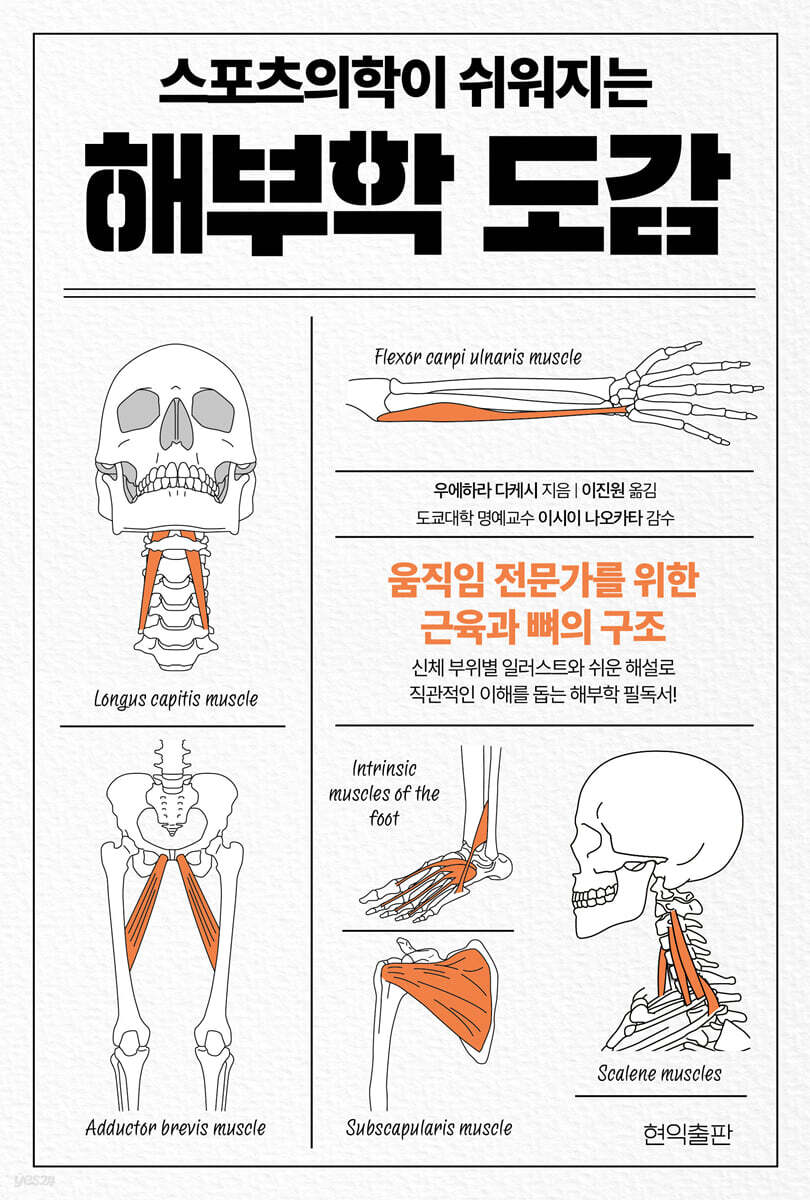
Over 100 illustrations detailing muscles and bones from head to toe, along with clear explanations, help you understand the human body structure at a glance.
Additionally, you can easily remember the major bones and muscles by focusing on the starting and ending points and actions of each muscle.
With the establishment of modern people's bad lifestyle habits, the aging population, and the increase in the leisure and sports population, the demand for managing physical pain through exercise or treatment is gradually increasing.
In order to carry out sophisticated treatments, prescriptions, and exercise guidance accordingly, a proper understanding of the bones, muscles, and joints that enable various human movements is essential.
However, the information covering the more than 200 large and small bones and approximately 400 muscles in the human body is simply enormous.
Therefore, the author, an anatomy expert who has trained 30,000 therapists, avoids lengthy explanations and focuses only on the essential points in this book so that knowledge can be applied quickly and efficiently in the field.
Focusing on one muscle and its function on each page, this dictionary-like guide provides easy-to-find information, making it a quick reference for the essentials of everyday exercise and rehabilitation.
It is written to help you easily understand the connections between parts and also includes practical tips for healthy movement and pain prevention.
Meanwhile, it provides useful information not only to professionals but also to the general public interested in health management, such as the function of bones and muscles that cause body pain, and clearly shows how knowledge of anatomy can help in health management.
Muscle and bone structure at a glance with illustrations
For movement professionals such as trainers, Pilates/yoga instructors, and physical therapists.
Page 1 of 1 Muscle, Friendly Illustrated Anatomy!
"Sports Medicine: An Easy-to-Use Anatomy Guide" is a practical reference book optimized for all professionals involved in human movement to quickly and easily understand the core of anatomy.
Over 100 illustrations detailing muscles and bones from head to toe, along with clear explanations, help you understand the human body structure at a glance.
Additionally, you can easily remember the major bones and muscles by focusing on the starting and ending points and actions of each muscle.
With the establishment of modern people's bad lifestyle habits, the aging population, and the increase in the leisure and sports population, the demand for managing physical pain through exercise or treatment is gradually increasing.
In order to carry out sophisticated treatments, prescriptions, and exercise guidance accordingly, a proper understanding of the bones, muscles, and joints that enable various human movements is essential.
However, the information covering the more than 200 large and small bones and approximately 400 muscles in the human body is simply enormous.
Therefore, the author, an anatomy expert who has trained 30,000 therapists, avoids lengthy explanations and focuses only on the essential points in this book so that knowledge can be applied quickly and efficiently in the field.
Focusing on one muscle and its function on each page, this dictionary-like guide provides easy-to-find information, making it a quick reference for the essentials of everyday exercise and rehabilitation.
It is written to help you easily understand the connections between parts and also includes practical tips for healthy movement and pain prevention.
Meanwhile, it provides useful information not only to professionals but also to the general public interested in health management, such as the function of bones and muscles that cause body pain, and clearly shows how knowledge of anatomy can help in health management.
- You can preview some of the book's contents.
Preview
index
Entering
【Know】Location of the main skeleton
【Let's learn】Location of major muscles
Prologue: What the Therapist Needs to Know About the Bones and Muscles
Chapter 1: The Skeleton and Muscles of the Head
the skeleton of the head
Skeletal muscles of the head
facial expression muscles
Chewing muscles (masticatory muscles)
temporalis muscle
Medial pterygoid muscle
lateral pterygoid muscle
Masseter muscle
Orbicularis oculi muscle
Buccinator muscle
Orbicularis oculi muscle (orbicularis oris)
Points of hair treatment
Chapter 2 The Skeleton and Muscles of the Neck
Neck bone
cervical skeletal muscles
sternocleidomastoid muscle
scalene group (scalene group)
anterior scalene muscle (anterior oblique muscle)
middle scalene muscle (middle scalene muscle)
posterior scalene muscle (scaphoid muscle)
Splenius capitis muscle
Prevertebral muscle group (prevertebral muscle group)
Suboccipital muscle group (suboccipital group)
Points of neck treatment
Chapter 3: The Skeleton and Muscles of the Arm
arm bones
skeletal muscles of the arm
Right forearm extensor group (back of the hand)
Right flexor brachii group (palm side)
deltoid muscle (scapula)
Coracobrachialis muscle
Greater perspective (major perspective)
Small distance (small distance)
subscapularis muscle
supraspinatus muscle
infraspinatus (infraspinatus)
biceps brachii muscle
triceps brachii
Brachialis (brachialis)
brachii muscle (brachioradialis muscle)
Pronator teres
supinator (supinator)
extensor digitorum (extensor digitorum)
flexor digitorum superficialis (flexor digitorum superficialis)
flexor carpi ulnaris
extensor carpi radialis longus muscle
Pronator quadratus lumborum (pronator quadratus)
Points of arm treatment
Chapter 4: The Skeleton and Muscles of the Chest
chest bone
pectoralis major
pectoralis major muscle
pectoralis minor muscle
subclavius muscle
Serratus anterior muscle (serratus anterior)
External intercostal muscles
internal intercostal muscles
diaphragm
Points of chest treatment
Chapter 5: The Skeleton and Muscles of the Abdomen and Pelvis
The skeleton of the abdomen and pelvis
skeletal muscles of the abdomen and pelvis
rectus abdominis muscle
External oblique muscle
internal oblique muscle
transverse abdominis muscle
Quadratus lumborum (quadriceps lumborum)
pelvic floor muscle group (pelvic floor muscle group)
Points of abdominal and pelvic treatment
Chapter 6: Skeleton and Muscles of the Back
back bone
skeletal muscles of the back
Trapezius scapulae
levator scapulae
latissimus dorsi (latissimus dorsi)
rhomboid muscle
rhomboid muscle (minor rhomboid muscle)
erector spinae muscle
Longissimus capitis muscle (longissimus capitis)
Longissimus cervicis (longissimus cervicis)
Longissimus dorsi (longissimus thorax)
cervicolimus (scrotum magnus)
thoracic costalis muscle
Lumbar intercostal muscles (lumbosacral muscles)
psoas major (spinalis major)
dorsal spinous process (spinatus pectoralis)
rotator cuff
multifidus muscle
cervical spine (semispinalis muscle)
semispinatus thorax (semispinatus thorax)
Points of back treatment
Chapter 7: The Skeleton and Muscles of the Leg 1
The skeleton of the leg
skeletal muscles of the legs
Iliopsoas (iliopsoas)
psoas major muscle
psoas minor (psoas minor)
gluteus maximus (iliacus)
gluteus maximus
gluteus medius muscle
gluteus minimus muscle
piriformis muscle
superior gemelli muscle
Inferior Gemini Muscle (Inferior Gemini Muscle)
obturator internus
obturator externalis muscle (obturator externus)
quadratus femoris
Adductor group (adductor group)
pubic muscle (pubis muscle)
adductor brevis (brevis)
adductor longus (adductor longus)
adductor magnus
tibialis anterior muscle (gracilis muscle)
Point 1 of leg treatment
Chapter 8: The Skeleton and Muscles of the Leg 2
quadriceps femoris
Rectus femoris
Vastus medialis (vastus medialis)
vastus lateralis muscle
Vastus intermedius (vastus intermedius)
tensor fascia lata (tensor fascia lata)
sartorius muscle
hamstrings
biceps femoris
Semitendinosus muscle
triceps calf muscle
gastrocnemius muscle
soleus muscle (pectoralis major)
popliteus muscle
calf muscles (plantar muscles)
tibialis anterior muscle
tibialis posterior muscle
flexor digitorum longus muscle
flexor pollicis longus
extensor digitorum longus muscle
extensor pollicis longus muscle
Third calf muscle (third peroneal muscle)
longus peroneus (peroneus longus)
brevis calf muscle (peroneus brevis)
Other intrinsic muscles of the foot
Point 2 of leg treatment
Appendix Skeletal Muscle Name Test
【Know】Location of the main skeleton
【Let's learn】Location of major muscles
Prologue: What the Therapist Needs to Know About the Bones and Muscles
Chapter 1: The Skeleton and Muscles of the Head
the skeleton of the head
Skeletal muscles of the head
facial expression muscles
Chewing muscles (masticatory muscles)
temporalis muscle
Medial pterygoid muscle
lateral pterygoid muscle
Masseter muscle
Orbicularis oculi muscle
Buccinator muscle
Orbicularis oculi muscle (orbicularis oris)
Points of hair treatment
Chapter 2 The Skeleton and Muscles of the Neck
Neck bone
cervical skeletal muscles
sternocleidomastoid muscle
scalene group (scalene group)
anterior scalene muscle (anterior oblique muscle)
middle scalene muscle (middle scalene muscle)
posterior scalene muscle (scaphoid muscle)
Splenius capitis muscle
Prevertebral muscle group (prevertebral muscle group)
Suboccipital muscle group (suboccipital group)
Points of neck treatment
Chapter 3: The Skeleton and Muscles of the Arm
arm bones
skeletal muscles of the arm
Right forearm extensor group (back of the hand)
Right flexor brachii group (palm side)
deltoid muscle (scapula)
Coracobrachialis muscle
Greater perspective (major perspective)
Small distance (small distance)
subscapularis muscle
supraspinatus muscle
infraspinatus (infraspinatus)
biceps brachii muscle
triceps brachii
Brachialis (brachialis)
brachii muscle (brachioradialis muscle)
Pronator teres
supinator (supinator)
extensor digitorum (extensor digitorum)
flexor digitorum superficialis (flexor digitorum superficialis)
flexor carpi ulnaris
extensor carpi radialis longus muscle
Pronator quadratus lumborum (pronator quadratus)
Points of arm treatment
Chapter 4: The Skeleton and Muscles of the Chest
chest bone
pectoralis major
pectoralis major muscle
pectoralis minor muscle
subclavius muscle
Serratus anterior muscle (serratus anterior)
External intercostal muscles
internal intercostal muscles
diaphragm
Points of chest treatment
Chapter 5: The Skeleton and Muscles of the Abdomen and Pelvis
The skeleton of the abdomen and pelvis
skeletal muscles of the abdomen and pelvis
rectus abdominis muscle
External oblique muscle
internal oblique muscle
transverse abdominis muscle
Quadratus lumborum (quadriceps lumborum)
pelvic floor muscle group (pelvic floor muscle group)
Points of abdominal and pelvic treatment
Chapter 6: Skeleton and Muscles of the Back
back bone
skeletal muscles of the back
Trapezius scapulae
levator scapulae
latissimus dorsi (latissimus dorsi)
rhomboid muscle
rhomboid muscle (minor rhomboid muscle)
erector spinae muscle
Longissimus capitis muscle (longissimus capitis)
Longissimus cervicis (longissimus cervicis)
Longissimus dorsi (longissimus thorax)
cervicolimus (scrotum magnus)
thoracic costalis muscle
Lumbar intercostal muscles (lumbosacral muscles)
psoas major (spinalis major)
dorsal spinous process (spinatus pectoralis)
rotator cuff
multifidus muscle
cervical spine (semispinalis muscle)
semispinatus thorax (semispinatus thorax)
Points of back treatment
Chapter 7: The Skeleton and Muscles of the Leg 1
The skeleton of the leg
skeletal muscles of the legs
Iliopsoas (iliopsoas)
psoas major muscle
psoas minor (psoas minor)
gluteus maximus (iliacus)
gluteus maximus
gluteus medius muscle
gluteus minimus muscle
piriformis muscle
superior gemelli muscle
Inferior Gemini Muscle (Inferior Gemini Muscle)
obturator internus
obturator externalis muscle (obturator externus)
quadratus femoris
Adductor group (adductor group)
pubic muscle (pubis muscle)
adductor brevis (brevis)
adductor longus (adductor longus)
adductor magnus
tibialis anterior muscle (gracilis muscle)
Point 1 of leg treatment
Chapter 8: The Skeleton and Muscles of the Leg 2
quadriceps femoris
Rectus femoris
Vastus medialis (vastus medialis)
vastus lateralis muscle
Vastus intermedius (vastus intermedius)
tensor fascia lata (tensor fascia lata)
sartorius muscle
hamstrings
biceps femoris
Semitendinosus muscle
triceps calf muscle
gastrocnemius muscle
soleus muscle (pectoralis major)
popliteus muscle
calf muscles (plantar muscles)
tibialis anterior muscle
tibialis posterior muscle
flexor digitorum longus muscle
flexor pollicis longus
extensor digitorum longus muscle
extensor pollicis longus muscle
Third calf muscle (third peroneal muscle)
longus peroneus (peroneus longus)
brevis calf muscle (peroneus brevis)
Other intrinsic muscles of the foot
Point 2 of leg treatment
Appendix Skeletal Muscle Name Test
Detailed image
.jpg)
Into the book
The temporomandibular joint is a very important joint for survival.
It was said that facial expression muscles do not have the function of moving joints.
So, does the head actually have a joint of its own? Actually, there's only one type (two on each side), and that's the temporomandibular joint.
The temporomandibular joint is a rather interesting joint that has developed and evolved through several mysterious and dramatic coincidences.
In a word, it can be said to be a 'high-function' joint.
--- p.45 From “Chapter 1: The Skeleton and Muscles of the Head”
The spine, the pillar of the human body, is supported by the sacrum as its foundation.
The tissue that connects the torso and legs is the pelvis.
When viewed from the front, the sacrum, which corresponds to the root of the spine, is located at the center back (posterior) of the pelvis.
Below that, the lowest part of the spine, connected to the sacrum, is the coccyx.
On either side of it are the hip bones, which correspond to the buttocks, and these are connected to form the pelvis.
--- p.109 From “Chapter 5: Skeleton and Muscles of the Abdomen and Pelvis”
In other words, it can be said that the care that the body needs changes along with the person's body clock.
As we age, exercise and maintenance are not optional, but essential.
And the people who can regularly check the condition of the body, including muscles and posture, close to the client who needs it are therapists and massage therapists.
Their most important role is to assess their clients' condition and help them improve and maintain their health through treatment and appropriate advice.
It was said that facial expression muscles do not have the function of moving joints.
So, does the head actually have a joint of its own? Actually, there's only one type (two on each side), and that's the temporomandibular joint.
The temporomandibular joint is a rather interesting joint that has developed and evolved through several mysterious and dramatic coincidences.
In a word, it can be said to be a 'high-function' joint.
--- p.45 From “Chapter 1: The Skeleton and Muscles of the Head”
The spine, the pillar of the human body, is supported by the sacrum as its foundation.
The tissue that connects the torso and legs is the pelvis.
When viewed from the front, the sacrum, which corresponds to the root of the spine, is located at the center back (posterior) of the pelvis.
Below that, the lowest part of the spine, connected to the sacrum, is the coccyx.
On either side of it are the hip bones, which correspond to the buttocks, and these are connected to form the pelvis.
--- p.109 From “Chapter 5: Skeleton and Muscles of the Abdomen and Pelvis”
In other words, it can be said that the care that the body needs changes along with the person's body clock.
As we age, exercise and maintenance are not optional, but essential.
And the people who can regularly check the condition of the body, including muscles and posture, close to the client who needs it are therapists and massage therapists.
Their most important role is to assess their clients' condition and help them improve and maintain their health through treatment and appropriate advice.
--- p.201 From “Chapter 8: Skeleton and Muscles of the Leg 2”
Publisher's Review
Anatomy is no longer easy!
Quickly get to the core with over 100 body part illustrations!
With the establishment of modern people's bad lifestyle habits, the aging population, and the increase in the leisure and sports population, the demand for managing physical pain through exercise or treatment is gradually increasing.
In order to carry out sophisticated treatments, prescriptions, and exercise guidance accordingly, a proper understanding of the bones, muscles, and joints that enable various human movements is essential.
However, the information covering the more than 200 large and small bones and approximately 400 muscles in the human body is simply enormous.
“I want to learn about muscles and bones, but I don’t know where to start.”
“Even when I try to memorize the types of muscles, I can’t remember them well.”
Surprisingly, many therapists and exercise instructors confess this to me.
How great would it be if useful anatomy knowledge could be easily understood and memorized?
The author, who has trained 30,000 therapists as an anatomy and physiology expert, has written "Anatomy Guide for Sports Medicine," an essential guide for therapists studying the structure of the body, sports instructors who need to anatomically verify movements, and anyone who wants to understand the causes of body pain and expand their knowledge.
This book uses over 100 illustrations of each body part to illustrate the complex structure of the human body at a glance, and provides clear, core commentary to quickly and easily organize anatomical knowledge.
It helps you visually understand the shape and positional relationship of muscles through illustrations of the central muscles for each part from head to toe.
Additionally, it divides the human body into the head, neck, arms, chest, abdomen and pelvis, back, and legs, and includes precautions to keep in mind when handling the muscles of those areas.
It is especially useful for those who have difficulty understanding anatomy or who need a comprehensive resource that can be effectively referenced in treatment and guidance settings.
In this book, the author emphasizes that it is important to go beyond simply knowing the names and locations of muscles and to accurately understand where the muscles 'start' (starting point), where they 'end' (ending point), and how they function, helping readers better understand and remember the structure of the human body.
Page 1 1 Central Muscles
Quick Guide to Anatomy
In recent years, the demand for personalized training and rehabilitation programs has skyrocketed in the fields of exercise and health, increasing the need for in-depth anatomical knowledge not only for therapists but also for trainers and coaches.
In particular, situations frequently arise where it is necessary to quickly reference information about the muscle and bone structure of a specific area for customized exercise or rehabilitation tailored to the individual client's body type or condition.
However, realistically, trainers and therapists don't have the time and resources to research extensive anatomical knowledge in their busy schedules, and quickly mastering it is also a daunting task. "Sports Medicine Made Easy: Anatomy Illustrated Guide" provides an easy-to-understand overview of "one muscle per page" to efficiently acquire the knowledge needed in the field.
It is structured so that you can look up information like a dictionary whenever you need it.
Because each page illustrates one central muscle and its function, it is easy to understand the relationship between each part.
Additionally, it serves as a friendly summary that does not require a summary of the main points by concisely organizing complex anatomical knowledge into subheadings and key points.
It is also very useful for those who require an understanding of the overall human body structure.
This allows for faster and more accurate information to be verified and applied on-site.
It is especially recommended for readers who want to offer their clients immediate solutions or are looking for more grounded treatment methods.
It will be possible to greatly improve the efficiency of anatomy learning and enhance understanding.
Anatomy, a prerequisite for movement experts,
Learn properly by simply summarizing the key points!
This book focuses on the principles of muscle and bone that therapists and trainers commonly encounter.
In order to properly understand the discomfort of daily physical activities and the causes of back pain, stiff shoulders, headaches, and joint pain that cause them, and to prevent them from progressing to severe conditions, it is necessary to properly understand the principles of anatomy that support the body.
This book will help you become more professional by providing a solid foundation of basic anatomy knowledge for improving movement.
Quickly get to the core with over 100 body part illustrations!
With the establishment of modern people's bad lifestyle habits, the aging population, and the increase in the leisure and sports population, the demand for managing physical pain through exercise or treatment is gradually increasing.
In order to carry out sophisticated treatments, prescriptions, and exercise guidance accordingly, a proper understanding of the bones, muscles, and joints that enable various human movements is essential.
However, the information covering the more than 200 large and small bones and approximately 400 muscles in the human body is simply enormous.
“I want to learn about muscles and bones, but I don’t know where to start.”
“Even when I try to memorize the types of muscles, I can’t remember them well.”
Surprisingly, many therapists and exercise instructors confess this to me.
How great would it be if useful anatomy knowledge could be easily understood and memorized?
The author, who has trained 30,000 therapists as an anatomy and physiology expert, has written "Anatomy Guide for Sports Medicine," an essential guide for therapists studying the structure of the body, sports instructors who need to anatomically verify movements, and anyone who wants to understand the causes of body pain and expand their knowledge.
This book uses over 100 illustrations of each body part to illustrate the complex structure of the human body at a glance, and provides clear, core commentary to quickly and easily organize anatomical knowledge.
It helps you visually understand the shape and positional relationship of muscles through illustrations of the central muscles for each part from head to toe.
Additionally, it divides the human body into the head, neck, arms, chest, abdomen and pelvis, back, and legs, and includes precautions to keep in mind when handling the muscles of those areas.
It is especially useful for those who have difficulty understanding anatomy or who need a comprehensive resource that can be effectively referenced in treatment and guidance settings.
In this book, the author emphasizes that it is important to go beyond simply knowing the names and locations of muscles and to accurately understand where the muscles 'start' (starting point), where they 'end' (ending point), and how they function, helping readers better understand and remember the structure of the human body.
Page 1 1 Central Muscles
Quick Guide to Anatomy
In recent years, the demand for personalized training and rehabilitation programs has skyrocketed in the fields of exercise and health, increasing the need for in-depth anatomical knowledge not only for therapists but also for trainers and coaches.
In particular, situations frequently arise where it is necessary to quickly reference information about the muscle and bone structure of a specific area for customized exercise or rehabilitation tailored to the individual client's body type or condition.
However, realistically, trainers and therapists don't have the time and resources to research extensive anatomical knowledge in their busy schedules, and quickly mastering it is also a daunting task. "Sports Medicine Made Easy: Anatomy Illustrated Guide" provides an easy-to-understand overview of "one muscle per page" to efficiently acquire the knowledge needed in the field.
It is structured so that you can look up information like a dictionary whenever you need it.
Because each page illustrates one central muscle and its function, it is easy to understand the relationship between each part.
Additionally, it serves as a friendly summary that does not require a summary of the main points by concisely organizing complex anatomical knowledge into subheadings and key points.
It is also very useful for those who require an understanding of the overall human body structure.
This allows for faster and more accurate information to be verified and applied on-site.
It is especially recommended for readers who want to offer their clients immediate solutions or are looking for more grounded treatment methods.
It will be possible to greatly improve the efficiency of anatomy learning and enhance understanding.
Anatomy, a prerequisite for movement experts,
Learn properly by simply summarizing the key points!
This book focuses on the principles of muscle and bone that therapists and trainers commonly encounter.
In order to properly understand the discomfort of daily physical activities and the causes of back pain, stiff shoulders, headaches, and joint pain that cause them, and to prevent them from progressing to severe conditions, it is necessary to properly understand the principles of anatomy that support the body.
This book will help you become more professional by providing a solid foundation of basic anatomy knowledge for improving movement.
GOODS SPECIFICS
- Date of issue: November 20, 2024
- Page count, weight, size: 208 pages | 152*225*20mm
- ISBN13: 9791193217733
- ISBN10: 1193217733
You may also like
카테고리
korean


korean

![GQ KOREA Mark (Monthly): December [2025]](http://librairie.coreenne.fr/cdn/shop/files/8ef265dbbfbf186523ed75ba7319009d.jpg?v=1765340328&width=3840)


