

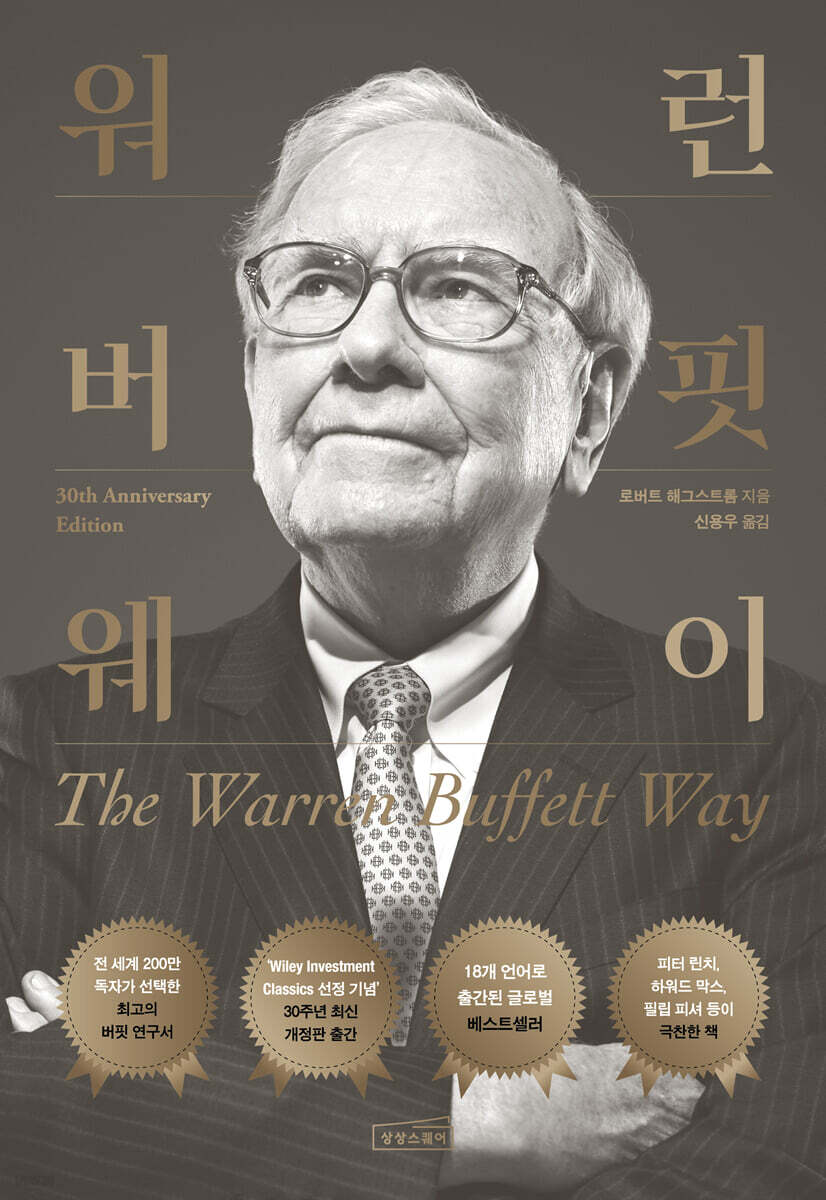
Warren Buffett Way
 |
Description
Book Introduction
* The best Buffett research book chosen by 2 million readers worldwide
* A global bestseller published in 18 languages
* A book highly praised by Peter Lynch, Howard Marks, Philip Fisher, and others.
In this 30th anniversary edition of The Warren Buffett Way, renowned author and investor Robert Hagstrom presents the definitive version of his bestselling book, which culminates the investment strategies of one of today's most accomplished investors, Warren Buffett.
This book explains the twelve principles of Warren Buffett's investment strategy, "Business-Driven Investing," and his unique approach to managing his portfolio.
Readers will gain insights into how to apply these principles to their own portfolios, the psychological mindset required for long-term investing, and common mistakes and how to avoid them.
Legendary investors such as Peter Lynch, Howard Marks, and Philip Fisher praised this book.
Through this book, you will learn not only the wisdom of Warren Buffett, whom they praise, but also the insight into the 'worldly wisdom' emphasized by Charlie Munger, Buffett's long-time partner.
In addition, the appendix includes Berkshire Hathaway's entire portfolio yearbook.
For investors who want to delve deeper into Warren Buffett's remarkable achievements and investment philosophy, "The Warren Buffett Way" will undoubtedly be the best book they'll ever read.
* A global bestseller published in 18 languages
* A book highly praised by Peter Lynch, Howard Marks, Philip Fisher, and others.
In this 30th anniversary edition of The Warren Buffett Way, renowned author and investor Robert Hagstrom presents the definitive version of his bestselling book, which culminates the investment strategies of one of today's most accomplished investors, Warren Buffett.
This book explains the twelve principles of Warren Buffett's investment strategy, "Business-Driven Investing," and his unique approach to managing his portfolio.
Readers will gain insights into how to apply these principles to their own portfolios, the psychological mindset required for long-term investing, and common mistakes and how to avoid them.
Legendary investors such as Peter Lynch, Howard Marks, and Philip Fisher praised this book.
Through this book, you will learn not only the wisdom of Warren Buffett, whom they praise, but also the insight into the 'worldly wisdom' emphasized by Charlie Munger, Buffett's long-time partner.
In addition, the appendix includes Berkshire Hathaway's entire portfolio yearbook.
For investors who want to delve deeper into Warren Buffett's remarkable achievements and investment philosophy, "The Warren Buffett Way" will undoubtedly be the best book they'll ever read.
- You can preview some of the book's contents.
Preview
index
Praise for this book
Recommendation
Preface to the First Edition
Preface to the Revised Edition
Preface to the Second Revised Edition
introduction
Chapter 1.
The world's best investor
Understanding the Pattern | The Birth of an Entrepreneur | Buffett Limited Partnership | Berkshire Hathaway: The King of Conglomerates, a Giant Conglomerate
Chapter 2.
Warren Buffett's Investment Lessons
Howard Homan Buffett: Early Influence | Benjamin Graham: Developing an Investment Methodology | Philip Fisher: Identifying Good Companies | Charlie Munger: Intellectual Perspective
Chapter 3.
Corporate-focused investments
Business Principles | Management Principles | Financial Principles | Value Principles | The Intelligent Investor
Chapter 4.
Purchase of common stock
The Washington Post | Geico Corporation | Capital Cities/ABC | Coca-Cola | Apple | The Value of Retained Earnings
Chapter 5.
Corporate Portfolio Management
Managing Today's Portfolio: Two Options | The Third: Concentrated Investing | Super Investors in Buffett Village | 3,000 Concentrated Investors | More Effective Performance Measurement | Concentrated Active Investing
Chapter 6.
Active management still valid
Masters of Modern Finance | The Efficient Market Hypothesis | Investing vs. Speculation: Understanding the Difference | Investing in Parallel Worlds
Chapter 7.
Money Mind
Sportsman, Teacher, Artist | Berkshire Hathaway: America's Leading Corporation
Acknowledgements
* Appendix A Comparison of Berkshire Hathaway's Performance with the S&P 500 Index (1965-2022)
* Appendix B Berkshire's Common Stock Portfolio (1977–2021)
References
Search
Recommendation
Preface to the First Edition
Preface to the Revised Edition
Preface to the Second Revised Edition
introduction
Chapter 1.
The world's best investor
Understanding the Pattern | The Birth of an Entrepreneur | Buffett Limited Partnership | Berkshire Hathaway: The King of Conglomerates, a Giant Conglomerate
Chapter 2.
Warren Buffett's Investment Lessons
Howard Homan Buffett: Early Influence | Benjamin Graham: Developing an Investment Methodology | Philip Fisher: Identifying Good Companies | Charlie Munger: Intellectual Perspective
Chapter 3.
Corporate-focused investments
Business Principles | Management Principles | Financial Principles | Value Principles | The Intelligent Investor
Chapter 4.
Purchase of common stock
The Washington Post | Geico Corporation | Capital Cities/ABC | Coca-Cola | Apple | The Value of Retained Earnings
Chapter 5.
Corporate Portfolio Management
Managing Today's Portfolio: Two Options | The Third: Concentrated Investing | Super Investors in Buffett Village | 3,000 Concentrated Investors | More Effective Performance Measurement | Concentrated Active Investing
Chapter 6.
Active management still valid
Masters of Modern Finance | The Efficient Market Hypothesis | Investing vs. Speculation: Understanding the Difference | Investing in Parallel Worlds
Chapter 7.
Money Mind
Sportsman, Teacher, Artist | Berkshire Hathaway: America's Leading Corporation
Acknowledgements
* Appendix A Comparison of Berkshire Hathaway's Performance with the S&P 500 Index (1965-2022)
* Appendix B Berkshire's Common Stock Portfolio (1977–2021)
References
Search
Detailed image
.jpg)
Into the book
How can an ordinary investor utilize Warren Buffett's investment approach? Warren Buffett never invests in businesses outside his "sphere of competence" or that he doesn't understand.
Over time, every investor can develop and deepen their expertise in the industry or business area they enjoy exploring.
---From the “Preface to the First Edition”
The Warren Buffett Way has one important thing in common with the classics.
The advice in this book may not make you rich, but it's unlikely to make you poor.
If you understand the techniques and principles contained in this book and put them into practice rationally, you will become a better investor.
---From the “Preface to the Revised Edition”
Of course, Warren Buffett has many of the same characteristics as other great investors.
He is focused, disciplined, and has a clear sense of purpose.
He is also hard-working, has excellent numerical sense, and is logical.
He is also passionate about collecting massive amounts of information.
He is also a passionate learner who constantly gathers information by reading books and interacting with people he admires.
And now, he invests not to gain fame or make money, but to enjoy the process of solving complex intellectual puzzles that come from investing itself.
For him, fame and wealth are merely byproducts of his efforts, not his ultimate goals.
---From the “Preface to the Second Revised Edition”
A major challenge I faced in writing this book was to prove Warren Buffett's assertion that "what I do is within the realm of anyone's ability to do it."
Despite his success, some critics argue that Warren Buffett's idiosyncratic nature makes his investment approach inapplicable.
But I disagree.
It is clear that Buffett is a unique individual, and this is what led to his success.
But once you understand his methodology, it can be applied to both individuals and institutions.
The goal of this book is to help investors use the strategies that Warren Buffett has found so successful.
---From the "Preface"
Buffett does not equate risk with price volatility.
Rather than managing a broadly diversified portfolio of common stocks, he manages a portfolio that focuses on a small number of stocks and has low turnover.
Nonetheless, his investment performance over nearly 70 years has led many to call him 'the world's greatest investor.'
Or, it is likened to a '5 sigma incident', which refers to an exceptional case that statistically rarely occurs.
---「Chapter 1.
Among the world's best investors
Second, “What does it take to leverage the market?” This is more complex because it involves two separate elements: methodology and personal characteristics.
In this respect too, Buffett provides us with guidance.
He advises investors to maintain a concentrated, low-turnover portfolio, but one built on business-centric principles.
He also emphasizes that when evaluating the value of these stocks, the discounted present value model of future free cash flows should be utilized.
This is exactly what Buffett uses to beat the market—his investment process.
Regarding the second factor, the investor's personal characteristics, Buffett mentions the importance of the investor's "temperament."
In particular, he says, the key is how investors view volatility.
---「Chapter 2.
From "Warren Buffett's Investment Lessons"
Where Buffett clashed with Graham's teachings was not with the concept of margin of safety itself, but with how to view long-term intrinsic value.
If an investor buys a company with poor economic performance, but the price is below its book value and the price-to-earnings ratio is low, this clearly conforms to Graham's concept of margin of safety.
But when stocks are revalued to a price closer to the fair value of their assets, investors are left with the poor economic performance of an average company.
What Buffett learned in his early days at Berkshire was that understanding the economics of better businesses that can compound earnings at high rates required a different way of thinking about intrinsic value.
The game has shifted from simply buying "undervalued real assets" to learning how to intelligently assess the fair value of companies that generate cash flow and can deliver high long-term economic returns.
---「Chapter 2.
From "Warren Buffett's Investment Lessons"
To Warren Buffett, stocks are just an abstract concept.
He doesn't think in terms of market theory, macroeconomic concepts, or industry trends.
Instead, decisions are made solely based on how the business is run.
Buffett believes that when people invest based on superficial concepts rather than the fundamentals of a business, they are more likely to become frightened when problems first arise and ultimately lose money.
Buffett, on the other hand, focuses on learning everything he can about the companies he is considering investing in.
He focuses on three main areas:
· The business must be simple and easy to understand.
· The company must have a consistent operating history.
· The business must have a favorable long-term outlook.
---「Chapter 3.
From “Corporate-Centered Investment”
As always, Warren Buffett distills complex concepts into clear, single words.
Money mind, this simple expression holds many important meanings.
First of all, this refers to the way of thinking about the big question of investment.
On the other hand, it also means forming the right mindset in the modern financial world.
Furthermore, money mind refers to a person who has the attitude to continue learning and maintain concentration even in the midst of unnecessary noise.
And if we delve deeper, the philosophical and ethical foundations at the heart of a money mind tell us a lot about who a person is.
Such people are more likely to succeed not only in investing but also in many aspects of life.
Over time, every investor can develop and deepen their expertise in the industry or business area they enjoy exploring.
---From the “Preface to the First Edition”
The Warren Buffett Way has one important thing in common with the classics.
The advice in this book may not make you rich, but it's unlikely to make you poor.
If you understand the techniques and principles contained in this book and put them into practice rationally, you will become a better investor.
---From the “Preface to the Revised Edition”
Of course, Warren Buffett has many of the same characteristics as other great investors.
He is focused, disciplined, and has a clear sense of purpose.
He is also hard-working, has excellent numerical sense, and is logical.
He is also passionate about collecting massive amounts of information.
He is also a passionate learner who constantly gathers information by reading books and interacting with people he admires.
And now, he invests not to gain fame or make money, but to enjoy the process of solving complex intellectual puzzles that come from investing itself.
For him, fame and wealth are merely byproducts of his efforts, not his ultimate goals.
---From the “Preface to the Second Revised Edition”
A major challenge I faced in writing this book was to prove Warren Buffett's assertion that "what I do is within the realm of anyone's ability to do it."
Despite his success, some critics argue that Warren Buffett's idiosyncratic nature makes his investment approach inapplicable.
But I disagree.
It is clear that Buffett is a unique individual, and this is what led to his success.
But once you understand his methodology, it can be applied to both individuals and institutions.
The goal of this book is to help investors use the strategies that Warren Buffett has found so successful.
---From the "Preface"
Buffett does not equate risk with price volatility.
Rather than managing a broadly diversified portfolio of common stocks, he manages a portfolio that focuses on a small number of stocks and has low turnover.
Nonetheless, his investment performance over nearly 70 years has led many to call him 'the world's greatest investor.'
Or, it is likened to a '5 sigma incident', which refers to an exceptional case that statistically rarely occurs.
---「Chapter 1.
Among the world's best investors
Second, “What does it take to leverage the market?” This is more complex because it involves two separate elements: methodology and personal characteristics.
In this respect too, Buffett provides us with guidance.
He advises investors to maintain a concentrated, low-turnover portfolio, but one built on business-centric principles.
He also emphasizes that when evaluating the value of these stocks, the discounted present value model of future free cash flows should be utilized.
This is exactly what Buffett uses to beat the market—his investment process.
Regarding the second factor, the investor's personal characteristics, Buffett mentions the importance of the investor's "temperament."
In particular, he says, the key is how investors view volatility.
---「Chapter 2.
From "Warren Buffett's Investment Lessons"
Where Buffett clashed with Graham's teachings was not with the concept of margin of safety itself, but with how to view long-term intrinsic value.
If an investor buys a company with poor economic performance, but the price is below its book value and the price-to-earnings ratio is low, this clearly conforms to Graham's concept of margin of safety.
But when stocks are revalued to a price closer to the fair value of their assets, investors are left with the poor economic performance of an average company.
What Buffett learned in his early days at Berkshire was that understanding the economics of better businesses that can compound earnings at high rates required a different way of thinking about intrinsic value.
The game has shifted from simply buying "undervalued real assets" to learning how to intelligently assess the fair value of companies that generate cash flow and can deliver high long-term economic returns.
---「Chapter 2.
From "Warren Buffett's Investment Lessons"
To Warren Buffett, stocks are just an abstract concept.
He doesn't think in terms of market theory, macroeconomic concepts, or industry trends.
Instead, decisions are made solely based on how the business is run.
Buffett believes that when people invest based on superficial concepts rather than the fundamentals of a business, they are more likely to become frightened when problems first arise and ultimately lose money.
Buffett, on the other hand, focuses on learning everything he can about the companies he is considering investing in.
He focuses on three main areas:
· The business must be simple and easy to understand.
· The company must have a consistent operating history.
· The business must have a favorable long-term outlook.
---「Chapter 3.
From “Corporate-Centered Investment”
As always, Warren Buffett distills complex concepts into clear, single words.
Money mind, this simple expression holds many important meanings.
First of all, this refers to the way of thinking about the big question of investment.
On the other hand, it also means forming the right mindset in the modern financial world.
Furthermore, money mind refers to a person who has the attitude to continue learning and maintain concentration even in the midst of unnecessary noise.
And if we delve deeper, the philosophical and ethical foundations at the heart of a money mind tell us a lot about who a person is.
Such people are more likely to succeed not only in investing but also in many aspects of life.
---「Chapter 7.
From "Money Mind"
From "Money Mind"
Publisher's Review
The Buffett Bible: A Must-Read for Investors!
Uncovering the secrets to success of the great investor Warren Buffett!
"The Warren Buffett Way" is a book that compiles the investment philosophy and principles of Warren Buffett, the world's most trusted investor and the "Sage of Omaha."
Since its first publication in 1994, it has been consistently loved around the world, and goes beyond simply praising Buffett, offering concrete and practical suggestions on how to think and act like Buffett.
Why do we need "The Warren Buffett Way" now? In the first quarter of 2025, when the world's wealthiest individuals and investors were struggling due to the decline in the U.S. stock market, there was one person whose wealth increased.
It's Warren Buffett.
He emphasizes the importance of "proven principles" to survive in a market where overheating and collapse are repeated.
Buffett's way of thinking, which allowed him to accumulate wealth without wavering even in a rapidly changing environment, goes beyond simple investment techniques and can be considered a "survival strategy" for navigating times of crisis.
Despite the volatility of the capital markets, Warren Buffett consistently adhered to the principles of "concentrated investment," "business analysis," "securing a margin of safety," "holding for the long term," and "controlling emotions."
"The Warren Buffett Way" is a guidebook that dissects Buffett's thought process and systematizes it so that anyone can follow it.
Buffett's "12 Investment Principles," which can be applied to investing and life in particular, are like an old compass that guides you steadily even in complex markets.
The Warren Buffett Way goes beyond simple investment methods to encompass human psychology and behavioral economics.
Buffett says:
“You don’t have to do extraordinary things to get extraordinary results.” This book teaches us how to achieve extraordinary results not only in the stock market but also in life.
Especially for those new to the stock market, long-term investors looking ahead ten years, those dreaming of financial freedom, and those easily swayed by market volatility, "The Warren Buffett Way" can help establish a solid investment standard.
This book will also be a powerful tool for those who want to develop business acumen beyond simple investment skills, and for those who want to maintain self-control and judgment at crucial moments in life.
Warren Buffett will turn 95 in 2025.
It has been filled with success for nearly 100 years.
Everyone has had success, some even big ones, but few people in history have achieved as much consistent success as Warren Buffett.
If you want to know the secret, I recommend reading The Warren Buffett Way.
You will discover what wisdom truly begins with success.
Uncovering the secrets to success of the great investor Warren Buffett!
"The Warren Buffett Way" is a book that compiles the investment philosophy and principles of Warren Buffett, the world's most trusted investor and the "Sage of Omaha."
Since its first publication in 1994, it has been consistently loved around the world, and goes beyond simply praising Buffett, offering concrete and practical suggestions on how to think and act like Buffett.
Why do we need "The Warren Buffett Way" now? In the first quarter of 2025, when the world's wealthiest individuals and investors were struggling due to the decline in the U.S. stock market, there was one person whose wealth increased.
It's Warren Buffett.
He emphasizes the importance of "proven principles" to survive in a market where overheating and collapse are repeated.
Buffett's way of thinking, which allowed him to accumulate wealth without wavering even in a rapidly changing environment, goes beyond simple investment techniques and can be considered a "survival strategy" for navigating times of crisis.
Despite the volatility of the capital markets, Warren Buffett consistently adhered to the principles of "concentrated investment," "business analysis," "securing a margin of safety," "holding for the long term," and "controlling emotions."
"The Warren Buffett Way" is a guidebook that dissects Buffett's thought process and systematizes it so that anyone can follow it.
Buffett's "12 Investment Principles," which can be applied to investing and life in particular, are like an old compass that guides you steadily even in complex markets.
The Warren Buffett Way goes beyond simple investment methods to encompass human psychology and behavioral economics.
Buffett says:
“You don’t have to do extraordinary things to get extraordinary results.” This book teaches us how to achieve extraordinary results not only in the stock market but also in life.
Especially for those new to the stock market, long-term investors looking ahead ten years, those dreaming of financial freedom, and those easily swayed by market volatility, "The Warren Buffett Way" can help establish a solid investment standard.
This book will also be a powerful tool for those who want to develop business acumen beyond simple investment skills, and for those who want to maintain self-control and judgment at crucial moments in life.
Warren Buffett will turn 95 in 2025.
It has been filled with success for nearly 100 years.
Everyone has had success, some even big ones, but few people in history have achieved as much consistent success as Warren Buffett.
If you want to know the secret, I recommend reading The Warren Buffett Way.
You will discover what wisdom truly begins with success.
GOODS SPECIFICS
- Date of issue: May 21, 2025
- Page count, weight, size: 500 pages | 852g | 160*233*30mm
- ISBN13: 9791194368137
- ISBN10: 1194368131
You may also like
카테고리
korean


korean

![ELLE 엘르 스페셜 에디션 A형 : 12월 [2025]](http://librairie.coreenne.fr/cdn/shop/files/b8e27a3de6c9538896439686c6b0e8fb.jpg?v=1766436872&width=3840)


