

The world's easiest-to-understand muscle diagram
 |
Description
Book Introduction
A Japanese Amazon comprehensive bestseller, this book has sold over 100,000 copies!
Drawn by Japan's best rehabilitation therapist
The World's Easiest Muscle User Manual
Fitbly, a health YouTuber with 1.4 million subscribers, highly recommends!
As interest in health has rapidly increased since the COVID-19 pandemic, the number of people exercising in Korea is also increasing.
In an aging society, the demand for a healthy lifespan and a healthy body is higher than ever. But how many people truly understand the muscles that make up their bodies? To maintain proper function and injury-free performance during exercise and in our daily lives, we need to understand the movements and connections of our muscles.
The muscles of the human body are very complexly connected, and it is not easy to understand their structure even by reading anatomy textbooks.
Difficult and rigid explanations may actually make your mind more complicated.
But what if there was a book that made it easy to understand muscle connections at a glance just by looking at it?
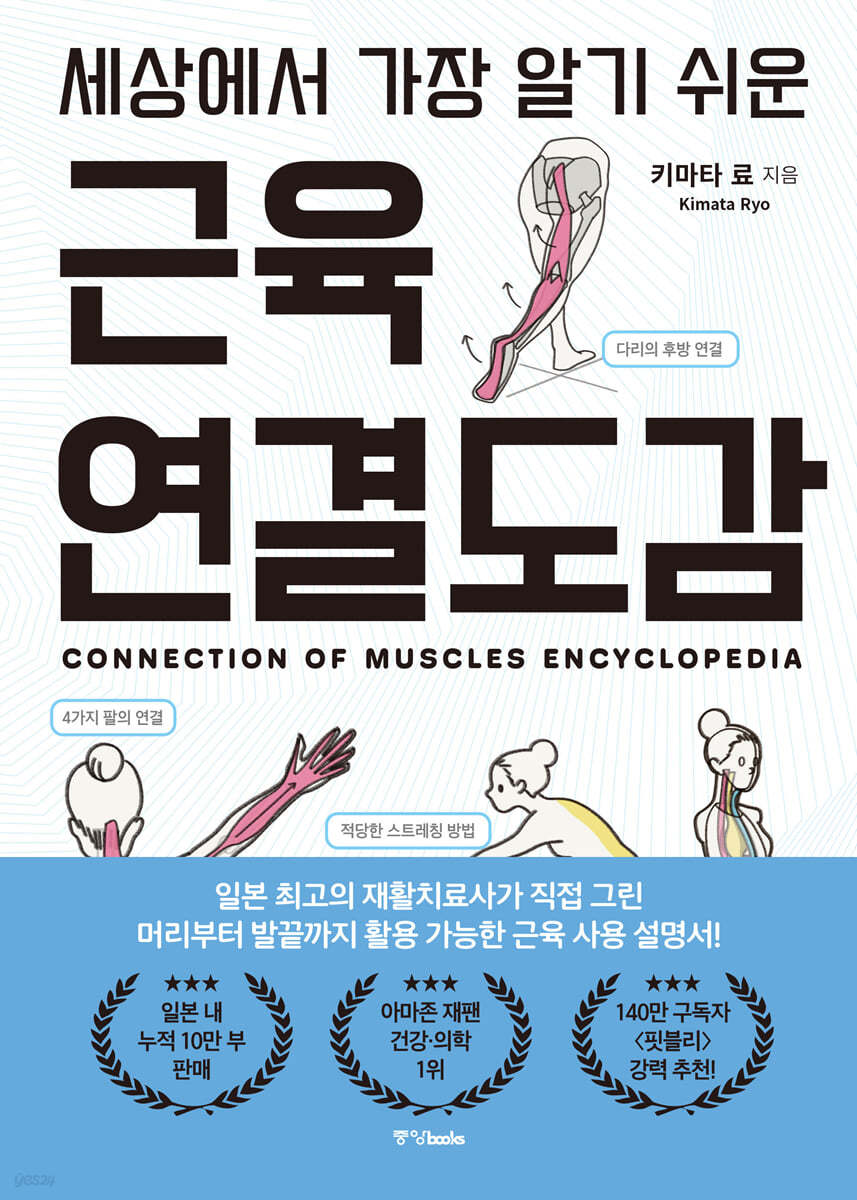
This book, "The World's Easiest Muscle Connection Guide," ranked first in the Japanese Amazon category and a general bestseller as soon as it was published in October 2023. The author, who is an active stretching trainer, personally drew color illustrations to convey the interconnection of muscles and the structure of the body in a way that anyone can easily understand at a glance.
The author says that he has always had a hard time explaining muscle connections while treating patients in the field.
When I explained that it was 'releasing the arms to treat the neck muscles', most patients had a hard time understanding right away.
So, to make it easier and more intuitive for patients to understand, I started drawing muscle connection diagrams.
The author expressed his hope that this book would serve as a bridge between experts and the general public.
The general public will find this book helpful in understanding muscle connections, while professionals will find it a valuable aid in training and treating clients.
The usefulness and completeness of this book can be guessed from the reviews of Japanese readers who said, “This book is overwhelmingly easy to learn about muscle movements and connection images,” and “As a practicing medical professional, I was impressed by the simple and easy-to-understand explanations.”
Currently, there is no book in Korea that deals with the connection between muscles and fascia in such a simple and easy-to-understand way.
This book will serve as a solid practical resource for both exercise and therapy professionals and the general public.
Drawn by Japan's best rehabilitation therapist
The World's Easiest Muscle User Manual
Fitbly, a health YouTuber with 1.4 million subscribers, highly recommends!
As interest in health has rapidly increased since the COVID-19 pandemic, the number of people exercising in Korea is also increasing.
In an aging society, the demand for a healthy lifespan and a healthy body is higher than ever. But how many people truly understand the muscles that make up their bodies? To maintain proper function and injury-free performance during exercise and in our daily lives, we need to understand the movements and connections of our muscles.
The muscles of the human body are very complexly connected, and it is not easy to understand their structure even by reading anatomy textbooks.
Difficult and rigid explanations may actually make your mind more complicated.
But what if there was a book that made it easy to understand muscle connections at a glance just by looking at it?
This book, "The World's Easiest Muscle Connection Guide," ranked first in the Japanese Amazon category and a general bestseller as soon as it was published in October 2023. The author, who is an active stretching trainer, personally drew color illustrations to convey the interconnection of muscles and the structure of the body in a way that anyone can easily understand at a glance.
The author says that he has always had a hard time explaining muscle connections while treating patients in the field.
When I explained that it was 'releasing the arms to treat the neck muscles', most patients had a hard time understanding right away.
So, to make it easier and more intuitive for patients to understand, I started drawing muscle connection diagrams.
The author expressed his hope that this book would serve as a bridge between experts and the general public.
The general public will find this book helpful in understanding muscle connections, while professionals will find it a valuable aid in training and treating clients.
The usefulness and completeness of this book can be guessed from the reviews of Japanese readers who said, “This book is overwhelmingly easy to learn about muscle movements and connection images,” and “As a practicing medical professional, I was impressed by the simple and easy-to-understand explanations.”
Currently, there is no book in Korea that deals with the connection between muscles and fascia in such a simple and easy-to-understand way.
This book will serve as a solid practical resource for both exercise and therapy professionals and the general public.
- You can preview some of the book's contents.
Preview
index
To begin with
Chapter 0 What is Muscle Connection?
Chapter 1 Forward Connection
Chapter 2 Back Connection
Chapter 3 External Connections
Chapter 4 Spiral Connection
Chapter 5 Deep Connections
Chapter 6 Exercise Connections
Chapter 7: Arm Connections
Chapter 8: Connection of the Pelvis and Hip Joints
Chapter 9: Connecting the Ship
Chapter 10: The Connection of the Hips
Chapter 11: Connection of the Initiative
Chapter 12 Shoulder and Arm Connection
Chapter 13: Interbody Connections
Chapter 14: Hints for Improving Connections
In conclusion
References
Chapter 0 What is Muscle Connection?
Chapter 1 Forward Connection
Chapter 2 Back Connection
Chapter 3 External Connections
Chapter 4 Spiral Connection
Chapter 5 Deep Connections
Chapter 6 Exercise Connections
Chapter 7: Arm Connections
Chapter 8: Connection of the Pelvis and Hip Joints
Chapter 9: Connecting the Ship
Chapter 10: The Connection of the Hips
Chapter 11: Connection of the Initiative
Chapter 12 Shoulder and Arm Connection
Chapter 13: Interbody Connections
Chapter 14: Hints for Improving Connections
In conclusion
References
Detailed image

Publisher's Review
With over 100 illustrations drawn by the author himself
Muscle connections and operating principles that are 'immediately understandable at first glance'
All the muscles in our body are connected and move through the ‘fascia.’
Fascia is a spider web-like tissue that spreads throughout the body and connects muscles to support the entire body.
Although it has a strong image of a membrane that surrounds muscles, strictly speaking, it also refers to various connective tissues that support the body, such as bones, tendons, ligaments, internal nerves, and blood vessels, in addition to muscles.
《The World's Easiest Muscle Connection Guide》 uses illustrations to easily explain how fascia surrounds the entire body and how muscles are connected and move.
The author, an active stretching trainer, began drawing diagrams of muscle connections to help his clients (patients) understand.
The author, who emphasized the importance of muscle connections and fascia in the field, said he always had a hard time explaining the theory in words.
When I explained that it was 'releasing the arms to treat the neck muscles', most patients had a hard time understanding right away.
So, to make it easier and more intuitive for patients to understand, I started drawing muscle connection diagrams.
The picture he had been posting on his personal SNS spread by word of mouth among sports professionals, leading to its publication. Immediately after its publication, it became the number one health category and general bestseller in Japan, helping far more people than the author had initially anticipated.
The core contents of the bible of fascia theory, Anatomy Train
Show it in the easiest way in the world!
The author realized the importance of fascia after reading the book Anatomy Trains.
Afterwards, I wanted to learn more about fascia properly, so I went to the Ida Rolf Training Center in the United States (Dr.
After completing 730 hours of formal training at the Ida Rolf Institute, he became a Rolfing therapist (Rolfer).
Anatomy Train, a classic in fascia theory, was the first book to introduce the then-unfamiliar theories of fascia and fascial meridians to the world. It is now considered a must-read for physical therapists, rehabilitation therapists, yoga and Pilates instructors, and people in various industries that use the body.
《The World's Easiest Guide to Muscle Connections》 selects the core concepts of fascia introduced in 《Anatomy Train》 and introduces them in easy-to-understand illustrations.
First, Chapter 0, which is the prologue, introduces what muscle connections are and what role they play.
Chapters 1 through 6 describe the motor connections, along with the major connections that spread throughout the body: the anterior connection, the posterior connection, the lateral connection, the spiral connection, and the deep connection.
Chapters 7 through 13 contain basic anatomy of each region along with specific information on connections.
The final 14 chapters summarize the impact of connection on the body and examples of improvement.
“This book connects experts and the general public.
“I hope to become a bridge.”
《The World's Easiest Muscle Connection Guide》 is written to be as easy to understand as possible for the general public, and large illustrations enhance readability.
After reading this book, therapists will find it easier to develop treatment plans, and trainers will improve their exercise guidance skills.
By understanding the connections between muscles through this book, the general public can improve the effectiveness of stretching, exercise capacity, and muscle training.
The author stated, "I hope this book will serve as a bridge between experts and the general public."
As the title suggests, this book, “the easiest to understand in the world,” will provide direct help to many people in their daily lives, in treatment settings, and in exercise settings.
Muscle connections and operating principles that are 'immediately understandable at first glance'
All the muscles in our body are connected and move through the ‘fascia.’
Fascia is a spider web-like tissue that spreads throughout the body and connects muscles to support the entire body.
Although it has a strong image of a membrane that surrounds muscles, strictly speaking, it also refers to various connective tissues that support the body, such as bones, tendons, ligaments, internal nerves, and blood vessels, in addition to muscles.
《The World's Easiest Muscle Connection Guide》 uses illustrations to easily explain how fascia surrounds the entire body and how muscles are connected and move.
The author, an active stretching trainer, began drawing diagrams of muscle connections to help his clients (patients) understand.
The author, who emphasized the importance of muscle connections and fascia in the field, said he always had a hard time explaining the theory in words.
When I explained that it was 'releasing the arms to treat the neck muscles', most patients had a hard time understanding right away.
So, to make it easier and more intuitive for patients to understand, I started drawing muscle connection diagrams.
The picture he had been posting on his personal SNS spread by word of mouth among sports professionals, leading to its publication. Immediately after its publication, it became the number one health category and general bestseller in Japan, helping far more people than the author had initially anticipated.
The core contents of the bible of fascia theory, Anatomy Train
Show it in the easiest way in the world!
The author realized the importance of fascia after reading the book Anatomy Trains.
Afterwards, I wanted to learn more about fascia properly, so I went to the Ida Rolf Training Center in the United States (Dr.
After completing 730 hours of formal training at the Ida Rolf Institute, he became a Rolfing therapist (Rolfer).
Anatomy Train, a classic in fascia theory, was the first book to introduce the then-unfamiliar theories of fascia and fascial meridians to the world. It is now considered a must-read for physical therapists, rehabilitation therapists, yoga and Pilates instructors, and people in various industries that use the body.
《The World's Easiest Guide to Muscle Connections》 selects the core concepts of fascia introduced in 《Anatomy Train》 and introduces them in easy-to-understand illustrations.
First, Chapter 0, which is the prologue, introduces what muscle connections are and what role they play.
Chapters 1 through 6 describe the motor connections, along with the major connections that spread throughout the body: the anterior connection, the posterior connection, the lateral connection, the spiral connection, and the deep connection.
Chapters 7 through 13 contain basic anatomy of each region along with specific information on connections.
The final 14 chapters summarize the impact of connection on the body and examples of improvement.
“This book connects experts and the general public.
“I hope to become a bridge.”
《The World's Easiest Muscle Connection Guide》 is written to be as easy to understand as possible for the general public, and large illustrations enhance readability.
After reading this book, therapists will find it easier to develop treatment plans, and trainers will improve their exercise guidance skills.
By understanding the connections between muscles through this book, the general public can improve the effectiveness of stretching, exercise capacity, and muscle training.
The author stated, "I hope this book will serve as a bridge between experts and the general public."
As the title suggests, this book, “the easiest to understand in the world,” will provide direct help to many people in their daily lives, in treatment settings, and in exercise settings.
GOODS SPECIFICS
- Date of issue: March 30, 2024
- Page count, weight, size: 164 pages | 356g | 150*210*11mm
- ISBN13: 9788927880325
- ISBN10: 8927880323
You may also like
카테고리
korean


korean

![GQ KOREA Mark (Monthly): December [2025]](http://librairie.coreenne.fr/cdn/shop/files/8ef265dbbfbf186523ed75ba7319009d.jpg?v=1765340328&width=3840)


