

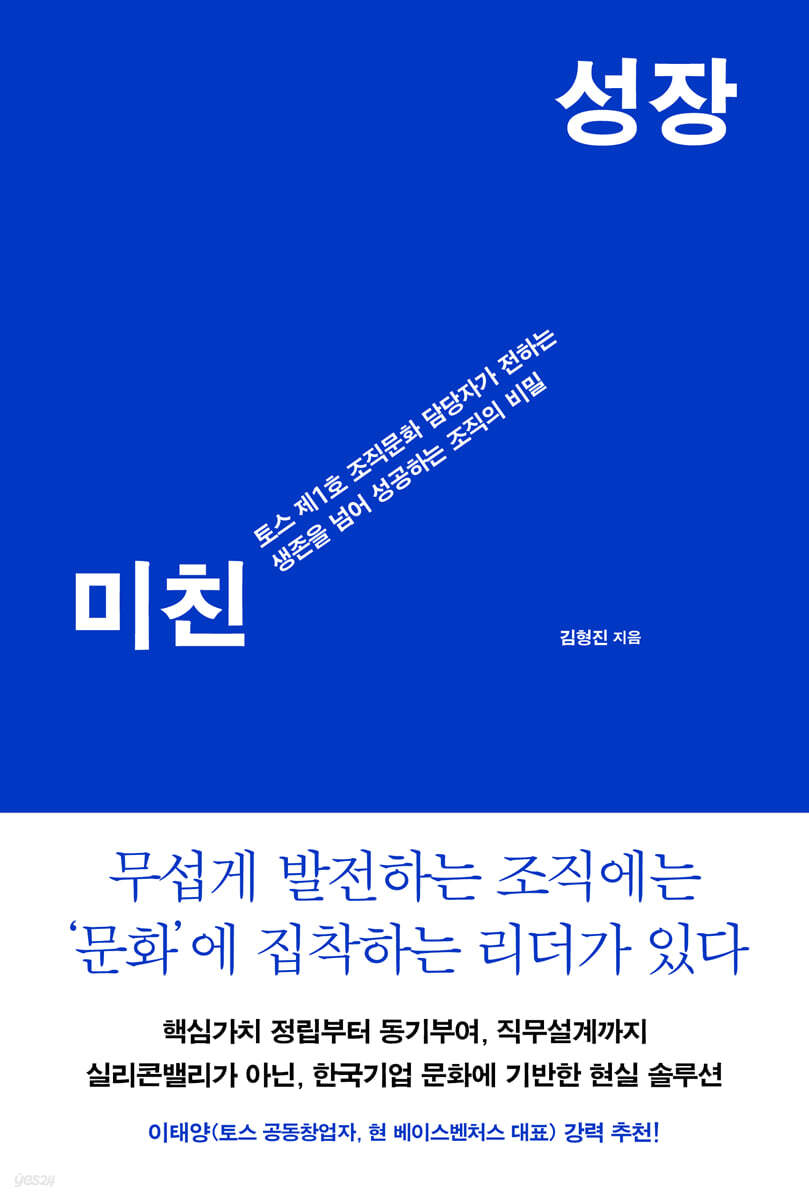
Crazy growth
 |
Description
Book Introduction
“Culture is a strategy that brings performance to an organization.”
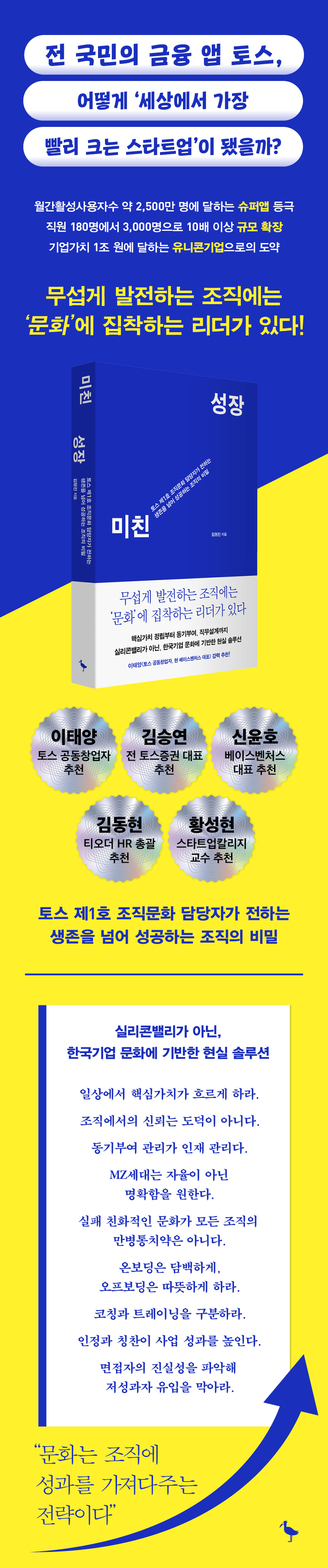
A leap forward to becoming a unicorn company with a corporate value of 1 trillion won.
It has become a super app with approximately 25 million monthly active users.
It experienced more than tenfold growth from 180 employees to approximately 3,000.
The Weapons of High-Performing Organizations: The First Organizational Culture Manager at Toss
In 2018, Toss became the first domestic fintech company to become a unicorn with a corporate value of approximately 1 trillion won.
Since then, it has continued to grow steadily, surpassing 24.8 million monthly active users (MAU) in 2024, and has become the largest financial app in Korea, surpassing Kakao Pay in just 10 years since the launch of Toss.
What is the reason that Toss, the "world's fastest-growing startup," was able to achieve such incredible growth?
Kim Hyung-jin, Toss' first organizational culture manager, finds the secret in Toss' unique organizational culture.
"Crazy Growth" is a book in which the author, who planned major cultural strategies such as Toss's Core Value 3.0, Core Value Internalization, Core Value Day, and Culture Fit Interview, and who, as an HRBP at Toss Securities, implemented personnel strategies that matched business goals, personally experienced the turning point of the organization's surplus and compressed growth, and summarized his personal insights.
It covers everything from the concept of organizational culture to its practical application.
Therefore, "Crazy Growth" contains all the know-how in areas that many leaders find difficult and curious, such as establishing core values, motivation, job design, and talent density management.
And we provide practical solutions that can be used right away in the workplace.
Furthermore, this book helps readers design a unique culture for their individual organizations based on their own realities and culture, rather than simply following the trendy cultures from innovative companies in Silicon Valley.
Reading this book means 1) building the foundation for "crazy growth," 2) custom-designing a culture that fits your organization, and 3) monitoring your organization to maintain that crazy growth.
I recommend this book to all leaders, including middle managers leading small teams, CEOs leading large organizations, and entrepreneurs running businesses.
We will help you take the first step towards ‘crazy growth’.
A leap forward to becoming a unicorn company with a corporate value of 1 trillion won.
It has become a super app with approximately 25 million monthly active users.
It experienced more than tenfold growth from 180 employees to approximately 3,000.
The Weapons of High-Performing Organizations: The First Organizational Culture Manager at Toss
In 2018, Toss became the first domestic fintech company to become a unicorn with a corporate value of approximately 1 trillion won.
Since then, it has continued to grow steadily, surpassing 24.8 million monthly active users (MAU) in 2024, and has become the largest financial app in Korea, surpassing Kakao Pay in just 10 years since the launch of Toss.
What is the reason that Toss, the "world's fastest-growing startup," was able to achieve such incredible growth?
Kim Hyung-jin, Toss' first organizational culture manager, finds the secret in Toss' unique organizational culture.
"Crazy Growth" is a book in which the author, who planned major cultural strategies such as Toss's Core Value 3.0, Core Value Internalization, Core Value Day, and Culture Fit Interview, and who, as an HRBP at Toss Securities, implemented personnel strategies that matched business goals, personally experienced the turning point of the organization's surplus and compressed growth, and summarized his personal insights.
It covers everything from the concept of organizational culture to its practical application.
Therefore, "Crazy Growth" contains all the know-how in areas that many leaders find difficult and curious, such as establishing core values, motivation, job design, and talent density management.
And we provide practical solutions that can be used right away in the workplace.
Furthermore, this book helps readers design a unique culture for their individual organizations based on their own realities and culture, rather than simply following the trendy cultures from innovative companies in Silicon Valley.
Reading this book means 1) building the foundation for "crazy growth," 2) custom-designing a culture that fits your organization, and 3) monitoring your organization to maintain that crazy growth.
I recommend this book to all leaders, including middle managers leading small teams, CEOs leading large organizations, and entrepreneurs running businesses.
We will help you take the first step towards ‘crazy growth’.
- You can preview some of the book's contents.
Preview
index
Praise from those who read it first
Prologue: What Makes a Crazy-Growing Organization Different?
More Important Organizational culture is more important than anything else
_The foundation of crazy growth
Chapter 1: Core Values: The Standard for All Decisions and the Equation for Creating Performance
This is how we win
Details that core values must have
Let your core values flow through your daily life.
Flywheel Building Q&A
If there is no codified performance equation yet,
Who will exert a positive influence on the organization?
Four Challenges Leaders Face
Chapter 2: Trust Resources: Strategic Resources for Increasing Organizational Speed and Cohesion
Trust and Doubt: What Are Our Organization's Resources?
Trust in an organization is not moral.
Transparency: We have nothing to hide.
Consistency: consistently showing the same attitude
Empathy: Important decisions are fully explained.
Meaning: Your submitted comments are actually considered.
What to do when you are betrayed
Chapter 3: Motivation: The Driving Force of Key Talents Who Do Well on Their Own
Should organizations manage or individuals manage?
Motivation management is talent management.
Characteristics of Self-Motivated Crazy Talents
How to manage members' capabilities individually
How to rebuild a broken motivation
Not Accept Break the old habits
_Custom designed for crazy growth
Chapter 4: Clarity: Don't Expect Autonomy Without Principles
Is clarity dogmatic?
Clear rules that give wings to autonomy
The promise of increased productivity: the team's ground rules
When roles are clear, priorities become apparent.
What have we learned and what will we improve?
A structure for clear feedback without emotional exhaustion
Chapter 5: Uniqueness: Don't Follow the Trends
There are trends in organizational culture too.
How far should you delegate?
How far will you tolerate failure?
How to set goals
Will you encourage peer feedback?
Chapter 6 Onboarding and Offboarding - A Simple Welcome, a Warm Farewell
Remember the real purpose of onboarding.
Leave new hires to Buddy
The breakup process is a symbolic scene in organizational culture.
Exit interviews: the golden time for retaining talent.
Acknowledge the void and seek a new path.
Take Control: The leader takes care of it himself.
_Checklist to maintain insane growth
Chapter 7 Leadership: The Practice of Leadership is People
The Real Reasons People Leave Organizations
The First Step to Leadership: A People-Centered Communication Strategy
Leadership Checklist: Five Fundamental Roles
Leadership and Communication: Effective One-on-One Methods
Strengthening Leadership: Managing Weaknesses with Metacognition
Leadership Mindset: Raise Your Discomfort Threshold
Chapter 8: Work Engagement: Accurately Measure and Manage in Detail
Avoid feelings and prefer data.
Key Variables in Work Engagement 1: Recognition and Praise
Key Variable in Work Engagement 2: Challenging Tasks
Key Variable in Work Engagement 3: Are You Confident in Your Company's Success?
Chapter 9: Talent Density: Minimize Low-Performance Employees
Who is having a detrimental impact on the organization?
How to Improve Underperformers
Three Dams to Prevent the Influx of Low-Performance Students
How to determine the interviewer's honesty
Conclusion: A leader is someone who designs organizational culture.
Epilogue
References
Prologue: What Makes a Crazy-Growing Organization Different?
More Important Organizational culture is more important than anything else
_The foundation of crazy growth
Chapter 1: Core Values: The Standard for All Decisions and the Equation for Creating Performance
This is how we win
Details that core values must have
Let your core values flow through your daily life.
Flywheel Building Q&A
If there is no codified performance equation yet,
Who will exert a positive influence on the organization?
Four Challenges Leaders Face
Chapter 2: Trust Resources: Strategic Resources for Increasing Organizational Speed and Cohesion
Trust and Doubt: What Are Our Organization's Resources?
Trust in an organization is not moral.
Transparency: We have nothing to hide.
Consistency: consistently showing the same attitude
Empathy: Important decisions are fully explained.
Meaning: Your submitted comments are actually considered.
What to do when you are betrayed
Chapter 3: Motivation: The Driving Force of Key Talents Who Do Well on Their Own
Should organizations manage or individuals manage?
Motivation management is talent management.
Characteristics of Self-Motivated Crazy Talents
How to manage members' capabilities individually
How to rebuild a broken motivation
Not Accept Break the old habits
_Custom designed for crazy growth
Chapter 4: Clarity: Don't Expect Autonomy Without Principles
Is clarity dogmatic?
Clear rules that give wings to autonomy
The promise of increased productivity: the team's ground rules
When roles are clear, priorities become apparent.
What have we learned and what will we improve?
A structure for clear feedback without emotional exhaustion
Chapter 5: Uniqueness: Don't Follow the Trends
There are trends in organizational culture too.
How far should you delegate?
How far will you tolerate failure?
How to set goals
Will you encourage peer feedback?
Chapter 6 Onboarding and Offboarding - A Simple Welcome, a Warm Farewell
Remember the real purpose of onboarding.
Leave new hires to Buddy
The breakup process is a symbolic scene in organizational culture.
Exit interviews: the golden time for retaining talent.
Acknowledge the void and seek a new path.
Take Control: The leader takes care of it himself.
_Checklist to maintain insane growth
Chapter 7 Leadership: The Practice of Leadership is People
The Real Reasons People Leave Organizations
The First Step to Leadership: A People-Centered Communication Strategy
Leadership Checklist: Five Fundamental Roles
Leadership and Communication: Effective One-on-One Methods
Strengthening Leadership: Managing Weaknesses with Metacognition
Leadership Mindset: Raise Your Discomfort Threshold
Chapter 8: Work Engagement: Accurately Measure and Manage in Detail
Avoid feelings and prefer data.
Key Variables in Work Engagement 1: Recognition and Praise
Key Variable in Work Engagement 2: Challenging Tasks
Key Variable in Work Engagement 3: Are You Confident in Your Company's Success?
Chapter 9: Talent Density: Minimize Low-Performance Employees
Who is having a detrimental impact on the organization?
How to Improve Underperformers
Three Dams to Prevent the Influx of Low-Performance Students
How to determine the interviewer's honesty
Conclusion: A leader is someone who designs organizational culture.
Epilogue
References
Detailed image
Into the book
But what exactly are core values, and why are they so important? They are the set of principles that define a company's success.
It is a condensation of how the organization has achieved results so far.
It also includes principles that must be followed in order to survive in the future.
The goal of a company is to win in the market and achieve its vision.
That's good for shareholders, good for employees, and good for society.
Victory is achieved through intense strategic thinking, numerous executions, and growth through failure.
If products, marketing, and financing fall under the category of "management strategy," then core values, which are the means by which an organization produces results, fall under "cultural strategy."
--- p.29, from “Core Values: The Standard for All Decisions and the Equation for Creating Performance”
In June 2022, news broke that Netflix, famous for its "No Rules" show, was shifting to a "Rules" culture.
This was surprising news, as Netflix's existing culture is known for emphasizing autonomy and responsibility.
At the time, Netflix's stock price fell as its subscriber count declined for the first time in a decade.
Netflix's belief that "the best means of control is autonomy" has been called into question.
Subsequently, reports emerged that Netflix's internal cultural notes had actually been revised.
In a culture of autonomy and responsibility, the weight has shifted towards responsibility.
This case shows that trust is not based on unconditional belief.
It is also predictable that if we move towards eliminating procedures and then creating new ones, trust resources will actually be weakened.
--- p.76, from “Trust Resources: Strategic Resources for Increasing Organizational Speed and Cohesion”
What motivations can we fulfill? This question is especially important when recruiting.
As mentioned earlier, motivation includes various factors such as compensation, personal growth, diverse job opportunities, and professional development.
What an individual values most may be a motivation that our company and team cannot fulfill.
In cases like this, it is better not to hire them no matter how excellent their abilities are.
Because motivation must be good to have a positive impact on the team.
Companies and teams need to be aware of the types of motivation they can foster.
And if there is a motive that cannot be fulfilled, you should coldly give up on hiring.
Even if he is a famous person in the market.
--- p.95, from “Motivation - The driving force of key talents who do well on their own”
The survey titled "What Role Do You Expect from a Leader?" published by Hunet CEO in May 2025 is quite impressive.
The role that the so-called 'MZ Generation', the millennials and Generation Z, most expect from their leaders is 'problem solving and crisis management.'
This is a contrasting result to the baby boomer generation's choice to 'lead innovation and change.'
I think this is a result of the MZ generation's preference for clarity.
In my experience, these people tend to want to be told what they should do and what they can do to be considered good at it.
What's interesting is that older generation leaders, including Generation X, often feel that these people only want autonomy.
But autonomy without clarity is neglect.
Autonomy without process and principles is recklessness.
Neglect and neglect alone cannot create a culture that fosters organizational growth.
--- p.130, from “Clarity _ Don’t Expect Autonomy Without Principles”
My perspective on trends in organizational culture is similar to my perspective on trends in clothing.
Following trends wastes more of your company's budget and forces you to constantly compare yourself to other companies you're benchmarking against.
Organizational culture trends change rapidly whenever the larger macro environment changes.
At this time, the organization's ability to respond greatly depends on whether or not the company truly defines and pursues its own unique culture.
If you value uniqueness, it is easy to flexibly change your culture to suit changes in the external environment.
However, if you blindly follow the culture of other organizations without developing your own unique culture, you have no choice but to wait and see how the companies you benchmark against will respond.
Not only will you be late in responding, you may also miss the golden time to change and manage the culture internally.
--- p.168, from “Uniqueness _ Don’t follow the trendy culture”
How can we boost team morale after a key player leaves? Rather than doing anything special, it's better to faithfully implement the steps discussed above.
First, convey your sincerity to key talent through exit interviews and conduct appropriate events to ensure that offboarding remains a positive memory.
So that the negative impact that the person leaving can have on the team can be minimized.
From now on, it's all ours.
The important thing is communication with your team members.
Continue to recognize the importance of key personnel even after they leave.
Thanks to him, the team's performance was good, and it's a shame to see him leave.
The behavior to avoid the most at this time is to react awkwardly and coolly, such as saying, "Those who want to leave, leave, and those who are left will do their work" or "I don't really care."
--- p.214, from “Onboarding and Offboarding _ A simple welcome, a warm farewell”
Do you think that all groups can, or should, have the same purpose? I believe that each group should have a different purpose.
To explain why, I'd like to look at the purpose of coaching and training and the differences between them.
First of all, the etymology of training, 'Train', means train.
Coaching's 'Coach' is probably well known as a bag brand name, and if you look at its logo, you can see a picture of a carriage.
In the end, you just have to think about the difference between a train and a carriage.
Trains have a set destination because the tracks are already laid along the way, but for carriages, the destination is determined by the customer.
Therefore, training is about making team members perfectly fit into the area where there is an answer key, and coaching is about helping team members find the answer on their own.
--- p.239, from “Leadership _ The Practice of Leadership is People”
In my experience, growth has been the most important factor influencing work engagement.
This tendency is especially strong in startups, as they have less to offer their employees in terms of branding, compensation, and stability compared to large corporations.
Especially with the advent of the AI era, individuals are increasingly required to take on challenging and creative tasks.
In the past, I felt like I had grown simply by performing repetitive, operational tasks well for a long period of time, but now I don't have that opportunity, and I feel like I have to excel at creative tasks to grow.
As such, the growth of members is changing in a direction that is increasingly difficult to achieve.
--- p.269, from “Work Engagement _ Accurately Measure and Manage in Detail”
Research conducted by Google, McKinsey, and others shows that no matter how long and elaborate the interview process is, the accuracy of evaluating candidates is unlikely to exceed 50 percent.
Half of the time, it's bad hiring.
These people may not fit in with the company and may need to go through a process of improvement or even break up.
Because of this, the HR team spends more time than expected preparing and executing member improvement and separation.
This also applies to leaders.
And because of the Ringelmann effect we discussed earlier, one in ten people will inevitably be a bad hire.
You can't say that one person isn't a harmful person.
You might ask, since hiring can never be 100% successful, why not think about it after you've chosen the candidate?
“Absolutely not” is my answer.
Even if we can't be 100 percent accurate, we should always try our best.
Every single detail of effort ensures the growth of the organization.
--- p.289, from “Talent Density _ Minimize Low Performers”
Organizational culture is also a product.
And employees are customers who consume and create this organizational culture together.
Their experience with organizational culture is directly linked to their satisfaction with the organization and the company's performance.
The organizational culture I've been talking about, as a practice rather than a theory, can be achieved through the following experience design.
Only by designing these experiences can we truly meet the requirements for a great organizational culture.
Adding a great business strategy to this will position your organization as a high-performing force in its field.
It is a condensation of how the organization has achieved results so far.
It also includes principles that must be followed in order to survive in the future.
The goal of a company is to win in the market and achieve its vision.
That's good for shareholders, good for employees, and good for society.
Victory is achieved through intense strategic thinking, numerous executions, and growth through failure.
If products, marketing, and financing fall under the category of "management strategy," then core values, which are the means by which an organization produces results, fall under "cultural strategy."
--- p.29, from “Core Values: The Standard for All Decisions and the Equation for Creating Performance”
In June 2022, news broke that Netflix, famous for its "No Rules" show, was shifting to a "Rules" culture.
This was surprising news, as Netflix's existing culture is known for emphasizing autonomy and responsibility.
At the time, Netflix's stock price fell as its subscriber count declined for the first time in a decade.
Netflix's belief that "the best means of control is autonomy" has been called into question.
Subsequently, reports emerged that Netflix's internal cultural notes had actually been revised.
In a culture of autonomy and responsibility, the weight has shifted towards responsibility.
This case shows that trust is not based on unconditional belief.
It is also predictable that if we move towards eliminating procedures and then creating new ones, trust resources will actually be weakened.
--- p.76, from “Trust Resources: Strategic Resources for Increasing Organizational Speed and Cohesion”
What motivations can we fulfill? This question is especially important when recruiting.
As mentioned earlier, motivation includes various factors such as compensation, personal growth, diverse job opportunities, and professional development.
What an individual values most may be a motivation that our company and team cannot fulfill.
In cases like this, it is better not to hire them no matter how excellent their abilities are.
Because motivation must be good to have a positive impact on the team.
Companies and teams need to be aware of the types of motivation they can foster.
And if there is a motive that cannot be fulfilled, you should coldly give up on hiring.
Even if he is a famous person in the market.
--- p.95, from “Motivation - The driving force of key talents who do well on their own”
The survey titled "What Role Do You Expect from a Leader?" published by Hunet CEO in May 2025 is quite impressive.
The role that the so-called 'MZ Generation', the millennials and Generation Z, most expect from their leaders is 'problem solving and crisis management.'
This is a contrasting result to the baby boomer generation's choice to 'lead innovation and change.'
I think this is a result of the MZ generation's preference for clarity.
In my experience, these people tend to want to be told what they should do and what they can do to be considered good at it.
What's interesting is that older generation leaders, including Generation X, often feel that these people only want autonomy.
But autonomy without clarity is neglect.
Autonomy without process and principles is recklessness.
Neglect and neglect alone cannot create a culture that fosters organizational growth.
--- p.130, from “Clarity _ Don’t Expect Autonomy Without Principles”
My perspective on trends in organizational culture is similar to my perspective on trends in clothing.
Following trends wastes more of your company's budget and forces you to constantly compare yourself to other companies you're benchmarking against.
Organizational culture trends change rapidly whenever the larger macro environment changes.
At this time, the organization's ability to respond greatly depends on whether or not the company truly defines and pursues its own unique culture.
If you value uniqueness, it is easy to flexibly change your culture to suit changes in the external environment.
However, if you blindly follow the culture of other organizations without developing your own unique culture, you have no choice but to wait and see how the companies you benchmark against will respond.
Not only will you be late in responding, you may also miss the golden time to change and manage the culture internally.
--- p.168, from “Uniqueness _ Don’t follow the trendy culture”
How can we boost team morale after a key player leaves? Rather than doing anything special, it's better to faithfully implement the steps discussed above.
First, convey your sincerity to key talent through exit interviews and conduct appropriate events to ensure that offboarding remains a positive memory.
So that the negative impact that the person leaving can have on the team can be minimized.
From now on, it's all ours.
The important thing is communication with your team members.
Continue to recognize the importance of key personnel even after they leave.
Thanks to him, the team's performance was good, and it's a shame to see him leave.
The behavior to avoid the most at this time is to react awkwardly and coolly, such as saying, "Those who want to leave, leave, and those who are left will do their work" or "I don't really care."
--- p.214, from “Onboarding and Offboarding _ A simple welcome, a warm farewell”
Do you think that all groups can, or should, have the same purpose? I believe that each group should have a different purpose.
To explain why, I'd like to look at the purpose of coaching and training and the differences between them.
First of all, the etymology of training, 'Train', means train.
Coaching's 'Coach' is probably well known as a bag brand name, and if you look at its logo, you can see a picture of a carriage.
In the end, you just have to think about the difference between a train and a carriage.
Trains have a set destination because the tracks are already laid along the way, but for carriages, the destination is determined by the customer.
Therefore, training is about making team members perfectly fit into the area where there is an answer key, and coaching is about helping team members find the answer on their own.
--- p.239, from “Leadership _ The Practice of Leadership is People”
In my experience, growth has been the most important factor influencing work engagement.
This tendency is especially strong in startups, as they have less to offer their employees in terms of branding, compensation, and stability compared to large corporations.
Especially with the advent of the AI era, individuals are increasingly required to take on challenging and creative tasks.
In the past, I felt like I had grown simply by performing repetitive, operational tasks well for a long period of time, but now I don't have that opportunity, and I feel like I have to excel at creative tasks to grow.
As such, the growth of members is changing in a direction that is increasingly difficult to achieve.
--- p.269, from “Work Engagement _ Accurately Measure and Manage in Detail”
Research conducted by Google, McKinsey, and others shows that no matter how long and elaborate the interview process is, the accuracy of evaluating candidates is unlikely to exceed 50 percent.
Half of the time, it's bad hiring.
These people may not fit in with the company and may need to go through a process of improvement or even break up.
Because of this, the HR team spends more time than expected preparing and executing member improvement and separation.
This also applies to leaders.
And because of the Ringelmann effect we discussed earlier, one in ten people will inevitably be a bad hire.
You can't say that one person isn't a harmful person.
You might ask, since hiring can never be 100% successful, why not think about it after you've chosen the candidate?
“Absolutely not” is my answer.
Even if we can't be 100 percent accurate, we should always try our best.
Every single detail of effort ensures the growth of the organization.
--- p.289, from “Talent Density _ Minimize Low Performers”
Organizational culture is also a product.
And employees are customers who consume and create this organizational culture together.
Their experience with organizational culture is directly linked to their satisfaction with the organization and the company's performance.
The organizational culture I've been talking about, as a practice rather than a theory, can be achieved through the following experience design.
Only by designing these experiences can we truly meet the requirements for a great organizational culture.
Adding a great business strategy to this will position your organization as a high-performing force in its field.
--- p.305, from “Conclusion: A leader is someone who designs organizational culture”
Publisher's Review
How are they the 'world's best'?
Could it be a 'fast-growing startup'?
Organizations that are growing rapidly have leaders who are obsessed with 'culture'!
A message from the first Toss organizational culture manager
The Secret of Organizations That Succeed Beyond Survival
Toss has become the largest financial app in Korea, surpassing Kakao Pay and Naver Pay in just 10 years since its launch.
Where did this overwhelming growth and innovation come from? What is the secret to their success, not just survival, amidst ever-changing customer needs and a rapidly changing technological landscape?
At the heart of this 'crazy' growth is organizational culture.
Kim Hyung-jin, Toss' first organizational culture manager, says that organizational culture is "a strategy that brings performance to the organization."
Organizational culture is especially important for startups and small organizations that do not have many resources to utilize.
Because it is a resource that can be utilized immediately and is also inexpensive.
Some leaders may be skeptical about the importance of organizational culture.
Many leaders of organizations large and small, including startups, discount this from their priority list because they are busy just surviving day to day.
But if you want to lead your organization to success, you must keep this in mind.
Organizations that are growing rapidly have leaders who are obsessed with 'culture'.
In fact, as has been revealed in various media, Toss CEO Seung-Geon Lee is a person who deeply considers the culture of an organization.
While observing and working with him from a close distance, the author became convinced that he was "perhaps the person who studied organizational culture the most and most deeply in our country," and that Toss's concerns and goals regarding culture, as revealed to the public, were 100 percent genuine.
Thus, in 2018, Toss joined the ranks of unicorn companies with a corporate value of 1 trillion won (approximately 1 billion dollars).
This was an achievement made in about three years since the first launch of the Toss app in 2015.
It was the fourth time in Korea, and the first among fintech companies, that a unicorn company was born.
Furthermore, in 2024, the number of monthly active users (MAU) is expected to exceed 24.8 million, and operating profit will rapidly grow to KRW 1.9556 trillion.
There is no longer any doubt that culture is a strategy that brings performance to an organization.
To achieve crazy growth
Three Strategies for Organizational Culture
Having worked at Toss for approximately seven years and subsequently advising various companies as an organizational culture expert, the author has closely observed the challenges leaders face.
And through solutions that he himself had applied, researched, and proven effective, he established three strategies for a successful organizational culture.
Following this strategy means 1) building a foundation for "crazy growth," 2) customizing a culture that fits your organization, and 3) monitoring your organization to maintain that crazy growth.
Below, we briefly introduce these three strategies and specific guidelines for implementing them.
1.
(The foundation of crazy growth) More important than anything else is organizational culture.
There are many reasons why leaders should prioritize culture.
Because culture is a ‘strategy that brings performance to an organization.’
For example, Toss values organizational culture above all else, and will not hire anyone, no matter how renowned they are in the industry, if their work style and values do not fit their culture.
Many leaders consider organizational culture to be secondary, excluding it from their priority list, or abandon it midway because they are too busy trying to survive.
However, if you have a strong will and don't give up, culture will eventually become a competitive edge that supports the organization.
· Establish 'core values' as the basis for all decisions and the equation for creating performance.
· Build up 'trust resources', a strategic resource that increases the speed and cohesion of the organization.
· Manage the 'motivation' that drives key talent to do their job well.
2.
(Custom Design for Crazy Growth) Not Accept Break the mold.
There are trends in organizational culture as well.
Trends have been driven primarily by high-cap IT companies, such as Spotify's agile approach, Netflix's autonomy and responsibility, and Google's psychological safety.
However, to improve an organization's responsiveness in a crisis, we need to rethink the practices we have blindly followed.
This is to avoid missing the golden time to make internal changes while waiting to see how the benchmarking companies respond.
Let's use third-party examples as reference only, and find the answer that fits our organization internally.
· Without principles, there is no autonomy or responsibility.
Maintain the 'clarity' of our organization.
· Don't blindly follow popular culture, but maintain your own uniqueness.
· The key to 'on/offboarding' is to welcome with a simple attitude and say goodbye with a warm heart.
3.
(Checklist to maintain insane growth) Take Control: The leader must personally take care of it.
Organizational culture must be managed directly by leaders using their authority.
A company whose organizational culture is the exclusive domain of the HR department will never achieve explosive growth.
Areas that influence organizational culture but that many leaders find difficult to manage include leadership, work engagement, and talent density.
Let's keep in mind that a leader's practice is about "people," that work engagement must be confirmed with clear data, and that underperforming employees must be minimized through a process of improvement and separation.
· Most talented people leave an organization because of the leader.
Check the leader's 'leadership'.
· Employees' 'work engagement' must be accurately measured and managed in detail.
· Manage the organization's 'talent density' by minimizing the number of underperforming employees.
Based on Korean corporate culture, not Silicon Valley
Realistic solutions
“I trusted my team members because they said trust was important, but now I feel like I’m being treated like a fool.”
“We introduced a culture of autonomy and responsibility, but it seems like we’re focusing more on autonomy than responsibility.”
“I followed the advice to grow through rapid failure, but when I actually failed, I received a bad evaluation.”
“I can’t tell if my boss’s feedback is ‘completely honest’ or rude.”
“We introduced peer evaluation, but performance remained the same and the team atmosphere became more strained.”
As Silicon Valley's organizational cultures are introduced to Korea, many leaders are trying to introduce them into their own organizations.
However, this is often not the case in our case.
The introduction of a horizontal organizational culture is a representative example.
If you blindly follow the rules without considering the circumstances of the industry and organization, you will often experience negative side effects.
Based on the case studies of Korean companies, this book helps you build a unique culture tailored to your organization and translate it into high performance.
To this end, we present practical solutions that can be used immediately in the workplace.
For example, if you want to introduce a culture of autonomy to ensure employee creativity, you must first establish 'clarity' in the organization.
Because without 'clarity', autonomy is nothing more than neglect or laxity.
Many older generation leaders in Korea, including Generation X, often misunderstand that Generation MZ simply wants autonomy.
However, as various studies show, what the MZ generation truly wants is clarity rather than autonomy.
They want a leader who clearly states what they should do and what they will be judged for doing well.
When the standards are clear, autonomy also takes flight.
To this end, the author suggests establishing team "ground rules"—"a set of agreed-upon promises that will allow us to work well together."
In addition, we introduce specific action items needed in actual workplaces, such as clear feedback methods, how to clearly define members' roles, and what to decide in advance when conducting meetings.
How employees experience organizational culture is directly linked to their satisfaction with the organization and the company's performance.
Therefore, the leader must ultimately become the person who designs the experience of organizational culture.
This book contains essential information for leaders to design organizational culture, from establishing core values to motivation, job design, and enhancing work engagement.
This book will serve as a guide for many Korean leaders who want to lead their organizations to success.
Could it be a 'fast-growing startup'?
Organizations that are growing rapidly have leaders who are obsessed with 'culture'!
A message from the first Toss organizational culture manager
The Secret of Organizations That Succeed Beyond Survival
Toss has become the largest financial app in Korea, surpassing Kakao Pay and Naver Pay in just 10 years since its launch.
Where did this overwhelming growth and innovation come from? What is the secret to their success, not just survival, amidst ever-changing customer needs and a rapidly changing technological landscape?
At the heart of this 'crazy' growth is organizational culture.
Kim Hyung-jin, Toss' first organizational culture manager, says that organizational culture is "a strategy that brings performance to the organization."
Organizational culture is especially important for startups and small organizations that do not have many resources to utilize.
Because it is a resource that can be utilized immediately and is also inexpensive.
Some leaders may be skeptical about the importance of organizational culture.
Many leaders of organizations large and small, including startups, discount this from their priority list because they are busy just surviving day to day.
But if you want to lead your organization to success, you must keep this in mind.
Organizations that are growing rapidly have leaders who are obsessed with 'culture'.
In fact, as has been revealed in various media, Toss CEO Seung-Geon Lee is a person who deeply considers the culture of an organization.
While observing and working with him from a close distance, the author became convinced that he was "perhaps the person who studied organizational culture the most and most deeply in our country," and that Toss's concerns and goals regarding culture, as revealed to the public, were 100 percent genuine.
Thus, in 2018, Toss joined the ranks of unicorn companies with a corporate value of 1 trillion won (approximately 1 billion dollars).
This was an achievement made in about three years since the first launch of the Toss app in 2015.
It was the fourth time in Korea, and the first among fintech companies, that a unicorn company was born.
Furthermore, in 2024, the number of monthly active users (MAU) is expected to exceed 24.8 million, and operating profit will rapidly grow to KRW 1.9556 trillion.
There is no longer any doubt that culture is a strategy that brings performance to an organization.
To achieve crazy growth
Three Strategies for Organizational Culture
Having worked at Toss for approximately seven years and subsequently advising various companies as an organizational culture expert, the author has closely observed the challenges leaders face.
And through solutions that he himself had applied, researched, and proven effective, he established three strategies for a successful organizational culture.
Following this strategy means 1) building a foundation for "crazy growth," 2) customizing a culture that fits your organization, and 3) monitoring your organization to maintain that crazy growth.
Below, we briefly introduce these three strategies and specific guidelines for implementing them.
1.
(The foundation of crazy growth) More important than anything else is organizational culture.
There are many reasons why leaders should prioritize culture.
Because culture is a ‘strategy that brings performance to an organization.’
For example, Toss values organizational culture above all else, and will not hire anyone, no matter how renowned they are in the industry, if their work style and values do not fit their culture.
Many leaders consider organizational culture to be secondary, excluding it from their priority list, or abandon it midway because they are too busy trying to survive.
However, if you have a strong will and don't give up, culture will eventually become a competitive edge that supports the organization.
· Establish 'core values' as the basis for all decisions and the equation for creating performance.
· Build up 'trust resources', a strategic resource that increases the speed and cohesion of the organization.
· Manage the 'motivation' that drives key talent to do their job well.
2.
(Custom Design for Crazy Growth) Not Accept Break the mold.
There are trends in organizational culture as well.
Trends have been driven primarily by high-cap IT companies, such as Spotify's agile approach, Netflix's autonomy and responsibility, and Google's psychological safety.
However, to improve an organization's responsiveness in a crisis, we need to rethink the practices we have blindly followed.
This is to avoid missing the golden time to make internal changes while waiting to see how the benchmarking companies respond.
Let's use third-party examples as reference only, and find the answer that fits our organization internally.
· Without principles, there is no autonomy or responsibility.
Maintain the 'clarity' of our organization.
· Don't blindly follow popular culture, but maintain your own uniqueness.
· The key to 'on/offboarding' is to welcome with a simple attitude and say goodbye with a warm heart.
3.
(Checklist to maintain insane growth) Take Control: The leader must personally take care of it.
Organizational culture must be managed directly by leaders using their authority.
A company whose organizational culture is the exclusive domain of the HR department will never achieve explosive growth.
Areas that influence organizational culture but that many leaders find difficult to manage include leadership, work engagement, and talent density.
Let's keep in mind that a leader's practice is about "people," that work engagement must be confirmed with clear data, and that underperforming employees must be minimized through a process of improvement and separation.
· Most talented people leave an organization because of the leader.
Check the leader's 'leadership'.
· Employees' 'work engagement' must be accurately measured and managed in detail.
· Manage the organization's 'talent density' by minimizing the number of underperforming employees.
Based on Korean corporate culture, not Silicon Valley
Realistic solutions
“I trusted my team members because they said trust was important, but now I feel like I’m being treated like a fool.”
“We introduced a culture of autonomy and responsibility, but it seems like we’re focusing more on autonomy than responsibility.”
“I followed the advice to grow through rapid failure, but when I actually failed, I received a bad evaluation.”
“I can’t tell if my boss’s feedback is ‘completely honest’ or rude.”
“We introduced peer evaluation, but performance remained the same and the team atmosphere became more strained.”
As Silicon Valley's organizational cultures are introduced to Korea, many leaders are trying to introduce them into their own organizations.
However, this is often not the case in our case.
The introduction of a horizontal organizational culture is a representative example.
If you blindly follow the rules without considering the circumstances of the industry and organization, you will often experience negative side effects.
Based on the case studies of Korean companies, this book helps you build a unique culture tailored to your organization and translate it into high performance.
To this end, we present practical solutions that can be used immediately in the workplace.
For example, if you want to introduce a culture of autonomy to ensure employee creativity, you must first establish 'clarity' in the organization.
Because without 'clarity', autonomy is nothing more than neglect or laxity.
Many older generation leaders in Korea, including Generation X, often misunderstand that Generation MZ simply wants autonomy.
However, as various studies show, what the MZ generation truly wants is clarity rather than autonomy.
They want a leader who clearly states what they should do and what they will be judged for doing well.
When the standards are clear, autonomy also takes flight.
To this end, the author suggests establishing team "ground rules"—"a set of agreed-upon promises that will allow us to work well together."
In addition, we introduce specific action items needed in actual workplaces, such as clear feedback methods, how to clearly define members' roles, and what to decide in advance when conducting meetings.
How employees experience organizational culture is directly linked to their satisfaction with the organization and the company's performance.
Therefore, the leader must ultimately become the person who designs the experience of organizational culture.
This book contains essential information for leaders to design organizational culture, from establishing core values to motivation, job design, and enhancing work engagement.
This book will serve as a guide for many Korean leaders who want to lead their organizations to success.
GOODS SPECIFICS
- Date of issue: September 30, 2025
- Page count, weight, size: 320 pages | 538g | 140*205*30mm
- ISBN13: 9791172540807
- ISBN10: 1172540802
You may also like
카테고리
korean


korean

![GQ KOREA Mark (Monthly): December [2025]](http://librairie.coreenne.fr/cdn/shop/files/8ef265dbbfbf186523ed75ba7319009d.jpg?v=1765340328&width=3840)


