

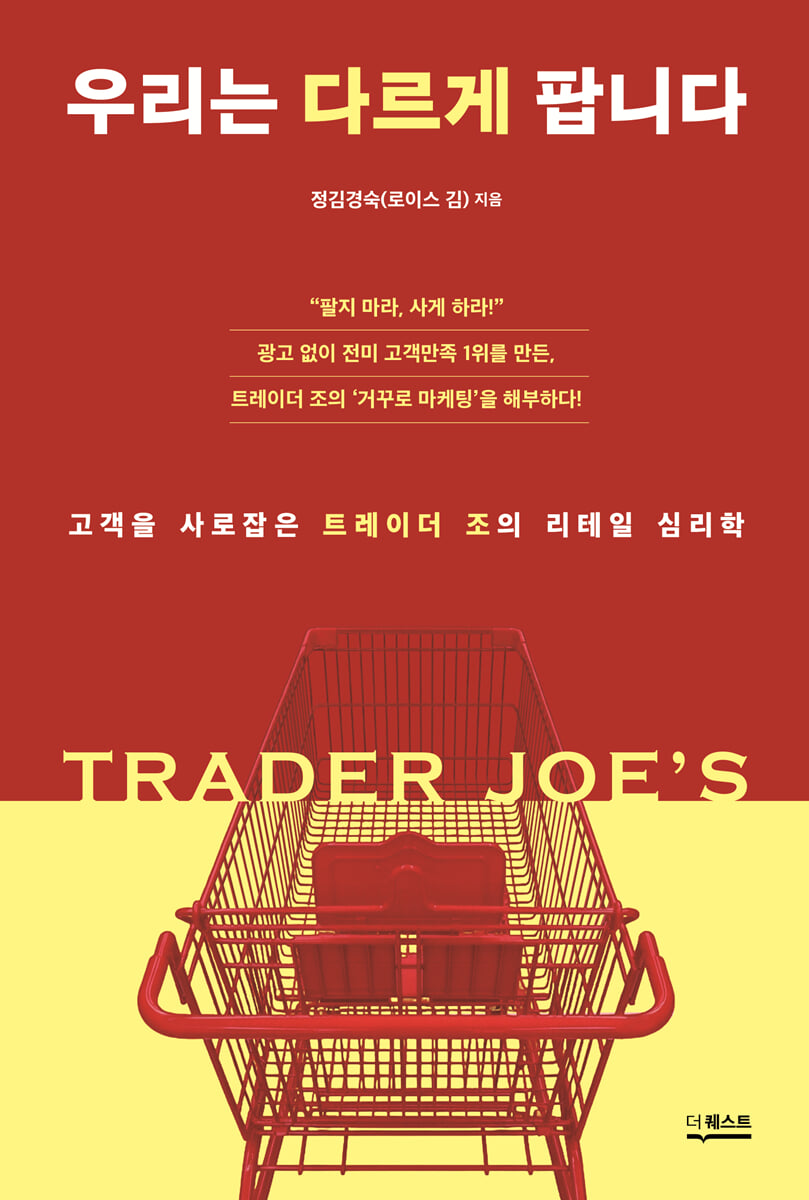
We sell differently
 |
Description
Book Introduction
- A word from MD
-
Why are we drawn to certain brands?Trader Joe's, the supermarket that achieved the #1 customer satisfaction rating in the U.S. without advertising, memberships, or big-name brands.
This book shows how a brand's philosophy drives consumption through a reverse-thinking strategy of 'making customers buy on their own even if you don't sell.'
October 17, 2025. Economics and Management PD Oh Da-eun
Trader Joe's Retail Psychology: Captivating Customers
We Sell Differently
"We don't sell, we make customers buy."
Trader Joe's, a supermarket that succeeded through reverse thinking
'Trader Joe's eco bag' once became a hot topic on social media.
The resale value of a small cloth bag reached $1,000, raising the question, "What kind of place is Trader Joe's?"
What kind of brand is Trader Joe's? Trader Joe's, an American brick-and-mortar supermarket, doesn't advertise or offer a membership program.
They don't even sell Coca-Cola, a popular brand.
Despite this, it has become a benchmark for marketers and retailers around the world, recording the highest sales per unit area and the highest customer satisfaction in the U.S.
Trader Joe's Success Formula: Unraveling Psychology and Traditional Marketing Theory
Trader Joe's strategy isn't simply differentiation.
- Scarcity principle: Instills in customers the mindset that they should buy while it is available.
- The Paradox of Choice: Provides curation that replaces complex purchasing decisions.
- Brand personification: Make your store feel like a friend.
- Self-reference effect: It allows customers to find their own identity within the brand.
Here's why customers line up even without advertising.
A store is a brand, and tastings are not just promotions, they are a culture.
We incorporate stories into our product names and packaging, and we thoroughly align our pricing policy, location selection, and growth rate with our philosophy.
The author interpreted this using traditional marketing theory and psychological concepts and organized it into principles that practitioners can immediately apply.
We Sell Differently
"We don't sell, we make customers buy."
Trader Joe's, a supermarket that succeeded through reverse thinking
'Trader Joe's eco bag' once became a hot topic on social media.
The resale value of a small cloth bag reached $1,000, raising the question, "What kind of place is Trader Joe's?"
What kind of brand is Trader Joe's? Trader Joe's, an American brick-and-mortar supermarket, doesn't advertise or offer a membership program.
They don't even sell Coca-Cola, a popular brand.
Despite this, it has become a benchmark for marketers and retailers around the world, recording the highest sales per unit area and the highest customer satisfaction in the U.S.
Trader Joe's Success Formula: Unraveling Psychology and Traditional Marketing Theory
Trader Joe's strategy isn't simply differentiation.
- Scarcity principle: Instills in customers the mindset that they should buy while it is available.
- The Paradox of Choice: Provides curation that replaces complex purchasing decisions.
- Brand personification: Make your store feel like a friend.
- Self-reference effect: It allows customers to find their own identity within the brand.
Here's why customers line up even without advertising.
A store is a brand, and tastings are not just promotions, they are a culture.
We incorporate stories into our product names and packaging, and we thoroughly align our pricing policy, location selection, and growth rate with our philosophy.
The author interpreted this using traditional marketing theory and psychological concepts and organized it into principles that practitioners can immediately apply.
- You can preview some of the book's contents.
Preview
index
prolog
Recommendation
Chapter 1: A Special Supermarket That Turns Ordinary Shopping into a Fun Experience
A special supermarket with a passionate fandom
The Secret of America's No. 1 Customer Satisfaction Supermarket: Honesty
The overwhelming No. 1 in sales per unit area, a strategic product lineup
I tried freezing kimbap once, and 80% of it was a private brand (PB) product.
The Trader Joe's Tote Bag Craze: Retail Supply Discontinuities
Analog for the digital generation, T-Segwon for the MZ generation
Introducing Trader Joe's, the Supermarket with a Fandom
Chapter 2.
Trader Joe's Secret to Success: Timeless Marketing Management Principles
Psychological STP Approach and Trader Joe's Reading Customers' Minds
The Scarcity Principle and Trader Joe's: Buy When You Have It
The Paradox of Choice and Trader Joe's: Curating on behalf of customers
The Self-Reference Effect and Trader Joe's: Establishing Customer Identity
Brand Personification and Trader Joe's: Feeling Like Visiting a Friend
Fomo and Trader Joe's, I'm worried I'll miss out.
Decontextualization and Trader Joe's: Products That Blur Borders
Justifying the effort and going to Trader Joe's even if there's no parking lot
Story and Trader Joe's: Selling Stories
Value Consumption Solidarity and Trader Joe's Doing Good Together
Trader Joe's from a Brand Equity Theory Perspective
Chapter 3.
Trader Joe's: A Marketing Principle That's Backwards
Stores are soon rejecting brands and online shopping.
The absence of Coca-Cola is a differentiating factor; compete with your own brand.
Strategic naming with storytelling
Trader Joe's Delicious Packaging Strategy
Stores without digital retail media
Remuch deliberately confuses customers
Impossible to follow pricing policy
Tasting is a culture, not a marketing strategy.
Store location strategy that reflects corporate philosophy
Trader Joe's Growth Pace
The most powerful advertising is the one that resonates with customers, not the ads.
We do not collect member information.
Chapter 4: The Trader Joe's System That Makes It All Possible
Employee-first management philosophy, humane utilization of people
All employees are all-round players
Introducing unique products that attract customers through newsletters
Part-timers are also "knowledge workers." Ask anything.
No vendor entry fees or dispatched sales representatives
Minimal inventory, small quantity, frequent sales
Flexible work arrangements and the talent pool that supports them
Hiring employees as picky as Google and Apple
Tasting Panel, Alchemist of Flavor
Consistency and authenticity of corporate philosophy, a place where employees are immersed.
Epilogue
Acknowledgements
Recommendation
Chapter 1: A Special Supermarket That Turns Ordinary Shopping into a Fun Experience
A special supermarket with a passionate fandom
The Secret of America's No. 1 Customer Satisfaction Supermarket: Honesty
The overwhelming No. 1 in sales per unit area, a strategic product lineup
I tried freezing kimbap once, and 80% of it was a private brand (PB) product.
The Trader Joe's Tote Bag Craze: Retail Supply Discontinuities
Analog for the digital generation, T-Segwon for the MZ generation
Introducing Trader Joe's, the Supermarket with a Fandom
Chapter 2.
Trader Joe's Secret to Success: Timeless Marketing Management Principles
Psychological STP Approach and Trader Joe's Reading Customers' Minds
The Scarcity Principle and Trader Joe's: Buy When You Have It
The Paradox of Choice and Trader Joe's: Curating on behalf of customers
The Self-Reference Effect and Trader Joe's: Establishing Customer Identity
Brand Personification and Trader Joe's: Feeling Like Visiting a Friend
Fomo and Trader Joe's, I'm worried I'll miss out.
Decontextualization and Trader Joe's: Products That Blur Borders
Justifying the effort and going to Trader Joe's even if there's no parking lot
Story and Trader Joe's: Selling Stories
Value Consumption Solidarity and Trader Joe's Doing Good Together
Trader Joe's from a Brand Equity Theory Perspective
Chapter 3.
Trader Joe's: A Marketing Principle That's Backwards
Stores are soon rejecting brands and online shopping.
The absence of Coca-Cola is a differentiating factor; compete with your own brand.
Strategic naming with storytelling
Trader Joe's Delicious Packaging Strategy
Stores without digital retail media
Remuch deliberately confuses customers
Impossible to follow pricing policy
Tasting is a culture, not a marketing strategy.
Store location strategy that reflects corporate philosophy
Trader Joe's Growth Pace
The most powerful advertising is the one that resonates with customers, not the ads.
We do not collect member information.
Chapter 4: The Trader Joe's System That Makes It All Possible
Employee-first management philosophy, humane utilization of people
All employees are all-round players
Introducing unique products that attract customers through newsletters
Part-timers are also "knowledge workers." Ask anything.
No vendor entry fees or dispatched sales representatives
Minimal inventory, small quantity, frequent sales
Flexible work arrangements and the talent pool that supports them
Hiring employees as picky as Google and Apple
Tasting Panel, Alchemist of Flavor
Consistency and authenticity of corporate philosophy, a place where employees are immersed.
Epilogue
Acknowledgements
Detailed image
.jpg)
Publisher's Review
Practical Insights for Marketers and Retailers
This book is not just a simple success story; it is a strategy book that can be applied in real-world situations.
It contains concrete ideas that can be immediately applied in the field, from product planning to pricing, store operation, and customer experience design.
Retail and brand marketers, commerce professionals, and startup founders can learn from Trader Joe's how to "captivate customers."
In this book, the author, who has been in charge of marketing for 35 years at global companies such as Google and Motorola, sharply analyzes "reverse marketing" through a combination of marketing theory and real-world examples, which he experienced while working directly at a Trader Joe's store.
The author reveals the secrets of Trader Joe's, which succeeded with an "analog strategy" in an era dominated by big data and online shopping.
This book is not just a simple success story; it is a strategy book that can be applied in real-world situations.
It contains concrete ideas that can be immediately applied in the field, from product planning to pricing, store operation, and customer experience design.
Retail and brand marketers, commerce professionals, and startup founders can learn from Trader Joe's how to "captivate customers."
In this book, the author, who has been in charge of marketing for 35 years at global companies such as Google and Motorola, sharply analyzes "reverse marketing" through a combination of marketing theory and real-world examples, which he experienced while working directly at a Trader Joe's store.
The author reveals the secrets of Trader Joe's, which succeeded with an "analog strategy" in an era dominated by big data and online shopping.
GOODS SPECIFICS
- Date of issue: September 24, 2025
- Page count, weight, size: 272 pages | 510g | 152*225*18mm
- ISBN13: 9791140715633
- ISBN10: 1140715631
You may also like
카테고리
korean


korean

![ELLE 엘르 스페셜 에디션 A형 : 12월 [2025]](http://librairie.coreenne.fr/cdn/shop/files/b8e27a3de6c9538896439686c6b0e8fb.jpg?v=1766436872&width=3840)


