

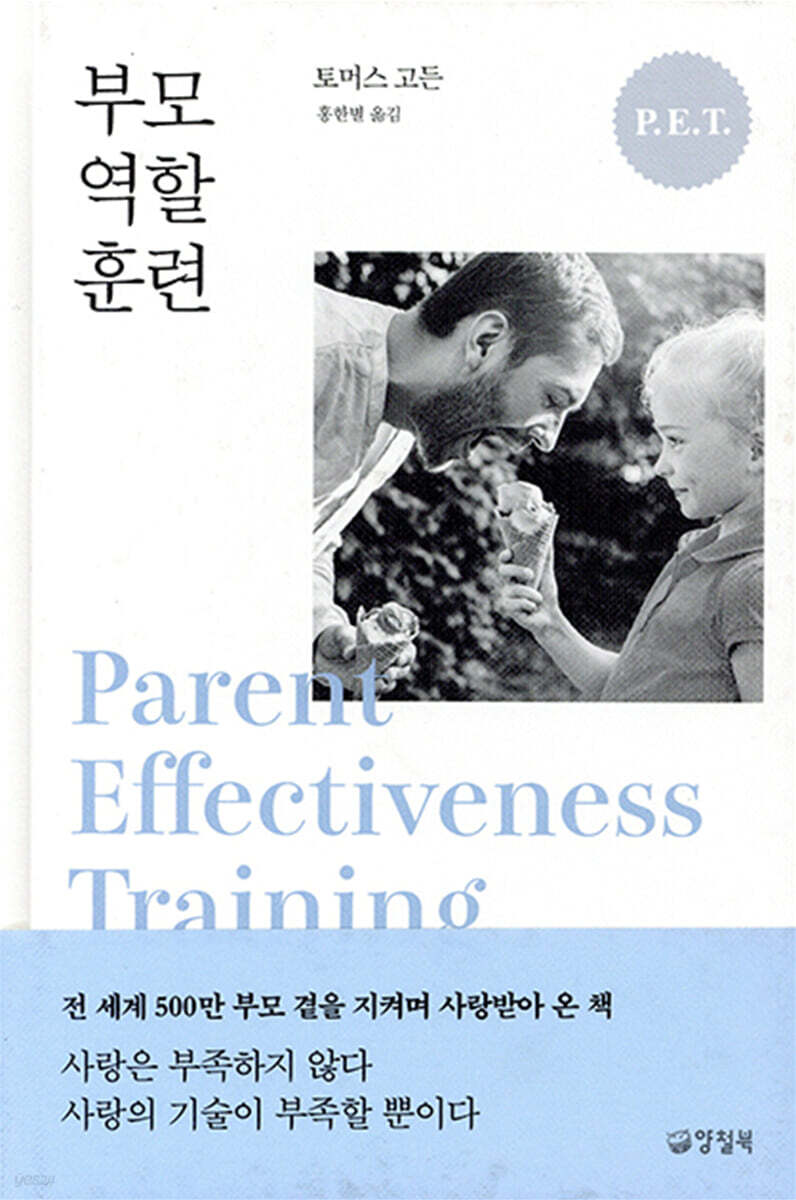
Parenting Role Training
 |
Description
Book Introduction
Recognized by millions of parents around the world
Wisdom passed down from generation to generation
- How to build a constructive relationship between parents and children and help children grow into responsible individuals.
PET (Parent Effectiveness Training) literally stands for ‘effective parenting training.’
This program provides specific techniques for parents to effectively communicate with their children and methods for resolving conflicts.
It is a parenting education program chosen by millions of parents around the world.
In this book, Thomas Gordon presents a new model of parenting.
There is a way to have a peaceful day with your child without having to discipline them harshly or be a parent who drags them around giving in to every request.
Good parents don't try to solve their children's problems for them, and they don't take away their children's initiative.
Knows how to resolve conflicts without getting hurt, without forcing one's thoughts through force or authority.
This book is a timeless classic for anyone who wants to be a wise parent.
Wisdom passed down from generation to generation
- How to build a constructive relationship between parents and children and help children grow into responsible individuals.
PET (Parent Effectiveness Training) literally stands for ‘effective parenting training.’
This program provides specific techniques for parents to effectively communicate with their children and methods for resolving conflicts.
It is a parenting education program chosen by millions of parents around the world.
In this book, Thomas Gordon presents a new model of parenting.
There is a way to have a peaceful day with your child without having to discipline them harshly or be a parent who drags them around giving in to every request.
Good parents don't try to solve their children's problems for them, and they don't take away their children's initiative.
Knows how to resolve conflicts without getting hurt, without forcing one's thoughts through force or authority.
This book is a timeless classic for anyone who wants to be a wise parent.
- You can preview some of the book's contents.
Preview
index
To Korean readers
Acknowledgements
Publishing the 2019 revised edition
Entering
1 Parenting also requires training.
2 Parents are also people with feelings.
What is acceptance?
You can't always treat your child consistently.
Both parents do not need to show the same attitude toward their children.
false acceptance
What if you said it wasn't that you didn't like the child, but that you didn't like the child's behavior?
What it means to say that parents are human too
Whose problem is it that needs to be solved?
3 How to Get Your Child to Open Up? Receptive Speech
The power of receptive speech
How to Convey Acceptance with Nonverbal Messages
How to convey acceptance through verbal messages
A simple way to open up
Active listening
4. Listening also requires skill? Active listening
Active listening when your child is having trouble
Examples of active listening
When to Practice Active Listening
Common Mistakes When Using Active Listening
5 How can we listen to a baby who can't speak?
What kind of beings are babies?
Identify your baby's needs and problems
Help your baby with active listening
Give your baby the opportunity to satisfy his or her own needs.
6 How to Talk to Your Child So They'll Listen
When parents have problems
Ineffective methods for dealing with children
How to deal with children effectively
The three components of a me-message
Why I-Messages Are More Effective
7 Let's use I-Messages effectively
You-messages disguised as me-messages
Don't emphasize negative emotions
Parents must convey their honest feelings.
Sending Nonverbal Me-Messages to Babies
When I encountered a problem while writing a message
Other uses of Na-Message
8. Solve the problem by changing the environment
Enrich the surrounding environment
Simplify your surroundings
Simplify your surroundings
Limit your space of activity
Create a safe and clean environment
Change one behavior into another
Prepare your child for environmental changes
For older children, create the surrounding environment together.
9 The Unavoidable Conflict Between Parents and Children - Who Should Win?
The Parent-Child Power Struggle: Who Will Win and Who Will Lose?
The limitations of the win-or-lose conflict resolution method
10 Is Parental Authority Necessary and Justified?
What is authority?
Limitations of Using Authority
What happens to children when parents are authoritarian?
Misunderstanding of parental authority
11 Unbeatable Ways to Resolve Conflict
Method 3: No One Supports You
The child is motivated to follow the solution.
The likelihood of finding a better solution increases.
Develops children's thinking skills
Hostility decreases and love increases.
There is no need to force it
No need to exert force
It can address real-world issues between parents and children.
Treat children like adults
Method 3 is effective
12 Worries and Fears About the Undefeated Method
How is it different from a traditional family meeting?
Doesn't that make parents powerless?
When many people gather together, they cannot reach a conclusion.
It takes too long
Since parents are wiser than their children, isn't it right to use method 1?
Can it be used on children too?
Isn't there a time when you need to use method 1?
I wonder if my respect for my parents will disappear.
13 Putting the Undefeated Method into Practice
When is a good time to start?
Six Steps to Becoming Undefeated
Problems that may arise when using the undefeated method
The undefeated method should also be applied to fights between children.
When both parents have different opinions
Can't we use all three methods together?
Aren't there times when the undefeated method doesn't work?
14. To avoid being treated like a parent
A matter of values, beliefs, or tastes
The issue of children's human rights
Shouldn't parents teach their children values?
15 Parents Must Change
You need to be more generous to yourself.
A child is not a possession
Do you truly like children or do you only like a certain type of child?
Are only parents' values and beliefs correct?
Spouse comes first, not children
Can Parents' Attitudes Be Changed?
16 Parents aren't the only ones who influence children.
supplement
1 Listening to Your Emotions Test
2 Test Ineffective Conversation Techniques
3. Test your ability to speak with a message
4. Test the degree to which you use authority
5 How Twelve Wrong Ways of Conversation Can Affect Your Child
Acknowledgements
Publishing the 2019 revised edition
Entering
1 Parenting also requires training.
2 Parents are also people with feelings.
What is acceptance?
You can't always treat your child consistently.
Both parents do not need to show the same attitude toward their children.
false acceptance
What if you said it wasn't that you didn't like the child, but that you didn't like the child's behavior?
What it means to say that parents are human too
Whose problem is it that needs to be solved?
3 How to Get Your Child to Open Up? Receptive Speech
The power of receptive speech
How to Convey Acceptance with Nonverbal Messages
How to convey acceptance through verbal messages
A simple way to open up
Active listening
4. Listening also requires skill? Active listening
Active listening when your child is having trouble
Examples of active listening
When to Practice Active Listening
Common Mistakes When Using Active Listening
5 How can we listen to a baby who can't speak?
What kind of beings are babies?
Identify your baby's needs and problems
Help your baby with active listening
Give your baby the opportunity to satisfy his or her own needs.
6 How to Talk to Your Child So They'll Listen
When parents have problems
Ineffective methods for dealing with children
How to deal with children effectively
The three components of a me-message
Why I-Messages Are More Effective
7 Let's use I-Messages effectively
You-messages disguised as me-messages
Don't emphasize negative emotions
Parents must convey their honest feelings.
Sending Nonverbal Me-Messages to Babies
When I encountered a problem while writing a message
Other uses of Na-Message
8. Solve the problem by changing the environment
Enrich the surrounding environment
Simplify your surroundings
Simplify your surroundings
Limit your space of activity
Create a safe and clean environment
Change one behavior into another
Prepare your child for environmental changes
For older children, create the surrounding environment together.
9 The Unavoidable Conflict Between Parents and Children - Who Should Win?
The Parent-Child Power Struggle: Who Will Win and Who Will Lose?
The limitations of the win-or-lose conflict resolution method
10 Is Parental Authority Necessary and Justified?
What is authority?
Limitations of Using Authority
What happens to children when parents are authoritarian?
Misunderstanding of parental authority
11 Unbeatable Ways to Resolve Conflict
Method 3: No One Supports You
The child is motivated to follow the solution.
The likelihood of finding a better solution increases.
Develops children's thinking skills
Hostility decreases and love increases.
There is no need to force it
No need to exert force
It can address real-world issues between parents and children.
Treat children like adults
Method 3 is effective
12 Worries and Fears About the Undefeated Method
How is it different from a traditional family meeting?
Doesn't that make parents powerless?
When many people gather together, they cannot reach a conclusion.
It takes too long
Since parents are wiser than their children, isn't it right to use method 1?
Can it be used on children too?
Isn't there a time when you need to use method 1?
I wonder if my respect for my parents will disappear.
13 Putting the Undefeated Method into Practice
When is a good time to start?
Six Steps to Becoming Undefeated
Problems that may arise when using the undefeated method
The undefeated method should also be applied to fights between children.
When both parents have different opinions
Can't we use all three methods together?
Aren't there times when the undefeated method doesn't work?
14. To avoid being treated like a parent
A matter of values, beliefs, or tastes
The issue of children's human rights
Shouldn't parents teach their children values?
15 Parents Must Change
You need to be more generous to yourself.
A child is not a possession
Do you truly like children or do you only like a certain type of child?
Are only parents' values and beliefs correct?
Spouse comes first, not children
Can Parents' Attitudes Be Changed?
16 Parents aren't the only ones who influence children.
supplement
1 Listening to Your Emotions Test
2 Test Ineffective Conversation Techniques
3. Test your ability to speak with a message
4. Test the degree to which you use authority
5 How Twelve Wrong Ways of Conversation Can Affect Your Child
Into the book
Even when I was working as a clinical psychologist, I, like other parents, thought that teenage rebellion was a natural and inevitable part of life.
It was believed that all teenagers wanted to be independent from their parents and that was why they rebelled.
I thought that adolescence was a 'storm and stress period' and that every family would inevitably go through such a difficult time.
But after experiencing PET, I realized that was not the right idea.
PET
Because I've heard countless times that educated parents say that their children don't rebel and there's never any conflict.
Now my conviction has changed to 'teenagers do not rebel against their parents.'
Children simply resist the wrong discipline methods their parents use.
pp.20~21, 「1.
“Parenting also requires training”
Children want their parents to stop pretending to be something they are not.
How can parents be "human" to their children? How can they make their children feel real? This chapter will argue that there's absolutely no need to pretend to be inhuman to fulfill the role of parent effectively.
When you look at a child, you can accept that he or she is a human being who can feel both positive and negative emotions.
It doesn't necessarily have to be consistent.
There is no need to pretend to love and embrace your child when you honestly don't feel that way.
There is no need to love and embrace all children equally.
Also, couples do not necessarily have to take a united front when dealing with children.
However, it is important to know how you are feeling right now.
pp.34~35, 「2.
“Parents are people with emotions too”
Acceptance is like the soil that allows the flower contained within the small seed to bloom beautifully.
The soil only acts as a catalyst in the process of turning a seed into a flower.
In other words, it only plays a role in realizing the growth potential that the original seed possessed.
Like seeds, children also have the potential to develop.
Acceptance acts like soil that nurtures a child to realize his or her potential.
p.58, 「3.
How to get your child to open his mouth? - Receptive Speech
A mother lost her son in a supermarket.
A mother's primary emotion is fear.
I'm afraid something bad will happen to my child.
If someone had asked her how she was feeling while searching for her child, she would have said something like, “I’m scared to death,” or “I’m so, so worried.”
When you find your child, you feel an overwhelming sense of relief.
In my heart, I said, 'Thank you, God.
You'll think, 'Thank goodness nothing happened.'
But out of his mouth he says something completely different.
Pretend to be angry and say things like, “You’re a troublemaker,” or “You’re driving me crazy.
“Where the hell did you go, you idiot?” “I told you to stop distracting yourself and follow your mom, didn’t I?” they’ll say things like that.
In this situation, the mother acts as if she is angry (secondary emotion).
To punish the child for surprising his mother and teach him not to do it again.
Anger, a secondary emotion, is always expressed in the form of a you-message that criticizes or scolds the child.
pp.181~182, 「7.
Let's use I-Message effectively"
When conflict arises between parents and children, many parents try to resolve it in a way that they win and the child loses.
Some parents always give in to avoid conflict and disappoint their children.
The biggest problem parents face today is that they only know how to win or lose.
It was believed that all teenagers wanted to be independent from their parents and that was why they rebelled.
I thought that adolescence was a 'storm and stress period' and that every family would inevitably go through such a difficult time.
But after experiencing PET, I realized that was not the right idea.
PET
Because I've heard countless times that educated parents say that their children don't rebel and there's never any conflict.
Now my conviction has changed to 'teenagers do not rebel against their parents.'
Children simply resist the wrong discipline methods their parents use.
pp.20~21, 「1.
“Parenting also requires training”
Children want their parents to stop pretending to be something they are not.
How can parents be "human" to their children? How can they make their children feel real? This chapter will argue that there's absolutely no need to pretend to be inhuman to fulfill the role of parent effectively.
When you look at a child, you can accept that he or she is a human being who can feel both positive and negative emotions.
It doesn't necessarily have to be consistent.
There is no need to pretend to love and embrace your child when you honestly don't feel that way.
There is no need to love and embrace all children equally.
Also, couples do not necessarily have to take a united front when dealing with children.
However, it is important to know how you are feeling right now.
pp.34~35, 「2.
“Parents are people with emotions too”
Acceptance is like the soil that allows the flower contained within the small seed to bloom beautifully.
The soil only acts as a catalyst in the process of turning a seed into a flower.
In other words, it only plays a role in realizing the growth potential that the original seed possessed.
Like seeds, children also have the potential to develop.
Acceptance acts like soil that nurtures a child to realize his or her potential.
p.58, 「3.
How to get your child to open his mouth? - Receptive Speech
A mother lost her son in a supermarket.
A mother's primary emotion is fear.
I'm afraid something bad will happen to my child.
If someone had asked her how she was feeling while searching for her child, she would have said something like, “I’m scared to death,” or “I’m so, so worried.”
When you find your child, you feel an overwhelming sense of relief.
In my heart, I said, 'Thank you, God.
You'll think, 'Thank goodness nothing happened.'
But out of his mouth he says something completely different.
Pretend to be angry and say things like, “You’re a troublemaker,” or “You’re driving me crazy.
“Where the hell did you go, you idiot?” “I told you to stop distracting yourself and follow your mom, didn’t I?” they’ll say things like that.
In this situation, the mother acts as if she is angry (secondary emotion).
To punish the child for surprising his mother and teach him not to do it again.
Anger, a secondary emotion, is always expressed in the form of a you-message that criticizes or scolds the child.
pp.181~182, 「7.
Let's use I-Message effectively"
When conflict arises between parents and children, many parents try to resolve it in a way that they win and the child loses.
Some parents always give in to avoid conflict and disappoint their children.
The biggest problem parents face today is that they only know how to win or lose.
-p.216, from “9 Unavoidable Conflicts Between Parents and Children - Who Should Win?”
Publisher's Review
A book loved by 5 million parents around the world
"Motherbook: The 21st Century Parenting Guide"
This book, which originated from Thomas Gordon's Parenting Education (PET) program, developed in 1962 and spread to 43 countries around the world, has been translated into 34 languages and is a classic that has sold over 5 million copies.
“I helped raise my children decades ago, and now I give it to my grandchildren as a gift,” says this book, which has been loved by wise parents for over half a century.
This book provides simple and clear methods for solving problems that arise in relationships with children.
Gordon met with children who were labeled "problem children" and discovered why they were so silent in front of their parents and dismissed their parents as counselors who could help them navigate the important issues of their lives.
How can we get children to open up to their parents, listen to them, and work together to resolve conflicts? PET is a systematized method developed to address this issue.
It's a program.
Gordon weaves together three core concepts and real-world examples: active listening, I-message conversations, and the undefeated method.
This book allows parents to utilize various counseling techniques, once considered the exclusive domain of professional counselors, at home.
This book is a living treasure trove of psychological theory refined over half a century, plus the diverse case studies of millions of parents who have taken PET.
Parenting books published since then assume an equal relationship between parents and children, which is the core foundation of this book.
This is why this book is called “the mother book of 21st century parenting education.”
How to Help Your Child Grow into a Responsible and Thinking Person
Every year, millions of parents are 'born'.
They take on the hardest jobs in the world.
Raising a baby who doesn't know how to do anything to become a healthy and useful member of society.
Could there be anything more challenging than this? How many parents are truly trained to do it?
This book assumes that both parents and children are 'people' with emotions and desires.
If you try to force your child with force and authority, your child will become distant from you, and if you ignore your feelings and needs and only try to accommodate your child, you will become exhausted first.
This book teaches the 'undefeated method' of resolving conflict without either side winning or losing.
It also teaches children how to take responsibility for their own problems through 'active listening' and how to effectively convey the problems parents feel due to their child's behavior without blaming or judging them through 'I-message delivery', which allows children to correct their own behavior.
PET
To use the method properly, you must not only learn the concept but also practice it until it becomes second nature.
This is because it is not easy to break away from existing customs when dealing with children every day.
The various real-life examples in this book will be helpful at that time.
Vivid examples of parents' experiences and lessons learned over decades of trial and error will provide practical help to readers.
The appendix also includes a self-assessment test to help you assess how much power and authority you've used with your child and how you speak to him or her.
Until this book came out
Thomas Gordon, the author of this book, served as an officer teaching flying techniques to the Air Force during World War II in 1944.
And we experience that educational outcomes are much better when teachers and students have a horizontal relationship rather than an authoritarian one.
After the war, he studied under renowned psychologist Carl Rogers at the University of Chicago, receiving his Ph.D. in philosophy in 1949.
As an assistant professor, Gordon develops his skills as a professional consultant by advising corporate executives and organizational managers on employee engagement and leadership issues.
Gordon later left his professorship and became a professional consultant.
He meets many children who have been brought here by their parents these days.
These were children who were labeled as ‘problem children’ or ‘children who could not adapt to their environment.’
But Gordon realizes that the root of the child's problems lies with the parents and teachers, and that the labels are placed by adults.
It's not that they're just going through puberty and 'naturally' rebelling and going astray to break away from their parents and become independent, but rather that they're resisting the adults who don't listen to them and discipline them in the wrong way.
Gordon combined the model he had been studying with the relationship between parents and children and announced the 'Parent Role Training' program in 1962.
And he published this book in 1970, collecting the core concepts and cases of PET.
Universal principles that transcend culture and time
The book received an explosive response from parents who were feeling a heightened sense of crisis due to the counterculture movement that spread among American youth around 1970.
As young people expressed their resentment toward their parents' generation, wearing ripped jeans and obsessed with marijuana and rock 'n' roll, they clashed with their parents at home, and the parents felt the need to establish a new relationship with their children.
Parents trained with PET have learned a new way to respect their children.
Instead of suppressing your children with force and authority, you can rebuild your relationship with them by listening to them and learning how to express your feelings appropriately.
Relations improved and there was less conflict between them.
By the mid-1970s, every state in the United States had PET
The training was implemented and spread around the world, starting with Canada and France.
Currently, PET is used in 43 countries around the world.
Education is being implemented.
PET is recognized as a universal principle and concept that transcends borders, cultures, and eras.
The reason this book has been consistently loved for over 50 years since its publication is because the essence of the relationship between parents and children remains unchanged.
It has become common sense and truth that parents and children should resolve conflicts and build a more constructive relationship by recognizing and respecting each other's needs as individuals.
PET
There is a growing number of adults who have been educated in this way and have experienced its effects firsthand.
They are PET
Thanks to this, he was able to grow up to be a mentally healthy, happy and productive person, and now he has his own children as PETs.
He says he is raising them in that way.
This book, published by Yangcheolbuk Publishing in 2021, is a newly translated version of the 2019 revised edition.
A more natural and clear translation will bring Thomas Gordon's philosophy and concepts to life in a much more vivid way.
A must-read for families with children.
Teaches children how to open up to their parents._Amazon D. TM
I became a PET in the 1970s to become a better parent.
After listening to the program, my life completely changed.
PET
After training, I never argued with my son once, and neither did I with my students.
We built relationships using educational methods.
I have been using this program for over 40 years in all my relationships.
The greatest achievement among them is my son, who is now 45 years old. _Gabriole, Amazon
PET helps me respect my children's feelings.
Instead of teaching your children how to think, help them develop how to think.
A book that will be valuable for centuries to come._Amazon Renee
Timeless wisdom.
I found this book helpful 35 years ago while raising my son.
This time I bought this book again for my nephew who was born recently.
A must-read for all parents. _Amazon Carol
The bible of parenting books.
Great insight into 'normal' parenting errors.
A must-read for parents of children of all ages. _Snehal Shah, Amazon
Even though I knew that treating a child with authority was never a good solution, I couldn't help but repeat the way my parents raised me.
Even though I absolutely hated that approach! This book opened my eyes to alternatives.
The concepts in this book are not simple to put into practice and require patience, but after just a few weeks of doing so, the atmosphere in my home became much more relaxed.
My relationship with my children has also improved significantly, and they have begun to behave differently. _Amazon Cedric Couble
At the age of forty, I became the stepfather of an eleven-year-old girl.
A child who witnessed his parents' divorce was placed in a class for children with behavioral disorders and was negatively influenced by his peers.
Then one day I discovered this book and started using the techniques in PET.
The child graduated from a prestigious university last year and became the CEO of a highly profitable company.
Sadly, my daughter is one of the few success stories in our society.
Children my daughter's age struggle with problems like eating disorders and bullying.
I have given dozens of copies of this book as gifts to my dear friends.
I highly recommend it._Amazon Magri
My mother read this book to me when I was young, and I grew up following its principles.
I am convinced that this is the right approach to dealing with children.
Now that I'm in my 40s, I'm rereading this book.
To deal with two teenage sons and a ten-year-old daughter.
It is very worthwhile to recall the basic principles of PET.
As a childcare teacher, I use active listening with children as young as three, and it works! This is a must-read for anyone involved in education. _Dorothee Dentan, Amazon
I've read almost every parenting book on the market, and I think this one will be the most helpful to you.
Very simple and easy to remember.
It will bring about a dramatic change in the way you think about your children.
Through this book, I learned how to problem-solve, how to stop and listen to my children, and how to let them know that I am listening.
Now I don't have to feel like I'm constantly losing something, or my kids have to feel like they're losing something, or I don't have to hold any resentment against them.
Now we are all winning.
This book is timeless!_Amazon reflectionmommy
My wife and I came across this book in the 1970s when our child was four years old.
I don't remember the details, but I still vividly remember how effective the undefeated method was.
I have been able to use that method to define who I am in many situations in my life.
The children are now 41 and 33 years old.
The children grew into real adults.
Responsible, kind, intelligent, and contributing greatly to the world.
That's what we all want our children to be! And it's not just luck.
It is closely related to the successful use of the methods presented in this book.
No other book will ever surpass this one.
The concepts in this book will improve your real life and relationships.
What else can you expect from a book? _Amazon Steve Garcia
"Motherbook: The 21st Century Parenting Guide"
This book, which originated from Thomas Gordon's Parenting Education (PET) program, developed in 1962 and spread to 43 countries around the world, has been translated into 34 languages and is a classic that has sold over 5 million copies.
“I helped raise my children decades ago, and now I give it to my grandchildren as a gift,” says this book, which has been loved by wise parents for over half a century.
This book provides simple and clear methods for solving problems that arise in relationships with children.
Gordon met with children who were labeled "problem children" and discovered why they were so silent in front of their parents and dismissed their parents as counselors who could help them navigate the important issues of their lives.
How can we get children to open up to their parents, listen to them, and work together to resolve conflicts? PET is a systematized method developed to address this issue.
It's a program.
Gordon weaves together three core concepts and real-world examples: active listening, I-message conversations, and the undefeated method.
This book allows parents to utilize various counseling techniques, once considered the exclusive domain of professional counselors, at home.
This book is a living treasure trove of psychological theory refined over half a century, plus the diverse case studies of millions of parents who have taken PET.
Parenting books published since then assume an equal relationship between parents and children, which is the core foundation of this book.
This is why this book is called “the mother book of 21st century parenting education.”
How to Help Your Child Grow into a Responsible and Thinking Person
Every year, millions of parents are 'born'.
They take on the hardest jobs in the world.
Raising a baby who doesn't know how to do anything to become a healthy and useful member of society.
Could there be anything more challenging than this? How many parents are truly trained to do it?
This book assumes that both parents and children are 'people' with emotions and desires.
If you try to force your child with force and authority, your child will become distant from you, and if you ignore your feelings and needs and only try to accommodate your child, you will become exhausted first.
This book teaches the 'undefeated method' of resolving conflict without either side winning or losing.
It also teaches children how to take responsibility for their own problems through 'active listening' and how to effectively convey the problems parents feel due to their child's behavior without blaming or judging them through 'I-message delivery', which allows children to correct their own behavior.
PET
To use the method properly, you must not only learn the concept but also practice it until it becomes second nature.
This is because it is not easy to break away from existing customs when dealing with children every day.
The various real-life examples in this book will be helpful at that time.
Vivid examples of parents' experiences and lessons learned over decades of trial and error will provide practical help to readers.
The appendix also includes a self-assessment test to help you assess how much power and authority you've used with your child and how you speak to him or her.
Until this book came out
Thomas Gordon, the author of this book, served as an officer teaching flying techniques to the Air Force during World War II in 1944.
And we experience that educational outcomes are much better when teachers and students have a horizontal relationship rather than an authoritarian one.
After the war, he studied under renowned psychologist Carl Rogers at the University of Chicago, receiving his Ph.D. in philosophy in 1949.
As an assistant professor, Gordon develops his skills as a professional consultant by advising corporate executives and organizational managers on employee engagement and leadership issues.
Gordon later left his professorship and became a professional consultant.
He meets many children who have been brought here by their parents these days.
These were children who were labeled as ‘problem children’ or ‘children who could not adapt to their environment.’
But Gordon realizes that the root of the child's problems lies with the parents and teachers, and that the labels are placed by adults.
It's not that they're just going through puberty and 'naturally' rebelling and going astray to break away from their parents and become independent, but rather that they're resisting the adults who don't listen to them and discipline them in the wrong way.
Gordon combined the model he had been studying with the relationship between parents and children and announced the 'Parent Role Training' program in 1962.
And he published this book in 1970, collecting the core concepts and cases of PET.
Universal principles that transcend culture and time
The book received an explosive response from parents who were feeling a heightened sense of crisis due to the counterculture movement that spread among American youth around 1970.
As young people expressed their resentment toward their parents' generation, wearing ripped jeans and obsessed with marijuana and rock 'n' roll, they clashed with their parents at home, and the parents felt the need to establish a new relationship with their children.
Parents trained with PET have learned a new way to respect their children.
Instead of suppressing your children with force and authority, you can rebuild your relationship with them by listening to them and learning how to express your feelings appropriately.
Relations improved and there was less conflict between them.
By the mid-1970s, every state in the United States had PET
The training was implemented and spread around the world, starting with Canada and France.
Currently, PET is used in 43 countries around the world.
Education is being implemented.
PET is recognized as a universal principle and concept that transcends borders, cultures, and eras.
The reason this book has been consistently loved for over 50 years since its publication is because the essence of the relationship between parents and children remains unchanged.
It has become common sense and truth that parents and children should resolve conflicts and build a more constructive relationship by recognizing and respecting each other's needs as individuals.
PET
There is a growing number of adults who have been educated in this way and have experienced its effects firsthand.
They are PET
Thanks to this, he was able to grow up to be a mentally healthy, happy and productive person, and now he has his own children as PETs.
He says he is raising them in that way.
This book, published by Yangcheolbuk Publishing in 2021, is a newly translated version of the 2019 revised edition.
A more natural and clear translation will bring Thomas Gordon's philosophy and concepts to life in a much more vivid way.
A must-read for families with children.
Teaches children how to open up to their parents._Amazon D. TM
I became a PET in the 1970s to become a better parent.
After listening to the program, my life completely changed.
PET
After training, I never argued with my son once, and neither did I with my students.
We built relationships using educational methods.
I have been using this program for over 40 years in all my relationships.
The greatest achievement among them is my son, who is now 45 years old. _Gabriole, Amazon
PET helps me respect my children's feelings.
Instead of teaching your children how to think, help them develop how to think.
A book that will be valuable for centuries to come._Amazon Renee
Timeless wisdom.
I found this book helpful 35 years ago while raising my son.
This time I bought this book again for my nephew who was born recently.
A must-read for all parents. _Amazon Carol
The bible of parenting books.
Great insight into 'normal' parenting errors.
A must-read for parents of children of all ages. _Snehal Shah, Amazon
Even though I knew that treating a child with authority was never a good solution, I couldn't help but repeat the way my parents raised me.
Even though I absolutely hated that approach! This book opened my eyes to alternatives.
The concepts in this book are not simple to put into practice and require patience, but after just a few weeks of doing so, the atmosphere in my home became much more relaxed.
My relationship with my children has also improved significantly, and they have begun to behave differently. _Amazon Cedric Couble
At the age of forty, I became the stepfather of an eleven-year-old girl.
A child who witnessed his parents' divorce was placed in a class for children with behavioral disorders and was negatively influenced by his peers.
Then one day I discovered this book and started using the techniques in PET.
The child graduated from a prestigious university last year and became the CEO of a highly profitable company.
Sadly, my daughter is one of the few success stories in our society.
Children my daughter's age struggle with problems like eating disorders and bullying.
I have given dozens of copies of this book as gifts to my dear friends.
I highly recommend it._Amazon Magri
My mother read this book to me when I was young, and I grew up following its principles.
I am convinced that this is the right approach to dealing with children.
Now that I'm in my 40s, I'm rereading this book.
To deal with two teenage sons and a ten-year-old daughter.
It is very worthwhile to recall the basic principles of PET.
As a childcare teacher, I use active listening with children as young as three, and it works! This is a must-read for anyone involved in education. _Dorothee Dentan, Amazon
I've read almost every parenting book on the market, and I think this one will be the most helpful to you.
Very simple and easy to remember.
It will bring about a dramatic change in the way you think about your children.
Through this book, I learned how to problem-solve, how to stop and listen to my children, and how to let them know that I am listening.
Now I don't have to feel like I'm constantly losing something, or my kids have to feel like they're losing something, or I don't have to hold any resentment against them.
Now we are all winning.
This book is timeless!_Amazon reflectionmommy
My wife and I came across this book in the 1970s when our child was four years old.
I don't remember the details, but I still vividly remember how effective the undefeated method was.
I have been able to use that method to define who I am in many situations in my life.
The children are now 41 and 33 years old.
The children grew into real adults.
Responsible, kind, intelligent, and contributing greatly to the world.
That's what we all want our children to be! And it's not just luck.
It is closely related to the successful use of the methods presented in this book.
No other book will ever surpass this one.
The concepts in this book will improve your real life and relationships.
What else can you expect from a book? _Amazon Steve Garcia
GOODS SPECIFICS
- Publication date: August 30, 2021
- Format: Hardcover book binding method guide
- Page count, weight, size: 412 pages | 594g | 146*215mm
- ISBN13: 9788963723730
- ISBN10: 8963723739
You may also like
카테고리
korean


korean

![ELLE 엘르 스페셜 에디션 A형 : 12월 [2025]](http://librairie.coreenne.fr/cdn/shop/files/b8e27a3de6c9538896439686c6b0e8fb.jpg?v=1766436872&width=3840)


