

Elementary note-taking skills
 |
Description
Book Introduction
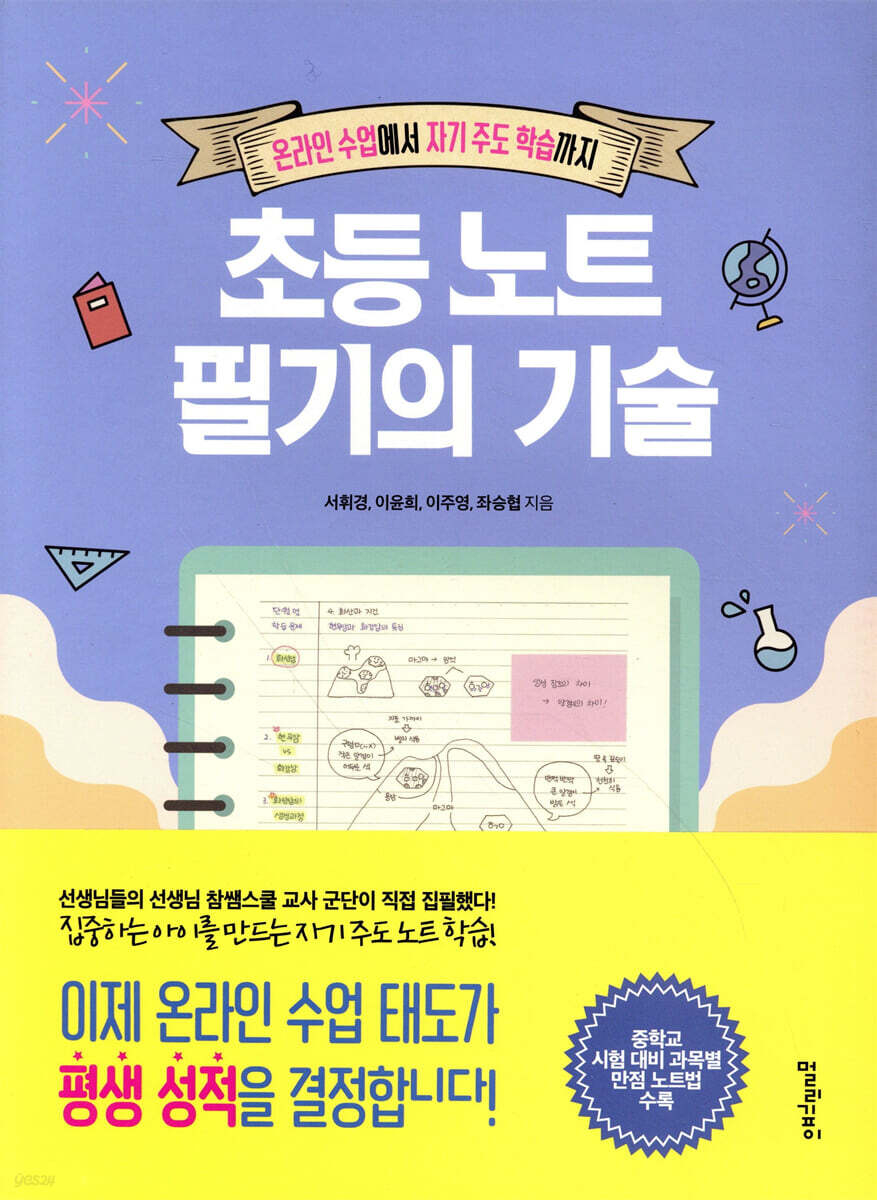
The only escape from online classes that leave moms heartbroken and children heartbroken! A self-directed note-taking method created by the "elementary school teachers' learning instructors," the ChamSamSchool Corps! "Elementary Note-Taking Skills" was published to improve our children's academic ability and concentration, which have been rapidly declining due to the prolonged online classes caused by COVID-19. The four authors who wrote the actual book are all elementary school teachers who are teaching children on the front lines. They wrote this book out of concern for our children who have become accustomed to texting on their phones and have become 'children who don't know how to write' even outside of the online learning environment. We'll teach you the best note-taking methods to establish lifelong study habits without spending a fortune or worrying about sending your child to another academy. One textbook and notebook is all you need to worry about schoolwork! This is the bible for self-directed learning. |
- You can preview some of the book's contents.
Preview
index
Preface ∥ A surefire weapon for online classes! Children who take notes become top students!
PART 1: Everything You Need to Know About Note-Organizing Before Writing
1.
Create notes tailored to your subject and purpose
01. Divide the space into 1. Take notes on the first key concept.
Second T-shaped note taking
02 How to compose your first mind map
Second Visual Thinking
Third Thinking Map
PART 2: Everything You Need to Know About Subject-Specific Note-Taking
1.
Korean language notes that are important for understanding the flow and theme of the text
01 Summary Area 02 Writing Area 03 Concept Organization Area
2.
Math notes where the principles of numbers and the definition of shapes are important
01 Number and Operation Area 02 Shape and Measurement Area 03 Measurement Area
3.
Social studies notes where visual organization, such as maps and timelines, is important
01 Geography 02 History 03 Other areas
4.
A science notebook where understanding principles and organizing observations are important.
01 Experimental Exploration Area 88 02 Concept Organization Area
5.
English notes where memorizing words and grasping key points are important
01 Words Section 02 Listening & Speaking Section 03 Reading & Writing Section
PART 3: Everything You Need to Know About Taking Notes for Exams Before Entering Middle School
1.
Note-taking for a perfect score in Korean: Thoroughly organize the works in the first textbook.
Difficult concepts such as second grammar are organized separately.
I keep a record of every book I read, even the third one.
Build your vocabulary by organizing the fourth unknown word.
2.
Incorrect Answer Notes for a Perfect Score in Math: Be sure to write down the reason for your first mistake.
Let's summarize the second key point.
3.
Social Studies? Science Note-taking: Organize the first key word perfectly.
Create a second blank and do a self-evaluation.
Let's summarize the third incorrect question and the reasons.
4.
Note-taking for a perfect score in English: Memorize vocabulary using cellophane paper for the first time.
Use the second note fold to memorize the words.
PART 4: Special Lecture for Perfect Preparation for Online Classes
How to participate in class and use a smart pad
Complete online class mastery: Join classes via ZOOM
Participate in class with Padlet
Mastering Tablet Usage: Using the GoodNotes App
Using the iPad Notes App
Using the Galaxy Tab S Note App
Acknowledgements
PART 1: Everything You Need to Know About Note-Organizing Before Writing
1.
Create notes tailored to your subject and purpose
01. Divide the space into 1. Take notes on the first key concept.
Second T-shaped note taking
02 How to compose your first mind map
Second Visual Thinking
Third Thinking Map
PART 2: Everything You Need to Know About Subject-Specific Note-Taking
1.
Korean language notes that are important for understanding the flow and theme of the text
01 Summary Area 02 Writing Area 03 Concept Organization Area
2.
Math notes where the principles of numbers and the definition of shapes are important
01 Number and Operation Area 02 Shape and Measurement Area 03 Measurement Area
3.
Social studies notes where visual organization, such as maps and timelines, is important
01 Geography 02 History 03 Other areas
4.
A science notebook where understanding principles and organizing observations are important.
01 Experimental Exploration Area 88 02 Concept Organization Area
5.
English notes where memorizing words and grasping key points are important
01 Words Section 02 Listening & Speaking Section 03 Reading & Writing Section
PART 3: Everything You Need to Know About Taking Notes for Exams Before Entering Middle School
1.
Note-taking for a perfect score in Korean: Thoroughly organize the works in the first textbook.
Difficult concepts such as second grammar are organized separately.
I keep a record of every book I read, even the third one.
Build your vocabulary by organizing the fourth unknown word.
2.
Incorrect Answer Notes for a Perfect Score in Math: Be sure to write down the reason for your first mistake.
Let's summarize the second key point.
3.
Social Studies? Science Note-taking: Organize the first key word perfectly.
Create a second blank and do a self-evaluation.
Let's summarize the third incorrect question and the reasons.
4.
Note-taking for a perfect score in English: Memorize vocabulary using cellophane paper for the first time.
Use the second note fold to memorize the words.
PART 4: Special Lecture for Perfect Preparation for Online Classes
How to participate in class and use a smart pad
Complete online class mastery: Join classes via ZOOM
Participate in class with Padlet
Mastering Tablet Usage: Using the GoodNotes App
Using the iPad Notes App
Using the Galaxy Tab S Note App
Acknowledgements
Detailed image

Publisher's Review
The writing skills to create a 'perfect one-page notebook'
It determines your child's grades for the rest of his or her life!
Self-directed note-taking that fully reflects the rapidly changing classroom environment.
A more user-friendly handwriting bible created by elementary school teachers
Ms. Son, a working mother raising children in the 5th and 6th grades in Gyeonggi Province, was shocked when she recently visited her child's e-learning site.
The average class participation rate was only 64%.
"No, you're saying that 4 out of 10 students don't attend class at all?" Surprised, Mr. Son also went to his 6th grader's e-learning site.
The class participation rate of sixth graders, who are about to enter middle school, was only 82%.
"If these are the kids who don't even log in, is my child receiving proper instruction?" Son was overcome with worry.
Teachers' concerns are also considerable.
Recently, a post full of concerns was posted on a prospective teacher cafe with 110,000 members.
The author, who introduced herself as a new teacher in charge of upper elementary school students, expressed her concerns, saying, "I'm worried because my kids aren't doing their homework, so they don't answer my calls or respond to my texts," and "I'm worried about how to teach kids who are late or don't come to Zoom classes."
"Elementary Note-Taking Skills: From Online Classes to Self-Directed Learning" (published by Geuri Deep, 2020) was published to improve the academic abilities and concentration of our children, who have been rapidly declining due to the prolonged online classes caused by COVID-19.
The four authors who wrote the actual book are all elementary school teachers who are teaching children on the front lines. They wrote this book out of concern for our children who have become accustomed to texting on their phones and have become 'children who don't know how to write' even outside of the online learning environment.
Author Seunghyeop Jo, who wrote the book's foreword, said, "One thing I've learned through experience over my long career as a teacher is that 'children who study well are bound to be children who are good at taking notes,'" and added, "The key to becoming an excellent student is being able to organize what you've heard for an hour into a one-page notebook."
The area of online education will inevitably expand in the future, and parents will feel frustrated every time they see their children staring blankly at a monitor screen.
But if a child can make a perfect one-page note, the classroom environment doesn't matter.
Rather, this crisis could be a golden opportunity to develop excellent study habits that will last a lifetime.
Let's teach you how to create a perfect one-page notebook through "Elementary Note-Taking Skills."
It will become the cornerstone for a child to grow into a child who can do well on his own and focus.
A surefire way for middle-class children to grow and study!
A self-directed note-taking guide for each subject to help you develop your study skills!
"My smart child, why aren't they getting good grades?" This is the so-called "middle-class dilemma" that many parents worry about.
When you feel like you just need a little effort but are wondering how to help, note-taking is the most reliable prescription.
According to the author, note-taking itself is a means of memorization and organization, and a tool for developing systematic thinking and creativity.
The primary purpose of taking notes is to organize what you hear, but the more you take notes, the more systematic and creative your understanding of the learning becomes.
"Elementary Note-Taking Skills" categorizes the major areas of Korean, Math, Social Studies, Science, and English, and systematically guides you through what to check in your textbooks and notes before, during, and after class.
For example, in the Korean language section, the areas of Korean language learning are categorized into 'summarizing', 'writing', and 'concept organization', and in the 'summarizing' class, the teacher provides detailed information on what content to pay close attention to and what notes to take.
In the same vein, after reviewing the 'Writing' section of this book, you will be able to quickly write a well-organized piece of writing based on the content you have marked in the textbook and organized in your notes.
Detailed note-taking methods tailored to the characteristics of each subject are included, including math and science, which require conceptual understanding, and social studies and English, which require memorization skills.
For middle-class children, elementary school is a crucial time to build the basic physical strength to endure middle and high school, and to acquire the confidence and attitude that will determine their lifelong academic ability.
The art of note-taking is the best and most effective way for middle-class children to learn independently, and it can be a powerful weapon for parents who are torn between paying for expensive private academy classes and neglecting their children.
Makes you a kid waiting for your report card
Includes a perfect note-taking method for preparing for the middle school exam!
The book includes a 'perfect score note-taking method for each subject' to help children prepare for the first exam they will take when they enter middle school without panicking.
In the Korean language section, we provide guidance on how to organize difficult concepts such as grammar and unfamiliar vocabulary, and we carefully introduce, with examples, how to create a math error notebook without much effort.
For the social studies and science sections, which have a lot of memorization elements such as maps, timelines, and experimental observations, there is a neat method for writing memorization notes that can be looked at 5 minutes before the test begins.
In the English section, it provides a method to memorize a large number of words at once by using cellophane and folded notebooks, providing a simple but reliable memorization tip for children who dislike English because of the vocabulary memorization.
Tips for Raising Children Who Attend Online Classes
1.
Before class, I look over the textbook in advance.
2.
During class, important content is checked using simple symbols.
3.
After class, I organize my notes using the key concept note-taking method.
4.
Check what you have learned through one-line summaries and self-evaluations.
5.
If you have any questions during online classes, write them down on a post-it note and ask the teacher on the first day of school.
6.
Complex maps are simplified, and historical events are organized into a timeline.
7.
Memorizing English words uses cellophane.
8.
The error note is selected from problems that are easy to understand the concept.
9.
Let's use a tablet PC and a note app.
10.
The habit of organizing the books you read is the foundation of learning any subject.
It determines your child's grades for the rest of his or her life!
Self-directed note-taking that fully reflects the rapidly changing classroom environment.
A more user-friendly handwriting bible created by elementary school teachers
Ms. Son, a working mother raising children in the 5th and 6th grades in Gyeonggi Province, was shocked when she recently visited her child's e-learning site.
The average class participation rate was only 64%.
"No, you're saying that 4 out of 10 students don't attend class at all?" Surprised, Mr. Son also went to his 6th grader's e-learning site.
The class participation rate of sixth graders, who are about to enter middle school, was only 82%.
"If these are the kids who don't even log in, is my child receiving proper instruction?" Son was overcome with worry.
Teachers' concerns are also considerable.
Recently, a post full of concerns was posted on a prospective teacher cafe with 110,000 members.
The author, who introduced herself as a new teacher in charge of upper elementary school students, expressed her concerns, saying, "I'm worried because my kids aren't doing their homework, so they don't answer my calls or respond to my texts," and "I'm worried about how to teach kids who are late or don't come to Zoom classes."
"Elementary Note-Taking Skills: From Online Classes to Self-Directed Learning" (published by Geuri Deep, 2020) was published to improve the academic abilities and concentration of our children, who have been rapidly declining due to the prolonged online classes caused by COVID-19.
The four authors who wrote the actual book are all elementary school teachers who are teaching children on the front lines. They wrote this book out of concern for our children who have become accustomed to texting on their phones and have become 'children who don't know how to write' even outside of the online learning environment.
Author Seunghyeop Jo, who wrote the book's foreword, said, "One thing I've learned through experience over my long career as a teacher is that 'children who study well are bound to be children who are good at taking notes,'" and added, "The key to becoming an excellent student is being able to organize what you've heard for an hour into a one-page notebook."
The area of online education will inevitably expand in the future, and parents will feel frustrated every time they see their children staring blankly at a monitor screen.
But if a child can make a perfect one-page note, the classroom environment doesn't matter.
Rather, this crisis could be a golden opportunity to develop excellent study habits that will last a lifetime.
Let's teach you how to create a perfect one-page notebook through "Elementary Note-Taking Skills."
It will become the cornerstone for a child to grow into a child who can do well on his own and focus.
A surefire way for middle-class children to grow and study!
A self-directed note-taking guide for each subject to help you develop your study skills!
"My smart child, why aren't they getting good grades?" This is the so-called "middle-class dilemma" that many parents worry about.
When you feel like you just need a little effort but are wondering how to help, note-taking is the most reliable prescription.
According to the author, note-taking itself is a means of memorization and organization, and a tool for developing systematic thinking and creativity.
The primary purpose of taking notes is to organize what you hear, but the more you take notes, the more systematic and creative your understanding of the learning becomes.
"Elementary Note-Taking Skills" categorizes the major areas of Korean, Math, Social Studies, Science, and English, and systematically guides you through what to check in your textbooks and notes before, during, and after class.
For example, in the Korean language section, the areas of Korean language learning are categorized into 'summarizing', 'writing', and 'concept organization', and in the 'summarizing' class, the teacher provides detailed information on what content to pay close attention to and what notes to take.
In the same vein, after reviewing the 'Writing' section of this book, you will be able to quickly write a well-organized piece of writing based on the content you have marked in the textbook and organized in your notes.
Detailed note-taking methods tailored to the characteristics of each subject are included, including math and science, which require conceptual understanding, and social studies and English, which require memorization skills.
For middle-class children, elementary school is a crucial time to build the basic physical strength to endure middle and high school, and to acquire the confidence and attitude that will determine their lifelong academic ability.
The art of note-taking is the best and most effective way for middle-class children to learn independently, and it can be a powerful weapon for parents who are torn between paying for expensive private academy classes and neglecting their children.
Makes you a kid waiting for your report card
Includes a perfect note-taking method for preparing for the middle school exam!
The book includes a 'perfect score note-taking method for each subject' to help children prepare for the first exam they will take when they enter middle school without panicking.
In the Korean language section, we provide guidance on how to organize difficult concepts such as grammar and unfamiliar vocabulary, and we carefully introduce, with examples, how to create a math error notebook without much effort.
For the social studies and science sections, which have a lot of memorization elements such as maps, timelines, and experimental observations, there is a neat method for writing memorization notes that can be looked at 5 minutes before the test begins.
In the English section, it provides a method to memorize a large number of words at once by using cellophane and folded notebooks, providing a simple but reliable memorization tip for children who dislike English because of the vocabulary memorization.
Tips for Raising Children Who Attend Online Classes
1.
Before class, I look over the textbook in advance.
2.
During class, important content is checked using simple symbols.
3.
After class, I organize my notes using the key concept note-taking method.
4.
Check what you have learned through one-line summaries and self-evaluations.
5.
If you have any questions during online classes, write them down on a post-it note and ask the teacher on the first day of school.
6.
Complex maps are simplified, and historical events are organized into a timeline.
7.
Memorizing English words uses cellophane.
8.
The error note is selected from problems that are easy to understand the concept.
9.
Let's use a tablet PC and a note app.
10.
The habit of organizing the books you read is the foundation of learning any subject.
GOODS SPECIFICS
- Publication date: October 28, 2020
- Page count, weight, size: 160 pages | 440g | 188*257*10mm
- ISBN13: 9791197139666
- ISBN10: 1197139664
- KC Certification: Certification Type: Conformity Confirmation
You may also like
카테고리
korean


korean

![GQ KOREA Mark (Monthly): December [2025]](http://librairie.coreenne.fr/cdn/shop/files/8ef265dbbfbf186523ed75ba7319009d.jpg?v=1765340328&width=3840)


