

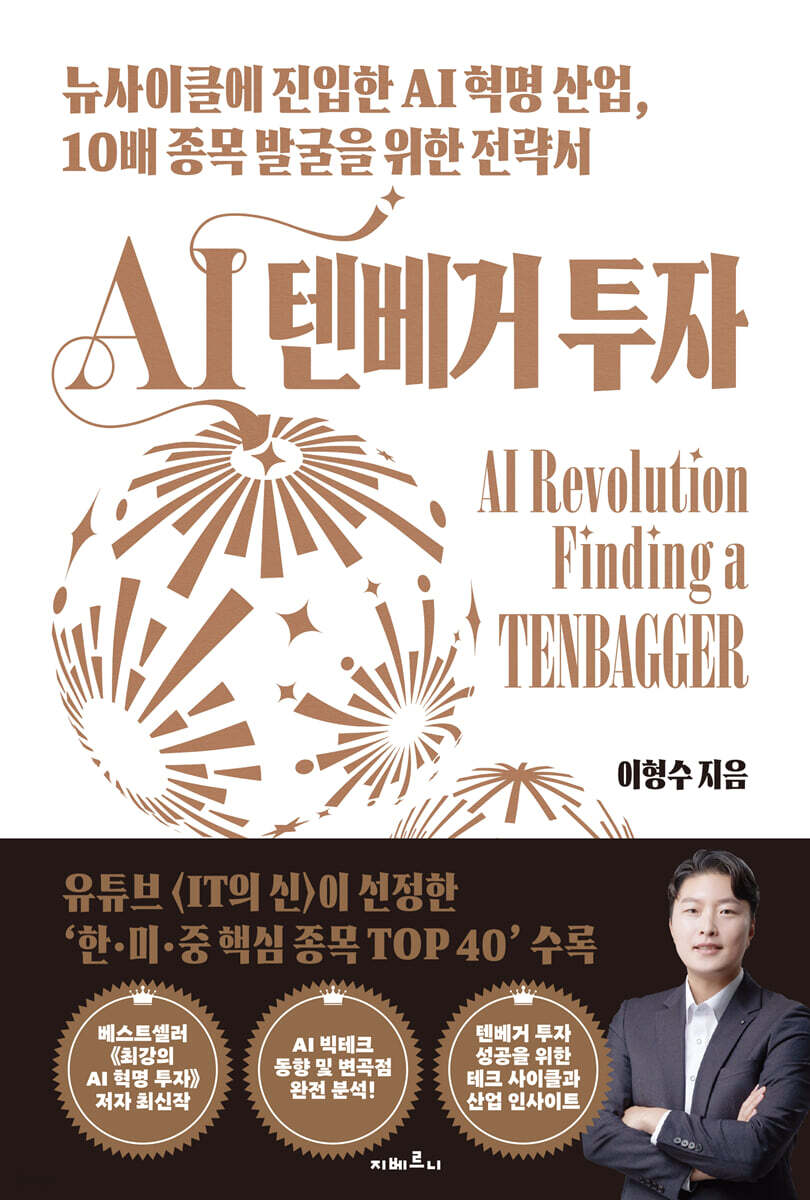
AI Tenbeger Investment
 |
Description
Book Introduction
★15.5 million cumulative YouTube views, 130,000 subscribers (God of IT)
★Complete analysis of AI big tech trends and inflection points!
★The latest work from the author of the bestselling books "Investing in the AI Revolution" and "The Most Powerful Semiconductor Investment You Can Use Right Away."
The Internet revolution of the 1990s created a huge bubble.
But those sprouts grew into global companies like Google, Amazon, and Meta.
The mobile revolution of the 2000s brought about a different response.
Recognizing the value of the platform, new unicorns like Uber and Airbnb were born.
The AI revolution of the 2020s is at the beginning of the second of five stages.
There is no set future.
But everything is moving towards AI.
"AI Ten-Bagger Investment" provides crucial insights to investors seeking to seize opportunities amidst technological changes where the two axes of "AI" and "investment" converge.
As an expert well-versed in the trends of IT technology and industry, the author sheds light on the current global shock caused by China's DeepSec and the start of President Trump's second term, and offers insight into the AI revolution industry entering a new cycle.
The book first examines the present and future of artificial intelligence and examines how the technology is reshaping entire industries.
In particular, noteworthy technological trends such as 'Large Language Models (LLM)', 'Generative AI', and 'AI Semiconductors' are analyzed in detail.
These technologies don't just open up new industries; they disrupt and reshape existing ones, creating new winners and losers.
The author goes further, focusing on leading companies in the AI industry and explaining how they lead the market and create value.
In particular, it highlights the roles of AI semiconductor company NVIDIA, cloud infrastructure companies, OpenAI, and various startups.
We analyze the value, growth potential, and even risks of these companies using data.
The core of this book is, ultimately, 'How to find the AI Tenbeger of the future.'
Rather than simply a technical guide, it poses a practical question to readers: “Which companies will be the Googles, Amazons, and Teslas of the future?”
It also contains a wealth of knowledge necessary for practical investment, including AI-related ETFs, corporate valuation, and cycle analysis.
In an era where investing without a thorough understanding of technology is difficult, "AI Ten-Bagger Investment" will serve as a powerful compass for readers seeking to simultaneously grasp the essence of technology and investment opportunities.
★Complete analysis of AI big tech trends and inflection points!
★The latest work from the author of the bestselling books "Investing in the AI Revolution" and "The Most Powerful Semiconductor Investment You Can Use Right Away."
The Internet revolution of the 1990s created a huge bubble.
But those sprouts grew into global companies like Google, Amazon, and Meta.
The mobile revolution of the 2000s brought about a different response.
Recognizing the value of the platform, new unicorns like Uber and Airbnb were born.
The AI revolution of the 2020s is at the beginning of the second of five stages.
There is no set future.
But everything is moving towards AI.
"AI Ten-Bagger Investment" provides crucial insights to investors seeking to seize opportunities amidst technological changes where the two axes of "AI" and "investment" converge.
As an expert well-versed in the trends of IT technology and industry, the author sheds light on the current global shock caused by China's DeepSec and the start of President Trump's second term, and offers insight into the AI revolution industry entering a new cycle.
The book first examines the present and future of artificial intelligence and examines how the technology is reshaping entire industries.
In particular, noteworthy technological trends such as 'Large Language Models (LLM)', 'Generative AI', and 'AI Semiconductors' are analyzed in detail.
These technologies don't just open up new industries; they disrupt and reshape existing ones, creating new winners and losers.
The author goes further, focusing on leading companies in the AI industry and explaining how they lead the market and create value.
In particular, it highlights the roles of AI semiconductor company NVIDIA, cloud infrastructure companies, OpenAI, and various startups.
We analyze the value, growth potential, and even risks of these companies using data.
The core of this book is, ultimately, 'How to find the AI Tenbeger of the future.'
Rather than simply a technical guide, it poses a practical question to readers: “Which companies will be the Googles, Amazons, and Teslas of the future?”
It also contains a wealth of knowledge necessary for practical investment, including AI-related ETFs, corporate valuation, and cycle analysis.
In an era where investing without a thorough understanding of technology is difficult, "AI Ten-Bagger Investment" will serve as a powerful compass for readers seeking to simultaneously grasp the essence of technology and investment opportunities.
- You can preview some of the book's contents.
Preview
index
Praise for this book 4
Finishing up writing "AI Ten-Bagger Investment" 14
Prologue: The AI Revolution: No Set Future 24
PART 1
The misconception that the AI semiconductor era is over
Chapter 1: South Korea in Crisis Amid Trump's Restructuring of the World Order
The Age of Elegant Hypocrisy Gone, the Age of Honest Barbarism Arrives 36
Trump and the AI Revolution Are a Perfect Match 44
AI will contribute $20 trillion to the global economy by 2030.
[IT God] Selects the 'Top 40 Key Stocks in Korea, the US, and China' 51
Chapter 2: The Misconception That the AI Semiconductor Era Is Over
AI Cycle: A New Leading Player Competition 54
The AI revolution is ripening in the US.
The AI Arms Race: A Difference Between Investors and Engineers
How far has AI progressed toward AGI? 67
Polarization of demand between AI and non-AI 70
The government's role in the AI war is changing.
[IT God] Selects the Top 40 Key Stocks in Korea, the US, and China 76
Chapter 3: China's DeepSec Counterattack: Changing the Tide of the AI Revolution
DeepSec Shock: What Did the US Tech Market Miss? 82
The US-led AI revolution is accelerating competitively.
Impact on Nvidia, TSMC, and SK Hynix 91
China's AI 94 Leads Open Source
[IT God] Selects the Top 40 Key Stocks in Korea, the US, and China 96
PART 2
Don't doubt the flow of AI investment.
Chapter 4: Demand for AI Infrastructure is Strong
Project Name: "Stargate" Brings Together 104 Leading AI Companies
Stargate's first data center will be equipped with 400,000 GPUs.
Elon Musk's Grok, xAI, and GPU 110
NVIDIA Blackwell: What It Means to Sell Out for the First Year 111
Big Tech's Big Four Invest 288 Trillion Won in AI Money War
Jack Ma returns after seven years, attracting a flood of investment in AI servers from China.
Europe Regrets AI Regulation, Belatedly Invests Large-Scale 115
India Aims to Build the World's Largest AI Data Center
"Don't Believe the Flow of AI Infrastructure Investment" 119
HBM oversupply is unrealistic 124
Universal memory turnaround also gets faster 126
[IT God] Selects the Top 40 Key Stocks in Korea, the US, and China 128
Chapter 5: Will Glass Substrates Follow HBM in the Korean Stock Market?
The Rapid Rise of the Glass Substrate Market 134
Benefiting Small and Medium-sized Enterprises 141
Samsung Electronics to directly enter the glass substrate market? 143
The Next Step in the AI Revolution: Reducing Network Bottlenecks 145
Server networking technology grows in importance 146
Photovoltaic Device Technology Innovations Benefit Broadcom and Marvell Technologies 150
Broadcom and Marvell Earnings Draw Mixed Market Reactions 151
Optical Semiconductor Development Speed Race 154
[IT God] Selects the Top 40 Key Stocks in Korea, the US, and China 156
Chapter 6: ASIC Chips Becoming More Powerful for AI Inference
TSMC's largest customer shifts from Apple to NVIDIA.
169 Tech Companies Focusing on Developing Their Own AI Chips
ASIC Growth Doesn't Mean Nvidia's Weakness 172
What are Samsung Foundry's opportunities in the ASIC market? 176
[IT God] Selects the 'Top 40 Key Stocks in Korea, the US, and China' 184
PART 3
It all depends on semiconductors
Chapter 7: Will the On-Device AI Boom Come in 2025?
It All Depends on Semiconductors 192
The Second HBM? NVIDIA Commercializes SOCAMM, On-Demand Memory
NVIDIA Adopts Micron's SOCAMM for GB300 197
Samsung Electronics vs. SK Hynix: On-Device AI Custom Memory War 198
[IT God] Selected the 'Top 40 Key Stocks in Korea, the US, and China' 202
Chapter 8: South Korea's Fall from the AI Revolution
Korea, lagging behind, needs a breakthrough in public-private cooperation. 210
Early launch of the National AI Computing Center within the year, with a surge in participation.
SK Hynix's Yongin Semiconductor Cluster Supports National Industrial Complex-Level Infrastructure 217
The AI Revolution is a War Against Government: The US Government's Quest to Save Intel 218
Samsung Foundry Continues its Lonely Fight 222
[IT God] Selects the Top 40 Key Stocks in Korea, the US, and China 224
Chapter 9: The Era of Perpetual Second-Ranking Companies Becoming Leading Players in the AI Revolution
SK Hynix's HBM technology outperforms its competitors by 8.8x.
SK Hynix Leads Memory Foundry 234
Samsung Electronics' 1C DRAM mass production schedule delayed by six months.
Legacy memory rebound provides Samsung Electronics with a breath of fresh air.
Chinese memory supply increases, centered on mobile devices.
The Big Three Memory Companies Increase Their Share of Outsourced Packaging 243
Micron's power outage cuts production, leading to YMTC price hikes of 245.
[IT God] Selects the 'Top 40 Key Stocks in Korea, the US, and China' 246
PART 4
It's written as AI revolution, but read as Tenbeger.
Chapter 10: The Threat of China's AI and Semiconductors? Now Is the Time to Learn
Korea's semiconductor technology foundation lags behind China's in all areas.
Jack Ma's Return, Explosive China Tech Rally 260
US Semiconductor Sanctions? Responding with a Bulk of General-Purpose Chips 265
CXMT's DRAM Market Entry: Like a Special Forces Operation 266
Samsung Electronics, the world's leading NAND flash company, is using its patents in China.
The background of YMTC's quantum leap in technology is Chinese-made equipment 268.
The US formalizes HBM export restrictions to China.
[IT God] Selects the 'Top 40 Key Stocks in Korea, the US, and China' 273
Chapter 11: The AI Revolution Brings a Celebration to the Power Infrastructure Industry
Trump Declares 'National Energy Emergency' 286
The AI revolution and manufacturing reshoring are collaborating to drive a surge in electricity demand in the US.
Data Center REITs Raise Rents Amid Surge in AI Demand
Uncontrollable surge in power demand 294
AI Neocloud, a new AI accelerator demand source 299
[IT God] Selected the 'Top 40 Key Stocks in Korea, the US, and China' 300
Epilogue _ The US-China Hegemony War in AI and the Cold War's Nuclear Developments Are Similar 308
Search 312
Finishing up writing "AI Ten-Bagger Investment" 14
Prologue: The AI Revolution: No Set Future 24
PART 1
The misconception that the AI semiconductor era is over
Chapter 1: South Korea in Crisis Amid Trump's Restructuring of the World Order
The Age of Elegant Hypocrisy Gone, the Age of Honest Barbarism Arrives 36
Trump and the AI Revolution Are a Perfect Match 44
AI will contribute $20 trillion to the global economy by 2030.
[IT God] Selects the 'Top 40 Key Stocks in Korea, the US, and China' 51
Chapter 2: The Misconception That the AI Semiconductor Era Is Over
AI Cycle: A New Leading Player Competition 54
The AI revolution is ripening in the US.
The AI Arms Race: A Difference Between Investors and Engineers
How far has AI progressed toward AGI? 67
Polarization of demand between AI and non-AI 70
The government's role in the AI war is changing.
[IT God] Selects the Top 40 Key Stocks in Korea, the US, and China 76
Chapter 3: China's DeepSec Counterattack: Changing the Tide of the AI Revolution
DeepSec Shock: What Did the US Tech Market Miss? 82
The US-led AI revolution is accelerating competitively.
Impact on Nvidia, TSMC, and SK Hynix 91
China's AI 94 Leads Open Source
[IT God] Selects the Top 40 Key Stocks in Korea, the US, and China 96
PART 2
Don't doubt the flow of AI investment.
Chapter 4: Demand for AI Infrastructure is Strong
Project Name: "Stargate" Brings Together 104 Leading AI Companies
Stargate's first data center will be equipped with 400,000 GPUs.
Elon Musk's Grok, xAI, and GPU 110
NVIDIA Blackwell: What It Means to Sell Out for the First Year 111
Big Tech's Big Four Invest 288 Trillion Won in AI Money War
Jack Ma returns after seven years, attracting a flood of investment in AI servers from China.
Europe Regrets AI Regulation, Belatedly Invests Large-Scale 115
India Aims to Build the World's Largest AI Data Center
"Don't Believe the Flow of AI Infrastructure Investment" 119
HBM oversupply is unrealistic 124
Universal memory turnaround also gets faster 126
[IT God] Selects the Top 40 Key Stocks in Korea, the US, and China 128
Chapter 5: Will Glass Substrates Follow HBM in the Korean Stock Market?
The Rapid Rise of the Glass Substrate Market 134
Benefiting Small and Medium-sized Enterprises 141
Samsung Electronics to directly enter the glass substrate market? 143
The Next Step in the AI Revolution: Reducing Network Bottlenecks 145
Server networking technology grows in importance 146
Photovoltaic Device Technology Innovations Benefit Broadcom and Marvell Technologies 150
Broadcom and Marvell Earnings Draw Mixed Market Reactions 151
Optical Semiconductor Development Speed Race 154
[IT God] Selects the Top 40 Key Stocks in Korea, the US, and China 156
Chapter 6: ASIC Chips Becoming More Powerful for AI Inference
TSMC's largest customer shifts from Apple to NVIDIA.
169 Tech Companies Focusing on Developing Their Own AI Chips
ASIC Growth Doesn't Mean Nvidia's Weakness 172
What are Samsung Foundry's opportunities in the ASIC market? 176
[IT God] Selects the 'Top 40 Key Stocks in Korea, the US, and China' 184
PART 3
It all depends on semiconductors
Chapter 7: Will the On-Device AI Boom Come in 2025?
It All Depends on Semiconductors 192
The Second HBM? NVIDIA Commercializes SOCAMM, On-Demand Memory
NVIDIA Adopts Micron's SOCAMM for GB300 197
Samsung Electronics vs. SK Hynix: On-Device AI Custom Memory War 198
[IT God] Selected the 'Top 40 Key Stocks in Korea, the US, and China' 202
Chapter 8: South Korea's Fall from the AI Revolution
Korea, lagging behind, needs a breakthrough in public-private cooperation. 210
Early launch of the National AI Computing Center within the year, with a surge in participation.
SK Hynix's Yongin Semiconductor Cluster Supports National Industrial Complex-Level Infrastructure 217
The AI Revolution is a War Against Government: The US Government's Quest to Save Intel 218
Samsung Foundry Continues its Lonely Fight 222
[IT God] Selects the Top 40 Key Stocks in Korea, the US, and China 224
Chapter 9: The Era of Perpetual Second-Ranking Companies Becoming Leading Players in the AI Revolution
SK Hynix's HBM technology outperforms its competitors by 8.8x.
SK Hynix Leads Memory Foundry 234
Samsung Electronics' 1C DRAM mass production schedule delayed by six months.
Legacy memory rebound provides Samsung Electronics with a breath of fresh air.
Chinese memory supply increases, centered on mobile devices.
The Big Three Memory Companies Increase Their Share of Outsourced Packaging 243
Micron's power outage cuts production, leading to YMTC price hikes of 245.
[IT God] Selects the 'Top 40 Key Stocks in Korea, the US, and China' 246
PART 4
It's written as AI revolution, but read as Tenbeger.
Chapter 10: The Threat of China's AI and Semiconductors? Now Is the Time to Learn
Korea's semiconductor technology foundation lags behind China's in all areas.
Jack Ma's Return, Explosive China Tech Rally 260
US Semiconductor Sanctions? Responding with a Bulk of General-Purpose Chips 265
CXMT's DRAM Market Entry: Like a Special Forces Operation 266
Samsung Electronics, the world's leading NAND flash company, is using its patents in China.
The background of YMTC's quantum leap in technology is Chinese-made equipment 268.
The US formalizes HBM export restrictions to China.
[IT God] Selects the 'Top 40 Key Stocks in Korea, the US, and China' 273
Chapter 11: The AI Revolution Brings a Celebration to the Power Infrastructure Industry
Trump Declares 'National Energy Emergency' 286
The AI revolution and manufacturing reshoring are collaborating to drive a surge in electricity demand in the US.
Data Center REITs Raise Rents Amid Surge in AI Demand
Uncontrollable surge in power demand 294
AI Neocloud, a new AI accelerator demand source 299
[IT God] Selected the 'Top 40 Key Stocks in Korea, the US, and China' 300
Epilogue _ The US-China Hegemony War in AI and the Cold War's Nuclear Developments Are Similar 308
Search 312
Detailed image

Into the book
Technology is not a 'tool' that changes the market, but rather 'redefines' the market itself.
Technology always creates new markets and ecosystems, disrupting existing orders and establishing new rules. AI is no exception.
We are now moving beyond an era where AI simply serves as a tool to improve work efficiency and into a central axis for designing a new economic structure.
Understanding this technology accurately is key to understanding the market and determining future investment opportunities.
--- p.14
AI is not just a revolutionary technology.
It is a force that changes the fundamental constitution of industry.
Just as electricity sparked the Industrial Revolution and the Internet sparked the Information Revolution, AI will usher in a new level of productivity shock called the "Intelligence Revolution."
This will reshape how companies operate, how they relate to customers, how they design their products, and even how they operate their business models.
The changes we are witnessing now are just the beginning, and this massive wave of change will continue for the next decade or more.
--- p.22
Generative AI goes beyond simply replacing repetitive tasks; it's breaking down the boundaries of creativity, once considered a uniquely human domain.
We live in an era where AI can perform tasks such as writing, drawing, music, and even software coding.
This technology is revolutionizing not only existing content production methods, but also automating and optimizing creative activities across industries.
Humans are no longer beings who create something from nothing, but are becoming beings who coordinate and discern the something created by AI.
--- p.44
The reason Nvidia is more than just a semiconductor company is because each of its chips goes beyond simple computation and functions as the "heart" of the AI ecosystem.
The company has been providing an environment for developers, researchers, and businesses to implement AI not only through GPU hardware but also through a software platform called CUDA.
Only by combining technological prowess and ecosystem strategies can we truly achieve market leadership.
Nvidia's surge in market capitalization isn't just a triumph of technology, but a result of its strategy of creating platforms and industry standards.
--- p.66
Data is the crude oil of the AI era, and the semiconductors that process and learn from it are literally the "key currency."
Beyond the mere competition in computing performance, the gap in semiconductor supply and demand and technology is escalating into issues of national security and industrial sovereignty.
In particular, specialized semiconductors such as high-performance AI accelerators, HBM memory, and ASIC chips are positioned as strategic assets in limited supply.
For this reason, companies that dominate the semiconductor industry are becoming the new center of the AI economy.
--- p.71
There have always been promising technologies in the market, but there are other conditions that need to be met for them to become ten-baggers.
It is a business model innovation.
No matter how excellent the technology is, if there is no structure to monetize it, it will be ignored by the market.
Conversely, companies that accurately recognize existing market problems, solve them with technology, and generate profits experience explosive growth in the market.
Tenbeger was born at this very point, at the intersection of technology and business.
--- p.90
Even when using the same AI technology, some companies simply use it as a means to improve efficiency, while others place it at the center of their business strategies.
The latter companies use AI as a kind of "operating system" throughout the entire process, including data collection, analysis, product improvement, and customer prediction.
Ultimately, a company's growth trajectory will inevitably differ depending on its attitude toward AI.
Companies that embrace technology as their philosophy are the ones that bring about real change.
--- p.94
AI-related industries are highly fragmented, spanning semiconductors, software, data centers, power, and robotics.
Analyzing and approaching each company and sector individually is a burden for general investors.
ETFs are a good alternative in this case.
ETFs structured around specific themes capture industry-wide trends while also diversifying risk. This is why AI investments are widely applicable to everyone, from beginners to intermediate investors.
--- p.108
Bubbles have always existed throughout the history of investing, including the IT bubble, the real estate bubble, and the cryptocurrency bubble.
But the technology at the heart of the bubble should never be ignored.
Just as Amazon and Google were born in the internet bubble, and Apple and Netflix in the mobile bubble, the current AI bubble is clearly giving birth to the next era.
The key is not to avoid bubbles, but to have the discernment to identify the real technologies and companies at their core.
--- p.120
Unlike investments that focus on short-term returns, Tenweger investing is a mental exercise that predicts the future direction of industries and provides insight into the nature of change.
This requires a broader perspective that goes beyond corporate performance to encompass technology, policy, demographics, and world order.
Ultimately, Tenbeger is not about buying "stocks," but rather "paradigm inflection points," and this requires deeper insight and study than just news or stock price graphs.
Only those who can buy into the future can reap overwhelming profits.
Technology always creates new markets and ecosystems, disrupting existing orders and establishing new rules. AI is no exception.
We are now moving beyond an era where AI simply serves as a tool to improve work efficiency and into a central axis for designing a new economic structure.
Understanding this technology accurately is key to understanding the market and determining future investment opportunities.
--- p.14
AI is not just a revolutionary technology.
It is a force that changes the fundamental constitution of industry.
Just as electricity sparked the Industrial Revolution and the Internet sparked the Information Revolution, AI will usher in a new level of productivity shock called the "Intelligence Revolution."
This will reshape how companies operate, how they relate to customers, how they design their products, and even how they operate their business models.
The changes we are witnessing now are just the beginning, and this massive wave of change will continue for the next decade or more.
--- p.22
Generative AI goes beyond simply replacing repetitive tasks; it's breaking down the boundaries of creativity, once considered a uniquely human domain.
We live in an era where AI can perform tasks such as writing, drawing, music, and even software coding.
This technology is revolutionizing not only existing content production methods, but also automating and optimizing creative activities across industries.
Humans are no longer beings who create something from nothing, but are becoming beings who coordinate and discern the something created by AI.
--- p.44
The reason Nvidia is more than just a semiconductor company is because each of its chips goes beyond simple computation and functions as the "heart" of the AI ecosystem.
The company has been providing an environment for developers, researchers, and businesses to implement AI not only through GPU hardware but also through a software platform called CUDA.
Only by combining technological prowess and ecosystem strategies can we truly achieve market leadership.
Nvidia's surge in market capitalization isn't just a triumph of technology, but a result of its strategy of creating platforms and industry standards.
--- p.66
Data is the crude oil of the AI era, and the semiconductors that process and learn from it are literally the "key currency."
Beyond the mere competition in computing performance, the gap in semiconductor supply and demand and technology is escalating into issues of national security and industrial sovereignty.
In particular, specialized semiconductors such as high-performance AI accelerators, HBM memory, and ASIC chips are positioned as strategic assets in limited supply.
For this reason, companies that dominate the semiconductor industry are becoming the new center of the AI economy.
--- p.71
There have always been promising technologies in the market, but there are other conditions that need to be met for them to become ten-baggers.
It is a business model innovation.
No matter how excellent the technology is, if there is no structure to monetize it, it will be ignored by the market.
Conversely, companies that accurately recognize existing market problems, solve them with technology, and generate profits experience explosive growth in the market.
Tenbeger was born at this very point, at the intersection of technology and business.
--- p.90
Even when using the same AI technology, some companies simply use it as a means to improve efficiency, while others place it at the center of their business strategies.
The latter companies use AI as a kind of "operating system" throughout the entire process, including data collection, analysis, product improvement, and customer prediction.
Ultimately, a company's growth trajectory will inevitably differ depending on its attitude toward AI.
Companies that embrace technology as their philosophy are the ones that bring about real change.
--- p.94
AI-related industries are highly fragmented, spanning semiconductors, software, data centers, power, and robotics.
Analyzing and approaching each company and sector individually is a burden for general investors.
ETFs are a good alternative in this case.
ETFs structured around specific themes capture industry-wide trends while also diversifying risk. This is why AI investments are widely applicable to everyone, from beginners to intermediate investors.
--- p.108
Bubbles have always existed throughout the history of investing, including the IT bubble, the real estate bubble, and the cryptocurrency bubble.
But the technology at the heart of the bubble should never be ignored.
Just as Amazon and Google were born in the internet bubble, and Apple and Netflix in the mobile bubble, the current AI bubble is clearly giving birth to the next era.
The key is not to avoid bubbles, but to have the discernment to identify the real technologies and companies at their core.
--- p.120
Unlike investments that focus on short-term returns, Tenweger investing is a mental exercise that predicts the future direction of industries and provides insight into the nature of change.
This requires a broader perspective that goes beyond corporate performance to encompass technology, policy, demographics, and world order.
Ultimately, Tenbeger is not about buying "stocks," but rather "paradigm inflection points," and this requires deeper insight and study than just news or stock price graphs.
Only those who can buy into the future can reap overwhelming profits.
--- p.126
Publisher's Review
Technology always creates new markets.
Technology always creates new markets and has the power to dismantle and reorganize existing industrial structures.
Just as the internet revolution of the 1990s and the mobile revolution of the 2000s did, the current AI revolution is bringing about even broader and more fundamental changes.
The author defines AI not simply as a new technology, but as a massive megatrend that will fundamentally alter the very fabric of human civilization and the economy. Beyond simply serving as a tool to enhance the profitability of specific industries, AI is creating new industrial landscapes and value chains.
Through examples of past technological innovations, it explains how "Tenbeger" stocks emerged, and emphasizes that similar opportunities are emerging in the AI industry today.
By examining how Amazon, Google, and Apple drove innovation despite market concerns, this paper provides a framework for predicting the growth potential of current AI-related companies.
The author repeatedly reminds us that technology always creates new 'questions', and that companies that answer those questions become winners, not losers, in the market.
What is Artificial Intelligence and Why is it Important?
AI is no longer a concept of the future, but rather a present-day phenomenon.
AI, once considered merely "automation" or "algorithms," is now deeply embedded in real life and across industries, including autonomous driving, voice recognition, image analysis, and recommendation systems.
This chapter provides a simple and concise explanation of core AI technologies, including generative AI, machine learning, deep learning, and LLM (Large Language Model), while analyzing in detail how they connect to actual business activities.
In particular, it presents specific examples of the productivity improvements, cost reductions, and improved customer experiences that companies can achieve when adopting AI.
The author highlights the structural transformation of human civilization brought about by AI, emphasizing that we stand at the threshold of an industrial "paradigm shift" that goes beyond short-term investment returns. The author focuses on helping readers understand the problems AI technology solves and why it is the most powerful weapon in the 21st-century economy.
Generative AI and LLM: Transforming Industries
This course delves into the structure, operating principles, and impact of generative AI, particularly LLMs like ChatGPT. LLMs are AIs that go beyond traditional search-based information consumption and are capable of directly "creating" content.
This is structurally changing countless fields, including the content industry, marketing, software development, and customer service.
In particular, AI that 'writes and speaks like a human' is emerging as a means to replace or amplify human creativity and labor, rather than simply being a helper.
The author predicts that these AI technologies will function not simply as tools, but as "platforms" and "economic entities," and introduces the newly emerging companies and business models that will result.
The author emphasizes that generative AI is also at the pinnacle of customer-tailored services, and that the companies that most effectively commercialize it are likely to become the next generation of TenBaggers.
Leading Industries and Companies in the AI Era
AI goes beyond being an independent technology and operates as a 'hub technology' that connects multiple industries.
This chapter focuses on analyzing trends in industries most closely linked to AI, such as semiconductors, cloud computing, data centers, and AI software companies.
Among them, NVIDIA is by far the most important company, recording an overwhelming share of the AI accelerator market and serving as the “heart of the infrastructure.”
The AI investment strategies of the three major cloud companies (Amazon, Microsoft, and Google) are also highlighted, explaining how the massive computing power required for AI learning is transforming these companies' business structures and profitability.
We also introduce the AI competition among Korean, US, and Chinese companies and examine national investment strategies.
The author's analysis that the key to uncovering Tenberger lies in understanding the flow of the entire industrial ecosystem, beyond simply individual companies, is impressive.
How to find AI TenBagger
'Tenbeger' is not a simple stock price increase, but a title given only to companies that change the landscape of their industries.
The author cites the following characteristics of such companies: first, innovativeness that rides the wave of industry trends; second, a strong business model and profit structure; and third, a scalable global strategy.
In particular, it is necessary to pay attention to areas that the market overlooked or underestimated before the stock price rose.
He identifies various industries as potential TenBagger candidates, including AI semiconductors (NVIDIA), cloud infrastructure companies, B2B platform companies based on AI tools, and power infrastructure REITs, and analyzes each company's performance, supply and demand, and industry position from various angles.
South Korea's Fall from the AI Revolution
This article exposes the reality that Korea is gradually falling behind in the AI industry and sharply analyzes the causes. While AI has become a key element of national competitiveness, Korea remains stuck in its manufacturing-centric structure, and both the government and businesses have inadequate investment strategies.
The author examines the current state of semiconductor clusters, AI data centers, and government-led AI projects, criticizing the lack of public-private cooperation and the lack of bold policy implementation. Compared to the US and China, which are rapidly building AI infrastructure, Korea's innovation momentum is noticeably lagging and it is hampered by regulations and bureaucracy.
Nonetheless, he emphasizes that potential still exists in terms of technological infrastructure and talent, and that strategic public-private partnerships, bold investments, and regulatory innovation are urgently needed to revive this.
An era where perennial second-place companies are emerging as leaders in the AI revolution.
In the AI industry, the technological gap and limitations of latecomers are gradually losing their meaning.
A prime example is SK Hynix. Demonstrating technological prowess even surpassing Samsung Electronics in HBM (high-bandwidth memory), SK Hynix is emerging as a key component supplier in the AI era.
In particular, it is demonstrating a competitive edge in its "memory foundry" strategy, high-performance DRAM mass production capabilities, and securing global customers, suggesting its growing importance in AI semiconductor infrastructure.
We also analyze in detail the changes in the supply structure of the three memory companies, their pricing strategies, and their competitive landscape with Chinese semiconductor companies.
The key point is that "even latecomers can become leaders in terms of technological prowess and market responsiveness," and this provides important implications for identifying future AI TenBagger candidates.
From an investor's perspective, it becomes clear why they should pay attention to the possibility of a turnaround for the "perennial second-place company."
The threat of China's AI and semiconductors? Now is the time to learn.
China has gone beyond being a threat in the AI and semiconductor industries to becoming a competitor we must learn from and be wary of.
We focus on the growth of China's AI technology and semiconductor industry structure.
Major Chinese companies such as DeepSeek, CXMT, and YMTC are rapidly narrowing the gap with the United States through technological independence and speed war strategies.
In particular, the "building of an internal ecosystem" using Chinese equipment and technology is accelerating the internalization of the industry while circumventing U.S. export restrictions.
The author emphasizes that it is now time for Korea to learn from China's strategic thinking and drive, recalling its past success as a "fast follower."
It highlights the need for an integrated strategy encompassing not only technological prowess but also the industrial ecosystem, government policies, and talent development.
From semiconductors and AI algorithms to infrastructure and the growth of domestic platform companies, China's all-out challenges are forcing a strong restructuring of Korean industries.
The AI revolution is also bringing a festival to the power infrastructure industry.
AI technology requires massive computational power, which will inevitably lead to a surge in demand for electricity. This article highlights the impact of AI on the power infrastructure industry and explains how non-IT companies, such as data center REITs, power equipment companies, and energy companies, are emerging as beneficiaries of the AI boom.
A confluence of factors, including Trump's declaration of a "national energy emergency," the reshoring of manufacturing in the US, and the high-density power demands of data centers, has made grid construction, energy storage, and supply chain expansion key requirements for the AI industry. The expansion of the AI industry isn't simply fueling the growth of tech companies; it's also providing structural opportunities for traditional industries. This suggests the possibility that new "ten-bagger" candidates could emerge from unexpected sectors.
The author emphasizes that as demand for AI accelerators grows, the value of energy and infrastructure companies supporting them will be re-evaluated.
It's written as AI revolution, but read as Tenbeger.
This paper comprehensively summarizes how the AI revolution can be interpreted as an economic opportunity, particularly an investment opportunity. Beyond technological advancement, the AI revolution is an event that is reshaping economic systems and industrial structures, opening up new wealth opportunities.
The author believes that the potential for TenBagger lies within the entire AI value chain, including AI-based platform companies, semiconductors, cloud computing, software, and power infrastructure.
Rather than simply recommending stocks, this study delves into how macroeconomic variables, such as inter-industry convergence, government policy changes, capital flows, and supply chain restructuring, impact the stock prices of specific companies.
Rather than short-term thematic AI investments, it presents a methodology for finding stocks that can be "held for the long term" within structural trends, conveying the message that TenBagger is ultimately an opportunity that only the prepared can seize.
It also contains practical insights that investors need both ‘technical acumen’ and ‘macro-awareness’ simultaneously.
The US-China hegemony war over AI and the nuclear development of the Cold War between the US and the Soviet Union are similar.
We examine the AI industry through the lens of transnational competition. AI is no longer simply a technological or industrial issue; it has become a core element of national security, politics, and military power.
The battle for AI hegemony between the United States and China is described as being similar to the nuclear development competition during the Cold War. In an era where everything—AI algorithms, data, semiconductors, and power resources—is directly linked to national defense, the pace of AI development is directly linked to a nation's standing.
The United States is seeking to maintain its tech hegemony through the Chips Act, Infrastructure Act, and various subsidies, while China is seeking self-reliance based on its own technology, equipment, and algorithms.
This warning contains that Korea urgently needs its own independent path and industrial strategy to secure 'technological security' in the meantime.
The author argues that this AI hegemony war will be a pivotal moment in redefining the global order over the next decade, and emphasizes that investors must also consider both the growth potential and risks of companies within this dynamic.
Technology always creates new markets and has the power to dismantle and reorganize existing industrial structures.
Just as the internet revolution of the 1990s and the mobile revolution of the 2000s did, the current AI revolution is bringing about even broader and more fundamental changes.
The author defines AI not simply as a new technology, but as a massive megatrend that will fundamentally alter the very fabric of human civilization and the economy. Beyond simply serving as a tool to enhance the profitability of specific industries, AI is creating new industrial landscapes and value chains.
Through examples of past technological innovations, it explains how "Tenbeger" stocks emerged, and emphasizes that similar opportunities are emerging in the AI industry today.
By examining how Amazon, Google, and Apple drove innovation despite market concerns, this paper provides a framework for predicting the growth potential of current AI-related companies.
The author repeatedly reminds us that technology always creates new 'questions', and that companies that answer those questions become winners, not losers, in the market.
What is Artificial Intelligence and Why is it Important?
AI is no longer a concept of the future, but rather a present-day phenomenon.
AI, once considered merely "automation" or "algorithms," is now deeply embedded in real life and across industries, including autonomous driving, voice recognition, image analysis, and recommendation systems.
This chapter provides a simple and concise explanation of core AI technologies, including generative AI, machine learning, deep learning, and LLM (Large Language Model), while analyzing in detail how they connect to actual business activities.
In particular, it presents specific examples of the productivity improvements, cost reductions, and improved customer experiences that companies can achieve when adopting AI.
The author highlights the structural transformation of human civilization brought about by AI, emphasizing that we stand at the threshold of an industrial "paradigm shift" that goes beyond short-term investment returns. The author focuses on helping readers understand the problems AI technology solves and why it is the most powerful weapon in the 21st-century economy.
Generative AI and LLM: Transforming Industries
This course delves into the structure, operating principles, and impact of generative AI, particularly LLMs like ChatGPT. LLMs are AIs that go beyond traditional search-based information consumption and are capable of directly "creating" content.
This is structurally changing countless fields, including the content industry, marketing, software development, and customer service.
In particular, AI that 'writes and speaks like a human' is emerging as a means to replace or amplify human creativity and labor, rather than simply being a helper.
The author predicts that these AI technologies will function not simply as tools, but as "platforms" and "economic entities," and introduces the newly emerging companies and business models that will result.
The author emphasizes that generative AI is also at the pinnacle of customer-tailored services, and that the companies that most effectively commercialize it are likely to become the next generation of TenBaggers.
Leading Industries and Companies in the AI Era
AI goes beyond being an independent technology and operates as a 'hub technology' that connects multiple industries.
This chapter focuses on analyzing trends in industries most closely linked to AI, such as semiconductors, cloud computing, data centers, and AI software companies.
Among them, NVIDIA is by far the most important company, recording an overwhelming share of the AI accelerator market and serving as the “heart of the infrastructure.”
The AI investment strategies of the three major cloud companies (Amazon, Microsoft, and Google) are also highlighted, explaining how the massive computing power required for AI learning is transforming these companies' business structures and profitability.
We also introduce the AI competition among Korean, US, and Chinese companies and examine national investment strategies.
The author's analysis that the key to uncovering Tenberger lies in understanding the flow of the entire industrial ecosystem, beyond simply individual companies, is impressive.
How to find AI TenBagger
'Tenbeger' is not a simple stock price increase, but a title given only to companies that change the landscape of their industries.
The author cites the following characteristics of such companies: first, innovativeness that rides the wave of industry trends; second, a strong business model and profit structure; and third, a scalable global strategy.
In particular, it is necessary to pay attention to areas that the market overlooked or underestimated before the stock price rose.
He identifies various industries as potential TenBagger candidates, including AI semiconductors (NVIDIA), cloud infrastructure companies, B2B platform companies based on AI tools, and power infrastructure REITs, and analyzes each company's performance, supply and demand, and industry position from various angles.
South Korea's Fall from the AI Revolution
This article exposes the reality that Korea is gradually falling behind in the AI industry and sharply analyzes the causes. While AI has become a key element of national competitiveness, Korea remains stuck in its manufacturing-centric structure, and both the government and businesses have inadequate investment strategies.
The author examines the current state of semiconductor clusters, AI data centers, and government-led AI projects, criticizing the lack of public-private cooperation and the lack of bold policy implementation. Compared to the US and China, which are rapidly building AI infrastructure, Korea's innovation momentum is noticeably lagging and it is hampered by regulations and bureaucracy.
Nonetheless, he emphasizes that potential still exists in terms of technological infrastructure and talent, and that strategic public-private partnerships, bold investments, and regulatory innovation are urgently needed to revive this.
An era where perennial second-place companies are emerging as leaders in the AI revolution.
In the AI industry, the technological gap and limitations of latecomers are gradually losing their meaning.
A prime example is SK Hynix. Demonstrating technological prowess even surpassing Samsung Electronics in HBM (high-bandwidth memory), SK Hynix is emerging as a key component supplier in the AI era.
In particular, it is demonstrating a competitive edge in its "memory foundry" strategy, high-performance DRAM mass production capabilities, and securing global customers, suggesting its growing importance in AI semiconductor infrastructure.
We also analyze in detail the changes in the supply structure of the three memory companies, their pricing strategies, and their competitive landscape with Chinese semiconductor companies.
The key point is that "even latecomers can become leaders in terms of technological prowess and market responsiveness," and this provides important implications for identifying future AI TenBagger candidates.
From an investor's perspective, it becomes clear why they should pay attention to the possibility of a turnaround for the "perennial second-place company."
The threat of China's AI and semiconductors? Now is the time to learn.
China has gone beyond being a threat in the AI and semiconductor industries to becoming a competitor we must learn from and be wary of.
We focus on the growth of China's AI technology and semiconductor industry structure.
Major Chinese companies such as DeepSeek, CXMT, and YMTC are rapidly narrowing the gap with the United States through technological independence and speed war strategies.
In particular, the "building of an internal ecosystem" using Chinese equipment and technology is accelerating the internalization of the industry while circumventing U.S. export restrictions.
The author emphasizes that it is now time for Korea to learn from China's strategic thinking and drive, recalling its past success as a "fast follower."
It highlights the need for an integrated strategy encompassing not only technological prowess but also the industrial ecosystem, government policies, and talent development.
From semiconductors and AI algorithms to infrastructure and the growth of domestic platform companies, China's all-out challenges are forcing a strong restructuring of Korean industries.
The AI revolution is also bringing a festival to the power infrastructure industry.
AI technology requires massive computational power, which will inevitably lead to a surge in demand for electricity. This article highlights the impact of AI on the power infrastructure industry and explains how non-IT companies, such as data center REITs, power equipment companies, and energy companies, are emerging as beneficiaries of the AI boom.
A confluence of factors, including Trump's declaration of a "national energy emergency," the reshoring of manufacturing in the US, and the high-density power demands of data centers, has made grid construction, energy storage, and supply chain expansion key requirements for the AI industry. The expansion of the AI industry isn't simply fueling the growth of tech companies; it's also providing structural opportunities for traditional industries. This suggests the possibility that new "ten-bagger" candidates could emerge from unexpected sectors.
The author emphasizes that as demand for AI accelerators grows, the value of energy and infrastructure companies supporting them will be re-evaluated.
It's written as AI revolution, but read as Tenbeger.
This paper comprehensively summarizes how the AI revolution can be interpreted as an economic opportunity, particularly an investment opportunity. Beyond technological advancement, the AI revolution is an event that is reshaping economic systems and industrial structures, opening up new wealth opportunities.
The author believes that the potential for TenBagger lies within the entire AI value chain, including AI-based platform companies, semiconductors, cloud computing, software, and power infrastructure.
Rather than simply recommending stocks, this study delves into how macroeconomic variables, such as inter-industry convergence, government policy changes, capital flows, and supply chain restructuring, impact the stock prices of specific companies.
Rather than short-term thematic AI investments, it presents a methodology for finding stocks that can be "held for the long term" within structural trends, conveying the message that TenBagger is ultimately an opportunity that only the prepared can seize.
It also contains practical insights that investors need both ‘technical acumen’ and ‘macro-awareness’ simultaneously.
The US-China hegemony war over AI and the nuclear development of the Cold War between the US and the Soviet Union are similar.
We examine the AI industry through the lens of transnational competition. AI is no longer simply a technological or industrial issue; it has become a core element of national security, politics, and military power.
The battle for AI hegemony between the United States and China is described as being similar to the nuclear development competition during the Cold War. In an era where everything—AI algorithms, data, semiconductors, and power resources—is directly linked to national defense, the pace of AI development is directly linked to a nation's standing.
The United States is seeking to maintain its tech hegemony through the Chips Act, Infrastructure Act, and various subsidies, while China is seeking self-reliance based on its own technology, equipment, and algorithms.
This warning contains that Korea urgently needs its own independent path and industrial strategy to secure 'technological security' in the meantime.
The author argues that this AI hegemony war will be a pivotal moment in redefining the global order over the next decade, and emphasizes that investors must also consider both the growth potential and risks of companies within this dynamic.
GOODS SPECIFICS
- Date of issue: May 9, 2025
- Page count, weight, size: 316 pages | 488g | 152*225*20mm
- ISBN13: 9791198773425
- ISBN10: 1198773421
You may also like
카테고리
korean


korean

![ELLE 엘르 스페셜 에디션 A형 : 12월 [2025]](http://librairie.coreenne.fr/cdn/shop/files/b8e27a3de6c9538896439686c6b0e8fb.jpg?v=1766436872&width=3840)


