

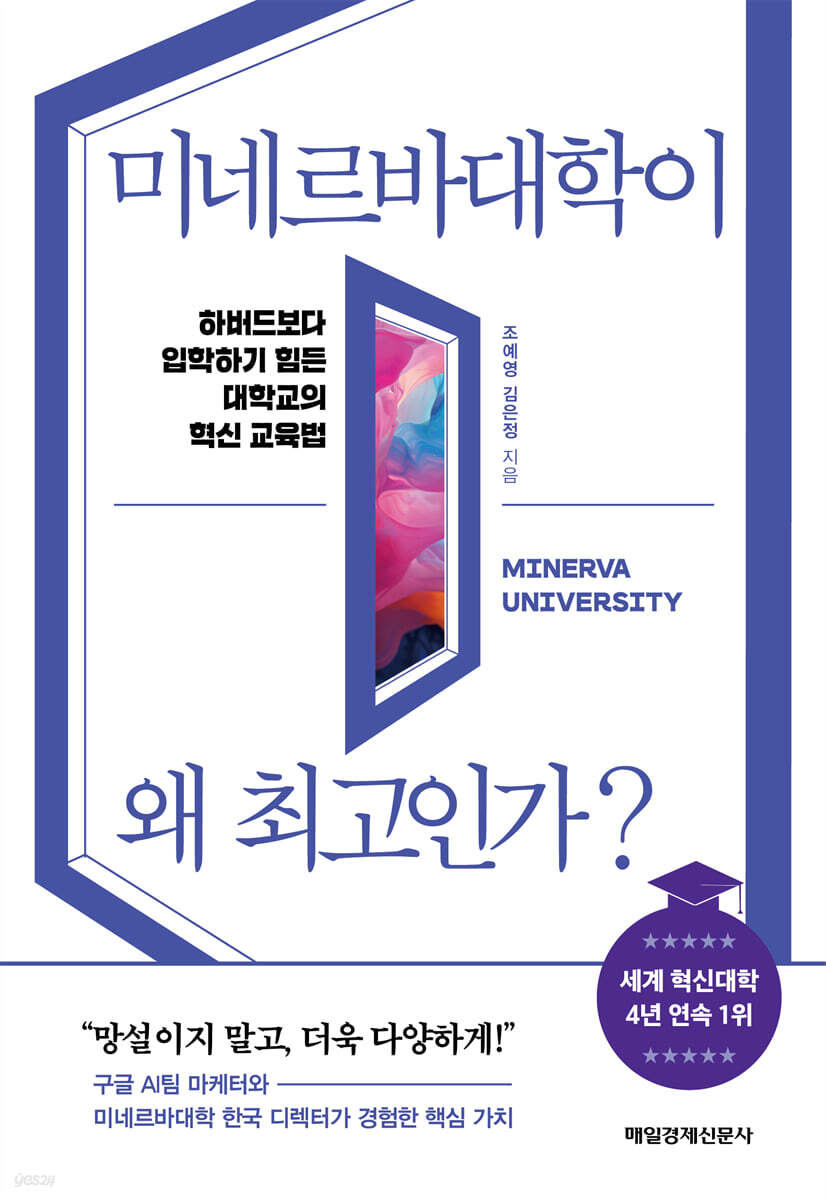
Why is Minerva University the best?
 |
Description
Book Introduction
Minerva University: 21st-Century Education in Seven Cities Around the World
“If you try 7 times, you will grow 7 times!”
Innovative Education: A Google AI Team Marketer and Minerva University Korea Director
★Recommended by Minerva University President Mike Magee!
Minerva University, which has been ranked the "World's #1 Innovative University" for four consecutive years, has published a book titled "Why is Minerva the Best?", which contains the "educational method for creating future talent in the AI era."
Minerva University's core values, such as "Learning does not happen in a vacuum," "The city is both a campus and a community," and "Build the muscle of failure through rejection and challenge," are included, breaking away from the traditional passive education and emphasizing a proactive attitude.
The author, who created and operated the curriculum and learning model as the Korean director of Minerva University, and the author who left a prestigious American university to re-enroll and graduate from Minerva University and currently works in marketing for the Google Gemini team, share in detail Minerva's unique educational method that they personally acquired and experienced.
Although it was only recently established, Minerva University, known as "the home of the world's smartest and most creative students," has students who learn through collaborations with domestic and international companies such as IBM, Google, Unilever, Kakao, Naver, and SK, and who are actively working at global companies or founding startups after graduation.
This book explains the inside story of Minerva University's growth from its founding to its current status, including Minerva's unique mindset and curriculum for nurturing talent, coaching, and purposefully designed learning environment.
Minerva alumni, who take pride in their Minerva mindset and striving to reach out to the global Minerva community, continue to connect and lead through the Minerva Alumni Association, a global community that continues to expand and grow.
This book, which kindly explains 'what is taught' and 'how to learn' at Minerva University, which has campuses in seven cities around the world, will be a good guide for students who wish to enter Minerva University to learn in advance 'how to apply' and 'what is tested'.
“If you try 7 times, you will grow 7 times!”
Innovative Education: A Google AI Team Marketer and Minerva University Korea Director
★Recommended by Minerva University President Mike Magee!
Minerva University, which has been ranked the "World's #1 Innovative University" for four consecutive years, has published a book titled "Why is Minerva the Best?", which contains the "educational method for creating future talent in the AI era."
Minerva University's core values, such as "Learning does not happen in a vacuum," "The city is both a campus and a community," and "Build the muscle of failure through rejection and challenge," are included, breaking away from the traditional passive education and emphasizing a proactive attitude.
The author, who created and operated the curriculum and learning model as the Korean director of Minerva University, and the author who left a prestigious American university to re-enroll and graduate from Minerva University and currently works in marketing for the Google Gemini team, share in detail Minerva's unique educational method that they personally acquired and experienced.
Although it was only recently established, Minerva University, known as "the home of the world's smartest and most creative students," has students who learn through collaborations with domestic and international companies such as IBM, Google, Unilever, Kakao, Naver, and SK, and who are actively working at global companies or founding startups after graduation.
This book explains the inside story of Minerva University's growth from its founding to its current status, including Minerva's unique mindset and curriculum for nurturing talent, coaching, and purposefully designed learning environment.
Minerva alumni, who take pride in their Minerva mindset and striving to reach out to the global Minerva community, continue to connect and lead through the Minerva Alumni Association, a global community that continues to expand and grow.
This book, which kindly explains 'what is taught' and 'how to learn' at Minerva University, which has campuses in seven cities around the world, will be a good guide for students who wish to enter Minerva University to learn in advance 'how to apply' and 'what is tested'.
- You can preview some of the book's contents.
Preview
index
Recommendation
prolog
Chapter 1_How to go higher and further?
View of the Marketer
1.
What is education to me?
2.
Write a college application
3.
Find the right education for you
4.
Studying is a launching pad for leaps forward.
5.
Mindset: Continuously learning and developing
View of the Director
6.
Elementary school students learn the essence of life early.
7.
A full schedule and empty motivation
8.
When the wind changes direction, the ship takes a new course.
9.
Times of confusion and frustration are inevitable.
10.
Answer the question of what education means
11.
Find your purpose within the process
Chapter 2: How I Found Minerva University
View of the Marketer
1.
What is education for the 21st century?
2.
How to Apply to Minerva University
3.
Accepted to Minerva University
4. From UCLA to Minerva University
5.
Get a taste of a practical curriculum
6.
Get coaching like a talent agency
7.
Minerva Community Broadens Your Horizons
View of the Director
8.
get lucky by chance
9.
Initiative and persistence shine through
10.
The final hurdle of the interview process: Minerva students
11.
Four Values You Can't Give Up at Work
Chapter 3: What is a Minerva Brain?
View of the Director
1.
Intentionally Designed Learning Environments: Founding Classes
2.
Intentionally designed learning environment: 300 students
3.
Minerva's Four Pillars: Innovative Academics
4.
HC that upgrades your mindset
5.
Gain the power to learn beyond boundaries
6.
New attempts are natural
View of the Marketer
7.
Can we solve global problems in 10 minutes?
8.
Develop your critical thinking skills
9. HC changes your mindset like brain surgery.
10.
A mental model I still use every day
◎Minerva Member Story: Alberto, CEO of an Education Startup
Chapter 4: Minerva Core Concepts: Growth Mindset
View of the Marketer
1.
Learning a growth mindset through the flipped classroom method.
2.
Successful entrepreneurs aren't afraid of rejection.
3.
Become a 'T-Type Generalist'
4.
No permission is required to learn
5.
Curiosity is a muscle
6.
Learn how to learn and think
7.
Changing the direction of the university together
View of the Director
8.
The growth trajectory is layered
9.
Seven challenges lead to seven growths.
10.
Turn any challenge into a learning experience
11.
Learn and grow with your students
12.
There is order in chaos, and learning opportunities in discomfort.
13.
Bring out intrinsic motivation and create a system
14.
Postmortem: Maintenance, Reconstruction, and Discard Stages
15.
A feedback culture that neither professors nor students can avoid
16.
Every challenge is finding a solution alone.
17.
There's fun in coming in last and improving.
◎Minerva Member Story: Business Professor Eberhart
Chapter 5: The Minerva Community: Creating a Growth Environment
View of the Marketer
1.
Learning doesn't happen in a vacuum.
2.
First: Trust, openness, and diversity at the group level.
3.
Second: "Friendsgiving," a school-level communication activity
4.
Third: The city is both a campus and a community.
View of the Director
5.
Community is the foundation of learning
6.
Communities expand across cities and globally.
◎Minerva Member Story: Lewis, Education Community Expert
Chapter 6: Minerva Lessons Outside the Classroom
View of the Marketer
1.
Find your own career
2.
Turn mistakes into learning opportunities
3.
Exploring Seoul's Huge Campus
4.
Civic Project: "Find the Trend"
5.
Experiential learning cycle from the symposium
6.
Passionate Female Startup Founders in India
7.
A Berlin ceramics workshop that brought me into a state of immersion
8.
Branding is a mysterious and colorful field.
9.
The fun of learning is in practice.
10.
Graduation thesis 'Capstone Project'
11.
What education means to my future self
View of the Director
12.
Learning goes beyond the acquisition of knowledge; it becomes an attitude toward life.
13.
Using the city as a university campus
14.
Civic Projects: Turning Ideas into Deliverables
15.
Case studies of civic projects that shined in Seoul
16.
Location-Based Tasks: Connecting Knowledge to Reality
17.
Sustainability, AI, and health labs around the world
18.
Proud Achievements of Graduates
19.
What education means to my future self
Minerva Member Story: Tessa, Google's Sustainable Investment Manager
Epilogue | Global Talent in the AI Era
In closing
prolog
Chapter 1_How to go higher and further?
View of the Marketer
1.
What is education to me?
2.
Write a college application
3.
Find the right education for you
4.
Studying is a launching pad for leaps forward.
5.
Mindset: Continuously learning and developing
View of the Director
6.
Elementary school students learn the essence of life early.
7.
A full schedule and empty motivation
8.
When the wind changes direction, the ship takes a new course.
9.
Times of confusion and frustration are inevitable.
10.
Answer the question of what education means
11.
Find your purpose within the process
Chapter 2: How I Found Minerva University
View of the Marketer
1.
What is education for the 21st century?
2.
How to Apply to Minerva University
3.
Accepted to Minerva University
4. From UCLA to Minerva University
5.
Get a taste of a practical curriculum
6.
Get coaching like a talent agency
7.
Minerva Community Broadens Your Horizons
View of the Director
8.
get lucky by chance
9.
Initiative and persistence shine through
10.
The final hurdle of the interview process: Minerva students
11.
Four Values You Can't Give Up at Work
Chapter 3: What is a Minerva Brain?
View of the Director
1.
Intentionally Designed Learning Environments: Founding Classes
2.
Intentionally designed learning environment: 300 students
3.
Minerva's Four Pillars: Innovative Academics
4.
HC that upgrades your mindset
5.
Gain the power to learn beyond boundaries
6.
New attempts are natural
View of the Marketer
7.
Can we solve global problems in 10 minutes?
8.
Develop your critical thinking skills
9. HC changes your mindset like brain surgery.
10.
A mental model I still use every day
◎Minerva Member Story: Alberto, CEO of an Education Startup
Chapter 4: Minerva Core Concepts: Growth Mindset
View of the Marketer
1.
Learning a growth mindset through the flipped classroom method.
2.
Successful entrepreneurs aren't afraid of rejection.
3.
Become a 'T-Type Generalist'
4.
No permission is required to learn
5.
Curiosity is a muscle
6.
Learn how to learn and think
7.
Changing the direction of the university together
View of the Director
8.
The growth trajectory is layered
9.
Seven challenges lead to seven growths.
10.
Turn any challenge into a learning experience
11.
Learn and grow with your students
12.
There is order in chaos, and learning opportunities in discomfort.
13.
Bring out intrinsic motivation and create a system
14.
Postmortem: Maintenance, Reconstruction, and Discard Stages
15.
A feedback culture that neither professors nor students can avoid
16.
Every challenge is finding a solution alone.
17.
There's fun in coming in last and improving.
◎Minerva Member Story: Business Professor Eberhart
Chapter 5: The Minerva Community: Creating a Growth Environment
View of the Marketer
1.
Learning doesn't happen in a vacuum.
2.
First: Trust, openness, and diversity at the group level.
3.
Second: "Friendsgiving," a school-level communication activity
4.
Third: The city is both a campus and a community.
View of the Director
5.
Community is the foundation of learning
6.
Communities expand across cities and globally.
◎Minerva Member Story: Lewis, Education Community Expert
Chapter 6: Minerva Lessons Outside the Classroom
View of the Marketer
1.
Find your own career
2.
Turn mistakes into learning opportunities
3.
Exploring Seoul's Huge Campus
4.
Civic Project: "Find the Trend"
5.
Experiential learning cycle from the symposium
6.
Passionate Female Startup Founders in India
7.
A Berlin ceramics workshop that brought me into a state of immersion
8.
Branding is a mysterious and colorful field.
9.
The fun of learning is in practice.
10.
Graduation thesis 'Capstone Project'
11.
What education means to my future self
View of the Director
12.
Learning goes beyond the acquisition of knowledge; it becomes an attitude toward life.
13.
Using the city as a university campus
14.
Civic Projects: Turning Ideas into Deliverables
15.
Case studies of civic projects that shined in Seoul
16.
Location-Based Tasks: Connecting Knowledge to Reality
17.
Sustainability, AI, and health labs around the world
18.
Proud Achievements of Graduates
19.
What education means to my future self
Minerva Member Story: Tessa, Google's Sustainable Investment Manager
Epilogue | Global Talent in the AI Era
In closing
Detailed image

Into the book
Ultimately, the biggest lesson I gained from my time at an American university was that true learning comes from finding your own path, rather than being obsessed with the results of competition like grades or rankings.
But it took a long time to reach this truth.
The moments when I lost my way and wandered, the anxiety I felt from comparing myself to others, and the experiences of barely hanging on to small accomplishments all became the foundation for me.
That confusion and frustration were not failures to be avoided, but rather processes I had to go through.
The accumulated experiments to find out what I like and in what environment I shine the most have made me who I am today.
I realized that true learning begins not in the results, but in the process, in the moments when you stumble and fall, but then get back up again.
--- From Chapter 1, “Times of Confusion and Frustration Are Necessary”
Minerva College Dean Stephen Kosslyn likens the process of studying to painting a wooden desk.
If you're desperate to paint your desk as quickly as possible, you can just pour the paint all over it.
At first this method may seem effective, but over time air bubbles will slowly form or thick clumps of paint will start to peel off first.
Crash studying may seem effective in the short term, but in the long run, it will eventually reveal shortcomings in building knowledge.
On the other hand, if you apply the paint to the desk thinly and evenly, waiting for each layer to dry, the coating will be much smoother.
This metaphorical story really struck me that the way we acquire information is through multiple layers of knowledge, building it up layer by layer to make it more solid and effective.
--- From Chapter 2, "A Taste of a Practical Curriculum"
Minerva's core values are clearly revealed in the detailed experiences of the founding class.
Students experienced the curriculum firsthand, from the idea stage to reality, for a year, and they critically examined the educational environment, actively providing feedback to identify areas for improvement.
As a result, many programs have developed to reflect students' opinions.
'10:01' and 'Minerva Talks' are representative programs led by the founding class students.
--- From Chapter 3, “Intentionally Designed Learning Environments: The Founding Class”
As a freshman at Minerva, I started a student club to help students learn more about entrepreneurship and build their entrepreneurial skills.
Living in San Francisco, many of us students were interested in startups, and the city was the perfect place to learn about them.
We hosted a variety of events throughout the year, including panel discussions with startup founders, hackathons, and tours of startup offices around the city.
A particularly memorable event was when we heard a TED talk by an entrepreneur and got an idea for an event for our club.
--- From Chapter 4, “Successful Entrepreneurs Are Not Afraid of Rejection”
The name Minerva comes from ancient Roman mythology, known as the goddess of wisdom, and Civitas marks the beginning of Minerva's broader community in Seoul, bringing together students from all over the university and corporate representatives who will lead students' projects for the semester.
On average, around 50 corporate representatives and 150 students gather for this event. For the corporate representatives, it is their first impression of Minerva, and for the students, it is their first opportunity to interact with local experts in Seoul. Therefore, it is an event that requires special care to clearly define the event's objectives and to leave a good first impression on everyone.
But it took a long time to reach this truth.
The moments when I lost my way and wandered, the anxiety I felt from comparing myself to others, and the experiences of barely hanging on to small accomplishments all became the foundation for me.
That confusion and frustration were not failures to be avoided, but rather processes I had to go through.
The accumulated experiments to find out what I like and in what environment I shine the most have made me who I am today.
I realized that true learning begins not in the results, but in the process, in the moments when you stumble and fall, but then get back up again.
--- From Chapter 1, “Times of Confusion and Frustration Are Necessary”
Minerva College Dean Stephen Kosslyn likens the process of studying to painting a wooden desk.
If you're desperate to paint your desk as quickly as possible, you can just pour the paint all over it.
At first this method may seem effective, but over time air bubbles will slowly form or thick clumps of paint will start to peel off first.
Crash studying may seem effective in the short term, but in the long run, it will eventually reveal shortcomings in building knowledge.
On the other hand, if you apply the paint to the desk thinly and evenly, waiting for each layer to dry, the coating will be much smoother.
This metaphorical story really struck me that the way we acquire information is through multiple layers of knowledge, building it up layer by layer to make it more solid and effective.
--- From Chapter 2, "A Taste of a Practical Curriculum"
Minerva's core values are clearly revealed in the detailed experiences of the founding class.
Students experienced the curriculum firsthand, from the idea stage to reality, for a year, and they critically examined the educational environment, actively providing feedback to identify areas for improvement.
As a result, many programs have developed to reflect students' opinions.
'10:01' and 'Minerva Talks' are representative programs led by the founding class students.
--- From Chapter 3, “Intentionally Designed Learning Environments: The Founding Class”
As a freshman at Minerva, I started a student club to help students learn more about entrepreneurship and build their entrepreneurial skills.
Living in San Francisco, many of us students were interested in startups, and the city was the perfect place to learn about them.
We hosted a variety of events throughout the year, including panel discussions with startup founders, hackathons, and tours of startup offices around the city.
A particularly memorable event was when we heard a TED talk by an entrepreneur and got an idea for an event for our club.
--- From Chapter 4, “Successful Entrepreneurs Are Not Afraid of Rejection”
The name Minerva comes from ancient Roman mythology, known as the goddess of wisdom, and Civitas marks the beginning of Minerva's broader community in Seoul, bringing together students from all over the university and corporate representatives who will lead students' projects for the semester.
On average, around 50 corporate representatives and 150 students gather for this event. For the corporate representatives, it is their first impression of Minerva, and for the students, it is their first opportunity to interact with local experts in Seoul. Therefore, it is an event that requires special care to clearly define the event's objectives and to leave a good first impression on everyone.
--- From Chapter 5, “Community Expands to Cities and Globally”
Publisher's Review
“You don’t need permission to learn!”
Minerva University, a cradle of global talent that dominates Silicon Valley.
Minerva Brain's innovative educational method that transforms any challenge into learning.
Workshops and career coaching starting immediately after admission
ㆍA mindset that allows for continuous learning and development
ㆍA learning process that allows students to discover their own purpose
A feedback culture that both professors and students cannot avoid
Communication activities that encourage and create space for active communication
Sustainability, AI, and health research labs located around the world
ㆍMinerva community maintained among current students and alumni
Seven cities around the world are preparing students for the jobs of the future.
Unlike typical universities that focus on academic achievement during their time at Minerva, Minerva University guides students to identify and achieve their future careers immediately upon admission.
This university's teaching method, which teaches from a completely new perspective, produces talents on a different level from those of graduates of traditional prestigious universities whose futures are predicted to be the same.
Minerva's unique and distinctive curriculum, grounded in the science of learning, provides students with opportunities to develop their individual expertise, and the Minerva community, more diverse than any other university, provides a strength that rivals that of world-renowned universities.
Ben Nelson, founder of Minerva, envisioned the innovative university he wanted to create while still a student at the Wharton School of the University of Pennsylvania, and he made that dream come true with the help of Stephen Kosslyn, the founding dean of Minerva, who served as Dean of Social Sciences at Harvard University.
Career Coaching Starting in the First Year _Minerva Learning Method 1
Stephen Kosslyn, president of Minerva College, likens the process of studying to the process of painting a wooden desk.
If you pour it all in because you want to finish painting quickly, the surface of the desk will harden into a thick lump, and over time, many air bubbles will form and it will fall off easily.
The same goes for studying. Crash-style studying may be effective in the short term, but in the long run, it will inevitably have negative consequences for the student's ability to accumulate knowledge.
It is more effective to study by building up knowledge layer by layer, like painting, slowly waiting for each layer to dry, thus solidifying the knowledge.
At Minerva University, students begin career coaching right from their first year. The program begins with calm conversations, followed by various workshops, including "1:1 mentoring" and "group coaching," designed to help students think about their futures.
Once you have narrowed down your area of interest, you can look for internships that fit your interests or work on self-development and professional development.
Intentionally Designed Learning Environments _Minerva Learning Method 2
One of the unique things about Minerva Education is that it brings together people who are brave enough to take risks with the vision of "a completely new university for the 21st century."
Not only students, but also professors and city staff are all part of Minerva.
Minerva's founding class, called the "Founding Class," began with 30 individuals who most closely embodied Minerva's ideal talent, and their experiences clearly revealed its core values.
After experiencing the curriculum firsthand, from the idea stage to the reality stage, we examine the educational environment with a rigorous critical eye, identify areas for improvement, and provide feedback.
As a result, representative programs led by the founding class, such as '10:01' and 'Minerva Talk', were created.
Minerva students from around the world were not afraid to ask questions about the project, and this willingness elevated the conversation and made the purpose and context clear.
At Minerva, where there is no separate university campus, this is a new way of communicating where students ‘learn by directly encountering cultural differences using the city as their campus.’
Students continuously experience these integrative learning outcomes throughout their studies, and in the process, they reflect on key concepts such as interpretive lenses, bias identification, and bias mitigation.
Four Pillars of Innovative Learning _Minerva Learning Method 3
The four pillars of the Minerva educational model are 'Innovative Academics,' 'Accessible Admissions,' 'Global Community,' and 'Global Immersion.'
The educational method, which is conducted through a self-developed online platform, is designed to maximize students' exposure to reality and experiences by moving across seven cities.
In class, the professor acts as a facilitator, asking questions and encouraging students to participate actively.
This class, which requires 100% participation, requires thorough preparation. Students are required to spend twice as much time studying in advance as the class, and new professors are required to learn how to use the forum platform, apply thinking habits and basic concepts, and practice at least two mock classes.
These classes, which are conducted so thoroughly, ultimately lead to one goal: to ‘cultivate people who think and act wisely.’
Minerva University systematically trains its graduates in four core competencies: critical thinking, creative thinking, effective communication, and effective interaction, enabling them to go out into the world and create meaningful innovation.
These are Minerva's four pillars that complete innovative scholarship.
Changing Your Perspective on the World and Business _ Minerva Member Stories
The Minerva Alumni Council, which holds annual events and is actively maintained, is another privilege enjoyed by current and former students of the university.
Minerva alumni, located in various countries, help new graduates adjust to their new hometowns and volunteer to host major events like Friendsgiving in cities around the world, including New York.
These events, supported by Minerva University, are led by rotating alumni members, and this shared desire to dedicate time to the community and grow it fosters a strong global network unique to Minerva.
The 'Minerva Member Stories' told by Minerva alumni are all the more vivid because of this. You can hear interviews directly from the founder of an education startup who was featured in Forbes' '30 Under 30', a business professor and director of Delta Air Lines' mid-career leadership program, and a manager of Google's Global Environmental Protection Department.
They say Minerva's influence on them has helped them develop an entrepreneurial mindset and given them the skills to learn from successful leaders.
The story is that Minerva education changed my perspective on the world and business.
Minerva University, a cradle of global talent that dominates Silicon Valley.
Minerva Brain's innovative educational method that transforms any challenge into learning.
Workshops and career coaching starting immediately after admission
ㆍA mindset that allows for continuous learning and development
ㆍA learning process that allows students to discover their own purpose
A feedback culture that both professors and students cannot avoid
Communication activities that encourage and create space for active communication
Sustainability, AI, and health research labs located around the world
ㆍMinerva community maintained among current students and alumni
Seven cities around the world are preparing students for the jobs of the future.
Unlike typical universities that focus on academic achievement during their time at Minerva, Minerva University guides students to identify and achieve their future careers immediately upon admission.
This university's teaching method, which teaches from a completely new perspective, produces talents on a different level from those of graduates of traditional prestigious universities whose futures are predicted to be the same.
Minerva's unique and distinctive curriculum, grounded in the science of learning, provides students with opportunities to develop their individual expertise, and the Minerva community, more diverse than any other university, provides a strength that rivals that of world-renowned universities.
Ben Nelson, founder of Minerva, envisioned the innovative university he wanted to create while still a student at the Wharton School of the University of Pennsylvania, and he made that dream come true with the help of Stephen Kosslyn, the founding dean of Minerva, who served as Dean of Social Sciences at Harvard University.
Career Coaching Starting in the First Year _Minerva Learning Method 1
Stephen Kosslyn, president of Minerva College, likens the process of studying to the process of painting a wooden desk.
If you pour it all in because you want to finish painting quickly, the surface of the desk will harden into a thick lump, and over time, many air bubbles will form and it will fall off easily.
The same goes for studying. Crash-style studying may be effective in the short term, but in the long run, it will inevitably have negative consequences for the student's ability to accumulate knowledge.
It is more effective to study by building up knowledge layer by layer, like painting, slowly waiting for each layer to dry, thus solidifying the knowledge.
At Minerva University, students begin career coaching right from their first year. The program begins with calm conversations, followed by various workshops, including "1:1 mentoring" and "group coaching," designed to help students think about their futures.
Once you have narrowed down your area of interest, you can look for internships that fit your interests or work on self-development and professional development.
Intentionally Designed Learning Environments _Minerva Learning Method 2
One of the unique things about Minerva Education is that it brings together people who are brave enough to take risks with the vision of "a completely new university for the 21st century."
Not only students, but also professors and city staff are all part of Minerva.
Minerva's founding class, called the "Founding Class," began with 30 individuals who most closely embodied Minerva's ideal talent, and their experiences clearly revealed its core values.
After experiencing the curriculum firsthand, from the idea stage to the reality stage, we examine the educational environment with a rigorous critical eye, identify areas for improvement, and provide feedback.
As a result, representative programs led by the founding class, such as '10:01' and 'Minerva Talk', were created.
Minerva students from around the world were not afraid to ask questions about the project, and this willingness elevated the conversation and made the purpose and context clear.
At Minerva, where there is no separate university campus, this is a new way of communicating where students ‘learn by directly encountering cultural differences using the city as their campus.’
Students continuously experience these integrative learning outcomes throughout their studies, and in the process, they reflect on key concepts such as interpretive lenses, bias identification, and bias mitigation.
Four Pillars of Innovative Learning _Minerva Learning Method 3
The four pillars of the Minerva educational model are 'Innovative Academics,' 'Accessible Admissions,' 'Global Community,' and 'Global Immersion.'
The educational method, which is conducted through a self-developed online platform, is designed to maximize students' exposure to reality and experiences by moving across seven cities.
In class, the professor acts as a facilitator, asking questions and encouraging students to participate actively.
This class, which requires 100% participation, requires thorough preparation. Students are required to spend twice as much time studying in advance as the class, and new professors are required to learn how to use the forum platform, apply thinking habits and basic concepts, and practice at least two mock classes.
These classes, which are conducted so thoroughly, ultimately lead to one goal: to ‘cultivate people who think and act wisely.’
Minerva University systematically trains its graduates in four core competencies: critical thinking, creative thinking, effective communication, and effective interaction, enabling them to go out into the world and create meaningful innovation.
These are Minerva's four pillars that complete innovative scholarship.
Changing Your Perspective on the World and Business _ Minerva Member Stories
The Minerva Alumni Council, which holds annual events and is actively maintained, is another privilege enjoyed by current and former students of the university.
Minerva alumni, located in various countries, help new graduates adjust to their new hometowns and volunteer to host major events like Friendsgiving in cities around the world, including New York.
These events, supported by Minerva University, are led by rotating alumni members, and this shared desire to dedicate time to the community and grow it fosters a strong global network unique to Minerva.
The 'Minerva Member Stories' told by Minerva alumni are all the more vivid because of this. You can hear interviews directly from the founder of an education startup who was featured in Forbes' '30 Under 30', a business professor and director of Delta Air Lines' mid-career leadership program, and a manager of Google's Global Environmental Protection Department.
They say Minerva's influence on them has helped them develop an entrepreneurial mindset and given them the skills to learn from successful leaders.
The story is that Minerva education changed my perspective on the world and business.
GOODS SPECIFICS
- Date of issue: October 27, 2025
- Page count, weight, size: 320 pages | 148*215*19mm
- ISBN13: 9791164848225
You may also like
카테고리
korean


korean

![ELLE 엘르 스페셜 에디션 A형 : 12월 [2025]](http://librairie.coreenne.fr/cdn/shop/files/b8e27a3de6c9538896439686c6b0e8fb.jpg?v=1766436872&width=3840)


