

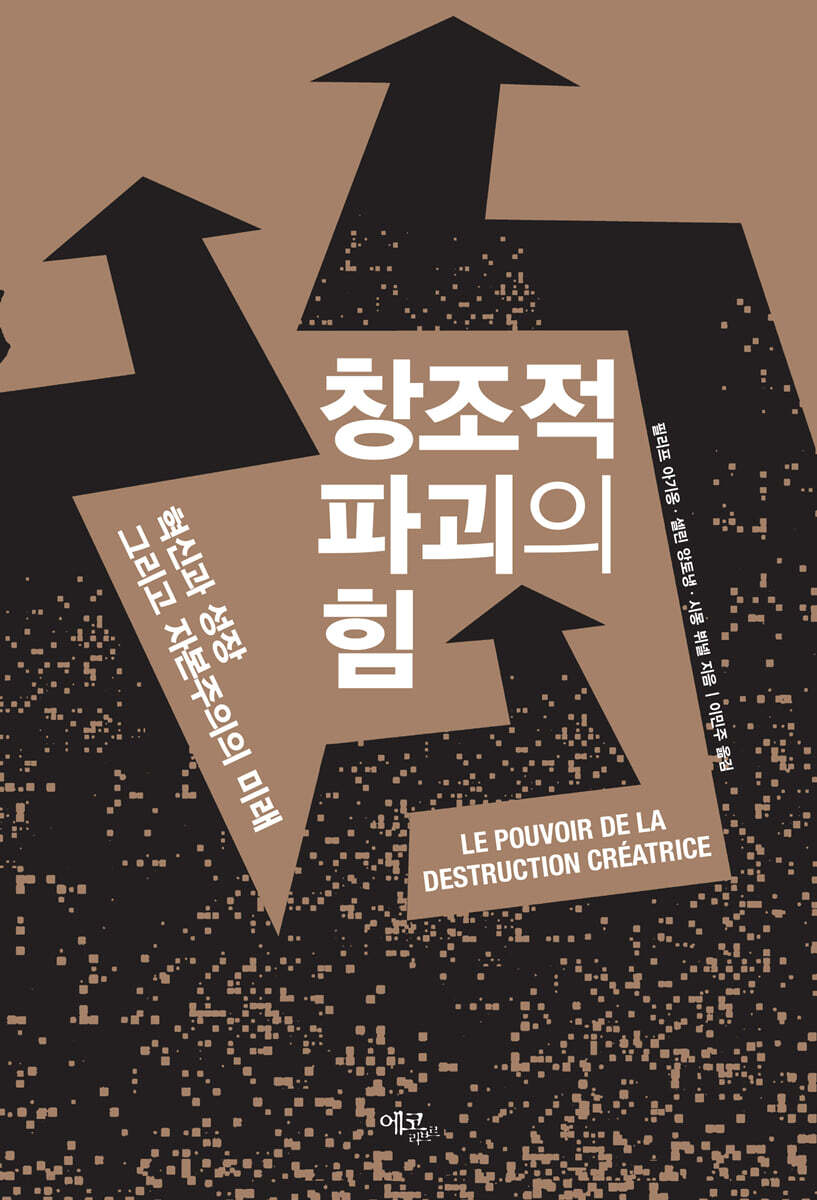
The power of creative destruction
 |
Description
Book Introduction
A new approach to innovation by one of the founders of new growth theory and his colleagues. Philippe Aghion is one of the founders of the new growth theory. This theory centers on the power and impact of technological advancement. Based on over 30 years of research, this book demonstrates the richness and utility of this approach, serving as a foundation for examining the nature of growth and considering industrial policy and the structure of the labor market. - Olivier Blanchard, Senior Fellow at the Peterson Institute for International Economics |
- You can preview some of the book's contents.
Preview
index
Preface to the Korean edition
introduction
01 New Paradigm
02 The Riddle of 'Takeoff'
03 Should we fear the wave of technological advancement?
04 Is Competition Desirable?
05 Innovation, Inequality, and the Tax System
06 Discussion on long-term stagnation
07 Argentina Syndrome
08 Should we achieve industrialization at all costs?
09 Eco-friendly innovation and sustainable growth
10 Behind the Scenes of Innovation
11 Creative Destruction, Health, and Happiness
12 Funding Creative Destruction
13 How to Respond to Globalization
14. The emergence of a guarantee country following an investment country
15 countries, how far?
Conclusion: What is the future of capitalism?
Acknowledgements
main
Search
introduction
01 New Paradigm
02 The Riddle of 'Takeoff'
03 Should we fear the wave of technological advancement?
04 Is Competition Desirable?
05 Innovation, Inequality, and the Tax System
06 Discussion on long-term stagnation
07 Argentina Syndrome
08 Should we achieve industrialization at all costs?
09 Eco-friendly innovation and sustainable growth
10 Behind the Scenes of Innovation
11 Creative Destruction, Health, and Happiness
12 Funding Creative Destruction
13 How to Respond to Globalization
14. The emergence of a guarantee country following an investment country
15 countries, how far?
Conclusion: What is the future of capitalism?
Acknowledgements
main
Search
Publisher's Review
Raising an issue
Coincidentally, the authors began writing this book in late November 2019, just before the unprecedented pandemic of COVID-19 broke out.
There is a need for an ontological debate on how to envision the post-COVID-19 world that humanity currently faces, and “creative destruction” is at the center of that discussion.
Indeed, while the COVID-19 pandemic has caused job losses and forced many businesses to bankrupt, it has also opened up a new and innovative economic landscape.
In other words, humanity faces new challenges as the recognition that creative destruction can be a driving force for growth in the post-pandemic era becomes widespread.
On the one hand, we must support companies that have a chance of survival, preserve jobs, and protect the human capital they have accumulated.
But on the other hand, 'reallocation' is necessary.
This means encouraging the entry of new businesses and new economic activities that are more competitive or better able to meet new consumer demands.
Moreover, the COVID-19 pandemic crisis has had the unintended consequence of exposing more serious problems affecting existing forms of capitalist systems in many countries.
In a broader sense, the current situation, faced with the growing inequality that has been developing over the past several decades, the concentration of vested interests, increasingly precarious employment conditions, and the deterioration of the health system and the environment, raises the question of whether we must now radically transform our economic system and abandon capitalism itself.
The book argues that rather than 'ending' capitalism, we need to better 'regulate' it.
The power of creative destruction comes, above all, from its tremendous ability to drive growth.
Creative destruction is the driving force that has brought our society to a level of wealth that would have been unimaginable just 200 years ago.
Our challenge now is to properly understand the driving force of this force of creative destruction and direct it in the direction we desire.
How can we guide creative destruction toward a more environmentally friendly and equitable growth path? How can we prevent yesterday's innovators from using their vested interests gained through innovation to stifle new innovations? How can we minimize the potential negative impact of creative destruction on factors like jobs, health, and well-being? What forces can guide creative destruction in the direction we desire? This book seeks to answer these questions.
Topics covered through the lens of creative destruction
First, it provides clues to solving events that remain important mysteries in the history of economic growth.
For example, why did industrial takeoff not occur in China but in Europe only in the 1820s? Despite revolutions in information and communications technology and artificial intelligence, why has the United States struggled to overcome its long-term stagnation since the early 2000s? Why do some countries fall into the middle-income trap—that is, why do some countries, after developing very rapidly, then stagnate or even cease growth? Furthermore, the book discusses the evolution of inequality and deindustrialization.
Second, we attempt to re-engage with key discussions surrounding innovation and economic growth in advanced societies.
Is it possible to balance innovation and creative destruction while simultaneously preserving the environment and addressing inequality? And is there a way to avoid the potential negative impacts of creative destruction on jobs, health, and well-being for our citizens? Should the revolution in information and communication technology or the advancement of artificial intelligence be feared?
Third, it questions false “universal wisdom” and flawed policies.
For example, taxing the use of robots to reduce unemployment, relying on protectionism to counter foreign competition or preserve value chains, or pursuing zero or negative growth to combat climate change.
Fourth, we reexamine the roles of the state and civil society.
What role can the state and civil society play in fostering innovation and creative destruction? And how can they, in turn, contribute to the accumulation of national wealth? How can we protect our economy and citizens from extreme capitalism?
Fifth, rethink the future of capitalism.
Above all, the discussion centers on the question of whether it is possible to integrate the unique strengths of American capitalism, namely the innovation ecosystem, with the strengths of Danish capitalism, a more inclusive and socially secure model.
Joseph Schumpeter, who emphasized the benefits of creative destruction as a driving force for growth, was also pessimistic about the future of capitalism.
In particular, he predicted that small and medium-sized businesses would disappear due to conglomerates, which would lead to the extinction of entrepreneurs and the rise of bureaucracy and vested interests.
Thus, the book deals with the role of government and the regulation of capitalism, yet concludes with optimism through 'struggle'.
“Philosophers simply interpret the world in different ways.
He emphasizes the importance of change by quoting Marx's famous words: "Now our task is to change the world."
In this book, the authors explore ways to avoid Schumpeter's pessimistic predictions and achieve sustainable growth through the triangular structure of corporations, the state, and civil society.
Previous growth theories and their problems
The mainstream theory explaining economic growth in the 1980s was the neoclassical model, the most representative of which was the theory put forward by Robert Solow in 1956.
He also won the Nobel Prize in Economics in 1987 for this theory.
His model, thanks to its distinctive clarity and elegance, has become an essential starting point for the overall stream of economic growth research.
To put his theory in a nutshell, “In short, capital is needed for production, and as this capital accumulation increases, GDP increases.”
This increased economic unit forms the basis of Solo's economic growth theory.
So where does capital accumulation originate? Assuming that savings are a constant fraction of GDP, capital accumulation originates from household savings.
But ultimately, in these economies, everything always seems to go well.
In an economy like this, economic growth continues perpetually, simply due to the effects of capital accumulation, without any technological advancement.
However, the weakness of this theory is that the profits that can be generated with capital alone decrease over time.
As the number of machines increases, the increase in GDP per unit of machine equipment decreases.
Therefore, savings growth slows down, and subsequently capital accumulation also slows down.
As Robert Solow has well explained, achieving sustained economic growth requires improving the quality of machinery and equipment through technological advancements, which is precisely what we call productivity gains.
However, Solo left the analysis of what factors determine technological advancement as a task for future generations.
In particular, research on what factors promote or hinder innovation within economic units remains an important task.
This neoclassical growth theory fails to explain the factors that determine long-term economic growth.
Moreover, it does not help us understand the series of puzzles related to the growth process.
Above all, it does not contribute to solving the mystery of why some countries grow faster than others, while others stagnate or even suddenly stop growing without narrowing the gap.
That's why we need a new growth theory.
Schumpeterian paradigm of creative destruction
So what is the "theory of economic growth through creative destruction" proposed by Aghion, the so-called Schumpeterian growth model? It's called this because, although it hasn't been formally theorized or validated before, it draws on three ideas from Austrian economist Joseph Schumpeter.
The first idea is that innovation and the accumulation and dissemination of knowledge are central to the growth process.
This means that each new innovator was able to achieve innovation because he or she was able to stand on the 'shoulders of giants' who had achieved success before him.
In other words, without the process of disseminating and systematizing knowledge so that innovation could continue to accumulate, the current achievements would not have been possible.
The second idea is that protecting and valuing intellectual property rights is essential for innovation.
Innovation is a measure that guarantees the profits of innovators, and among them, measures that guarantee intellectual property rights for the content of innovation serve to encourage innovators to invest more in innovation.
The third idea is the very concept of creative destruction.
New innovations obsolete old ones.
In other words, economic growth through creative destruction places the old and the new in a constant state of conflict.
Therefore, creative destruction creates a kind of dilemma or contradiction within the growth process itself.
On the one hand, profits should be generated as a reward for innovation, that is, as an incentive to promote reality.
On the other hand, we must not allow past innovators to use the profits they have earned to stifle new innovations.
This means that there is no way to prevent established companies from blocking the entry of new companies, and here Schumpeter saw a bleak future for capitalism.
The solution to this is to properly regulate existing businesses, that is, capitalism.
Creative destruction in reality
So, can we measure creative destruction? We can perceive it through the emergence of new products or technologies, which can be measured by the number of patents registered each year in a given country or region.
What this tells us is that there is a clear proportional relationship between the intensity of innovation and the increase in productivity.
In other words, the more innovation there is, the faster the growth.
Another way to measure creative destruction is to closely observe the cycle of startups.
This means looking at the series of events that occur as new companies emerge, grow, and are eventually pushed out of the market.
The final method is to average the startup and closure rates of new firms, which is actually the most common method used in studies of the dynamics of firms and jobs.
This method tells us that creative destruction is directly proportional to GDP per capita.
Some Mysteries Surrounding Growth
In economics, theoretical models or paradigms are evaluated based on their ability to illuminate the truth of a specific phenomenon and thereby enable a better understanding of it.
The Schumpeterian paradigm helps us understand many of the puzzles surrounding growth.
Here are five of the mysteries that can be explained through Schumpeter's model.
First, how can we explain the fact that economic growth is a recent phenomenon in human history, with the take-off phase only occurring in 1820? (Chapter 2)
Second, competition and growth.
It is said that there is a positive correlation between competition and innovation within an economic activity, and between competition and productivity growth within that economic activity.
How can we explain these paradoxical results? (Chapter 4) Third, the middle-income trap.
It is well known that Argentina has fallen into the middle-income trap.
How can we explain the phenomenon in which Argentina's standard of living converged with that of the United States, only to halt and then widen the gap? And how can we explain why the Japanese economy, which had enjoyed remarkable growth since World War II, has been in prolonged stagnation since 1985? (Chapter 7)
Fourth, why has productivity growth in the United States slowed since 2005, despite the revolutionary developments in information and communication technology and artificial intelligence? (Chapter 6) Fifth, the inequality created by innovation is temporary.
Because innovation enables social mobility (Chapter 5).
Growth policies and the Schumpeterian paradigm
The accumulation of innovation is the primary source of growth, which is the central concept of the Schumpeterian paradigm.
Because individuals have limited ability to invest in innovation, the role of the state is crucial.
Chapter 10 discusses the role of education and science in the innovation process, Chapter 12 discusses financing innovation, and Chapter 14 discusses the emergence of the state as an investor.
The second central concept of the Schumpeterian paradigm is that innovation is driven by the prospect of profit from monopoly as a reward.
This suggests a second role for the state: as a protector of intellectual property rights related to innovation.
Chapter 4 explores this issue in more detail, discussing the complementarity between intellectual property protection and competition policy, while Chapter 5 addresses the relationship between tax policy and innovation.
The third central concept has to do with creative destruction.
Every new innovation destroys all the gains made by previous innovations.
What this creative destruction implies is that every innovation must fight against incumbents who will protect their interests at all costs.
Moreover, established companies can attract the support of employees who fear job losses if existing economic activities are harmed by innovation.
In this way, the state must protect competition above all else.
In other words, we must ensure that new innovative companies can enter the product and service markets (Chapters 4, 6, 15).
Another role of the state is to protect employees from potential unemployment.
This is discussed in detail in Chapter 11, which deals with the relationship between creative destruction and health and happiness, and Chapter 14, which deals with the emergence of the social security state.
Two additional implications of the Schumpeterian paradigm
Through the lens of the Schumpeterian paradigm, we can explore two additional fundamental aspects of the national prosperity process.
1.
There are two ways to further improve productivity and technological advancement.
First, there is technological imitation.
It is a form of following what happens at the boundaries of technology.
Second, innovation takes place in the realm of boundaries.
This means forcing companies already in that field to compete with themselves and innovate.
In that company's case, there is no other target to imitate.
Chapter 7 covers these cases in detail.
As the author notes in the “Preface to the Korean Edition,” our country is an exceptional nation that has succeeded from an imitation economy to an innovative economy.
2.
The problem is that we must break the trend of 'path dependence' and move towards 'environmental and directional innovation.'
In other words, the problem with established companies isn't just that they try to block innovative startups from entering the market.
The problems of existing companies are also related to their conservative attitude toward innovation and technological advancement.
As we will discuss in more detail in Chapter 9, for example, auto companies that have previously innovated in the development of internal combustion engines tend to continue to innovate in the same field later.
Because they excel in that field.
Therefore, government intervention using various methods is necessary to shift the direction of corporate innovation towards environmentally friendly technologies.
Why is that?
Chapters 14 and 15, which deal with the role of the state, show that competition between states on the one hand and the intervention of civil society on the other are the forces that compel governments and states around the world to pursue the public good.
They are the force that forces us to pursue public welfare.
So we can be more optimistic about the future of capitalism than Schumpeter was, because it is precisely these checks and balances that complement the market economy and ensure that it is well-regulated.
They also enable us to anticipate prosperity in a more inclusive and environmentally friendly way.
Conclusion: The Future of Capitalism
The market economy itself has a disruptive nature in that it causes creative destruction.
Nevertheless, throughout history, market economies have been the engines of tremendous prosperity.
It has led to economic development in our society to a degree that was unimaginable 200 years ago.
Does this mean that, in order to create prosperity and escape poverty, we must accept the serious risks and weaknesses inherent in capitalism as an unavoidable price to pay?
In this book, we seek to deeply understand how growth through creative destruction interacts with competition, inequality, the environment, finance, unemployment, health, happiness, industrialization, and catch-up policies in poor countries.
We also discussed whether state intervention, i.e., appropriate control and management by the executive branch, could promote wealth creation to some extent while addressing the problems mentioned above.
In particular, we have confirmed that as we move from a capitalism that is rigidly focused on laissez-faire or "market supremacy" to a stage of capitalism in which civil society fully plays its unique role, the following becomes possible:
First, it is possible to reduce inequality without stimulating social mobility or stifling the will to innovate.
And we can improve competition policies to stem the downward trend in growth, and redirect innovation toward green technologies to combat climate change.
We can also strengthen competitiveness through investment and innovation without sounding the alarm on protectionist trade, and establish a genuine social safety net to protect citizens who face unemployment.
We also examined how to strengthen national competitiveness through investment and innovation without abandoning globalization.
And finally, we discussed what we can do, with the essential support of civil society, to ensure that past innovators do not collude with administrative power to "kick away the ladder" from future innovators who threaten their position.
Clearly, the current crisis will spark an existential debate about how we should consider the post-COVID-19 era.
Although it is impossible to predict in advance where these discussions will go, I believe they are likely to draw on many of the themes and analyses discussed in this book.
To the question, “What is the future of capitalism?” we would like to answer by quoting Henri Bergson.
“The future is not something that happens to us, but something we do.”
Coincidentally, the authors began writing this book in late November 2019, just before the unprecedented pandemic of COVID-19 broke out.
There is a need for an ontological debate on how to envision the post-COVID-19 world that humanity currently faces, and “creative destruction” is at the center of that discussion.
Indeed, while the COVID-19 pandemic has caused job losses and forced many businesses to bankrupt, it has also opened up a new and innovative economic landscape.
In other words, humanity faces new challenges as the recognition that creative destruction can be a driving force for growth in the post-pandemic era becomes widespread.
On the one hand, we must support companies that have a chance of survival, preserve jobs, and protect the human capital they have accumulated.
But on the other hand, 'reallocation' is necessary.
This means encouraging the entry of new businesses and new economic activities that are more competitive or better able to meet new consumer demands.
Moreover, the COVID-19 pandemic crisis has had the unintended consequence of exposing more serious problems affecting existing forms of capitalist systems in many countries.
In a broader sense, the current situation, faced with the growing inequality that has been developing over the past several decades, the concentration of vested interests, increasingly precarious employment conditions, and the deterioration of the health system and the environment, raises the question of whether we must now radically transform our economic system and abandon capitalism itself.
The book argues that rather than 'ending' capitalism, we need to better 'regulate' it.
The power of creative destruction comes, above all, from its tremendous ability to drive growth.
Creative destruction is the driving force that has brought our society to a level of wealth that would have been unimaginable just 200 years ago.
Our challenge now is to properly understand the driving force of this force of creative destruction and direct it in the direction we desire.
How can we guide creative destruction toward a more environmentally friendly and equitable growth path? How can we prevent yesterday's innovators from using their vested interests gained through innovation to stifle new innovations? How can we minimize the potential negative impact of creative destruction on factors like jobs, health, and well-being? What forces can guide creative destruction in the direction we desire? This book seeks to answer these questions.
Topics covered through the lens of creative destruction
First, it provides clues to solving events that remain important mysteries in the history of economic growth.
For example, why did industrial takeoff not occur in China but in Europe only in the 1820s? Despite revolutions in information and communications technology and artificial intelligence, why has the United States struggled to overcome its long-term stagnation since the early 2000s? Why do some countries fall into the middle-income trap—that is, why do some countries, after developing very rapidly, then stagnate or even cease growth? Furthermore, the book discusses the evolution of inequality and deindustrialization.
Second, we attempt to re-engage with key discussions surrounding innovation and economic growth in advanced societies.
Is it possible to balance innovation and creative destruction while simultaneously preserving the environment and addressing inequality? And is there a way to avoid the potential negative impacts of creative destruction on jobs, health, and well-being for our citizens? Should the revolution in information and communication technology or the advancement of artificial intelligence be feared?
Third, it questions false “universal wisdom” and flawed policies.
For example, taxing the use of robots to reduce unemployment, relying on protectionism to counter foreign competition or preserve value chains, or pursuing zero or negative growth to combat climate change.
Fourth, we reexamine the roles of the state and civil society.
What role can the state and civil society play in fostering innovation and creative destruction? And how can they, in turn, contribute to the accumulation of national wealth? How can we protect our economy and citizens from extreme capitalism?
Fifth, rethink the future of capitalism.
Above all, the discussion centers on the question of whether it is possible to integrate the unique strengths of American capitalism, namely the innovation ecosystem, with the strengths of Danish capitalism, a more inclusive and socially secure model.
Joseph Schumpeter, who emphasized the benefits of creative destruction as a driving force for growth, was also pessimistic about the future of capitalism.
In particular, he predicted that small and medium-sized businesses would disappear due to conglomerates, which would lead to the extinction of entrepreneurs and the rise of bureaucracy and vested interests.
Thus, the book deals with the role of government and the regulation of capitalism, yet concludes with optimism through 'struggle'.
“Philosophers simply interpret the world in different ways.
He emphasizes the importance of change by quoting Marx's famous words: "Now our task is to change the world."
In this book, the authors explore ways to avoid Schumpeter's pessimistic predictions and achieve sustainable growth through the triangular structure of corporations, the state, and civil society.
Previous growth theories and their problems
The mainstream theory explaining economic growth in the 1980s was the neoclassical model, the most representative of which was the theory put forward by Robert Solow in 1956.
He also won the Nobel Prize in Economics in 1987 for this theory.
His model, thanks to its distinctive clarity and elegance, has become an essential starting point for the overall stream of economic growth research.
To put his theory in a nutshell, “In short, capital is needed for production, and as this capital accumulation increases, GDP increases.”
This increased economic unit forms the basis of Solo's economic growth theory.
So where does capital accumulation originate? Assuming that savings are a constant fraction of GDP, capital accumulation originates from household savings.
But ultimately, in these economies, everything always seems to go well.
In an economy like this, economic growth continues perpetually, simply due to the effects of capital accumulation, without any technological advancement.
However, the weakness of this theory is that the profits that can be generated with capital alone decrease over time.
As the number of machines increases, the increase in GDP per unit of machine equipment decreases.
Therefore, savings growth slows down, and subsequently capital accumulation also slows down.
As Robert Solow has well explained, achieving sustained economic growth requires improving the quality of machinery and equipment through technological advancements, which is precisely what we call productivity gains.
However, Solo left the analysis of what factors determine technological advancement as a task for future generations.
In particular, research on what factors promote or hinder innovation within economic units remains an important task.
This neoclassical growth theory fails to explain the factors that determine long-term economic growth.
Moreover, it does not help us understand the series of puzzles related to the growth process.
Above all, it does not contribute to solving the mystery of why some countries grow faster than others, while others stagnate or even suddenly stop growing without narrowing the gap.
That's why we need a new growth theory.
Schumpeterian paradigm of creative destruction
So what is the "theory of economic growth through creative destruction" proposed by Aghion, the so-called Schumpeterian growth model? It's called this because, although it hasn't been formally theorized or validated before, it draws on three ideas from Austrian economist Joseph Schumpeter.
The first idea is that innovation and the accumulation and dissemination of knowledge are central to the growth process.
This means that each new innovator was able to achieve innovation because he or she was able to stand on the 'shoulders of giants' who had achieved success before him.
In other words, without the process of disseminating and systematizing knowledge so that innovation could continue to accumulate, the current achievements would not have been possible.
The second idea is that protecting and valuing intellectual property rights is essential for innovation.
Innovation is a measure that guarantees the profits of innovators, and among them, measures that guarantee intellectual property rights for the content of innovation serve to encourage innovators to invest more in innovation.
The third idea is the very concept of creative destruction.
New innovations obsolete old ones.
In other words, economic growth through creative destruction places the old and the new in a constant state of conflict.
Therefore, creative destruction creates a kind of dilemma or contradiction within the growth process itself.
On the one hand, profits should be generated as a reward for innovation, that is, as an incentive to promote reality.
On the other hand, we must not allow past innovators to use the profits they have earned to stifle new innovations.
This means that there is no way to prevent established companies from blocking the entry of new companies, and here Schumpeter saw a bleak future for capitalism.
The solution to this is to properly regulate existing businesses, that is, capitalism.
Creative destruction in reality
So, can we measure creative destruction? We can perceive it through the emergence of new products or technologies, which can be measured by the number of patents registered each year in a given country or region.
What this tells us is that there is a clear proportional relationship between the intensity of innovation and the increase in productivity.
In other words, the more innovation there is, the faster the growth.
Another way to measure creative destruction is to closely observe the cycle of startups.
This means looking at the series of events that occur as new companies emerge, grow, and are eventually pushed out of the market.
The final method is to average the startup and closure rates of new firms, which is actually the most common method used in studies of the dynamics of firms and jobs.
This method tells us that creative destruction is directly proportional to GDP per capita.
Some Mysteries Surrounding Growth
In economics, theoretical models or paradigms are evaluated based on their ability to illuminate the truth of a specific phenomenon and thereby enable a better understanding of it.
The Schumpeterian paradigm helps us understand many of the puzzles surrounding growth.
Here are five of the mysteries that can be explained through Schumpeter's model.
First, how can we explain the fact that economic growth is a recent phenomenon in human history, with the take-off phase only occurring in 1820? (Chapter 2)
Second, competition and growth.
It is said that there is a positive correlation between competition and innovation within an economic activity, and between competition and productivity growth within that economic activity.
How can we explain these paradoxical results? (Chapter 4) Third, the middle-income trap.
It is well known that Argentina has fallen into the middle-income trap.
How can we explain the phenomenon in which Argentina's standard of living converged with that of the United States, only to halt and then widen the gap? And how can we explain why the Japanese economy, which had enjoyed remarkable growth since World War II, has been in prolonged stagnation since 1985? (Chapter 7)
Fourth, why has productivity growth in the United States slowed since 2005, despite the revolutionary developments in information and communication technology and artificial intelligence? (Chapter 6) Fifth, the inequality created by innovation is temporary.
Because innovation enables social mobility (Chapter 5).
Growth policies and the Schumpeterian paradigm
The accumulation of innovation is the primary source of growth, which is the central concept of the Schumpeterian paradigm.
Because individuals have limited ability to invest in innovation, the role of the state is crucial.
Chapter 10 discusses the role of education and science in the innovation process, Chapter 12 discusses financing innovation, and Chapter 14 discusses the emergence of the state as an investor.
The second central concept of the Schumpeterian paradigm is that innovation is driven by the prospect of profit from monopoly as a reward.
This suggests a second role for the state: as a protector of intellectual property rights related to innovation.
Chapter 4 explores this issue in more detail, discussing the complementarity between intellectual property protection and competition policy, while Chapter 5 addresses the relationship between tax policy and innovation.
The third central concept has to do with creative destruction.
Every new innovation destroys all the gains made by previous innovations.
What this creative destruction implies is that every innovation must fight against incumbents who will protect their interests at all costs.
Moreover, established companies can attract the support of employees who fear job losses if existing economic activities are harmed by innovation.
In this way, the state must protect competition above all else.
In other words, we must ensure that new innovative companies can enter the product and service markets (Chapters 4, 6, 15).
Another role of the state is to protect employees from potential unemployment.
This is discussed in detail in Chapter 11, which deals with the relationship between creative destruction and health and happiness, and Chapter 14, which deals with the emergence of the social security state.
Two additional implications of the Schumpeterian paradigm
Through the lens of the Schumpeterian paradigm, we can explore two additional fundamental aspects of the national prosperity process.
1.
There are two ways to further improve productivity and technological advancement.
First, there is technological imitation.
It is a form of following what happens at the boundaries of technology.
Second, innovation takes place in the realm of boundaries.
This means forcing companies already in that field to compete with themselves and innovate.
In that company's case, there is no other target to imitate.
Chapter 7 covers these cases in detail.
As the author notes in the “Preface to the Korean Edition,” our country is an exceptional nation that has succeeded from an imitation economy to an innovative economy.
2.
The problem is that we must break the trend of 'path dependence' and move towards 'environmental and directional innovation.'
In other words, the problem with established companies isn't just that they try to block innovative startups from entering the market.
The problems of existing companies are also related to their conservative attitude toward innovation and technological advancement.
As we will discuss in more detail in Chapter 9, for example, auto companies that have previously innovated in the development of internal combustion engines tend to continue to innovate in the same field later.
Because they excel in that field.
Therefore, government intervention using various methods is necessary to shift the direction of corporate innovation towards environmentally friendly technologies.
Why is that?
Chapters 14 and 15, which deal with the role of the state, show that competition between states on the one hand and the intervention of civil society on the other are the forces that compel governments and states around the world to pursue the public good.
They are the force that forces us to pursue public welfare.
So we can be more optimistic about the future of capitalism than Schumpeter was, because it is precisely these checks and balances that complement the market economy and ensure that it is well-regulated.
They also enable us to anticipate prosperity in a more inclusive and environmentally friendly way.
Conclusion: The Future of Capitalism
The market economy itself has a disruptive nature in that it causes creative destruction.
Nevertheless, throughout history, market economies have been the engines of tremendous prosperity.
It has led to economic development in our society to a degree that was unimaginable 200 years ago.
Does this mean that, in order to create prosperity and escape poverty, we must accept the serious risks and weaknesses inherent in capitalism as an unavoidable price to pay?
In this book, we seek to deeply understand how growth through creative destruction interacts with competition, inequality, the environment, finance, unemployment, health, happiness, industrialization, and catch-up policies in poor countries.
We also discussed whether state intervention, i.e., appropriate control and management by the executive branch, could promote wealth creation to some extent while addressing the problems mentioned above.
In particular, we have confirmed that as we move from a capitalism that is rigidly focused on laissez-faire or "market supremacy" to a stage of capitalism in which civil society fully plays its unique role, the following becomes possible:
First, it is possible to reduce inequality without stimulating social mobility or stifling the will to innovate.
And we can improve competition policies to stem the downward trend in growth, and redirect innovation toward green technologies to combat climate change.
We can also strengthen competitiveness through investment and innovation without sounding the alarm on protectionist trade, and establish a genuine social safety net to protect citizens who face unemployment.
We also examined how to strengthen national competitiveness through investment and innovation without abandoning globalization.
And finally, we discussed what we can do, with the essential support of civil society, to ensure that past innovators do not collude with administrative power to "kick away the ladder" from future innovators who threaten their position.
Clearly, the current crisis will spark an existential debate about how we should consider the post-COVID-19 era.
Although it is impossible to predict in advance where these discussions will go, I believe they are likely to draw on many of the themes and analyses discussed in this book.
To the question, “What is the future of capitalism?” we would like to answer by quoting Henri Bergson.
“The future is not something that happens to us, but something we do.”
GOODS SPECIFICS
- Date of issue: June 30, 2022
- Format: Hardcover book binding method guide
- Page count, weight, size: 578 pages | 912g | 153*224*35mm
- ISBN13: 9788962632392
- ISBN10: 896263239X
You may also like
카테고리
korean


korean

![ELLE 엘르 스페셜 에디션 A형 : 12월 [2025]](http://librairie.coreenne.fr/cdn/shop/files/b8e27a3de6c9538896439686c6b0e8fb.jpg?v=1766436872&width=3840)


