

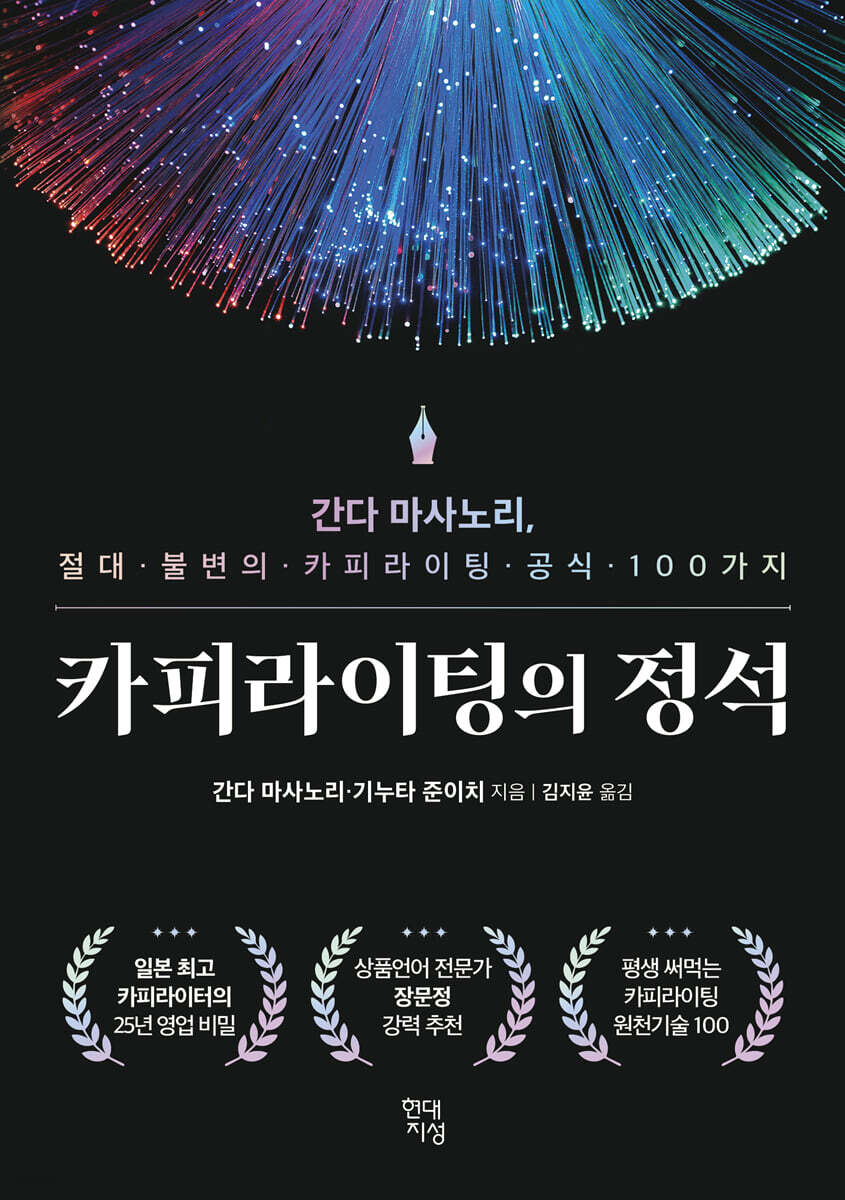
The Classics of Copywriting
 |
Description
Book Introduction
Japan's best copywriter
A culmination of 25 years of know-how from Masanori Kanda
Copywriting textbook
“570 pages, every single sentence is directly linked to your sales and performance.”
― Jang Moon-jeong (Home Shopping Guinness World Record 12.5 Billion Won Myth, Author of "Don't Sell, Make Them Buy")
This book contains the survival strategies that Masanori Kanda, who recovered from the brink of layoffs in his youth, has proven in the field for 25 years.
He generously displayed the power that allows one to stand up again with a single pen even in a barren plain without a single hill to climb, and the sense and concretization ability of copywriting that he has acquired.
With 100 techniques and proven cases, not just 'feelings,' anyone can build a copywriting system that can be replicated.
Now your copy becomes the science of persuasion, and your sales become a predictable outcome.
'Why does that person earn more than me even though he works less?'
This book provides clear answers to the questions raised in the face of life's absurdities.
The ability to structure valuable ideas into monetizable language is what makes the difference.
Whether you're twenty or eighty, this book's insights will equip you with a lifelong weapon to break free from the low-price competition, clearly communicate your expertise and skills, and live without worrying about securing customers.
Your copywriting
100 Core Technologies That Make Persuasion a Science
"Copywriting Essentials" condenses 25 years of know-how into 100 core techniques, spanning 570 pages.
These techniques are not simply sentence patterns.
It is the “muscle of sentences that generate sales.”
Here are some of the know-how provided in the book:
· Loss-Aversion Copy Strategy: Stimulate what you might lose rather than what you might gain.
Humans expend twice as much energy to avoid loss.
A single sentence like “This offer is only available until midnight tonight” is enough to make you decide to buy sooner.
· PMM Search Sheet: A research tool that analyzes product-market match using 23 items.
A small cosmetics brand redefined the common product, "moisturizing cream," into a "5-second after-work skin recovery routine," tripling its online sales in just one month.
· Commercial Insight: When customers express their unrecognized pain in words, they experience an explosion of empathy, saying, "This is my story."
In fact, one Japanese insurance company said, “When I was young, I thought I didn’t need insurance.
However, by applying Masanori Kanda-style copy that begins with “But…”, the new contract rate was raised by over 200%.
The world this book shows is clear.
Copywriting is no longer the realm of inspiration.
It is the 'science of language' that anyone can reproduce according to the formula and design predictable results.
Masanori Kanda's language is not flowery.
Instead, it is predictable and reproducible.
That is precisely why this book deserves to be called the 'standard'.
A culmination of 25 years of know-how from Masanori Kanda
Copywriting textbook
“570 pages, every single sentence is directly linked to your sales and performance.”
― Jang Moon-jeong (Home Shopping Guinness World Record 12.5 Billion Won Myth, Author of "Don't Sell, Make Them Buy")
This book contains the survival strategies that Masanori Kanda, who recovered from the brink of layoffs in his youth, has proven in the field for 25 years.
He generously displayed the power that allows one to stand up again with a single pen even in a barren plain without a single hill to climb, and the sense and concretization ability of copywriting that he has acquired.
With 100 techniques and proven cases, not just 'feelings,' anyone can build a copywriting system that can be replicated.
Now your copy becomes the science of persuasion, and your sales become a predictable outcome.
'Why does that person earn more than me even though he works less?'
This book provides clear answers to the questions raised in the face of life's absurdities.
The ability to structure valuable ideas into monetizable language is what makes the difference.
Whether you're twenty or eighty, this book's insights will equip you with a lifelong weapon to break free from the low-price competition, clearly communicate your expertise and skills, and live without worrying about securing customers.
Your copywriting
100 Core Technologies That Make Persuasion a Science
"Copywriting Essentials" condenses 25 years of know-how into 100 core techniques, spanning 570 pages.
These techniques are not simply sentence patterns.
It is the “muscle of sentences that generate sales.”
Here are some of the know-how provided in the book:
· Loss-Aversion Copy Strategy: Stimulate what you might lose rather than what you might gain.
Humans expend twice as much energy to avoid loss.
A single sentence like “This offer is only available until midnight tonight” is enough to make you decide to buy sooner.
· PMM Search Sheet: A research tool that analyzes product-market match using 23 items.
A small cosmetics brand redefined the common product, "moisturizing cream," into a "5-second after-work skin recovery routine," tripling its online sales in just one month.
· Commercial Insight: When customers express their unrecognized pain in words, they experience an explosion of empathy, saying, "This is my story."
In fact, one Japanese insurance company said, “When I was young, I thought I didn’t need insurance.
However, by applying Masanori Kanda-style copy that begins with “But…”, the new contract rate was raised by over 200%.
The world this book shows is clear.
Copywriting is no longer the realm of inspiration.
It is the 'science of language' that anyone can reproduce according to the formula and design predictable results.
Masanori Kanda's language is not flowery.
Instead, it is predictable and reproducible.
That is precisely why this book deserves to be called the 'standard'.
- You can preview some of the book's contents.
Preview
index
Masanori Kanda's Preface _Even in a burning field, if I only had this technique...
A Copywriting Roadmap to Complete Your Growth
The structure and core of the book
PMM Search Sheet: Preliminary Research Tool
PMM Self-Checklist: A Post-Complete Verification Tool
【BTRNUTSS Checklist】
【PASBECONA Basic Structure】
【PASBECONA Application Template】
Chapter 1.
The Magic of Copywriting That Drives Sales
1.
Response advertising, which enables direct sales
2.
Providing real 'benefits' to customers
3.
A 'Paper Salesman' who works for you 24 hours a day
(1) What is a salesman on paper?
[Column] Everything You Need to Know About Swipe Files: A Practical Copywriter's Essential
(2) The evolution of sales letters with 100 years of history
(3) From Paper to Digital: The Birth of the Detail Page (SP)
(4) SP vs. HP: Different purposes, different appearances
4.
Structure for generating sustainable profits
(1) Lead, Front-End, Back-End: The Three-Stage Rocket of Marketing
[Column] Two-Step Marketing and CVR (Conversion Rate): Dividing the Stages Leads to Greater Results
(2) Understanding the core of the profit structure: LTV and CPA
(3) Three sales strategies to increase sales: upselling, crossselling, and downselling.
Points of this chapter
[Column] Marketing that Grows Customers Step by Step
Chapter 2.
The introduction must be compelling within 3 seconds to sell.
: 8 formulas for creating impact 'BTRNUTSS' (Butternut)
1.
The introduction contains a formula: 15 golden patterns and 66 frames.
2.
Impact copy designed with frames
3.
8 Magical Keywords That Get Clicks BTRNUTSS
4.
How to Make Your Introduction More Powerful with 8 Elements
5.
How to Use the BTRNUTSS Checklist to Quantify the Impact of Your Introduction
Points of this chapter
[Column] The Science of Copywriting Revealed by Behavioral Economics
Chapter 3.
The sales detail page has a different structure.
1.
Basic structure of the detail page
2.
13 Key Elements of a Detail Page
(1) Headline
(2) Opening
(3) Body copy
(4) Benefits
(5) Evidence/basis
(6) Offer
(7) Special benefits
(8) Risk reversal (peace of mind)
(9) Limited
(10) Deadline
(11) Closing
(12) CTA (Call to Action)
(13) Postscript
Points of this chapter
[Column] The Secret to Readable Copy: Subheadings and Bullets
Chapter 4.
The essence of compelling copy: PMM (Product Market Matching)
1.
What sells isn't "sentences," but "ideas that fit the market."
2.
Selling ideas come from matching.
3. One question that defines PMM
(1) 'Who did what and how did it happen?'
(2) Two common mistakes when thinking about PMM
(3) Compress what you want to say into one word.
(4) Technology to effectively express PMM
Points of this chapter
[Column] Your Customer List Is Your Best Asset
Chapter 5.
The persuasion formula that works online today
: 'PASBECONA'
1.
The Law of 'Persona': The Fundamentals of Sentences That Move People
2.
PASBECONA: A Persuasive Structure Optimized for the Online Age
3.
Easily create detailed pages with templates
4.
'Pasvicona' Utilization Strategy as Seen Through Actual Detail Page Case Studies
5.
Weight and influence of each detail page component
6.
'Pasvicona' also applies to plans, proposals, and presentations.
Points of this chapter
Chapter 6. The PMM Search Sheet: Finding PMMs
1. Five Preliminary Questions That Determine the Success of Your PMM Search Sheet
2.
How to use the 'PMM Search Sheet'
(1) Product name (①)
(2) Ideal Customer (②)
(3) Current customers (③~⑦)
(4) Offer (⑧~⑬)
(5) Positioning (⑭~⑮)
(6) Product contents (16~20)
(7) Benefits (21)
(8) Identifying and Responding to Customer Hesitation (22)
(9) Final Summary: 'Who did what, and what happened?' (23)
3.
The relationship between the 'PMM Search Sheet' and the detailed page configuration part
Points of this chapter
Chapter 7.
32 Writing Techniques to Increase Your Close
1.
How to Create "Sellable Sentences" That Will Make You Buy The Moment You Read Them
(1) The number of customers you gather varies depending on the message you write.
(2) Technology to convey benefits ‘in depth’
(3) How to set a persona
(4) Why should we use “what’s in the customer’s head”?
(5) What is ‘commercial insight’, the ultimate insight that shakes up customers’ thinking?
(6) Three key elements that move people
(7) Just borrow the idea: A copywriting example of a 'request letter'
(8) Copywriting techniques that move the hearts of B2B managers
(9) The '33 minute 33 second concentration method' that dramatically improves writing speed
(10) How to create a 'story chart' that also works with videos
2.
A persuasive sentence formula that goes beyond understanding and leads to acceptance and action.
(11) The persuasive formula for creating “the same side”: the common enemy strategy
(12) 'Sizzle' writing that makes the scene come alive the moment you read it
(13) 3 sets of sentence structures to imprint at once
(14) Loss-aversion copy strategy that emphasizes “you’ll lose out if you don’t buy”
(15) The art of handling objections by turning doubts into opportunities
(16) One word from a customer is worth a hundred words of persuasion.
(17) Persuasion strategy starting from zero review
(18) 'Future paging', which elicits action by previewing the next scene.
(19) Persuasive writing skills that break down price resistance
(20) How to Use CTA: Timing and Copy Can Change Sales
3.
Ending Gracefully: The Art of Sentence Completion
(21) Detail page, what is the optimal length?
(22) Editing techniques for the '8-second concentration era'
(23) Even just by breaking lines properly, click-through rates can change.
(24) In the smartphone era, from ‘reading sentences’ to ‘seeing sentences’
(25) Share the font and adjust the strength
(26) How to use images and captions effectively
(27) Appropriate line spacing determines readability.
(28) Sentences must be carefully edited.
(29) Things to remember when receiving feedback
(30) The most powerful correction technique you can do alone
(31) Even veterans make mistakes: a post-completion self-checklist
4.
Reverse thinking to create a plan that sells
(32) Use SP before product - Planning changes.
Points of this chapter
[Column] It's Not Writing, It's Skill: How to Make a Living as a Professional Copywriter
Chapter 8.
Copywriting Weapons to Generate Sales Online
1.
The overall structure of Internet marketing
(1) Online vs.
Offline, essential difference
Column Paper Isn't Dead: 5 Persuasive Techniques for Offline Copy
(2) Advertising, Content, and Messages: Anatomy of Internet Marketing Flow
(3) The Power of Internet Advertising: One Click Makes a Sale
2.
Email copywriting
(1) From DM to Email: Still a Powerful Sales Channel
(2) Points to keep your email alive: Sender and subject
(3) Reading customer sentiment through opening and click-through rates
(4) Step Mail Strategy: Why One-Time Sending Fails
(5) Segmentation: Reduce fatigue and increase responsiveness
3.
Tests to improve advertising performance
(1) A/B testing
(2) Advertising test case
4.
Video Sales Copy: What You See, What You Hear
5. FAQ
Points of this chapter
Chapter 9.
29 Copywriting Tips from Masanori Kanda
Going Out _ Copywriting is Your Possibility
References
Special Appendix ① 100 Original Copywriting Techniques
Special Appendix ② 105 Essential Copywriting Terms
A Copywriting Roadmap to Complete Your Growth
The structure and core of the book
PMM Search Sheet: Preliminary Research Tool
PMM Self-Checklist: A Post-Complete Verification Tool
【BTRNUTSS Checklist】
【PASBECONA Basic Structure】
【PASBECONA Application Template】
Chapter 1.
The Magic of Copywriting That Drives Sales
1.
Response advertising, which enables direct sales
2.
Providing real 'benefits' to customers
3.
A 'Paper Salesman' who works for you 24 hours a day
(1) What is a salesman on paper?
[Column] Everything You Need to Know About Swipe Files: A Practical Copywriter's Essential
(2) The evolution of sales letters with 100 years of history
(3) From Paper to Digital: The Birth of the Detail Page (SP)
(4) SP vs. HP: Different purposes, different appearances
4.
Structure for generating sustainable profits
(1) Lead, Front-End, Back-End: The Three-Stage Rocket of Marketing
[Column] Two-Step Marketing and CVR (Conversion Rate): Dividing the Stages Leads to Greater Results
(2) Understanding the core of the profit structure: LTV and CPA
(3) Three sales strategies to increase sales: upselling, crossselling, and downselling.
Points of this chapter
[Column] Marketing that Grows Customers Step by Step
Chapter 2.
The introduction must be compelling within 3 seconds to sell.
: 8 formulas for creating impact 'BTRNUTSS' (Butternut)
1.
The introduction contains a formula: 15 golden patterns and 66 frames.
2.
Impact copy designed with frames
3.
8 Magical Keywords That Get Clicks BTRNUTSS
4.
How to Make Your Introduction More Powerful with 8 Elements
5.
How to Use the BTRNUTSS Checklist to Quantify the Impact of Your Introduction
Points of this chapter
[Column] The Science of Copywriting Revealed by Behavioral Economics
Chapter 3.
The sales detail page has a different structure.
1.
Basic structure of the detail page
2.
13 Key Elements of a Detail Page
(1) Headline
(2) Opening
(3) Body copy
(4) Benefits
(5) Evidence/basis
(6) Offer
(7) Special benefits
(8) Risk reversal (peace of mind)
(9) Limited
(10) Deadline
(11) Closing
(12) CTA (Call to Action)
(13) Postscript
Points of this chapter
[Column] The Secret to Readable Copy: Subheadings and Bullets
Chapter 4.
The essence of compelling copy: PMM (Product Market Matching)
1.
What sells isn't "sentences," but "ideas that fit the market."
2.
Selling ideas come from matching.
3. One question that defines PMM
(1) 'Who did what and how did it happen?'
(2) Two common mistakes when thinking about PMM
(3) Compress what you want to say into one word.
(4) Technology to effectively express PMM
Points of this chapter
[Column] Your Customer List Is Your Best Asset
Chapter 5.
The persuasion formula that works online today
: 'PASBECONA'
1.
The Law of 'Persona': The Fundamentals of Sentences That Move People
2.
PASBECONA: A Persuasive Structure Optimized for the Online Age
3.
Easily create detailed pages with templates
4.
'Pasvicona' Utilization Strategy as Seen Through Actual Detail Page Case Studies
5.
Weight and influence of each detail page component
6.
'Pasvicona' also applies to plans, proposals, and presentations.
Points of this chapter
Chapter 6. The PMM Search Sheet: Finding PMMs
1. Five Preliminary Questions That Determine the Success of Your PMM Search Sheet
2.
How to use the 'PMM Search Sheet'
(1) Product name (①)
(2) Ideal Customer (②)
(3) Current customers (③~⑦)
(4) Offer (⑧~⑬)
(5) Positioning (⑭~⑮)
(6) Product contents (16~20)
(7) Benefits (21)
(8) Identifying and Responding to Customer Hesitation (22)
(9) Final Summary: 'Who did what, and what happened?' (23)
3.
The relationship between the 'PMM Search Sheet' and the detailed page configuration part
Points of this chapter
Chapter 7.
32 Writing Techniques to Increase Your Close
1.
How to Create "Sellable Sentences" That Will Make You Buy The Moment You Read Them
(1) The number of customers you gather varies depending on the message you write.
(2) Technology to convey benefits ‘in depth’
(3) How to set a persona
(4) Why should we use “what’s in the customer’s head”?
(5) What is ‘commercial insight’, the ultimate insight that shakes up customers’ thinking?
(6) Three key elements that move people
(7) Just borrow the idea: A copywriting example of a 'request letter'
(8) Copywriting techniques that move the hearts of B2B managers
(9) The '33 minute 33 second concentration method' that dramatically improves writing speed
(10) How to create a 'story chart' that also works with videos
2.
A persuasive sentence formula that goes beyond understanding and leads to acceptance and action.
(11) The persuasive formula for creating “the same side”: the common enemy strategy
(12) 'Sizzle' writing that makes the scene come alive the moment you read it
(13) 3 sets of sentence structures to imprint at once
(14) Loss-aversion copy strategy that emphasizes “you’ll lose out if you don’t buy”
(15) The art of handling objections by turning doubts into opportunities
(16) One word from a customer is worth a hundred words of persuasion.
(17) Persuasion strategy starting from zero review
(18) 'Future paging', which elicits action by previewing the next scene.
(19) Persuasive writing skills that break down price resistance
(20) How to Use CTA: Timing and Copy Can Change Sales
3.
Ending Gracefully: The Art of Sentence Completion
(21) Detail page, what is the optimal length?
(22) Editing techniques for the '8-second concentration era'
(23) Even just by breaking lines properly, click-through rates can change.
(24) In the smartphone era, from ‘reading sentences’ to ‘seeing sentences’
(25) Share the font and adjust the strength
(26) How to use images and captions effectively
(27) Appropriate line spacing determines readability.
(28) Sentences must be carefully edited.
(29) Things to remember when receiving feedback
(30) The most powerful correction technique you can do alone
(31) Even veterans make mistakes: a post-completion self-checklist
4.
Reverse thinking to create a plan that sells
(32) Use SP before product - Planning changes.
Points of this chapter
[Column] It's Not Writing, It's Skill: How to Make a Living as a Professional Copywriter
Chapter 8.
Copywriting Weapons to Generate Sales Online
1.
The overall structure of Internet marketing
(1) Online vs.
Offline, essential difference
Column Paper Isn't Dead: 5 Persuasive Techniques for Offline Copy
(2) Advertising, Content, and Messages: Anatomy of Internet Marketing Flow
(3) The Power of Internet Advertising: One Click Makes a Sale
2.
Email copywriting
(1) From DM to Email: Still a Powerful Sales Channel
(2) Points to keep your email alive: Sender and subject
(3) Reading customer sentiment through opening and click-through rates
(4) Step Mail Strategy: Why One-Time Sending Fails
(5) Segmentation: Reduce fatigue and increase responsiveness
3.
Tests to improve advertising performance
(1) A/B testing
(2) Advertising test case
4.
Video Sales Copy: What You See, What You Hear
5. FAQ
Points of this chapter
Chapter 9.
29 Copywriting Tips from Masanori Kanda
Going Out _ Copywriting is Your Possibility
References
Special Appendix ① 100 Original Copywriting Techniques
Special Appendix ② 105 Essential Copywriting Terms
Detailed image

Into the book
Copywriting is generally known as the art of writing sentences that express products or services in an attractive way.
But after 25 years in this field, I've realized there's something more fundamental here.
If I had to summarize this technique in one sentence, it would be this:
“The power to rise again with a single piece of paper and a single pen, even in the midst of a burnt-out field.” In other words, it is the “language survival power” that enables one to survive in turbulent times and create opportunities, and it is the true Korean language skills that all members of society must possess.
Many people might think, "Korean? I've been learning it since elementary school, so that's enough."
But there is a crucial misconception here.
Most of the Korean language we learn in school is about 'how to read and understand', or 90% about reading comprehension training.
The skills of speaking and writing to influence the world are something I have never really learned properly.
This alone is far from enough to live in the 100-year era.
This fact becomes even clearer when we examine the nature of reading comprehension.
--- p.9, from "Preface by Masanori Kanda"
I have some good news.
Copywriting is a skill that is easier to learn than you might think.
There is no need to delve into extensive professional books like certified public accountants, lawyers, or doctors, nor is there a need for extensive practical training like hairdressers or physical therapists.
It's not like learning a new language like programming or English.
There are significant advantages to using your native language, which you are already familiar with, in depth.
Moreover, if you can clearly convey the value of your expertise and skills through copywriting, you can live without worrying about securing customers by breaking free from price competition.
The only difficulty is that the know-how is scattered all over the place.
(…)
Copywriting has developed into an independent field in its own right, thanks to its remarkable effectiveness.
But in the digital age, you can't survive as a 'sentence technician' like this.
Creating effective copy requires insight that encompasses product development and business strategy.
So we thought we needed a practical master guide for the modern copywriter—the "language creator" who pioneers new paths in a complex digital environment.
The result is this book, “The Essentials of Copywriting.”
--- p.12-13, from "Preface by Masanori Kanda"
In copywriting, this is called a 'benefit'.
It is a concept that goes beyond simple features or advantages.
The essence of benefit is the answer to the following question:
“How will your life change if you buy this product (what are the benefits)?”
Why do we insist on using the word "benefit" instead of "advantage"? Because people don't want the product itself, they want the "change"—the result—that the product brings.
Here is the most famous example.
“People don’t want drills, they want holes in walls.”
In this way, benefits are like magic that solve customers' problems and make their dreams come true.
For customers, this is a lifesaver.
If you communicate this benefit properly, sales will naturally follow.
Understanding and properly expressing benefits is the beginning and end of copywriting.
Many sales messages shout, "This is great," or "That's great," but if they fail to explain how it changes the buyer's life, they fail.
The saying, “You’ll know how good it is if you try it yourself…” is of no use.
Because purchasing a product is something you decide to do before using it.
So, you have to make them feel its value before they even use it.
This is the power of benefits.
--- p.45-46, from “Chapter 1: The Magic of Copywriting That Drives Sales”
If you want to learn copywriting properly, there is only one way.
“Reading and writing.” These two are the most basic of the basics.
There are three types of teaching materials to be used in training.
"Piano Copy", "English Mistakes", "Two Young Men".
All under 3,000 characters, text-only with no pictures, making it perfect for training.
First, read aloud.
It's not 2 or 3 times.
20 times without fail.
90% of people drop out here.
I was like that too.
“Do I really have to do this? Isn’t it too childish?” But after about 10 times, things change.
The rhythm and flow hidden within the sentences begin to stick in your ears.
Next is transcription.
At first, copy it by hand seven times.
You don't have to do it consecutively.
But your wrists will hurt.
That's a given.
And finally, type it three more times on the computer.
Both handwriting and keyboarding must be engraved on the body.
Very few people make it this far.
But this is where the difference begins.
“A person who does what others absolutely cannot do.”
That is the decisive criterion that separates amateurs from professionals.
--- p.448, from Chapter 7, “32 Writing Techniques to Increase Contract Success Rate”
The essence of copywriting is not simply the art of writing sentences.
It is a technology that designs the structure that makes people open their wallets, the ‘selling flow.’
The psychological mechanisms that drive people's purchasing behavior have remained largely unchanged for the past 100 years.
In “The Complete History of Philosophy and Religion,” Deguchi Haruaki states, “The human brain has hardly changed in 12,000 years.”
If that's true, the principles of purchasing behavior won't change easily in the future.
Products and services may change with the times, but the structure that moves people's hearts remains unchanged.
So copywriting is relevant in any era.
--- p.523, from “Chapter 9: 29 Tips on Copywriting from Masanori Kanda”
As I keep emphasizing, you are gathering customers who respond to your message.
If you emphasize 'cheapness' as your strength, you will only attract customers who are sensitive to 'price'.
If you find yourself wondering, "Why are my customers always only concerned with price?", start by reviewing your advertising copy.
Are you simply repeating messages like, “We’re cheaper than others” or “This is the best price you’ll ever get”?
Talking about price is not the problem.
The key is to sufficiently convey the benefits, or 'what value this product provides', before that.
Customers must first identify with the benefits before comparing prices becomes meaningful.
Only after understanding the value can you connect with the reaction, “This is really a good price.”
But after 25 years in this field, I've realized there's something more fundamental here.
If I had to summarize this technique in one sentence, it would be this:
“The power to rise again with a single piece of paper and a single pen, even in the midst of a burnt-out field.” In other words, it is the “language survival power” that enables one to survive in turbulent times and create opportunities, and it is the true Korean language skills that all members of society must possess.
Many people might think, "Korean? I've been learning it since elementary school, so that's enough."
But there is a crucial misconception here.
Most of the Korean language we learn in school is about 'how to read and understand', or 90% about reading comprehension training.
The skills of speaking and writing to influence the world are something I have never really learned properly.
This alone is far from enough to live in the 100-year era.
This fact becomes even clearer when we examine the nature of reading comprehension.
--- p.9, from "Preface by Masanori Kanda"
I have some good news.
Copywriting is a skill that is easier to learn than you might think.
There is no need to delve into extensive professional books like certified public accountants, lawyers, or doctors, nor is there a need for extensive practical training like hairdressers or physical therapists.
It's not like learning a new language like programming or English.
There are significant advantages to using your native language, which you are already familiar with, in depth.
Moreover, if you can clearly convey the value of your expertise and skills through copywriting, you can live without worrying about securing customers by breaking free from price competition.
The only difficulty is that the know-how is scattered all over the place.
(…)
Copywriting has developed into an independent field in its own right, thanks to its remarkable effectiveness.
But in the digital age, you can't survive as a 'sentence technician' like this.
Creating effective copy requires insight that encompasses product development and business strategy.
So we thought we needed a practical master guide for the modern copywriter—the "language creator" who pioneers new paths in a complex digital environment.
The result is this book, “The Essentials of Copywriting.”
--- p.12-13, from "Preface by Masanori Kanda"
In copywriting, this is called a 'benefit'.
It is a concept that goes beyond simple features or advantages.
The essence of benefit is the answer to the following question:
“How will your life change if you buy this product (what are the benefits)?”
Why do we insist on using the word "benefit" instead of "advantage"? Because people don't want the product itself, they want the "change"—the result—that the product brings.
Here is the most famous example.
“People don’t want drills, they want holes in walls.”
In this way, benefits are like magic that solve customers' problems and make their dreams come true.
For customers, this is a lifesaver.
If you communicate this benefit properly, sales will naturally follow.
Understanding and properly expressing benefits is the beginning and end of copywriting.
Many sales messages shout, "This is great," or "That's great," but if they fail to explain how it changes the buyer's life, they fail.
The saying, “You’ll know how good it is if you try it yourself…” is of no use.
Because purchasing a product is something you decide to do before using it.
So, you have to make them feel its value before they even use it.
This is the power of benefits.
--- p.45-46, from “Chapter 1: The Magic of Copywriting That Drives Sales”
If you want to learn copywriting properly, there is only one way.
“Reading and writing.” These two are the most basic of the basics.
There are three types of teaching materials to be used in training.
"Piano Copy", "English Mistakes", "Two Young Men".
All under 3,000 characters, text-only with no pictures, making it perfect for training.
First, read aloud.
It's not 2 or 3 times.
20 times without fail.
90% of people drop out here.
I was like that too.
“Do I really have to do this? Isn’t it too childish?” But after about 10 times, things change.
The rhythm and flow hidden within the sentences begin to stick in your ears.
Next is transcription.
At first, copy it by hand seven times.
You don't have to do it consecutively.
But your wrists will hurt.
That's a given.
And finally, type it three more times on the computer.
Both handwriting and keyboarding must be engraved on the body.
Very few people make it this far.
But this is where the difference begins.
“A person who does what others absolutely cannot do.”
That is the decisive criterion that separates amateurs from professionals.
--- p.448, from Chapter 7, “32 Writing Techniques to Increase Contract Success Rate”
The essence of copywriting is not simply the art of writing sentences.
It is a technology that designs the structure that makes people open their wallets, the ‘selling flow.’
The psychological mechanisms that drive people's purchasing behavior have remained largely unchanged for the past 100 years.
In “The Complete History of Philosophy and Religion,” Deguchi Haruaki states, “The human brain has hardly changed in 12,000 years.”
If that's true, the principles of purchasing behavior won't change easily in the future.
Products and services may change with the times, but the structure that moves people's hearts remains unchanged.
So copywriting is relevant in any era.
--- p.523, from “Chapter 9: 29 Tips on Copywriting from Masanori Kanda”
As I keep emphasizing, you are gathering customers who respond to your message.
If you emphasize 'cheapness' as your strength, you will only attract customers who are sensitive to 'price'.
If you find yourself wondering, "Why are my customers always only concerned with price?", start by reviewing your advertising copy.
Are you simply repeating messages like, “We’re cheaper than others” or “This is the best price you’ll ever get”?
Talking about price is not the problem.
The key is to sufficiently convey the benefits, or 'what value this product provides', before that.
Customers must first identify with the benefits before comparing prices becomes meaningful.
Only after understanding the value can you connect with the reaction, “This is really a good price.”
--- p.533, from “Chapter 9: 29 Tips on Copywriting from Masanori Kanda”
Publisher's Review
Is your sales stalling just because of your copy?
―It's not just a sentence or two that's different, it's the structure of the thought that's different.
“Why doesn’t mine sell even though it’s the same product?”
“Why does that person earn more than me even though he works less?”
Everyone has thought about this at least once.
But to be honest, the world is inherently unreasonable.
Instead of lamenting the irrationality, what if we could use it in reverse through 'language'?
Everyone tries, but the results are different in just one sentence.
Now, it is an era where ‘how you say something’ rather than ‘what you do’ determines your career.
Japan's best copywriter, Masanori Kanda, is a person who survived in this gap of irrationality with 'language'.
The copywriting he talks about is not just a simple writing technique.
It is “the power to rise again with a piece of paper and a pen, even in the middle of a burned field.”
"The Essentials of Copywriting" is a compilation of survival strategies proven in the field for 25 years by Japan's top copywriter, Masanori Kanda, and the most realistic textbook for restoring "language survival skills."
In an era where even a single line on a detail page or a single sentence in a message can change the sales curve, language is the most powerful asset that can support your career.
A Sentence That Turned Despair Around: The Beginning of Copywriting
―Masanori Kanda's 25 years of proven sales skills, proven in the field for 25 years.
The book begins with one man's desperate story.
When Masanori Kanda was young, he was put in charge of a foreign company's entry into the Japanese market, but he was given a deadline of six months to "produce results or be fired."
An MBA degree from the US and a fancy resume were of no use.
In fact, he didn't even know how to attract a single customer.
Then, one day, while on a business trip, a sentence he saw in a magazine changed his life.
“If you know the laws of language that move people, even a small advertisement will bring customers.”
He held onto that sentence, and every day after work until dawn, he copied and read the sales letter, dissecting each word.
One success after several failures.
That one small ad eventually led to billions in sales.
Since then, Masanori Kanda has emerged as a pioneer in the field of DRM (direct response marketing).
He became the founder of "Japan's Best Marketing Company," the only one among 2,405 companies to receive a perfect score of 5, and became a mentor to countless managers and creators.
Co-author Junichi Kinuta also looked for “work that is not bound by time and place” for his children with disabilities.
I started copywriting.
For him, writing was a survival skill.
Although he had neither capital nor connections, he opened a second life by connecting with the world through 'language'.
"The Essentials of Copywriting" is a survival know-how proven through the experiences of these two authors, and a practical system that anyone can follow to learn how to make a living through words and writing.
It's not the sentences that sell, it's the ideas that fit the market.
― The art of persuasion, accomplished through structure, not sense.
Masanori Kanda says:
“Copywriting is not art, it’s design.”
His core insight is simple.
Selling sentences come from structure, not inspiration.
With 25 years of experience, he has proven that persuasion can be trained with a 'formula' rather than a 'feeling'.
This book contains 15 golden patterns to capture the customer's brain within 3 seconds, 66 practical frames, the BTRNUTSS law (8 elements) that structure impact, and PASBECONA, a persuasion formula optimized for the smartphone era.
And at the heart of all these formulas is 'benefit'.
Customers don't open their wallets for the features of a product.
What they really want is the change that the product will bring.
Anyone selling dental education programs should sell "changes that lead to increased repeat visits and hospital stability" rather than "training results at 300 hospitals."
This one line difference can make or break your sales.
We live in an era where AI replicates content and anyone can automatically generate advertising copy.
But the power to decide 'what to say' remains a human domain.
What this book teaches is precisely that judgment, that is, the power to discover ideas.
Three Changes "Copywriting Essentials" Promises Readers
1.
Master the language of persuasion that guarantees sales even without natural talent.
Many people think copywriting requires a "feel," but in reality, it's more of a "design job"—a strategic combination of proven elements.
Masanori Kanda experimented with thousands of advertising phrases over 25 years and systematized the commonalities of "language that sells."
By learning just 15 golden patterns and 66 practical frames, anyone can create a sentence that captures the hearts of customers in less than 3 seconds.
Sales are determined by 'selling sentences', not 'luck'.
2.
Learn practical language survival skills that will help you avoid lifelong financial insecurity.
Masanori Kanda stood up again with a single pen even in the face of the threat of dismissal.
What he proved is that 'writing skills' are the key to survival.
Copywriting is a lifelong skill, more powerful than a qualification.
The moment you clearly articulate your expertise, you can break free from the low-price competition and live a life free from the worry of securing customers.
By analyzing, transcribing, and reciting the original texts of the most successful sales letters in history, including "Piano Copy," "English Mistakes," and "Two Young Men," the book also presents training methods that will help you learn the psychological structure that drives explosive sales.
This book is more than just a writing textbook; it is a 'life design manual.'
3.
Possess the "idea discovery" and "strategic planning" skills to penetrate markets and customers.
Selling sentences start with ideas that fit the market rather than excellent writing skills.
This book presents a method for finding product-market match through the 'PMM Search Sheet' that reads customers' desires, fears, and pains.
By going through this process, you will be able to develop strategic planning skills that will allow you to see everything from "what to say" to "how to sell."
Your ideas become science that moves the market, not just feelings.
―It's not just a sentence or two that's different, it's the structure of the thought that's different.
“Why doesn’t mine sell even though it’s the same product?”
“Why does that person earn more than me even though he works less?”
Everyone has thought about this at least once.
But to be honest, the world is inherently unreasonable.
Instead of lamenting the irrationality, what if we could use it in reverse through 'language'?
Everyone tries, but the results are different in just one sentence.
Now, it is an era where ‘how you say something’ rather than ‘what you do’ determines your career.
Japan's best copywriter, Masanori Kanda, is a person who survived in this gap of irrationality with 'language'.
The copywriting he talks about is not just a simple writing technique.
It is “the power to rise again with a piece of paper and a pen, even in the middle of a burned field.”
"The Essentials of Copywriting" is a compilation of survival strategies proven in the field for 25 years by Japan's top copywriter, Masanori Kanda, and the most realistic textbook for restoring "language survival skills."
In an era where even a single line on a detail page or a single sentence in a message can change the sales curve, language is the most powerful asset that can support your career.
A Sentence That Turned Despair Around: The Beginning of Copywriting
―Masanori Kanda's 25 years of proven sales skills, proven in the field for 25 years.
The book begins with one man's desperate story.
When Masanori Kanda was young, he was put in charge of a foreign company's entry into the Japanese market, but he was given a deadline of six months to "produce results or be fired."
An MBA degree from the US and a fancy resume were of no use.
In fact, he didn't even know how to attract a single customer.
Then, one day, while on a business trip, a sentence he saw in a magazine changed his life.
“If you know the laws of language that move people, even a small advertisement will bring customers.”
He held onto that sentence, and every day after work until dawn, he copied and read the sales letter, dissecting each word.
One success after several failures.
That one small ad eventually led to billions in sales.
Since then, Masanori Kanda has emerged as a pioneer in the field of DRM (direct response marketing).
He became the founder of "Japan's Best Marketing Company," the only one among 2,405 companies to receive a perfect score of 5, and became a mentor to countless managers and creators.
Co-author Junichi Kinuta also looked for “work that is not bound by time and place” for his children with disabilities.
I started copywriting.
For him, writing was a survival skill.
Although he had neither capital nor connections, he opened a second life by connecting with the world through 'language'.
"The Essentials of Copywriting" is a survival know-how proven through the experiences of these two authors, and a practical system that anyone can follow to learn how to make a living through words and writing.
It's not the sentences that sell, it's the ideas that fit the market.
― The art of persuasion, accomplished through structure, not sense.
Masanori Kanda says:
“Copywriting is not art, it’s design.”
His core insight is simple.
Selling sentences come from structure, not inspiration.
With 25 years of experience, he has proven that persuasion can be trained with a 'formula' rather than a 'feeling'.
This book contains 15 golden patterns to capture the customer's brain within 3 seconds, 66 practical frames, the BTRNUTSS law (8 elements) that structure impact, and PASBECONA, a persuasion formula optimized for the smartphone era.
And at the heart of all these formulas is 'benefit'.
Customers don't open their wallets for the features of a product.
What they really want is the change that the product will bring.
Anyone selling dental education programs should sell "changes that lead to increased repeat visits and hospital stability" rather than "training results at 300 hospitals."
This one line difference can make or break your sales.
We live in an era where AI replicates content and anyone can automatically generate advertising copy.
But the power to decide 'what to say' remains a human domain.
What this book teaches is precisely that judgment, that is, the power to discover ideas.
Three Changes "Copywriting Essentials" Promises Readers
1.
Master the language of persuasion that guarantees sales even without natural talent.
Many people think copywriting requires a "feel," but in reality, it's more of a "design job"—a strategic combination of proven elements.
Masanori Kanda experimented with thousands of advertising phrases over 25 years and systematized the commonalities of "language that sells."
By learning just 15 golden patterns and 66 practical frames, anyone can create a sentence that captures the hearts of customers in less than 3 seconds.
Sales are determined by 'selling sentences', not 'luck'.
2.
Learn practical language survival skills that will help you avoid lifelong financial insecurity.
Masanori Kanda stood up again with a single pen even in the face of the threat of dismissal.
What he proved is that 'writing skills' are the key to survival.
Copywriting is a lifelong skill, more powerful than a qualification.
The moment you clearly articulate your expertise, you can break free from the low-price competition and live a life free from the worry of securing customers.
By analyzing, transcribing, and reciting the original texts of the most successful sales letters in history, including "Piano Copy," "English Mistakes," and "Two Young Men," the book also presents training methods that will help you learn the psychological structure that drives explosive sales.
This book is more than just a writing textbook; it is a 'life design manual.'
3.
Possess the "idea discovery" and "strategic planning" skills to penetrate markets and customers.
Selling sentences start with ideas that fit the market rather than excellent writing skills.
This book presents a method for finding product-market match through the 'PMM Search Sheet' that reads customers' desires, fears, and pains.
By going through this process, you will be able to develop strategic planning skills that will allow you to see everything from "what to say" to "how to sell."
Your ideas become science that moves the market, not just feelings.
GOODS SPECIFICS
- Date of issue: October 28, 2025
- Page count, weight, size: 576 pages | 760g | 148*210*34mm
- ISBN13: 9791139728033
- ISBN10: 1139728032
You may also like
카테고리
korean


korean

![ELLE 엘르 스페셜 에디션 A형 : 12월 [2025]](http://librairie.coreenne.fr/cdn/shop/files/b8e27a3de6c9538896439686c6b0e8fb.jpg?v=1766436872&width=3840)


