

Howard Marks's Investing and the Law of Market Cycles
 |
Description
Book Introduction
- A word from MD
-
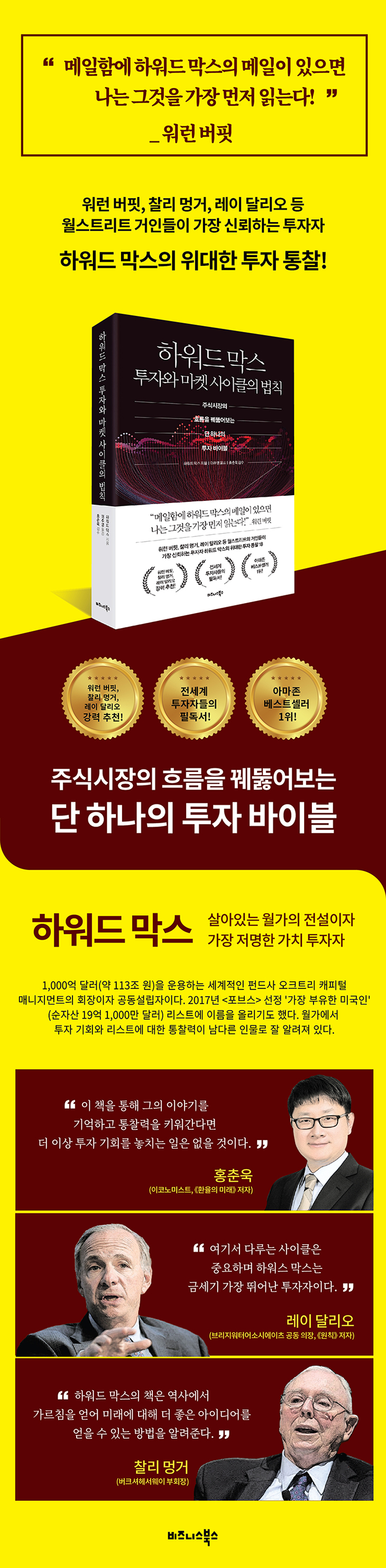
A great investment strategy that masters opportunity and risk."I read his book whenever I have investment concerns." The great investment insight of Howard Marks, a living legend on Wall Street and the most trusted investor by Wall Street giants such as Warren Buffett, Charlie Munger, and Ray Dalio.
The ultimate value investing strategy: reading hidden market patterns and discovering opportunities.
October 30, 2018. Economics and Management PD Kim Hyun-joo
Living Wall Street legend Howard Marks tells us
0.001% investment insight that helps you read hidden market patterns and discover opportunities!
We all know that markets go up and down.
So when should you withdraw from the market and when should you stay? The answer lies in understanding the underlying causes of the cycle's rhythm.
By learning about the economic, market, and corporate dynamics, as well as investor psychology and the patterns of investment behavior determined by all of these, we can confidently determine where we are in the cycle and apply this knowledge to our investments to improve our odds of success.
In this book, legendary Wall Street investor Howard Marks, respected even by Warren Buffett, explains the cycles that govern the stock market and teaches you how to read and profit from these patterns.
His explanations, presented with exceptional insight and clarity, provide us with the insight to adapt to the changing investment environment.
While others are frustrated by unexpected events and paralyzed by fear and greed, you will be able to recognize and prepare for the cycles of investing and the market.
0.001% investment insight that helps you read hidden market patterns and discover opportunities!
We all know that markets go up and down.
So when should you withdraw from the market and when should you stay? The answer lies in understanding the underlying causes of the cycle's rhythm.
By learning about the economic, market, and corporate dynamics, as well as investor psychology and the patterns of investment behavior determined by all of these, we can confidently determine where we are in the cycle and apply this knowledge to our investments to improve our odds of success.
In this book, legendary Wall Street investor Howard Marks, respected even by Warren Buffett, explains the cycles that govern the stock market and teaches you how to read and profit from these patterns.
His explanations, presented with exceptional insight and clarity, provide us with the insight to adapt to the changing investment environment.
While others are frustrated by unexpected events and paralyzed by fear and greed, you will be able to recognize and prepare for the cycles of investing and the market.
- You can preview some of the book's contents.
Preview
index
The wisdom of a master who will remain forever in the world of investment.
Introduction: What Great Investors Know
Author's Note
Chapter 1: Why Study Cycling?
Chapter 2 The Nature of the Cycle
Chapter 3 Regularity of Cycles
Chapter 4 Economic Cycle
Chapter 5 Economic Cycles and Government Intervention
Chapter 6: The Profit Cycle
Chapter 7: The Pendulum of Investor Psychology
Chapter 8: The Cycle of Attitudes Toward Risk
Chapter 9: The Credit Cycle
Chapter 10: The Bad Debt Cycle
Chapter 11: The Real Estate Cycle
Chapter 12: Summary of Market Cycles
Chapter 13: How to Respond to Market Cycles
Chapter 14 Cycle Positioning
Chapter 15: Limitations of Response
Chapter 16: The Cycle of Success
Chapter 17: The Future of Cycling
Chapter 18: The Core of the Cycle
Introduction: What Great Investors Know
Author's Note
Chapter 1: Why Study Cycling?
Chapter 2 The Nature of the Cycle
Chapter 3 Regularity of Cycles
Chapter 4 Economic Cycle
Chapter 5 Economic Cycles and Government Intervention
Chapter 6: The Profit Cycle
Chapter 7: The Pendulum of Investor Psychology
Chapter 8: The Cycle of Attitudes Toward Risk
Chapter 9: The Credit Cycle
Chapter 10: The Bad Debt Cycle
Chapter 11: The Real Estate Cycle
Chapter 12: Summary of Market Cycles
Chapter 13: How to Respond to Market Cycles
Chapter 14 Cycle Positioning
Chapter 15: Limitations of Response
Chapter 16: The Cycle of Success
Chapter 17: The Future of Cycling
Chapter 18: The Core of the Cycle
Detailed image
Into the book
The future should not be viewed as a single, fixed, predictable outcome, but rather as a range of possibilities and probability distributions (hopefully based on insight into each possibility).
Probability distributions reflect investors' views or interpretations of trends.
Chapter 1: Why Study Cycling?
The further a cycle moves from its midpoint—the more it deviates or goes beyond it—the more potential it has for disruption.
When the movement toward one extreme becomes excessive, the rebound becomes more violent and causes greater damage as the behavior promoted by the cycle at the extreme is found to be inappropriate.
In other words, as movements away from the middle ground—such as the economy and businesses doing “too well” and stock prices becoming “too high”—grow, the potential for disruption also increases.
A rise is followed by a simple correction, and a bull market is followed by a bear market.
But booms and bubbles are followed by far more damaging crashes, crashes, and panics.
Chapter 2: The Nature of the Cycle
The most unsound financial practices occur when the economy and financial markets are at their most prosperous.
In boom times, people are more optimistic, less cautious, and more satisfied with risky investments, even if they receive a small risk premium.
Moreover, since they are neither pessimistic nor anxious, they do not pay much attention to the safer areas of the risk/return graph.
Under these conditions, the price of risky assets rises compared to safe assets.
So it's no surprise that foolish investments are made in good times rather than bad.
This phenomenon occurs during boom times, even though jumping into risky investments at higher prices means the expected risk premium is much lower than in risk-conscious times.
Chapter 8: The Cycle of Attitudes Toward Risk
About 45 years ago, in the early 1970s, I received the greatest gift of all.
A wise, older investor once told me about the "three stages of a bull market."
● Stage 1: When only a very insightful few believe that things will get better
● Step 2: When most investors realize that improvement is actually happening
● Stage 3, when everyone concludes that things will get better forever
Chapter 12: Summary of Market Cycles
One way people respond to conundrums these days is to ask, “What inning are we in?”
I've been asked this question regularly since the financial crisis in late 2008.
What people are really asking with this question is, “Where are we in the cycle?”
In the fourth quarter of 2008, people wondered, "How much pain have we felt, and how much more will we have to suffer?"
More recently, questions have been asked mainly about credit cycles.
How much longer will the credit cycle continue to rise (borrowing becomes easier), and when will credit availability tighten?
Chapter 13: How to Respond to Market Cycles
Ruchir Sharma, chief global strategist at Morgan Stanley Investment Management, wrote in his book The Rise and Fall of Nations about the impact of the new reformers:
“Reforms lead to periods of growth and prosperity, and prosperity breeds complacency and arrogance, which leads to new crises,” Phipps noted, noting that history clearly demonstrates this trend.
The question is whether we are shrewd and cool-headed enough to realize that good times don't necessarily lead to better times, and that success can be cyclical.
Chapter 16: The Cycle of Success
Probability distributions reflect investors' views or interpretations of trends.
Chapter 1: Why Study Cycling?
The further a cycle moves from its midpoint—the more it deviates or goes beyond it—the more potential it has for disruption.
When the movement toward one extreme becomes excessive, the rebound becomes more violent and causes greater damage as the behavior promoted by the cycle at the extreme is found to be inappropriate.
In other words, as movements away from the middle ground—such as the economy and businesses doing “too well” and stock prices becoming “too high”—grow, the potential for disruption also increases.
A rise is followed by a simple correction, and a bull market is followed by a bear market.
But booms and bubbles are followed by far more damaging crashes, crashes, and panics.
Chapter 2: The Nature of the Cycle
The most unsound financial practices occur when the economy and financial markets are at their most prosperous.
In boom times, people are more optimistic, less cautious, and more satisfied with risky investments, even if they receive a small risk premium.
Moreover, since they are neither pessimistic nor anxious, they do not pay much attention to the safer areas of the risk/return graph.
Under these conditions, the price of risky assets rises compared to safe assets.
So it's no surprise that foolish investments are made in good times rather than bad.
This phenomenon occurs during boom times, even though jumping into risky investments at higher prices means the expected risk premium is much lower than in risk-conscious times.
Chapter 8: The Cycle of Attitudes Toward Risk
About 45 years ago, in the early 1970s, I received the greatest gift of all.
A wise, older investor once told me about the "three stages of a bull market."
● Stage 1: When only a very insightful few believe that things will get better
● Step 2: When most investors realize that improvement is actually happening
● Stage 3, when everyone concludes that things will get better forever
Chapter 12: Summary of Market Cycles
One way people respond to conundrums these days is to ask, “What inning are we in?”
I've been asked this question regularly since the financial crisis in late 2008.
What people are really asking with this question is, “Where are we in the cycle?”
In the fourth quarter of 2008, people wondered, "How much pain have we felt, and how much more will we have to suffer?"
More recently, questions have been asked mainly about credit cycles.
How much longer will the credit cycle continue to rise (borrowing becomes easier), and when will credit availability tighten?
Chapter 13: How to Respond to Market Cycles
Ruchir Sharma, chief global strategist at Morgan Stanley Investment Management, wrote in his book The Rise and Fall of Nations about the impact of the new reformers:
“Reforms lead to periods of growth and prosperity, and prosperity breeds complacency and arrogance, which leads to new crises,” Phipps noted, noting that history clearly demonstrates this trend.
The question is whether we are shrewd and cool-headed enough to realize that good times don't necessarily lead to better times, and that success can be cyclical.
Chapter 16: The Cycle of Success
--- From the text
Publisher's Review
The best investment book recommended by Warren Buffett!
There are investors that Wall Street giants trust the most, including Warren Buffett, the 'Oracle of Omaha', Charlie Munger, the 'Vice Chairman of Berkshire Hathaway', Ray Dalio, the 'Godfather of Hedge Funds', and Jeffrey Gundlach, known as the 'New Bond King'.
This is Howard Marks, the head of Oaktree Capital Management, which manages $100 billion (approximately 113 trillion won).
Marks is well known on Wall Street for his exceptional insight into investment opportunities and risks.
The letters he sends to clients in the form of memos are full of sharp comments and practical philosophies, and Warren Buffett trusts Marks so much that he says that whenever a letter from Marks appears in his mailbox, it's the first thing he opens.
Howard Marks attributes the 22 years of success his firm, Oaktree Capital, has enjoyed to timing the cycle.
Howard Marks' book, "Investing and the Laws of Market Cycles," contains interesting facts about cycles that he discovered, such as "What is a cycle?", "Why do market ups and downs occur?", and "What kind of investment behavior can lead to success in such ups and downs?"
This is the first book to truly address the essence of cycles, and it is packed with insights that anyone in the investment world can use to develop their own investment philosophy and strategy.
Investment wisdom that creates unwavering profits even in the turbulent waves of the market!
There is an old superstition in the world of investing.
This is the 10-year cycle theory.
For example, the story is, 'There was a foreign exchange crisis in 1997 and a global financial crisis in 2008, so a new crisis will come starting in 2017.'
In Korea's investment market, where asset prices can be halved at any moment due to significant external influences, investors who experienced the dramatic ups and downs of 1997 and 2008 have made investment decisions based on reading cycles.
But as we all know, if we had taken the 10-year cycle theory seriously and therefore been passive in our investments, we would have missed the investment opportunities in 2017 (stocks) and 2018 (Seoul real estate).
Howard Marks says that cycles should be viewed as probabilistic phenomena, not as something "set in stone" that a crisis will occur every ten years.
And he says that cycles are created according to certain 'patterns', which tend to result from changes in human psychology and behavior rather than natural phenomena.
If we remember this fact and pay attention, cycles are not uncontrollable, but rather opportunities that can be harnessed, and even become a minefield for achieving results beyond expectations.
The ultimate value investing strategy that masters market opportunities and risks!
This book consists of a total of 18 chapters.
Chapters 1 through 3 explain why investors need to understand cycles and how they work.
Chapters 4 through 11 examine key factors that determine the investment environment, including the economy, corporate profits, investor psychology, investor attitudes toward risk, capital markets (credit), non-performing loans, and real estate. They examine how these events trigger cycles and why extreme bubbles and crashes occur, rather than simple fluctuations.
Chapters 12 through 15 provide an interim summary of the previously discussed cycles by type, and discuss how investors should respond to changes in these cycles and how they should change their portfolio positioning.
Finally, chapters 16 through 18 emphasize the importance of caution for investors by mentioning that success also has ups and downs, or cycles.
We conclude by anticipating that the cycle will not stop, and discussing key points about the cycle that must be remembered.
By following Howard Marks' story, which makes complex and difficult wisdom easy to understand, we can gain insight into important questions such as the following:
● (In the cycle) Is this the beginning or the end of an upward phase?
● If a particular cycle has been rising for a while, is it currently in a dangerous phase?
● Are investors’ actions driven by greed or fear?
● Are investors appropriately risk-averse or recklessly risk-taking?
● Is the market overheated (and therefore too expensive) or cooled (and therefore cheap) because of what happened in the cycle?
● All things considered, should our current position in the cycle be focused on defense or offense?
Investors who have repeatedly suffered losses by buying at the peak of the cycle and selling at the bottom, investors who have been swayed by market fluctuations and failed to seize opportunities, and investors who are developing their own investment philosophy and strategy will gain wise wisdom to adapt appropriately to the ever-changing investment environment through this book.
Furthermore, you will no longer regret missing out on opportunities that create favorable investment odds for you.
There are investors that Wall Street giants trust the most, including Warren Buffett, the 'Oracle of Omaha', Charlie Munger, the 'Vice Chairman of Berkshire Hathaway', Ray Dalio, the 'Godfather of Hedge Funds', and Jeffrey Gundlach, known as the 'New Bond King'.
This is Howard Marks, the head of Oaktree Capital Management, which manages $100 billion (approximately 113 trillion won).
Marks is well known on Wall Street for his exceptional insight into investment opportunities and risks.
The letters he sends to clients in the form of memos are full of sharp comments and practical philosophies, and Warren Buffett trusts Marks so much that he says that whenever a letter from Marks appears in his mailbox, it's the first thing he opens.
Howard Marks attributes the 22 years of success his firm, Oaktree Capital, has enjoyed to timing the cycle.
Howard Marks' book, "Investing and the Laws of Market Cycles," contains interesting facts about cycles that he discovered, such as "What is a cycle?", "Why do market ups and downs occur?", and "What kind of investment behavior can lead to success in such ups and downs?"
This is the first book to truly address the essence of cycles, and it is packed with insights that anyone in the investment world can use to develop their own investment philosophy and strategy.
Investment wisdom that creates unwavering profits even in the turbulent waves of the market!
There is an old superstition in the world of investing.
This is the 10-year cycle theory.
For example, the story is, 'There was a foreign exchange crisis in 1997 and a global financial crisis in 2008, so a new crisis will come starting in 2017.'
In Korea's investment market, where asset prices can be halved at any moment due to significant external influences, investors who experienced the dramatic ups and downs of 1997 and 2008 have made investment decisions based on reading cycles.
But as we all know, if we had taken the 10-year cycle theory seriously and therefore been passive in our investments, we would have missed the investment opportunities in 2017 (stocks) and 2018 (Seoul real estate).
Howard Marks says that cycles should be viewed as probabilistic phenomena, not as something "set in stone" that a crisis will occur every ten years.
And he says that cycles are created according to certain 'patterns', which tend to result from changes in human psychology and behavior rather than natural phenomena.
If we remember this fact and pay attention, cycles are not uncontrollable, but rather opportunities that can be harnessed, and even become a minefield for achieving results beyond expectations.
The ultimate value investing strategy that masters market opportunities and risks!
This book consists of a total of 18 chapters.
Chapters 1 through 3 explain why investors need to understand cycles and how they work.
Chapters 4 through 11 examine key factors that determine the investment environment, including the economy, corporate profits, investor psychology, investor attitudes toward risk, capital markets (credit), non-performing loans, and real estate. They examine how these events trigger cycles and why extreme bubbles and crashes occur, rather than simple fluctuations.
Chapters 12 through 15 provide an interim summary of the previously discussed cycles by type, and discuss how investors should respond to changes in these cycles and how they should change their portfolio positioning.
Finally, chapters 16 through 18 emphasize the importance of caution for investors by mentioning that success also has ups and downs, or cycles.
We conclude by anticipating that the cycle will not stop, and discussing key points about the cycle that must be remembered.
By following Howard Marks' story, which makes complex and difficult wisdom easy to understand, we can gain insight into important questions such as the following:
● (In the cycle) Is this the beginning or the end of an upward phase?
● If a particular cycle has been rising for a while, is it currently in a dangerous phase?
● Are investors’ actions driven by greed or fear?
● Are investors appropriately risk-averse or recklessly risk-taking?
● Is the market overheated (and therefore too expensive) or cooled (and therefore cheap) because of what happened in the cycle?
● All things considered, should our current position in the cycle be focused on defense or offense?
Investors who have repeatedly suffered losses by buying at the peak of the cycle and selling at the bottom, investors who have been swayed by market fluctuations and failed to seize opportunities, and investors who are developing their own investment philosophy and strategy will gain wise wisdom to adapt appropriately to the ever-changing investment environment through this book.
Furthermore, you will no longer regret missing out on opportunities that create favorable investment odds for you.
GOODS SPECIFICS
- Date of publication: October 29, 2018
- Page count, weight, size: 436 pages | 768g | 152*225*30mm
- ISBN13: 9791162540466
- ISBN10: 116254046X
You may also like
카테고리
korean


korean

![ELLE 엘르 스페셜 에디션 A형 : 12월 [2025]](http://librairie.coreenne.fr/cdn/shop/files/b8e27a3de6c9538896439686c6b0e8fb.jpg?v=1766436872&width=3840)


