

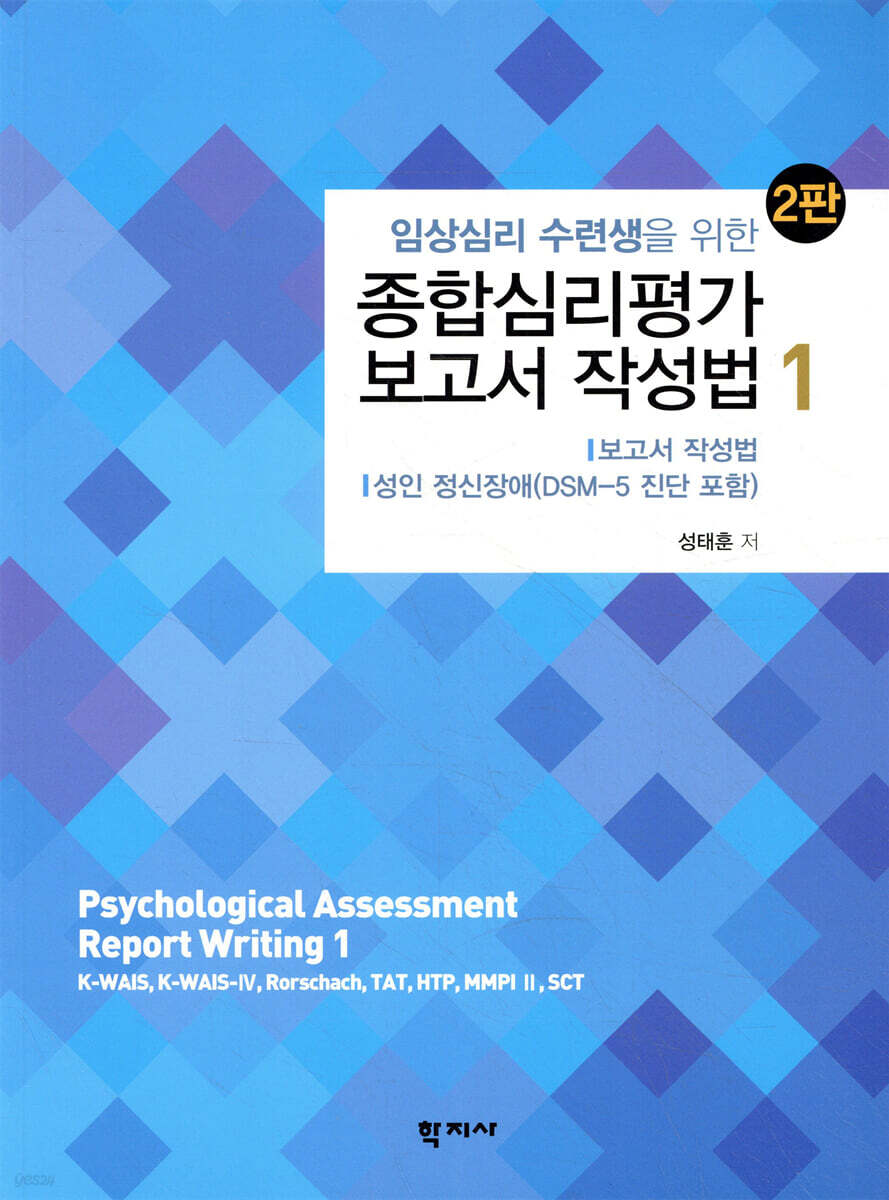
How to Write a Comprehensive Psychological Evaluation Report 1
 |
Description
Book Introduction
In the 2nd edition of 『How to Write a Comprehensive Psychological Evaluation Report』, unlike child mental disorders, there are many mental disorders that share similar symptoms, and organizing the data for each disorder that is similar but slightly different would be wasteful, so the raw data was not organized.
To fill this void, we included as many cases as possible and indicated the main characteristics of each case in the title.
Additionally, this second edition includes adult mental disorders (excluding childhood disorders and neuropsychological disorders) diagnosed in DSM-5 along with report writing instructions.
To fill this void, we included as many cases as possible and indicated the main characteristics of each case in the title.
Additionally, this second edition includes adult mental disorders (excluding childhood disorders and neuropsychological disorders) diagnosed in DSM-5 along with report writing instructions.
index
PART 1 How to Write a Report
Chapter 1: How to Interpret Test Data
1.
cognitive concepts
2.
Inference about personality
Chapter 2: Report Cover and Reason for Request
1.
Writing a report cover
2.
Write the reason for the request
Chapter 3: Behavioral Observation and Interview Writing
1.
Appearance and companion
2.
Hygiene, eye contact
3.
Inspection attitude
4.
Diagnosis-specific behavior
5.
Content of the speech
6.
Interview content
7.
Examples of behavioral observations and interview transcripts
Chapter 4: Intelligence and Cognitive Function
1.
The entire composition of 'Intelligence and Cognitive Function'
2.
Overall intelligence aspect
3.
Interpretation of subtests within the four indicators (verbal comprehension, perceptual reasoning, working memory, and processing speed)
4.
Intelligence Test Summary
5.
Cognitive function (Rorschach-centered)
6.
Examples of writing intelligence and cognitive functions
Chapter 5: Writing Personality and Emotions
1.
Step 1: Interpret individual tests
2.
Step 2: Group similar content (applying the first interpretation)
3.
Step 3: Drawing the Psychological Process (Applying Secondary Interpretation)
4.
Step 4: Explain the Core Problem
5.
Step 5: Paragraph Structure
6.
Examples of personality and emotional writing
Chapter 6: Writing a Summary and Suggestions
1.
Integration of intelligence and personality
2.
Write a diagnosis and suggestions
3.
Examples of writing a summary and suggestions
Chapter 7 Report Case Study
1.
A female elementary school student (7 years old, 2nd grade) being bullied by a male student
2.
A man hospitalized due to frequent drinking and violence (male/52 years old/college graduate)
PART 2 Diagnosis-Specific Report Cases: Adult Mental Disorders (Including DSM-5 Diagnoses)
01 Schizophrenia
02 Delusional Disorder
03 Brief Psychotic Disorder
04 Schizoaffective Disorder
05 Bipolar I Disorder
06 Bipolar II Disorder
07 Cyclothymic Disorder
08 Major Depressive Disorder
09 Persistent Depressive Disorder
10 Unspecified Depressive Disorder
11 Specific Phobia
12 Social Anxiety Disorder
13 Panic Disorder
14 Generalized Anxiety Disorder
15 Unspecified Anxiety Disorder
16 Obsessive-Compulsive Disorder
17 Body Dysmorphic Disorder
18 Hoarding Disorder
19 Excoriation Disorder
20 Posttraumatic Stress Disorder
21 Acute Stress Disorder
22 Adjustment Disorder
23 Dissociative Identity Disorder
24 Dissociative Amnesia
25 Depersonalization-Derealization Disorder
26 Unspecified Dissociative Disorder
27 Somatic Symptom Disorder
28 Illness Anxiety Disorder
29 Conversion Disorder
30 Anorexia Nervosa
31 Bulimia Nervosa
32 Insomnia Disorder
33 Non-Rapid Eye Movement Sleep Arousal Disorder
34 Nightmare Disorder
35 Unspecified Sleep-Wake Disorder
36 Gender Dysphoria in Adults
37 Intermittent Explosive Disorder
38 Kleptomania
39 Alcohol Use Disorder
40 Gambling Disorder
41 Paranoid Personality Disorder
42 Schizoid Personality Disorder
43 Schizophrenic Personality Disorder
44 Antisocial Personality Disorder
45 Borderline Personality Disorder
46 Histrionic Personality Disorder
47 Narcissistic Personality Disorder
48 Avoidant Personality Disorder
49 Dependent Personality Disorder
50 Obsessive-Compulsive Personality Disorder
51 Unspecified Personality Disorder
52 Sexual Dysfunction & Paraphilic Disorder
supplement.
Books to help you write psychological evaluation reports
Chapter 1: How to Interpret Test Data
1.
cognitive concepts
2.
Inference about personality
Chapter 2: Report Cover and Reason for Request
1.
Writing a report cover
2.
Write the reason for the request
Chapter 3: Behavioral Observation and Interview Writing
1.
Appearance and companion
2.
Hygiene, eye contact
3.
Inspection attitude
4.
Diagnosis-specific behavior
5.
Content of the speech
6.
Interview content
7.
Examples of behavioral observations and interview transcripts
Chapter 4: Intelligence and Cognitive Function
1.
The entire composition of 'Intelligence and Cognitive Function'
2.
Overall intelligence aspect
3.
Interpretation of subtests within the four indicators (verbal comprehension, perceptual reasoning, working memory, and processing speed)
4.
Intelligence Test Summary
5.
Cognitive function (Rorschach-centered)
6.
Examples of writing intelligence and cognitive functions
Chapter 5: Writing Personality and Emotions
1.
Step 1: Interpret individual tests
2.
Step 2: Group similar content (applying the first interpretation)
3.
Step 3: Drawing the Psychological Process (Applying Secondary Interpretation)
4.
Step 4: Explain the Core Problem
5.
Step 5: Paragraph Structure
6.
Examples of personality and emotional writing
Chapter 6: Writing a Summary and Suggestions
1.
Integration of intelligence and personality
2.
Write a diagnosis and suggestions
3.
Examples of writing a summary and suggestions
Chapter 7 Report Case Study
1.
A female elementary school student (7 years old, 2nd grade) being bullied by a male student
2.
A man hospitalized due to frequent drinking and violence (male/52 years old/college graduate)
PART 2 Diagnosis-Specific Report Cases: Adult Mental Disorders (Including DSM-5 Diagnoses)
01 Schizophrenia
02 Delusional Disorder
03 Brief Psychotic Disorder
04 Schizoaffective Disorder
05 Bipolar I Disorder
06 Bipolar II Disorder
07 Cyclothymic Disorder
08 Major Depressive Disorder
09 Persistent Depressive Disorder
10 Unspecified Depressive Disorder
11 Specific Phobia
12 Social Anxiety Disorder
13 Panic Disorder
14 Generalized Anxiety Disorder
15 Unspecified Anxiety Disorder
16 Obsessive-Compulsive Disorder
17 Body Dysmorphic Disorder
18 Hoarding Disorder
19 Excoriation Disorder
20 Posttraumatic Stress Disorder
21 Acute Stress Disorder
22 Adjustment Disorder
23 Dissociative Identity Disorder
24 Dissociative Amnesia
25 Depersonalization-Derealization Disorder
26 Unspecified Dissociative Disorder
27 Somatic Symptom Disorder
28 Illness Anxiety Disorder
29 Conversion Disorder
30 Anorexia Nervosa
31 Bulimia Nervosa
32 Insomnia Disorder
33 Non-Rapid Eye Movement Sleep Arousal Disorder
34 Nightmare Disorder
35 Unspecified Sleep-Wake Disorder
36 Gender Dysphoria in Adults
37 Intermittent Explosive Disorder
38 Kleptomania
39 Alcohol Use Disorder
40 Gambling Disorder
41 Paranoid Personality Disorder
42 Schizoid Personality Disorder
43 Schizophrenic Personality Disorder
44 Antisocial Personality Disorder
45 Borderline Personality Disorder
46 Histrionic Personality Disorder
47 Narcissistic Personality Disorder
48 Avoidant Personality Disorder
49 Dependent Personality Disorder
50 Obsessive-Compulsive Personality Disorder
51 Unspecified Personality Disorder
52 Sexual Dysfunction & Paraphilic Disorder
supplement.
Books to help you write psychological evaluation reports
Publisher's Review
At the time of the first edition, the implementation manuals for each test, including the intelligence test, were awkward and rigid in applying them directly to actual testing situations. Therefore, the author revised the implementation guidelines and presented them so that they could be administered comfortably without damaging the test context, based on his experience.
But in the meantime, the intelligence tests for both children and adults have been revised, and the manuals have been made much more practical.
In addition, there are many reference books for other tests, so there is no need to supplement the method of implementation.
On the other hand, the first edition emphasized a structured framework for writing, but did not fully organize the framework. This has been significantly improved in this second edition.
In the first and second editions of this book (Child and Adolescent Mental Disorders), raw data frequently appearing by symptom were organized and included in the ‘Frequently Occurring Reactions’ section for each disorder. However, in this second edition, unlike child mental disorders, there are many mental disorders that share similar symptoms, and organizing data for each disorder that is similar but slightly different would have been wasteful, so raw data organization was not included.
To fill this void, we included as many cases as possible and indicated the main characteristics of each case in the title.
Although the first edition included many adult disorders, it was a mix of child and adult disorders. However, since child and adolescent mental disorders were organized separately in Volume 2, this second edition includes only adult mental disorders (excluding childhood disorders and neuropsychological disorders) diagnosed in DSM-5 along with instructions for writing reports.
We plan to publish three volumes in the future, combining non-diagnostic and diagnosed cases.
I believe that organizing it into three volumes will serve as an encyclopedic guide for those who need to write psychological evaluation reports, providing them with the necessary information for each type of examinee.
In addition, in Volume 2 (Child and Adolescent Mental Disorders), the psychological process characteristics of each disorder were explained, but since the amount of data was so vast and there were many disorders that shared similar content, it was decided to add them through partial revision in the future and not include them this time.
But in the meantime, the intelligence tests for both children and adults have been revised, and the manuals have been made much more practical.
In addition, there are many reference books for other tests, so there is no need to supplement the method of implementation.
On the other hand, the first edition emphasized a structured framework for writing, but did not fully organize the framework. This has been significantly improved in this second edition.
In the first and second editions of this book (Child and Adolescent Mental Disorders), raw data frequently appearing by symptom were organized and included in the ‘Frequently Occurring Reactions’ section for each disorder. However, in this second edition, unlike child mental disorders, there are many mental disorders that share similar symptoms, and organizing data for each disorder that is similar but slightly different would have been wasteful, so raw data organization was not included.
To fill this void, we included as many cases as possible and indicated the main characteristics of each case in the title.
Although the first edition included many adult disorders, it was a mix of child and adult disorders. However, since child and adolescent mental disorders were organized separately in Volume 2, this second edition includes only adult mental disorders (excluding childhood disorders and neuropsychological disorders) diagnosed in DSM-5 along with instructions for writing reports.
We plan to publish three volumes in the future, combining non-diagnostic and diagnosed cases.
I believe that organizing it into three volumes will serve as an encyclopedic guide for those who need to write psychological evaluation reports, providing them with the necessary information for each type of examinee.
In addition, in Volume 2 (Child and Adolescent Mental Disorders), the psychological process characteristics of each disorder were explained, but since the amount of data was so vast and there were many disorders that shared similar content, it was decided to add them through partial revision in the future and not include them this time.
GOODS SPECIFICS
- Date of issue: June 10, 2019
- Page count, weight, size: 808 pages | 1,405g | 188*257*40mm
- ISBN13: 9788999718366
- ISBN10: 8999718360
You may also like
카테고리
korean


korean

![ELLE 엘르 스페셜 에디션 A형 : 12월 [2025]](http://librairie.coreenne.fr/cdn/shop/files/b8e27a3de6c9538896439686c6b0e8fb.jpg?v=1766436872&width=3840)


