

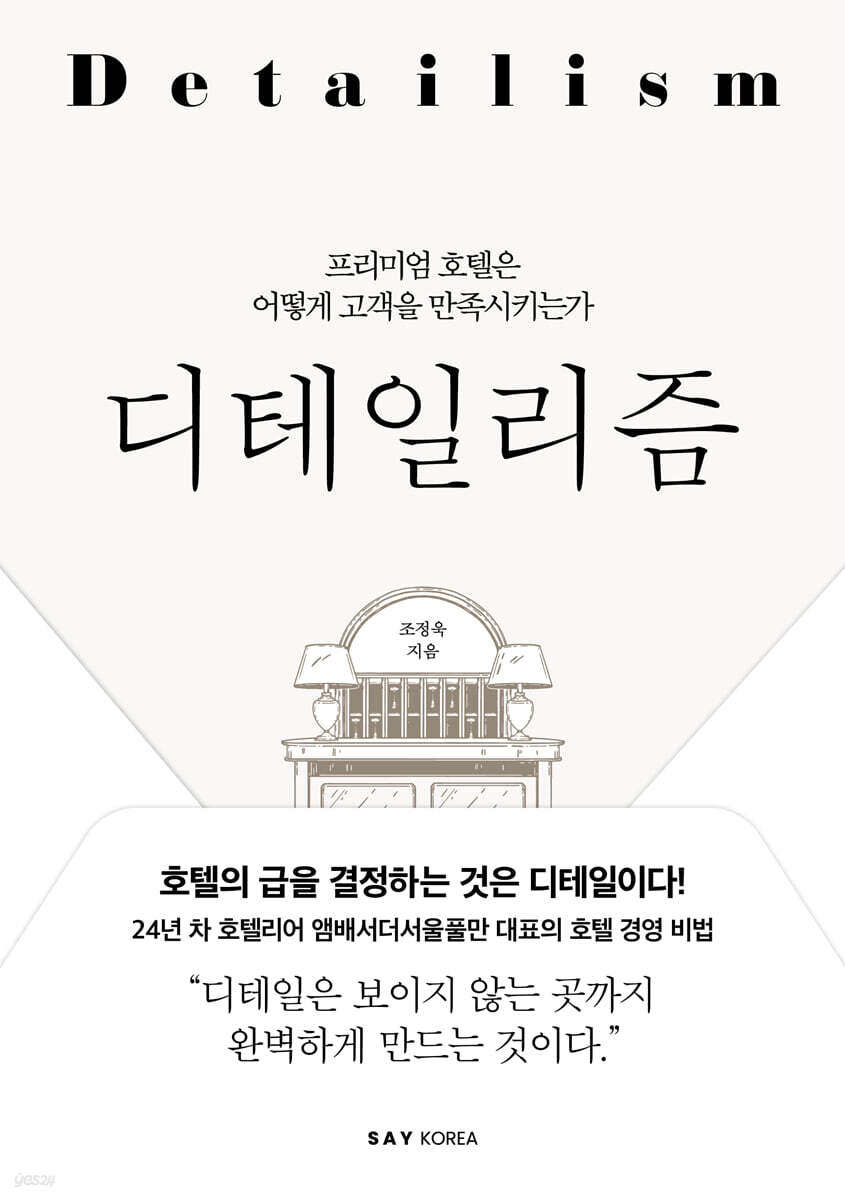
Detailism
 |
Description
Book Introduction
The crucial difference between a 4-star hotel and a 5-star hotel,
The reason why rooms costing tens of millions of won per night are always fully booked is because of the details!
★ Korea's first Michelin 3-star restaurant challenge
★ The Arabian Nights that heated up social media: The story behind the birth of Kaymak Bingsu
★ Unprecedented hotel shutdowns and overcoming the crisis amid the MERS pandemic
The first public disclosure by CEO Jo Jeong-wook, a hotelier with 24 years of experience
The secret to premium hotels satisfying their customers!
Actress Seonwoo Yongnyeo, who has started a new career as 'Korea's oldest YouTuber', has become a hot topic with a video of herself eating breakfast at a hotel buffet every day, and Ambassador Seoul Pullman has also become the center of attention.
Already famous as a "breakfast restaurant," the hotel is undergoing a complete remodel and reopening in 2022, with CEO Cho Jeong-wook leading the change and innovation.
What secrets lie behind the management of this hotel, which has been featured in the Michelin Guide for two consecutive years, has become a renowned breakfast restaurant, and has developed unique F&B products, attracting the attention of both the industry and the public?
CEO Cho Jeong-wook, who joined Samsung Group in 1989 and moved to Shilla Hotel in 2002, served as general manager of Shilla Hotels in Seoul and Jeju, and is in his 24th year as a hotelier.
The experiences and insights gained from working in hotels for such a long time are revealed for the first time in 『Detailism: How Premium Hotels Satisfy Guests』.
CEO Cho Jeong-wook describes hotels as “complex business ecosystems that bring together almost every function in the world.”
While working as a hotelier, he discovered that the essence of hotel management was 'detail' and that "every moment was a series of uncompromising details."
'Detailism,' which is also the title of this book, is an expression that encapsulates this management philosophy.
This is not simply technical perfectionism.
It refers to a natural result that comes from a sense of ownership based on respect for customers and responsibility for the brand.
"Detailism" explains "detail," which is considered the essence of hotel management, in detail, dividing it into four topics: philosophy, talent and organizational culture, crisis response and management, and service and product differentiation.
This book is a precious record of 24 years of listening to the pulse of the field, anticipating customer movements, and preserving the essence of the hotel at every moment of change. It provides a field sense to students dreaming of hotel management, and management wisdom to those working in the field, while showing the essence of "customer-oriented management."
The reason why rooms costing tens of millions of won per night are always fully booked is because of the details!
★ Korea's first Michelin 3-star restaurant challenge
★ The Arabian Nights that heated up social media: The story behind the birth of Kaymak Bingsu
★ Unprecedented hotel shutdowns and overcoming the crisis amid the MERS pandemic
The first public disclosure by CEO Jo Jeong-wook, a hotelier with 24 years of experience
The secret to premium hotels satisfying their customers!
Actress Seonwoo Yongnyeo, who has started a new career as 'Korea's oldest YouTuber', has become a hot topic with a video of herself eating breakfast at a hotel buffet every day, and Ambassador Seoul Pullman has also become the center of attention.
Already famous as a "breakfast restaurant," the hotel is undergoing a complete remodel and reopening in 2022, with CEO Cho Jeong-wook leading the change and innovation.
What secrets lie behind the management of this hotel, which has been featured in the Michelin Guide for two consecutive years, has become a renowned breakfast restaurant, and has developed unique F&B products, attracting the attention of both the industry and the public?
CEO Cho Jeong-wook, who joined Samsung Group in 1989 and moved to Shilla Hotel in 2002, served as general manager of Shilla Hotels in Seoul and Jeju, and is in his 24th year as a hotelier.
The experiences and insights gained from working in hotels for such a long time are revealed for the first time in 『Detailism: How Premium Hotels Satisfy Guests』.
CEO Cho Jeong-wook describes hotels as “complex business ecosystems that bring together almost every function in the world.”
While working as a hotelier, he discovered that the essence of hotel management was 'detail' and that "every moment was a series of uncompromising details."
'Detailism,' which is also the title of this book, is an expression that encapsulates this management philosophy.
This is not simply technical perfectionism.
It refers to a natural result that comes from a sense of ownership based on respect for customers and responsibility for the brand.
"Detailism" explains "detail," which is considered the essence of hotel management, in detail, dividing it into four topics: philosophy, talent and organizational culture, crisis response and management, and service and product differentiation.
This book is a precious record of 24 years of listening to the pulse of the field, anticipating customer movements, and preserving the essence of the hotel at every moment of change. It provides a field sense to students dreaming of hotel management, and management wisdom to those working in the field, while showing the essence of "customer-oriented management."
- You can preview some of the book's contents.
Preview
index
Recommendation
Check-in How will hotels make money now?
Floor 1 Why do we bring suffering upon ourselves?
: Details of strategic decision making
The devil is in the details: The obsession with detail that determines customer satisfaction.
Dead fish taste better: Being first in the market comes from understanding customer needs and preparing in detail.
Earning Michelin 3 Stars: Reaching the Top Level Through Planned and Strategic Teamwork
Branding Time: Inheritance and Development through Reinterpretation of the Old
30 Years of Profitable Investments: A Strategic Investment Philosophy for the Hotel Industry
Details Behind: Packaging in a way that seems excessive, no matter what the customer says.
Floor 2: The persistent people who create extraordinary details
: Details of talent and organizational culture
The Birth of a Star Chef: Expertise Alone Isn't Enough for Success
Don't Raise Them, Bring Them: The Art of Tolerance for Quantum Jumps
Customers Don't Do Anything Wrong: The Root Causes of Dissatisfaction and Practical Service Beyond the Manual
What makes a hotel class: Systematic planning and execution create first-class status.
Talent is in the eye of the beholder: How to Find Collaborative Talent
Behind the Scenes: All Leaders Are Impatient
Floor 3 365 days a year in a hotel where there is no wind
: Details of crisis management and resolution
April 27, 2018: The irreplaceable power of experience and intuition.
The Alchemy of Customer Complaints: Turning Accidents and Complaints into Opportunities in Crisis Response
Don't put steps in hotels: The real solution is to find and address the root cause.
Shutdown and Beyond: Life or Death: Lessons from the MERS Pandemic
Two weeks, two months, two years: We won't go back to the way things were before the COVID-19 pandemic.
Details Behind_Hunger can be endured, but stomachache cannot be endured.
Showing the end of Floor 4 details
: Details of service and product differentiation
Private Secret Dinners: Enhance Your Brand Value by Making Reservations Difficult
Arabian Nights and Mango Bingsu: Innovation is a new interpretation of the existing.
Learning from the Seongsan Ilchulbong Merchant: Marketing is about timing. Be a season or two ahead of others.
Why Tasting at 3 PM: The Philosophy of Proper Tasting and Temperature Management
Stories that make everyday life extraordinary: Even everyday life can be the best moment, depending on how you look at it.
Details Behind the Scenes_ Tips Make Even Whales Dance
8,714 days as a hotelier
Check-in How will hotels make money now?
Floor 1 Why do we bring suffering upon ourselves?
: Details of strategic decision making
The devil is in the details: The obsession with detail that determines customer satisfaction.
Dead fish taste better: Being first in the market comes from understanding customer needs and preparing in detail.
Earning Michelin 3 Stars: Reaching the Top Level Through Planned and Strategic Teamwork
Branding Time: Inheritance and Development through Reinterpretation of the Old
30 Years of Profitable Investments: A Strategic Investment Philosophy for the Hotel Industry
Details Behind: Packaging in a way that seems excessive, no matter what the customer says.
Floor 2: The persistent people who create extraordinary details
: Details of talent and organizational culture
The Birth of a Star Chef: Expertise Alone Isn't Enough for Success
Don't Raise Them, Bring Them: The Art of Tolerance for Quantum Jumps
Customers Don't Do Anything Wrong: The Root Causes of Dissatisfaction and Practical Service Beyond the Manual
What makes a hotel class: Systematic planning and execution create first-class status.
Talent is in the eye of the beholder: How to Find Collaborative Talent
Behind the Scenes: All Leaders Are Impatient
Floor 3 365 days a year in a hotel where there is no wind
: Details of crisis management and resolution
April 27, 2018: The irreplaceable power of experience and intuition.
The Alchemy of Customer Complaints: Turning Accidents and Complaints into Opportunities in Crisis Response
Don't put steps in hotels: The real solution is to find and address the root cause.
Shutdown and Beyond: Life or Death: Lessons from the MERS Pandemic
Two weeks, two months, two years: We won't go back to the way things were before the COVID-19 pandemic.
Details Behind_Hunger can be endured, but stomachache cannot be endured.
Showing the end of Floor 4 details
: Details of service and product differentiation
Private Secret Dinners: Enhance Your Brand Value by Making Reservations Difficult
Arabian Nights and Mango Bingsu: Innovation is a new interpretation of the existing.
Learning from the Seongsan Ilchulbong Merchant: Marketing is about timing. Be a season or two ahead of others.
Why Tasting at 3 PM: The Philosophy of Proper Tasting and Temperature Management
Stories that make everyday life extraordinary: Even everyday life can be the best moment, depending on how you look at it.
Details Behind the Scenes_ Tips Make Even Whales Dance
8,714 days as a hotelier
Detailed image

Into the book
In the future, the strategic diagram of all hotels should change like this.
Location + Excellent People + Brand + AI Marketing = A Hotel Customers Love and Reach
The era of searches via Google or Naver, where page views were the core of KPIs, is now fading. AI visibility—how well AI's operating principles and results are visible and understandable—is becoming a core KPI. Therefore, the equation for success in the hotel business must change accordingly.
The ability to brand and connect with guests through diverse stories and content will become increasingly important across all areas of the hotel.
It's not easy to predict how the hotel business will evolve in the AI era, which could completely change the existing hotel systems and processes, from hotel reservations to service provision, and thus the entire business paradigm.
However, the core value of hotels that will not change is 'hospitality', and if we maintain this well, we will be able to find the right path even in the midst of great change.
--- p.21~22, from 「Check-in_ How will hotels make money now?」
What I learned from the CEO who agonized over a minibar until dawn was not simply the importance of perfectionism.
Because obsession with detail doesn't mean pursuing perfectionism.
The key is to have the mindset that it's my job.
Only when I have the mindset that everything in the hotel I work at is related to me and that every moment the guest experiences is my responsibility, can I truly create detail.
This is another expression of respect for our customers and responsibility for our brand.
And above all, it will be a natural result of the sense of ownership that ‘this is my job.’
(…)
True luxury is born from perfection, even in the unseen areas.
Completing the product with the highest quality, even in the parts that customers cannot see directly.
This is exactly what premium brands have in common.
And this philosophy should be applied equally in hotels.
An obsession that cannot neglect anything.
This is the only way to turn the ordinary into a luxury item.
Details are not a technique, they are a philosophy, and that philosophy ultimately determines the fate of a brand.
--- p.41~42, from 「Floor 1_ 'The devil is in the details'」
The head chef's invitation to appear on TV was a strategic decision based on insights gained from working at a Japanese sushi restaurant and at Per Se in New York.
No matter how well-made a product is developed or how good the hotel's service is, it is useless if customers do not recognize it and visit the hotel to spend their money.
Making something known to as many customers as possible is marketing and promotion.
The importance of these complex capabilities is even more evident in the hotel industry.
Key members of a hotel must not only be good at their jobs, but also possess the ability to externally demonstrate their expertise.
It was in this context that the head chef's TV appearance was successful.
He was able to achieve success because he was able to convey his outstanding cooking skills in a way that the general public could understand and relate to.
This experience convinced me of a new formula for success in modern business.
Professionalism is the foundation, and only when you add wings of communication and expressiveness to it can you truly soar.
--- p.127~128, from 「Floor 2_ 'The Birth of a Star Chef'」
As I gained more interview experience, it became a habit to observe the applicants around me while watching them answer questions.
The system of an organization called a hotel must operate continuously 24 hours a day, 365 days a year.
To make this possible, unity among employees was crucial, and it was necessary for everyone to work together to achieve something unique rather than trying to do something alone.
So, we needed someone who was good at team play rather than someone with flashy individual play, and the key to the interview was to find out such a person.
How well someone listens to other candidates' presentations, how focused they are when it's not their turn, and how well they respond to unexpected questions are all important indicators of their basic character and ability to collaborate within an organization.
No matter how excellent someone's qualifications are, if they are someone you can't work with, they can actually be toxic to the organization.
--- p.187~188, from 「Floor 2_ 'You can tell a person's talent by looking at their face'」
Accidents can happen anytime, anywhere.
The important thing is that the results can be completely different depending on your attitude and how you treat the customer.
The two incidents mentioned above are good examples of how a hotel's response can determine whether a customer becomes a stronger supporter or turns their back on the hotel completely.
This teaches us that how we respond to customers determines the outcome of our incident resolution efforts.
(…)
It is often said that a person's character and sincerity are revealed in times of crisis.
Customers experience the hotel's sincerity during the accident handling process.
The hotel's response to a crisis leaves a lasting impression on customers.
This is why incident response is the watershed that either strengthens your relationship with your customers or blocks and alienates them.
A wise response that turns a crisis into an opportunity is the true alchemy of resolving customer complaints and the perfection of hospitality.
--- p.221~223, from 「Floor 3_ 'The Alchemy of Customer Complaints'」
Innovation isn't about creating something completely new.
There is nothing completely new in this world.
Innovation is the process of reinterpreting something that already exists in the world and bringing it to life in a new way.
Arabian Nights was a reinterpretation of Middle Eastern drinks and desserts to suit the tastes of Korean hotel guests, and Jeju's mango bingsu was a unique experience that could only be experienced in Jeju, unlike in Seoul.
Innovation starts with looking around, reflecting on past experiences, and finding something a little different.
Simply reinterpreting and combining existing good products to suit our environment and satisfy our customers is enough to create innovative products.
Whenever we develop a new product at a hotel, we try to remember that it will always be an evolutionary process.
A perfect product that satisfies the customer cannot be created from the first attempt.
I believe that as these second and third attempts accumulate, the quality of the product will improve and progress towards the perfection we initially expected.
--- p.308~309, from 「Floor 4_ 'Arabian Nights and Mango Bingsu'」
Many people expressed sharp dissatisfaction with the order to conduct the tasting at 3 p.m., which was customarily conducted at the employees' mealtime, as they thought it was no different from asking them to eat again after eating.
However, as time went by and the quality of the food improved and customers gave it positive reviews, I experienced that the harder the hotel staff worked, the higher the customer satisfaction.
The tasting order at 3 p.m., which was difficult, was the management's will to provide the best quality to customers.
Scientific management of food temperature began with the realization that we must provide the best service to our customers.
Temperature is the lifeblood of food.
And the small efforts to maintain that temperature accumulate to create the hotel's brand value.
The unique experience that customers have at a hotel comes from these unseen details.
This is the essence of hotel service and customer-centric thinking.
Putting customer satisfaction before employee convenience is the beginning of true hospitality.
--- p.334, from 「Floor 4_ 'The reason for tasting at 3 PM'」
Ultimately, the most important thing in hotel management is to move the hearts of customers.
And the most powerful tool to move that heart is story.
Just as Cuban youth create everyday stories on the Malecón coast, hotels must constantly create stories that give special meaning to their guests' daily lives.
That is the true perfection of hospitality and how a brand comes to life.
Location + Excellent People + Brand + AI Marketing = A Hotel Customers Love and Reach
The era of searches via Google or Naver, where page views were the core of KPIs, is now fading. AI visibility—how well AI's operating principles and results are visible and understandable—is becoming a core KPI. Therefore, the equation for success in the hotel business must change accordingly.
The ability to brand and connect with guests through diverse stories and content will become increasingly important across all areas of the hotel.
It's not easy to predict how the hotel business will evolve in the AI era, which could completely change the existing hotel systems and processes, from hotel reservations to service provision, and thus the entire business paradigm.
However, the core value of hotels that will not change is 'hospitality', and if we maintain this well, we will be able to find the right path even in the midst of great change.
--- p.21~22, from 「Check-in_ How will hotels make money now?」
What I learned from the CEO who agonized over a minibar until dawn was not simply the importance of perfectionism.
Because obsession with detail doesn't mean pursuing perfectionism.
The key is to have the mindset that it's my job.
Only when I have the mindset that everything in the hotel I work at is related to me and that every moment the guest experiences is my responsibility, can I truly create detail.
This is another expression of respect for our customers and responsibility for our brand.
And above all, it will be a natural result of the sense of ownership that ‘this is my job.’
(…)
True luxury is born from perfection, even in the unseen areas.
Completing the product with the highest quality, even in the parts that customers cannot see directly.
This is exactly what premium brands have in common.
And this philosophy should be applied equally in hotels.
An obsession that cannot neglect anything.
This is the only way to turn the ordinary into a luxury item.
Details are not a technique, they are a philosophy, and that philosophy ultimately determines the fate of a brand.
--- p.41~42, from 「Floor 1_ 'The devil is in the details'」
The head chef's invitation to appear on TV was a strategic decision based on insights gained from working at a Japanese sushi restaurant and at Per Se in New York.
No matter how well-made a product is developed or how good the hotel's service is, it is useless if customers do not recognize it and visit the hotel to spend their money.
Making something known to as many customers as possible is marketing and promotion.
The importance of these complex capabilities is even more evident in the hotel industry.
Key members of a hotel must not only be good at their jobs, but also possess the ability to externally demonstrate their expertise.
It was in this context that the head chef's TV appearance was successful.
He was able to achieve success because he was able to convey his outstanding cooking skills in a way that the general public could understand and relate to.
This experience convinced me of a new formula for success in modern business.
Professionalism is the foundation, and only when you add wings of communication and expressiveness to it can you truly soar.
--- p.127~128, from 「Floor 2_ 'The Birth of a Star Chef'」
As I gained more interview experience, it became a habit to observe the applicants around me while watching them answer questions.
The system of an organization called a hotel must operate continuously 24 hours a day, 365 days a year.
To make this possible, unity among employees was crucial, and it was necessary for everyone to work together to achieve something unique rather than trying to do something alone.
So, we needed someone who was good at team play rather than someone with flashy individual play, and the key to the interview was to find out such a person.
How well someone listens to other candidates' presentations, how focused they are when it's not their turn, and how well they respond to unexpected questions are all important indicators of their basic character and ability to collaborate within an organization.
No matter how excellent someone's qualifications are, if they are someone you can't work with, they can actually be toxic to the organization.
--- p.187~188, from 「Floor 2_ 'You can tell a person's talent by looking at their face'」
Accidents can happen anytime, anywhere.
The important thing is that the results can be completely different depending on your attitude and how you treat the customer.
The two incidents mentioned above are good examples of how a hotel's response can determine whether a customer becomes a stronger supporter or turns their back on the hotel completely.
This teaches us that how we respond to customers determines the outcome of our incident resolution efforts.
(…)
It is often said that a person's character and sincerity are revealed in times of crisis.
Customers experience the hotel's sincerity during the accident handling process.
The hotel's response to a crisis leaves a lasting impression on customers.
This is why incident response is the watershed that either strengthens your relationship with your customers or blocks and alienates them.
A wise response that turns a crisis into an opportunity is the true alchemy of resolving customer complaints and the perfection of hospitality.
--- p.221~223, from 「Floor 3_ 'The Alchemy of Customer Complaints'」
Innovation isn't about creating something completely new.
There is nothing completely new in this world.
Innovation is the process of reinterpreting something that already exists in the world and bringing it to life in a new way.
Arabian Nights was a reinterpretation of Middle Eastern drinks and desserts to suit the tastes of Korean hotel guests, and Jeju's mango bingsu was a unique experience that could only be experienced in Jeju, unlike in Seoul.
Innovation starts with looking around, reflecting on past experiences, and finding something a little different.
Simply reinterpreting and combining existing good products to suit our environment and satisfy our customers is enough to create innovative products.
Whenever we develop a new product at a hotel, we try to remember that it will always be an evolutionary process.
A perfect product that satisfies the customer cannot be created from the first attempt.
I believe that as these second and third attempts accumulate, the quality of the product will improve and progress towards the perfection we initially expected.
--- p.308~309, from 「Floor 4_ 'Arabian Nights and Mango Bingsu'」
Many people expressed sharp dissatisfaction with the order to conduct the tasting at 3 p.m., which was customarily conducted at the employees' mealtime, as they thought it was no different from asking them to eat again after eating.
However, as time went by and the quality of the food improved and customers gave it positive reviews, I experienced that the harder the hotel staff worked, the higher the customer satisfaction.
The tasting order at 3 p.m., which was difficult, was the management's will to provide the best quality to customers.
Scientific management of food temperature began with the realization that we must provide the best service to our customers.
Temperature is the lifeblood of food.
And the small efforts to maintain that temperature accumulate to create the hotel's brand value.
The unique experience that customers have at a hotel comes from these unseen details.
This is the essence of hotel service and customer-centric thinking.
Putting customer satisfaction before employee convenience is the beginning of true hospitality.
--- p.334, from 「Floor 4_ 'The reason for tasting at 3 PM'」
Ultimately, the most important thing in hotel management is to move the hearts of customers.
And the most powerful tool to move that heart is story.
Just as Cuban youth create everyday stories on the Malecón coast, hotels must constantly create stories that give special meaning to their guests' daily lives.
That is the true perfection of hospitality and how a brand comes to life.
--- p.350, from 「Floor 4_ 'Stories that make everyday life special'」
Publisher's Review
Ambassador Seoul Pullman CEO, former General Manager of Seoul/Jeju Shilla
CEO Jo Jeong-wook's hotel management secrets
Pursuing perfection even in the unseen places
Revealing our 'Detailism' management philosophy, strategy, and achievements!
In the spring of 2025, 81-year-old actress Seonwoo Yongnyeo began a new career as 'Korea's oldest YouTuber.'
The first video to be officially released shows him driving a Benz to a hotel buffet and enjoying breakfast.
His appearance, which was healthy, cheerful, and confident despite his age, became a hot topic immediately after his release.
Also, the Ambassador Seoul Pullman Hotel he chose was at the center of the issue.
This hotel, which was famous for its "breakfast restaurant" even before the release of this video, has been actively responding to the changing consumer trend of enjoying the entire hotel beyond just accommodations since the COVID-19 pandemic, producing results that are attracting attention from the hotel industry as well as the public.
At the heart of these achievements is CEO Cho Jeong-wook, who took office in 2022 when Ambassador Seoul Pullman reopened after a complete remodel.
The inclusion of the Chinese restaurant 'Hobin', led by the self-proclaimed top-tier Chinese cuisine master chef Ho Deok Juk, in the Michelin Guide for two consecutive years, the rise of the buffet 'The Kings' to the top spot for breakfast, and the development of unique F&B products such as 'Arabian Night' and 'Kaimak Bingsu', which have become a hot topic for their unique desserts, are all changes since CEO Jo Jeong-wook took office.
What philosophy did he have regarding hotel management, and what strategies did he implement based on that philosophy that enabled him to create innovation?
After joining Samsung Group in 1989, CEO Cho Jeong-wook moved to Shilla Hotel in 2002 and served as general manager in Seoul and Jeju. This year marks his 24th year as a hotelier.
The experiences and management insights gained through these experiences are revealed for the first time in 『Detailism: How Premium Hotels Satisfy Customers』.
Philosophy, Talent and Organizational Culture, Crisis Management, and Service and Product Differentiation
Everything About Detail Management: A Four-Aspect Look
CEO Cho Jeong-wook describes hotels as “living management laboratories,” complex business ecosystems that bring together nearly every function in the world.
While working as a hotelier, he discovered that the essence of hotel management was 'detail' and that "every moment was a series of uncompromising details."
'Detailism,' which is also the title of this book, is an expression that encapsulates this management philosophy.
This is not simply technical perfectionism.
It refers to a natural result that comes from a sense of ownership based on respect for customers and responsibility for the brand.
"Detailism" explains in detail the essence of hotel management, "detail," divided into four topics.
First, Chapter 1, “Why Do We Struggle?”, delves into the philosophy of detail.
In particular, the author says that the image of the CEO agonizing over a mockup of the guest room minibar until dawn during his time at Shilla Hotel was what inspired him to write this book.
As this is the starting point of a message that runs through the entire book, the author draws the reader in more vividly than any other case.
Through this, readers can empathize with why the details are the result of the author's long experience, observation, experimentation, and contemplation.
Chapter 2, "The Tenacious People Who Create Outstanding Details," addresses the talent and organizational culture that will enable the on-site implementation of the details that are at the core of hotel management.
The support for Chef Shin Jong-cheol, who is well known as the boss of “The Boss’s Ears Are Donkey Ears” and an advisor for the popular drama “The Tyrant’s Chef,” to become an influencer (“Birth of a Star Chef”), the experience of innovation and achievement brought about by bold and strategic tolerance (“Don’t Raise Them, Bring Them”), and the know-how for selecting talent that matches the values pursued by the organization (“You Can Know Talent by Seeing Their Face”) provide those in leadership positions with new perspectives and insights on organizational management.
It also informs those who dream of becoming hoteliers of the qualities and capabilities they need to possess.
Chapter 3, “365 Days in a Hotel Where There’s Never a Good Day,” deals with crisis management in hotels, where unexpected incidents and accidents can occur at any time.
The author has been through numerous crises over the past 24 years.
Among them, the major ones include SARS (2003), the new flu and the global financial crisis (2008), MERS (2015), the THAAD deployment and THAAD retaliation (2016), and COVID-19 (2020).
Each book generously shares management lessons, explaining how companies responded to significant crises and the know-how they gained to overcome them and leap forward.
Chapter 4, "Showing the End of Detail," covers the efforts and achievements made to create the perfect customer experience.
Through examples of differentiated services and product development, such as 'Private Secret Dinner', 'Arabian Nights', and the character 'Amberd', the author demonstrates the implementation of 'evolutionary development', which he particularly emphasizes.
The message that “the starting point of innovation is to look around, reflect on past experiences, and find something a little different” makes us think that innovation is not about creating something completely new, but about reinterpreting it.
“It sets the standard of quality and leadership that hotels should pursue.
“This book is like a textbook on hotel management.”
Covered in four chapters and 20 sections, the 38 case studies are a precious record of the time spent listening to the pulse of the field, anticipating customer movements, and preserving the hotel's essence through every moment of change.
Although it may not be enough to fully capture the author's long journey of 24 years, the insights it conveys are by no means light.
As the recommendation puts it, "It elevates service quality, previously considered a matter of sense and experience, into a systematic management language," and "It provides students dreaming of hotel management with a practical sense and working professionals with management wisdom," while "It demonstrates the essence of 'customer-oriented management.'"
Even in the soon-to-be-opened AI era, the core value of hotels will remain "hospitality," a quality only humans can offer. The detailed moments contained in this book, and the management secrets discovered through them, will remain relevant for generations to come.
Above all, "Detailism" will serve as a guide not only for those in the hotel industry but also for everyone striving to satisfy customers and generate results.
CEO Jo Jeong-wook's hotel management secrets
Pursuing perfection even in the unseen places
Revealing our 'Detailism' management philosophy, strategy, and achievements!
In the spring of 2025, 81-year-old actress Seonwoo Yongnyeo began a new career as 'Korea's oldest YouTuber.'
The first video to be officially released shows him driving a Benz to a hotel buffet and enjoying breakfast.
His appearance, which was healthy, cheerful, and confident despite his age, became a hot topic immediately after his release.
Also, the Ambassador Seoul Pullman Hotel he chose was at the center of the issue.
This hotel, which was famous for its "breakfast restaurant" even before the release of this video, has been actively responding to the changing consumer trend of enjoying the entire hotel beyond just accommodations since the COVID-19 pandemic, producing results that are attracting attention from the hotel industry as well as the public.
At the heart of these achievements is CEO Cho Jeong-wook, who took office in 2022 when Ambassador Seoul Pullman reopened after a complete remodel.
The inclusion of the Chinese restaurant 'Hobin', led by the self-proclaimed top-tier Chinese cuisine master chef Ho Deok Juk, in the Michelin Guide for two consecutive years, the rise of the buffet 'The Kings' to the top spot for breakfast, and the development of unique F&B products such as 'Arabian Night' and 'Kaimak Bingsu', which have become a hot topic for their unique desserts, are all changes since CEO Jo Jeong-wook took office.
What philosophy did he have regarding hotel management, and what strategies did he implement based on that philosophy that enabled him to create innovation?
After joining Samsung Group in 1989, CEO Cho Jeong-wook moved to Shilla Hotel in 2002 and served as general manager in Seoul and Jeju. This year marks his 24th year as a hotelier.
The experiences and management insights gained through these experiences are revealed for the first time in 『Detailism: How Premium Hotels Satisfy Customers』.
Philosophy, Talent and Organizational Culture, Crisis Management, and Service and Product Differentiation
Everything About Detail Management: A Four-Aspect Look
CEO Cho Jeong-wook describes hotels as “living management laboratories,” complex business ecosystems that bring together nearly every function in the world.
While working as a hotelier, he discovered that the essence of hotel management was 'detail' and that "every moment was a series of uncompromising details."
'Detailism,' which is also the title of this book, is an expression that encapsulates this management philosophy.
This is not simply technical perfectionism.
It refers to a natural result that comes from a sense of ownership based on respect for customers and responsibility for the brand.
"Detailism" explains in detail the essence of hotel management, "detail," divided into four topics.
First, Chapter 1, “Why Do We Struggle?”, delves into the philosophy of detail.
In particular, the author says that the image of the CEO agonizing over a mockup of the guest room minibar until dawn during his time at Shilla Hotel was what inspired him to write this book.
As this is the starting point of a message that runs through the entire book, the author draws the reader in more vividly than any other case.
Through this, readers can empathize with why the details are the result of the author's long experience, observation, experimentation, and contemplation.
Chapter 2, "The Tenacious People Who Create Outstanding Details," addresses the talent and organizational culture that will enable the on-site implementation of the details that are at the core of hotel management.
The support for Chef Shin Jong-cheol, who is well known as the boss of “The Boss’s Ears Are Donkey Ears” and an advisor for the popular drama “The Tyrant’s Chef,” to become an influencer (“Birth of a Star Chef”), the experience of innovation and achievement brought about by bold and strategic tolerance (“Don’t Raise Them, Bring Them”), and the know-how for selecting talent that matches the values pursued by the organization (“You Can Know Talent by Seeing Their Face”) provide those in leadership positions with new perspectives and insights on organizational management.
It also informs those who dream of becoming hoteliers of the qualities and capabilities they need to possess.
Chapter 3, “365 Days in a Hotel Where There’s Never a Good Day,” deals with crisis management in hotels, where unexpected incidents and accidents can occur at any time.
The author has been through numerous crises over the past 24 years.
Among them, the major ones include SARS (2003), the new flu and the global financial crisis (2008), MERS (2015), the THAAD deployment and THAAD retaliation (2016), and COVID-19 (2020).
Each book generously shares management lessons, explaining how companies responded to significant crises and the know-how they gained to overcome them and leap forward.
Chapter 4, "Showing the End of Detail," covers the efforts and achievements made to create the perfect customer experience.
Through examples of differentiated services and product development, such as 'Private Secret Dinner', 'Arabian Nights', and the character 'Amberd', the author demonstrates the implementation of 'evolutionary development', which he particularly emphasizes.
The message that “the starting point of innovation is to look around, reflect on past experiences, and find something a little different” makes us think that innovation is not about creating something completely new, but about reinterpreting it.
“It sets the standard of quality and leadership that hotels should pursue.
“This book is like a textbook on hotel management.”
Covered in four chapters and 20 sections, the 38 case studies are a precious record of the time spent listening to the pulse of the field, anticipating customer movements, and preserving the hotel's essence through every moment of change.
Although it may not be enough to fully capture the author's long journey of 24 years, the insights it conveys are by no means light.
As the recommendation puts it, "It elevates service quality, previously considered a matter of sense and experience, into a systematic management language," and "It provides students dreaming of hotel management with a practical sense and working professionals with management wisdom," while "It demonstrates the essence of 'customer-oriented management.'"
Even in the soon-to-be-opened AI era, the core value of hotels will remain "hospitality," a quality only humans can offer. The detailed moments contained in this book, and the management secrets discovered through them, will remain relevant for generations to come.
Above all, "Detailism" will serve as a guide not only for those in the hotel industry but also for everyone striving to satisfy customers and generate results.
GOODS SPECIFICS
- Date of issue: November 10, 2025
- Page count, weight, size: 364 pages | 148*210*30mm
- ISBN13: 9791193239377
- ISBN10: 1193239370
You may also like
카테고리
korean


korean

![GQ KOREA Mark (Monthly): December [2025]](http://librairie.coreenne.fr/cdn/shop/files/8ef265dbbfbf186523ed75ba7319009d.jpg?v=1765340328&width=3840)


