

The Wealth of Nations (Korea's only complete single-volume translation)
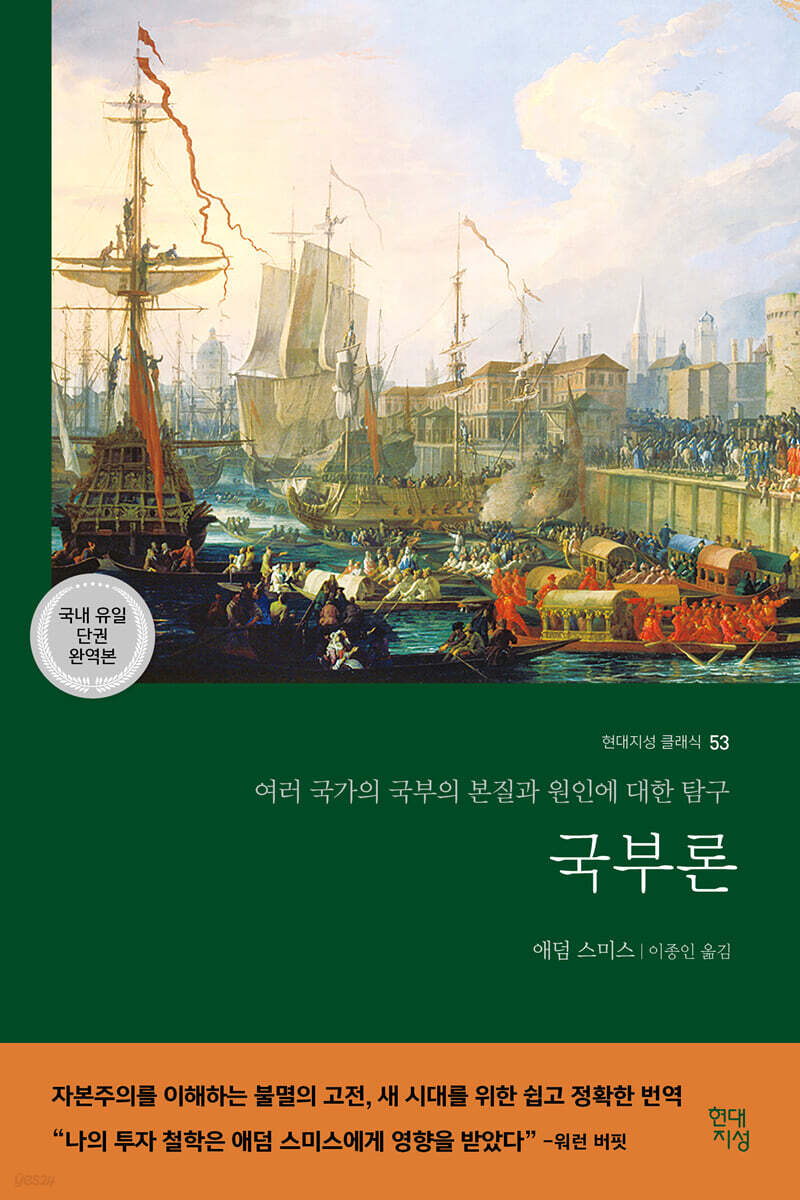 |
Description
Book Introduction
The origin of all economic thought
A classic among classics that serves as a starting point for new ideas
The only complete single-volume translation in Korea
『The Wealth of Nations』 is a book that provides not only economic insights but also information on various fields such as philosophy, politics, history, religion, education, and culture.
Set against the backdrop of important events such as the Seven Years' War (1756-1763), which was an international war, and the American Revolutionary War (1775-1783), this book contains humanistic insights into how national wealth accumulates, flows, and changes history, along with Smith's system of thought, giving it the feel of a comprehensive humanities book.
In that sense, this book clearly shows the perspective of the greatest intellectual of the 18th century, who attempted to observe the world with an objective perspective.
Smith argued that a free economy is one in which differences in talent arise through division of labor and mechanization, and these are traded through peaceful and rational exchange in the market.
It was believed that when humans faithfully practice self-love, the 'invisible hand' works and the common good of society is powerfully promoted.
According to the author, national wealth increases with labor input, technology, and efficiency.
That is, the more products a country and individuals produce, the richer the country is.
It is common sense now, but in the mercantilist era of Smith's time, when the accumulation of gold and silver was considered the core of national wealth, it was a new and revolutionary idea.
『The Wealth of Nations』 consists of five volumes. Volumes 1 and 2 are economic theories, Volume 3 provides an overview of the history of industrial development since Rome, Volume 4 criticizes the economic theories of mercantilism and physiocracy, and Volume 5 describes the expenses and sources of revenue (taxes and public bonds) required for state administration and judicial administration, and even covers law and political science.
In publishing 『The Wealth of Nations』 for the 53rd time, Hyundai Jisung Classics not only translated the entire, complex and complex original text written 250 years ago in an easy and clear manner, but also polished it to a level of readability that even young people can follow if they set their mind to it.
With hundreds of helpful footnotes for deeper understanding, and a high-quality explanation of the historical background and author, it becomes a book that you can “read from start to finish.”
You will understand why Elon Musk, famous for leading the times and thinking strategically, praised it highly, saying, “This is the best book I have ever read!”
A classic among classics that serves as a starting point for new ideas
The only complete single-volume translation in Korea
『The Wealth of Nations』 is a book that provides not only economic insights but also information on various fields such as philosophy, politics, history, religion, education, and culture.
Set against the backdrop of important events such as the Seven Years' War (1756-1763), which was an international war, and the American Revolutionary War (1775-1783), this book contains humanistic insights into how national wealth accumulates, flows, and changes history, along with Smith's system of thought, giving it the feel of a comprehensive humanities book.
In that sense, this book clearly shows the perspective of the greatest intellectual of the 18th century, who attempted to observe the world with an objective perspective.
Smith argued that a free economy is one in which differences in talent arise through division of labor and mechanization, and these are traded through peaceful and rational exchange in the market.
It was believed that when humans faithfully practice self-love, the 'invisible hand' works and the common good of society is powerfully promoted.
According to the author, national wealth increases with labor input, technology, and efficiency.
That is, the more products a country and individuals produce, the richer the country is.
It is common sense now, but in the mercantilist era of Smith's time, when the accumulation of gold and silver was considered the core of national wealth, it was a new and revolutionary idea.
『The Wealth of Nations』 consists of five volumes. Volumes 1 and 2 are economic theories, Volume 3 provides an overview of the history of industrial development since Rome, Volume 4 criticizes the economic theories of mercantilism and physiocracy, and Volume 5 describes the expenses and sources of revenue (taxes and public bonds) required for state administration and judicial administration, and even covers law and political science.
In publishing 『The Wealth of Nations』 for the 53rd time, Hyundai Jisung Classics not only translated the entire, complex and complex original text written 250 years ago in an easy and clear manner, but also polished it to a level of readability that even young people can follow if they set their mind to it.
With hundreds of helpful footnotes for deeper understanding, and a high-quality explanation of the historical background and author, it becomes a book that you can “read from start to finish.”
You will understand why Elon Musk, famous for leading the times and thinking strategically, praised it highly, saying, “This is the best book I have ever read!”
- You can preview some of the book's contents.
Preview
index
Introduction and Summary of the Work
Volume 1.
The cause of the increase in labor productivity and the order in which products from labor productivity are naturally distributed among each class.
Chapter 1.
Division of labor
Chapter 2.
The principle by which division of labor occurs
Chapter 3.
Division of labor is limited by market size.
Chapter 4.
The origin and use of currency
Chapter 5.
Real and nominal prices of goods or labor prices and money prices of goods
Chapter 6.
Components of product price
Chapter 7.
Natural price and market price of a commodity
Chapter 8.
labor wages
Chapter 9.
capital gains
Chapter 10.
Wages and profits when labor and capital are used in various investment destinations
Section 1.
Inequality arising from the nature of the job itself
Section 2.
Inequality arising from European policies
Chapter 11.
Land rent
Section 1.
The produce of land that always yields rent
Section 2.
The products of land that sometimes yield land and sometimes not
Section 3.
Fluctuations in the relative value ratio between products that always yield rent and products that yield rent intermittently
1.
A side note on the fluctuations in the value of silver over the past four centuries.
First period (1350-1570)
Second period (1570-1636)
Third period (1636-1700)
2.
Changes in the ratio between the values of gold and silver
3.
There is reason to suspect that the value of silver will continue to decline.
4.
The various impacts of social development on three different categories of raw products.
First category
Second category
Third category
5.
Conclusion of the side note regarding the change in silver value
6.
The Impact of Social Development on the Real Prices of Manufactured Goods
7.
Conclusion of this chapter on land
│Attachment│Wheat price by year?
Volume 2.
The nature, accumulation, and use of capital
Introduction
Chapter 1.
Detailed classification of inventory
Chapter 2.
The cost of maintaining money or national capital, considered as part of society's total stock
Chapter 3.
Capital accumulation, or productive and unproductive labor
Chapter 4.
Capital lent with the intention of receiving interest
Chapter 5.
Various uses of capital
Volume 3.
Different national wealth enhancement processes in each country
Chapter 1.
Natural increase in wealth
Chapter 2.
The agricultural backwardness of ancient Europe after the fall of the Roman Empire
Chapter 3.
The rise and development of cities after the fall of the Roman Empire
Chapter 4.
How urban commerce contributed to national development
Volume 4.
System of Political Economy
Introduction
Chapter 1.
The principle of mercantilism
Chapter 2.
Restrictions on importing goods that can be produced domestically from foreign countries
Chapter 3.
An emergency measure restricting imports of almost all goods from countries with unfavorable trade balances
Section 1.
The irrationality of such restrictions based on the principles of mercantilism
A side note on deposit banks, particularly the Bank of Amsterdam
Section 2.
Even in light of other principles, extraordinary import restrictions are unreasonable.
Chapter 4.
tax refund
Chapter 5.
subsidy
A side note on the grain industry and the grain laws
Chapter 6.
trade treaty
Chapter 7.
colony
Section 1.
Motivation for establishing new colonies
Section 2.
Several reasons why new colonies prospered
Section 3.
The benefits of Europe's discovery of America and the discovery of a route around the Cape of Good Hope to the East Indies
Chapter 8.
Conclusion of the mercantilist system
Chapter 9.
Physiocratism, an economic theory that holds that land production is the sole or primary source of a country's income and wealth
Volume 5.
income of a monarch or a country
Chapter 1.
The cost of a monarch or a country
Section 1.
Defense budget
Section 2.
judicial expenses
Section 3.
Costs of public works and public institutions
Article 1.
Public works and institutions to promote commerce within society
1) Public works and institutions necessary for overall commercial promotion
2) Public works and institutions necessary to promote specific commercial sectors
Article 2.
Cost of institutions for youth education
Article 3.
Costs of institutions for public education of all ages
Section 4.
The cost of supporting the monarch's majesty
Conclusion of Chapter 1
Chapter 2.
The general source of public income for society
Section 1.
A fund or source of income that belongs specifically to a monarch or country?
Section 2.
National taxes?
Article 1.
Taxes on land rent and rent
1) Taxes proportional to the land's produce, not to the land itself
2) Taxes imposed on housing rentals
Article 2.
Taxes on profits
1) Tax imposed on income generated from capital
2) Taxes imposed on the profits of specific businesses
Appendix to Articles 1 and 2: Taxes on Land, Houses, and Capital Value
Article 3.
Taxes levied on wages
Article 4.
A tax intended to be levied indiscriminately on all types of income
1) poll tax
2) Taxes imposed on consumer goods
Chapter 3.
fund
supplement
Release Lee Jong-in
Adam Smith Chronology
Volume 1.
The cause of the increase in labor productivity and the order in which products from labor productivity are naturally distributed among each class.
Chapter 1.
Division of labor
Chapter 2.
The principle by which division of labor occurs
Chapter 3.
Division of labor is limited by market size.
Chapter 4.
The origin and use of currency
Chapter 5.
Real and nominal prices of goods or labor prices and money prices of goods
Chapter 6.
Components of product price
Chapter 7.
Natural price and market price of a commodity
Chapter 8.
labor wages
Chapter 9.
capital gains
Chapter 10.
Wages and profits when labor and capital are used in various investment destinations
Section 1.
Inequality arising from the nature of the job itself
Section 2.
Inequality arising from European policies
Chapter 11.
Land rent
Section 1.
The produce of land that always yields rent
Section 2.
The products of land that sometimes yield land and sometimes not
Section 3.
Fluctuations in the relative value ratio between products that always yield rent and products that yield rent intermittently
1.
A side note on the fluctuations in the value of silver over the past four centuries.
First period (1350-1570)
Second period (1570-1636)
Third period (1636-1700)
2.
Changes in the ratio between the values of gold and silver
3.
There is reason to suspect that the value of silver will continue to decline.
4.
The various impacts of social development on three different categories of raw products.
First category
Second category
Third category
5.
Conclusion of the side note regarding the change in silver value
6.
The Impact of Social Development on the Real Prices of Manufactured Goods
7.
Conclusion of this chapter on land
│Attachment│Wheat price by year?
Volume 2.
The nature, accumulation, and use of capital
Introduction
Chapter 1.
Detailed classification of inventory
Chapter 2.
The cost of maintaining money or national capital, considered as part of society's total stock
Chapter 3.
Capital accumulation, or productive and unproductive labor
Chapter 4.
Capital lent with the intention of receiving interest
Chapter 5.
Various uses of capital
Volume 3.
Different national wealth enhancement processes in each country
Chapter 1.
Natural increase in wealth
Chapter 2.
The agricultural backwardness of ancient Europe after the fall of the Roman Empire
Chapter 3.
The rise and development of cities after the fall of the Roman Empire
Chapter 4.
How urban commerce contributed to national development
Volume 4.
System of Political Economy
Introduction
Chapter 1.
The principle of mercantilism
Chapter 2.
Restrictions on importing goods that can be produced domestically from foreign countries
Chapter 3.
An emergency measure restricting imports of almost all goods from countries with unfavorable trade balances
Section 1.
The irrationality of such restrictions based on the principles of mercantilism
A side note on deposit banks, particularly the Bank of Amsterdam
Section 2.
Even in light of other principles, extraordinary import restrictions are unreasonable.
Chapter 4.
tax refund
Chapter 5.
subsidy
A side note on the grain industry and the grain laws
Chapter 6.
trade treaty
Chapter 7.
colony
Section 1.
Motivation for establishing new colonies
Section 2.
Several reasons why new colonies prospered
Section 3.
The benefits of Europe's discovery of America and the discovery of a route around the Cape of Good Hope to the East Indies
Chapter 8.
Conclusion of the mercantilist system
Chapter 9.
Physiocratism, an economic theory that holds that land production is the sole or primary source of a country's income and wealth
Volume 5.
income of a monarch or a country
Chapter 1.
The cost of a monarch or a country
Section 1.
Defense budget
Section 2.
judicial expenses
Section 3.
Costs of public works and public institutions
Article 1.
Public works and institutions to promote commerce within society
1) Public works and institutions necessary for overall commercial promotion
2) Public works and institutions necessary to promote specific commercial sectors
Article 2.
Cost of institutions for youth education
Article 3.
Costs of institutions for public education of all ages
Section 4.
The cost of supporting the monarch's majesty
Conclusion of Chapter 1
Chapter 2.
The general source of public income for society
Section 1.
A fund or source of income that belongs specifically to a monarch or country?
Section 2.
National taxes?
Article 1.
Taxes on land rent and rent
1) Taxes proportional to the land's produce, not to the land itself
2) Taxes imposed on housing rentals
Article 2.
Taxes on profits
1) Tax imposed on income generated from capital
2) Taxes imposed on the profits of specific businesses
Appendix to Articles 1 and 2: Taxes on Land, Houses, and Capital Value
Article 3.
Taxes levied on wages
Article 4.
A tax intended to be levied indiscriminately on all types of income
1) poll tax
2) Taxes imposed on consumer goods
Chapter 3.
fund
supplement
Release Lee Jong-in
Adam Smith Chronology
Detailed image

Into the book
Everyone knows how much labor can be made easier and less laborious by the use of appropriate machinery.
Specific examples are unnecessary.
Therefore, what I want to say here is that the invention of all machines that have made labor so easy and reduced labor time was originally thanks to the division of labor.
People are more likely to find ways to achieve their goals more easily and smoothly when they focus their minds entirely on a single object than when they are distracted by a vast array of other things.
As a result of the division of labor, everyone naturally focuses their attention on one very simple goal.
Therefore, people working in each particular field of labor will soon find ways to make their work easier and more smooth if their work allows for such improvements.
This is something anyone can naturally predict.
Most of the machines used in manufacturing, where labor is extremely specialized, were originally invented by ordinary workers performing very simple tasks.
They naturally turned their thinking to making the task easier and more smooth.
Anyone who has visited manufacturing sites frequently has undoubtedly seen many impressive machines.
Such machines were invented to help workers perform specific areas of their work more easily and quickly.
The first steam engines required a boy to open and close the passage between the boiler and the cylinder, constantly watching the piston rise and fall.
However, a boy who liked to play with his friends attached a rope to the valve handle that opened this passage and connected it to another part of the machine, and discovered that the valve opened and closed by itself without anyone watching, and he naturally started using it.
Of course, by doing so, the boy was free to play with his friends.
One of the greatest improvements ever made after the invention of the steam engine was due to the ingenuity and discovery of a boy who sought to lessen his own labor in this way.
---From "Volume 1, Chapter 1, Division of Labor, p. 26 | Invention of Machines to Assist Labor"
As Thomas Hobbes said, wealth is power.
However, a person who acquires or inherits a great fortune does not necessarily acquire or inherit any political power, whether civil or military.
His wealth may provide him with the means to acquire both powers, but simply possessing vast wealth does not necessarily give him power.
What power does immense wealth immediately and directly give him? It is the purchasing power to buy things.
That is, the power to control all labor or all labor products on the market at any given time.
The amount of wealth a man has is proportional to the size of his purchasing power, and also to the amount of other people's labor, or what is the same thing, the product of other people's labor, which he can purchase or seize with his wealth.
The exchange value of any thing is always exactly equal to the degree of this power it gives to its owner.
Although labor is the true standard of exchange value for all commodities, commodity value is often not measured in terms of labor.
Determining the ratio between two different types of labor is sometimes tricky.
Because you can't determine this ratio based solely on the time you spend on two different things.
It is imperative to consider the extent to which the hardships endured by workers and the ingenuity displayed differ.
An hour of hard work may involve more labor than two hours of easy work, or an hour of labor in a trade that takes ten years to learn properly may involve more labor than a month of labor in a common and easy trade.
However, finding criteria that accurately measure difficulty or originality is not easy.
In reality, these two factors are taken into account to some extent when different goods produced by different types of labor are exchanged.
However, it is not adjusted to an exact scale, but rather according to market conditions or negotiations.
This adjustment is driven by a desire to achieve some degree of equilibrium by weighing the labor involved in the two goods.
Even though it may not be 100% accurate, it is a fairness that is acceptable enough for carrying out daily tasks.
---From "Volume 1, Chapter 5, Real and Nominal Prices of Commodities, or Labor Prices and Money Prices of Commodities, pp. 50-51"
But this is a completely different story from the circumstances of the majority of workers.
In contrast, workers who are paid generously by the day often end up ruining their health and body within a few years due to overwork.
In London and some other places, a carpenter cannot maintain peak vitality for more than eight years.
A similar phenomenon occurs in many other occupations where workers are paid by the day, and overwork occurs in contract work (contracts made on a per-piece basis) where wages are higher than the prevailing wage, even in manufacturing and even agricultural work.
Almost every class of craftsman is so absorbed in his own peculiar work that he develops peculiar diseases.
The renowned Italian physician Ramazzini wrote a special book on this type of disease.
We don't think soldiers are the most diligent of people.
When soldiers are employed for a certain type of work and receive generous wages on a contract basis, officers are obliged to agree with the employer that they cannot earn more than a certain amount each day.
Before these regulations were established, soldiers were often overworked by their competition with one another and their desire for greater profits, and such excessive work often damaged their health.
If you work too hard for four days a week, you have a direct need to rest and replenish your energy for the remaining three days.
Then people will complain loudly and vociferously, saying that they have been idle for three days.
So, what's really good is to consistently do a moderate amount of work throughout the week while getting adequate rest.
After several days of intense physical or mental exertion, most people feel the need to take a break.
Such a desire is almost unstoppable unless it is forced from outside or suppressed by some powerful need.
---From "Volume 1, Chapter 8, Labor Wages, pp. 110-111 | The more advanced a society, the happier its workers."
Some people with small incomes retire from business and invest their small capital in land, believing that land is the safest place.
Professionals who earn their income from other sources also often prefer to invest their money safely in the same way.
Another young man, instead of entering a trade or profession, might buy land with a capital of two or three thousand pounds and cultivate it himself, and hope to live a happy independent life.
In this case, the young person must give up any hope of acquiring great wealth or becoming successful.
If he had invested that capital in another business, he might have achieved success like others.
Some young people also often despise the life of a farmer because they do not want to become landowners.
Therefore, land is not readily available on the market, and even if it is available, it is expensive, so those who purchase land do not invest a lot of money in cultivating or improving the land.
If the circumstances had not been like that, we would have definitely moved towards land improvement.
In North America, on the other hand, 50 to 60 pounds is enough capital to start a farm.
Whether small or large, the most profitable business there is to purchase and improve uncultivated land.
In that region, farming is the fastest route to wealth and success.
In North America, there is land that is practically free, and land that can be purchased for less than its natural value.
This is impossible in Europe, and even more so in countries where all land is private property.
However, if a landowner with many children dies and the land needs to be divided equally among his children, the land is usually put up for sale.
If a lot of this land comes onto the market, it can no longer be sold at monopoly prices.
The fair rent for land will approach the interest on the purchase price, and purchasing land with a small capital will yield returns no less than any other investment.
---From "Volume 3, Chapter 4: How Urban Commerce Contributed to National Development, pp. 471-472 | Capital Investment: A Comparison of North America and Europe"
But while the prosperity of neighboring countries may be dangerous in the realms of war and politics, it is very beneficial in the realm of trade.
When we are at war, if our neighboring country is rich, it will maintain a stronger navy and army than ours.
But in times of peace and commerce, the prosperity of neighboring countries creates better markets, as they enable us to exchange goods of greater value with them.
It is to create a market where the direct products of our country's labor or other goods purchased with those products are exchanged.
For those who work to produce goods, rich neighbors are likely to be better customers than poor neighbors.
The same goes for rich countries.
Of course, a rich man who is also a manufacturer is the most dangerous neighbor to those in the same industry.
But there are far more neighbors who don't, and these people benefit from a good market where the rich pay for it.
They even profit by selling poor workers for cheap in the same way.
In the same way, manufacturers in rich countries can become very dangerous rivals to manufacturers in neighboring countries.
However, competition among manufacturers is beneficial to the public.
The public benefits greatly from the good markets provided to them by the large expenditures of these countries.
Individuals who want to make money never think of going to the poor remote areas of the country, but instead go to the capital or to the bustling commercial cities.
They intuitively know that big money cannot be made where big money does not circulate.
You have to go where there is a lot of money going around so that some of it can fall to you.
This principle is the force that moves one, ten, and twenty people, and at the same time, it is the force that supports the judgment of one million, ten million, and twenty million people.
Moreover, the nation should look at the wealth of other countries according to that principle and think that such wealth can be a cause for increasing the wealth of our own country.
A country that seeks to become wealthy through foreign trade is more likely to become wealthy if its neighbors are all wealthy, have diverse industries, and prosperous commerce.
A great nation surrounded by wandering barbarians and impoverished savages can only grow rich through the cultivation of its land and domestic commerce, and cannot increase its wealth through foreign trade.
Ancient Egypt and modern China acquired great wealth in this way.
The ancient Egyptians were known to have disregarded foreign trade, and the modern Chinese are also known to have extremely low regard for it.
The principles of modern mercantilism aim to impoverish neighboring countries.
If that principle had its desired effect, commerce with neighboring countries would be viewed with petty contempt.
Specific examples are unnecessary.
Therefore, what I want to say here is that the invention of all machines that have made labor so easy and reduced labor time was originally thanks to the division of labor.
People are more likely to find ways to achieve their goals more easily and smoothly when they focus their minds entirely on a single object than when they are distracted by a vast array of other things.
As a result of the division of labor, everyone naturally focuses their attention on one very simple goal.
Therefore, people working in each particular field of labor will soon find ways to make their work easier and more smooth if their work allows for such improvements.
This is something anyone can naturally predict.
Most of the machines used in manufacturing, where labor is extremely specialized, were originally invented by ordinary workers performing very simple tasks.
They naturally turned their thinking to making the task easier and more smooth.
Anyone who has visited manufacturing sites frequently has undoubtedly seen many impressive machines.
Such machines were invented to help workers perform specific areas of their work more easily and quickly.
The first steam engines required a boy to open and close the passage between the boiler and the cylinder, constantly watching the piston rise and fall.
However, a boy who liked to play with his friends attached a rope to the valve handle that opened this passage and connected it to another part of the machine, and discovered that the valve opened and closed by itself without anyone watching, and he naturally started using it.
Of course, by doing so, the boy was free to play with his friends.
One of the greatest improvements ever made after the invention of the steam engine was due to the ingenuity and discovery of a boy who sought to lessen his own labor in this way.
---From "Volume 1, Chapter 1, Division of Labor, p. 26 | Invention of Machines to Assist Labor"
As Thomas Hobbes said, wealth is power.
However, a person who acquires or inherits a great fortune does not necessarily acquire or inherit any political power, whether civil or military.
His wealth may provide him with the means to acquire both powers, but simply possessing vast wealth does not necessarily give him power.
What power does immense wealth immediately and directly give him? It is the purchasing power to buy things.
That is, the power to control all labor or all labor products on the market at any given time.
The amount of wealth a man has is proportional to the size of his purchasing power, and also to the amount of other people's labor, or what is the same thing, the product of other people's labor, which he can purchase or seize with his wealth.
The exchange value of any thing is always exactly equal to the degree of this power it gives to its owner.
Although labor is the true standard of exchange value for all commodities, commodity value is often not measured in terms of labor.
Determining the ratio between two different types of labor is sometimes tricky.
Because you can't determine this ratio based solely on the time you spend on two different things.
It is imperative to consider the extent to which the hardships endured by workers and the ingenuity displayed differ.
An hour of hard work may involve more labor than two hours of easy work, or an hour of labor in a trade that takes ten years to learn properly may involve more labor than a month of labor in a common and easy trade.
However, finding criteria that accurately measure difficulty or originality is not easy.
In reality, these two factors are taken into account to some extent when different goods produced by different types of labor are exchanged.
However, it is not adjusted to an exact scale, but rather according to market conditions or negotiations.
This adjustment is driven by a desire to achieve some degree of equilibrium by weighing the labor involved in the two goods.
Even though it may not be 100% accurate, it is a fairness that is acceptable enough for carrying out daily tasks.
---From "Volume 1, Chapter 5, Real and Nominal Prices of Commodities, or Labor Prices and Money Prices of Commodities, pp. 50-51"
But this is a completely different story from the circumstances of the majority of workers.
In contrast, workers who are paid generously by the day often end up ruining their health and body within a few years due to overwork.
In London and some other places, a carpenter cannot maintain peak vitality for more than eight years.
A similar phenomenon occurs in many other occupations where workers are paid by the day, and overwork occurs in contract work (contracts made on a per-piece basis) where wages are higher than the prevailing wage, even in manufacturing and even agricultural work.
Almost every class of craftsman is so absorbed in his own peculiar work that he develops peculiar diseases.
The renowned Italian physician Ramazzini wrote a special book on this type of disease.
We don't think soldiers are the most diligent of people.
When soldiers are employed for a certain type of work and receive generous wages on a contract basis, officers are obliged to agree with the employer that they cannot earn more than a certain amount each day.
Before these regulations were established, soldiers were often overworked by their competition with one another and their desire for greater profits, and such excessive work often damaged their health.
If you work too hard for four days a week, you have a direct need to rest and replenish your energy for the remaining three days.
Then people will complain loudly and vociferously, saying that they have been idle for three days.
So, what's really good is to consistently do a moderate amount of work throughout the week while getting adequate rest.
After several days of intense physical or mental exertion, most people feel the need to take a break.
Such a desire is almost unstoppable unless it is forced from outside or suppressed by some powerful need.
---From "Volume 1, Chapter 8, Labor Wages, pp. 110-111 | The more advanced a society, the happier its workers."
Some people with small incomes retire from business and invest their small capital in land, believing that land is the safest place.
Professionals who earn their income from other sources also often prefer to invest their money safely in the same way.
Another young man, instead of entering a trade or profession, might buy land with a capital of two or three thousand pounds and cultivate it himself, and hope to live a happy independent life.
In this case, the young person must give up any hope of acquiring great wealth or becoming successful.
If he had invested that capital in another business, he might have achieved success like others.
Some young people also often despise the life of a farmer because they do not want to become landowners.
Therefore, land is not readily available on the market, and even if it is available, it is expensive, so those who purchase land do not invest a lot of money in cultivating or improving the land.
If the circumstances had not been like that, we would have definitely moved towards land improvement.
In North America, on the other hand, 50 to 60 pounds is enough capital to start a farm.
Whether small or large, the most profitable business there is to purchase and improve uncultivated land.
In that region, farming is the fastest route to wealth and success.
In North America, there is land that is practically free, and land that can be purchased for less than its natural value.
This is impossible in Europe, and even more so in countries where all land is private property.
However, if a landowner with many children dies and the land needs to be divided equally among his children, the land is usually put up for sale.
If a lot of this land comes onto the market, it can no longer be sold at monopoly prices.
The fair rent for land will approach the interest on the purchase price, and purchasing land with a small capital will yield returns no less than any other investment.
---From "Volume 3, Chapter 4: How Urban Commerce Contributed to National Development, pp. 471-472 | Capital Investment: A Comparison of North America and Europe"
But while the prosperity of neighboring countries may be dangerous in the realms of war and politics, it is very beneficial in the realm of trade.
When we are at war, if our neighboring country is rich, it will maintain a stronger navy and army than ours.
But in times of peace and commerce, the prosperity of neighboring countries creates better markets, as they enable us to exchange goods of greater value with them.
It is to create a market where the direct products of our country's labor or other goods purchased with those products are exchanged.
For those who work to produce goods, rich neighbors are likely to be better customers than poor neighbors.
The same goes for rich countries.
Of course, a rich man who is also a manufacturer is the most dangerous neighbor to those in the same industry.
But there are far more neighbors who don't, and these people benefit from a good market where the rich pay for it.
They even profit by selling poor workers for cheap in the same way.
In the same way, manufacturers in rich countries can become very dangerous rivals to manufacturers in neighboring countries.
However, competition among manufacturers is beneficial to the public.
The public benefits greatly from the good markets provided to them by the large expenditures of these countries.
Individuals who want to make money never think of going to the poor remote areas of the country, but instead go to the capital or to the bustling commercial cities.
They intuitively know that big money cannot be made where big money does not circulate.
You have to go where there is a lot of money going around so that some of it can fall to you.
This principle is the force that moves one, ten, and twenty people, and at the same time, it is the force that supports the judgment of one million, ten million, and twenty million people.
Moreover, the nation should look at the wealth of other countries according to that principle and think that such wealth can be a cause for increasing the wealth of our own country.
A country that seeks to become wealthy through foreign trade is more likely to become wealthy if its neighbors are all wealthy, have diverse industries, and prosperous commerce.
A great nation surrounded by wandering barbarians and impoverished savages can only grow rich through the cultivation of its land and domestic commerce, and cannot increase its wealth through foreign trade.
Ancient Egypt and modern China acquired great wealth in this way.
The ancient Egyptians were known to have disregarded foreign trade, and the modern Chinese are also known to have extremely low regard for it.
The principles of modern mercantilism aim to impoverish neighboring countries.
If that principle had its desired effect, commerce with neighboring countries would be viewed with petty contempt.
---From "Volume 4, Chapter 3: Emergency Measures Restricting Imports of Almost All Goods from Countries with Unfavorable Trade Balances," pp. 554-555 | "Our Country Will Be Prosperous Only When Our Neighboring Countries Are Prosperous"
Publisher's Review
An immortal classic that explains the birth and evolution of capitalism over 250 years.
A book that will stay with us until the end of capitalism.
『The Wealth of Nations』 is an immortal masterpiece by Adam Smith (1723-1790), which laid the academic foundation of economics.
However, this book is not simply a book that introduces economic principles. It analyzes economic issues by comprehensively covering various fields such as society, philosophy, history, religion, and politics. Above all, it is closer to an integrated humanities book because it unravels the flow of economy and wealth centered on people based on thorough insight into human nature.
For 6,000 years, mankind has naturally engaged in economic activities.
Most of the exchange of labor (products) has been achieved through barter, commerce, and cooperation.
All of these activities were carried out at the individual or small group level, and there were limitations in deeply studying or understanding the fundamental principles or systems.
In this book, Smith attempted, for the first time in history, to systematically analyze and understand the nature of economic activity from a national perspective beyond the individual level.
He observed in detail how the economic activities of individuals, society, and the nation of the time were carried out, and clearly explained how capital was accumulated and invested within them, and how national wealth was created as a result.
So why, 250 years later, is it still recognized as a classic among classics, a book that continues to inspire and inspire countless scholars, thinkers, and investors? Isaac Newton, in 1686, heralded the beginning of modern science by using rigorous mathematical methodology to perfectly describe motion in nature through formulas.
Likewise, this book systematically describes the essence and principles of the system that makes economic behavior and phenomena in human society possible, extending them to the individual and national (and inter-national) levels, so that anyone can read it calmly and understand it, rather than relying on a single person's "brainwashing."
His explanations and interpretations are still accurate enough (with some minor refinements) to be relevant today.
Later economists developed his research little by little, each forming a field of study.
All economic activity, whether market autonomy or government intervention, can be reduced to three elements: wages, rent, and profit.
This basic principle established by Smith later became the starting point of modern economics.
After Smith, the theory of wages was developed in more detail in Ricardo's Principles of Taxation and Economics, the theory of capital in Marx's Capital, and the theory of land rent in Henry George's Progress and Poverty.
Smith's claim that the rich seek to make money in order to display their wealth (The Wealth of Nations, Book 1, Chapter 11, Section 2, "The highest pleasure of wealth is self-display") was established as the concept of conspicuous consumption in Thorstein Veblen's Theory of the Leisure Class.
Smith's theory of perfect equilibrium between supply and demand was later supplemented by Keynes's theory of imbalance.
Keynes's welfare state theory had already been sown in Volume 5 of The Wealth of Nations.
In this way, it can be said to be the bible of economics and capitalism.
A look into the principles and dynamics of how the flow of great wealth changes
The power to see through the times!
The economy of Smith's time was also closely linked to the political, military, and cultural background of the time.
During the century in which the book was written (1660-1760), there were the Great Fire of London, the plague, two Dutch Wars, the turmoil of the Glorious Revolution (1688), the Irish Wars, four wars against France (1688, 1702, 1742, 1756), and the American Revolutionary Wars.
The immediate background of this book is the Seven Years' War, which began in 1756.
Since overseas trade with India and North America is an important background for The Wealth of Nations, this incident appears frequently.
He argued that guaranteeing freedom of individual economic activity was more effective in increasing national wealth than having the state manage and regulate trade, an idea reflected in his "invisible hand" theory.
France, which was defeated by Britain as a result of the Seven Years' War, actively supported the British colonies in the American Revolutionary War that began in 1776, which was a decisive factor in the colonies' victory in the war of independence.
As a result, France, whose national power was weakened, faced a financial crisis in the 1780s, which became a factor in the French Revolution in 1789.
The colonization of America and the expanded trade with the East Indies (Asia), discussed in The Wealth of Nations, gave rise to a new consumer culture in Europe at the time of Smith.
Sugar, coffee, and tobacco created explosive demand in European markets, which in turn greatly increased the profitability of plantations in North and South America.
Smith discusses this trade in goods in detail in The Wealth of Nations.
The full title of The Wealth of Nations is “An Inquiry into the Nature and Causes of the Wealth of Nations.”
The source of wealth that Smith spoke of was not gold or silver, but the total annual production of a country's land and labor (in modern terms, gross national product, or GNP).
Looking at it now, Smith's argument seems like common sense, but in Smith's time, when mercantilism was rampant, it was a very revolutionary idea.
The reason England was able to win the Seven Years' War against France was ultimately because of its abundance of these resources.
Additionally, in the chapter on colonies in Books 4 and 5 of The Wealth of Nations, Smith makes the then-surprising suggestion that running the North American colonies (today the United States) was too expensive and that it would be best to abandon them quickly.
Had the British government accepted this proposal, they would have been able to withdraw from America without much material or moral damage.
Adam Smith meticulously laid out the principles and wisdom that permeate the entirety of capitalism, including the complex and intertwined conflicts between nations, the exchange of trade goods, the early stages of the banking system, the role of joint stock companies like the East India Company, the role of the market and the principles of individual self-interest that drive the economy, and the part about the national income and expenditure, in over 1,000 pages.
A book full of wisdom and enlightenment no matter which page you open and read.
Easy and accurate translation for a new era
“My investment philosophy was influenced by Adam Smith” (Warren Buffett).
“This is the best book I’ve ever read!” (Elon Musk).
Adam Smith wanted this book to be read by as many readers as possible.
In publishing 『The Wealth of Nations』 for the 53rd time, Hyundai Jisung Classics has done its best to provide a clear translation and highly readable editing so that anyone with a background knowledge equivalent to a high school economics textbook can read it without difficulty.
The emphasis was placed on making it flow smoothly, so that you don't have to go back and reread it several times to understand the meaning as you read.
With hundreds of helpful footnotes for deeper understanding, and a high-quality explanation of the historical background and author, it becomes a book that you can “read from start to finish.”
In Smith's time, it was fashionable to write long sentences that stretched across a page, but this translation divides paragraphs into appropriate lengths to make them visually easier to read, and subheadings are added to appropriate pages to help readers quickly grasp the topic of the section they are reading.
In an era when mercantilism was considered a natural source of wealth, Adam Smith overcame the spirit of the times and proposed a new source and principle of wealth called 'gross national product', which led to 250 years of prosperity.
Curious readers who want to explore the power and basis of this book will find themselves easily able to complete it and then discover their own path to wealth.
A book that will stay with us until the end of capitalism.
『The Wealth of Nations』 is an immortal masterpiece by Adam Smith (1723-1790), which laid the academic foundation of economics.
However, this book is not simply a book that introduces economic principles. It analyzes economic issues by comprehensively covering various fields such as society, philosophy, history, religion, and politics. Above all, it is closer to an integrated humanities book because it unravels the flow of economy and wealth centered on people based on thorough insight into human nature.
For 6,000 years, mankind has naturally engaged in economic activities.
Most of the exchange of labor (products) has been achieved through barter, commerce, and cooperation.
All of these activities were carried out at the individual or small group level, and there were limitations in deeply studying or understanding the fundamental principles or systems.
In this book, Smith attempted, for the first time in history, to systematically analyze and understand the nature of economic activity from a national perspective beyond the individual level.
He observed in detail how the economic activities of individuals, society, and the nation of the time were carried out, and clearly explained how capital was accumulated and invested within them, and how national wealth was created as a result.
So why, 250 years later, is it still recognized as a classic among classics, a book that continues to inspire and inspire countless scholars, thinkers, and investors? Isaac Newton, in 1686, heralded the beginning of modern science by using rigorous mathematical methodology to perfectly describe motion in nature through formulas.
Likewise, this book systematically describes the essence and principles of the system that makes economic behavior and phenomena in human society possible, extending them to the individual and national (and inter-national) levels, so that anyone can read it calmly and understand it, rather than relying on a single person's "brainwashing."
His explanations and interpretations are still accurate enough (with some minor refinements) to be relevant today.
Later economists developed his research little by little, each forming a field of study.
All economic activity, whether market autonomy or government intervention, can be reduced to three elements: wages, rent, and profit.
This basic principle established by Smith later became the starting point of modern economics.
After Smith, the theory of wages was developed in more detail in Ricardo's Principles of Taxation and Economics, the theory of capital in Marx's Capital, and the theory of land rent in Henry George's Progress and Poverty.
Smith's claim that the rich seek to make money in order to display their wealth (The Wealth of Nations, Book 1, Chapter 11, Section 2, "The highest pleasure of wealth is self-display") was established as the concept of conspicuous consumption in Thorstein Veblen's Theory of the Leisure Class.
Smith's theory of perfect equilibrium between supply and demand was later supplemented by Keynes's theory of imbalance.
Keynes's welfare state theory had already been sown in Volume 5 of The Wealth of Nations.
In this way, it can be said to be the bible of economics and capitalism.
A look into the principles and dynamics of how the flow of great wealth changes
The power to see through the times!
The economy of Smith's time was also closely linked to the political, military, and cultural background of the time.
During the century in which the book was written (1660-1760), there were the Great Fire of London, the plague, two Dutch Wars, the turmoil of the Glorious Revolution (1688), the Irish Wars, four wars against France (1688, 1702, 1742, 1756), and the American Revolutionary Wars.
The immediate background of this book is the Seven Years' War, which began in 1756.
Since overseas trade with India and North America is an important background for The Wealth of Nations, this incident appears frequently.
He argued that guaranteeing freedom of individual economic activity was more effective in increasing national wealth than having the state manage and regulate trade, an idea reflected in his "invisible hand" theory.
France, which was defeated by Britain as a result of the Seven Years' War, actively supported the British colonies in the American Revolutionary War that began in 1776, which was a decisive factor in the colonies' victory in the war of independence.
As a result, France, whose national power was weakened, faced a financial crisis in the 1780s, which became a factor in the French Revolution in 1789.
The colonization of America and the expanded trade with the East Indies (Asia), discussed in The Wealth of Nations, gave rise to a new consumer culture in Europe at the time of Smith.
Sugar, coffee, and tobacco created explosive demand in European markets, which in turn greatly increased the profitability of plantations in North and South America.
Smith discusses this trade in goods in detail in The Wealth of Nations.
The full title of The Wealth of Nations is “An Inquiry into the Nature and Causes of the Wealth of Nations.”
The source of wealth that Smith spoke of was not gold or silver, but the total annual production of a country's land and labor (in modern terms, gross national product, or GNP).
Looking at it now, Smith's argument seems like common sense, but in Smith's time, when mercantilism was rampant, it was a very revolutionary idea.
The reason England was able to win the Seven Years' War against France was ultimately because of its abundance of these resources.
Additionally, in the chapter on colonies in Books 4 and 5 of The Wealth of Nations, Smith makes the then-surprising suggestion that running the North American colonies (today the United States) was too expensive and that it would be best to abandon them quickly.
Had the British government accepted this proposal, they would have been able to withdraw from America without much material or moral damage.
Adam Smith meticulously laid out the principles and wisdom that permeate the entirety of capitalism, including the complex and intertwined conflicts between nations, the exchange of trade goods, the early stages of the banking system, the role of joint stock companies like the East India Company, the role of the market and the principles of individual self-interest that drive the economy, and the part about the national income and expenditure, in over 1,000 pages.
A book full of wisdom and enlightenment no matter which page you open and read.
Easy and accurate translation for a new era
“My investment philosophy was influenced by Adam Smith” (Warren Buffett).
“This is the best book I’ve ever read!” (Elon Musk).
Adam Smith wanted this book to be read by as many readers as possible.
In publishing 『The Wealth of Nations』 for the 53rd time, Hyundai Jisung Classics has done its best to provide a clear translation and highly readable editing so that anyone with a background knowledge equivalent to a high school economics textbook can read it without difficulty.
The emphasis was placed on making it flow smoothly, so that you don't have to go back and reread it several times to understand the meaning as you read.
With hundreds of helpful footnotes for deeper understanding, and a high-quality explanation of the historical background and author, it becomes a book that you can “read from start to finish.”
In Smith's time, it was fashionable to write long sentences that stretched across a page, but this translation divides paragraphs into appropriate lengths to make them visually easier to read, and subheadings are added to appropriate pages to help readers quickly grasp the topic of the section they are reading.
In an era when mercantilism was considered a natural source of wealth, Adam Smith overcame the spirit of the times and proposed a new source and principle of wealth called 'gross national product', which led to 250 years of prosperity.
Curious readers who want to explore the power and basis of this book will find themselves easily able to complete it and then discover their own path to wealth.
GOODS SPECIFICS
- Date of issue: January 8, 2024
- Page count, weight, size: 1,120 pages | 150*225*60mm
- ISBN13: 9791139716474
- ISBN10: 1139716476
You may also like
카테고리
korean


korean

![ELLE 엘르 스페셜 에디션 A형 : 12월 [2025]](http://librairie.coreenne.fr/cdn/shop/files/b8e27a3de6c9538896439686c6b0e8fb.jpg?v=1766436872&width=3840)


