

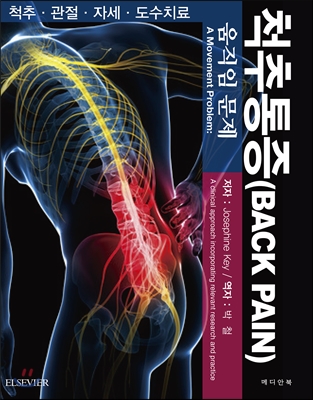
Back Pain: Movement Problems
 |
Description
Book Introduction
This book on spinal pain and movement considers the spine as an integrated system.
Functional changes in one part of the spine, from head to tail, result in adaptive changes in other parts because functions are interconnected.
Pain and associated symptoms in a specific spinal area may not necessarily be the result of altered function in that area, but may instead stem from a more widespread dysfunction.
A tremendous amount of research has been done on spinal pain, particularly in relation to low back pain.
Recently, research on cervical diseases has attracted more and more attention.
Exciting advances in movement control and pain are leading to a shift from the notion that specific anatomical structures cause spinal pain to a more dynamic systems approach that views most spinal disorders as having a diverse pathophysiology driven by interconnected neuromusculoskeletal functions.
This book focuses on the relationship between spinal pain and movement.
Chapters 3, 4, 5, and 6 explore and advance our understanding of healthy spinal regulation; subsequently, we examine the changes in movement function evident in patients with spinal pain.
Increased understanding will allow clinicians to better characterize postural movement deficits in specific patients, establishing a basis for better differential diagnosis and rehabilitation.
This book examines various currently accepted models of spinal pain and questions the validity of some of them.
The concepts presented in this book emerged as a process that attempted to balance evidence-based practice and clinical evidence.
In some cases, we present variants or alternative models that will serve as a basis for thought and discussion, which we hope will become the subject of further debate.
Other cases represent a paradigm shift: advocating a 'functional approach' - the quality of control of functional kinematic aspects involved in normal movements.
It presents a motor control perspective, suggesting that developmental and adaptive changes in movement underlie most 'spinal pain' syndromes.
The authors attempted to combine current evidence on spinal pain with clinically evident altered motor response patterns.
This is clearly evident when some areas are underregulated and others are overregulated, and the results are predictable.
The author believes that this book will provide information and guidance that will be helpful to all types of clinicians who deal with spinal pain—physiotherapists, osteopaths, chiropractors, orthopedic surgeons, rheumatologists, rehabilitation physicians, manual therapists, and others.
The same goes for people who study or retrain movement—exercise physiologists, Pilates instructors, yoga instructors, etc.
It is the author's special hope that those in the fitness industry, such as personal trainers in gyms, can help move beyond simple "strengthening" or "stretching" to provide more responsible, physiologically and functionally useful programs for clients who may one day become patients.
Functional changes in one part of the spine, from head to tail, result in adaptive changes in other parts because functions are interconnected.
Pain and associated symptoms in a specific spinal area may not necessarily be the result of altered function in that area, but may instead stem from a more widespread dysfunction.
A tremendous amount of research has been done on spinal pain, particularly in relation to low back pain.
Recently, research on cervical diseases has attracted more and more attention.
Exciting advances in movement control and pain are leading to a shift from the notion that specific anatomical structures cause spinal pain to a more dynamic systems approach that views most spinal disorders as having a diverse pathophysiology driven by interconnected neuromusculoskeletal functions.
This book focuses on the relationship between spinal pain and movement.
Chapters 3, 4, 5, and 6 explore and advance our understanding of healthy spinal regulation; subsequently, we examine the changes in movement function evident in patients with spinal pain.
Increased understanding will allow clinicians to better characterize postural movement deficits in specific patients, establishing a basis for better differential diagnosis and rehabilitation.
This book examines various currently accepted models of spinal pain and questions the validity of some of them.
The concepts presented in this book emerged as a process that attempted to balance evidence-based practice and clinical evidence.
In some cases, we present variants or alternative models that will serve as a basis for thought and discussion, which we hope will become the subject of further debate.
Other cases represent a paradigm shift: advocating a 'functional approach' - the quality of control of functional kinematic aspects involved in normal movements.
It presents a motor control perspective, suggesting that developmental and adaptive changes in movement underlie most 'spinal pain' syndromes.
The authors attempted to combine current evidence on spinal pain with clinically evident altered motor response patterns.
This is clearly evident when some areas are underregulated and others are overregulated, and the results are predictable.
The author believes that this book will provide information and guidance that will be helpful to all types of clinicians who deal with spinal pain—physiotherapists, osteopaths, chiropractors, orthopedic surgeons, rheumatologists, rehabilitation physicians, manual therapists, and others.
The same goes for people who study or retrain movement—exercise physiologists, Pilates instructors, yoga instructors, etc.
It is the author's special hope that those in the fitness industry, such as personal trainers in gyms, can help move beyond simple "strengthening" or "stretching" to provide more responsible, physiologically and functionally useful programs for clients who may one day become patients.
index
Translator's Preface vii
Translation Notes viii
Preface ix
Preface xi
Acknowledgments xiii
Abbreviation xv
1.
Introduction? 1
(Introduction)
2.
Spinal pain 3
(The problem of back pain)
3.
Development of Posture and Movement 11
(The development of posture and movement)
4.
Movement Analysis 39
(The analysis of movement)
5.
Muscle Classification 59
(Classification of muscles)
6.
77 Distinguished Features of Normal Trunk Function
(Salient aspects of normal function of the torso)
7.
Altered control of posture and movement: Dysfunction status 159
(Changed control of posture and movement: the dysfunctional state)
8.
Common Features of Postural Movement Dysfunction 175
(Common features of posturomovement dysfunction)
9.
What are the two primary aspects of trunk dysfunction? 225
(The two primary patterns of torso dysfunction)
10.
Clinical Postural Movement Disorders Syndrome 247
(Clinical posturomovement impairment syndromes)
11.
273 Examining factors that cause dysfunctional posture and movement
(Examining probable contributions towards dysfunctional posture and movement)
12.
Functional pathology of the locomotor system involves the pattern-generating mechanisms that underlie most spinal pain disorders 289
(A 'functional pathology of the motor system' involves a pattern generating mechanism underlying most spinal pain disorders)
13.
Therapeutic Approach 307
(Therapeutic approach)
14.
The Intrinsic Implications of This Model 385
(Inherent implications in this model)
Search 387
Translation Notes viii
Preface ix
Preface xi
Acknowledgments xiii
Abbreviation xv
1.
Introduction? 1
(Introduction)
2.
Spinal pain 3
(The problem of back pain)
3.
Development of Posture and Movement 11
(The development of posture and movement)
4.
Movement Analysis 39
(The analysis of movement)
5.
Muscle Classification 59
(Classification of muscles)
6.
77 Distinguished Features of Normal Trunk Function
(Salient aspects of normal function of the torso)
7.
Altered control of posture and movement: Dysfunction status 159
(Changed control of posture and movement: the dysfunctional state)
8.
Common Features of Postural Movement Dysfunction 175
(Common features of posturomovement dysfunction)
9.
What are the two primary aspects of trunk dysfunction? 225
(The two primary patterns of torso dysfunction)
10.
Clinical Postural Movement Disorders Syndrome 247
(Clinical posturomovement impairment syndromes)
11.
273 Examining factors that cause dysfunctional posture and movement
(Examining probable contributions towards dysfunctional posture and movement)
12.
Functional pathology of the locomotor system involves the pattern-generating mechanisms that underlie most spinal pain disorders 289
(A 'functional pathology of the motor system' involves a pattern generating mechanism underlying most spinal pain disorders)
13.
Therapeutic Approach 307
(Therapeutic approach)
14.
The Intrinsic Implications of This Model 385
(Inherent implications in this model)
Search 387
GOODS SPECIFICS
- Date of publication: February 15, 2017
- Page count, weight, size: 416 pages | 190*260mm
- ISBN13: 9788993340587
- ISBN10: 8993340587
You may also like
카테고리
korean


korean

![ELLE 엘르 스페셜 에디션 A형 : 12월 [2025]](http://librairie.coreenne.fr/cdn/shop/files/b8e27a3de6c9538896439686c6b0e8fb.jpg?v=1766436872&width=3840)


