

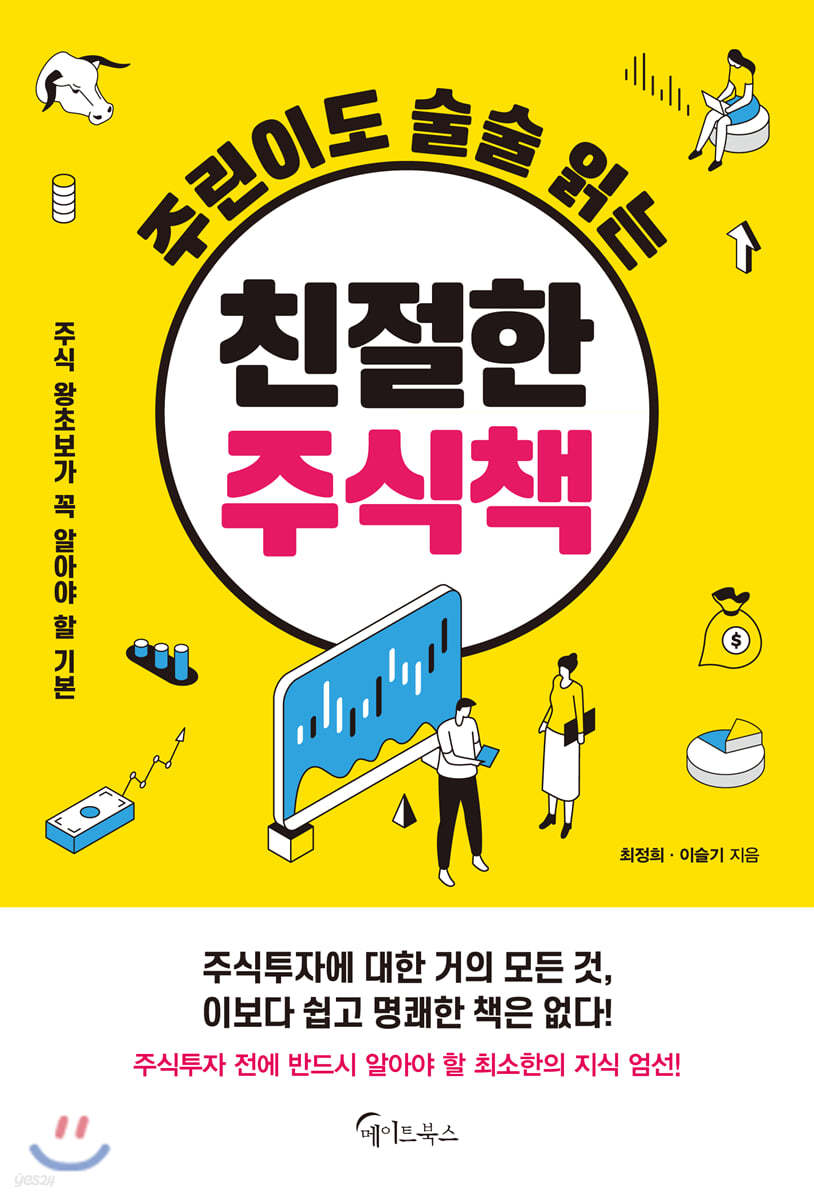
A friendly stock book that even children can read easily.
 |
Description
Book Introduction
There's no stock book easier and clearer than this one! Now is the time when stock investment is absolutely necessary. For many people, investing in stocks has become a necessity. In the past, simply saving money at a bank would have provided a secure retirement, but now, with interest rates so low, if you don't diligently invest in stocks, you'll inevitably face the gloomy age of living to be 100. The current stock market has the potential to fully meet the expectations of such investors. In other words, if you survive the Fourth Industrial Revolution and enjoy the value of a company that grows even further, you can earn a considerable amount of profit. But the problem is that making money with stocks is by no means easy. This book serves as a solid guide for those who are just starting out in stock investing and feel overwhelmed by everything. We have carefully selected and explained the minimum essential knowledge that beginners who still find stocks difficult must know before they start investing in earnest. If you are a beginner, you should read books that are suitable for beginners. If you read books that do not match your investment experience or level or books for professional investors, you are likely to suffer as if you are wearing clothes that do not fit you. It is important to keep in mind that the most important thing for beginner stock investors is the basics of stocks. If you treat stocks like gambling or hope for great luck, you will never survive. If you build a solid foundation in stock investing, stocks will become your best friend. Everyone's been saying stocks, so you've started investing, but you don't really know much about them! This book will answer all your questions: what's the difference between stocks, bonds, and funds? How should you trade stocks? How should you find profitable stocks? What's the relationship between the economy and stocks? How should you interpret and use charts? Which sectors are currently attracting money? |
- You can preview some of the book's contents.
Preview
index
Chapter 1: The Basics of Stock Investment You Must Know if You're a Investor
What is the difference between stocks, bonds, and funds?
Are KOSPI and KOSDAQ different markets?
What is the difference between Samsung Electronics and Samsung Electronics Preferred?
Why does it matter how much market capitalization has gone up?
Stocks also vary in size.
The intermission corner looks expensive. Should I buy it or wait?
Chapter 2: This is my first time trading stocks.
They said the fees would be free for life, but why are they charging so much?
The money I earned from selling stocks won't arrive today.
Accounts receivable? Did I incur debt for my investment?
Be aware of trading methods that change from time to time.
There is only one item, but why are there multiple prices?
You have money to buy 10 weeks, but you can only buy 8?
I heard Kakao Games is going public. Can I buy stocks in advance?
I want to buy Amazon or Tencent stock.
What level of return is needed to consider a stock a good investment?
Chapter 3 I want to choose a good stock that will make money.
If Samsung Electronics is the number one company, why is its stock price only 50,000 won?
Why LG Household & Health Care, priced at 1.4 million won, is cheaper than Amorepacific, priced at 170,000 won.
There are many different types of good fortune.
Is it good news if foreigners buy it?
Institutional investors are not all the same.
People often talk about program trading, but what is that?
I heard there are stocks that pay interest every quarter. What kind of stocks are they?
Stock prices rise after buying back and burning treasury stocks.
Are capital increases and potatoes good or bad news?
My company frequently issues CBs and BWs. Is this good news?
Is there any way to avoid delisting in advance?
Intermission Corner: Want to see information about the stocks I've invested in?
Chapter 4: When is a good day to invest in stocks?
The economy is not doing well, so why are stocks rising?
Can you predict the stock market just by looking at the price of gold or copper?
When the dollar rises, exports don't do well, right? But why do stock prices fall?
Interest rates are falling, but why are stock prices rising?
Is the drop in oil prices also related to stock prices?
They say the performance is good, but what is the standard?
They say to be careful when gift options expire, why?
They say short selling is a hell on earth, is that really true?
Why is the stock price rising when shareholders are fighting among themselves?
So when should I enter the stock market?
Intermission Corner: The world's stock markets are interconnected like organisms.
Chapter 5 chart tells you when to buy and sell?
Do you really need technical analysis?
What is a candlestick chart?
Can you tell when to buy and sell using moving averages?
What do you look at to judge stock market trends?
Is it good to have a lot of trading volume?
Intermission Corner Should I just invest for the long term or should I go for short-term trading?
Chapter 6: Stock-like products that look like stocks but aren't stocks
How to Bet on "Even if Stocks Fail, Korea Won't" _ ETF
Leveraged, Gobus ETFs lose money the longer you invest.
Can you bet on rising oil and soybean prices? _ ETN
In the stock market, if I have 10,000 won, I can become a building owner.
It's really hard to give gifts, is there an easy way to find out?
You buy and sell insurance in the stock market too?
Interlude Corner ELS is an 'E' shaped securities like ETFs and ETNs, but can I buy it on HTS?
Chapter 7 So what's selling the best these days?
The stock market has changed since the Fourth Industrial Revolution.
In a world shaped by COVID-19, let's focus on contactless interactions.
Platform dinosaurs monopolize the internet world.
An era where cars roll without holding the steering wheel or adding fuel
In an era where people dream of immortality, let's focus on bio.
Intermission Corner: Why didn't our grandfather buy Samsung Electronics?
What is the difference between stocks, bonds, and funds?
Are KOSPI and KOSDAQ different markets?
What is the difference between Samsung Electronics and Samsung Electronics Preferred?
Why does it matter how much market capitalization has gone up?
Stocks also vary in size.
The intermission corner looks expensive. Should I buy it or wait?
Chapter 2: This is my first time trading stocks.
They said the fees would be free for life, but why are they charging so much?
The money I earned from selling stocks won't arrive today.
Accounts receivable? Did I incur debt for my investment?
Be aware of trading methods that change from time to time.
There is only one item, but why are there multiple prices?
You have money to buy 10 weeks, but you can only buy 8?
I heard Kakao Games is going public. Can I buy stocks in advance?
I want to buy Amazon or Tencent stock.
What level of return is needed to consider a stock a good investment?
Chapter 3 I want to choose a good stock that will make money.
If Samsung Electronics is the number one company, why is its stock price only 50,000 won?
Why LG Household & Health Care, priced at 1.4 million won, is cheaper than Amorepacific, priced at 170,000 won.
There are many different types of good fortune.
Is it good news if foreigners buy it?
Institutional investors are not all the same.
People often talk about program trading, but what is that?
I heard there are stocks that pay interest every quarter. What kind of stocks are they?
Stock prices rise after buying back and burning treasury stocks.
Are capital increases and potatoes good or bad news?
My company frequently issues CBs and BWs. Is this good news?
Is there any way to avoid delisting in advance?
Intermission Corner: Want to see information about the stocks I've invested in?
Chapter 4: When is a good day to invest in stocks?
The economy is not doing well, so why are stocks rising?
Can you predict the stock market just by looking at the price of gold or copper?
When the dollar rises, exports don't do well, right? But why do stock prices fall?
Interest rates are falling, but why are stock prices rising?
Is the drop in oil prices also related to stock prices?
They say the performance is good, but what is the standard?
They say to be careful when gift options expire, why?
They say short selling is a hell on earth, is that really true?
Why is the stock price rising when shareholders are fighting among themselves?
So when should I enter the stock market?
Intermission Corner: The world's stock markets are interconnected like organisms.
Chapter 5 chart tells you when to buy and sell?
Do you really need technical analysis?
What is a candlestick chart?
Can you tell when to buy and sell using moving averages?
What do you look at to judge stock market trends?
Is it good to have a lot of trading volume?
Intermission Corner Should I just invest for the long term or should I go for short-term trading?
Chapter 6: Stock-like products that look like stocks but aren't stocks
How to Bet on "Even if Stocks Fail, Korea Won't" _ ETF
Leveraged, Gobus ETFs lose money the longer you invest.
Can you bet on rising oil and soybean prices? _ ETN
In the stock market, if I have 10,000 won, I can become a building owner.
It's really hard to give gifts, is there an easy way to find out?
You buy and sell insurance in the stock market too?
Interlude Corner ELS is an 'E' shaped securities like ETFs and ETNs, but can I buy it on HTS?
Chapter 7 So what's selling the best these days?
The stock market has changed since the Fourth Industrial Revolution.
In a world shaped by COVID-19, let's focus on contactless interactions.
Platform dinosaurs monopolize the internet world.
An era where cars roll without holding the steering wheel or adding fuel
In an era where people dream of immortality, let's focus on bio.
Intermission Corner: Why didn't our grandfather buy Samsung Electronics?
Detailed image
Into the book
Stocks are certificates issued by companies to raise funds.
By investing in a company and holding this certificate, you become a shareholder.
If a stock is listed on the Korea Exchange, it is called a listed stock.
Listed stocks can be bought and sold at any time through a securities firm account.
Let's say your friend's chicken restaurant, 'The Chicken', is a publicly traded company.
My friend said he needed 200 million won to open 'The Chicken' and asked me to invest only 100 million won.
They say that if you invest 100 million won, they will give you a chicken every month and 10% of the profits every year.
I will become a shareholder with 50% stake in the chicken restaurant.
Here, chicken is provided monthly and 10% of the annual profit becomes a dividend.
Of course, if business doesn't go well, you may not receive chicken or dividends.
Since I, as a shareholder, can make money only if the chicken restaurant does well, I have the right to intervene in the management of the chicken restaurant through the general shareholders' meeting, saying things like, "The chicken needs to be crispier," or "Why are there so many part-time workers?"
--- p.18
What exactly does preferred stock mean? It means paying a higher dividend than common stock.
In the case of Samsung Electronics, although preferred stocks are 15% cheaper than common stocks (as of August 2020), the dividend per share is the same as that of common stocks.
It's the same Samsung Electronics, but it's like receiving dividends at a cheaper price.
But there is no such thing as a free lunch.
There are things you have to give up to get more dividends.
It is the right to vote.
Voting rights refer to the right to vote for or against agenda items submitted to the general shareholders' meeting.
Voting rights are granted to anyone who holds even one share of stock, and with this voting right, one can vote against the dividend payment plan on the agenda of the general shareholders' meeting, demanding "more dividends."
However, if you buy preferred stock, you have to give up the shareholders' meeting.
--- p.26
By looking at the market capitalization rankings, you can see at a glance which industries dominate a country's industry and economy.
A look at the global market capitalization rankings reveals the world we live in today.
The most expensive company in the world is Apple.
Microsoft is in second place, Amazon is in third place, Alphabet is in fourth place, and Facebook is in fifth place (as of August 2020).
What they have in common is that they are online platform and related device companies.
As the Fourth Industrial Revolution, where 'data' is the golden egg, is taking root, the market capitalization of related companies is bound to be large.
Since stock prices fluctuate daily, the market capitalization also changes every time.
But in the short term it doesn't mean much.
However, if you look at it over a long period of time, say 10 or 20 years, you can see that the companies with the highest market capitalization influenced the economy of that country at that time.
--- p.31
The representative value investor is Warren Buffett.
As his famous saying goes, "If you can't hold a stock for 10 years, don't hold it for 10 minutes," his investment approach is to buy quality companies at a low price and then invest for the long term.
One example is Coca-Cola.
In 1988, when Coca-Cola was facing fierce competition from Pepsi-Cola and its stock price was falling, the price-to-earnings ratio (PER) had fallen to 15 times, Buffett purchased $1.2 billion worth of Coca-Cola stock.
This is because we were confident that people would continue to drink Coca-Cola, and we judged that the current stock price decline was excessive.
As Buffett had thought, Coca-Cola gradually expanded into the world, and by the 1990s, Coca-Cola's PER had risen to over 30 times.
Buffett still owns Coca-Cola stock.
--- p.39
If you sell stocks today, you can sell them at today's price, but the sale amount will not be deposited into your account until two business days later, after which you can withdraw the money.
Likewise, if you purchase stocks, the purchase price will be today's price, but the purchase amount will not be withdrawn from your account until two business days later.
It takes two days to change it into cash.
However, you can purchase other stocks with the same amount of money before the sale amount is actually deposited into your account.
For example, if you sell stocks, the amount you sold the stocks for will be added to the 'Deposit T+2' section of your account. This means that even if you cannot withdraw all of that money, you can use that money to purchase other stocks.
In simple terms, if you sold 50,000 won worth of B stock on Monday, you can buy 50,000 won worth of C stock on the same day (excluding taxes and public charges for convenience).
You just can't withdraw money.
--- p.51
Let's look at the trading method in chronological order.
When does the stock market open? The "regular market" is open from 9:00 AM to 3:30 PM, but the stock market opens 30 minutes earlier.
From 8:30 to 9:00, the 'single price trading' method is applied, where stocks are traded at one price, and is divided into two trading methods depending on the time.
From 8:30 to 8:40, for 10 minutes, trading is conducted at the closing price of the previous trading day.
Since there is only one price, if the buy and sell orders are correct, the transaction is immediately concluded starting from the first order.
Separately, ‘single price trading’ is applied from 8:30 to 9:00.
This is a method of receiving buy and sell orders for 30 minutes and then executing a transaction at the opening price at 9 o'clock.
Buy and sell orders that can be traded are linked, and the price that can be traded the most among them becomes the opening price.
Between 8:30 and 8:40, you can trade by choosing either 'after-hours previous day's closing price trading' or 'opening price single price trading'.
--- p.60
There is 1.2 million won in deposits in the securities account, and stock A is trading at 11,000 won per share during the trading day.
I placed a buy order to buy 100 shares of stock A because I thought it would rise further.
But hey, they're saying they can't buy 100 shares because they don't have enough margin.
Margin refers to the deposit for settlement of stock transactions.
If you want to buy 100 shares of a stock that costs 11,000 won, you only need 1,010,000 won, and you still have 190,000 won left over. What on earth is missing?
If you encounter this situation, you should carefully check whether you have selected 'market order' on HTS.
For market orders, the margin is calculated based on the upper price limit for 'buy' orders, and the margin is calculated based on the lower price limit for 'sell' orders.
If Stock A closed at 10,000 won the previous day, this means that you need to have at least 1.3 million won in your securities account to purchase 100 shares.
--- p.69-70
There are probably many investors who want to invest in overseas stocks, but find it difficult to stay awake during the US market hours due to lack of sleep.
There is a way for these investors to invest in US stocks: by using reservation orders.
If you have already exchanged your money, you can just place a reservation and go to sleep.
When placing a pre-order, you must specify when you will purchase, which stocks you will purchase, and how many shares you will purchase at what price.
When an investor places a reservation order, the securities firm accepts the order without checking the customer's balance, etc.
Pre-orders placed in this manner are transmitted to the U.S. in the order they are received, starting 5 minutes after the local exchange opens. If the customer does not have enough funds, the transaction is rejected.
Just because a pre-order has been placed does not necessarily mean that the transaction will be completed, so investors must personally check that they have sufficient funds in their account.
--- p.81-82
How are stock prices determined? Imagine a company is founded, distributes shares to shareholders, and raises capital by collecting investment.
If you need 1 billion won in capital, you have to think about what price per share you should give the stock to the shareholders.
If it's a 5,000 won stock, you'll need to print 200,000 shares, and if it's a 10,000 won stock, you'll only need to print 100,000 shares.
This is called the ‘face value’ or ‘par value’.
The par value is the stock price on the day the company was first established.
The par value is divided into six types: 100 won, 200 won, 500 won, 1,000 won, 2,500 won, and 5,000 won per share. Since the par value is determined by the company, there is no relationship between the par value and the corporate value.
What changes depending on the face value is the number of shares.
In other words, the question is how many shares will be issued.
The principle is that if you multiply the par value by the total number of issued shares, you get the capital stock. If you lower the par value while keeping the capital stock the same, the total number of issued shares increases, and if you raise the par value, the total number of issued shares decreases.
--- p.92
For example, if the performance of American semiconductor companies is good, it is possible to infer that the performance of Korean semiconductor companies will also be good.
So, if the stock prices of U.S. semiconductor companies rise the night before, the stock prices of Korean semiconductor companies often rise along with them the next morning.
In this case, it is expressed as ‘industry sentiment has improved.’
On the other hand, even if the negative factors that were weighing down the stock price are resolved, you may feel good about the expectation that the stock price will rise.
A representative example is when stock prices rebounded after the US and China reached a phase one trade agreement.
This can be rephrased as 'KOSPI market sentiment has improved', as the overall market sentiment has improved.
However, it should be kept in mind that sentiment is merely a matter of 'feeling', so unless there is a strong foundation, there is a high possibility that the stock price will fall again.
--- p.104
A stock dividend is a free distribution of stocks to shareholders.
As new stocks are issued as in a paid-in capital increase, the capital increases, but since the stocks are issued for free, no funds actually come into the company.
How can capital increase when there's no cash coming in? To understand this, we need to understand the composition of our assets.
Assets are divided into total capital and total liabilities, and total capital (equity capital) is divided into capital received by issuing stocks to shareholders and surplus.
Surplus is composed of retained earnings and capital surplus.
Retained earnings refers to the money left over after paying dividends to shareholders after generating profits through business based on capital, while capital surplus refers to profits earned by issuing stocks or stock premiums.
The excess capital for issuing stocks arises during the paid-in capital increase process.
If the issue price per share of new stock exceeds the par value, the excess amount becomes the stock issuance premium.
If stocks with a par value of 5,000 won are issued at 7,000 won per share, the excess capital generated will be the difference of 2,000 won multiplied by the number of newly issued shares.
--- p.132
Let's assume that war broke out in Korea at any moment and the economy collapsed.
Then the won will no longer have value in the international financial market.
The ten thousand won I have could be a piece of waste paper that can't even buy a grain of rice.
But what if I had a dollar of gold at that moment? Couldn't I exchange it for dollars and buy something? Gold is accepted worldwide, and even if its value plummets, it still exists as a physical asset, making it easily convertible into other assets.
It is classified as a safe asset because it is strong and liquid when the economy is difficult.
Other safe assets include the dollar and bonds.
These are all assets that show relative strength when the macroeconomy is difficult.
In 2019, when the trade dispute between the US and China was reignited, gold prices continued to hit record highs.
Even in 2020, the following year, despite the financial market crash due to the novel coronavirus, gold prices continued to hit record highs.
--- p.162
The stock market also has a flex season.
This is the so-called 'bullish period' where stock prices rise as money continues to flow into the stock market.
How can we capture a bull market? Despite the media's constant trolling about poor economic indicators, interest rates are low, and money with nowhere to go is flowing into the stock market, where it can be easily converted into cash.
This is the beginning of a major upward trend.
Conversely, is there no way to predict a major downturn? The media is popping champagne for economic recovery, citing indicators like exports and employment as record highs.
However, if the stock price strangely falls, it can be interpreted as the beginning of a bear market.
By simply understanding the signals surrounding you when the stock market is entering a major uptrend or downtrend, you can predict when to buy or sell stocks.
--- p.196
So, is short-term investing, or short-term trading, the answer? But short-term trading is more difficult.
Success requires incredible precision in timing the highs and lows within a short period of time, a feat that even investment geniuses like Warren Buffett find difficult to achieve, let alone analysts.
There is no investment god who can predict the stock price for the next day.
That's why experts recommend long-term investments that have a higher success rate than short-term investments that try to match daily volatility.
In addition, in the case of short-term investments, it is important to consider that various fees are charged each time a trade is made, which reduces the rate of return.
This is because if you trade dozens of times a day, the returns you earn from stocks and the commissions you incur are likely to be similar.
If you make a profit, that's great, but if you suffer a loss, the loss will snowball.
--- p.234
The biggest source of energy during the 'stay-at-home' life was non-contact hobbies such as Netflix (US), NCSoft, and Nintendo (Japan).
These content stocks have benefited as people spend more time at home watching movies or playing games instead of traveling or going out.
Among game stocks, NCSoft, Netmarble, Double Games, Neowiz, and Com2uS benefited, and overseas, Blizzard (USA), EA (USA), and Nexon (Japan) also received attention.
As the number of people reading webtoons increased, the stock price of Kidari Studio, a webtoon production company, also rose.
Kakao also saw its stock price soar as it emerged in the fintech business, thanks to its popular messenger KakaoTalk.
The reason why online life was so smooth was because of the robust internet environment.
This is also why Internet infrastructure is considered a beneficiary of the contactless era.
Additionally, 5G equipment and component manufacturer KMW is expected to expand its investment in 5G infrastructure in the future.
In the United States, Equinix, a data center REIT, has gained popularity, and American Tower, a cell tower REIT, has also been in the spotlight.
By investing in a company and holding this certificate, you become a shareholder.
If a stock is listed on the Korea Exchange, it is called a listed stock.
Listed stocks can be bought and sold at any time through a securities firm account.
Let's say your friend's chicken restaurant, 'The Chicken', is a publicly traded company.
My friend said he needed 200 million won to open 'The Chicken' and asked me to invest only 100 million won.
They say that if you invest 100 million won, they will give you a chicken every month and 10% of the profits every year.
I will become a shareholder with 50% stake in the chicken restaurant.
Here, chicken is provided monthly and 10% of the annual profit becomes a dividend.
Of course, if business doesn't go well, you may not receive chicken or dividends.
Since I, as a shareholder, can make money only if the chicken restaurant does well, I have the right to intervene in the management of the chicken restaurant through the general shareholders' meeting, saying things like, "The chicken needs to be crispier," or "Why are there so many part-time workers?"
--- p.18
What exactly does preferred stock mean? It means paying a higher dividend than common stock.
In the case of Samsung Electronics, although preferred stocks are 15% cheaper than common stocks (as of August 2020), the dividend per share is the same as that of common stocks.
It's the same Samsung Electronics, but it's like receiving dividends at a cheaper price.
But there is no such thing as a free lunch.
There are things you have to give up to get more dividends.
It is the right to vote.
Voting rights refer to the right to vote for or against agenda items submitted to the general shareholders' meeting.
Voting rights are granted to anyone who holds even one share of stock, and with this voting right, one can vote against the dividend payment plan on the agenda of the general shareholders' meeting, demanding "more dividends."
However, if you buy preferred stock, you have to give up the shareholders' meeting.
--- p.26
By looking at the market capitalization rankings, you can see at a glance which industries dominate a country's industry and economy.
A look at the global market capitalization rankings reveals the world we live in today.
The most expensive company in the world is Apple.
Microsoft is in second place, Amazon is in third place, Alphabet is in fourth place, and Facebook is in fifth place (as of August 2020).
What they have in common is that they are online platform and related device companies.
As the Fourth Industrial Revolution, where 'data' is the golden egg, is taking root, the market capitalization of related companies is bound to be large.
Since stock prices fluctuate daily, the market capitalization also changes every time.
But in the short term it doesn't mean much.
However, if you look at it over a long period of time, say 10 or 20 years, you can see that the companies with the highest market capitalization influenced the economy of that country at that time.
--- p.31
The representative value investor is Warren Buffett.
As his famous saying goes, "If you can't hold a stock for 10 years, don't hold it for 10 minutes," his investment approach is to buy quality companies at a low price and then invest for the long term.
One example is Coca-Cola.
In 1988, when Coca-Cola was facing fierce competition from Pepsi-Cola and its stock price was falling, the price-to-earnings ratio (PER) had fallen to 15 times, Buffett purchased $1.2 billion worth of Coca-Cola stock.
This is because we were confident that people would continue to drink Coca-Cola, and we judged that the current stock price decline was excessive.
As Buffett had thought, Coca-Cola gradually expanded into the world, and by the 1990s, Coca-Cola's PER had risen to over 30 times.
Buffett still owns Coca-Cola stock.
--- p.39
If you sell stocks today, you can sell them at today's price, but the sale amount will not be deposited into your account until two business days later, after which you can withdraw the money.
Likewise, if you purchase stocks, the purchase price will be today's price, but the purchase amount will not be withdrawn from your account until two business days later.
It takes two days to change it into cash.
However, you can purchase other stocks with the same amount of money before the sale amount is actually deposited into your account.
For example, if you sell stocks, the amount you sold the stocks for will be added to the 'Deposit T+2' section of your account. This means that even if you cannot withdraw all of that money, you can use that money to purchase other stocks.
In simple terms, if you sold 50,000 won worth of B stock on Monday, you can buy 50,000 won worth of C stock on the same day (excluding taxes and public charges for convenience).
You just can't withdraw money.
--- p.51
Let's look at the trading method in chronological order.
When does the stock market open? The "regular market" is open from 9:00 AM to 3:30 PM, but the stock market opens 30 minutes earlier.
From 8:30 to 9:00, the 'single price trading' method is applied, where stocks are traded at one price, and is divided into two trading methods depending on the time.
From 8:30 to 8:40, for 10 minutes, trading is conducted at the closing price of the previous trading day.
Since there is only one price, if the buy and sell orders are correct, the transaction is immediately concluded starting from the first order.
Separately, ‘single price trading’ is applied from 8:30 to 9:00.
This is a method of receiving buy and sell orders for 30 minutes and then executing a transaction at the opening price at 9 o'clock.
Buy and sell orders that can be traded are linked, and the price that can be traded the most among them becomes the opening price.
Between 8:30 and 8:40, you can trade by choosing either 'after-hours previous day's closing price trading' or 'opening price single price trading'.
--- p.60
There is 1.2 million won in deposits in the securities account, and stock A is trading at 11,000 won per share during the trading day.
I placed a buy order to buy 100 shares of stock A because I thought it would rise further.
But hey, they're saying they can't buy 100 shares because they don't have enough margin.
Margin refers to the deposit for settlement of stock transactions.
If you want to buy 100 shares of a stock that costs 11,000 won, you only need 1,010,000 won, and you still have 190,000 won left over. What on earth is missing?
If you encounter this situation, you should carefully check whether you have selected 'market order' on HTS.
For market orders, the margin is calculated based on the upper price limit for 'buy' orders, and the margin is calculated based on the lower price limit for 'sell' orders.
If Stock A closed at 10,000 won the previous day, this means that you need to have at least 1.3 million won in your securities account to purchase 100 shares.
--- p.69-70
There are probably many investors who want to invest in overseas stocks, but find it difficult to stay awake during the US market hours due to lack of sleep.
There is a way for these investors to invest in US stocks: by using reservation orders.
If you have already exchanged your money, you can just place a reservation and go to sleep.
When placing a pre-order, you must specify when you will purchase, which stocks you will purchase, and how many shares you will purchase at what price.
When an investor places a reservation order, the securities firm accepts the order without checking the customer's balance, etc.
Pre-orders placed in this manner are transmitted to the U.S. in the order they are received, starting 5 minutes after the local exchange opens. If the customer does not have enough funds, the transaction is rejected.
Just because a pre-order has been placed does not necessarily mean that the transaction will be completed, so investors must personally check that they have sufficient funds in their account.
--- p.81-82
How are stock prices determined? Imagine a company is founded, distributes shares to shareholders, and raises capital by collecting investment.
If you need 1 billion won in capital, you have to think about what price per share you should give the stock to the shareholders.
If it's a 5,000 won stock, you'll need to print 200,000 shares, and if it's a 10,000 won stock, you'll only need to print 100,000 shares.
This is called the ‘face value’ or ‘par value’.
The par value is the stock price on the day the company was first established.
The par value is divided into six types: 100 won, 200 won, 500 won, 1,000 won, 2,500 won, and 5,000 won per share. Since the par value is determined by the company, there is no relationship between the par value and the corporate value.
What changes depending on the face value is the number of shares.
In other words, the question is how many shares will be issued.
The principle is that if you multiply the par value by the total number of issued shares, you get the capital stock. If you lower the par value while keeping the capital stock the same, the total number of issued shares increases, and if you raise the par value, the total number of issued shares decreases.
--- p.92
For example, if the performance of American semiconductor companies is good, it is possible to infer that the performance of Korean semiconductor companies will also be good.
So, if the stock prices of U.S. semiconductor companies rise the night before, the stock prices of Korean semiconductor companies often rise along with them the next morning.
In this case, it is expressed as ‘industry sentiment has improved.’
On the other hand, even if the negative factors that were weighing down the stock price are resolved, you may feel good about the expectation that the stock price will rise.
A representative example is when stock prices rebounded after the US and China reached a phase one trade agreement.
This can be rephrased as 'KOSPI market sentiment has improved', as the overall market sentiment has improved.
However, it should be kept in mind that sentiment is merely a matter of 'feeling', so unless there is a strong foundation, there is a high possibility that the stock price will fall again.
--- p.104
A stock dividend is a free distribution of stocks to shareholders.
As new stocks are issued as in a paid-in capital increase, the capital increases, but since the stocks are issued for free, no funds actually come into the company.
How can capital increase when there's no cash coming in? To understand this, we need to understand the composition of our assets.
Assets are divided into total capital and total liabilities, and total capital (equity capital) is divided into capital received by issuing stocks to shareholders and surplus.
Surplus is composed of retained earnings and capital surplus.
Retained earnings refers to the money left over after paying dividends to shareholders after generating profits through business based on capital, while capital surplus refers to profits earned by issuing stocks or stock premiums.
The excess capital for issuing stocks arises during the paid-in capital increase process.
If the issue price per share of new stock exceeds the par value, the excess amount becomes the stock issuance premium.
If stocks with a par value of 5,000 won are issued at 7,000 won per share, the excess capital generated will be the difference of 2,000 won multiplied by the number of newly issued shares.
--- p.132
Let's assume that war broke out in Korea at any moment and the economy collapsed.
Then the won will no longer have value in the international financial market.
The ten thousand won I have could be a piece of waste paper that can't even buy a grain of rice.
But what if I had a dollar of gold at that moment? Couldn't I exchange it for dollars and buy something? Gold is accepted worldwide, and even if its value plummets, it still exists as a physical asset, making it easily convertible into other assets.
It is classified as a safe asset because it is strong and liquid when the economy is difficult.
Other safe assets include the dollar and bonds.
These are all assets that show relative strength when the macroeconomy is difficult.
In 2019, when the trade dispute between the US and China was reignited, gold prices continued to hit record highs.
Even in 2020, the following year, despite the financial market crash due to the novel coronavirus, gold prices continued to hit record highs.
--- p.162
The stock market also has a flex season.
This is the so-called 'bullish period' where stock prices rise as money continues to flow into the stock market.
How can we capture a bull market? Despite the media's constant trolling about poor economic indicators, interest rates are low, and money with nowhere to go is flowing into the stock market, where it can be easily converted into cash.
This is the beginning of a major upward trend.
Conversely, is there no way to predict a major downturn? The media is popping champagne for economic recovery, citing indicators like exports and employment as record highs.
However, if the stock price strangely falls, it can be interpreted as the beginning of a bear market.
By simply understanding the signals surrounding you when the stock market is entering a major uptrend or downtrend, you can predict when to buy or sell stocks.
--- p.196
So, is short-term investing, or short-term trading, the answer? But short-term trading is more difficult.
Success requires incredible precision in timing the highs and lows within a short period of time, a feat that even investment geniuses like Warren Buffett find difficult to achieve, let alone analysts.
There is no investment god who can predict the stock price for the next day.
That's why experts recommend long-term investments that have a higher success rate than short-term investments that try to match daily volatility.
In addition, in the case of short-term investments, it is important to consider that various fees are charged each time a trade is made, which reduces the rate of return.
This is because if you trade dozens of times a day, the returns you earn from stocks and the commissions you incur are likely to be similar.
If you make a profit, that's great, but if you suffer a loss, the loss will snowball.
--- p.234
The biggest source of energy during the 'stay-at-home' life was non-contact hobbies such as Netflix (US), NCSoft, and Nintendo (Japan).
These content stocks have benefited as people spend more time at home watching movies or playing games instead of traveling or going out.
Among game stocks, NCSoft, Netmarble, Double Games, Neowiz, and Com2uS benefited, and overseas, Blizzard (USA), EA (USA), and Nexon (Japan) also received attention.
As the number of people reading webtoons increased, the stock price of Kidari Studio, a webtoon production company, also rose.
Kakao also saw its stock price soar as it emerged in the fintech business, thanks to its popular messenger KakaoTalk.
The reason why online life was so smooth was because of the robust internet environment.
This is also why Internet infrastructure is considered a beneficiary of the contactless era.
Additionally, 5G equipment and component manufacturer KMW is expected to expand its investment in 5G infrastructure in the future.
In the United States, Equinix, a data center REIT, has gained popularity, and American Tower, a cell tower REIT, has also been in the spotlight.
--- p.285
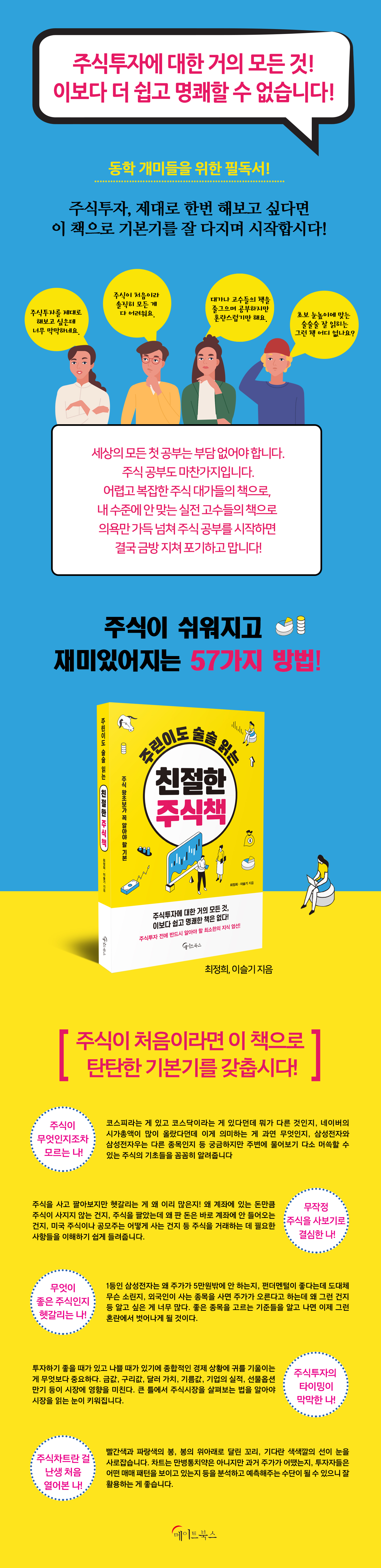
Publisher's Review
If you're new to stocks, get the basics covered with this book!
This book consists of a total of six chapters.
Chapter 1 covers the basics of stock investment that every beginner should know.
I don't even know what a stock is! Are there different things like KOSPI and KOSDAQ? What does Naver's market capitalization mean when it rises significantly? Are Samsung Electronics and Samsung Electronics Preferred Stock different stocks? I'll explain the basics thoroughly, even if you're curious but a little hesitant to ask.
Chapter 2 provides basic knowledge about trading for those who are new to stock trading.
I decided to buy stocks without thinking.
However, it explains in an easy-to-understand way the necessary information for stock trading, such as why stocks are not purchased in proportion to the amount of money in the account, why the money from selling stocks is not immediately deposited into the account when selling stocks out of fear, and how to buy US stocks or public offerings.
Chapter 3 introduces how to select good stocks that will make money.
I'm thinking about which stocks to buy.
But I'm confused about what makes a good stock.
There are so many things I want to know, such as why Samsung Electronics, the number one company, only has a stock price of 50,000 won, what on earth does it mean when they say the fundamentals are good, and why the stock price goes up when you buy stocks that foreigners are buying.
Once you know the criteria for choosing good stocks, you will be free from such confusion.
Chapter 4 talks about the timing of stock investment.
Even if you invest in the same stock in the same market, there are good times and bad times to invest.
So, when investing in stocks, it is most important to pay attention to the overall economic situation.
There are various indicators around us that can help us judge the economic situation, such as the price of gold, copper, dollar value, and oil.
Corporate performance, futures and options expiration dates also affect market conditions.
It will teach you how to look at the stock market from a big picture perspective, which will help you develop an eye for reading the market.
Chapter 5 explains how to view and utilize stock charts.
It was my first time opening a stock chart.
The red and blue peaks, the long tail extending above and below the peaks, and the long colorful lines are eye-catching.
Some say you can make money in stocks just by looking at charts. Is that true? Charts can be a valuable tool for analyzing and predicting past stock prices and investor trading patterns, so it's wise to utilize them effectively.
Chapter 6 introduces stock-like products that appear to be stocks but are not.
You can't just buy and sell stocks of listed companies on the stock market.
If you are afraid to invest in one stock, you can also buy multiple stocks at once.
It is also possible to invest in real estate through the stock market.
Meanwhile, there are also products that make profits by betting on whether the stock price will rise or not.
It explains in an easy-to-understand way what characteristics these products have and what you should pay attention to.
This book consists of a total of six chapters.
Chapter 1 covers the basics of stock investment that every beginner should know.
I don't even know what a stock is! Are there different things like KOSPI and KOSDAQ? What does Naver's market capitalization mean when it rises significantly? Are Samsung Electronics and Samsung Electronics Preferred Stock different stocks? I'll explain the basics thoroughly, even if you're curious but a little hesitant to ask.
Chapter 2 provides basic knowledge about trading for those who are new to stock trading.
I decided to buy stocks without thinking.
However, it explains in an easy-to-understand way the necessary information for stock trading, such as why stocks are not purchased in proportion to the amount of money in the account, why the money from selling stocks is not immediately deposited into the account when selling stocks out of fear, and how to buy US stocks or public offerings.
Chapter 3 introduces how to select good stocks that will make money.
I'm thinking about which stocks to buy.
But I'm confused about what makes a good stock.
There are so many things I want to know, such as why Samsung Electronics, the number one company, only has a stock price of 50,000 won, what on earth does it mean when they say the fundamentals are good, and why the stock price goes up when you buy stocks that foreigners are buying.
Once you know the criteria for choosing good stocks, you will be free from such confusion.
Chapter 4 talks about the timing of stock investment.
Even if you invest in the same stock in the same market, there are good times and bad times to invest.
So, when investing in stocks, it is most important to pay attention to the overall economic situation.
There are various indicators around us that can help us judge the economic situation, such as the price of gold, copper, dollar value, and oil.
Corporate performance, futures and options expiration dates also affect market conditions.
It will teach you how to look at the stock market from a big picture perspective, which will help you develop an eye for reading the market.
Chapter 5 explains how to view and utilize stock charts.
It was my first time opening a stock chart.
The red and blue peaks, the long tail extending above and below the peaks, and the long colorful lines are eye-catching.
Some say you can make money in stocks just by looking at charts. Is that true? Charts can be a valuable tool for analyzing and predicting past stock prices and investor trading patterns, so it's wise to utilize them effectively.
Chapter 6 introduces stock-like products that appear to be stocks but are not.
You can't just buy and sell stocks of listed companies on the stock market.
If you are afraid to invest in one stock, you can also buy multiple stocks at once.
It is also possible to invest in real estate through the stock market.
Meanwhile, there are also products that make profits by betting on whether the stock price will rise or not.
It explains in an easy-to-understand way what characteristics these products have and what you should pay attention to.
GOODS SPECIFICS
- Date of issue: September 1, 2020
- Page count, weight, size: 308 pages | 486g | 153*225*30mm
- ISBN13: 9791160022988
- ISBN10: 1160022984
You may also like
카테고리
korean


korean

![ELLE 엘르 스페셜 에디션 A형 : 12월 [2025]](http://librairie.coreenne.fr/cdn/shop/files/b8e27a3de6c9538896439686c6b0e8fb.jpg?v=1766436872&width=3840)


