

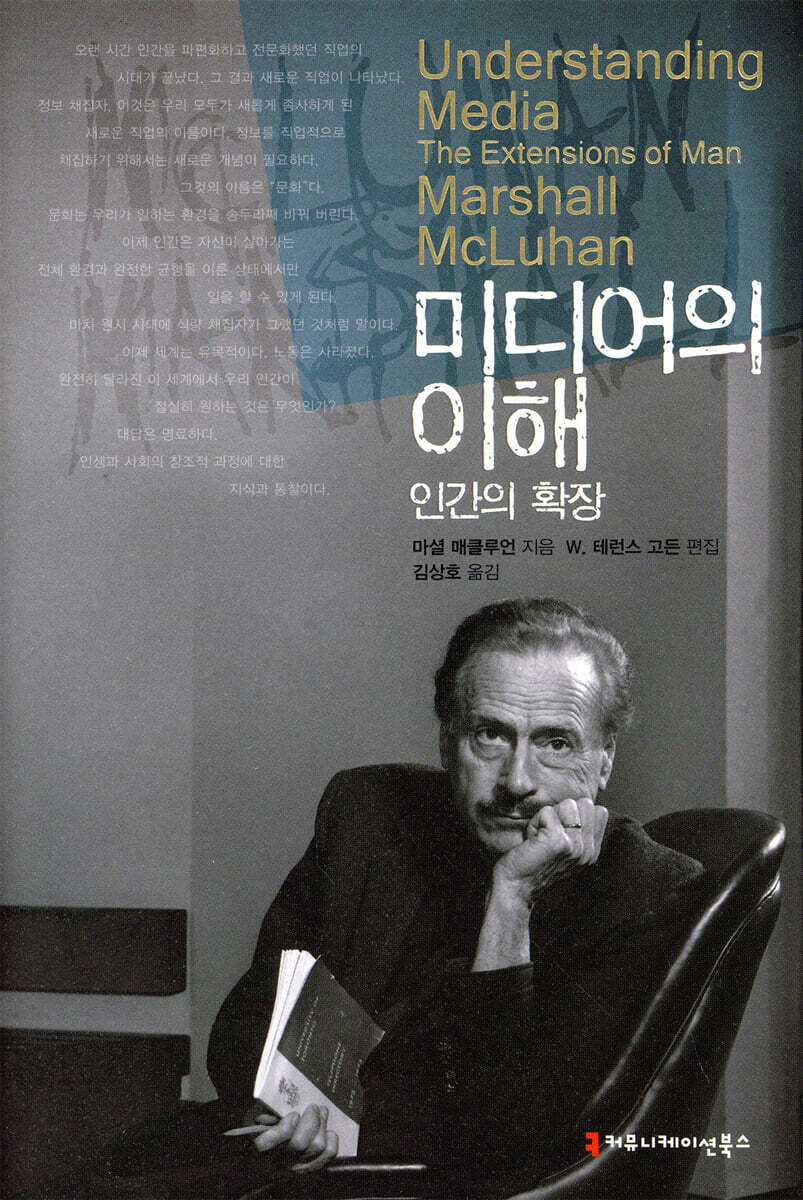
Understanding the Media
 |
Description
Book Introduction
The definitive edition of Marshall McLuhan's "Understanding Media," newly edited
The greatest classic of our time, whose value increases with time.
McLuhan's classic Understanding Media is a book that is 'more often recalled than read.'
McLuhan's writing style was to show the exploration and exploration of the phenomenon itself rather than to describe a certain object.
The translator chose to overcome these difficulties in reading by adding rather bold footnotes.
This newly translated book, Understanding Media, contains 470 translation notes.
Reading the commentary by a true McLuhan expert will help you overcome the difficulties presented by McLuhan's difficult writing style and understand his media ideology more easily.
Additionally, this book was edited by W.
This is a translation of the critical edition edited by Terence Gordon.
This critical edition was edited by W.
Includes a preface by Terence Gordon and the prefaces to both the first and second editions by McLuhan.
A distinctive feature of this edition is that each chapter is accompanied by a brief commentary by the editor.
Editor Gordon also wrote McLuhan's biography at the request of the McLuhan family.
Gordon also created an appendix to aid the reader's understanding.
The appendix contains the 'Research Report on Understanding New Media', which is the basis for 'Understanding Media', a glossary, a bibliography, a subject and biographical index, and a list of McLuhan's writings.
Additionally, the process of publishing 『Understanding Media』 as a single book and the critical responses surrounding 『Understanding Media』 are also recorded.
This is the best opportunity to read McLuhan's classic, which has turned communication theory upside down and is one of the greatest classics of our time, one that becomes more valuable the more you read it.
The greatest classic of our time, whose value increases with time.
McLuhan's classic Understanding Media is a book that is 'more often recalled than read.'
McLuhan's writing style was to show the exploration and exploration of the phenomenon itself rather than to describe a certain object.
The translator chose to overcome these difficulties in reading by adding rather bold footnotes.
This newly translated book, Understanding Media, contains 470 translation notes.
Reading the commentary by a true McLuhan expert will help you overcome the difficulties presented by McLuhan's difficult writing style and understand his media ideology more easily.
Additionally, this book was edited by W.
This is a translation of the critical edition edited by Terence Gordon.
This critical edition was edited by W.
Includes a preface by Terence Gordon and the prefaces to both the first and second editions by McLuhan.
A distinctive feature of this edition is that each chapter is accompanied by a brief commentary by the editor.
Editor Gordon also wrote McLuhan's biography at the request of the McLuhan family.
Gordon also created an appendix to aid the reader's understanding.
The appendix contains the 'Research Report on Understanding New Media', which is the basis for 'Understanding Media', a glossary, a bibliography, a subject and biographical index, and a list of McLuhan's writings.
Additionally, the process of publishing 『Understanding Media』 as a single book and the critical responses surrounding 『Understanding Media』 are also recorded.
This is the best opportunity to read McLuhan's classic, which has turned communication theory upside down and is one of the greatest classics of our time, one that becomes more valuable the more you read it.
- You can preview some of the book's contents.
Preview
index
Translator's Preface
Editor's Preface to the Critical Edition
Part 1
Preface to the 1st edition
Preface to the 2nd edition
01 The media is the message
02 Hot Media and Cold Media
03 The reversal of overheated media
04 The Mechanical Collector: Narcissus, the Anesthetized
05 Hybrid Energy: Dangerous Relationships
06 Media as a Translator
07 Challenge and Collapse: The Revenge of Creativity
Part 2
08 Voice Language: Is it the Flower of Evil?
09 Written Language: Eyes Instead of Ears
10 Road and Paper Routes
11 Number: Crowd Profile
12 Clothing: Our Extended Skin
13 Houses: New Facades and New Views
14 Money: The Poor Man's Credit Card
15 Watches: The Scent of Time
16 Print: How to Dig It Out
17 Comics, Mad: The Road to Television
18 Printed Words: Architects of Nationalism
19 wheels, bicycles, airplanes
20 Photo: A brothel without walls
21 Newspapers: Rule by Leaks
22 Cars: Mechanical Bride
Advertisement 23: A commotion to avoid being beaten by a neighbor
24 Games: Human Expansion
25 Whole Body: Hormones of Society
26 Typewriter: The Age of Iron Curves
27 Telephone: Is it a resonating brass instrument or a ringing symbol?
28 Gramophone: The Toy That Shrunk the Nation's Heart
29 Movie: The World of Reels
30 Radio: Drums of the Primitive Tribe
31 Television: The Timid Giant
32 Weapons: War of Icons
33 Automation: Learning to Live
Editor's Preface to the Critical Edition
Part 1
Preface to the 1st edition
Preface to the 2nd edition
01 The media is the message
02 Hot Media and Cold Media
03 The reversal of overheated media
04 The Mechanical Collector: Narcissus, the Anesthetized
05 Hybrid Energy: Dangerous Relationships
06 Media as a Translator
07 Challenge and Collapse: The Revenge of Creativity
Part 2
08 Voice Language: Is it the Flower of Evil?
09 Written Language: Eyes Instead of Ears
10 Road and Paper Routes
11 Number: Crowd Profile
12 Clothing: Our Extended Skin
13 Houses: New Facades and New Views
14 Money: The Poor Man's Credit Card
15 Watches: The Scent of Time
16 Print: How to Dig It Out
17 Comics, Mad: The Road to Television
18 Printed Words: Architects of Nationalism
19 wheels, bicycles, airplanes
20 Photo: A brothel without walls
21 Newspapers: Rule by Leaks
22 Cars: Mechanical Bride
Advertisement 23: A commotion to avoid being beaten by a neighbor
24 Games: Human Expansion
25 Whole Body: Hormones of Society
26 Typewriter: The Age of Iron Curves
27 Telephone: Is it a resonating brass instrument or a ringing symbol?
28 Gramophone: The Toy That Shrunk the Nation's Heart
29 Movie: The World of Reels
30 Radio: Drums of the Primitive Tribe
31 Television: The Timid Giant
32 Weapons: War of Icons
33 Automation: Learning to Live
Into the book
01 The media is the message
Our traditional response to all media—"what matters is how they're used"—is the sensory numbness of a technologically ignorant fool.
Because the 'content' of the media is like a juicy piece of meat that a thief uses to divert the attention of a watchdog, it diverts our attention elsewhere.
06 Media as a Translator
Under the influence of electrical technology, the entire human business is becoming about 'learning' and 'knowing'.
…this phenomenon means that all forms of employment become ‘learning while receiving a salary’ and arise from the movement of all forms of additional information.
The problem of finding a job or employment may become difficult, as opposed to the easy acquisition of wealth.
08 Spoken Language
Just as digital computers do not need numbers, electronic technology does not need speech or writing.
Electricity opens the way to extending the process of consciousness itself on a global scale, without any verbalization at all.
…this kind of consciousness would be very similar to the collective unconscious that Bergson dreamed of.
The "weightlessness" that biologists say promises physical immortality may be the same as the languageless state that would bring eternal harmony and peace to groups.
14 money
In the age of instant information, humans will end their fragmented and specialized careers and take on the role of information gatherers.
Today's information gathering reintroduces the inclusive concept of "culture," much like the primitive foragers who worked in complete equilibrium with their entire environment.
Our pressing concern in this new nomadic and “workless” world is knowledge and insight into the creative processes of life and society.
18 printed words
Perhaps the most important gift that printing has bestowed upon humanity is the ability to distance and not get involved.
This gave humans the power to act without reacting.
Since the Renaissance, science has praised this gift.
But in the age of electricity, it has become a rather embarrassing gift.
Because in the electric age, everyone is involved with everyone else at all times.
31 Television
The book's theme is that even the clearest understanding of the unique power of a single medium cannot prevent the "closure" of our everyday senses that forces us to conform to a given pattern of experience.
Our traditional response to all media—"what matters is how they're used"—is the sensory numbness of a technologically ignorant fool.
Because the 'content' of the media is like a juicy piece of meat that a thief uses to divert the attention of a watchdog, it diverts our attention elsewhere.
06 Media as a Translator
Under the influence of electrical technology, the entire human business is becoming about 'learning' and 'knowing'.
…this phenomenon means that all forms of employment become ‘learning while receiving a salary’ and arise from the movement of all forms of additional information.
The problem of finding a job or employment may become difficult, as opposed to the easy acquisition of wealth.
08 Spoken Language
Just as digital computers do not need numbers, electronic technology does not need speech or writing.
Electricity opens the way to extending the process of consciousness itself on a global scale, without any verbalization at all.
…this kind of consciousness would be very similar to the collective unconscious that Bergson dreamed of.
The "weightlessness" that biologists say promises physical immortality may be the same as the languageless state that would bring eternal harmony and peace to groups.
14 money
In the age of instant information, humans will end their fragmented and specialized careers and take on the role of information gatherers.
Today's information gathering reintroduces the inclusive concept of "culture," much like the primitive foragers who worked in complete equilibrium with their entire environment.
Our pressing concern in this new nomadic and “workless” world is knowledge and insight into the creative processes of life and society.
18 printed words
Perhaps the most important gift that printing has bestowed upon humanity is the ability to distance and not get involved.
This gave humans the power to act without reacting.
Since the Renaissance, science has praised this gift.
But in the age of electricity, it has become a rather embarrassing gift.
Because in the electric age, everyone is involved with everyone else at all times.
31 Television
The book's theme is that even the clearest understanding of the unique power of a single medium cannot prevent the "closure" of our everyday senses that forces us to conform to a given pattern of experience.
--- From the text
Publisher's Review
The definitive edition of "Understanding Media," newly published with expert translation and editing.
A distinctive feature of this edition is that the editor has provided brief notes for each chapter.
Appendices are also provided, containing the report on which Understanding Media was based, a glossary, a bibliography, a subject and biographical index, and a list of McLuhan's writings.
Translator Professor Kim Sang-ho added 470 footnotes.
His commentary will guide you on the easiest path to accurately understanding media phenomena.
The definitive edition of Understanding Media, newly edited by the author of McLuhan's biography.
This book is a translation of Understanding Media: The Extensions of Man (Critical Edition, Gingko Press, 2003).
This critical edition is edited by W.
Includes a preface by Terence Gordon and prefaces to both the first and second editions by author McLuhan.
A distinctive feature of this edition is that each chapter is accompanied by a brief commentary by the editor.
Editor Gordon also wrote McLuhan's biography at the request of the McLuhan family.
Gordon also created an appendix to aid the reader's understanding.
The appendix contains the "Research Report on Understanding New Media," which is the basis for "Understanding Media," a glossary, a bibliography, a subject and biographical index, and a list of McLuhan's writings.
Additionally, the process of publishing 『Understanding Media』 as a single book and the critical responses surrounding 『Understanding Media』 are also recorded.
The easiest 『Understanding Media』, translated and commented by a professor specializing in media philosophy.
“Understanding Media” is “a book that is more often talked about than read.”
Many people consider it an important book, but why don't they actually read it? A quick glance at the book reveals the answer.
Because it's not easy.
McLuhan's writing style was to show the exploration and exploration of the phenomenon itself rather than to describe a certain object.
Additionally, the book contains extensive citations from literature, philosophy, music, art, and science.
Without a diverse knowledge of the humanities, it would be difficult to interpret the implications of the countless people, claims, stories, and works that appear without warning.
The translator chose to overcome these difficulties in reading by adding rather bold footnotes.
This newly translated book, Understanding Media, contains 470 translation notes.
Professor Kim Sang-ho's main research areas are media philosophy and journalism, and he has consistently published papers on McLuhan's ideas and theories.
Reading his commentary, which can be considered a true McLuhan expert, will help you overcome the difficulties presented by McLuhan's difficult writing style and understand media thought more easily.
The greatest classic of our time, whose value increases with time and reading.
Despite not receiving as many readers as its fame suggests, why does Understanding Media still hold a prominent place among modern classics? Marshall McLuhan defines communication media as any technology that has the power to alter or distort human perception and cognition.
“A car is an extension of the legs, clothes are an extension of the skin, and letters are an extension of the sense of sight.”
At the time of its publication, this novel perspective shocked society and attracted attention. Now, its value has increased even more as a commentary that most accurately explains the media phenomena around us.
The networked society he called the "global village" has already become a reality, and his prediction that the era of occupations that fragmented and specialized humans for a long time will end and we will transition to a new world of roles as information gatherers has come true.
This book, which offers different interpretations and insights each time you read it, will further fulfill its role as a guide for understanding and embracing the new media that will appear before us in the future.
I am not trying to present any theory or opinion.
I only provide what I have discovered through my own perception and the tools you need to navigate the media.
- Marshall McLuhan
Chaplin, Joyce, Chopin, Pavlova, Eliot and Charles Boyer.
All these people appear in one paragraph.
…this book is virtually impossible to summarize.
That's exactly what McLuhan wanted.
- W.
Terrence Gordon
A new perspective on media can never come from someone who studies 'only' media.
I confirmed this fact through 『Understanding Media』.
- Kim Sang-ho
A distinctive feature of this edition is that the editor has provided brief notes for each chapter.
Appendices are also provided, containing the report on which Understanding Media was based, a glossary, a bibliography, a subject and biographical index, and a list of McLuhan's writings.
Translator Professor Kim Sang-ho added 470 footnotes.
His commentary will guide you on the easiest path to accurately understanding media phenomena.
The definitive edition of Understanding Media, newly edited by the author of McLuhan's biography.
This book is a translation of Understanding Media: The Extensions of Man (Critical Edition, Gingko Press, 2003).
This critical edition is edited by W.
Includes a preface by Terence Gordon and prefaces to both the first and second editions by author McLuhan.
A distinctive feature of this edition is that each chapter is accompanied by a brief commentary by the editor.
Editor Gordon also wrote McLuhan's biography at the request of the McLuhan family.
Gordon also created an appendix to aid the reader's understanding.
The appendix contains the "Research Report on Understanding New Media," which is the basis for "Understanding Media," a glossary, a bibliography, a subject and biographical index, and a list of McLuhan's writings.
Additionally, the process of publishing 『Understanding Media』 as a single book and the critical responses surrounding 『Understanding Media』 are also recorded.
The easiest 『Understanding Media』, translated and commented by a professor specializing in media philosophy.
“Understanding Media” is “a book that is more often talked about than read.”
Many people consider it an important book, but why don't they actually read it? A quick glance at the book reveals the answer.
Because it's not easy.
McLuhan's writing style was to show the exploration and exploration of the phenomenon itself rather than to describe a certain object.
Additionally, the book contains extensive citations from literature, philosophy, music, art, and science.
Without a diverse knowledge of the humanities, it would be difficult to interpret the implications of the countless people, claims, stories, and works that appear without warning.
The translator chose to overcome these difficulties in reading by adding rather bold footnotes.
This newly translated book, Understanding Media, contains 470 translation notes.
Professor Kim Sang-ho's main research areas are media philosophy and journalism, and he has consistently published papers on McLuhan's ideas and theories.
Reading his commentary, which can be considered a true McLuhan expert, will help you overcome the difficulties presented by McLuhan's difficult writing style and understand media thought more easily.
The greatest classic of our time, whose value increases with time and reading.
Despite not receiving as many readers as its fame suggests, why does Understanding Media still hold a prominent place among modern classics? Marshall McLuhan defines communication media as any technology that has the power to alter or distort human perception and cognition.
“A car is an extension of the legs, clothes are an extension of the skin, and letters are an extension of the sense of sight.”
At the time of its publication, this novel perspective shocked society and attracted attention. Now, its value has increased even more as a commentary that most accurately explains the media phenomena around us.
The networked society he called the "global village" has already become a reality, and his prediction that the era of occupations that fragmented and specialized humans for a long time will end and we will transition to a new world of roles as information gatherers has come true.
This book, which offers different interpretations and insights each time you read it, will further fulfill its role as a guide for understanding and embracing the new media that will appear before us in the future.
I am not trying to present any theory or opinion.
I only provide what I have discovered through my own perception and the tools you need to navigate the media.
- Marshall McLuhan
Chaplin, Joyce, Chopin, Pavlova, Eliot and Charles Boyer.
All these people appear in one paragraph.
…this book is virtually impossible to summarize.
That's exactly what McLuhan wanted.
- W.
Terrence Gordon
A new perspective on media can never come from someone who studies 'only' media.
I confirmed this fact through 『Understanding Media』.
- Kim Sang-ho
GOODS SPECIFICS
- Date of issue: April 22, 2011
- Page count, weight, size: 602 pages | 128*188*35mm
- ISBN13: 9788964061510
- ISBN10: 8964061519
You may also like
카테고리
korean


korean

![ELLE 엘르 스페셜 에디션 A형 : 12월 [2025]](http://librairie.coreenne.fr/cdn/shop/files/b8e27a3de6c9538896439686c6b0e8fb.jpg?v=1766436872&width=3840)


