

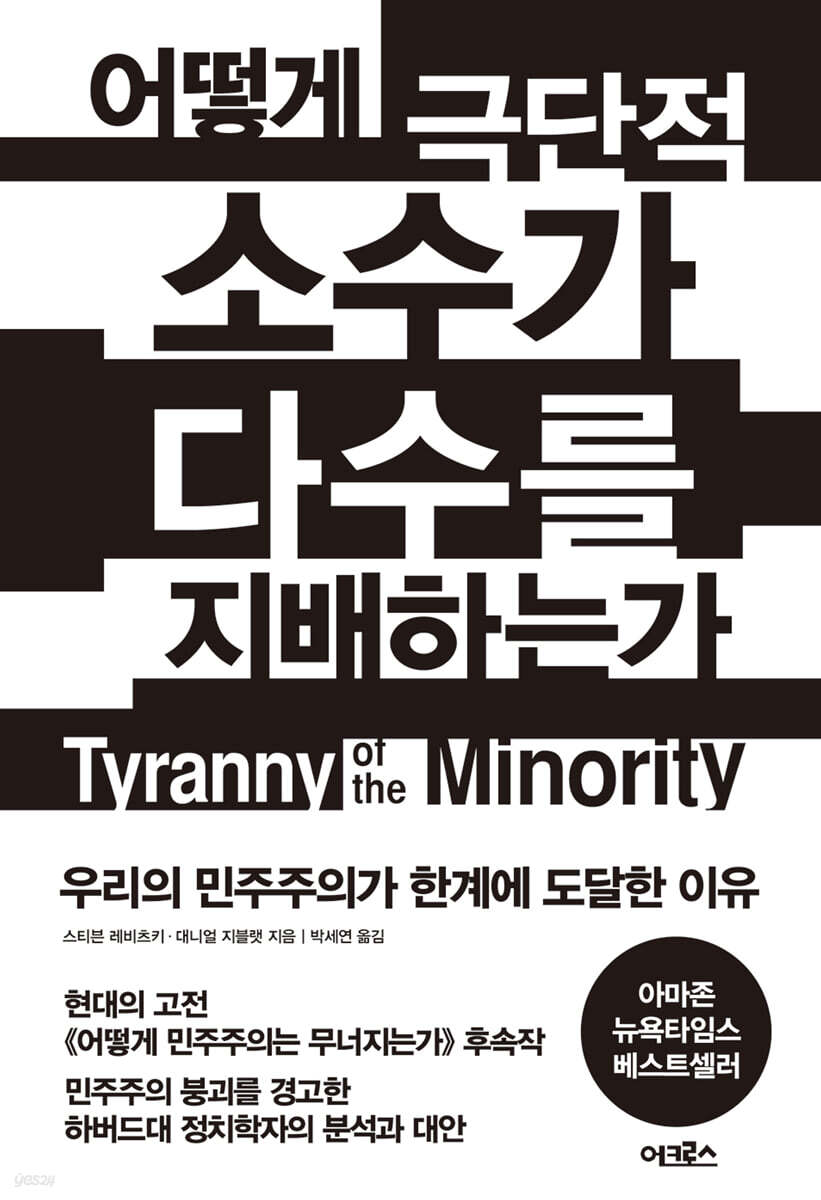
How an Extreme Minority Rules the Majority
 |
Description
Book Introduction
- A word from MD
-
A world that cannot be changed by votingTrump supporters storm the Capitol, refusing to accept the results of the last presidential election.
This incident symbolically shows the current state of American democracy.
Not only that.
Gun control legislation and legalized abortion are blocked in Congress against the will of the American people.
A world that cannot be changed through voting is a crisis of democracy.
May 24, 2024. Social and Political PD Son Min-gyu
The sequel to the long-running bestseller in the political field, "How Democracy Falls."
Harvard political scientists Steven Levitsky and Daniel Ziblatt analyze the limitations of modern democratic systems, where a minority with extreme ideologies dominates a sensible majority.
On January 6, 2021, as Trump supporters, refusing to accept their election defeat, stormed the Capitol, the shocked authors asked questions.
"Why is America's long-standing democratic system in jeopardy?" The authors argue that behind the collapse of democracy are politicians who only pretend to be loyal to democracy, and the outdated system that serves as their weapon.
Mainstream politicians who covertly support extremist forces use a system that allows them to seize power with the support of a small minority to manipulate the majority of the population.
Will it become a democratic country where diverse members coexist, or a dictatorship where only a few enjoy rights?
The authors strongly warn that if we do not reform the old system now, we may face an even more dire future.
Harvard political scientists Steven Levitsky and Daniel Ziblatt analyze the limitations of modern democratic systems, where a minority with extreme ideologies dominates a sensible majority.
On January 6, 2021, as Trump supporters, refusing to accept their election defeat, stormed the Capitol, the shocked authors asked questions.
"Why is America's long-standing democratic system in jeopardy?" The authors argue that behind the collapse of democracy are politicians who only pretend to be loyal to democracy, and the outdated system that serves as their weapon.
Mainstream politicians who covertly support extremist forces use a system that allows them to seize power with the support of a small minority to manipulate the majority of the population.
Will it become a democratic country where diverse members coexist, or a dictatorship where only a few enjoy rights?
The authors strongly warn that if we do not reform the old system now, we may face an even more dire future.
- You can preview some of the book's contents.
Preview
index
Entering
Chapter 1: Fear of Defeat
Chapter 2: The Banality of Dictatorship
Chapter 3: What Happened on This Earth
Chapter 4: Why the Republican Party Abandoned Democracy
Chapter 5 The Chained Majority
Chapter 6: The Tyranny of the Minority
Chapter 7: Substandard Democracy, the United States
Chapter 8: Democratizing Democracy
Acknowledgements
main
Search
Chapter 1: Fear of Defeat
Chapter 2: The Banality of Dictatorship
Chapter 3: What Happened on This Earth
Chapter 4: Why the Republican Party Abandoned Democracy
Chapter 5 The Chained Majority
Chapter 6: The Tyranny of the Minority
Chapter 7: Substandard Democracy, the United States
Chapter 8: Democratizing Democracy
Acknowledgements
main
Search
Detailed image

Into the book
On January 6th, Americans witnessed a scene that was almost unimaginable.
It was a riot instigated by the President of the United States.
This marked the culmination of four years of democratic regression in an attempted coup.
Many Americans who witnessed the spectacle felt the same fear, confusion, and anger that people in other countries felt when they witnessed the collapse of their democracies.
The series of events Americans witnessed—the politically motivated wave of violence, the threats against campaign workers, the various attempts to make voting more difficult, the president's plot to overturn the election results—all represented a regression in democracy.
---From "Entering"
Fear sometimes acts as a driving force to turn society back into dictatorship.
The fear of losing political power, and more importantly, the fear of losing one's existing dominant social position, is precisely what drives this force.
But if these fears cause mainstream political parties to turn their backs on democracy, what exactly is driving them to do so?
---From "Chapter 1: Fear of Defeat"
While a loyal democrat consistently and firmly rejects any action that is anti-democratic, a superficially loyal democrat adopts a somewhat ambiguous attitude.
They move in two ways.
That is, while claiming to support democracy, they simultaneously turn a blind eye to violence and anti-democratic extremism.
This ambiguity is what makes them so dangerous.
---From "Chapter 2: The Ordinariness of Dictatorship"
On Election Day, the White House dispatched election “watchers” to local polling places, and local newspapers urged black people not to vote.
The Red Shirts rode horses through the streets.
Few black people left their homes.
Most of the black people who bravely went to the polls were turned away by the threat of guns.
In areas with large Black populations, Democratic assassination squads stormed polling places after voting closed, threatened election officials, and stuffed ballot boxes with the ballots they had brought.
Unsurprisingly, the Democrats won a landslide victory.
It won 98 of the 118 seats in the state legislature.
---From "Chapter 3 What Happened on This Land"
Minorities can sometimes frustrate or temporarily win political battles against the majority.
This can happen through normal negotiations in democratic politics.
But it is quite another for a political minority to 'continue' to beat the vast majority or impose its policies, or even to use the system to solidify its own dominance.
When this happens, it is not a democracy, but a world ruled by the few.
It was a riot instigated by the President of the United States.
This marked the culmination of four years of democratic regression in an attempted coup.
Many Americans who witnessed the spectacle felt the same fear, confusion, and anger that people in other countries felt when they witnessed the collapse of their democracies.
The series of events Americans witnessed—the politically motivated wave of violence, the threats against campaign workers, the various attempts to make voting more difficult, the president's plot to overturn the election results—all represented a regression in democracy.
---From "Entering"
Fear sometimes acts as a driving force to turn society back into dictatorship.
The fear of losing political power, and more importantly, the fear of losing one's existing dominant social position, is precisely what drives this force.
But if these fears cause mainstream political parties to turn their backs on democracy, what exactly is driving them to do so?
---From "Chapter 1: Fear of Defeat"
While a loyal democrat consistently and firmly rejects any action that is anti-democratic, a superficially loyal democrat adopts a somewhat ambiguous attitude.
They move in two ways.
That is, while claiming to support democracy, they simultaneously turn a blind eye to violence and anti-democratic extremism.
This ambiguity is what makes them so dangerous.
---From "Chapter 2: The Ordinariness of Dictatorship"
On Election Day, the White House dispatched election “watchers” to local polling places, and local newspapers urged black people not to vote.
The Red Shirts rode horses through the streets.
Few black people left their homes.
Most of the black people who bravely went to the polls were turned away by the threat of guns.
In areas with large Black populations, Democratic assassination squads stormed polling places after voting closed, threatened election officials, and stuffed ballot boxes with the ballots they had brought.
Unsurprisingly, the Democrats won a landslide victory.
It won 98 of the 118 seats in the state legislature.
---From "Chapter 3 What Happened on This Land"
Minorities can sometimes frustrate or temporarily win political battles against the majority.
This can happen through normal negotiations in democratic politics.
But it is quite another for a political minority to 'continue' to beat the vast majority or impose its policies, or even to use the system to solidify its own dominance.
When this happens, it is not a democracy, but a world ruled by the few.
---From "Chapter 6: The Tyranny of the Minority"
Publisher's Review
★ Immediately after publication, it became an Amazon and New York Times bestseller.
★ Selected as Newsweek's Book of the Year
★ A sequel to the political bestseller, "How Democracy Falls"
★ Highly recommended by The New Yorker, Newsweek, The Washington Post, The New York Times, and CNN
From distorted elections to unelected power
Extremism comes disguised as legality and democracy.
What made Trump's return possible?
How can an extreme minority shake the common sense majority?
A masterpiece by a Harvard political scientist who explores the limitations of modern democratic systems.
The sequel to the modern classic "How Democracies Die", which warned of the collapse of democracy, "How the Few Rule the Many" has been published.
Harvard political science professors Steven Levitsky and Daniel Ziblatt's masterpiece, "How Democracies Die," has been a global bestseller since its publication in 2018.
Not only was it selected as the "Book of the Year" by major international media outlets and President Barack Obama, but it also garnered attention from the domestic media and political circles, becoming the longest-running steady seller in the political field.
This book, "How the Extreme Minority Rules the Majority," also rose to the top of the Amazon and New York Times bestseller lists immediately after its publication, receiving praise as a must-read for readers around the world who will face Trump's return.
If the previous book began with Trump's election, this book, "How the Extreme Few Rule the Majority," begins with the storming of the Capitol by Trump supporters.
In January 2021, Trump supporters, refusing to accept their election defeat, occupied the Capitol, and Trump encouraged his supporters to carry out political terrorism.
It was the most shocking event in 21st-century American political history.
The right to vote has been guaranteed for over 50 years.
GDP per capita of $63,000.
According to social science theory, American democracy could never have collapsed.
However, American democracy has been in rapid decline as not only his supporters but also former presidents and mainstream Republican politicians refuse to accept the election results.
Why is America's seemingly robust democracy in jeopardy? This book examines the US Constitution, electoral system, and modern history, as well as the "legal" collapse of democracy in countries like France, Hungary, and Thailand. It explores how a minority with extremist ideologies comes to dominate a sensible majority.
Who is the culprit who is destroying the basic principles of democracy?
A dangerous alliance between those who are only democratic in name and extremist forces.
The authors argue that behind the movement to destroy democracy are “superficially loyal democrats” and an outdated democratic system that blocks change.
Democracy faces fatal consequences when an old, flawed democratic system falls into the hands of seemingly loyal democrats.
But what's the difference between a "loyal democrat" and a "semi-loyal democrat"? A democrat must adhere to three fundamental principles.
I will accept the election results.
Do not use violence to gain power.
Do not ally with extremist forces.
A loyal democrat transfers power peacefully, seizes power through fair competition, and resolutely cuts ties with extremist forces, even within the same camp.
On the surface, loyal democrats appear to adhere to the first two principles.
They are mainstream politicians who wear ties and do not act in a way that is blatantly anti-democratic.
But they subvert the fundamental principles of democracy by condoning or secretly supporting extremist forces.
On February 6, 1934, tens of thousands of young men belonging to groups such as the Legion of Honor, the Patriotic Youth, and Action de France stormed the French National Assembly.
They entered the parliament demanding the dissolution of parliament and the restoration of the Bonapartist government, and many were killed or wounded.
More lethal than their political terrorism was the reaction of mainstream politicians.
France's main political party, the Republican League, not only downplayed the violence that erupted from the attack, but also hailed the rioters as "martyrs," obstructed the commission's work, and manipulated its findings to suit its own agenda.
Overt political terrorism quickly became a political issue, and the violence of extremist groups was legitimized by mainstream politics.
As the 1934 storming of the French Capitol and the 2021 storming of the U.S. Capitol demonstrate, when mainstream politics aligns with extremist forces, extremism gains momentum and can achieve hegemony.
They just followed democratic procedures.
The weaknesses and limitations of the democratic system that have become weapons for extremists.
An outdated system that fails to reflect the spirit of the times is a powerful weapon for both extremists and superficially loyal democrats.
In the United States, the Constitution is considered sacrosanct.
The balance of power and the functioning of liberal democracy are possible thanks to the constitution carefully designed by the “Founding Fathers.”
However, if we look at the origins of the Constitution, we can see that such a perception is a misunderstanding.
In particular, the composition of Congress and the Electoral College system are products of compromise and anti-majoritarianism aimed at persuading slave owners.
Some American states that wanted to maintain slavery threatened to secede from the Union unless their rights were guaranteed, which risked leaving the United States vulnerable to external attack.
In the end, states with slavery recognized slaves who could not vote as part of the voting population, so Virginia, which had a smaller voting population than Massachusetts, ended up winning five more seats than Massachusetts.
It goes without saying that the electoral college system, which elects the president in proportion to the number of seats in the National Assembly, has a great influence on the presidential election.
The electoral college system, which is essentially an indirect election with seats not proportional to population, has been maintained to this day, allowing the majority of seats and the presidency to be won solely by the votes of the South and white people.
This is why Donald Trump and the Republican Party have been able to seize power despite abusing hatred against women and people of color.
In fact, in 2000, George W.
Bush, Donald Trump was elected president in 2016 despite receiving fewer votes than his opponent.
The loser became the winner.
The will of the majority for change is repeatedly ignored due to a system that favors a select few over the majority.
The Supreme Court, comprised of Trump-appointed justices, has struck down the constitutionally guaranteed right to abortion.
Even though 55 percent of Americans supported legalizing abortion and only 39 percent opposed it, the Supreme Court made abortion rights a matter for individual states, not the national government.
The Supreme Court ruled that gerrymandering, which divides electoral districts to favor a specific political party, was not an issue for it to judge, further increasing the possibility of an absurdity in which a majority of seats are secured with a small number of votes.
The filibuster is also a weapon that strengthens the rule of the minority.
The U.S. Senate has a “supermajority rule” requiring 60 votes to pass legislation.
When there are fewer than 60 votes in favor, a minority of lawmakers have the power to block legislation through a filibuster.
Throughout American political history, bills to expand voting rights, abortion rights, and gun control have died due to filibusters despite receiving more than 50 percent of the vote.
Many institutions that purport to be democratic actually benefit the extreme minority rather than the social minority, and empower those who dream of reaction.
Is it for minority rights or partisan interests?
The seeds of democratic collapse contained in familiar laws and institutions
In a democracy, there is a need for mechanisms to limit the power of the majority.
This is especially true in the realm of individual freedom.
An elected government cannot force us to worship a particular god, or dictate which books we should read, which movies we should see, or what we should study in college.
Nor should individuals decide what race or gender they should marry.
But can we also say that a situation where those with fewer votes are elected to office instead of those with more, where bills passed by the majority in parliament are blocked by a small number of lawmakers, and where we are constantly forced to listen to the extreme opinions of a small minority, can this also be considered a mechanism for controlling democracy? The authors argue that we must draw a clear distinction between "institutions that protect minorities and preserve democracy" and "institutions that provide unfair advantages to a privileged few," and urge us to critically examine the institutions we habitually follow and praise.
The tyranny of unelected power.
An election that overrepresents a specific group.
Legal and illegal, optionally defined.
This book shows that the political system we hold sacred is actually a system full of compromises and limitations, and that it can become a weapon for those who dream of reaction.
Will we become a democratic nation where diverse constituencies coexist, or a dictatorship where only a select few enjoy the rights they deserve? In this year of super elections, when half the world's population will head to the polls, the authors strongly warn that the fate of democracy hinges on our choices.
★ Selected as Newsweek's Book of the Year
★ A sequel to the political bestseller, "How Democracy Falls"
★ Highly recommended by The New Yorker, Newsweek, The Washington Post, The New York Times, and CNN
From distorted elections to unelected power
Extremism comes disguised as legality and democracy.
What made Trump's return possible?
How can an extreme minority shake the common sense majority?
A masterpiece by a Harvard political scientist who explores the limitations of modern democratic systems.
The sequel to the modern classic "How Democracies Die", which warned of the collapse of democracy, "How the Few Rule the Many" has been published.
Harvard political science professors Steven Levitsky and Daniel Ziblatt's masterpiece, "How Democracies Die," has been a global bestseller since its publication in 2018.
Not only was it selected as the "Book of the Year" by major international media outlets and President Barack Obama, but it also garnered attention from the domestic media and political circles, becoming the longest-running steady seller in the political field.
This book, "How the Extreme Minority Rules the Majority," also rose to the top of the Amazon and New York Times bestseller lists immediately after its publication, receiving praise as a must-read for readers around the world who will face Trump's return.
If the previous book began with Trump's election, this book, "How the Extreme Few Rule the Majority," begins with the storming of the Capitol by Trump supporters.
In January 2021, Trump supporters, refusing to accept their election defeat, occupied the Capitol, and Trump encouraged his supporters to carry out political terrorism.
It was the most shocking event in 21st-century American political history.
The right to vote has been guaranteed for over 50 years.
GDP per capita of $63,000.
According to social science theory, American democracy could never have collapsed.
However, American democracy has been in rapid decline as not only his supporters but also former presidents and mainstream Republican politicians refuse to accept the election results.
Why is America's seemingly robust democracy in jeopardy? This book examines the US Constitution, electoral system, and modern history, as well as the "legal" collapse of democracy in countries like France, Hungary, and Thailand. It explores how a minority with extremist ideologies comes to dominate a sensible majority.
Who is the culprit who is destroying the basic principles of democracy?
A dangerous alliance between those who are only democratic in name and extremist forces.
The authors argue that behind the movement to destroy democracy are “superficially loyal democrats” and an outdated democratic system that blocks change.
Democracy faces fatal consequences when an old, flawed democratic system falls into the hands of seemingly loyal democrats.
But what's the difference between a "loyal democrat" and a "semi-loyal democrat"? A democrat must adhere to three fundamental principles.
I will accept the election results.
Do not use violence to gain power.
Do not ally with extremist forces.
A loyal democrat transfers power peacefully, seizes power through fair competition, and resolutely cuts ties with extremist forces, even within the same camp.
On the surface, loyal democrats appear to adhere to the first two principles.
They are mainstream politicians who wear ties and do not act in a way that is blatantly anti-democratic.
But they subvert the fundamental principles of democracy by condoning or secretly supporting extremist forces.
On February 6, 1934, tens of thousands of young men belonging to groups such as the Legion of Honor, the Patriotic Youth, and Action de France stormed the French National Assembly.
They entered the parliament demanding the dissolution of parliament and the restoration of the Bonapartist government, and many were killed or wounded.
More lethal than their political terrorism was the reaction of mainstream politicians.
France's main political party, the Republican League, not only downplayed the violence that erupted from the attack, but also hailed the rioters as "martyrs," obstructed the commission's work, and manipulated its findings to suit its own agenda.
Overt political terrorism quickly became a political issue, and the violence of extremist groups was legitimized by mainstream politics.
As the 1934 storming of the French Capitol and the 2021 storming of the U.S. Capitol demonstrate, when mainstream politics aligns with extremist forces, extremism gains momentum and can achieve hegemony.
They just followed democratic procedures.
The weaknesses and limitations of the democratic system that have become weapons for extremists.
An outdated system that fails to reflect the spirit of the times is a powerful weapon for both extremists and superficially loyal democrats.
In the United States, the Constitution is considered sacrosanct.
The balance of power and the functioning of liberal democracy are possible thanks to the constitution carefully designed by the “Founding Fathers.”
However, if we look at the origins of the Constitution, we can see that such a perception is a misunderstanding.
In particular, the composition of Congress and the Electoral College system are products of compromise and anti-majoritarianism aimed at persuading slave owners.
Some American states that wanted to maintain slavery threatened to secede from the Union unless their rights were guaranteed, which risked leaving the United States vulnerable to external attack.
In the end, states with slavery recognized slaves who could not vote as part of the voting population, so Virginia, which had a smaller voting population than Massachusetts, ended up winning five more seats than Massachusetts.
It goes without saying that the electoral college system, which elects the president in proportion to the number of seats in the National Assembly, has a great influence on the presidential election.
The electoral college system, which is essentially an indirect election with seats not proportional to population, has been maintained to this day, allowing the majority of seats and the presidency to be won solely by the votes of the South and white people.
This is why Donald Trump and the Republican Party have been able to seize power despite abusing hatred against women and people of color.
In fact, in 2000, George W.
Bush, Donald Trump was elected president in 2016 despite receiving fewer votes than his opponent.
The loser became the winner.
The will of the majority for change is repeatedly ignored due to a system that favors a select few over the majority.
The Supreme Court, comprised of Trump-appointed justices, has struck down the constitutionally guaranteed right to abortion.
Even though 55 percent of Americans supported legalizing abortion and only 39 percent opposed it, the Supreme Court made abortion rights a matter for individual states, not the national government.
The Supreme Court ruled that gerrymandering, which divides electoral districts to favor a specific political party, was not an issue for it to judge, further increasing the possibility of an absurdity in which a majority of seats are secured with a small number of votes.
The filibuster is also a weapon that strengthens the rule of the minority.
The U.S. Senate has a “supermajority rule” requiring 60 votes to pass legislation.
When there are fewer than 60 votes in favor, a minority of lawmakers have the power to block legislation through a filibuster.
Throughout American political history, bills to expand voting rights, abortion rights, and gun control have died due to filibusters despite receiving more than 50 percent of the vote.
Many institutions that purport to be democratic actually benefit the extreme minority rather than the social minority, and empower those who dream of reaction.
Is it for minority rights or partisan interests?
The seeds of democratic collapse contained in familiar laws and institutions
In a democracy, there is a need for mechanisms to limit the power of the majority.
This is especially true in the realm of individual freedom.
An elected government cannot force us to worship a particular god, or dictate which books we should read, which movies we should see, or what we should study in college.
Nor should individuals decide what race or gender they should marry.
But can we also say that a situation where those with fewer votes are elected to office instead of those with more, where bills passed by the majority in parliament are blocked by a small number of lawmakers, and where we are constantly forced to listen to the extreme opinions of a small minority, can this also be considered a mechanism for controlling democracy? The authors argue that we must draw a clear distinction between "institutions that protect minorities and preserve democracy" and "institutions that provide unfair advantages to a privileged few," and urge us to critically examine the institutions we habitually follow and praise.
The tyranny of unelected power.
An election that overrepresents a specific group.
Legal and illegal, optionally defined.
This book shows that the political system we hold sacred is actually a system full of compromises and limitations, and that it can become a weapon for those who dream of reaction.
Will we become a democratic nation where diverse constituencies coexist, or a dictatorship where only a select few enjoy the rights they deserve? In this year of super elections, when half the world's population will head to the polls, the authors strongly warn that the fate of democracy hinges on our choices.
GOODS SPECIFICS
- Date of issue: May 21, 2024
- Page count, weight, size: 440 pages | 608g | 147*215*24mm
- ISBN13: 9791167741509
- ISBN10: 1167741501
You may also like
카테고리
korean


korean

![GQ KOREA Mark (Monthly): December [2025]](http://librairie.coreenne.fr/cdn/shop/files/8ef265dbbfbf186523ed75ba7319009d.jpg?v=1765340328&width=3840)


