

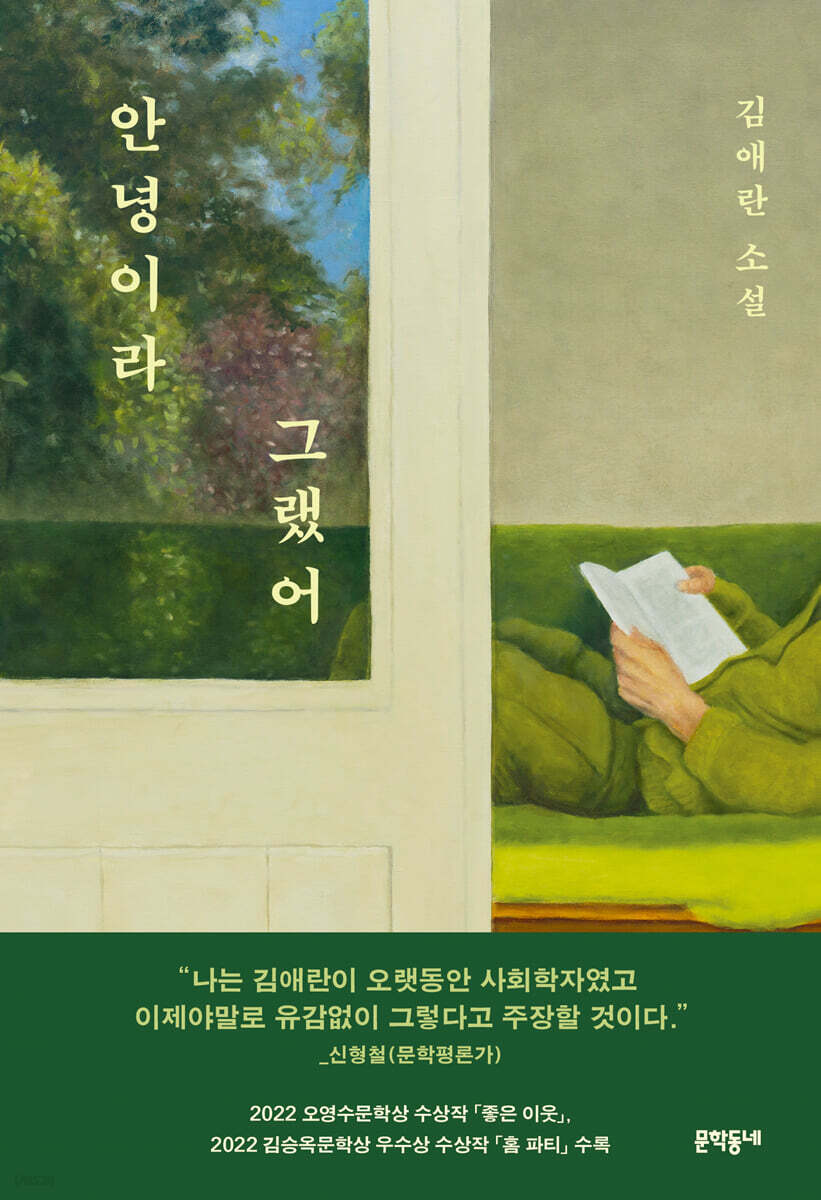
I said hello
 |
Description
Book Introduction
- A word from MD
-
May all of our places be safeNovelist Kim Ae-ran, who received much love for her work “One of Them Is a Lie,” opens early summer with a collection of short stories.
It is a compilation of seven novels captured with a sharp and keen eye that brings to mind the author's early works.
A cool and sparkling story that brings about belated realization through characters who resemble aspects of ourselves.
June 20, 2025. Novel/Poetry PD Kim Yu-ri
“I think Kim Ae-ran has been a sociologist for a long time.
Now, I can confidently assert that this is true.” _Shin Hyeong-cheol (literary critic)
2022 Oh Young-su Literary Award Winner “Good Neighbor”
Included in the 2022 Kim Seung-ok Literary Award Excellence Award winner, "Home Party"
Novelist Kim Ae-ran has returned with a new collection of short stories, eight years after 『Outside is Summer』 (Munhakdongne, 2017).
"I Said Hello" is a collection of seven short stories, including "Home Party," which won the Excellence Award at the 2022 Kim Seung-ok Literary Award, and "Good Neighbor," which won the 2022 Oh Young-soo Literary Award, with the review that it is "a novel that keenly displays the unique ability to capture particles of emotion floating in social space and give them clear expression." While still displaying her unique ability to layer a world with powerful emotional appeal and dilemmatic questions, you can meet Kim Ae-ran who has become a little colder and more ruthless than before.
The protagonist of this collection of short stories could also be said to be ‘space.’
As the novel says, “Many events in the play begin with ‘invitation,’ ‘visit,’ ‘intrusion,’ and ‘escape’” (Home Party, p. 42), the story in this book unfolds as the characters visit someone else’s space.
It is an elegant and stable space that hints at the owner's aesthetic sense and leisure ("Home Party"), or it is a single-family home overseas that allows for the "first-ever luxury" of a month-long trip thanks to the low cost of living and accommodation ("Little House in the Forest").
Or it may be a rental house that has been lovingly maintained and used but now needs to be prepared for a new owner (“Good Neighbor”), or it may be a bookstore that was opened after quitting the company and pouring all the money that had been saved (“Lemon Cake”).
The reason why space is important in “I Said Hello” is because it does not simply function as a background for the story, but is like the lives of the characters themselves.
For Kim Ae-ran, who has described the meaning of a single room in our society with extraordinary insight, a certain space is a place that allows one to gauge someone's economic and social indicators, and a comprehensive and complex place that contains a person's entire history.
Therefore, the conflict that arises over space in this collection of short stories can be said to be a clash of standards of life.
Entering someone else's space is, in other words, an event that breaks out of the boundaries of the life I have lived.
Kim Ae-ran asks the following question in “Home Party.”
“How difficult is it for one person to stand in another person’s shoes?” (p. 24) Will visiting another person’s space be a way to expand our understanding of others, or will it be a way to invade and suppress each other’s standards?
In a reality where it is more difficult than ever to break out of the confines of "I" and move toward "we," and where the scenery before our eyes and the people we connect with are becoming numbers that can be converted into money, Kim Ae-ran's question strikes us with even greater urgency.
And the question can be rephrased like this:
When we experience common abandonment and discouragement and a new starting line unfolds, what has changed and what has been preserved?
Or what needs to change and what needs to be preserved?
This is exactly the kind of greeting we need in Kim Ae-ran's style, as we desperately need to ask someone for their well-being and peace.
Now, I can confidently assert that this is true.” _Shin Hyeong-cheol (literary critic)
2022 Oh Young-su Literary Award Winner “Good Neighbor”
Included in the 2022 Kim Seung-ok Literary Award Excellence Award winner, "Home Party"
Novelist Kim Ae-ran has returned with a new collection of short stories, eight years after 『Outside is Summer』 (Munhakdongne, 2017).
"I Said Hello" is a collection of seven short stories, including "Home Party," which won the Excellence Award at the 2022 Kim Seung-ok Literary Award, and "Good Neighbor," which won the 2022 Oh Young-soo Literary Award, with the review that it is "a novel that keenly displays the unique ability to capture particles of emotion floating in social space and give them clear expression." While still displaying her unique ability to layer a world with powerful emotional appeal and dilemmatic questions, you can meet Kim Ae-ran who has become a little colder and more ruthless than before.
The protagonist of this collection of short stories could also be said to be ‘space.’
As the novel says, “Many events in the play begin with ‘invitation,’ ‘visit,’ ‘intrusion,’ and ‘escape’” (Home Party, p. 42), the story in this book unfolds as the characters visit someone else’s space.
It is an elegant and stable space that hints at the owner's aesthetic sense and leisure ("Home Party"), or it is a single-family home overseas that allows for the "first-ever luxury" of a month-long trip thanks to the low cost of living and accommodation ("Little House in the Forest").
Or it may be a rental house that has been lovingly maintained and used but now needs to be prepared for a new owner (“Good Neighbor”), or it may be a bookstore that was opened after quitting the company and pouring all the money that had been saved (“Lemon Cake”).
The reason why space is important in “I Said Hello” is because it does not simply function as a background for the story, but is like the lives of the characters themselves.
For Kim Ae-ran, who has described the meaning of a single room in our society with extraordinary insight, a certain space is a place that allows one to gauge someone's economic and social indicators, and a comprehensive and complex place that contains a person's entire history.
Therefore, the conflict that arises over space in this collection of short stories can be said to be a clash of standards of life.
Entering someone else's space is, in other words, an event that breaks out of the boundaries of the life I have lived.
Kim Ae-ran asks the following question in “Home Party.”
“How difficult is it for one person to stand in another person’s shoes?” (p. 24) Will visiting another person’s space be a way to expand our understanding of others, or will it be a way to invade and suppress each other’s standards?
In a reality where it is more difficult than ever to break out of the confines of "I" and move toward "we," and where the scenery before our eyes and the people we connect with are becoming numbers that can be converted into money, Kim Ae-ran's question strikes us with even greater urgency.
And the question can be rephrased like this:
When we experience common abandonment and discouragement and a new starting line unfolds, what has changed and what has been preserved?
Or what needs to change and what needs to be preserved?
This is exactly the kind of greeting we need in Kim Ae-ran's style, as we desperately need to ask someone for their well-being and peace.
- You can preview some of the book's contents.
Preview
index
Home Party 007
Little House in the Forest 045
Good Neighbor 097
Foreign body sensation 143
Lemon Cake 189
I said hello 217
Like Raindrops 257
Commentary | Shin Hyeong-cheol (literary critic)
Treat your neighbor as your money 295
Author's Note 315
Little House in the Forest 045
Good Neighbor 097
Foreign body sensation 143
Lemon Cake 189
I said hello 217
Like Raindrops 257
Commentary | Shin Hyeong-cheol (literary critic)
Treat your neighbor as your money 295
Author's Note 315
Into the book
Lee Yeon felt a small sense of satisfaction at the way he treated the subject without prejudice.
It was the result of cultivation rather than innate character.
‘When I was young, I really judged others very carefully… …’ Over the years, my heart had become rounded as it was worn and broken by the waves of time.
In fact, the truth that Lee Yeon realized while lending his body to various people for over twenty years was simple.
It was about 'how difficult it is for one person to stand in another person's place.'
And from that came misunderstandings, conflicts, and drama.
--- pp.23-24 From "Home Party"
I learned that in life, there are certain tensions that must be overcome, and that certain performances must be completed safely before stepping off the stage. This is a literal realm of existence, unrelated to worldly recognition or love, unrelated to pretense or courtesy.
--- pp.39-40 From "Home Party"
No matter where or how long I stay, keeping my surroundings tidy has been a long-standing habit and a source of pride for me.
I wasn't like that when I was young, but it was a habit I developed after living on my own.
And then I felt like I was living a little better.
It felt like I hadn't completely let go of something yet.
--- p.57 From “Little House in the Forest”
No matter how practical the content, a letter takes time and effort, and it always leaves something more than practical between the sender and recipient.
--- pp.72-73 from "Little House in the Forest"
In reality, I didn't want to explain my life to people who didn't really care about me all the time.
I tried to think that people just needed something to criticize lightly, like a source of energy for life, and that this was how they could endure the weariness of life to some extent.
When you can't change the wallpaper in your own room, it's comforting to think that someone else's entrance is dirty.
I did it even though I knew that it was just as materialistic as those who gossip about others.
--- p.78 From “Little House in the Forest”
It's not the first or second time this has happened, and even I've invaded someone's space in that way. Seeing that, the process we went through last time, all the exposure and disclosure, felt unfair and disorganized.
Anyone with the intention of renting or selling can come into a resident's home and inspect everything.
--- p.108 From “Good Neighbor”
For the past year, real estate articles have been flooded with comments mocking and dismissing those without homes who hope for stable housing prices.
Words like 'envy' and 'jealousy' were insulting, but words like 'ignorance' and 'laziness' were also unfair.
But what bothered us more than anything was the doubt, 'Maybe the fault really lies with us?'
My husband, who crosses the Han River every morning to go to work, laughed out loud while watching the news, saying, "These days, everything looks like money."
--- p.120 From “Good Neighbor”
When I was young, I wanted to protect 'people', but these days, I keep wanting to protect 'property'.
I feel anxious that I will be able to protect myself and my family only then.
But ironically, other people's desires feel like greed, while mine feel like needs.
--- p.141 From “Good Neighbor”
The two kissed classically under a cherry tree in full bloom.
The two joined forces to break down the distance of 'appropriateness' that had been maintained for a long time.
Without the urgency or hesitation of a twenty-year-old, without excessive expectations or disappointments, just focusing on each other's feelings.
--- p.152 From “Foreign Sense”
Of course, there were good things about getting older.
The words and thoughts that spilled out like breadcrumbs here and there in my youth, the clumsy behavior, the shame that came after easily getting excited or angry, have all decreased a lot now.
Having a lot of experience also means having a lot of experience in interpreting experiences.
However, the smell, nausea, and burping were not easily blocked by 'interpretation' or 'will'.
The problem was that this was just the beginning.
Kitae realized anew that he knew nothing about aging, and that even what he believed he knew was not really what he knew.
--- pp.175-176 From "Foreign Sense"
When the pain overwhelms me, I deliberately go outside and walk among the centuries-old trees.
I walk through a park lined with tall trees, like a baby just learning to walk passing between its mother and father's legs.
As if I would grow more if I got through there.
Then he returns home and realizes that there is no such thing as nature that can solve the world's suffering.
Then, the next day, I go back to the same place to realize what I already know.
I feel strangely relieved in the face of nature's indifference to my suffering.
--- p.204 From "Lemon Cake"
I had no idea how anyone was going to solve this homework.
'Why do they all come to work every day without showing any signs of it?' Sober, without any intoxication.
--- p.214 From "Lemon Cake"
'Life is largely banal, but it seems difficult to deny the inevitability of that banality, its obviousness, its vulgarity, its helplessness.'
'It seems that in the dark times of life, what comes to mind are words that are neither sophisticated nor cutting edge,' he said.
'Easy and old words, words that everyone knows, words that we often ignore and get sick of, seem to be sticking to us.'
--- p.249 From "I said hello"
Things like that 'just' happen.
And this time it was just my turn.
But why do we always look so shocked when we see him? As if we've never experienced a breakup in our lives.
--- p.250 From "I Said Hello"
Now, in this room where I have no parents, no mother, and no young me who dreamed of the 'next step,' I listen to the song with the lyrics, 'I learned from you, I learned so much, I learned so much.'
More precisely, I learned something from your absence, not from you.
--- p.253 From "I said hello"
One day, when a coworker asked me, “So, you went to a higher-class area?” I couldn’t answer easily because it was the first time I had heard the terms “high-class area” and “low-class area,” which are popular on real estate channels these days, and I suddenly felt like a fish in a stream.
Depending on where you live, the ‘class’ itself is divided, not the ‘level’.
--- p.260 From "Like Raindrops"
The two tried to somehow overcome this situation.
During that process, the thing the two of them did most was 'waiting' for something.
Together, they discovered that one of the hardest things in the world is waiting for something indefinitely.
It was the result of cultivation rather than innate character.
‘When I was young, I really judged others very carefully… …’ Over the years, my heart had become rounded as it was worn and broken by the waves of time.
In fact, the truth that Lee Yeon realized while lending his body to various people for over twenty years was simple.
It was about 'how difficult it is for one person to stand in another person's place.'
And from that came misunderstandings, conflicts, and drama.
--- pp.23-24 From "Home Party"
I learned that in life, there are certain tensions that must be overcome, and that certain performances must be completed safely before stepping off the stage. This is a literal realm of existence, unrelated to worldly recognition or love, unrelated to pretense or courtesy.
--- pp.39-40 From "Home Party"
No matter where or how long I stay, keeping my surroundings tidy has been a long-standing habit and a source of pride for me.
I wasn't like that when I was young, but it was a habit I developed after living on my own.
And then I felt like I was living a little better.
It felt like I hadn't completely let go of something yet.
--- p.57 From “Little House in the Forest”
No matter how practical the content, a letter takes time and effort, and it always leaves something more than practical between the sender and recipient.
--- pp.72-73 from "Little House in the Forest"
In reality, I didn't want to explain my life to people who didn't really care about me all the time.
I tried to think that people just needed something to criticize lightly, like a source of energy for life, and that this was how they could endure the weariness of life to some extent.
When you can't change the wallpaper in your own room, it's comforting to think that someone else's entrance is dirty.
I did it even though I knew that it was just as materialistic as those who gossip about others.
--- p.78 From “Little House in the Forest”
It's not the first or second time this has happened, and even I've invaded someone's space in that way. Seeing that, the process we went through last time, all the exposure and disclosure, felt unfair and disorganized.
Anyone with the intention of renting or selling can come into a resident's home and inspect everything.
--- p.108 From “Good Neighbor”
For the past year, real estate articles have been flooded with comments mocking and dismissing those without homes who hope for stable housing prices.
Words like 'envy' and 'jealousy' were insulting, but words like 'ignorance' and 'laziness' were also unfair.
But what bothered us more than anything was the doubt, 'Maybe the fault really lies with us?'
My husband, who crosses the Han River every morning to go to work, laughed out loud while watching the news, saying, "These days, everything looks like money."
--- p.120 From “Good Neighbor”
When I was young, I wanted to protect 'people', but these days, I keep wanting to protect 'property'.
I feel anxious that I will be able to protect myself and my family only then.
But ironically, other people's desires feel like greed, while mine feel like needs.
--- p.141 From “Good Neighbor”
The two kissed classically under a cherry tree in full bloom.
The two joined forces to break down the distance of 'appropriateness' that had been maintained for a long time.
Without the urgency or hesitation of a twenty-year-old, without excessive expectations or disappointments, just focusing on each other's feelings.
--- p.152 From “Foreign Sense”
Of course, there were good things about getting older.
The words and thoughts that spilled out like breadcrumbs here and there in my youth, the clumsy behavior, the shame that came after easily getting excited or angry, have all decreased a lot now.
Having a lot of experience also means having a lot of experience in interpreting experiences.
However, the smell, nausea, and burping were not easily blocked by 'interpretation' or 'will'.
The problem was that this was just the beginning.
Kitae realized anew that he knew nothing about aging, and that even what he believed he knew was not really what he knew.
--- pp.175-176 From "Foreign Sense"
When the pain overwhelms me, I deliberately go outside and walk among the centuries-old trees.
I walk through a park lined with tall trees, like a baby just learning to walk passing between its mother and father's legs.
As if I would grow more if I got through there.
Then he returns home and realizes that there is no such thing as nature that can solve the world's suffering.
Then, the next day, I go back to the same place to realize what I already know.
I feel strangely relieved in the face of nature's indifference to my suffering.
--- p.204 From "Lemon Cake"
I had no idea how anyone was going to solve this homework.
'Why do they all come to work every day without showing any signs of it?' Sober, without any intoxication.
--- p.214 From "Lemon Cake"
'Life is largely banal, but it seems difficult to deny the inevitability of that banality, its obviousness, its vulgarity, its helplessness.'
'It seems that in the dark times of life, what comes to mind are words that are neither sophisticated nor cutting edge,' he said.
'Easy and old words, words that everyone knows, words that we often ignore and get sick of, seem to be sticking to us.'
--- p.249 From "I said hello"
Things like that 'just' happen.
And this time it was just my turn.
But why do we always look so shocked when we see him? As if we've never experienced a breakup in our lives.
--- p.250 From "I Said Hello"
Now, in this room where I have no parents, no mother, and no young me who dreamed of the 'next step,' I listen to the song with the lyrics, 'I learned from you, I learned so much, I learned so much.'
More precisely, I learned something from your absence, not from you.
--- p.253 From "I said hello"
One day, when a coworker asked me, “So, you went to a higher-class area?” I couldn’t answer easily because it was the first time I had heard the terms “high-class area” and “low-class area,” which are popular on real estate channels these days, and I suddenly felt like a fish in a stream.
Depending on where you live, the ‘class’ itself is divided, not the ‘level’.
--- p.260 From "Like Raindrops"
The two tried to somehow overcome this situation.
During that process, the thing the two of them did most was 'waiting' for something.
Together, they discovered that one of the hardest things in the world is waiting for something indefinitely.
--- p.271 From "Like Raindrops"
Publisher's Review
It provides a completely different experience in terms of emotion, perception, and thinking.
Kim Ae-ran's shining present
If the protagonist of "I Said Hello" is space, then we, who follow the story, are visitors invited to an unfamiliar space alongside the characters in the novel.
Just as the characters' senses become sharper as they set foot in new places, so too do we, with Kim Ae-ran's novels, experience our five senses opening wider than ever before, seeing things we had never seen before and hearing things we had never heard before.
For example, when Lee Yeon in "Home Party" is invited to the home of Representative Oh, a "social mainstream" who has drawn a completely different life trajectory from her own, and carefully walks into her house, when she instinctively notices how the furniture and interior placed throughout the house create a "narrative luster," and when she is conscious of the fine crack drawn between herself and Representative Oh at every moment, we cannot help but think about what is hidden behind the eyes, expressions, and conversations exchanged between Representative Oh and her acquaintances, following Lee Yeon, who is sensitive to the information surrounding her.
Kim Ae-ran's power of observation, which peers deep into the hidden side of things that are not revealed on the surface, also shines in "Little House in the Forest."
The 'I' in 'Little House in the Forest' is currently traveling abroad with her husband.
The reason I was able to go on a month-long trip was because of the excuse of going on a honeymoon that I had been putting off for a while and the fact that I had recently quit my job, but “the biggest factor was the price” (p. 51).
While I was satisfied with the low local prices and low accommodation costs in the travel destination I had left for, I felt uncomfortable for that very reason.
After realizing that the woman who manages the accommodations every day is about the same age as himself, he begins to feel “a bit overwhelmed by the blatant class differences I encountered in a foreign country” (p. 66).
So, because of the fact that “while it is good that prices are low and goods are cheap, the fact that the labor to make them is cheap is still awkward” (same side).
How to tip a woman and what to call her are so intertwined with these very perceptions that what might be a simple and easy problem for some becomes a huge problem for me that mobilizes my entire way of life.
The intense emotional turmoil felt by the character in the awareness that he and his opponents are class-separated is revealed once again in a complex manner in the following short story, "Good Neighbor."
There are two problems that I, a reading instructor, am currently facing.
One is that Siwoo, a student he teaches, is about to move.
Another thing is that he also has to move.
The difference is that Siwoo's family is moving to a larger space by purchasing 'my own home', while 'I' have to find a new home in a situation where real estate prices have skyrocketed in the past few years.
'I' have felt pride and satisfaction while teaching Siwoo, but when Siwoo's mother asks if I can continue teaching Siwoo after moving, I find it difficult to answer.
In this situation, the question that comes to us sharply, cutting through the middle of the novel, is this.
"What does it really mean to be a good neighbor?" Kim Ae-ran explores the possibility, or impossibility, of being good neighbors to one another amidst the real-world conditions that make it difficult to be a "good neighbor."
When words like “community, neighbor, solidarity” (p. 125) are honestly spoken by the characters in the novel, we are made to feel anew how these taken-for-granted and familiar values have been broken down in recent years, and what has accelerated this.
We ask for peace and well-being for our weak ones.
Greetings of our time
Characters who are keenly aware of the differences between themselves and others also appear in other novels.
In "The Sense of Alienation," Ki-tae, a bank employee, cannot hold back a conversation with his juniors and offers them a word of "advice" as an older generation member about how they have benefited from something different from him, but soon regrets it, and Ki-jin in "Lemon Cake" considers the short time he spends with his mother, who came to Seoul for a hospital checkup, as "a feeling of doing a big homework assignment," but as he thinks of his mother returning home alone, he feels "regret and regret, annoyance and relief, pity and guilt" (p. 209) all at the same time in the "self-evident that my today and your today are different" (p. 214).
As they grow older, their environment changes, and their immediate concerns change, the characters often feel a sense of alienation in their relationships with others, and they feel frustrated by the feeling that something undigested remains inside them.
But that sense of difference doesn't just flow in a negative direction.
Kim Ae-ran also pays attention to the beautiful moments that those differences create.
The index of "Like a Raindrop" is in a situation where it feels like everything has been lost and the end has come.
Jisoo, who hired a painter to neatly finish her 'last' without causing trouble to anyone, instead finds some comfort in her and feels the possibility of a 'beginning' emerging, very faintly.
That might have been because she, the painter, didn't really know Jisoo's situation, or because she didn't pretend to know.
The process of reaching the realm of understanding through ignorance also occurs in "I Said Hello."
Eun-mi, who broke up with her lover a long time ago and recently lost her mother, is learning English through video calls because “studying a foreign language gives me the illusion that I still have some possibilities and opportunities left” (p. 226).
Of course, Robert, a native English teacher, doesn't know about Eunmi's circumstances.
Likewise, Eunmi doesn't know what kind of loss Robert has suffered.
When two people like that muster up the courage to reveal their situations to each other little by little, as if playing the Twenty Questions game, and then take hints from them and walk toward each other, we see how not many words and enough time, but few words and limited time, illuminate each other's hearts.
And as the title 'I Said Hello' implies, it is also a process of moving from misunderstanding to understanding.
In the past, Eun-mi was listening to a pop song with her lover when she misheard part of the lyrics as 'hello'.
The lover corrects Eun-mi's mistake by telling her the correct lyrics, but as time passes, he apologizes for his actions that day.
So, about overlooking the possibility that “our lives could not help but be so wrong” (p. 253).
In this way, the characters are able to close off a period of their lives by embracing the illusions and misunderstandings of the past.
According to the dictionary, ‘hello’ “contains both the meaning of ‘nice to meet you’ and ‘goodbye’” (p. 222), that is, it is a word used at the moment of meeting and parting, but according to Kim Ae-ran, ‘hello’ becomes a word necessary not only for a relationship but also for opening and closing a period of time.
And it is a word that quietly nods toward someone without correcting their mistakes or misunderstandings, and it is also a word that wishes for the other person's peace through it.
Then we can say this:
Kim Ae-ran's deep and mature sense of the times shines through in every chapter of "I Said Hello," a book written by and for her contemporaries.
I am publishing my fifth collection of novels.
In the meantime, I have seen people, scenery, seasons, and values change as the seasons change.
In the process, I made a surprised expression like a character in a novel who had “never experienced a breakup before,” and apologized to the recipient in a distant place that they would never hear.
I think that all this time I have been writing about loss without knowing what loss is, and about absence without knowing what absence is.
Going forward, I will continue to draw life without knowing what life is, and death without knowing what death is. But perhaps I will learn anew that sometimes, there are things that can only be understood when viewed through the lens of that "not knowing."
Because life always comes to us in the form of belated realizations.
_From the author's note
Kim Ae-ran's shining present
If the protagonist of "I Said Hello" is space, then we, who follow the story, are visitors invited to an unfamiliar space alongside the characters in the novel.
Just as the characters' senses become sharper as they set foot in new places, so too do we, with Kim Ae-ran's novels, experience our five senses opening wider than ever before, seeing things we had never seen before and hearing things we had never heard before.
For example, when Lee Yeon in "Home Party" is invited to the home of Representative Oh, a "social mainstream" who has drawn a completely different life trajectory from her own, and carefully walks into her house, when she instinctively notices how the furniture and interior placed throughout the house create a "narrative luster," and when she is conscious of the fine crack drawn between herself and Representative Oh at every moment, we cannot help but think about what is hidden behind the eyes, expressions, and conversations exchanged between Representative Oh and her acquaintances, following Lee Yeon, who is sensitive to the information surrounding her.
Kim Ae-ran's power of observation, which peers deep into the hidden side of things that are not revealed on the surface, also shines in "Little House in the Forest."
The 'I' in 'Little House in the Forest' is currently traveling abroad with her husband.
The reason I was able to go on a month-long trip was because of the excuse of going on a honeymoon that I had been putting off for a while and the fact that I had recently quit my job, but “the biggest factor was the price” (p. 51).
While I was satisfied with the low local prices and low accommodation costs in the travel destination I had left for, I felt uncomfortable for that very reason.
After realizing that the woman who manages the accommodations every day is about the same age as himself, he begins to feel “a bit overwhelmed by the blatant class differences I encountered in a foreign country” (p. 66).
So, because of the fact that “while it is good that prices are low and goods are cheap, the fact that the labor to make them is cheap is still awkward” (same side).
How to tip a woman and what to call her are so intertwined with these very perceptions that what might be a simple and easy problem for some becomes a huge problem for me that mobilizes my entire way of life.
The intense emotional turmoil felt by the character in the awareness that he and his opponents are class-separated is revealed once again in a complex manner in the following short story, "Good Neighbor."
There are two problems that I, a reading instructor, am currently facing.
One is that Siwoo, a student he teaches, is about to move.
Another thing is that he also has to move.
The difference is that Siwoo's family is moving to a larger space by purchasing 'my own home', while 'I' have to find a new home in a situation where real estate prices have skyrocketed in the past few years.
'I' have felt pride and satisfaction while teaching Siwoo, but when Siwoo's mother asks if I can continue teaching Siwoo after moving, I find it difficult to answer.
In this situation, the question that comes to us sharply, cutting through the middle of the novel, is this.
"What does it really mean to be a good neighbor?" Kim Ae-ran explores the possibility, or impossibility, of being good neighbors to one another amidst the real-world conditions that make it difficult to be a "good neighbor."
When words like “community, neighbor, solidarity” (p. 125) are honestly spoken by the characters in the novel, we are made to feel anew how these taken-for-granted and familiar values have been broken down in recent years, and what has accelerated this.
We ask for peace and well-being for our weak ones.
Greetings of our time
Characters who are keenly aware of the differences between themselves and others also appear in other novels.
In "The Sense of Alienation," Ki-tae, a bank employee, cannot hold back a conversation with his juniors and offers them a word of "advice" as an older generation member about how they have benefited from something different from him, but soon regrets it, and Ki-jin in "Lemon Cake" considers the short time he spends with his mother, who came to Seoul for a hospital checkup, as "a feeling of doing a big homework assignment," but as he thinks of his mother returning home alone, he feels "regret and regret, annoyance and relief, pity and guilt" (p. 209) all at the same time in the "self-evident that my today and your today are different" (p. 214).
As they grow older, their environment changes, and their immediate concerns change, the characters often feel a sense of alienation in their relationships with others, and they feel frustrated by the feeling that something undigested remains inside them.
But that sense of difference doesn't just flow in a negative direction.
Kim Ae-ran also pays attention to the beautiful moments that those differences create.
The index of "Like a Raindrop" is in a situation where it feels like everything has been lost and the end has come.
Jisoo, who hired a painter to neatly finish her 'last' without causing trouble to anyone, instead finds some comfort in her and feels the possibility of a 'beginning' emerging, very faintly.
That might have been because she, the painter, didn't really know Jisoo's situation, or because she didn't pretend to know.
The process of reaching the realm of understanding through ignorance also occurs in "I Said Hello."
Eun-mi, who broke up with her lover a long time ago and recently lost her mother, is learning English through video calls because “studying a foreign language gives me the illusion that I still have some possibilities and opportunities left” (p. 226).
Of course, Robert, a native English teacher, doesn't know about Eunmi's circumstances.
Likewise, Eunmi doesn't know what kind of loss Robert has suffered.
When two people like that muster up the courage to reveal their situations to each other little by little, as if playing the Twenty Questions game, and then take hints from them and walk toward each other, we see how not many words and enough time, but few words and limited time, illuminate each other's hearts.
And as the title 'I Said Hello' implies, it is also a process of moving from misunderstanding to understanding.
In the past, Eun-mi was listening to a pop song with her lover when she misheard part of the lyrics as 'hello'.
The lover corrects Eun-mi's mistake by telling her the correct lyrics, but as time passes, he apologizes for his actions that day.
So, about overlooking the possibility that “our lives could not help but be so wrong” (p. 253).
In this way, the characters are able to close off a period of their lives by embracing the illusions and misunderstandings of the past.
According to the dictionary, ‘hello’ “contains both the meaning of ‘nice to meet you’ and ‘goodbye’” (p. 222), that is, it is a word used at the moment of meeting and parting, but according to Kim Ae-ran, ‘hello’ becomes a word necessary not only for a relationship but also for opening and closing a period of time.
And it is a word that quietly nods toward someone without correcting their mistakes or misunderstandings, and it is also a word that wishes for the other person's peace through it.
Then we can say this:
Kim Ae-ran's deep and mature sense of the times shines through in every chapter of "I Said Hello," a book written by and for her contemporaries.
I am publishing my fifth collection of novels.
In the meantime, I have seen people, scenery, seasons, and values change as the seasons change.
In the process, I made a surprised expression like a character in a novel who had “never experienced a breakup before,” and apologized to the recipient in a distant place that they would never hear.
I think that all this time I have been writing about loss without knowing what loss is, and about absence without knowing what absence is.
Going forward, I will continue to draw life without knowing what life is, and death without knowing what death is. But perhaps I will learn anew that sometimes, there are things that can only be understood when viewed through the lens of that "not knowing."
Because life always comes to us in the form of belated realizations.
_From the author's note
GOODS SPECIFICS
- Date of issue: June 20, 2025
- Page count, weight, size: 320 pages | 133*200*30mm
- ISBN13: 9791141602376
- ISBN10: 1141602377
You may also like
카테고리
korean


korean

![GQ KOREA Mark (Monthly): December [2025]](http://librairie.coreenne.fr/cdn/shop/files/8ef265dbbfbf186523ed75ba7319009d.jpg?v=1765340328&width=3840)


