

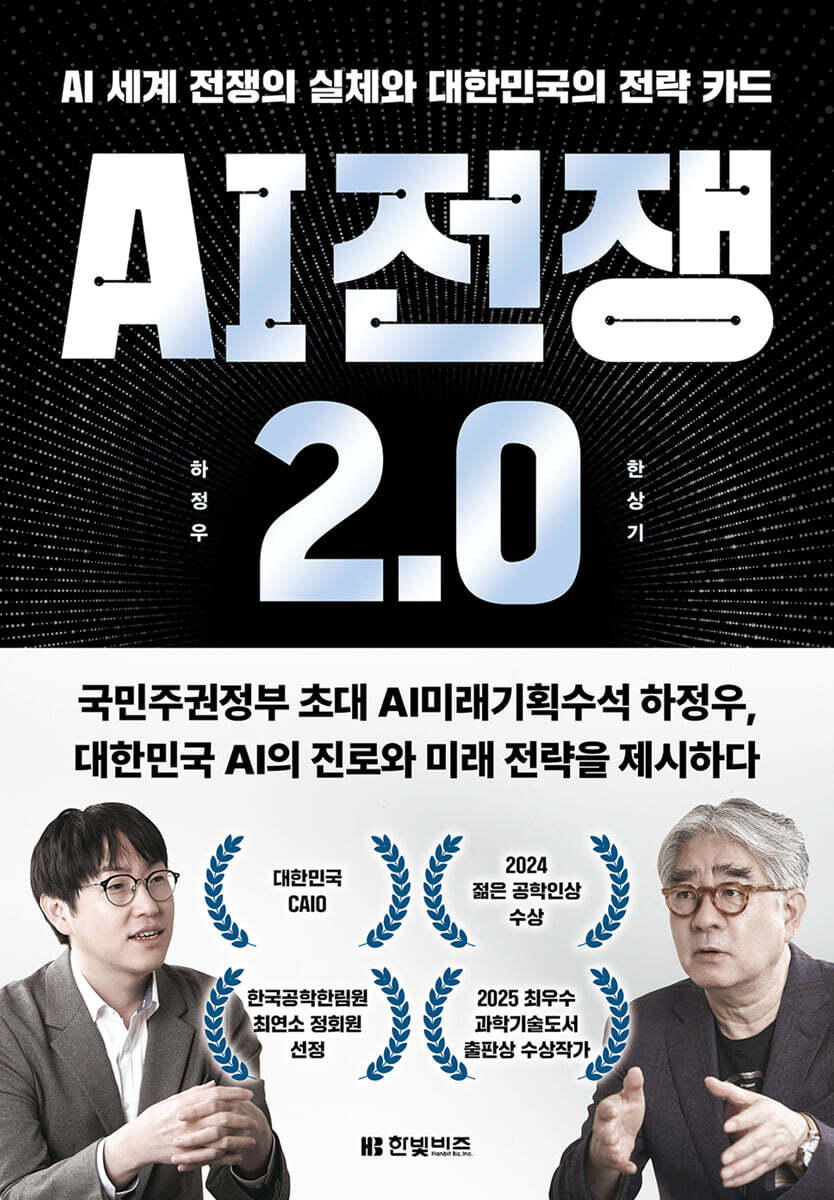
AI War 2.0
 |
Description
Book Introduction
The fate of the Republic of Korea as diagnosed by the new government's AI future planning chief.
And the future direction and strategy of Korean AI
Kwak No-jeong, Park Tae-woong, Yoon Ui-jun, Lee Hae-min…
Highly recommended by leaders in the AI industry, academia, politics, and society!
《AI Wars 2.0》 is the sequel to 《AI Wars》, which was published in 2023 and caused a huge stir at the time.
In 2023, when many media outlets and books were excited by the ChatGPT craze, introducing foreign technologies and global trends, "AI War" had already analyzed the current state of artificial intelligence in South Korea and forecasted its future.
Two years later, the warnings of the previous work have become reality, and we must re-strategize.
"AI War 2.0" is an urgent report that soberly diagnoses the existential crisis facing South Korea in this rapidly changing global AI landscape and presents concrete solutions for reversing the situation.
Author Ha Jung-woo served as the head of Naver's Future AI Center and is currently the first senior secretary for AI future planning under the People's Sovereign Government, directly designing Korea's AI policy.
His analysis, based on his academic achievements such as over 15,000 citations on Google Scholar, participation in the NeurIPS and ICML organizing committees, and being the youngest full member of the National Academy of Engineering of Korea, as well as his vivid experience in policymaking, is more realistic and persuasive than any other AI book.
In particular, his diagnosis that “if the AGI era arrives within 3 to 5 years, a country that secures it on its own will have national power and global influence greater than that of a nuclear weapons state” clearly shows that AI is not just a technology but a matter directly related to national survival.
The plans presented in the book, including building an AI data center, establishing a national superintelligence research institute, and creating an AI digital innovation department, are a roadmap the author believes can be implemented during the policy-making process.
The author's message that "the AI era is still in its infancy, and opportunities still exist" offers a powerful hope to South Korea, which is facing a critical moment.
This is why this book is drawing attention not only from the AI industry and academia, but also from political and social leaders, such as Kwak No-jeong (CEO of SK Hynix), Park Tae-woong (CEO of Everyone's Question Q), Yoon Eui-jun (Chairman of the National Academy of Engineering of Korea), and Lee Hae-min (22nd National Assembly member).
《AI War 2.0》 sharply dissects the strategic crossroads facing South Korea in the global battle for AI hegemony.
And we present our own survival strategy to survive in the chaotic battlefield.
If you're curious about the coordinates and future horizons of AI in Korea, and want to discover the hidden opportunities within, then read this book now.
And the future direction and strategy of Korean AI
Kwak No-jeong, Park Tae-woong, Yoon Ui-jun, Lee Hae-min…
Highly recommended by leaders in the AI industry, academia, politics, and society!
《AI Wars 2.0》 is the sequel to 《AI Wars》, which was published in 2023 and caused a huge stir at the time.
In 2023, when many media outlets and books were excited by the ChatGPT craze, introducing foreign technologies and global trends, "AI War" had already analyzed the current state of artificial intelligence in South Korea and forecasted its future.
Two years later, the warnings of the previous work have become reality, and we must re-strategize.
"AI War 2.0" is an urgent report that soberly diagnoses the existential crisis facing South Korea in this rapidly changing global AI landscape and presents concrete solutions for reversing the situation.
Author Ha Jung-woo served as the head of Naver's Future AI Center and is currently the first senior secretary for AI future planning under the People's Sovereign Government, directly designing Korea's AI policy.
His analysis, based on his academic achievements such as over 15,000 citations on Google Scholar, participation in the NeurIPS and ICML organizing committees, and being the youngest full member of the National Academy of Engineering of Korea, as well as his vivid experience in policymaking, is more realistic and persuasive than any other AI book.
In particular, his diagnosis that “if the AGI era arrives within 3 to 5 years, a country that secures it on its own will have national power and global influence greater than that of a nuclear weapons state” clearly shows that AI is not just a technology but a matter directly related to national survival.
The plans presented in the book, including building an AI data center, establishing a national superintelligence research institute, and creating an AI digital innovation department, are a roadmap the author believes can be implemented during the policy-making process.
The author's message that "the AI era is still in its infancy, and opportunities still exist" offers a powerful hope to South Korea, which is facing a critical moment.
This is why this book is drawing attention not only from the AI industry and academia, but also from political and social leaders, such as Kwak No-jeong (CEO of SK Hynix), Park Tae-woong (CEO of Everyone's Question Q), Yoon Eui-jun (Chairman of the National Academy of Engineering of Korea), and Lee Hae-min (22nd National Assembly member).
《AI War 2.0》 sharply dissects the strategic crossroads facing South Korea in the global battle for AI hegemony.
And we present our own survival strategy to survive in the chaotic battlefield.
If you're curious about the coordinates and future horizons of AI in Korea, and want to discover the hidden opportunities within, then read this book now.
- You can preview some of the book's contents.
Preview
index
prolog
Chapter 1: How far has AI come and how far can it go?
A New Trend in AI Evolution: The Emergence of the Grand Argument Model (LRM)
Is the AI open-source ecosystem truly open?
How far has AI agent technology come in transforming our daily lives and work?
The Next Stage of On-Device AI
In the AGI era, can artificial intelligence replace organizations?
Chapter 2: The world is now in a war for AI supremacy!
How will the AI hegemony race change in the Trump era?
The UK's AI strategy shifts from safety to security.
The Paris AI Action Summit Chooses Accelerated Competition Over AI Safety
From Mistral to Gigafactories: The Future of Europe's AI Strategy
The Secret to China's Rapid AI Rise: Government-Led Speed Strategy
The next battle for hegemony in the Middle East: What AI strategies will the UAE and Saudi Arabia choose?
Singapore's Strengths We Lack: The Secret to AI Leadership
Multicultural Inclusion Strategies: Learning from Canada's AI Policy
Sovereign AI: The Path to AI Technology Sovereignty
Chapter 3: The AI War Among Big Tech Companies: Who Will Be the Real Winner?
The Release of GPT-4.5 and Changes Within OpenAI
From AI Safety to Business Innovation: Anthropic's Strategy
Will cloud companies become the real winners in the AI market?
Google and Microsoft's AI Strategies: Who Will Win?
Why are domestic cloud companies joining hands with global AI?
Meta's massive infrastructure investment is a decisive move for global AI competitiveness.
The Dilemma of China's AI Model Performance and Market Confidence
The formula for AI startup success: technology, culture, and policy support.
Why Aren't AI Devices and Smartphones Innovative?
Chapter 4: AI Becomes Everyday Life: What Should Humans Protect?
From AI Safety to Security: A New Paradigm Beyond Technology
The dawn of the AI risk era: multi-layered risks and multi-layered responses.
How sophisticated should AI safety inspections become?
Whose Hands Are AI in? The Shadow of Hegemony Hidden Behind Regulation
In the age of personalized AI, who will determine value?
AI Ethics: Finding a Balance Between Universal Standards and Cultural Diversity
Who will manage the risks of uncontrollable open-source AI?
Shadows of the AGI Era: Labor, Platforms, and Social Protection
Coexistence with AI necessitates redefining human relationships.
In an age of technological optimism, is humanity's future secure?
Chapter 5: In the Age of AI Warfare, What Will Be Korea's Key Strategy?
Korea dreams of becoming an AI powerhouse, but the gap between research and industrialization remains.
National Tasks for Securing Global AI Competitiveness
What's needed to build a national AI data center?
Synergy with Models: The Key to AI Semiconductor Competitiveness
When securing AI talent, qualitative strategies take precedence over quantitative expansion.
How should we design national AI projects to avoid failure?
Efficient Organizational Structure for a National AI Strategy
AI policymakers desperately need practical experts.
Defense AI requires strategic infrastructure and integrated systems.
Sovereign AI: Securing Technological Sovereignty Through International Cooperation
Epilogue 375
Chapter 1: How far has AI come and how far can it go?
A New Trend in AI Evolution: The Emergence of the Grand Argument Model (LRM)
Is the AI open-source ecosystem truly open?
How far has AI agent technology come in transforming our daily lives and work?
The Next Stage of On-Device AI
In the AGI era, can artificial intelligence replace organizations?
Chapter 2: The world is now in a war for AI supremacy!
How will the AI hegemony race change in the Trump era?
The UK's AI strategy shifts from safety to security.
The Paris AI Action Summit Chooses Accelerated Competition Over AI Safety
From Mistral to Gigafactories: The Future of Europe's AI Strategy
The Secret to China's Rapid AI Rise: Government-Led Speed Strategy
The next battle for hegemony in the Middle East: What AI strategies will the UAE and Saudi Arabia choose?
Singapore's Strengths We Lack: The Secret to AI Leadership
Multicultural Inclusion Strategies: Learning from Canada's AI Policy
Sovereign AI: The Path to AI Technology Sovereignty
Chapter 3: The AI War Among Big Tech Companies: Who Will Be the Real Winner?
The Release of GPT-4.5 and Changes Within OpenAI
From AI Safety to Business Innovation: Anthropic's Strategy
Will cloud companies become the real winners in the AI market?
Google and Microsoft's AI Strategies: Who Will Win?
Why are domestic cloud companies joining hands with global AI?
Meta's massive infrastructure investment is a decisive move for global AI competitiveness.
The Dilemma of China's AI Model Performance and Market Confidence
The formula for AI startup success: technology, culture, and policy support.
Why Aren't AI Devices and Smartphones Innovative?
Chapter 4: AI Becomes Everyday Life: What Should Humans Protect?
From AI Safety to Security: A New Paradigm Beyond Technology
The dawn of the AI risk era: multi-layered risks and multi-layered responses.
How sophisticated should AI safety inspections become?
Whose Hands Are AI in? The Shadow of Hegemony Hidden Behind Regulation
In the age of personalized AI, who will determine value?
AI Ethics: Finding a Balance Between Universal Standards and Cultural Diversity
Who will manage the risks of uncontrollable open-source AI?
Shadows of the AGI Era: Labor, Platforms, and Social Protection
Coexistence with AI necessitates redefining human relationships.
In an age of technological optimism, is humanity's future secure?
Chapter 5: In the Age of AI Warfare, What Will Be Korea's Key Strategy?
Korea dreams of becoming an AI powerhouse, but the gap between research and industrialization remains.
National Tasks for Securing Global AI Competitiveness
What's needed to build a national AI data center?
Synergy with Models: The Key to AI Semiconductor Competitiveness
When securing AI talent, qualitative strategies take precedence over quantitative expansion.
How should we design national AI projects to avoid failure?
Efficient Organizational Structure for a National AI Strategy
AI policymakers desperately need practical experts.
Defense AI requires strategic infrastructure and integrated systems.
Sovereign AI: Securing Technological Sovereignty Through International Cooperation
Epilogue 375
Detailed image

Into the book
This is because many people confuse the open source we talk about in AI models with the traditional open source we used to know.
Traditional open source makes the source code public, allowing users to freely use the code.
Because the code itself is the most important core.
However, open source of AI models only involves disclosing the weight files or some code of the trained model.
Also, isn't open source code a relatively minor factor? So, while the Open Source Institute (OSI), which defines open source, doesn't recognize it as such, we often call it open source.
Because of this misunderstanding, most executives tend to think too easily, "It's open source, so why don't we just make something with it?"
--- p.38
OpenAI has defined AGI very clearly.
The final stage of AGI is AI that has the ability to completely replace an organization.
The reason I used the term 'organization' is because an organization is a structure in which people with various abilities come together to perform work.
In other words, if AI can specifically perform the organization's tasks, it can be judged as AGI, and at this time, the role and value of AGI can also be clearly determined.
--- p.66
While there may have been differences in detail across the Obama-Trump-Biden-Trump administrations, I believe the overall framework of the principle that the United States must maintain strong leadership in AI remains unchanged.
Rather, when looking solely at the topic of AI, I believe the Biden administration's regulations have been somewhat strict due to safety concerns, and there's a stronger push to ease them.
In other words, the direction itself is the same, but the difference is whether to take a cautious, regulation-oriented approach or to pursue it actively.
--- p.81
China has a structure that allows the government to quickly decide on data utilization, regulations, and national resource priorities as it sees fit.
China is probably the only country in the world where the government can access not only national data but also corporate data at any time.
This kind of strong centralized control strategy is difficult for other countries to follow.
No matter how strong the Trump administration's policies are, they cannot operate as efficiently as China.
Additionally, China is actively utilizing open source to expand its influence around the world, a strategy they call the "Silk Road of AI."
I believe this is also greatly beneficial to the expansion of China's AI ecosystem.
--- p.113
The recently released Claude 4 reportedly activated ASL-3 protection measures for the first time. This indicates that ASL-3 is both powerful and highly dangerous.
This means that, especially after the release of the Claude 3.7 Sonnet model, the risks that were only seen as potential in the chemical, biological, radiological, and nuclear fields have now been assessed to be at a level where they could become actual threats.
In a real-world biological weapons acquisition scenario, Claude 4 Opus was shown to improve expected quality by a factor of 2.53.
They say similar results were found in external red team evaluations.
Now, with AI reaching Claude 4, there may be growing calls for governments or international organizations, rather than companies, to manage how and for what purpose it is being used.
--- p.168
No matter how powerful a generative AI is, it can only have real impact when it runs on a platform, but neither OpenAI nor Antropic have their own platforms.
Simply put, they lack their own playground. Even if AI agents possess exceptional reasoning and planning abilities, the difference between companies that provide content and have services or platforms to connect with others and those that must build all connections from scratch or through transactions is bound to be significant.
In this respect, hyperscalers have a significant advantage.
--- p.175
Among recent malicious use cases of AI, one problem has emerged that is both intriguing and serious.
This is exactly the case in Russia, where they created millions of articles favorable to themselves, spread them online, and then let AI learn from them.
They call this LLM grooming.
In other words, the problem is that just because AI learns from a vast amount of content, its results do not necessarily align with common human values.
--- p.258
As we enter an era where AI and humans coexist, not only human relationships but also the relationship between humans and AI is expected to undergo significant changes.
There is a good chance that people will become overly dependent on or addicted to AI, as we have already experienced with games and social media.
Of course, games and social media themselves are not intended to be addictive, but there are definitely cases where they lead to addiction.
In the past, when TV became popular, the term "TV addiction" came up, but that expression was rarely used when talking about books or music.
But I think AI has the potential to be really powerful and addictive to people.
In fact, there are cases among teenagers these days where they avoid real human relationships because of AI, or even feel more comfortable in romantic relationships with AI.
--- p.283
For example, according to the Computer Vision Society, Korea ranks third in the world in the number of papers.
In the fields of natural language processing and machine learning, it was outside the top 10 until a few years ago, but recently it has risen to the top 7.
However, despite this large number of papers, the proportion of papers that have actual industrial impact or receive global attention is relatively small.
One of the reasons is brand awareness.
While global companies like Google, Meta, DeepMind, and OpenAI unconditionally attract global attention when they publish papers, Korean research institutions still lack that brand power.
Moreover, our research team is relatively lacking in actively promoting the results of their papers globally or making them open source.
--- p.305
The first is top-tier AI research talent capable of driving global-level AI innovation.
These are people who have worked really hard in AI graduate schools at KAIST and Seoul National University.
However, these talented individuals do not stay in Korea after graduating with a doctorate; almost all of them go abroad, especially to the United States.
The reason is simple.
This is because the research environment overseas is better, there are many excellent researchers, the treatment is good, and you can freely use infrastructure such as GPUs.
In Korea, it is difficult to conduct innovative research, so we need policies to first attract these talented individuals.
Traditional open source makes the source code public, allowing users to freely use the code.
Because the code itself is the most important core.
However, open source of AI models only involves disclosing the weight files or some code of the trained model.
Also, isn't open source code a relatively minor factor? So, while the Open Source Institute (OSI), which defines open source, doesn't recognize it as such, we often call it open source.
Because of this misunderstanding, most executives tend to think too easily, "It's open source, so why don't we just make something with it?"
--- p.38
OpenAI has defined AGI very clearly.
The final stage of AGI is AI that has the ability to completely replace an organization.
The reason I used the term 'organization' is because an organization is a structure in which people with various abilities come together to perform work.
In other words, if AI can specifically perform the organization's tasks, it can be judged as AGI, and at this time, the role and value of AGI can also be clearly determined.
--- p.66
While there may have been differences in detail across the Obama-Trump-Biden-Trump administrations, I believe the overall framework of the principle that the United States must maintain strong leadership in AI remains unchanged.
Rather, when looking solely at the topic of AI, I believe the Biden administration's regulations have been somewhat strict due to safety concerns, and there's a stronger push to ease them.
In other words, the direction itself is the same, but the difference is whether to take a cautious, regulation-oriented approach or to pursue it actively.
--- p.81
China has a structure that allows the government to quickly decide on data utilization, regulations, and national resource priorities as it sees fit.
China is probably the only country in the world where the government can access not only national data but also corporate data at any time.
This kind of strong centralized control strategy is difficult for other countries to follow.
No matter how strong the Trump administration's policies are, they cannot operate as efficiently as China.
Additionally, China is actively utilizing open source to expand its influence around the world, a strategy they call the "Silk Road of AI."
I believe this is also greatly beneficial to the expansion of China's AI ecosystem.
--- p.113
The recently released Claude 4 reportedly activated ASL-3 protection measures for the first time. This indicates that ASL-3 is both powerful and highly dangerous.
This means that, especially after the release of the Claude 3.7 Sonnet model, the risks that were only seen as potential in the chemical, biological, radiological, and nuclear fields have now been assessed to be at a level where they could become actual threats.
In a real-world biological weapons acquisition scenario, Claude 4 Opus was shown to improve expected quality by a factor of 2.53.
They say similar results were found in external red team evaluations.
Now, with AI reaching Claude 4, there may be growing calls for governments or international organizations, rather than companies, to manage how and for what purpose it is being used.
--- p.168
No matter how powerful a generative AI is, it can only have real impact when it runs on a platform, but neither OpenAI nor Antropic have their own platforms.
Simply put, they lack their own playground. Even if AI agents possess exceptional reasoning and planning abilities, the difference between companies that provide content and have services or platforms to connect with others and those that must build all connections from scratch or through transactions is bound to be significant.
In this respect, hyperscalers have a significant advantage.
--- p.175
Among recent malicious use cases of AI, one problem has emerged that is both intriguing and serious.
This is exactly the case in Russia, where they created millions of articles favorable to themselves, spread them online, and then let AI learn from them.
They call this LLM grooming.
In other words, the problem is that just because AI learns from a vast amount of content, its results do not necessarily align with common human values.
--- p.258
As we enter an era where AI and humans coexist, not only human relationships but also the relationship between humans and AI is expected to undergo significant changes.
There is a good chance that people will become overly dependent on or addicted to AI, as we have already experienced with games and social media.
Of course, games and social media themselves are not intended to be addictive, but there are definitely cases where they lead to addiction.
In the past, when TV became popular, the term "TV addiction" came up, but that expression was rarely used when talking about books or music.
But I think AI has the potential to be really powerful and addictive to people.
In fact, there are cases among teenagers these days where they avoid real human relationships because of AI, or even feel more comfortable in romantic relationships with AI.
--- p.283
For example, according to the Computer Vision Society, Korea ranks third in the world in the number of papers.
In the fields of natural language processing and machine learning, it was outside the top 10 until a few years ago, but recently it has risen to the top 7.
However, despite this large number of papers, the proportion of papers that have actual industrial impact or receive global attention is relatively small.
One of the reasons is brand awareness.
While global companies like Google, Meta, DeepMind, and OpenAI unconditionally attract global attention when they publish papers, Korean research institutions still lack that brand power.
Moreover, our research team is relatively lacking in actively promoting the results of their papers globally or making them open source.
--- p.305
The first is top-tier AI research talent capable of driving global-level AI innovation.
These are people who have worked really hard in AI graduate schools at KAIST and Seoul National University.
However, these talented individuals do not stay in Korea after graduating with a doctorate; almost all of them go abroad, especially to the United States.
The reason is simple.
This is because the research environment overseas is better, there are many excellent researchers, the treatment is good, and you can freely use infrastructure such as GPUs.
In Korea, it is difficult to conduct innovative research, so we need policies to first attract these talented individuals.
--- p.334~335
Publisher's Review
Can South Korea emerge victorious in the AI war?
Re-examining Korea's strategy amidst the AI conflict
Now that AGI is no longer science fiction but a feasible technology, the world has entered a silent AI war.
The technological stage has expanded beyond the United States and China to include the EU, the UK, Canada, the Middle East, Japan, and Singapore, and each country is engaging in a fierce competition for its survival across AI technology, infrastructure, legal systems, and national defense systems.
In the midst of this fierce competition, a book has been published that asks, "Where are we and where should we go?"
This is AI War 2.0.
This book is a sequel to "AI Wars," which was published in 2023 and created a huge stir in domestic policy and industry circles. It precisely diagnoses the sense of crisis we face today, two years later, when the pace of AI technology development and the global strategic landscape have fundamentally changed, and presents a realistic survival strategy that Korea must adopt.
In an era of intensifying global hegemony wars,
What is our breakthrough?
《AI War 2.0》 is not just a technology outlook.
This book diagnoses the global political, economic, and industrial hegemony war surrounding AI, humanity's greatest technology and risk factor, and serves as a "South Korean version of the AI national strategy book" to overcome it.
As with their previous work, the authors, Ha Jung-woo, Senior Vice President for AI Future Planning, and Dr. Han Sang-ki, based on their accumulated experience leading real-world projects, sharply suggest the strategic decisions South Korea must make amidst the evolution of AI technology and the shifting global order.
Chapter 1 begins by capturing the most significant turning points in recent AI history.
This is a diagnosis of the emergence of large reasoning models capable of argumentative thinking, such as OpenAI o1 and DeepSeak R1, and the reality of AGI approaching faster than expected.
We also covered the innovations brought to the global open source ecosystem and the AI agents that were fully realized with MCP.
The following two chapters examine the heated battlefield of the global competition for AI supremacy.
We analyzed the AI geopolitics, which has entered a completely new phase, including the Trump administration's AI promotion, the EU's announcement of a 300 trillion won investment, China's counterattack that narrowed the technology gap with the US with the launch of DeepSec, and the Middle East's move to secure hundreds of thousands of GPUs.
Chapter 3 highlights the mind-boggling speed war between Silicon Valley's big tech companies, including OpenAI, Google, and Meta.
We also analyzed the advancements of Chinese AI companies, including DeepSec and Alibaba, while addressing the structural obstacles hindering the domestic AI ecosystem.
Chapter 4 poses existential questions facing humanity in the face of imminent AGI.
It highlights the paradoxical weakening of AI safety following the Paris AI Summit and explores new ways to establish relationships between humans and self-evolving AI, such as AlphaEvolve.
Finally, Chapter 5 diagnoses the last opportunity for the Republic of Korea at a critical moment.
In a reality where the US-China AI competition has intensified to the point of being comparable to war, while Korea has faltered, its competitors have either surpassed or reached an equal level.
However, the authors offer a message of hope, stating that the AI era is still in its infancy. They present a concrete and actionable roadmap for Korea's leap forward, encompassing bridging the gap between AI research and industry, establishing an AI data center, establishing a National Superintelligence Research Institute and a Ministry of AI and Digital Innovation, pursuing talent acquisition policies, and transitioning to AI in national defense.
The country that controls AI will rule the world.
A Strategy Paper Presented by a Key Architect of Korea's AI Policy
"AI War 2.0" is a must-read, outlining Korea's survival strategy in the AI era. It's a timely warning and a message of hope for everyone, from policymakers to the general public. In an era where AI is becoming a national power surpassing nuclear weapons, "AI War 2.0" asserts that AI is not simply a technology; it's a survival strategy, a defining variable that will determine the future of South Korea.
But this book doesn't just warn of a crisis.
Instead, he emphasizes that Korea can definitely seize the opportunity if it has the right strategy and execution capabilities, even now.
Author Ha Jung-woo served as the former head of the AI-Data Subcommittee of the Defense Policy Committee of the former government and is currently the first Senior Secretary for AI Future Planning of the People's Sovereign Government, where he is directly designing Korea's sovereign AI policy.
Each of his remarks serves as an indicator of the direction of Korea's AI policy.
Therefore, through this book containing his voice, you will be able to see the future of AI in Korea before anyone else.
Re-examining Korea's strategy amidst the AI conflict
Now that AGI is no longer science fiction but a feasible technology, the world has entered a silent AI war.
The technological stage has expanded beyond the United States and China to include the EU, the UK, Canada, the Middle East, Japan, and Singapore, and each country is engaging in a fierce competition for its survival across AI technology, infrastructure, legal systems, and national defense systems.
In the midst of this fierce competition, a book has been published that asks, "Where are we and where should we go?"
This is AI War 2.0.
This book is a sequel to "AI Wars," which was published in 2023 and created a huge stir in domestic policy and industry circles. It precisely diagnoses the sense of crisis we face today, two years later, when the pace of AI technology development and the global strategic landscape have fundamentally changed, and presents a realistic survival strategy that Korea must adopt.
In an era of intensifying global hegemony wars,
What is our breakthrough?
《AI War 2.0》 is not just a technology outlook.
This book diagnoses the global political, economic, and industrial hegemony war surrounding AI, humanity's greatest technology and risk factor, and serves as a "South Korean version of the AI national strategy book" to overcome it.
As with their previous work, the authors, Ha Jung-woo, Senior Vice President for AI Future Planning, and Dr. Han Sang-ki, based on their accumulated experience leading real-world projects, sharply suggest the strategic decisions South Korea must make amidst the evolution of AI technology and the shifting global order.
Chapter 1 begins by capturing the most significant turning points in recent AI history.
This is a diagnosis of the emergence of large reasoning models capable of argumentative thinking, such as OpenAI o1 and DeepSeak R1, and the reality of AGI approaching faster than expected.
We also covered the innovations brought to the global open source ecosystem and the AI agents that were fully realized with MCP.
The following two chapters examine the heated battlefield of the global competition for AI supremacy.
We analyzed the AI geopolitics, which has entered a completely new phase, including the Trump administration's AI promotion, the EU's announcement of a 300 trillion won investment, China's counterattack that narrowed the technology gap with the US with the launch of DeepSec, and the Middle East's move to secure hundreds of thousands of GPUs.
Chapter 3 highlights the mind-boggling speed war between Silicon Valley's big tech companies, including OpenAI, Google, and Meta.
We also analyzed the advancements of Chinese AI companies, including DeepSec and Alibaba, while addressing the structural obstacles hindering the domestic AI ecosystem.
Chapter 4 poses existential questions facing humanity in the face of imminent AGI.
It highlights the paradoxical weakening of AI safety following the Paris AI Summit and explores new ways to establish relationships between humans and self-evolving AI, such as AlphaEvolve.
Finally, Chapter 5 diagnoses the last opportunity for the Republic of Korea at a critical moment.
In a reality where the US-China AI competition has intensified to the point of being comparable to war, while Korea has faltered, its competitors have either surpassed or reached an equal level.
However, the authors offer a message of hope, stating that the AI era is still in its infancy. They present a concrete and actionable roadmap for Korea's leap forward, encompassing bridging the gap between AI research and industry, establishing an AI data center, establishing a National Superintelligence Research Institute and a Ministry of AI and Digital Innovation, pursuing talent acquisition policies, and transitioning to AI in national defense.
The country that controls AI will rule the world.
A Strategy Paper Presented by a Key Architect of Korea's AI Policy
"AI War 2.0" is a must-read, outlining Korea's survival strategy in the AI era. It's a timely warning and a message of hope for everyone, from policymakers to the general public. In an era where AI is becoming a national power surpassing nuclear weapons, "AI War 2.0" asserts that AI is not simply a technology; it's a survival strategy, a defining variable that will determine the future of South Korea.
But this book doesn't just warn of a crisis.
Instead, he emphasizes that Korea can definitely seize the opportunity if it has the right strategy and execution capabilities, even now.
Author Ha Jung-woo served as the former head of the AI-Data Subcommittee of the Defense Policy Committee of the former government and is currently the first Senior Secretary for AI Future Planning of the People's Sovereign Government, where he is directly designing Korea's sovereign AI policy.
Each of his remarks serves as an indicator of the direction of Korea's AI policy.
Therefore, through this book containing his voice, you will be able to see the future of AI in Korea before anyone else.
GOODS SPECIFICS
- Date of issue: June 30, 2025
- Page count, weight, size: 380 pages | 562g | 149*214*25mm
- ISBN13: 9791157848164
You may also like
카테고리
korean


korean

![GQ KOREA Mark (Monthly): December [2025]](http://librairie.coreenne.fr/cdn/shop/files/8ef265dbbfbf186523ed75ba7319009d.jpg?v=1765340328&width=3840)


