

propaganda
 |
Description
Book Introduction
A classic of propaganda and public relations, read by Goebbels and praised by Chomsky.
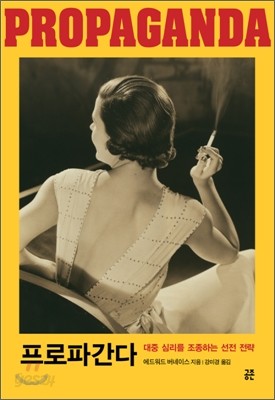
This is a representative work by Edward Bernays, the nephew of psychologist Freud and known as the 'father of PR', and introduces the meaning and role of propaganda born in a capitalist democratic country.
The author dispels the negative image of propaganda and clearly explains how to utilize propaganda in various fields such as politics, economics, education, and the arts.
This book focuses on distinguishing between 'propaganda as a means of governance' and 'propaganda as a PR industry.'
We examine the "invisible mechanisms" that consciously and intelligently manipulate public practices and opinions, and how such mechanisms can be manipulated to garner public support when presenting specific ideas or products to the public.
Bernays says that those who manipulate these mechanisms are the 'invisible government' that truly dominates the power of the state, and he sees rule by a small elite as inevitable, emphasizing the importance of election as a means of that rule.
In fact, Hitler's propaganda minister, Goebbels, who read this book avidly, is said to have freely used Bernays's PR skills to incite the German people to the massacre of Jews and war.
But this book tells us that 20th-century political propaganda was not born from totalitarianism, but from the heart of liberal democracy in the capitalist nation of the United States.
A classic and bestseller in the field of public relations (PR), this book has been read for over 80 years and will continue to illuminate the true nature of the invisible hand even today, in a world of highly developed media and dominated by large corporations.
This is a representative work by Edward Bernays, the nephew of psychologist Freud and known as the 'father of PR', and introduces the meaning and role of propaganda born in a capitalist democratic country.
The author dispels the negative image of propaganda and clearly explains how to utilize propaganda in various fields such as politics, economics, education, and the arts.
This book focuses on distinguishing between 'propaganda as a means of governance' and 'propaganda as a PR industry.'
We examine the "invisible mechanisms" that consciously and intelligently manipulate public practices and opinions, and how such mechanisms can be manipulated to garner public support when presenting specific ideas or products to the public.
Bernays says that those who manipulate these mechanisms are the 'invisible government' that truly dominates the power of the state, and he sees rule by a small elite as inevitable, emphasizing the importance of election as a means of that rule.
In fact, Hitler's propaganda minister, Goebbels, who read this book avidly, is said to have freely used Bernays's PR skills to incite the German people to the massacre of Jews and war.
But this book tells us that 20th-century political propaganda was not born from totalitarianism, but from the heart of liberal democracy in the capitalist nation of the United States.
A classic and bestseller in the field of public relations (PR), this book has been read for over 80 years and will continue to illuminate the true nature of the invisible hand even today, in a world of highly developed media and dominated by large corporations.
- You can preview some of the book's contents.
Preview
index
Recommendation / Preface
Chapter 1: From Chaos to Order
Chapter 2 New Propaganda
Chapter 3: The New Propagandist
Chapter 4: The Psychology of PR
Chapter 5: Corporations and the Public
Chapter 6 Propaganda and Political Leadership
Chapter 7: Women's Activities and Propaganda
Chapter 8 Propaganda for Education
Chapter 9 Propaganda and Social Work
Chapter 10: Arts and Sciences
Chapter 11: Principles of Propaganda
About the Author / Translator's Note
Chapter 1: From Chaos to Order
Chapter 2 New Propaganda
Chapter 3: The New Propagandist
Chapter 4: The Psychology of PR
Chapter 5: Corporations and the Public
Chapter 6 Propaganda and Political Leadership
Chapter 7: Women's Activities and Propaganda
Chapter 8 Propaganda for Education
Chapter 9 Propaganda and Social Work
Chapter 10: Arts and Sciences
Chapter 11: Principles of Propaganda
About the Author / Translator's Note
Detailed image

Publisher's Review
A classic of propaganda and public relations, read by Goebbels and praised by Chomsky!
The nephew of psychologist Freud and the “father of PR”
Edward Bernays' masterpiece, Propaganda, is published in Korean for the first time!
Today, thanks to advanced media such as newspapers, magazines, television, wireless phones, and the Internet, anyone can obtain the information they want quickly and easily.
Accordingly, the methods of achieving desired goals by spreading ideas and concepts, influencing the psychology and behavior of the public, and forming and manipulating public opinion have become more sophisticated.
We think we're making our own decisions when we buy necessities or stocks, book tickets to movies or shows, buy books, decide where to go on vacation, or elect a president. But in reality, we're often subconsciously following the crowd's lead, relying on information already disseminated.
In Korea, when people talk about PR (Public Relations), many people think of it as “the act of confidently promoting oneself” because of the familiar term “self-PR.”
Also, when we say the word 'propaganda', we think of the expressions 'propaganda' and 'agitation', along with negative connotations such as 'the act of misleading the public by spreading malicious information behind the scenes to achieve a sinister purpose'.
Both words are examples of things that have strayed significantly from their original meaning.
So when and how did modern public relations (PR) and propaganda come into being?
PR, a concept encompassing advertising and publicity (publicity-based media reports that do not reveal the advertiser), was established in the early 20th century by Ivy Ledbetter Lee and Edward Bernays in the United States.
In particular, Edward Bernays made a decisive contribution to establishing public relations as a scientific discipline and an independent industry in the early 20th century.
Bernays was the first to combine mass psychology with his uncle Sigmund Freud's psychoanalysis and use it for public relations and propaganda, was the first to teach a course on "public relations" at a university, and also published the first book on public relations.
Bernays, who is known today as the 'father of PR', always introduced himself as "PR counsel."
However, Bernays originally preferred the term 'propaganda' to 'PR' and the title 'propagandist' to 'PR consultant'.
However, after World War I, the word "propaganda," which had been a neutral word with religious connotations for centuries, took on a negative connotation, and he could no longer freely use the word "propaganda" in connection with his profession.
The masses, who had lost their blood relatives and neighbors in the war, were deceived by propaganda and agitation and no longer trusted 'propaganda'.
However, Bernays did not give up his attachment to the word 'propaganda' and tried to remove the negative image from it.
『Propaganda』 is an ambitious work that most clearly demonstrates such efforts.
This book details the diverse and extensive field activities of the decade following World War I.
By examining in detail the propaganda of the time, which was characterized not only by its sparkling creativity but also by its meaningful purpose and honest practical strategies, Bernays attempts to remove the bad smell from the word "propaganda."
Bernays considered himself a "seeker of truth and a propagandist."
So, we widely advertised 'public relations (PR)' by defending propaganda and emphasizing its healthy influence on the mass society.
By 1928 he had become a leading figure in the growing field of public relations.
Not only did he give legitimacy to his profession, he also ran a successful private business.
"Propaganda" appears to be aimed at the general public, but in fact it is primarily aimed at his potential corporate clients.
To him, a world where information flows through 'publicity' is simply a 'smoothly functioning society'.
In such a society, we live our lives guided, without even realizing it, by a group of benevolent and rational elites.
He promotes what he calls well-intentioned modern propaganda as 'new propaganda'.
But unfortunately, Bernays' ambitious intention to promote 'propaganda' ended up going astray.
Later, during World War II, 'propaganda' became further removed from its original purity and from its own profession, 'PR'.
That doesn't mean the book failed.
This book helped him increase his reputation and secure new clients.
Moreover, even today, more than 80 years after its publication, this book remains a classic in publicity and propaganda, and is widely read around the world as a bestseller.
Even Hitler's famous propaganda minister, Joseph Goebbels, was a huge Bernays fan and devoured the book in the 1930s.
Goebbels exploited Bernays's PR skills to incite the German people to the genocide of the Jews and to wage war.
This book, which is being introduced in Korean for the first time, has already been translated into many languages around the world, including French, German, Japanese, and Italian.
Patrick Schnur, head of the PR firm Portocali and the German translator, called the book “a classic strategy book, on par with Machiavelli’s The Prince and Clausewitz’s On War.”
Yasuhiko Nakata, a researcher at the Soejima Institute for National Strategy and the translator of the Japanese edition, said, “This is a must-read for everyone, both those who want to control and those who do not want to be controlled.
After reading this book, you will never again say, 'Oh, I was fooled by advertising again!'"
Chomsky praised Bernays as a “guru” and the book he used as a model for his own theory of propaganda as “the essential manual for the public relations industry.”
A must-read for both those who want to control and those who don't want to be controlled!
As can be seen from the authoritative reviews above, this book focuses on 'books as a means of governance' and 'books as a PR industry.'
In Chapter 1, Bernays writes, “The conscious and intelligent manipulation of public opinion and practices is a crucial element in a democratic society.
“Those who manipulate this invisible mechanism of society form the ‘invisible government’ that truly dominates the power of the state.” (p. 61)
He also says, “In almost all areas of our daily lives, we are ruled by a relatively small group” (p. 62), and he sees rule by a small number of elected or recognized elites as inevitable, and emphasizes the importance of propaganda as a means of that rule.
At the end of Chapter 1, Bernays states his intentions as follows:
“The purpose of this book is to examine the mechanisms that control the public mind and how to manipulate those mechanisms to gain public support when trying to introduce a particular idea or product to the public.
“Furthermore, while seeking the appropriate status of this new propaganda in modern democratic society, we also aim to present a gradually evolving set of propaganda ethics and practice standards.” (p. 74)
Bernays attempts to restore the reputation of 'propaganda' by showing how to use propaganda to garner public support and also presents ethical standards that propagandists should adhere to.
By doing so, they subtly attempt to establish their authority and promote a positive image of their profession, thereby increasing the public's favorability toward their profession.
So this book is 'too propaganda-y for propaganda'.
Mark Crispin Miller, a professor of media studies at New York University who wrote the commentary and “foreword” to this book in 2004, says:
“Even those who most detest propaganda are easily swayed by it.
Bernays fully understood this paradox.
“If we want to change the world that Edward Bernays created for us more than anyone else, we too must try to understand that paradox.” (p. 50)
From Chapters 1 to 4, Bernays shows the meaning and role of propaganda, the basic principles of PR, and examples of its application.
And from Chapters 5 to 10, each chapter presents ways to realize values and goals through propaganda in the fields of business, politics, women's activities, education, social work, arts, and science.
In particular, in Chapter 4, he emphasizes the role of his profession, PR, by talking about the relationship between companies and the public.
“The masses are not an amorphous mass that can be manipulated or ordered around at will.
Companies must communicate their existence, purpose, and goals to the public in ways that the public can understand and readily accept.
The relationship between businesses and the public can only be healthy when it is a give-and-take relationship.
It is precisely these conditions and needs that have created the demand for a specialized field called PR.
“Currently, companies employ public relations consultants who advise them on their relationships with the public, explain the company’s purpose to the public, and suggest improvements to meet public demands.” (pp. 139-140)
Chapter 5 also criticizes politics and highlights the importance of professional propaganda.
“The great problem facing politics in modern democratic societies is how to enable leaders to exercise leadership effectively.
Public opinion expresses the thoughts of the people, and the thoughts of the people are shaped by the leaders the people trust and those skilled in manipulating public opinion.
Fortunately, honest and competent politicians can shape the will of the people through the tool of propaganda.
Politics was one of the first sectors in the United States to make extensive use of propaganda, but today it lags far behind in the ability to adapt propaganda to the changing public psyche.
American business first learned how to appeal to a broad audience from politics.
But in the process of competing with each other, companies have continuously refined and refined these methods.
Politics, on the other hand, stuck to the old mold.
Politics was America's first big business.
“It is ironic, then, that while corporations have learned everything from politics, politics has learned little from corporations about how to mass-disseminate ideas and products.” (pp. 171-174)
The last chapter 11 talks about the principles of propaganda:
“The means by which propagandists convey their messages to the masses through propaganda include all the means by which people communicate with each other today.
Any means of human communication can become a means of propaganda.
Because propaganda is an activity that builds a bridge of mutual understanding between individuals and groups.
The relative value of various propaganda tools and their relationship to the public are constantly changing.
“To properly convey the message he has in mind, the propagandist must make the most of these ever-changing values.” (p. 251)
He also concludes the book with profound insights that transcend time and look to the future.
“The public is becoming increasingly aware of the methods used to shape its views and habits.
The more people know about how their lives unfold, the more readily they will accept reasonable advertising that aligns with their interests.
No matter how picky and cynical the public may be about advertising methods, they will eventually respond.
Because the masses always need food, crave entertainment, admire beauty, and follow leaders.
As the public becomes more aware of its economic needs, businesses will have to adapt to new standards.
As the public tires of the old methods used to persuade them to buy ideas or products, leaders who lead the masses must become more clever in their appeals.
Propaganda never goes away.
“The wiser the person, the more he recognizes that propaganda is a modern tool necessary for achieving productive goals and correcting disorder.” (pp. 260-261)
Edward Bernays, the legendary genius propagandist
Bernays was also given the title of “pioneer of the PR industry.”
He practically made PR an industry and had a huge impact on 20th century America and the world through propaganda and PR.
During World War I, he was selected by the Committee for Public Information (CPI) and developed excellent propaganda strategies against Germany and other countries, and led propaganda and publicity related to the Treaty of Paris and the formation of the League of Nations.
In 1922, his longtime friend and business partner, Doris E.
She married a playboy, and even used her marriage as a propaganda opportunity.
He registered his wife's maiden name in the guestbook of the Waldorf Astoria Hotel, which he had asked to promote, and held his wedding there, which was featured in over 250 newspapers as "the first case in history where a wife registered under her original surname, different from her husband's."
This incident made Doris a new symbol of the women's rights movement.
In 1924, a national soap carving contest was held to promote Procter & Gamble's Ivory soap.
The event was a huge success and continued until 1961, spreading to many countries around the world, including Korea.
In the same year, he also helped President Calvin Coolidge win reelection.
President Coolidge in 1923 Warren G.
Harding (Warren G.
After President Harding died in office, he ascended from Vice President to President and was nominated again for the presidency in 1924.
Bernays, who was commissioned to conduct public relations, dramatically changed Coolidge's image and reputation as a difficult and cold man, enabling him to win the election without a hitch.
In 1925, at the request of the Beech-Nut Packing Company, a bacon manufacturer, he changed the staple American breakfast menu from juice, toast, and coffee to bacon and eggs in order to increase bacon sales.
In 1928, he was commissioned to promote the American Tobacco Company's "Lucky Strike" cigarette, and for several years, he helped to promote smoking as a symbol of women's empowerment, a "torch of freedom," thereby doubling the female smoking rate and greatly expanding the cigarette market.
Not only that, the tobacco company also changed the fashion trend to green, as it was sticking to green cigarette packs that did not go well with women's clothing.
However, he himself did not smoke at all and was strongly against his wife's smoking.
In 1929, he planned and hosted the “Golden Festival of Light” to commemorate the 50th anniversary of Thomas Edison’s invention of the light bulb, an event that attracted worldwide attention and received much acclaim.
But in fact, the event was a carefully planned propaganda stunt led by Bernays to protect the interests of General Electric (GE) and the American Power Association.
In the 1930s, large publishers such as Simon and Schuster, Harcourt Brace, and Knopf popularized the installation of built-in bookshelves in homes to increase book sales.
In 1933, he was asked to advise on public relations by Adolf Hitler, who was on the verge of seizing power, but he declined.
The United Fruit Company, a fruit distribution company, was a major corporation that had long dominated the American fruit market.
However, the company faced a crisis when the military regime that had promised benefits in Guatemala withdrew and a democratic government came into power in 1945, implementing pro-communist policies such as confiscation and distribution.
Bernays manipulated public opinion to brand Guatemala as a communist outpost of the Soviet Union, and by influencing the Central Intelligence Agency (CIA), he overthrew the Guatemalan democratic government in 1954 and installed a pro-American oligarchy.
In the 1960s, Bernays devoted much effort to publicizing the dangers of cigarettes, saying, "If I had known in 1928, I would have refused the tobacco companies' request."
By the time he retired in the early 1960s, he had advised 435 clients over nearly half a century, including prominent figures, corporations, institutions, and organizations representing American politics, business, education, media, and the arts, from presidents to labor unions.
In this book, Propaganda, Bernays presented 'propaganda' in the most complete and systematic way possible at the time.
Reading this book reveals that 20th-century political propaganda was born not from totalitarianism, but from the heart of liberal democracy in the capitalist nation of the United States.
Bernays, while remaining faithful to his profession, points out the problems of contemporary democracy and attempts to suggest solutions.
This is a must-read for politicians, businesspeople, journalists, educators, artists, and anyone else who uses propaganda and public relations to manipulate public opinion and manipulate public sentiment.
The nephew of psychologist Freud and the “father of PR”
Edward Bernays' masterpiece, Propaganda, is published in Korean for the first time!
Today, thanks to advanced media such as newspapers, magazines, television, wireless phones, and the Internet, anyone can obtain the information they want quickly and easily.
Accordingly, the methods of achieving desired goals by spreading ideas and concepts, influencing the psychology and behavior of the public, and forming and manipulating public opinion have become more sophisticated.
We think we're making our own decisions when we buy necessities or stocks, book tickets to movies or shows, buy books, decide where to go on vacation, or elect a president. But in reality, we're often subconsciously following the crowd's lead, relying on information already disseminated.
In Korea, when people talk about PR (Public Relations), many people think of it as “the act of confidently promoting oneself” because of the familiar term “self-PR.”
Also, when we say the word 'propaganda', we think of the expressions 'propaganda' and 'agitation', along with negative connotations such as 'the act of misleading the public by spreading malicious information behind the scenes to achieve a sinister purpose'.
Both words are examples of things that have strayed significantly from their original meaning.
So when and how did modern public relations (PR) and propaganda come into being?
PR, a concept encompassing advertising and publicity (publicity-based media reports that do not reveal the advertiser), was established in the early 20th century by Ivy Ledbetter Lee and Edward Bernays in the United States.
In particular, Edward Bernays made a decisive contribution to establishing public relations as a scientific discipline and an independent industry in the early 20th century.
Bernays was the first to combine mass psychology with his uncle Sigmund Freud's psychoanalysis and use it for public relations and propaganda, was the first to teach a course on "public relations" at a university, and also published the first book on public relations.
Bernays, who is known today as the 'father of PR', always introduced himself as "PR counsel."
However, Bernays originally preferred the term 'propaganda' to 'PR' and the title 'propagandist' to 'PR consultant'.
However, after World War I, the word "propaganda," which had been a neutral word with religious connotations for centuries, took on a negative connotation, and he could no longer freely use the word "propaganda" in connection with his profession.
The masses, who had lost their blood relatives and neighbors in the war, were deceived by propaganda and agitation and no longer trusted 'propaganda'.
However, Bernays did not give up his attachment to the word 'propaganda' and tried to remove the negative image from it.
『Propaganda』 is an ambitious work that most clearly demonstrates such efforts.
This book details the diverse and extensive field activities of the decade following World War I.
By examining in detail the propaganda of the time, which was characterized not only by its sparkling creativity but also by its meaningful purpose and honest practical strategies, Bernays attempts to remove the bad smell from the word "propaganda."
Bernays considered himself a "seeker of truth and a propagandist."
So, we widely advertised 'public relations (PR)' by defending propaganda and emphasizing its healthy influence on the mass society.
By 1928 he had become a leading figure in the growing field of public relations.
Not only did he give legitimacy to his profession, he also ran a successful private business.
"Propaganda" appears to be aimed at the general public, but in fact it is primarily aimed at his potential corporate clients.
To him, a world where information flows through 'publicity' is simply a 'smoothly functioning society'.
In such a society, we live our lives guided, without even realizing it, by a group of benevolent and rational elites.
He promotes what he calls well-intentioned modern propaganda as 'new propaganda'.
But unfortunately, Bernays' ambitious intention to promote 'propaganda' ended up going astray.
Later, during World War II, 'propaganda' became further removed from its original purity and from its own profession, 'PR'.
That doesn't mean the book failed.
This book helped him increase his reputation and secure new clients.
Moreover, even today, more than 80 years after its publication, this book remains a classic in publicity and propaganda, and is widely read around the world as a bestseller.
Even Hitler's famous propaganda minister, Joseph Goebbels, was a huge Bernays fan and devoured the book in the 1930s.
Goebbels exploited Bernays's PR skills to incite the German people to the genocide of the Jews and to wage war.
This book, which is being introduced in Korean for the first time, has already been translated into many languages around the world, including French, German, Japanese, and Italian.
Patrick Schnur, head of the PR firm Portocali and the German translator, called the book “a classic strategy book, on par with Machiavelli’s The Prince and Clausewitz’s On War.”
Yasuhiko Nakata, a researcher at the Soejima Institute for National Strategy and the translator of the Japanese edition, said, “This is a must-read for everyone, both those who want to control and those who do not want to be controlled.
After reading this book, you will never again say, 'Oh, I was fooled by advertising again!'"
Chomsky praised Bernays as a “guru” and the book he used as a model for his own theory of propaganda as “the essential manual for the public relations industry.”
A must-read for both those who want to control and those who don't want to be controlled!
As can be seen from the authoritative reviews above, this book focuses on 'books as a means of governance' and 'books as a PR industry.'
In Chapter 1, Bernays writes, “The conscious and intelligent manipulation of public opinion and practices is a crucial element in a democratic society.
“Those who manipulate this invisible mechanism of society form the ‘invisible government’ that truly dominates the power of the state.” (p. 61)
He also says, “In almost all areas of our daily lives, we are ruled by a relatively small group” (p. 62), and he sees rule by a small number of elected or recognized elites as inevitable, and emphasizes the importance of propaganda as a means of that rule.
At the end of Chapter 1, Bernays states his intentions as follows:
“The purpose of this book is to examine the mechanisms that control the public mind and how to manipulate those mechanisms to gain public support when trying to introduce a particular idea or product to the public.
“Furthermore, while seeking the appropriate status of this new propaganda in modern democratic society, we also aim to present a gradually evolving set of propaganda ethics and practice standards.” (p. 74)
Bernays attempts to restore the reputation of 'propaganda' by showing how to use propaganda to garner public support and also presents ethical standards that propagandists should adhere to.
By doing so, they subtly attempt to establish their authority and promote a positive image of their profession, thereby increasing the public's favorability toward their profession.
So this book is 'too propaganda-y for propaganda'.
Mark Crispin Miller, a professor of media studies at New York University who wrote the commentary and “foreword” to this book in 2004, says:
“Even those who most detest propaganda are easily swayed by it.
Bernays fully understood this paradox.
“If we want to change the world that Edward Bernays created for us more than anyone else, we too must try to understand that paradox.” (p. 50)
From Chapters 1 to 4, Bernays shows the meaning and role of propaganda, the basic principles of PR, and examples of its application.
And from Chapters 5 to 10, each chapter presents ways to realize values and goals through propaganda in the fields of business, politics, women's activities, education, social work, arts, and science.
In particular, in Chapter 4, he emphasizes the role of his profession, PR, by talking about the relationship between companies and the public.
“The masses are not an amorphous mass that can be manipulated or ordered around at will.
Companies must communicate their existence, purpose, and goals to the public in ways that the public can understand and readily accept.
The relationship between businesses and the public can only be healthy when it is a give-and-take relationship.
It is precisely these conditions and needs that have created the demand for a specialized field called PR.
“Currently, companies employ public relations consultants who advise them on their relationships with the public, explain the company’s purpose to the public, and suggest improvements to meet public demands.” (pp. 139-140)
Chapter 5 also criticizes politics and highlights the importance of professional propaganda.
“The great problem facing politics in modern democratic societies is how to enable leaders to exercise leadership effectively.
Public opinion expresses the thoughts of the people, and the thoughts of the people are shaped by the leaders the people trust and those skilled in manipulating public opinion.
Fortunately, honest and competent politicians can shape the will of the people through the tool of propaganda.
Politics was one of the first sectors in the United States to make extensive use of propaganda, but today it lags far behind in the ability to adapt propaganda to the changing public psyche.
American business first learned how to appeal to a broad audience from politics.
But in the process of competing with each other, companies have continuously refined and refined these methods.
Politics, on the other hand, stuck to the old mold.
Politics was America's first big business.
“It is ironic, then, that while corporations have learned everything from politics, politics has learned little from corporations about how to mass-disseminate ideas and products.” (pp. 171-174)
The last chapter 11 talks about the principles of propaganda:
“The means by which propagandists convey their messages to the masses through propaganda include all the means by which people communicate with each other today.
Any means of human communication can become a means of propaganda.
Because propaganda is an activity that builds a bridge of mutual understanding between individuals and groups.
The relative value of various propaganda tools and their relationship to the public are constantly changing.
“To properly convey the message he has in mind, the propagandist must make the most of these ever-changing values.” (p. 251)
He also concludes the book with profound insights that transcend time and look to the future.
“The public is becoming increasingly aware of the methods used to shape its views and habits.
The more people know about how their lives unfold, the more readily they will accept reasonable advertising that aligns with their interests.
No matter how picky and cynical the public may be about advertising methods, they will eventually respond.
Because the masses always need food, crave entertainment, admire beauty, and follow leaders.
As the public becomes more aware of its economic needs, businesses will have to adapt to new standards.
As the public tires of the old methods used to persuade them to buy ideas or products, leaders who lead the masses must become more clever in their appeals.
Propaganda never goes away.
“The wiser the person, the more he recognizes that propaganda is a modern tool necessary for achieving productive goals and correcting disorder.” (pp. 260-261)
Edward Bernays, the legendary genius propagandist
Bernays was also given the title of “pioneer of the PR industry.”
He practically made PR an industry and had a huge impact on 20th century America and the world through propaganda and PR.
During World War I, he was selected by the Committee for Public Information (CPI) and developed excellent propaganda strategies against Germany and other countries, and led propaganda and publicity related to the Treaty of Paris and the formation of the League of Nations.
In 1922, his longtime friend and business partner, Doris E.
She married a playboy, and even used her marriage as a propaganda opportunity.
He registered his wife's maiden name in the guestbook of the Waldorf Astoria Hotel, which he had asked to promote, and held his wedding there, which was featured in over 250 newspapers as "the first case in history where a wife registered under her original surname, different from her husband's."
This incident made Doris a new symbol of the women's rights movement.
In 1924, a national soap carving contest was held to promote Procter & Gamble's Ivory soap.
The event was a huge success and continued until 1961, spreading to many countries around the world, including Korea.
In the same year, he also helped President Calvin Coolidge win reelection.
President Coolidge in 1923 Warren G.
Harding (Warren G.
After President Harding died in office, he ascended from Vice President to President and was nominated again for the presidency in 1924.
Bernays, who was commissioned to conduct public relations, dramatically changed Coolidge's image and reputation as a difficult and cold man, enabling him to win the election without a hitch.
In 1925, at the request of the Beech-Nut Packing Company, a bacon manufacturer, he changed the staple American breakfast menu from juice, toast, and coffee to bacon and eggs in order to increase bacon sales.
In 1928, he was commissioned to promote the American Tobacco Company's "Lucky Strike" cigarette, and for several years, he helped to promote smoking as a symbol of women's empowerment, a "torch of freedom," thereby doubling the female smoking rate and greatly expanding the cigarette market.
Not only that, the tobacco company also changed the fashion trend to green, as it was sticking to green cigarette packs that did not go well with women's clothing.
However, he himself did not smoke at all and was strongly against his wife's smoking.
In 1929, he planned and hosted the “Golden Festival of Light” to commemorate the 50th anniversary of Thomas Edison’s invention of the light bulb, an event that attracted worldwide attention and received much acclaim.
But in fact, the event was a carefully planned propaganda stunt led by Bernays to protect the interests of General Electric (GE) and the American Power Association.
In the 1930s, large publishers such as Simon and Schuster, Harcourt Brace, and Knopf popularized the installation of built-in bookshelves in homes to increase book sales.
In 1933, he was asked to advise on public relations by Adolf Hitler, who was on the verge of seizing power, but he declined.
The United Fruit Company, a fruit distribution company, was a major corporation that had long dominated the American fruit market.
However, the company faced a crisis when the military regime that had promised benefits in Guatemala withdrew and a democratic government came into power in 1945, implementing pro-communist policies such as confiscation and distribution.
Bernays manipulated public opinion to brand Guatemala as a communist outpost of the Soviet Union, and by influencing the Central Intelligence Agency (CIA), he overthrew the Guatemalan democratic government in 1954 and installed a pro-American oligarchy.
In the 1960s, Bernays devoted much effort to publicizing the dangers of cigarettes, saying, "If I had known in 1928, I would have refused the tobacco companies' request."
By the time he retired in the early 1960s, he had advised 435 clients over nearly half a century, including prominent figures, corporations, institutions, and organizations representing American politics, business, education, media, and the arts, from presidents to labor unions.
In this book, Propaganda, Bernays presented 'propaganda' in the most complete and systematic way possible at the time.
Reading this book reveals that 20th-century political propaganda was born not from totalitarianism, but from the heart of liberal democracy in the capitalist nation of the United States.
Bernays, while remaining faithful to his profession, points out the problems of contemporary democracy and attempts to suggest solutions.
This is a must-read for politicians, businesspeople, journalists, educators, artists, and anyone else who uses propaganda and public relations to manipulate public opinion and manipulate public sentiment.
GOODS SPECIFICS
- Date of issue: July 20, 2009
- Format: Hardcover book binding method guide
- Page count, weight, size: 275 pages | 544g | 153*224*20mm
- ISBN13: 9788995894576
- ISBN10: 8995894571
You may also like
카테고리
korean


korean

![GQ KOREA Mark (Monthly): December [2025]](http://librairie.coreenne.fr/cdn/shop/files/8ef265dbbfbf186523ed75ba7319009d.jpg?v=1765340328&width=3840)


