

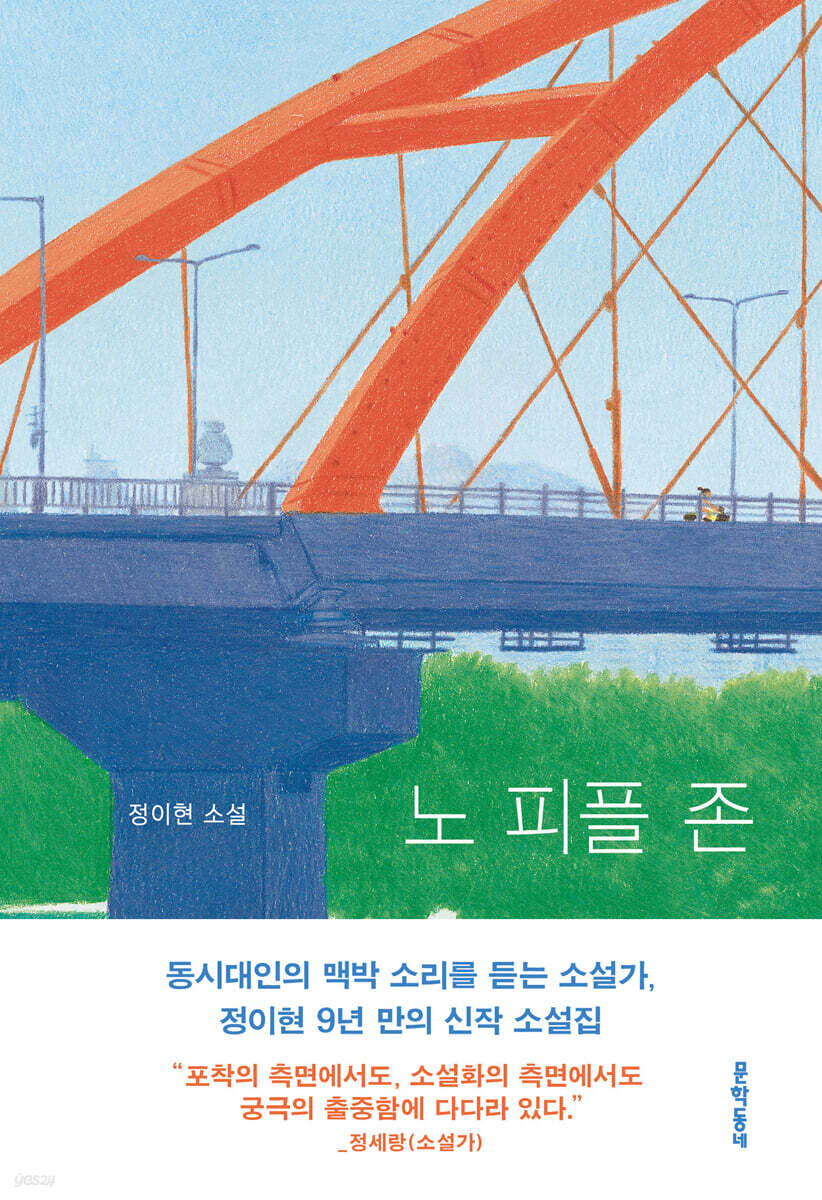
No People Zone
 |
Description
Book Introduction
- A word from MD
-
Our contradictions and desires are so clearA new collection of short stories by novelist Jeong I-hyeon, released after nine years.
The author's uniquely delicate perspective captures the lives of different generations and classes in detail.
Stories that allow us to look into the contradictions and desires that permeate both inside and outside of us, within the invisible yet solid structure of discrimination.
October 24, 2025. Novel/Poetry PD Kim Yu-ri
A novelist who listens to the pulse of his contemporaries,
Jeong I-hyeon's new novel collection published after 9 years!
“It has reached the ultimate excellence in both the aspect of capture and the aspect of novelization.”
_Jeong Se-rang (novelist)
“All the characters in ‘No People Zone’ confront the contradictions that come like uninvited guests at various points in life and overcome the storms of life with all their might.
After reading this book, I too gained the courage to live that way.”
Go Ah-sung (actress)
Sometimes relationships must continue, and sometimes they must end.
A desperate desire to be alone, but not to be completely alone.
Jeong I-hyeon's macro lens captures the people standing in between.
The new collection of short stories, "No People Zone," by Jeong I-hyeon, a leading Korean novelist who has depicted the loneliness and desires of those living in modern society with his uniquely delicate and sharp writing style, has been published.
It has been nine years since 『The Age of Gentle Violence』 (Munhak-kwa-Jiseong-sa, 2016), which captured the attention of both the literary world and readers by depicting the lives of modern people who live by inertia, exchanging hypocrisy and contempt without any particular malice.
The title of the book, 'No People Zone', is a word mentioned in the included work, 'Only One Child', and it captures the contradictory psychology of modern people who want to escape the various problems they experience in the web of society and relationships and live in a 'world without people', but are anxious about complete disconnection and isolation.
In an interview with the editor prior to the publication of “No People Zone,” Jeong I-hyeon stated, “While writing the novels in this book, I pursued a more universal and fundamental question: the relationship between social structure and human alienation” (in the special booklet “Attention Book”).
The artist, who has been called an "urban chronicler" for his surprisingly lively and vivid portrayal of the social situations of his contemporaries, now observes the wounded and inflicted wounds of modern people within and beyond the invisible lines of the social structure system through his own unique macro lens, adjusted to an even more detailed magnification.
From "Sister" released in 2017 to the latest "Failure Story Crew" released in 2025, "No People Zone" is a collection of nine short stories that the author painstakingly wrote and meticulously polished over a considerable period of time. It is a story of our times, built with realistic dialogue that feels as if you are hearing it right next to them and high-resolution reality.
Jeong I-hyeon's new novel collection published after 9 years!
“It has reached the ultimate excellence in both the aspect of capture and the aspect of novelization.”
_Jeong Se-rang (novelist)
“All the characters in ‘No People Zone’ confront the contradictions that come like uninvited guests at various points in life and overcome the storms of life with all their might.
After reading this book, I too gained the courage to live that way.”
Go Ah-sung (actress)
Sometimes relationships must continue, and sometimes they must end.
A desperate desire to be alone, but not to be completely alone.
Jeong I-hyeon's macro lens captures the people standing in between.
The new collection of short stories, "No People Zone," by Jeong I-hyeon, a leading Korean novelist who has depicted the loneliness and desires of those living in modern society with his uniquely delicate and sharp writing style, has been published.
It has been nine years since 『The Age of Gentle Violence』 (Munhak-kwa-Jiseong-sa, 2016), which captured the attention of both the literary world and readers by depicting the lives of modern people who live by inertia, exchanging hypocrisy and contempt without any particular malice.
The title of the book, 'No People Zone', is a word mentioned in the included work, 'Only One Child', and it captures the contradictory psychology of modern people who want to escape the various problems they experience in the web of society and relationships and live in a 'world without people', but are anxious about complete disconnection and isolation.
In an interview with the editor prior to the publication of “No People Zone,” Jeong I-hyeon stated, “While writing the novels in this book, I pursued a more universal and fundamental question: the relationship between social structure and human alienation” (in the special booklet “Attention Book”).
The artist, who has been called an "urban chronicler" for his surprisingly lively and vivid portrayal of the social situations of his contemporaries, now observes the wounded and inflicted wounds of modern people within and beyond the invisible lines of the social structure system through his own unique macro lens, adjusted to an even more detailed magnification.
From "Sister" released in 2017 to the latest "Failure Story Crew" released in 2025, "No People Zone" is a collection of nine short stories that the author painstakingly wrote and meticulously polished over a considerable period of time. It is a story of our times, built with realistic dialogue that feels as if you are hearing it right next to them and high-resolution reality.
- You can preview some of the book's contents.
Preview
index
Failure Story Crew… 7
Sister… 49
Good feelings… 83
In the middle of the light… 121
Just One Child… 155
On the beach we left… 189
Accelerated orbit… 225
About my aunt… 255
Living people… 299
Commentary | Kang Ji-hee (literary critic)
People who cross the line… 339
Author's Note … 365
Sister… 49
Good feelings… 83
In the middle of the light… 121
Just One Child… 155
On the beach we left… 189
Accelerated orbit… 225
About my aunt… 255
Living people… 299
Commentary | Kang Ji-hee (literary critic)
People who cross the line… 339
Author's Note … 365
Into the book
“The desire to interfere in other people’s stories, the desire to teach others, the desire to interfere, and the desire to use that as a medium to cover up one’s own story are all typical characteristics of an old fart.
We decided not to do it.”
--- p.29 From "Failure Story Crew"
“Deep in the human heart, there is a room that others cannot easily understand or invade.”
--- p.69 From "Sister"
In no case did I tell the patient that he would be okay.
I didn't even say it wouldn't be okay.
Perhaps the most important virtue in this profession is to strike a proper balance between what is okay and what is not okay.
--- p.95 From “The Feeling of Goodness”
If I could go back to a time when there was nothing, I would never have brought humans into the world.
Never.
That doesn't mean he doesn't love the human he gave birth to.
--- p.123 From “In the Middle of Light”
I've thought about this before when the no-kids zone issue became a social issue.
I wish that anyone who is too noisy and disturbs others, no matter who they are or how young or old, would not come into my presence.
No people zone.
A place where there is no one but me and my companions, or if there is, it is not noticeable.
The presence of others does not bother me.
The world Hannah ultimately desired was close to that.
Until you start doing that.
--- pp.157-158 From “Only One Child”
The only thing that kept Seol going was the hope that even unmoving love would one day disappear like that.
--- p.219 From “On the Beach We Left”
I had a vague idea of what I desperately wanted to protect.
A quiet and lonely life before the commenters showed up.
It was an uneventful day, one she had barely managed to arrange.
--- p.249 From "Acceleration Orbit"
How many things are there around us that we don't know, things that only we don't know?
Things like hiding your claws quietly and then waiting for the crucial moment to scratch your neck harshly.
--- p.294 From “About Aunt”
I want to beat myself at least once.
Even if I don't win, I want to practice from now on so that I can do it someday.
We decided not to do it.”
--- p.29 From "Failure Story Crew"
“Deep in the human heart, there is a room that others cannot easily understand or invade.”
--- p.69 From "Sister"
In no case did I tell the patient that he would be okay.
I didn't even say it wouldn't be okay.
Perhaps the most important virtue in this profession is to strike a proper balance between what is okay and what is not okay.
--- p.95 From “The Feeling of Goodness”
If I could go back to a time when there was nothing, I would never have brought humans into the world.
Never.
That doesn't mean he doesn't love the human he gave birth to.
--- p.123 From “In the Middle of Light”
I've thought about this before when the no-kids zone issue became a social issue.
I wish that anyone who is too noisy and disturbs others, no matter who they are or how young or old, would not come into my presence.
No people zone.
A place where there is no one but me and my companions, or if there is, it is not noticeable.
The presence of others does not bother me.
The world Hannah ultimately desired was close to that.
Until you start doing that.
--- pp.157-158 From “Only One Child”
The only thing that kept Seol going was the hope that even unmoving love would one day disappear like that.
--- p.219 From “On the Beach We Left”
I had a vague idea of what I desperately wanted to protect.
A quiet and lonely life before the commenters showed up.
It was an uneventful day, one she had barely managed to arrange.
--- p.249 From "Acceleration Orbit"
How many things are there around us that we don't know, things that only we don't know?
Things like hiding your claws quietly and then waiting for the crucial moment to scratch your neck harshly.
--- p.294 From “About Aunt”
I want to beat myself at least once.
Even if I don't win, I want to practice from now on so that I can do it someday.
--- p.318 From “Living People”
Publisher's Review
“The desire to intervene in other people’s narratives, the desire to teach others,
“We decided not to interfere.”
Misunderstanding between different generations and classes
People who fiercely protect their own things within it
"No People Zone" features a variety of stories from different generations and classes.
"Failure Story Crew," which opens the door to a collection of short stories, is the story of 'I', a lawyer in my thirties who joined the 'Failure Story Crew', a group that confesses the experiences of failure in life, and is also the youngest member of the group.
Among the members of the group, who are middle-aged and have established social standing, 'I' try to gain their recognition by telling them a great story of failure.
However, 'I's' presentations repeatedly end in failure, and 'I' am overcome with humiliation and defeat.
Through the image of such a 'me', the novel coolly captures the misunderstanding between generations and classes regarding success and failure.
This is a masterpiece that can be read with particular empathy by those who are living fiercely in their first year of life “to avoid being eliminated” (page 44), or by those who have just passed that period.
"Sister," which has garnered attention since its release, is a work that sheds light on "Sister In-hoe," a senior who remained in my heart during my college days in my early twenties like "a distant light that cannot be explained" (p. 81).
In-Hwi, a teaching assistant, takes on the workload of her advisor and works hard, but instead of receiving recognition for her work, she is treated unfairly and excluded from the school.
Sister In-Hwi staged a one-person protest against him, and 'I', who once worked with Sister In-Hwi, stood by him in support of her.
In the uncertain times of one's twenties, when there is no clear future, the figure of 'me' standing on the side of the weaker sister rather than the strong and the system symbolized by the university professor evokes no small amount of emotion in the reader.
While "Failure Story Crew" and "Sister" show the figures of people in their twenties and thirties, which can be considered youth from a life cycle perspective, "Good Feelings" and "In the Middle of Light" portray middle-aged people who support their parents, the older generation, or raise their children, the younger generation.
"Good Feelings" is a medical drama set during the height of the COVID-19 pandemic, depicting the dilemma faced by a doctor working at a hospital with a competitive performance-based pay system, one day when a patient dies, which may have been due to his own medical malpractice.
What the novel focuses on is not the truth of the truth, but the second half of the story, in which the daughter, who was the guardian of the deceased patient after the incident, reappears as 'my' patient.
This is a novel that powerfully questions what the 'line (線/善)' that must be maintained between people is.
"In the Middle of Light" is a story that unfolds around the friendly relationship between two women, Ahn-hee, who is raising a son, and Mi-ryeong, who is raising a daughter, while the shocking incident that unfolds when Ahn-hee's teenage son is accused of being a perpetrator of a deepfake sex crime unfolds on the other axis.
Literary critic Kang Ji-hee, who wrote the commentary, analyzes the novel's two-axis structure and interprets the deepfake incident not simply as "a specific youth's deviance," but as "a problem in which the sexual objectification of women accumulated over generations and the morals that disregard sexual violence are combined with digital technology to reproduce it as violence" (p. 363).
An-hee's heartbreaking cry, "No, I'm not that kind of mother" (p. 153), as she rebels against her husband who only defends his son, is read as a sharp voice that "breaks the tenacious bond" (p. 363) of "male domination" symbolized by the patriarchal system.
“Something that remains somewhere even though it does not exist,
“Hannah could never stop thinking about just one child.”
Beyond the harsh realism of "care," a story that confronts its structure.
“Only One Child” and “About Aunt” are novels that can be read with the keyword “care.”
However, unlike in most stories where the subject and object of care are set as family relationships, the care in Jeong I-hyeon's novel is unique in that the subject and object are not family, nor is it a story that highlights emotional empathy between them.
Rather, Jeong I-hyeon's novel seems to visualize the structure of the employment environment called care work and question the position of women who are hurt and marginalized within it.
"Only One Child" is a work that depicts the time spent by Hanna, a woman in her twenties who gets a job at a play tutoring company, with Hayu, a child who appears to be psychologically unstable.
As an employed caregiver, Hannah is required to keep an appropriate distance from the child and not interfere in the child's family affairs.
Then one day, Hanna discovers something concerning about Hayu and reports it to Hayu's guardian.
Before working as a play teacher, Hannah, who had “no interest in children” (p. 157), began to care deeply about the inner workings of children for the first time.
What kind of lives will Hannah and Hayu live from now on?
Meanwhile, "About Aunt" is the story of Jae-yeon, a team leader at a company, who, when pregnant with her second child, hires a Chinese compatriot, "Aunt," to live with her so she doesn't have to take parental leave again.
Unlike Hannah in "Only One Child," Jae-yeon is in the position of an employer in a caregiving relationship, but the novel shows that care work is not easily solved even with economic means.
Contrary to what the agency had revealed, her aunt's identity was somewhat questionable, and Jae-yeon's husband did not fully understand her feelings of trying to hold on to hope.
The emotions that Jae-yeon, who had been holding back, finally explodes and pours out to her husband make the reader feel the desperate “experience of a career break” (commentary, p. 352) of “harsh realism.”
How long do I have to be like this?
Jaeyeon screamed again.
I hope that my foolish husband, with his face turned pale, will become an accomplice in this dark plan.
If you never noticed, you still couldn't do anything.
Tears poured down.
I'll just live like this and die.
I guess I'll never be able to escape.
_「About Aunt」, p. 294
People who cross the line outside their familiar confines
The world of 'Jeong I-Hyeon Zone' is renewed there.
"To the Beach We Left," "Accelerating Orbit," and "Living People" are works in which Jeong I-hyeon's current sensibility shines through in capturing current social issues.
"To the Beach We Left" is a dating variety show, "Accelerating Orbit" is about dating violence, and "Living People" is about real estate and private education in Gangnam.
"To the Beach We Left" is a story about writer Seol and producer Seonwoo, who cover the current state of the so-called "Choi-ker (final couple)" who appeared on a dating variety show and became a hot topic over a decade ago. It is a lyrical and beautiful novel that makes us think about what emotional truth we can discover when love ends.
Just because we're like this now, does that special love we had back then disappear or disappear?
No, it won't disappear or disappear, Seol muttered to herself.
But, just because it's there, does it really stay that way?
Everything that stops fades, cracks open, and becomes worn out.
(…) Only the hope that even a love that does not move would one day disappear like that was what kept Seol going all this time.
_「To the Beach We Left」, p. 219
"Accelerating Orbit" is the story of Sojin, a cram school instructor whose daily life is filled with fear when a meaningful malicious comment is posted on her cram school blog one day.
Sojin's fear stems from the presence of an ex-boyfriend she had in college a long time ago.
Memories of her ex-boyfriend, who gaslighted her while they were dating and stalked her after the breakup, still send Sojin into a state of panic, like a car accelerating without brakes, even after more than a decade.
This work, which shows “why some women’s survival burns so quietly” and “stares at the source of that violence” (commentary, p. 359), maintains a dense suspense until the end, squeezing the reader’s breath.
"The Living Person" is a story about Dami, who works as a counselor at a private academy, who receives a request from a student to receive an exam paper in advance. The other story is about her going to a real estate agency with her boyfriend to live in an upscale apartment complex.
The novel's setting, Gangnam School District, where private education and real estate sharply intersect, sharply reveals the class-based desire of humans to climb even just one rung.
The multi-layered nature of "The Living Person," which evokes the charm of readers interpreting the meaning of "the living person" differently, such as living, buying, or surviving, seems to symbolize the complex and multifaceted state of Korean society.
As the author says, it is a novel that gives you a “premonition” (from “Attention Book”) that “tells you the direction of the next world you will move towards.”
In her commentary, Kang Ji-hee says that the characters in Jeong I-hyeon's novels "violate the familiar rules of the game" and "go beyond 'a room of one's own'" (p. 364).
The characters who “become each other’s older sisters and seek solidarity” are now trying to “break the inertia” (become on the same side) from a position beyond that line.
It is literally a 'no people zone' because nothing has been completely resolved and no one has arrived yet, but that void is "the other face of possibility" (same side).
"No People Zone" awaits us beyond the line drawn with that calm determination.
Today, too, I live surrounded by countless contradictions.
A desire for selective isolation, a desperate desire to be alone but not completely alone, would also fall into this category.
I wrote slowly and without stopping, looking long and hard at the contradictions and desires inside and outside of me.
_From the author's note
“We decided not to interfere.”
Misunderstanding between different generations and classes
People who fiercely protect their own things within it
"No People Zone" features a variety of stories from different generations and classes.
"Failure Story Crew," which opens the door to a collection of short stories, is the story of 'I', a lawyer in my thirties who joined the 'Failure Story Crew', a group that confesses the experiences of failure in life, and is also the youngest member of the group.
Among the members of the group, who are middle-aged and have established social standing, 'I' try to gain their recognition by telling them a great story of failure.
However, 'I's' presentations repeatedly end in failure, and 'I' am overcome with humiliation and defeat.
Through the image of such a 'me', the novel coolly captures the misunderstanding between generations and classes regarding success and failure.
This is a masterpiece that can be read with particular empathy by those who are living fiercely in their first year of life “to avoid being eliminated” (page 44), or by those who have just passed that period.
"Sister," which has garnered attention since its release, is a work that sheds light on "Sister In-hoe," a senior who remained in my heart during my college days in my early twenties like "a distant light that cannot be explained" (p. 81).
In-Hwi, a teaching assistant, takes on the workload of her advisor and works hard, but instead of receiving recognition for her work, she is treated unfairly and excluded from the school.
Sister In-Hwi staged a one-person protest against him, and 'I', who once worked with Sister In-Hwi, stood by him in support of her.
In the uncertain times of one's twenties, when there is no clear future, the figure of 'me' standing on the side of the weaker sister rather than the strong and the system symbolized by the university professor evokes no small amount of emotion in the reader.
While "Failure Story Crew" and "Sister" show the figures of people in their twenties and thirties, which can be considered youth from a life cycle perspective, "Good Feelings" and "In the Middle of Light" portray middle-aged people who support their parents, the older generation, or raise their children, the younger generation.
"Good Feelings" is a medical drama set during the height of the COVID-19 pandemic, depicting the dilemma faced by a doctor working at a hospital with a competitive performance-based pay system, one day when a patient dies, which may have been due to his own medical malpractice.
What the novel focuses on is not the truth of the truth, but the second half of the story, in which the daughter, who was the guardian of the deceased patient after the incident, reappears as 'my' patient.
This is a novel that powerfully questions what the 'line (線/善)' that must be maintained between people is.
"In the Middle of Light" is a story that unfolds around the friendly relationship between two women, Ahn-hee, who is raising a son, and Mi-ryeong, who is raising a daughter, while the shocking incident that unfolds when Ahn-hee's teenage son is accused of being a perpetrator of a deepfake sex crime unfolds on the other axis.
Literary critic Kang Ji-hee, who wrote the commentary, analyzes the novel's two-axis structure and interprets the deepfake incident not simply as "a specific youth's deviance," but as "a problem in which the sexual objectification of women accumulated over generations and the morals that disregard sexual violence are combined with digital technology to reproduce it as violence" (p. 363).
An-hee's heartbreaking cry, "No, I'm not that kind of mother" (p. 153), as she rebels against her husband who only defends his son, is read as a sharp voice that "breaks the tenacious bond" (p. 363) of "male domination" symbolized by the patriarchal system.
“Something that remains somewhere even though it does not exist,
“Hannah could never stop thinking about just one child.”
Beyond the harsh realism of "care," a story that confronts its structure.
“Only One Child” and “About Aunt” are novels that can be read with the keyword “care.”
However, unlike in most stories where the subject and object of care are set as family relationships, the care in Jeong I-hyeon's novel is unique in that the subject and object are not family, nor is it a story that highlights emotional empathy between them.
Rather, Jeong I-hyeon's novel seems to visualize the structure of the employment environment called care work and question the position of women who are hurt and marginalized within it.
"Only One Child" is a work that depicts the time spent by Hanna, a woman in her twenties who gets a job at a play tutoring company, with Hayu, a child who appears to be psychologically unstable.
As an employed caregiver, Hannah is required to keep an appropriate distance from the child and not interfere in the child's family affairs.
Then one day, Hanna discovers something concerning about Hayu and reports it to Hayu's guardian.
Before working as a play teacher, Hannah, who had “no interest in children” (p. 157), began to care deeply about the inner workings of children for the first time.
What kind of lives will Hannah and Hayu live from now on?
Meanwhile, "About Aunt" is the story of Jae-yeon, a team leader at a company, who, when pregnant with her second child, hires a Chinese compatriot, "Aunt," to live with her so she doesn't have to take parental leave again.
Unlike Hannah in "Only One Child," Jae-yeon is in the position of an employer in a caregiving relationship, but the novel shows that care work is not easily solved even with economic means.
Contrary to what the agency had revealed, her aunt's identity was somewhat questionable, and Jae-yeon's husband did not fully understand her feelings of trying to hold on to hope.
The emotions that Jae-yeon, who had been holding back, finally explodes and pours out to her husband make the reader feel the desperate “experience of a career break” (commentary, p. 352) of “harsh realism.”
How long do I have to be like this?
Jaeyeon screamed again.
I hope that my foolish husband, with his face turned pale, will become an accomplice in this dark plan.
If you never noticed, you still couldn't do anything.
Tears poured down.
I'll just live like this and die.
I guess I'll never be able to escape.
_「About Aunt」, p. 294
People who cross the line outside their familiar confines
The world of 'Jeong I-Hyeon Zone' is renewed there.
"To the Beach We Left," "Accelerating Orbit," and "Living People" are works in which Jeong I-hyeon's current sensibility shines through in capturing current social issues.
"To the Beach We Left" is a dating variety show, "Accelerating Orbit" is about dating violence, and "Living People" is about real estate and private education in Gangnam.
"To the Beach We Left" is a story about writer Seol and producer Seonwoo, who cover the current state of the so-called "Choi-ker (final couple)" who appeared on a dating variety show and became a hot topic over a decade ago. It is a lyrical and beautiful novel that makes us think about what emotional truth we can discover when love ends.
Just because we're like this now, does that special love we had back then disappear or disappear?
No, it won't disappear or disappear, Seol muttered to herself.
But, just because it's there, does it really stay that way?
Everything that stops fades, cracks open, and becomes worn out.
(…) Only the hope that even a love that does not move would one day disappear like that was what kept Seol going all this time.
_「To the Beach We Left」, p. 219
"Accelerating Orbit" is the story of Sojin, a cram school instructor whose daily life is filled with fear when a meaningful malicious comment is posted on her cram school blog one day.
Sojin's fear stems from the presence of an ex-boyfriend she had in college a long time ago.
Memories of her ex-boyfriend, who gaslighted her while they were dating and stalked her after the breakup, still send Sojin into a state of panic, like a car accelerating without brakes, even after more than a decade.
This work, which shows “why some women’s survival burns so quietly” and “stares at the source of that violence” (commentary, p. 359), maintains a dense suspense until the end, squeezing the reader’s breath.
"The Living Person" is a story about Dami, who works as a counselor at a private academy, who receives a request from a student to receive an exam paper in advance. The other story is about her going to a real estate agency with her boyfriend to live in an upscale apartment complex.
The novel's setting, Gangnam School District, where private education and real estate sharply intersect, sharply reveals the class-based desire of humans to climb even just one rung.
The multi-layered nature of "The Living Person," which evokes the charm of readers interpreting the meaning of "the living person" differently, such as living, buying, or surviving, seems to symbolize the complex and multifaceted state of Korean society.
As the author says, it is a novel that gives you a “premonition” (from “Attention Book”) that “tells you the direction of the next world you will move towards.”
In her commentary, Kang Ji-hee says that the characters in Jeong I-hyeon's novels "violate the familiar rules of the game" and "go beyond 'a room of one's own'" (p. 364).
The characters who “become each other’s older sisters and seek solidarity” are now trying to “break the inertia” (become on the same side) from a position beyond that line.
It is literally a 'no people zone' because nothing has been completely resolved and no one has arrived yet, but that void is "the other face of possibility" (same side).
"No People Zone" awaits us beyond the line drawn with that calm determination.
Today, too, I live surrounded by countless contradictions.
A desire for selective isolation, a desperate desire to be alone but not completely alone, would also fall into this category.
I wrote slowly and without stopping, looking long and hard at the contradictions and desires inside and outside of me.
_From the author's note
GOODS SPECIFICS
- Date of issue: October 21, 2025
- Page count, weight, size: 368 pages | 133*200*30mm
- ISBN13: 9791141613433
- ISBN10: 1141613433
You may also like
카테고리
korean


korean

![GQ KOREA Mark (Monthly): December [2025]](http://librairie.coreenne.fr/cdn/shop/files/8ef265dbbfbf186523ed75ba7319009d.jpg?v=1765340328&width=3840)


