

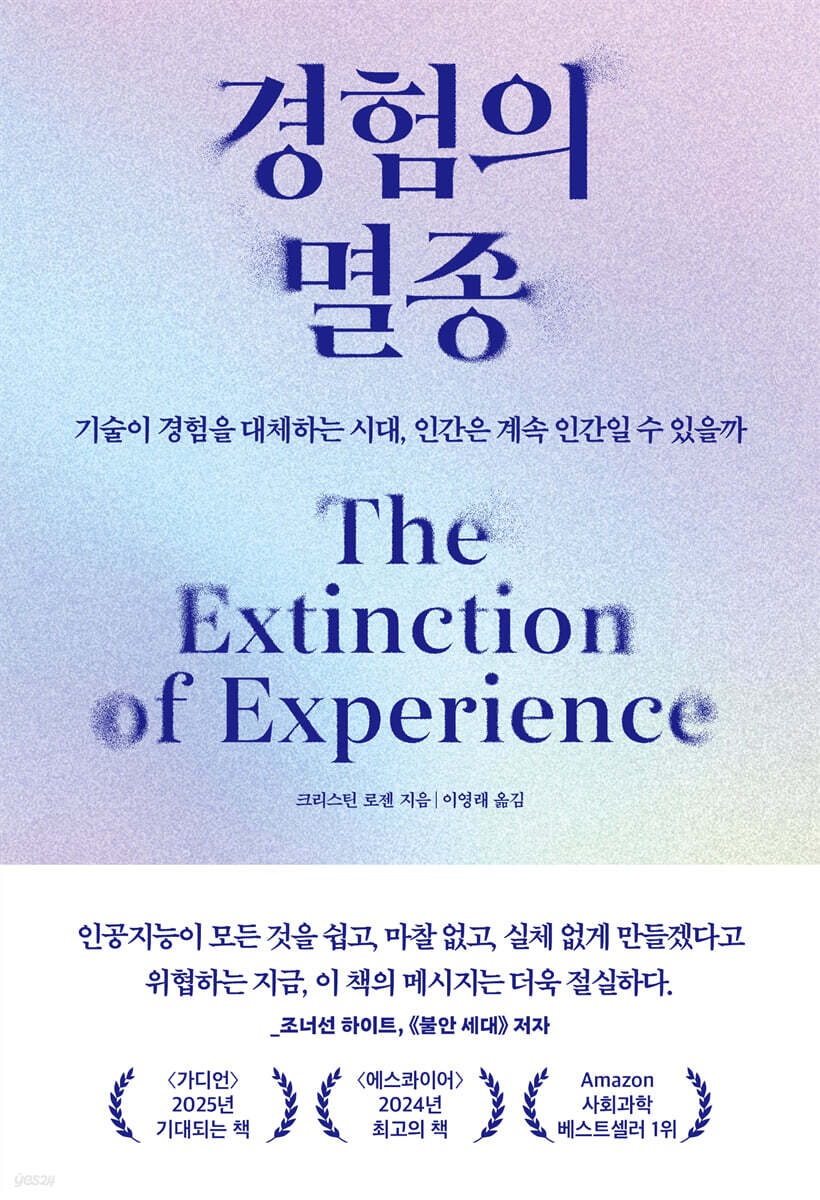
Extinction of experience
 |
Description
Book Introduction
- A word from MD
-
To the real world before it's too lateWe spend our days talking to AI, ordering food through delivery apps, and watching videos on OTT.
In the lives of modern people, there is no room for time to communicate with others.
Is this okay? In the 21st century, where the boundaries between the real world and the virtual world have disappeared, it's time to reclaim our lost humanity.
May 30, 2025. Humanities PD Son Min-gyu
"Save the Endangered 'Human Life'"
From face-to-face communication to a sense of direction,
A broad intellectual reflection begins to reclaim the moment of experience.
Our daily lives are becoming the foundation of digital technologies, including artificial intelligence.
We entrust ChatGPT with document summarization, communicate through remote meeting platforms, and upload our daily lives to social media in real time.
The boundaries between reality and the digital have already collapsed, and now technologically mediated experiences are replacing direct human experiences.
Core direct experiences that we once thought were part of every human experience—such as face-to-face communication, writing and drawing by hand, waiting for something, and a sense of publicness—are now endangered.
In "The Extinction of Experience," cultural critic and historian Christine Rosen explores the 21st-century phenomenon of the disappearance of experience and philosophically analyzes the implications of that disappearance.
Rosen's work, which explores countless examples across popular culture, science, politics, and law, provides us with the intellectual grounds to reverse this trend as the experiences that shaped the human condition are disappearing.
Since its publication, this book has ranked number one on Amazon's social science bestseller list and has garnered attention from leading media outlets including [The Guardian] and [Esquire].
From face-to-face communication to a sense of direction,
A broad intellectual reflection begins to reclaim the moment of experience.
Our daily lives are becoming the foundation of digital technologies, including artificial intelligence.
We entrust ChatGPT with document summarization, communicate through remote meeting platforms, and upload our daily lives to social media in real time.
The boundaries between reality and the digital have already collapsed, and now technologically mediated experiences are replacing direct human experiences.
Core direct experiences that we once thought were part of every human experience—such as face-to-face communication, writing and drawing by hand, waiting for something, and a sense of publicness—are now endangered.
In "The Extinction of Experience," cultural critic and historian Christine Rosen explores the 21st-century phenomenon of the disappearance of experience and philosophically analyzes the implications of that disappearance.
Rosen's work, which explores countless examples across popular culture, science, politics, and law, provides us with the intellectual grounds to reverse this trend as the experiences that shaped the human condition are disappearing.
Since its publication, this book has ranked number one on Amazon's social science bestseller list and has garnered attention from leading media outlets including [The Guardian] and [Esquire].
- You can preview some of the book's contents.
Preview
index
The era of disappearing prologue experiences
Chapter 1: The Downhill of Direct Experience
The illusion of experience without a body | There's no meteorologist behind the weather app | Experiences that become marketing | "Show yourself."
Chapter 2: The Need for Face-to-Face Interaction
The Power of the Face | The Loss of Interaction | A Society of Invisible People | Machines Replacing Humans | Teenagers Who Don't Meet Friends | Technology That Disrupts Intuition | We, Physical Beings
Chapter 3: What You Can Only Learn by Writing by Hand
The Butterfly Effect of Handwriting | The Power of Materiality | The Decline of Drawing | Touching, Feeling, and Consuming | Children's Learning Needs People | In the Face of the Disappearance of Physicality
Chapter 4: The Functions of Waiting and Boredom
The logic of queueing learned at Disney World | People who get angry quickly | The price of eliminating boredom | The fruit of patience | At the revolving theater
Chapter 5: Taming Your Emotions
The Emotional Being of Humans | Our Hidden Self | The Sixth Sense | The Consequences of Emotional Outsourcing
Chapter 6: Pleasure Mediated by Technology
Pleasure reduced to data | Travel to be recorded and pixelated art | Sex replaced by pornography | Dining without gastronomy, games without the scene | The return of hedonism | Experiences captured in photographs | Irreplaceable pleasure
Chapter 7: Vanishing Places, Personalized Spaces
A society uprooted from place | The rules of space | People who are disconnected | We are not together | Where do we stand?
Epilogue: Resist this chaos
Acknowledgements
main
Chapter 1: The Downhill of Direct Experience
The illusion of experience without a body | There's no meteorologist behind the weather app | Experiences that become marketing | "Show yourself."
Chapter 2: The Need for Face-to-Face Interaction
The Power of the Face | The Loss of Interaction | A Society of Invisible People | Machines Replacing Humans | Teenagers Who Don't Meet Friends | Technology That Disrupts Intuition | We, Physical Beings
Chapter 3: What You Can Only Learn by Writing by Hand
The Butterfly Effect of Handwriting | The Power of Materiality | The Decline of Drawing | Touching, Feeling, and Consuming | Children's Learning Needs People | In the Face of the Disappearance of Physicality
Chapter 4: The Functions of Waiting and Boredom
The logic of queueing learned at Disney World | People who get angry quickly | The price of eliminating boredom | The fruit of patience | At the revolving theater
Chapter 5: Taming Your Emotions
The Emotional Being of Humans | Our Hidden Self | The Sixth Sense | The Consequences of Emotional Outsourcing
Chapter 6: Pleasure Mediated by Technology
Pleasure reduced to data | Travel to be recorded and pixelated art | Sex replaced by pornography | Dining without gastronomy, games without the scene | The return of hedonism | Experiences captured in photographs | Irreplaceable pleasure
Chapter 7: Vanishing Places, Personalized Spaces
A society uprooted from place | The rules of space | People who are disconnected | We are not together | Where do we stand?
Epilogue: Resist this chaos
Acknowledgements
main
Detailed image

Into the book
In a world increasingly digitized, mediated, hyper-connected, surveillance, and algorithmic control, what kind of human will we be? What do we gain and what do we lose by focusing on user experience rather than the human condition? Humans have bodies, recognize their vulnerability, frequently move between mediated and unmediated experiences, require time and space for reflection, and are ultimately finite.
User experiences, on the other hand, are immaterial, digital, traceable, databased, and always intermediary.
It promises infinity without guaranteeing privacy (as some new technologies promise, by designing chatbots that collect digital data that remains after death, so that grieving families can be comforted).
--- p.16
Many children today are growing up in a world where their first experiences with nature, play, music, and language are mediated by technology, including screens.
Their toys talk to them and record their reactions.
Baby monitors keep an eye on them.
The device tracks and monitors them.
Parents create online IDs and Instagram pages as soon as their children are born.
They will grow up in a culture that values digital image above all else, where the social media platforms that dominate the online world virtually mandate sharing, where competition and constant expression are the norm, face-to-face interaction is rare, and anonymous harassment is easy.
It is a world where the perception of history has changed.
The past is no longer something distant and disconnected.
Facebook reminds us with its “One Year Ago Today” feature.
As tech companies often remind us, it's a world of possibilities, a place where, as Apple's advertising slogan promises, it's "automatic, easy, and seamless."
This is the world we live in.
Is this where we want to live?
--- p.47
French philosopher Simone Weil said:
“Concern is the rarest and purest form of generosity.” As physically embodied beings, showing concern for one another—breathing the same air, feeling each other’s unspoken emotions, seeing each other’s faces, and empathizing with each other’s body language—is at the core of what makes us human.
To be interested in another person, you have to spend time with their physical presence.
No matter how excellent the technology, it cannot satisfy all these demands.
--- p.87
Montaigne warned centuries ago:
“Everyone is moving in a hurry to somewhere else, to the future.
Because no one has ever reached himself.” Going inside yourself and figuring out who you are, what you like, and how you feel about the world and people takes time, patience, boredom, daydreaming, and the anticipation of discovery.
Without these, we are just killing time.
--- p.169
In his book From Anarchy to Utopia, philosopher Robert Nozick challenges hedonism by asking a simple question:
If you could create a machine that provided constant pleasure without you ever remembering being connected, would you want to be connected to it? The general belief was that most people would say "no."
“We don’t just want the experience of doing something; we want to actually do it,” Nozick argued.
“We want to be a certain way, a certain person,” he said, likening being connected to a machine to “a kind of suicide.”
User experiences, on the other hand, are immaterial, digital, traceable, databased, and always intermediary.
It promises infinity without guaranteeing privacy (as some new technologies promise, by designing chatbots that collect digital data that remains after death, so that grieving families can be comforted).
--- p.16
Many children today are growing up in a world where their first experiences with nature, play, music, and language are mediated by technology, including screens.
Their toys talk to them and record their reactions.
Baby monitors keep an eye on them.
The device tracks and monitors them.
Parents create online IDs and Instagram pages as soon as their children are born.
They will grow up in a culture that values digital image above all else, where the social media platforms that dominate the online world virtually mandate sharing, where competition and constant expression are the norm, face-to-face interaction is rare, and anonymous harassment is easy.
It is a world where the perception of history has changed.
The past is no longer something distant and disconnected.
Facebook reminds us with its “One Year Ago Today” feature.
As tech companies often remind us, it's a world of possibilities, a place where, as Apple's advertising slogan promises, it's "automatic, easy, and seamless."
This is the world we live in.
Is this where we want to live?
--- p.47
French philosopher Simone Weil said:
“Concern is the rarest and purest form of generosity.” As physically embodied beings, showing concern for one another—breathing the same air, feeling each other’s unspoken emotions, seeing each other’s faces, and empathizing with each other’s body language—is at the core of what makes us human.
To be interested in another person, you have to spend time with their physical presence.
No matter how excellent the technology, it cannot satisfy all these demands.
--- p.87
Montaigne warned centuries ago:
“Everyone is moving in a hurry to somewhere else, to the future.
Because no one has ever reached himself.” Going inside yourself and figuring out who you are, what you like, and how you feel about the world and people takes time, patience, boredom, daydreaming, and the anticipation of discovery.
Without these, we are just killing time.
--- p.169
In his book From Anarchy to Utopia, philosopher Robert Nozick challenges hedonism by asking a simple question:
If you could create a machine that provided constant pleasure without you ever remembering being connected, would you want to be connected to it? The general belief was that most people would say "no."
“We don’t just want the experience of doing something; we want to actually do it,” Nozick argued.
“We want to be a certain way, a certain person,” he said, likening being connected to a machine to “a kind of suicide.”
--- p.265
Publisher's Review
★ Recommended by Jonathan Haidt for "The Anxious Generation"
★ Books featured in The Guardian and Esquire
★ Amazon's #1 Social Science Bestseller
Why Teens Choose Social Media Over Voting
: Experiences replaced by technology, a disappearing reality
Direct experiences are disappearing from every aspect of our daily lives.
Face-to-face communication is uncomfortable, and finding your way around without the help of a map app seems foolish.
What has replaced it is digital technology, including artificial intelligence.
Now, beyond simply replacing experience, technologically mediated experiences are taking precedence over direct experience.
When asked whether they would rather stop using social media for a year or give up their right to vote, 64 percent of teens said they would give up their right to vote.
Fifty-three percent of teenagers worldwide said they would rather lose their sense of smell than lose their favorite skill.
The author declares that we have entered an era in which technologically mediated experiences surpass direct experiences.
As direct experience is replaced by mediated experience, experience is shifting from 'going through' to 'seeing'.
Rather than posting a photo of the travel destination, they broadcast their own travel experiences and post reaction videos of themselves watching the videos.
These are also attempts to experience direct experience, even if indirectly, in a society deprived of direct experience.
We no longer learn reality from experience.
Instead, the author believes that virtual experiences can mimic real experiences.
Is this smooth world where we want to live?
A 'safe utopia' created by technology and capital
There are two main reasons why technologically mediated experiences have come to overwhelm direct experiences.
One is the preference of technology users who prefer 'smoothness' and 'optimization', and the other is the pursuit of profit by the big tech companies that designed the technology.
The real world is full of chaos and friction.
Real experiences are always random and uncalculated, so there is a possibility that one's attempts will fail.
Technology experiences optimized through data are different.
The world of technology is a utopia that doesn't exist in reality, where the user's chances of failure are minimized.
Technological users replace real-world experiences with experiences that erase pain and failure in this seamless world.
Homogenized, mediated experiences are considered more valuable than unsystematized experiences of reality.
Additionally, the author points out that we have forgotten why big tech companies develop technology.
The goal is to pursue profit.
Big tech companies, in pursuit of their own profits, promise technology users a utopian world, thereby replacing their real-world experiences.
This slogan, promising a place that is “automatic, easy, and seamless,” is a line from Apple’s advertising.
The author asks whether this technological world is really the place we want to live.
In an age where experience has become extinct, is humanity possible?
: Text summarized by a device, documents organized by artificial intelligence, pictures created using instructions… .
The future of Homo sapiens threatened by a world where technology replaces experience.
Jonathan Haidt, author of The Anxious Generation, recommends The Extinction of Experience, saying:
“As artificial intelligence threatens to make everything easy, frictionless, and intangible, the message of this book becomes even more urgent.” Compared to the smooth, automated, mediated experience of reality, the real world is a chaotic space where the possibility of failure always exists.
However, the author argues that such a reality must be defended.
Because confusion and failure are at the heart of human life.
We are simultaneously eliminating the discomfort and the real experiences that are part of the human condition.
Asking a device to summarize a book without reading it could hasten the end of reading, leaving document creation to AI could hasten the end of thinking, and obtaining a picture by simply entering instructions could hasten the end of creation.
If we were to entrust all experiences we've called human to technology, how would we define humanity? The author poses a fundamental and crucial question.
Can we escape this data-driven world?
: A moment when community recovery and our choices are needed.
The author uses the collective noun 'we' in this book.
In this book, the word 'we' refers to a community that includes all human beings with real existence.
Given the widespread adoption of technology, even those who choose not to embrace various digital technologies cannot avoid being influenced by the technology use of others.
The authors argue that just as we are collectively affected by technology, we need to collectively address its challenges.
But as public spaces are fragmented for technological reasons, 'we' are increasingly disappearing.
People who have become accustomed to virtual communities mediated by technology become desensitized to the norms that must be observed in the physical, real public sphere, and they further lose the ability to interact with others.
At this very point, the mediated experience takes away even the ability to point out its harm.
So, first of all, we must recover ‘us.’
And rather than accepting the era of extinction as it is, we must resist it.
“The extinction of experience is not inevitable.
“It is a choice,” the author says.
“Christine Rosen deserves credit for looking at an area of life that even those who worry about the disruptive impact of technology rarely consider.
_〈Wall Street Journal〉
“This fascinating and impeccably researched book makes us realize that in a time of accelerating global change, humanity’s survival hinges on the human will to set intelligent and self-protective boundaries.
“Timely and informed.” _Kirkus Reviews
"Rigorously researched and elegantly written, The Extinction of Experience is a powerful reminder that 'Touch Grass' is not just an internet buzzword, but a human obligation." _Esquire
★ Books featured in The Guardian and Esquire
★ Amazon's #1 Social Science Bestseller
Why Teens Choose Social Media Over Voting
: Experiences replaced by technology, a disappearing reality
Direct experiences are disappearing from every aspect of our daily lives.
Face-to-face communication is uncomfortable, and finding your way around without the help of a map app seems foolish.
What has replaced it is digital technology, including artificial intelligence.
Now, beyond simply replacing experience, technologically mediated experiences are taking precedence over direct experience.
When asked whether they would rather stop using social media for a year or give up their right to vote, 64 percent of teens said they would give up their right to vote.
Fifty-three percent of teenagers worldwide said they would rather lose their sense of smell than lose their favorite skill.
The author declares that we have entered an era in which technologically mediated experiences surpass direct experiences.
As direct experience is replaced by mediated experience, experience is shifting from 'going through' to 'seeing'.
Rather than posting a photo of the travel destination, they broadcast their own travel experiences and post reaction videos of themselves watching the videos.
These are also attempts to experience direct experience, even if indirectly, in a society deprived of direct experience.
We no longer learn reality from experience.
Instead, the author believes that virtual experiences can mimic real experiences.
Is this smooth world where we want to live?
A 'safe utopia' created by technology and capital
There are two main reasons why technologically mediated experiences have come to overwhelm direct experiences.
One is the preference of technology users who prefer 'smoothness' and 'optimization', and the other is the pursuit of profit by the big tech companies that designed the technology.
The real world is full of chaos and friction.
Real experiences are always random and uncalculated, so there is a possibility that one's attempts will fail.
Technology experiences optimized through data are different.
The world of technology is a utopia that doesn't exist in reality, where the user's chances of failure are minimized.
Technological users replace real-world experiences with experiences that erase pain and failure in this seamless world.
Homogenized, mediated experiences are considered more valuable than unsystematized experiences of reality.
Additionally, the author points out that we have forgotten why big tech companies develop technology.
The goal is to pursue profit.
Big tech companies, in pursuit of their own profits, promise technology users a utopian world, thereby replacing their real-world experiences.
This slogan, promising a place that is “automatic, easy, and seamless,” is a line from Apple’s advertising.
The author asks whether this technological world is really the place we want to live.
In an age where experience has become extinct, is humanity possible?
: Text summarized by a device, documents organized by artificial intelligence, pictures created using instructions… .
The future of Homo sapiens threatened by a world where technology replaces experience.
Jonathan Haidt, author of The Anxious Generation, recommends The Extinction of Experience, saying:
“As artificial intelligence threatens to make everything easy, frictionless, and intangible, the message of this book becomes even more urgent.” Compared to the smooth, automated, mediated experience of reality, the real world is a chaotic space where the possibility of failure always exists.
However, the author argues that such a reality must be defended.
Because confusion and failure are at the heart of human life.
We are simultaneously eliminating the discomfort and the real experiences that are part of the human condition.
Asking a device to summarize a book without reading it could hasten the end of reading, leaving document creation to AI could hasten the end of thinking, and obtaining a picture by simply entering instructions could hasten the end of creation.
If we were to entrust all experiences we've called human to technology, how would we define humanity? The author poses a fundamental and crucial question.
Can we escape this data-driven world?
: A moment when community recovery and our choices are needed.
The author uses the collective noun 'we' in this book.
In this book, the word 'we' refers to a community that includes all human beings with real existence.
Given the widespread adoption of technology, even those who choose not to embrace various digital technologies cannot avoid being influenced by the technology use of others.
The authors argue that just as we are collectively affected by technology, we need to collectively address its challenges.
But as public spaces are fragmented for technological reasons, 'we' are increasingly disappearing.
People who have become accustomed to virtual communities mediated by technology become desensitized to the norms that must be observed in the physical, real public sphere, and they further lose the ability to interact with others.
At this very point, the mediated experience takes away even the ability to point out its harm.
So, first of all, we must recover ‘us.’
And rather than accepting the era of extinction as it is, we must resist it.
“The extinction of experience is not inevitable.
“It is a choice,” the author says.
“Christine Rosen deserves credit for looking at an area of life that even those who worry about the disruptive impact of technology rarely consider.
_〈Wall Street Journal〉
“This fascinating and impeccably researched book makes us realize that in a time of accelerating global change, humanity’s survival hinges on the human will to set intelligent and self-protective boundaries.
“Timely and informed.” _Kirkus Reviews
"Rigorously researched and elegantly written, The Extinction of Experience is a powerful reminder that 'Touch Grass' is not just an internet buzzword, but a human obligation." _Esquire
GOODS SPECIFICS
- Date of issue: May 20, 2025
- Page count, weight, size: 364 pages | 526g | 147*215*25mm
- ISBN13: 9791167742063
You may also like
카테고리
korean


korean

![GQ KOREA Mark (Monthly): December [2025]](http://librairie.coreenne.fr/cdn/shop/files/8ef265dbbfbf186523ed75ba7319009d.jpg?v=1765340328&width=3840)


