

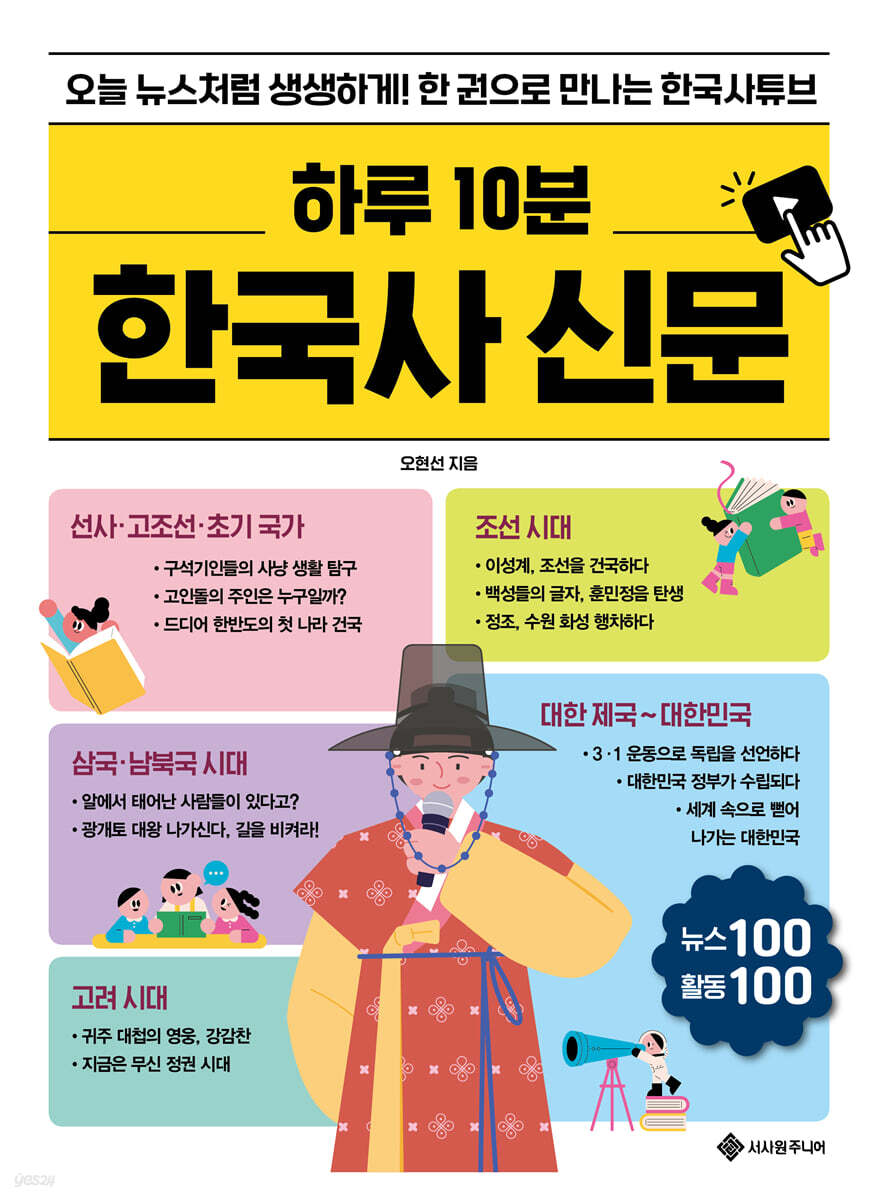
10 Minutes a Day Korean History Newspaper
 |
Description
Book Introduction
“Exploring the hunting life of Paleolithic people!”
“The shocking fall of Goguryeo, what was the real reason?”
“Finally, liberation has arrived!”
10 minutes a day, 100 Korean history newspapers! 100 fun activities!
Enjoy reading it anywhere, even alone!
“Teacher, we’re going to have a social studies class in the second semester, and I know the most about history in my class!”
“Reading history with you was so helpful!”
These are the reactions of children who took a Korean history reading class with author Oh Hyeon-seon.
For children who find Korean history books difficult, the author provides historical stories through interesting storytelling during class.
Sometimes it is told vividly like a fairy tale, and sometimes like a newspaper reporter.
This is the author's second Korean history book. While his first book, "Korean History Terminology 365 Days," invited children into Korean history by organizing historical terms, this book uses a vivid newspaper format to tell historical stories.
Teacher Raon Oh, author Hyunseon Oh, who has been meeting children and parents as a reading teacher for 25 years, has been reading newspaper articles related to the content of books and discussing them during class.
Children love the newspaper format. Imagine how engaging it would be if Korean history was told vividly, like a reporter from the Paleolithic period, or like a reporter from the Joseon Dynasty. A simple article written from the perspective of a reporter living in that era can be read in just 10 minutes, building a solid knowledge of Korean history.
We've carefully included light post-reading activities for each article to help readers organize historical events and recognize their place in the larger flow of history.
Author Oh Hyeon-seon, known as the "Teacher of Elementary School Teachers," travels around the country giving lectures, shining with the sincerity and ideas of reading education.
In this book, you can find the wishes of parents who wish this person were their neighborhood reading teacher.
“The shocking fall of Goguryeo, what was the real reason?”
“Finally, liberation has arrived!”
10 minutes a day, 100 Korean history newspapers! 100 fun activities!
Enjoy reading it anywhere, even alone!
“Teacher, we’re going to have a social studies class in the second semester, and I know the most about history in my class!”
“Reading history with you was so helpful!”
These are the reactions of children who took a Korean history reading class with author Oh Hyeon-seon.
For children who find Korean history books difficult, the author provides historical stories through interesting storytelling during class.
Sometimes it is told vividly like a fairy tale, and sometimes like a newspaper reporter.
This is the author's second Korean history book. While his first book, "Korean History Terminology 365 Days," invited children into Korean history by organizing historical terms, this book uses a vivid newspaper format to tell historical stories.
Teacher Raon Oh, author Hyunseon Oh, who has been meeting children and parents as a reading teacher for 25 years, has been reading newspaper articles related to the content of books and discussing them during class.
Children love the newspaper format. Imagine how engaging it would be if Korean history was told vividly, like a reporter from the Paleolithic period, or like a reporter from the Joseon Dynasty. A simple article written from the perspective of a reporter living in that era can be read in just 10 minutes, building a solid knowledge of Korean history.
We've carefully included light post-reading activities for each article to help readers organize historical events and recognize their place in the larger flow of history.
Author Oh Hyeon-seon, known as the "Teacher of Elementary School Teachers," travels around the country giving lectures, shining with the sincerity and ideas of reading education.
In this book, you can find the wishes of parents who wish this person were their neighborhood reading teacher.
- You can preview some of the book's contents.
Preview
index
offering
1.
Exploring the hunting lifestyle of Paleolithic people
2.
Why did Neolithic people make comb-patterned pottery?
3.
Farming that Changed the World: The Neolithic Revolution
4.
A new tool, bronze, emerges.
5.
Who owns the huge tomb, the dolmen?
6.
Rice farming begins to spread widely.
Early Gojoseon state
7.
Finally, the first nation on the Korean Peninsula was founded
8.
Gojoseon, law comes into being.
9.
Gojoseon, from the Bronze Age to the Iron Age
10.
Wiman overthrows King Jun and becomes the king of Gojoseon.
11.
Gojoseon collapses under Han attacks.
12.
There is a country famous for its daughter-in-law system?
13.
The three kingdoms of Samhan appear in the south.
Prehistoric~Early State Museum
Three Kingdoms
14.
There are people born from eggs?
15.
People who came out of eggs founded a country.
16.
Biryu and Onjo, who founded Baekje?
17.
Goguryeo moves aid to Guknaeseong.
18.
Pay attention to Gaya, which is rich in iron!
19.
Why did the Three Kingdoms accept Buddhism?
20.
Gwanggaeto the Great is coming out, get out of the way!
21.
Why did King Jangsu move the capital to Pyongyang?
22.
Baekje moved its capital twice.
23.
King Muryeong revives Baekje.
24.
Baekje, a land of beautiful culture
25.
Silla General Isabu conquers Usanguk!
26.
King Jinheung makes Silla great.
27.
Hwarangdo, a gathering of flower-like youth
28.
Silla is a country of gold
29.
Bone rank system, are there separate sacred bones?
30.
Gaya is incorporated into Silla.
31.
King Jinheung erects a monument to purity.
32.
The place that all three kingdoms desire, the Han River!
33.
Eulji Mundeok, defeat the million-strong Sui army!
34.
Silla's first queen is born.
35.
Why did Emperor Taizong of Tang tell Goguryeo not to attack?
36.
Baekje General Gyebaek falls at Hwangsanbeol.
37.
The shocking fall of Goguryeo: What was the real reason?
38.
Silla defeated Tang and unified the three kingdoms
North and South Korea
39.
Daejoyeong establishes Balhae.
40.
Now Balhae is the prosperous nation of the East!
41.
Here we go! The Sea King Jang Bogo
42.
Choi Chi-won's dream and frustration of changing Silla
43.
Gyeon Hwon establishes Later Baekje.
44.
Gung Ye establishes Later Goguryeo.
45.
The fall of Balhae, which country will succeed Goguryeo?
Three Kingdoms ~ North and South States Museum
consideration
46.
Wang Geon founded Goryeo and unified the Later Three Kingdoms.
47.
Why did Wang Geon marry twenty-nine women?
48.
How Gwangjong weakened the power of the local clans
49.
Seohee negotiates with the Khitan general.
50.
Gang Gam-chan, the hero of the Battle of Gwiju
51.
Yun Gwan drives out the Jurchen.
52.
The island of Byeokrando is currently bustling with international trade.
53.
The discriminated warriors finally rise up.
54.
The Choi family held the longest reign during the military regime.
55.
Nobi Manjeok, “Let’s change the world too!”
56.
The Mongol invasion casts a dark cloud over Goryeo.
57.
King Gongmin pursues reformist politics.
58.
New powers that emerged in the late Goryeo period
59.
Is it true that Yi Seong-gye is conducting a retreat at Wihwado?
60.
Goryeo, disappearing into history.
61.
In search of Goryeo's cultural heritage
Goryeo Museum
shipbuilding
62.
Yi Seong-gye founds Joseon.
63.
Joseon was a Confucian country
64.
Taejong Lee Bang-won, laying the foundation for the nation.
65.
Sejong, developing Joseon's culture.
66.
The birth of Hunminjeongeum, a writing system for the people!
67.
Sejo expelled his nephew and ascended to the throne.
68.
Japan causes the Imjin War.
69.
The last naval battle of Yi Sun-sin, the hero of the Imjin War
70.
What foreign policy sparked the Byeongjahoran?
71.
Byeongja Horan, humiliation at Samjeondo.
72.
King Hyojong launches the Northern Expedition.
73.
The factions are fighting over the period of time they wear mourning clothes?
74.
Sangpyeong Tongbo, the currency that appeared in Joseon
75.
King Yeongjo, "I will not pursue factionalism!" Implementing the Tangpyeong Policy
76.
King Jeongjo visits Hwaseong Fortress in Suwon.
77.
The most popular academic discipline these days is practical learning that helps with real life!
78.
Catholicism was introduced and Donghak was born.
79.
France and the United States invaded one after another.
80.
Sign the Ganghwa Island Treaty and open the country's doors.
81.
The Im-o Incident and the Gapsin Coup occurred.
82.
Jeon Bong-jun leads the Donghak Peasant Movement.
83.
The Gabo Reforms and the Sino-Japanese War, which raised Japan's voice
84.
Empress Myeongseong is assassinated.
Joseon Museum
Korean Empire during Japanese colonial period
85.
The Korean Empire loses its diplomatic rights.
86.
Gojong sends a special envoy to The Hague.
87.
An Jung-geun shoots Ito Hirobumi.
88.
To have one's country completely taken over.
89.
The Government-General of Korea was established.
90.
March 1st Movement: Shouts of "Long Live Korean Independence" Spread Nationwide
91.
Independence Army, fighting an armed struggle against Japan.
92.
Our people's independence movement, anyone, anything!
93.
Japan pursued a policy of national annihilation.
94.
Finally, liberation!
korea
95.
The government of the Republic of Korea is established.
96.
The Korean War broke out.
97.
Syngman Rhee's regime collapses due to the April 19 Revolution.
98.
The May 18 Democratization Movement takes place.
99.
Direct presidential election brought about by the June Democracy Movement
100.
South Korea extending into the world
Korean Empire~Republic of Korea Museum
1.
Exploring the hunting lifestyle of Paleolithic people
2.
Why did Neolithic people make comb-patterned pottery?
3.
Farming that Changed the World: The Neolithic Revolution
4.
A new tool, bronze, emerges.
5.
Who owns the huge tomb, the dolmen?
6.
Rice farming begins to spread widely.
Early Gojoseon state
7.
Finally, the first nation on the Korean Peninsula was founded
8.
Gojoseon, law comes into being.
9.
Gojoseon, from the Bronze Age to the Iron Age
10.
Wiman overthrows King Jun and becomes the king of Gojoseon.
11.
Gojoseon collapses under Han attacks.
12.
There is a country famous for its daughter-in-law system?
13.
The three kingdoms of Samhan appear in the south.
Prehistoric~Early State Museum
Three Kingdoms
14.
There are people born from eggs?
15.
People who came out of eggs founded a country.
16.
Biryu and Onjo, who founded Baekje?
17.
Goguryeo moves aid to Guknaeseong.
18.
Pay attention to Gaya, which is rich in iron!
19.
Why did the Three Kingdoms accept Buddhism?
20.
Gwanggaeto the Great is coming out, get out of the way!
21.
Why did King Jangsu move the capital to Pyongyang?
22.
Baekje moved its capital twice.
23.
King Muryeong revives Baekje.
24.
Baekje, a land of beautiful culture
25.
Silla General Isabu conquers Usanguk!
26.
King Jinheung makes Silla great.
27.
Hwarangdo, a gathering of flower-like youth
28.
Silla is a country of gold
29.
Bone rank system, are there separate sacred bones?
30.
Gaya is incorporated into Silla.
31.
King Jinheung erects a monument to purity.
32.
The place that all three kingdoms desire, the Han River!
33.
Eulji Mundeok, defeat the million-strong Sui army!
34.
Silla's first queen is born.
35.
Why did Emperor Taizong of Tang tell Goguryeo not to attack?
36.
Baekje General Gyebaek falls at Hwangsanbeol.
37.
The shocking fall of Goguryeo: What was the real reason?
38.
Silla defeated Tang and unified the three kingdoms
North and South Korea
39.
Daejoyeong establishes Balhae.
40.
Now Balhae is the prosperous nation of the East!
41.
Here we go! The Sea King Jang Bogo
42.
Choi Chi-won's dream and frustration of changing Silla
43.
Gyeon Hwon establishes Later Baekje.
44.
Gung Ye establishes Later Goguryeo.
45.
The fall of Balhae, which country will succeed Goguryeo?
Three Kingdoms ~ North and South States Museum
consideration
46.
Wang Geon founded Goryeo and unified the Later Three Kingdoms.
47.
Why did Wang Geon marry twenty-nine women?
48.
How Gwangjong weakened the power of the local clans
49.
Seohee negotiates with the Khitan general.
50.
Gang Gam-chan, the hero of the Battle of Gwiju
51.
Yun Gwan drives out the Jurchen.
52.
The island of Byeokrando is currently bustling with international trade.
53.
The discriminated warriors finally rise up.
54.
The Choi family held the longest reign during the military regime.
55.
Nobi Manjeok, “Let’s change the world too!”
56.
The Mongol invasion casts a dark cloud over Goryeo.
57.
King Gongmin pursues reformist politics.
58.
New powers that emerged in the late Goryeo period
59.
Is it true that Yi Seong-gye is conducting a retreat at Wihwado?
60.
Goryeo, disappearing into history.
61.
In search of Goryeo's cultural heritage
Goryeo Museum
shipbuilding
62.
Yi Seong-gye founds Joseon.
63.
Joseon was a Confucian country
64.
Taejong Lee Bang-won, laying the foundation for the nation.
65.
Sejong, developing Joseon's culture.
66.
The birth of Hunminjeongeum, a writing system for the people!
67.
Sejo expelled his nephew and ascended to the throne.
68.
Japan causes the Imjin War.
69.
The last naval battle of Yi Sun-sin, the hero of the Imjin War
70.
What foreign policy sparked the Byeongjahoran?
71.
Byeongja Horan, humiliation at Samjeondo.
72.
King Hyojong launches the Northern Expedition.
73.
The factions are fighting over the period of time they wear mourning clothes?
74.
Sangpyeong Tongbo, the currency that appeared in Joseon
75.
King Yeongjo, "I will not pursue factionalism!" Implementing the Tangpyeong Policy
76.
King Jeongjo visits Hwaseong Fortress in Suwon.
77.
The most popular academic discipline these days is practical learning that helps with real life!
78.
Catholicism was introduced and Donghak was born.
79.
France and the United States invaded one after another.
80.
Sign the Ganghwa Island Treaty and open the country's doors.
81.
The Im-o Incident and the Gapsin Coup occurred.
82.
Jeon Bong-jun leads the Donghak Peasant Movement.
83.
The Gabo Reforms and the Sino-Japanese War, which raised Japan's voice
84.
Empress Myeongseong is assassinated.
Joseon Museum
Korean Empire during Japanese colonial period
85.
The Korean Empire loses its diplomatic rights.
86.
Gojong sends a special envoy to The Hague.
87.
An Jung-geun shoots Ito Hirobumi.
88.
To have one's country completely taken over.
89.
The Government-General of Korea was established.
90.
March 1st Movement: Shouts of "Long Live Korean Independence" Spread Nationwide
91.
Independence Army, fighting an armed struggle against Japan.
92.
Our people's independence movement, anyone, anything!
93.
Japan pursued a policy of national annihilation.
94.
Finally, liberation!
korea
95.
The government of the Republic of Korea is established.
96.
The Korean War broke out.
97.
Syngman Rhee's regime collapses due to the April 19 Revolution.
98.
The May 18 Democratization Movement takes place.
99.
Direct presidential election brought about by the June Democracy Movement
100.
South Korea extending into the world
Korean Empire~Republic of Korea Museum
Detailed image

Publisher's Review
10 minutes a day, 100 articles seen through the eyes of a reporter from the past!
Time travel! How vivid and fascinating would it be if I could travel to that era and witness key historical scenes? If it were the Three Kingdoms period, it would be covered by a reporter who lived there. If it were the Joseon Dynasty, it would be covered by a reporter who lived there.
This is a fascinating newspaper reading book that allows you to follow the flow of half a million years of Korean history just by following the titles of 100 articles organized in chronological order.
From prehistoric times to Gojoseon, the Three Kingdoms, North and South States, Goryeo, Joseon, the Korean Empire, and the Japanese colonial period, to the proud Republic of Korea, discover key articles covering politics, economy, society, and culture.
"Why did Neolithic people make comb-patterned pottery?", "People were born from eggs?", "Is Yi Seong-gye leading the Wihwado Rebellion?"...
As you read these intriguing articles, you will realize that our present is ultimately a product of our past, and you will become very proud of our Republic of Korea for enduring and surviving difficult times.
It only takes 10 minutes a day.
Intuitive design and post-reading activities, like mobile news
We've introduced an intuitive design for mobile screens, making it easy for children to read articles in a friendly manner.
Express your feelings about what you read with emoticons.
Understand the core content of the article with the 'One Sentence Summary', and check what you read with the 'Initial Quiz', 'Mini Quiz', and 'Keyword Selection'. Also, develop historical imagination and critical thinking skills through the 'Mini Essay', which asks light questions related to the article.
Please help me organize my thoughts by talking about how I view this historical event, and broaden my horizons by researching more information that interests me.
I also recommend checking out the timeline, which will help you intuitively understand where the current events are in our half-millennium history.
A museum of vivid photographs and visual materials from each era
Let's take a look at our cultural assets, which even foreigners are enthusiastic about, by era.
Each article includes photos and maps to help you understand the content, and a "museum" corner is organized for each era, allowing you to view the major cultural assets and records of that era as if you were visiting the National Museum of Korea.
I recommend that you visit the museum to see the artifacts you see in the pictures in the book.
About the Producer
Time travel! How vivid and fascinating would it be if I could travel to that era and witness key historical scenes? If it were the Three Kingdoms period, it would be covered by a reporter who lived there. If it were the Joseon Dynasty, it would be covered by a reporter who lived there.
This is a fascinating newspaper reading book that allows you to follow the flow of half a million years of Korean history just by following the titles of 100 articles organized in chronological order.
From prehistoric times to Gojoseon, the Three Kingdoms, North and South States, Goryeo, Joseon, the Korean Empire, and the Japanese colonial period, to the proud Republic of Korea, discover key articles covering politics, economy, society, and culture.
"Why did Neolithic people make comb-patterned pottery?", "People were born from eggs?", "Is Yi Seong-gye leading the Wihwado Rebellion?"...
As you read these intriguing articles, you will realize that our present is ultimately a product of our past, and you will become very proud of our Republic of Korea for enduring and surviving difficult times.
It only takes 10 minutes a day.
Intuitive design and post-reading activities, like mobile news
We've introduced an intuitive design for mobile screens, making it easy for children to read articles in a friendly manner.
Express your feelings about what you read with emoticons.
Understand the core content of the article with the 'One Sentence Summary', and check what you read with the 'Initial Quiz', 'Mini Quiz', and 'Keyword Selection'. Also, develop historical imagination and critical thinking skills through the 'Mini Essay', which asks light questions related to the article.
Please help me organize my thoughts by talking about how I view this historical event, and broaden my horizons by researching more information that interests me.
I also recommend checking out the timeline, which will help you intuitively understand where the current events are in our half-millennium history.
A museum of vivid photographs and visual materials from each era
Let's take a look at our cultural assets, which even foreigners are enthusiastic about, by era.
Each article includes photos and maps to help you understand the content, and a "museum" corner is organized for each era, allowing you to view the major cultural assets and records of that era as if you were visiting the National Museum of Korea.
I recommend that you visit the museum to see the artifacts you see in the pictures in the book.
About the Producer
GOODS SPECIFICS
- Date of issue: November 10, 2025
- Page count, weight, size: 220 pages | 188*257*12mm
- ISBN13: 9791168224766
- KC Certification: Certification Type: Conformity Confirmation
You may also like
카테고리
korean


korean

![GQ KOREA Mark (Monthly): December [2025]](http://librairie.coreenne.fr/cdn/shop/files/8ef265dbbfbf186523ed75ba7319009d.jpg?v=1765340328&width=3840)


